Showing posts sorted by date for query dorkin. Sort by relevance Show all posts

Tuesday, June 27, 2023

Beasts of Burden: Occupied Territory by Evan Dorkin, Sarah Dyer & Benjamin Dewey

Every series needs a big flashback story. Usually it's to finally tell the Big Secret - the Noodle Incident, for example - that has been hinted about over and over again. Or at least a Big Secret, I suppose.

The alternative is using a big flashback to get a new cast and location, while still getting the benefit of starting off with all of the characters your audience already knows. That happens, too. I just read one of those, actually.

Beasts of Burden: Occupied Territory is the fourth collection of "Beasts of Burden" stories, all set in a mildly Lovecraftian world with animals that talk to each other (and to a few magical humans), some of whom actively battle those mildly Lovecraftian horrors when required. The animals - with a heavy emphasis on domesticated dogs, though some other domestic breeds do come in, here and there - are the heroes, with humans in support roles at best.

The original Beasts of Burden series, from the late Aughts, is available under the title Animal Rites. The second big series, about a decade later, was Wise Dogs and Eldrich Men. And the inevitable collection of one-shots and anthology stories and crossovers - all of the stuff that filled up that decade between the big stories, and then some - is Neighborhood Watch.

The series was created by Evan Dorkin (writer) and Jill Thompson (artist). Benjamin Dewey took over the art side for Wise Dogs, and has been the main artist since then. Sarah Dyer has been co-writer since a couple of the last stories in Neighborhood Watch, and here as well. Letters in the Dewey era have been by Nate Piekos, and Jason Lusk is credited on this book for "flats," which is some aspect of the coloring-to-printing process that I've seen described multiple times but never quite retain.

Occupied Territory was a miniseries from 2021, with the classic "hey, who's that other guy in this old photo?" frame story, allowing series character Emrys to tell the story of how he and his then-human partner Jonathan went to Northern Japan in 1947. [1] Emrys is supposedly telling the story, but his narration boxes disappear quickly, and the frame is just at the very beginning and end - it's not the kind of story that drops back out to the frame for interjections or for each issue. Just one simple "let me tell you the story," and then the story.

As you might guess, this is the "all the cool stuff from Japanese mythology" story, which many supernatural series in various media have fallen into before. It's a bit of a one-damn-thing-after-another story; it does all hang together, but the plotline is mostly held together by "and then we ran over there to fight an Oni, and then we met the local dogs, and then the local dogs summoned the Parliament of Friendly Yokai [2], but they were no help, so we all ran over there to fight something else, and then...". As with most of the Beasts of Burden stories, the humans get left behind quickly so the dogs can do all the fun stuff in the woods.

I have trouble taking these stories seriously: these are stories about dogs barking magic spells at monsters to save the world. They're fun, don't get me wrong: good characterization, spiffy dialogue, and a lovely world that Dewey depicts in gorgeous immersive panels. But I always need to call in extra-heavy ropes to suspend my disbelief, and keep pulling on them throughout the story to keep that disbelief from sinking down to the floor.

I wouldn't start the series here: it's a sidebar at best. But it's another solid story of the same kind as the earlier stories, and - especially for animal lovers - an enjoyable light battling-supernatural-horrors romp.


[1] The heroes of this series are exceptionally long-lived, especially for dogs. I don't think we've seen exactly how long they can live, since lives of danger more often end in the field.

[2] Not called this. But it's what they are.

Sunday, June 04, 2023

Books Read: May 2023

I do this every month, and it's really pointless. But here it is.

Jeff Lemire, Malachi Ward, and Matthew Sheean, Black Hammer Reborn, Part II (digital,  5/6)

Paul Buhle and Noah Van Sciver, Johnny Appleseed (digital, 5/7)

Apuleius, translated by Robert Graves, The Golden Ass (5/7)

Evan Dorkin, Sarah Dyer and Benjamin Dewey, Beasts of Burden: Occupied Territory (digital, 5/12)

Carl Speed McNeil, Finder: Dream Sequence (in The Finder Library, Vol. 2, 5/13)

Farel Dalrymple, Pop Gun War, Vol. 1: Gift (digital, 5/14)

Ray Davies, Americana (5/14)

Will Henry, Are We Lost Yet? (digital, 5/20)

Sergio Aragones with Mark Evanier, Groo: Friends and Foes, Vol. 3 (digital, 5/21)

Christian Durieaux, An Enchantment (digital, 5/27)

Joshua Ferris, To Rise Again at a Decent Hour (5/27)

Jim Benton, Man, I Hate Cursive (digital, 5/28)

Julie Maroh, Blue Is the Warmest Color (digital, 5/29)

P.G. Wodehouse, Full Moon (5/29)


Next month I'll do it again!

Friday, December 30, 2022

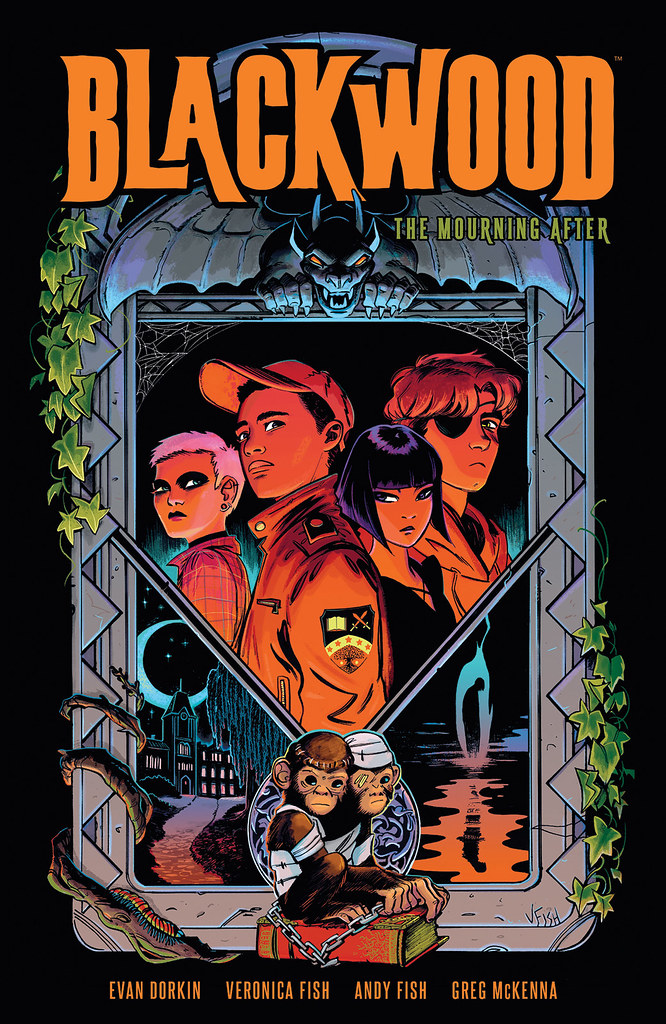
Blackwood: The Mourning After by Evan Dorkin, Veronica Fish, and Andy Fish

In the Before Times, this would have just been the next four issues of an ongoing series called Blackwood - it reads that way, and my guess is that Dorkin and the Fishes would have been happy to just keep telling a bunch of these stories in one series rather than mucking about with re-launching a new mini-series with a new title.

They might not have wanted to do it monthly, on the old chain-gang work-until-you-drop style, but that's an entirely different question.

But, in the Now Times, everything must be new, and everything must have an Issue #1, and the attention span of any comics reader is assumed - probably with good reason - to be lower than the belly of a ground sloth. So Blackwood: The Mourning After was a "brand-new" four-issue mini-series, following up the original Blackwood series and collection a couple of years later.

But it begins immediately after the ending of the previous book, and deals entirely with the fallout of the events in the previous book, and in no way is meant to stand on its own: it's not a new story, not a separate story, just the next story of this place and these people. And that's totally fine for an ongoing, though it feels a little odd in our modern mini-series world.

And it does mean that if I want to talk about any of the plot, I'm going to either utterly spoil the first book or be very, very vague. I'm going to try to err on the side of vague.

So the cover shows four people, which includes three of the four main characters of Blackwood, but not the one who SPOILER in the first book. And there's one more person, who was a secondary but important character the first time out, but has more to do here - maybe he'll turn out to be part of the Scooby Gang in the long term. And, as the title implies, someone important is dead - let me refer here to the first book, which I said started "with some old guy who just did something magically dangerous and is now dictating his last words while Something happens to him" and note that there is an funeral coming up in a couple of days, nudge nudge wink wink.

We learn a little more about the faculty of Blackwood, the college ostensibly some vague liberal-arts thing (though really really focused on anthropology as far as I can see) but secretly a training-bed for new magicians, plus "psychic researchers, alchemical engineers, occult archivists." We also see another secret magic-based organization, I.N.S.P.E.C.T., who seem to be some kind of government agency - big guns, dark suits, humorless affect, the whole works. Blackwood and I.N.S.P.E.C.T. are not on the chummiest of terms, of course, and even less so after the revelations of the new book.

An I.N.S.P.E.C.T. team is coming for that funeral, and various people are planning for the funeral and/or for secret magical rituals designed for fiendish ends, because of course they are. Our four heroes are in the middle of that, partly because of magical shenanigans in the first book, partly because they are nosy, and partly just because their are the heroes of this story, so we follow their viewpoints.

There is another big magical foofaraw at the end of this book, as there must be. A gigantic unpleasant entity is summoned from Somewhere, an evil actor gets hold of a Powerful Artifact and threatens to do Unspeakable Things, and there's a big confrontation in the college library, which is roughly as cool as you are hoping it will be. (Do I mean the confrontation, or the library itself? A bit of both.)

Like the first book, I found this zippy and fun, and this time writer Evan Dorkin has a little more time and space to start fleshing out the world, which I appreciate. Oh, it's still a thriller, so the action-plot takes precedence, and the artists (wife-husband team Veronica and Andy Fish) do good work there, with a lot of room for moody, creepy colors on top of their already pretty-darn-moody line art.

As I said, it would have been nice if this were still a world where Evan Dorkin and the Fishes - and doesn't that sound like a weird ska band? I bet Dorkin is amused by that - could do these more regularly and build their mythology more quickly. But we never get the world we want, and the world we have does have two solid Blackwood stories in it so far, so it's not all bad.

Sunday, December 18, 2022

Books Read: November 2022

I forgot this post for a couple of weeks, which is why it's appearing so late in the month. But, as always, it's mostly an index, and I think entirely for Future Me, so who cares?

Here's what I read this past month:

Bastien Vives, A Sister (digital, 11/5)

Jeff Lemire and Tyler Crook, Colonel Weird: Cosmagog (digital, 11/6)

John Le Carre, The Looking Glass War (11/7)

Sarah Andersen, Oddball (digital, 11/11)

Evan Dorkin, Veronica Fish, and Andy Fish, Blackwood: The Mourning After (digital, 11/12)

Manu Larcenet, Ordinary Victories, Vol. 1 (digital, 11/13)

Jasper Fforde, The Constant Rabbit (11/13)

Neil Gaiman and Collen Doran, Snow, Glass, Apples (digital, 11/19)

Koren Shadmi, Lugosi: The Rise and Fall of Hollywood's Dracula (digital, 11/20)

Bruce McCullough, Let's Start a Riot (11/20)

Mannie Murphy, I Never Promised You a Rose Garden (11/23)

Megan Kelso, Who Will Make the Pancakes: Five Stories (digital, 11/24)

Jean Shpeherd, Wanda Hickey's Night of Golden Memories (11/24)

Jason Shiga, Adventuregame Comics, Vol. 1: Leviathan (11/25)

Will Henry, Wallace the Brave (digital, 11/26)

Haruki Murakami, First Person Singular (11/26)

Jean-Yves Ferri and Manu Larcenet, Back to Basics, Vol. 4: The Flood (digital, 11/27)


In December, I continued to read books, and I'll list them here sometime in the future.

Wednesday, October 19, 2022

World's Funnest edited by some random DC functionary

It was someone's job to put together World's Funnest. Probably a pretty serious job, says the guy who used to assemble reprint books of prose fairly regularly - comics are even more complicated, since it's not just a batch of words that need to be flowed, but pages of art that have different aspect ratios over the years and exist in different file formats and levels of quality. Someone worked pretty hard on this, before it was published in 2016.

Comics used to have a serious credits problem, in that there were hardly any. Stories were about the characters, not the people who made the stories, so credits were left off most of the time for the first few decades. That changed, slowly. By the 1960s, Marvel pretended Stan Lee was in charge of everything, and whoever else he deigned to give a stupid nickname to got mentioned. That probably pushed DC and other competitors to do something similar.

So, these days, comics have lots of credits. Reprint collections even more so - to the point of being deeply silly.

World's Funnest has a page of small type for credits - it lists forty-six people, most of whom were the VP-level and higher corporate officers of DC in 2016.

Wait, I take it back. Comics still has a credits problem. And it's still the same one: credit goes to the company or the character or the "VP - Sales Planning & Trade Development" rather than to the people who actually made the thing.

This book was probably edited by Robin Wildman, listed as "Editor - Collected Edition." Maybe partially by Jeb Woodard, then "Group Editor - Collected Editions." Maybe the reason the cover says "by Evan Dorkin and Friends" is that Dorkin made the initial list of stories to be reprinted? Or kibitzed as Wildman and/or Woodard dug through the archives to find these?

Anyway, what we have here is the 2000 one-shot World's Funnest, written by Dorkin and drawn by Dave Gibbons for the early pages and then a cast of thousands for the rest of its 64-page epic, and then a selection of the first and/or best and/or most memorable stories featuring DC's lovable imps, Bat-Mite and Mr. Mxyztplk. Except for that first story, everything is in strict chronological order, which means related stories are separated several times, and it also means we end with a story from 2008, later than the Dorkin piece.

I said someone assembled this, and that it was hard work. I didn't say I agreed with all of their artistic decisions.

I'll come back to the Dorkin story, since it's the point and capstone of the exercise. But after it we get what amounts to a potted, slapdash history of DC Comics, starting with the first appearances of both Mxyztplk (a 1944 Siegel-Shuster story with a nice lightness and sense of humor to it) and Bat-Mite (a snoozier 1959 piece from Bill Finger, Sheldon Moldoff, and Charles Paris, deep in the giant-props and dull-detective era of Batman).

Then comes the inevitable team-up, "Bat-Mite Meets Mr. Myxzptlk," from 1960, from which Dorkin cribbed a few ideas for his story. It is pleasant, but this is still the Wooden Era of DC.

We then jump two decades for two short Bat-Mite vignettes: the first is a pleasant bit of metafiction mostly memorable for showing how a bunch of DC folks looked in 1979 (big hair, mustaches, etc.) and the second is a single-page gag.

Then we get two Mxy stories from the John Byrne Superman reboot of the late '80s - first Byrne himself and Karl Kessel have Supes tangle with Mxy (for the first time!...once again) and then the Stern Peyer Cullins Janke law-firm brings back Mxy to let Lex Luthor have a crack at him. Both of these are mostly serious, with some humor, though the Luthor one is more dour.

And that drops us into the grim-and-gritty '90s, with two Alan Grant/Kevin O'Neil "Dark Mite" stories, which are mostly parodies of the real Batman comics of the time. Grant and O'Neil are always great, but these are really close to poking yourself in the eye with a sharp stick.

In between those two, out of chronological order I guess entirely to separate them, is "The Imp-Possible Dream," the post-Crisis version of the "the Mite and the Mxy Meet!" story. Dorkin may have re-used some ideas from this story, too.

Last in the book is a two-parter from the New Earnest era, "L'il Leaguers," in which Mite and Myx port over Superman and Batman (and, eventually, a lot more) from a chibi version of Earth-1, and everyone has to learn The Meaning of Heroism. (Which is the point of roughly eight single issues every month, but nevermind.) It has really engaging art from Rafael Albuquerque, but the saccharine level is a bit high for my taste.

Finally, I'll get back to the opening story. Remember the fad for "this guy kills the <superhero company> universe" stories? It's one of those. Gibbons does his best Dick Sprang/Shelly Moldoff impression, to make it all look like a Silver Age comic, as Superman, Batman, and Robin capture the standard batch of '50s gangsters to start us all off, but then Mite & Mxy appear, start squabbling with each other, and things escalate. They kill the World's Finest folks, then the female versions, then the Super-Pets, then the Legion, and go on from there to depopulate and destroy first Earth-1 and then every other Earth Dorkin could remember existed at that point. (They get 2, S, X, the Zoo Crew one, and a few dozen others, including alternate futures and other imaginary stories - as always, Dorkin is thorough when he sets out to blow stuff up.)

Each universe is drawn by someone else, in many cases the creator or most famous artist: Frank Miller does three Dark Knight-y pages; Bruce Timm provides two pages of TV-show storyboards; Alex Ross paints three pages of gods getting slaughtered. Others involved are Mike Allred, Stephen DeStefano, Joe Giella, Jaime Hernandez, Stuart Immonen, Phil Jimenez, Doug Mahnke, David Mazzuccheli, Sheldon Moldoff hisownself, Glen Murakami, Norm Rapmund, Scott Shaw!, Jay Stephens, Ty Templeton, and Jim Woodring.

It's a lot. Frankly, it's a bit too much: by the mid-point, it starts to feel like a box-checking exercise ("Look, Lou, we've still got twenty-seven universes to wreck by quitting time, so let's get going!"). Myx and Mite don't actually have great chemistry, since they're both one-note characters designed to stymie their superhero foes...and Dorkin got rid of those on the sixth story page. But Dorkin is the master of Ids on the rampage, so he gamefully keeps them going until they destroy everything - and then pulls out the requisite superhero-universe ending.

I did not enjoy this book quite as much as I'd hoped. Partially it's that a little of these guys goes a long way - and this book has 300 pages of comics, which is a really, really long way.  I also suspect a more focused collection - maybe just Golden/Silver age stuff, without the meta-commentary - would be more fun. But this book exists, and it's probably got as much or more Mxyzptlk and Bat-Mite as anyone would want.

Wednesday, August 24, 2022

Blackwood by Evan Dorkin, Veronica Fish, and Andy Fish

All the most interesting people have the least-likely careers. (Says the man who started out as a SF editor and somehow ended up doing content marketing for corporate lawyers.) Evan Dorkin was a fiery young cartoonist in the '80s and 90s when I discovered his work, writing and drawing id-fueled scrawls like Milk & Cheese and The Eltingville Club. But somehow, along the way, his modern comics career is mostly about writing vaguely Lovecraftian-flavored fantasy/horror adventure stories for other artists to draw.

Like Beasts of Burden or Calla Cthulhu - or like this book: Blackwood, written by Dorkin with art by wife-and-husband team Veronica and Andy Fish.

Blackwood College seems to be just another mid-rank private learning institution, though it seems like all of their fields of study are specialized cases of anthropology with various cultural, occult, or religious bends. It's not that simple, of course: Blackwood has Deep Secrets.

And four brand-new first year students, who have all been recruited to the secret college-within-a-college at Blackwood, are going to find out about those secrets the hard way.

Blackwood collects a four-issue series, so it gets going quickly - with some old guy who just did something magically dangerous and is now dictating his last words while Something happens to him - and keeps at a blistering pace throughout. There's not a lot of room for the lore of this place to be explained, so the reader (and those four main characters) pick it up in bits and pieces as Dorkin tosses it out.

The last issue hits all of those Deep Secrets, some of which the reader will have guessed and some of which seem to come out of left field. (I wonder if this was originally planned to be longer - maybe six issues? and it got shortened somewhere in the process.) It all runs just a hair too fast and is a hair too generically Creeping Horrors for me, but it is fun and zippy throughout, and the Fishes make good artistic choices: they do grotesquerie well and Veronica's chapter-break art is particularly atmospheric and spooky.

All in all, I wanted a little more How This World Works and a little less "ahh! the bugs are going to kill us!" but this is largely a Teenagers in Danger movie done as a comic, so what I wanted is somewhat outside the bounds of the genre. This is just fine for what it is, and sets up a world where there could be plenty of other stories - I know there's at least one more already.

Saturday, August 06, 2022

Books Read: July 2022

I do this post monthly, as soon as I remember, and update it with links eventually. It's an index more than anything else, for me more than anyone else. But here's what I read this past month:

Evan Dorkin, Veronica Fish and Andy Fish, Blackwood (7/2, digital)

Lewis Trondheim, Little Nothings, Vol. 3: Uneasy Happiness (7/3)

Koren Shadmi, Bionic (7/4, digital)

Maia Kobabe, Gender Queer (7/5, digital)

Jeff Lemire, Michael Walsh, and Nate Piekos, Black Hammer/Justice League: Hammer of Justice! (7/6, digital)

Frank Stack, Foolbert Funnies: Histories and Other Fictions (7/7, digital)

Paul Theroux, On the Plain of Snakes (7/7)

Carolyn Nowak, Girl Town (7/8, digital)

Yannick Pelegrin, Aldo (7/9, digital)

Peter Milligan and Duncan Fegredo, Girl (7/10, digital)

Lilli Carre, Heads or Tails (7/16, digital)

Andi Watson and Simon Gane, Paris (7/17, digital)

Walter Jon Williams, Quillifer (7/17)

Aude Picault, Amalia (7/23, digital)

Claire Bretecher, The Trials of Agrippina (7/24, digital)

J.G. Ballard, The Drowned World (7/24)

Jade Khoo, Zoc (7/30)

Lee Lai, Stone Fruit (7/31)

Algis Budrys, Michaelmas (7/31, in SF Gateway Omnibus)


Next month, I expect I'll read some more books. And, assuming I remember, I'll list them here.

Sunday, May 01, 2022

Books Read: March 2022

Since I seem to have missed a month, I'm going to do March and post it today, and do April and set that to post tomorrow. That's a rather bland Monday post, but it looks to be a rather bland Monday, so there you go.

Here's what I read a month or so ago:

Noah Van Sciver, Fante Bukowski (digital, 3/5)

Evan Dorkin, et. al., Beasts of Burden: Neighborhood Watch (digital, 3/6)

John le Carre, A Murder of Quality (3/6)

Jeremy Jusay, The Strange Ones (3/12)

John Allison, Sarah Stern, and Jim Campbell, Steeple (3/13)

Lewis Trondheim, Little Nothings, Vol. 1: The Curse of the Umbrella (3/19)

Ian McEwan, Nutshell (3/19)

Budjette Tan and KaJo Baldisimo, Trese, Vol. 2: Unreported Murders (3/20)

Micah Stahl and Algoed Bram, Assholes (digital, 3/26)

Fabien Vehlmann and Gwen De Bonneval, Saturday and Sunday, Vol. 2: Hearts of Palm (digital, 3/27)

Elizabeth Bishop, The Complete Poems: 1927-1979 (3/31)


Normally I would say here "come back in a month to see what I read next," but, this time, it'll be much faster than that. Missing links will appear once the posts go live and I remember to add them, which will probably be early June but, given my forgetfulness, could be never.

Wednesday, April 20, 2022

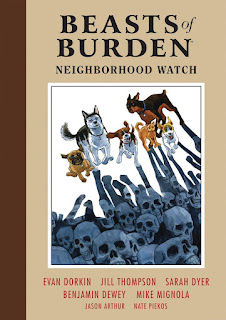
Beasts of Burden: Neighborhood Watch by Dorkin, Thompson, Dyer, Dewey, Mignola and others

It's an odd thing: while actually reading a Beasts of Burden book, it's entirely plausible - my disbelief is reasonably suspended. But both before and afterward, in retrospect, it all seems silly and I struggle to write about it in a non-dismissive way.

If that tone sneaks in, I don't really mean it. But there is something inherently goofy about the whole series, and I do have to acknowledge that.

As seen previously in the original Beasts of Burden (later subtitled "Animal Rites," har de har har), and seen later in the follow-up series Wise Dogs and Eldrich Men, all animals can talk to each other and some animals have magical skills and abilities.

I don't know if series creator Evan Dorkin meant it this way, but domesticated animals (dogs and cats so far) are on the side of Good, and wild animals (rats, corvids, some more exotic monsters) are on the side of a quite Lovecraftian Evil. The forces of Evil are led by the usual extradimensional entities in the final extent, but usually an evil human (alive or currently dead) in the immediate situation. [1]

The Good animals do coordinate with humans, some of the time, and there's a long tradition of partnership, man and dog, but the dogs are fully capable of battling eldritch menaces without the aid of opposable thumbs. So the Beasts of Burden stories are mostly about dogs running around the woods around Burden Hill, Pennsylvania, barking at and biting monsters to save at least this small corner of the world from the Many-Angled Ones. I should add that they do have mages as well: a couple of the animals here can cast spells, but most of them are just the standard somewhat-stronger-tougher-and-longer-lived-than-normal.

Neighborhood Watch is the miscellaneous collection of the series; it gathers all of the smaller and shorter series that came out in between the original series and Wise Dogs. So we have a couple of single-issue stories, a two-part epic, several anthology stories that were later stuck together into one comic book, and a crossover with Hellboy.

Hm, I may have discovered why I'm having trouble taking this seriously. When Hellboy wanders through one of your stories and puts a main character in his pocket, showing that what are massive supernatural threats to you are no big deal to him, the overall universe loses a certain amount of tension. Sure, these dogs might fail to stop any particular nasty thing, but that just means Hellboy or one of his crew will have to come in and quickly mop up. Sad, but not apocalyptic.

Anyway, these are miscellaneous stories, about (mostly) the same main cast as the other stories. Dorkin wrote or co-wrote all of them; Mike Mignola co-wrote the Hellboy story (semi-obviously), Sara Dyer co-wrote one other story. Art is by either Jill Thompson, the co-originator of the series, or Benjamin Dewey, who took over for a lot of this stuff and then did Wise Dogs. Lettering is credited to Jason Arthur and Nate Piekos: I don't think they worked on the same stories, but I can't tell you if it lines up as neatly as Arthur lettered Thompson and Piekos did Dewey.

And, as I said up top, I enjoy reading these stories even though I am in no way an animal person, particular a domesticated animal person. I suspect the people who really like them are much more heavily invested than I am, but that's fine: we all like and react differently to different things. If you want comics about dogs fighting supernatural evil, I don't know of any better option.


[1] Thinking far too deeply about it, I would love to see a series with the opposite premise: dogs and cats are the villains, because they have been tainted by human evil, and badgers or foxes or opossums or maybe raccoons are the heroes. Actually, yes, raccoons, maybe with corvids as advisors: that's the one I want.

Tuesday, January 11, 2022

Bill and Ted Are Doomed by Evan Dorkin and Roger Langridge

This is another one of those cases where I'm a fan of the other thing in the mix, and so will probably not be that good at reviewing how good the final product is at achieving its end. Just a warning up front.

What I mean is: I've been following Evan Dorkin (especially the comics he both wrote and drew, which are rare this last decade or two) and, to a an only slightly lesser extent, Roger Langridge, for years and years. They're both comics creators whose work I'll try to read almost no matter what it is.

Even if it's a sharecropped story deliberately constructed to fit in between two movies that I have never seen, for example.

Bill and Ted Are Doomed was a four-issue miniseries, collected into a single book a little later - that's how I read it - designed to help bridge the gap between the 1991 movie Bill and Ted's Bogus Journey and Bill & Ted Face the Music, which came out last year in some way. (Movie releases were a bit disjointed and weird in 2020, like so much else in the world.)

Now, I did see the first movie, Bill & Ted's Excellent Adventure, so I'm not completely unaware of the thing. But that was a long time ago, and is filed in my brain more under "'80s surfer stereotypes" than "the Bill & Ted universe."

So this book, which has their robot duplicates - who were evil in the second movie, I thought, but aren't evil here - and some little hairy naked inventor-types who only say "Station!" and I presume are also from that movie, because it would be really weird otherwise,...anyway, this book has a lot of stuff that I assume is fan-service for the actual fans, but I am not really one of them, so it's just weird details.

This is also handicapped by its mid-quel nature: it was seemingly designed to show Bill & Ted (and their families) roughly halfway between the youthful slackers of Bogus and the middle-aged losers of Music. And it can't solve the problem the later movie will, which is the core problem of the series (such as it is): Bill & Ted will, eventually, write the one song that brings the world together in peace and harmony and forms a global utopia.

Which is a fun conceit, but if they actually do it, all of the stories are over. So, unless they do in Music (I hope they do), they haven't done it yet.

Doomed is thus a book of failure. Bill & Ted are nearly broke, their band is forgotten, and they spend all their time trying to write the One Song and getting nowhere. Everyone around them is more sensible and normal than they are - that would pretty much have to be the case, honestly - so the band (Bill, Ted, their wives, and Death on bass) set off on a tour to refill their bank accounts.

And if you've ever seen any story about a band setting off on tour, you know it will not go well.

It does not.

There's a band that hates Bill & Ted for mostly inexplicable reasons - they're not metal enough, which is fair since Wyld Stallyns never stuck me as particularly metal, but I may be biased - and that of course leads to a disastrous festival somewhere frozen in Scandinavia where Our Heroes are once again in danger of dying.

It all does end, somewhat mutedly, since they can't actually write The Song or change their slacker/loser future or resolve their money problems. Again, this is a story set between two already-defined points, and exists mostly as a line extension to shake more money out of fans' pockets. It's a fun entertaining story, with the loose-limbed appeal of the other Bill & Ted stories, so it's almost certainly worth the few dollars it does shake out. But that doesn't change the pointlessness of it all.

Then again, I'm generally of the opinion that all sharecropped stories are deeply pointless, so you may not want to listen to me. This one is harmless at worst, goofy fun at best.

Tuesday, January 04, 2022

Beasts of Burden: Wise Dogs and Eldrich Men by Evan Dorkin, Benjamin Dewey, and Nate Piekos

I'm not sure if this is the second book in the series or not.

On the positive side, after the original Beasts of Burden - there can be no argument that's the first book - the next substantial series was called Beasts of Burden: Wise Dogs and Eldrich Men, and that is definitely collected here.

On the negative side, there were four other comics-format Beasts of Burden issues (some collecting anthology stories, to make it all more complicated) published before this series, and those are collected, along with a couple of later stories, as Neighborhood Watch. And most of those stories are drawn by original series artist Jill Thompson, if that makes any difference in the what-comes-first argument.

So, in my considered opinion, Wise Dogs is Schrodinger-ly the second book of the series, along with Neighborhood Watch: if you want to argue it's clearly not, go ahead but do it somewhere else. It's two, or two-and-a-half, or possibly three. (Five is right out.)

Now, I read the first book more than a decade ago - I gather the stories slowed down after that initial rush, as Thompson got busy with other things, but they did keep appearing; there was no huge gap in the actual real world - so my memories are vague and possibly confused. (I had a sense that the non-Thompson stories would have a different cast; that does not seem to be the case.)

Anyway, here's the scoop, as I remembered and re-discovered it: animals are intelligent and can talk to each other, as in many other stories, and to a few special humans. Magic is real, with vaguely Lovecraftian implications: there are monsters that can be created or called or unsealed, and the good side of magic is one part protecting yourself and others from monsters, about three parts getting rid of monsters, and absolutely no parts doing anything else.

These stories follow a group of dogs in a rural part of Pennsylvania, centered on Burden Hill, which has an unusually high level of supernatural disturbances. These dogs fight the evil and get rid of it. All of the stories are written by Evan Dorkin; Thompson was the original artist, but Benjamin Dewey (whose first work on the series is in this book) looks to be the main artist these days. (Nate Piekos is the letterer; I don't usually list those, but my current rubric is "include everyone listed on the cover in the largest size type, unless I disagree and want to include more people" so he counts that way.)

This is actually one longer story - the first multi-issue Beasts of Burden story, I think - in which a team under Lundy (the dark Scottie who is the biggest head on the cover) travel across the local landscape to deal with a couple of problems that, inevitably, turn out to be related and bigger than they expect. As will surprise exactly no one, they do not fail and let a magical apocalypse destroy...um, what would be closest? maybe Harrisburg?

It's all pretty straightforward contemporary supernatural adventure, with all of the expected story beats done professionally and well - except for the fact that the entire cast runs around on four legs and eats out of bowls on the ground. I am not a big animal person, to put it mildly, but these are fun stories, and it's particularly interesting to see how Dorkin deals with a cast that have no hands and who would have trouble accessing anything more than four feet above ground-level.

So this is not great literature of any kind, but it's solid adventure comics that does not involve anyone wearing spandex. That's a win in my book.

Sunday, December 05, 2021

Books Read: November 2021

Burying this on the first weekend of the month, as I usually remember to do, since it's really just an index for Future Me. Links will populate as the posts go live - all of them have been written at this point - so here's what I read this past month:

Hazel Newlevant, No Ivy League (digital, 11/5)

Dave McKean, Black Dog: The Dreams of Paul Nash (digital, 11/6)

Charles Forsman, Celebrated Summer (digital, 11/7)

Farel Dalrymple, It Will All Hurt (digital, 11/13)

James Albon, A Shining Beacon (digital, 11/14)

Fabien Vehlmann and Gwen De Bonneval, Saturday and Sunday, Vol. 1: Rock Heaven (digital, 11/20)

Matt Fraction and Chip Zdarsky, Sex Criminals, Vol. 6: Six Criminals (digital, 11/21)

Evan Dorkin, Benjamin Dewey, and Nate Piekos, Beasts of Burden: Wise Dogs and Eldrich Men (digital, 11/25)

Franck Biancarelli and Lewis Trondheim, Karmela Krimm, Vol. 1: Ramadan Blues (digital, 11/26)

Dan Abnett and I.N.J. Culbard, Wild's End, Vol. 1: First Light (digital, 11/27)

Evan Dorkin and Roger Langridge, Bill and Ted Are Doomed (digital, 11/28)


One interesting tidbit, since I've been reading a SFF novel more slowly than expected (and didn't manage to finish it this month), every last thing I did finish was read in digital format. This is mostly because I'm running through the app Hoopla and hitting everything my library system has access to; I'm expecting eventually things will tighten up so I'm taking advantage while I can.

Monday, September 06, 2021

Reading Into the Past: Week of 9/6/01

Nothing new arrived this week, so I'll fire up the RNG and...here's what I was reading this week in 2001:

David Garnett, Bikini Planet (bound galleys, 9/1)

This is a humorous SF novel, published in the UK in 2000; the US edition was more than a year later, at the end of 2001. I was clearly reading it a few months ahead of publication with an eye towards offering it in the SFBC.

We did not, in the end, offer it in the club. That may indicate my opinion of the book at the time, or may be because I made an offer and it fell through. (But I think it was the former.) I didn't remember ever holding or even knowing about a book called Bikini Planet until picking up the reading notebook a few minutes ago. And I don't think I've read anything else by Garnett (though I keep mixing him up with Paul Barnett, who I did know). 

P.N. Elrod, editor, Dracula in London (bound galleys, 9/2)

Elrod had a couple of fun series about vampires herself: Jack Fleming of "The Vampire Files" was a PI, I think in the traditional '30s, who solved crimes and hobnobbed with mobsters. And the Jonathan Barrett books, which I recall being a bit more ambitious, were set during the Revolution. And it looks like the rest of her career was pretty vampire-centric, as well.

So she edited this anthology, which looks to have been entirely original. I don't see a SFBC edition on ISFDB, which makes sense: anthologies were then and are now a tough sell; they never do as well as a single equivalent novel. I don't remember the specific stories, but it is an anthology I read during Worldcon twenty years ago. But Elrod was generally good with the vampire stuff, and Ace put together smoothly professional books, so my bet is this would still be fun and entertaining if you had a copy of it.

Alan Dean Foster, Star Wars: Splinter of the Mind's Eye (9/3)

I had definitely read this before. I know I read it at least once before Empire came out, and possibly other times afterward. My guess is that I was reading it in 2001 with the thought in my head that having a Star Wars book in one of our twice-yearly "Collector's Issues" would be a good seller, and that this book could slot in there and not be embarrassing. That's the guess, since there doesn't seem to have been a new edition around 2001 that could have triggered the re-read.

Or maybe I was reading it for pleasure? It's not impossible, but SFF tended to all be work, in those days.

Anyway, this is the very first sharecropped SW novel (after Foster's adaptation of the movie itself), and I've heard stories that it was a potential plot for Movie 2, if Star Wars did well enough to get a sequel but the budget got cut. It would have definitely been a lower-budget movie, mostly with Luke running around a misty planet and hiding from Vader - I don't remember the details all these years later, but it was OK adventure fiction that only showed slight indications of having been built from much earlier ideas of the Star Wars universe.

Evan Dorkin, Dork, Vol. 1: Who's Laughing Now? (9/4)

This was the first trade paperback collecting Dorkin's solo, and roughly-yearly, comic Dork! As I remember, there were eventually three volumes of Dork!; this one has the first five issues. You can get all of this material in more permanent form these days - most of it is in the big omnibus Dork (note the lack of exclamation point, indicating we are older and wiser now), with some of the strips over in the series-specific books about Milk & Cheese or the Eltingville Club.

Dorkin is, and was even more then, the grumpiest, most cynical cartoonist about the comics field (and a strong contender for "grumpiest and most cynical" in the overall event, too). I always appreciated that: he is funny, biting, and unstoppable at his best. But I always thought being Evan Dorkin seemed to be a really difficult, unpleasant thing - I hope he's mellowed as the years have passed, and that I don't see as much bile from him because he doesn't need to spread as much bile as he used to.

But these are awesome, nasty, funny comics and everyone who reads comics should read them. In this format, if you randomly find this book, in Dork, wherever. Dorkin is one of the greats.

The Humorous World of Jerome K. Jerome (9/6)

This appears to be a 1962 book from Dover Publications - famously a house that focuses on works out of copyright to simplify their accounting - and I have no idea why I was reading it, or what's included in it. I have read other Jerome - obviously I started with Three Men in a Boat, like everyone else, but I've also read Idle Thoughts of an Idle Fellow and (I think) Three Men on the Bummel. And this, whatever this was.

My guess is that it was an anonymously-edited collection of excerpts from a lot of Jerome's work, but it could also have been a small omnibus - maybe of Boat and one other book.

Jerome is still entertaining, at his best: he was frivolous enough, and his time modern enough, that he still reads well today. So if you're looking for funny stuff, he's still a good place to go.

Philip Gourevitch, A Cold Case (9/6)

This was almost brand-new at the time; the hardcover came out in July. So I suspect I got a copy at work, since this was late enough that I think the BOMC-Doubleday merger had gone through and I had access to basically any normally-published book I could possibly want.

Gourevich was famous from We Wish to Inform You That Tomorrow We Will Be Killed with Our Families, which had come out a few years before (and which is still on my shelf, unread - it's hard to get the energy to read several hundred pages about massacres). This book was shorter and about just one murder, which may be why I managed to read it. As I remember, it's a great book of reportage, following one detective as he cracks a personally-important thirty-year-old case. 

The beginning of this week overlapped the Millennium Philcon - the Worldcon was in Philly that year, so it was an easy, convenient trip, and I vaguely remember having a good time there. (As much as I've ever had a good time at any convention: I'm not good at crowds, or small-talk, and I never quite figured out what to do at conventions.) So those first few books were read in chairs in hotel lobbies, or at random moments in the exhibit hall, or (probably) in too much time in my hotel room. I seem to have been trying to "work" during that time, which makes sense: Worldcon was work for me. 

Wednesday, January 02, 2019

Book-A-Day 2018 #367: Calla Cthulhu. Vol. 1 by Dorkin, Dyer & Humiston

I have to believe the name came first. Maybe semi-serious, maybe entirely as a joke. But someone said "Doesn't Call o' Cthulhu sound like a girl's name?" and it all went on from there.

In the end, it's not quite that on-the-nose -- the green-haired teen on the cover of Calla Cthulhu, Vol. 1 is actually named Calla Tafali. But she is descended from the Great Old One who lies dreaming in R'lyeh. [1] And she is being urged, rather strongly, to join the family business. (By her "Uncle Hastur," the fellow in the yellow mask at lower left.)

So, yes, Calla Cthulhu is a YA coming-of-age action-adventure story set in the Cthulhu Mythos, with the usual kid who rejects her evil heritage in favor of goodness and awesomeness and niceness. It's a little bit like a Lovecraftian-flavored distaff version of Hellboy, aimed squarely at a teen audience. This first volume collects the first four issues -- or maybe episodes, since it was originally published on-line, and the panels are reproduced larger here than I expected.

Since those panels are large, and there are fewer of them on the page than you might expect, Calla Cthulhu has less story than you'd expect from a book of 250ish pages -- the "action-adventure" aspect also adds to that, since fight scenes take more time and page-space than long scenes of talking heads droning on about things that are squamous or rugose or possibly both. (Note: Calla contains quite a bit of the former but none of the latter.)

The four episodes here are just enough to introduce Calla, give us her origin, and set up the opponents/family and some potential allies in her battle to keep humanity sane and alive. Her origin has the usual tragedy, and actually explains how her hair turned green. (It doesn't seem to be as tentacle-like in the actual story as on the cover, but maybe that's a power-up she hasn't entirely unlocked yet.) She also has a spooky old ancestral house, because all of the Old Gods need to have a pad in town, dig?

(Narrator: None of the other Old Gods have a pad in town.)

It's hard for me to say if the impetus behind Calla Cthulhu was silly, cynical, or honest -- it's such a high concept that it makes me suspicious, but it's all done straightforwardly and directly here, without any winks to the reader. I'm not sure if Lovecraftian ideas are that embedded in the culture that you can just use them in a YA story like this and expect a large audience of actual young people will recognize and accept them, but young people are probably smarter and more genre-savvy than I'm giving them credit for.

If you do know the Mythos, and are interested in a story about a spunky teen girl trying not to live up to her destiny, Calla Cthulhu does the job nicely. It's smart enough about its tropes in the writing (by Evan Dorkin and Sarah Dyer) and has a clean webcomics look from artist Erin Humiston. It might be dead, though: the thirteen episodes to date on the webcomics platform Stela seem to have been reconfigured into the four chapters of this book and the website hasn't been updated since launch in 2016. So there's a bit of a caveat there: if you want the beginning of a story that will possibly never go any further, check it out.


[1] The book does not explain how, and perhaps it's best not to try to envision what kind of matings would lead to a human child of human parents whose distant ancestor is a sea-dwelling space monster made of tentacles. That's not the genre of this story, at least....

Tuesday, January 01, 2019

Book-A-Day 2018: Post-Mortem

Introductory

First of all: yes, I know. It does seem odd to have a post-mortem for something not yet dead. But, trust me, Book-A-Day 2018 is dead: everything is read and all of the posts written and scheduled. [1] It's just going to twitch a bit for the next two weeks while the dying makes it out to all of the extremities.

2018 was my fourth run of Book-A-Day here on Antick Musings -- before that, it was something I did myself in a desultory way for a few weeks or months, to kick myself out of a reading doldrum. Those prior runs are the year of 2014, a year-long stretch covering 2010-2011, and a 200-day stretch in 2006-2007.

Book-A-Day can be either of two things: either I'm reading a book every day, or I'm writing a post about a book every day. Over the course of a year, the latter turns into the former, obviously. And every time I do this, I try to do both, and I think it's been more successful each time. (Of course, I would think that.)

This is probably the last time I do a Book-A-Day year. I have two reasons for that, one serious-logistical and one silly.

The silly reason first: I just realized that I was laid off soon after finishing every other Book-A-Day run: first in April of 2006 (after ending in February) and then in January of 2015 (after the 2014 run). I should be safe this time, but I'm not planning to tempt fate.

The more serious reason is that I just don't have the vast masses of quick-to-read books coming into my house that I did back in the SFBC days, and I've now worked down all of the remnants of both those days and what I've bought since then. (Well, the quick-to-read portions of both: I still have far more unread books than I can get to in the next five years.)

So even if I wanted to do Book-A-Day again, in 2021 or so, and tempt the Job Gods, I probably wouldn't have the books to do it with. I relied heavily on the library this time out, and the only way to do that again would be to read a lot of junk that I don't care much about just to pad out the totals. (Which, come to think of it, I did quite a bit in the 2014 and 2010-2011 runs.)

Given that, let me take a look at what I did read in 2018, in the manner of the previous Post-Mortems for 2006-2007 and 2014. There will be only one graph, I think, and this is it.

In 2018, I read 433 books in 365 days and wrote 379 blog posts covering 437 books and 6 individual comics issues. Careful readers will note that I wrote about more books in 2018 than I read; I started the year with a small cushion of stuff read in December 2017. I also read more books than I wrote posts, because I wrote about longer series (all comics) more and more as the year went on. The numbers and percentages in the chart and below are based on number of books rather than number of posts.

I don't know if everyone likes placing books into tidy little categories as much as I do, though the wars over the SF/Fantasy border seem to prove they do. But it's how I organize these Post-Mortem posts, so here's what I read, as I categorize it:

Fiction: SF and Fantasy (18, 4.2%)

This is what I used to do for a living: I know, I'm surprised it's this small a portion of my reading these days, too. I keep saying that I'd be happy to go back to SFF publishing if they wanted me, but I have no idea how my current expertise would align with that world.

In 2014, this was 4.4%, with 16 books.

Fiction: Mystery and Thriller (5, 1.2%)

The larger genre right next door to SFF, in which I also used to read a lot more. Several of my would-be reading projects are in this area; maybe one or more will happen in 2019.

In 2014, this was 0.5%, with 2 books.

Fiction: Mainstream (10, 2.3%)

I'm reading fewer long books of prose in the first place these days, but it seems like about the same percentage of it is not obviously genre. But I tend to think of this category as defined negatively: it's what doesn't fit into clear genres.

In 2014, this was 2.7%, with 10 books.

Non-Fiction: Narrative (15, 3.5%)

This is the category for relatively serious non-fiction -- histories, travelogues, memoirs, stuff like that. It's really miscellaneous, obviously.

In 2014, this was 6%, with 22 books.

Non-Fiction: Lists and Frivolities (17, 3.9%)

And this is the non-fiction category for things that aren't serious at all -- a lot of these were bathroom books, and this category has often been the place for things I read quickly in an evening when I realized I hadn't read a book yet that day. But my sense is that the cute little gift-y thing that sits by the cast register isn't really a big book category anymore.

In 2014, this was 2.7%, with 10 books.

Comics: Strip and Panel Collections (27, 6.2%)

I divide the world of comics into possibly idiosyncratic categories, based on how they first appeared. I think it makes sense; you may disagree. First up are books of comics that originally appeared as individual strips somewhere -- online or in print. This used to be mostly collections of newspaper comics, then mostly collections of webcomics, and now it's pretty miscellaneous.

In 2014, this was 10.4%, with 38 books.

Comics: Floppy Collections (194, 44.8%)

The second category of comics includes things that were mostly reprinted from periodical comic books. Most of this stuff reprints series (ongoing or mini-) in an obvious way, but there are a few oddballs like the Best American Comics series, which I put here to put them somewhere. But, generally, things in this category appeared as a publication under the same overall name as the eventual collection. Since the American comics market is what it is, and I was reading a lot of comics this year, it's the largest category -- almost half of all books.

In 2014, this was 19.5%, with 71 books.

Comics: Originals in Book Form (66, 15.2%)

This category should be pretty self-explanatory: comics, by people working in the English language, that first appeared as a book, without any previous serial publication.

In 2014, this was 29%, with 106 books.

Comics: Translated from Japanese (and other Asian languages) (17, 3.9%)

Comics, mostly manga, translated for an American audience.

In 2014, this was 12.9%, with 47 books. I used to read a lot more in this area, but that was mostly stuff that came in as publicity packages and that I didn't necessarily like all that much. Once the flow of free product stopped, there were only a few things from that flood I wanted to keep up with on my own.

Comics: Translated from French (and other European languages) (42, 9.7%)

In 2014, this was 7.7%, with 28 books. This one swapped size with the translated-from-Asia category since 2014, interestingly. I think part of that is just that there's more "art comics" coming over, accessibly, from France than from Japan, and part is that I did a big re-read of the whole Dungeon series, which contributed 17 books all on its own.

Art Books (9, 2.1%)

Back in my SFBC days, this was a huge staple of my book-a-day runs, and often the trigger for them: when I had too many art books stacked up, it was time to run through them comprehensively. But I think there are fewer books like that being published at all, in this Internet age, and I haven't had a way to get them free for a decade now.

In 2014, this was 2.2%, with 8 books.

Books for Children of Various Ages (12, 2.8%)

This is one of my fuzziest categories, since nearly everything here could be counted as something else -- a novel, an original GN, or whatever. But this is where I put things that are very specifically for younger readers, and not just accessible to younger readers. I try to put "YA" books -- which regularly bleed into adult readership -- in the general categories, and books aimed at middle-grade or younger readers here. But I don't promise absolute consistency.

In 2014, this was 1.6%, with 6 books.

Poetry (1, 0.2%)

I read a book of poetry this year! And I have a bookmark in another one, so I may actually finish a similar book next year. I used to read more poetry, ten to fifteen years back -- the book I had going in the bathroom was generally poetry, until some particularly horrible British historical survey anthology knocked me out of the habit.

I have not read any poetry, as far as I can tell, in any prior book-a-day run.

Playscripts (1, 0.2%)

I did read one playscript in 2014, for 0.3% of the total. So that number holds absolutely steady.


That's what I read in 2018. I should come back in about two weeks and add in the last links, once all of the posts have gone live. If you're reading this later than January 16, 2019, you can judge whether I did that or not.

If you've read this far, let me leave you with one last thought. There's probably some similarly crazy project in the back of your head -- maybe for your work, maybe gardening, maybe exercise- or diet-related, maybe housecleaning, maybe running for Congress!

Do it. Do it this year. Start in on it as soon as you can. Jump onto your crazy hard-work ideas and make them real. There's nothing like finishing up something you really wanted to do and looking back on it. I want all of you to have that feeling. So do it. Start the planning today.


[1] With one tiny asterisk: the post for the book I finished today isn't quite done yet. I wrote the post for book #380 today (which I read yesterday) and started #381, but it's not final. So, tomorrow morning I will finalize and set to post the very last Book-A-Day 2018 post.