First, the disclaimers: I usually try to read Dozois's Year's Best Science Fiction before nominating, since I don't get to read much short fiction otherwise, and I do like to nominate across as many categories as I can. This year, however, St. Martin's hasn't gotten it to me yet, so I've read less short stuff than usual. Also, I can only nominate things I've read and liked -- I can't read everything, and I tend to be grumpy, so I don't like some things that are probably perfectly wonderful.
Anyway, here's what I'm nominating this year:
Best Novel:
Anansi Boys by Neil Gaiman
The Narrows by Alexander C. Irvine
Counting Heads by David Marusek
Learning the World by Ken MacLeod
Thud! by Terry Pratchett
Best Novella:
"Magic for Beginners" by Kelly Link
"The Little Goddess" by Ian McDonald
"Audubon in Atlantis" by Harry Turtledove
"Inside Job" by Connie Willis
Best Novelette:
"The Gist Hunter" by Matthew Hughes
"Rats of the System" by Paul McAuley
"The Policeman's Daughter" by Wil McCarthy
"Written in the Stars" by Ian McDonald
"Beyond the Aquila Rift" by Alastair Reynolds
Best Short Story:
"Second Person, First Tense" by Darryl Gregory
"Third Day Lights" by Alaya Johnson
"Monster" by Kelly Link
"Sheila" by Lauren McLaughlin
"Girls and Boys, Come Out To Play" by Michael Swanwick
Best Related Book:
Raw Spirit by Iain Banks
Spectrum 12 edited by Cathy & Arnie Fenner
Up Through an Empty House of Stars by David Langford
The Lord of the Rings Sketchbook by Alan Lee
The Disappointment Artist by Jonathan Lethem
Best Professional Editor:
Ellen Asher
Ginjer Buchanan
Anne Groell
David G. Hartwell
Patrick Nielsen Hayden
Best Professional Artist:
Donato Giancola
Bruce Jensen
Todd Lockwood
Stephan Martiniere
John Jude Palencar
Best Dramatic Presentation, Long Form:
Mirrormask
Wallace & Gromit: The Curse of the Were-Rabbit
Best Dramatic Presentation, Short Form:
Prix Victor Hugo Award Ceremonies at Interaction
Best Semiprozine:
Ansible
Emerald City
Locus
The New York Review of Science Fiction
Best Fanzine:
no nominations
Best Fan Writer:
David Langford
Cheryl Morgan
James Nicoll
Steven H. Silver
Best Fan Artist:
no nominations
Best Interactive Video Game:
The Incredible Hulk: Ultimate Destruction
Lego Star Wars
John W. Campbell (Not a Hugo) Award for Best New Writer:
K.J. Bishop
Alaya Johnson
Justine Larbalestier
Chris Roberson
John Scalzi
If anyone reading this is a member of this year's or last year's Worldcon, and hasn't nominated yet -- do it now.
Wednesday, March 08, 2006


Tuesday, March 07, 2006
Today's WFA Reading: 3/7
I hadn't gotten anything for WFA consideration for quite a while -- long enough that I was beginning to wonder if I needed to confront my mailman. But the drought broke yesterday, with three issues of a 'zine called Dreams and Nightmares. I haven't looked at them closely, but they seem to be all poetry. (I'm not sure where that fits into the WFA categories, so it's time to scrutinize the instructions once again.)
Today's mail was one book, from FSG: Specimen Days by Michael Cunningham. I've heard absolutely glowing reports of this novel from several widely separated sources, so I'm looking forward to it.
Also arriving today, but not for WFA consideration (or to be read any time soon) is a new book from the Library of America: James Agee's Let Us Now Praise Famous Men, A Death in the Family, & Shorter Fiction.
Today's mail was one book, from FSG: Specimen Days by Michael Cunningham. I've heard absolutely glowing reports of this novel from several widely separated sources, so I'm looking forward to it.
Also arriving today, but not for WFA consideration (or to be read any time soon) is a new book from the Library of America: James Agee's Let Us Now Praise Famous Men, A Death in the Family, & Shorter Fiction.
This is a Public Service Announcement...With Guitar
The deadline for Hugo Nominations is this Friday. Unless you have very dependable and quick mail service, your best bet at this point is to nominate online. If you're a member of LA Con IV, or were a member of Interthingy, please do take some time to think about what you read and nominate the stuff you liked best -- the Hugos are supposed to be our awards, and they work better the more people nominate and vote.
At this point I should shill for things I was involved in. I'm not a writer, so there's nothing of my own to mention. I did edit Off the Main Sequence last year, but that's not eligible for anything as far as I can figure. (I can't say I entirely understand the rules governing Best Related Book, but I'm pretty sure a short story collection is right out.) So let me instead suggest that if you liked any of the stories in SFBC's original anthologies last year (Marvin Kaye's The Fair Folk and Mike Resnick's Down These Dark Spaceways), please remember them when filling out your Hugo Nomination form.
I intend to nominate tonight -- my notes are at home -- and probably post what I nominated here, in case anyone is so blinded by my brilliant Editorial Glow (TM) as to follow me slavishly.
At this point I should shill for things I was involved in. I'm not a writer, so there's nothing of my own to mention. I did edit Off the Main Sequence last year, but that's not eligible for anything as far as I can figure. (I can't say I entirely understand the rules governing Best Related Book, but I'm pretty sure a short story collection is right out.) So let me instead suggest that if you liked any of the stories in SFBC's original anthologies last year (Marvin Kaye's The Fair Folk and Mike Resnick's Down These Dark Spaceways), please remember them when filling out your Hugo Nomination form.
I intend to nominate tonight -- my notes are at home -- and probably post what I nominated here, in case anyone is so blinded by my brilliant Editorial Glow (TM) as to follow me slavishly.
Welcome to Rikers Island
This is the Department of Corrections:
Patrick Nielsen Hayden notes that Adam Stemple is not a "young musician," but instead a musician, once young but now probably older than this reporter. Antick Musings regrets the error, and bemoans the lost youth of Mr. Stemple.
John DeNardo comments that Doris Lessing can also be cited as a SF writer already listed as part of Book Magazine's poll for the Greatest Living British Writer. Rich Horton further adds some more names that have written works in the SFF field. Antick Musings at first planned to insist that his aim was to point out the self-identified SFF writers, but then he remembered that Ms. Rowling was utterly shocked to find out she was writing the stuff. The Antick Musings Public Editor is investigating the situation, and will report at length sometime after everyone has forgotten all about it.
Finally, Antick Musings is rethinking its Master Plan for the Novel Hugo, and does not now intend to present a proposal at this year's Worldcon. This is in no way a capitulation to threats of violence, nor is Antick Musings giving up its goal of emulating the fecundity of awards enjoyed by our much more successful compatriots in Romance. A full manifesto may be forthcoming.
Patrick Nielsen Hayden notes that Adam Stemple is not a "young musician," but instead a musician, once young but now probably older than this reporter. Antick Musings regrets the error, and bemoans the lost youth of Mr. Stemple.
John DeNardo comments that Doris Lessing can also be cited as a SF writer already listed as part of Book Magazine's poll for the Greatest Living British Writer. Rich Horton further adds some more names that have written works in the SFF field. Antick Musings at first planned to insist that his aim was to point out the self-identified SFF writers, but then he remembered that Ms. Rowling was utterly shocked to find out she was writing the stuff. The Antick Musings Public Editor is investigating the situation, and will report at length sometime after everyone has forgotten all about it.
Finally, Antick Musings is rethinking its Master Plan for the Novel Hugo, and does not now intend to present a proposal at this year's Worldcon. This is in no way a capitulation to threats of violence, nor is Antick Musings giving up its goal of emulating the fecundity of awards enjoyed by our much more successful compatriots in Romance. A full manifesto may be forthcoming.
Monday, March 06, 2006
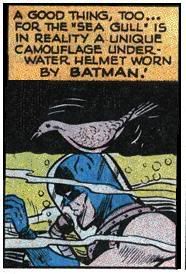
My New Comics Metric
Inspired by Comics Should Be Good, I have a new test for comics.
If a given comic is not as much fun as a picture of Batman in a fake-seagull-diving-helmet, then I shouldn't be reading it.
(I'm working on a similar test for WFA reading, but that one cannot be revealed to the public.)
If a given comic is not as much fun as a picture of Batman in a fake-seagull-diving-helmet, then I shouldn't be reading it.
(I'm working on a similar test for WFA reading, but that one cannot be revealed to the public.)
A SF Reviewer Who Hates SF
The New York Times has found itself a new reviewer for science fiction: Dave Itzkoff. Itzkoff has so far written two pieces on SF, one in which he lists his favorite books in the field and his first review, of David Marusek's Counting Heads.
This has already caused quite a bit of comment: two letters to Locus so far, by Elizabeth Hand and Lucius Sorrentino; a post in Matthew Cheney's blog; a post on Emerald City; and one by Nick Mamatas (who can always be counted on to detest, in very strong language, whatever is going on). There's probably more commentary that I haven't seen yet.
Let's take Itzkoff's Top 10 Sci-Fi Books first:
What's missing here? Everything. This is the "best of" list of the guy who read some SF in college, and didn't engage in it terribly deeply. Some people are jumping on his use of the dreaded "sci-fi," but that's common among those not indoctrinated by fandom. That doesn't, by itself, show that he's not a serious reader of the stuff -- the books he chooses to explain his taste do that.
And look at those dates: the bulk of the list is from 1959-1965. (But what's missing from those dates? No Dune, no Stranger in a Strange Land or Starship Troopers, no Delany, nobody that you would have to read deeply in SF to encounter.) Again, this is the college bull session reading list; the books that all the English majors in the dorm read in their spare time.
So, already we know this guy is going to be trouble. Gerald Jonas, the old Times SF reviewer, might have only had a little bit of space a few times a year (and he might have been overly fond of the most literary, experimental side of the field, at least in my opinion), but he knew the SFF world intimately, and he was a great reviewer (when the Times deigned to give him space.) But this new guy starts off by blowing smoke in our faces.
His first full-scale review, of Counting Heads (a wonderful book with a couple of major flaws of structure), is a masterpiece of wrong-headedness. He starts off by insisting that all contemporary SF is "so geeky," which will come as a surprise to the readers making David Weber, Anne McCaffrey, Harry Turtledove, John Ringo, Orson Scott Card and S.M. Stirling among the most popular writers in the field. His straw man hastily assembled, he then reminds us that he's the guy who still reads his college favorites on the subway (because he can't find any new good SF, presumably), and that this makes him a social outcast. Pity poor Itzkoff; Oprah-book readers look down on him.
(Cue choral version of "It's a proud and lonely thing to be a fan.")
Itzkoff wants to say that Counting Heads is worth reading, really he does. But, sadly, it is more like "a biology textbook or a stereo manual." Now, there are writers who lovingly catalog obsessive tiny details -- either to explain the specific science like the Analog crowd, to show off their geek-fu like Stephenson, or to revel in military techo-porn like [insert insult here] -- but Marusek doesn't write like that at all. Perhaps Itzkoff has not read enough SF to understand the process of incluing, so the details of the world (which are, of course, different from the world he lives in, since SF is a literature of change) confuse and sadden him.
It's Itzkoff's right to say that the people in Counting Heads didn't come alive for him (and he does finally get to that, after wandering off down a few rhetorical cul-de-sacs and having to cut his way free). I completely disagree with him, though, and I don't think anyone else who has read Counting Heads has had that criticism of it. I think he's saying that the people didn't come alive for him because he couldn't place them in their world; he couldn't figure out how things worked (he's massively misread this near-utopia as a satire), so these people, who fit so well into their world, don't seem real to him.
All in all, then, from the evidence of this review he just doesn't know how to read SF. That would usually be a fatal flaw for a dedicated SF reviewer, but not for the Times. Their book review section, under relatively new leadership, has been seemingly pursuing a policy of assigning a few books each week to the most biased or unqualified reviewers possible, with the aim of creating controversy. I guess it's possible that this seeming policy is purely the result of incompetence, but there seems to be a method behind it. Some of the results so far have been very funny, so perhaps I'm only complaining now because it's my ox being gored. But I don't think so: I think Itzkoff isn't quite right for the job either way. He's not outrageous enough to be the anti-SF reviewer, and he's clearly not qualified to actually review it straight.
Cheryl at Emerald City thinks Itzkoff was under orders not to say that SF can ever be worthy, but I don't buy that. It sounds like Cheryl is just engaging in our own SFnal cultural cringe -- God knows we've had reason for it, over the years, but I don't think the Times works that way.
Nick Mamatas, predictably, goes off on a rant about class. I think he's on to something in general, but blows it out of proportion. This isn't primarily about class; it's mostly about knowing how to read a SF text.
Matt Cheney also found Counting Heads geeky, which I didn't, so I may have unrealistically high standards for geekiness. (Stephenson is geeky, yes. Egan gets geeky sometimes, sure. But Counting Heads is an immersive novel -- none of the tech is paraded around to show off its coolness; it just exists and everyone in the world of the book takes it for granted. That's not geeky at all to me; geekiness is concentrating on the intrinsic cool-stuff-ness of the invented world.)
Elizabeth Hand's letter in Locus seems radically beside the point to me: Itzkoff, whatever he is, is not a committee, nor is he the Czar of Political Correctness. He likes the books he likes. We can infer things from that about him, but deploring that list because it is not Representative of the Diversity of Wimmin and Other Small Furry Woodland Creatures is just silly.
Lucius Sorrentino's letter to Locus is longer and better argued. I don't have any real problems with it, nor any snarky comments to make about it.
So, to sum up: the Grey Lady has a new sci-fi gun. And he doesn't know his territory at all. It might be interesting to see him flail around for a while, but having him reviewing SF won't be at all helpful for the genre.
This has already caused quite a bit of comment: two letters to Locus so far, by Elizabeth Hand and Lucius Sorrentino; a post in Matthew Cheney's blog; a post on Emerald City; and one by Nick Mamatas (who can always be counted on to detest, in very strong language, whatever is going on). There's probably more commentary that I haven't seen yet.
Let's take Itzkoff's Top 10 Sci-Fi Books first:
- A Canticle for Leibowitz (1959) by Walter M. Miller, Jr.
- Cat's Cradle (1963) by Kurt Vonnegut
- A Clockwork Orange (1962) by Anthony Burgess
- The Crying of Lot 49 (1965) by Thomas Pynchon
- Gun, With Occasional Music: A Novel (1994) by Jonathan Lethem
- Looking for Jake (2005) by China Mieville
- The Man in the High Castle (1962) by Philip K. Dick
- R is for Rocket (1962) by Ray Bradbury
- The Twilight Zone Companion (1982) by Marc Scott Zicree
- Watchmen (1987) by Alan Moore and Dave Gibbons
What's missing here? Everything. This is the "best of" list of the guy who read some SF in college, and didn't engage in it terribly deeply. Some people are jumping on his use of the dreaded "sci-fi," but that's common among those not indoctrinated by fandom. That doesn't, by itself, show that he's not a serious reader of the stuff -- the books he chooses to explain his taste do that.
And look at those dates: the bulk of the list is from 1959-1965. (But what's missing from those dates? No Dune, no Stranger in a Strange Land or Starship Troopers, no Delany, nobody that you would have to read deeply in SF to encounter.) Again, this is the college bull session reading list; the books that all the English majors in the dorm read in their spare time.
So, already we know this guy is going to be trouble. Gerald Jonas, the old Times SF reviewer, might have only had a little bit of space a few times a year (and he might have been overly fond of the most literary, experimental side of the field, at least in my opinion), but he knew the SFF world intimately, and he was a great reviewer (when the Times deigned to give him space.) But this new guy starts off by blowing smoke in our faces.
His first full-scale review, of Counting Heads (a wonderful book with a couple of major flaws of structure), is a masterpiece of wrong-headedness. He starts off by insisting that all contemporary SF is "so geeky," which will come as a surprise to the readers making David Weber, Anne McCaffrey, Harry Turtledove, John Ringo, Orson Scott Card and S.M. Stirling among the most popular writers in the field. His straw man hastily assembled, he then reminds us that he's the guy who still reads his college favorites on the subway (because he can't find any new good SF, presumably), and that this makes him a social outcast. Pity poor Itzkoff; Oprah-book readers look down on him.
(Cue choral version of "It's a proud and lonely thing to be a fan.")
Itzkoff wants to say that Counting Heads is worth reading, really he does. But, sadly, it is more like "a biology textbook or a stereo manual." Now, there are writers who lovingly catalog obsessive tiny details -- either to explain the specific science like the Analog crowd, to show off their geek-fu like Stephenson, or to revel in military techo-porn like [insert insult here] -- but Marusek doesn't write like that at all. Perhaps Itzkoff has not read enough SF to understand the process of incluing, so the details of the world (which are, of course, different from the world he lives in, since SF is a literature of change) confuse and sadden him.
It's Itzkoff's right to say that the people in Counting Heads didn't come alive for him (and he does finally get to that, after wandering off down a few rhetorical cul-de-sacs and having to cut his way free). I completely disagree with him, though, and I don't think anyone else who has read Counting Heads has had that criticism of it. I think he's saying that the people didn't come alive for him because he couldn't place them in their world; he couldn't figure out how things worked (he's massively misread this near-utopia as a satire), so these people, who fit so well into their world, don't seem real to him.
All in all, then, from the evidence of this review he just doesn't know how to read SF. That would usually be a fatal flaw for a dedicated SF reviewer, but not for the Times. Their book review section, under relatively new leadership, has been seemingly pursuing a policy of assigning a few books each week to the most biased or unqualified reviewers possible, with the aim of creating controversy. I guess it's possible that this seeming policy is purely the result of incompetence, but there seems to be a method behind it. Some of the results so far have been very funny, so perhaps I'm only complaining now because it's my ox being gored. But I don't think so: I think Itzkoff isn't quite right for the job either way. He's not outrageous enough to be the anti-SF reviewer, and he's clearly not qualified to actually review it straight.
Cheryl at Emerald City thinks Itzkoff was under orders not to say that SF can ever be worthy, but I don't buy that. It sounds like Cheryl is just engaging in our own SFnal cultural cringe -- God knows we've had reason for it, over the years, but I don't think the Times works that way.
Nick Mamatas, predictably, goes off on a rant about class. I think he's on to something in general, but blows it out of proportion. This isn't primarily about class; it's mostly about knowing how to read a SF text.
Matt Cheney also found Counting Heads geeky, which I didn't, so I may have unrealistically high standards for geekiness. (Stephenson is geeky, yes. Egan gets geeky sometimes, sure. But Counting Heads is an immersive novel -- none of the tech is paraded around to show off its coolness; it just exists and everyone in the world of the book takes it for granted. That's not geeky at all to me; geekiness is concentrating on the intrinsic cool-stuff-ness of the invented world.)
Elizabeth Hand's letter in Locus seems radically beside the point to me: Itzkoff, whatever he is, is not a committee, nor is he the Czar of Political Correctness. He likes the books he likes. We can infer things from that about him, but deploring that list because it is not Representative of the Diversity of Wimmin and Other Small Furry Woodland Creatures is just silly.
Lucius Sorrentino's letter to Locus is longer and better argued. I don't have any real problems with it, nor any snarky comments to make about it.
So, to sum up: the Grey Lady has a new sci-fi gun. And he doesn't know his territory at all. It might be interesting to see him flail around for a while, but having him reviewing SF won't be at all helpful for the genre.
Sunday, March 05, 2006
Reading Into the Past: Week of 3/5
As I do every Sunday evening, I roll a few dice to choose a random year in the past decade-and-a-half, dig out my list of what I read this week in that year, and see if I can remember anything at all about those books. This week I rolled a 13, so we're going back to the heady days of grunge and Clinton I:
That was the start of a streak of at least two books a days from 2/26 (except the 28th) through 3/17. I only read one book on 3/18, 3/20, 3/25, and 3/28, but otherwise read at least two a day through 4/1. I didn't hit a day without finishing at least one book until 4/17. (And that was before my modern tricks; I was pretty much just reading things straight through then.)
Of course, as you can see from the selection above, these were mostly short books, and there were a lot of art books (which don't take much time). The SFBC and our sister clubs were preparing to move offices for the second time in a year (and, this time, it wasn't just up a floor in the same building but across town to the newly christened Bertelsmann Building). So there was a lot of house-cleaning, and giant piles of books that had been kept for years for various odd reasons were being disposed of. I grabbed them with both hands and lugged them home in bulk, complicated slightly by the fact that I was also moving, into my first (and, so far, only) apartment, in Lodi, NJ. I lived alone there in bachelor splendor for about a month and a half, from the beginning of April until my wedding day, May 22nd. And it looks like I prepared for marriage in the way I prepared for just about everything in the early '90s: I read a whole lot of completely unrelated books. There's probably a lesson there, but I'm damned if I can figure out what it is.
- Medusa by Chris Achilleos (2/26)
Art book by a Greek-born British artist, with a lot of "fighting fantasy" and various media ties. I never warmed up to his style as much I'd have liked, but he does very good warrior women, and we sold lots of copies of this book in the SFBC for many years. - The Fantastic Art of Frank Frazetta, Book Three edited by Betty Ballantine (2/26)
As far as I can remember, this had no text, or maybe just a short into by Ballantine. The art is swell, of course, but this and the others in the series have since been superseded by the three big Underwood collections. - The Fantastic Art of Frank Frazetta, Book Four edited by Betty Ballantine (2/26)
Just like the above, with different pieces of art. - Let's Go 1993: The Budget Guide to Britain & Ireland edited by Carolyn McKee (2/26)
I was preparing for my honeymoon, which we spent in London and Edinburgh. (There were vague plans for day trips from London, but we didn't even see everything there that we wanted to get to.) I think this book was useful, so if you are also planning a trip to London in mid-1993, I recommend this guidebook. - Fodor's Scotland '92 (2/26)
Ditto. Note that I read five books in one day. Men were capable of that in those pre-Web days. Oh for the glory of our youth! - Heroic Dreams by Nigel Suckling (2/27)
It's possible that this should really be cited as edited by Suckling, but that's how I wrote it down back then. I know he wrote the text for a collection of fantasy art, mostly featuring women in shiny metal trinkets that only barely cover their assets. I don't remember it well, but I'm pretty sure it's still on my shelves. (But, then, I've only gotten rid of art books if they're really lousy.) - Golden Trillium by Andre Norton (2/27)
Does anyone remember the "Trillium" series these days? It started with Black Trillium, which was quite a big seller in 1990 or so, and had the novelty of being a three-way collaboration between Marion Zimmer Bradley, Julian May and Norton. Then each of the individual writers wrote their own sequels -- as I recall, Bradley was first, and changed everything, then May tried to write a sequel to Bradley's book (even though Bradley may have killed off or completely changed her viewpoint character), then Norton wrote this book, which ignored the first two sequels. Further sequels followed, proving that each author was writing an entirely separate series that were only joined in origin. As I remember it, a decade and more later, May's was the best of the bunch, but none of them seemed terribly inspired. - Dream Makers edited by Martyn Dean (2/28)
More various SF/Fantasy art. Mostly British artists, as I recall. - "...And Then We'll Get Him!" by Gahan Wilson (3/1)
Great, great cartoons by the true heir to Gorey and Addams. This book has some of his best stuff, too. - The Book of the Damned by Tanith Lee (3/1)
Probably book three of "The Secret Books of Paradys." Various unpleasant things happen in brooding, ominous ways to damaged characters in an odd city. I've liked the Lee books I've read, but none of them have really compelled me to read more, for whatever reason. - Ultraterranium by Bruce Pennington (3/1)
Art book by a British artist, part of my general haul of Paper Tiger books that you may have noticed I was working through. - The Book of the Beast by Tanith Lee (3/2)
The last of the "Secret Books of Paradys," with more as above. - The Unconquered Country by Geoff Ryman (3/2)
The award-winning novella, something like an allegory of the Vietnam War, as published as a book. I am generally allergic to allegory, and tend to be a mild right-winger, so this must be awfully damn good for me to have liked it as much as I did. - British English A To Zed by Norman W. Schur (3/2)
A great reference and dictionary (probably now superseded by a dozen websites) of the idiosyncrasies of the language as spoken by British people, with particular emphasis on the words mostly likely to cause trouble or distress for Americans. - The Fantastic World of Gervasio Callardo edited by Betty Ballantine (3/2)
I remember this being very '60s surrealism, and that it felt like the visual equivalent of magical realism. I appreciated it, but didn't particularly like it. - Perfume by Patrick Suskind (3/3)
A literary horror novel, loosely based on the legend of Bluebeard, that I think won the World Fantasy Award. It's quite good, and very creepy, and I don't think the author has ever been heard from in our parts since. - The Silver Arm by Jim Fitzpatrick (3/3)
An art book, by an artist from somewhere in the British Isles (I want to say Ireland, but I'm not sure), that re-told some myths reasonably well. I think it was mostly Cu Chullain. - Jeeves in the Morning by P.G. Wodehouse (3/4)
An absolutely sublime book, though these days it's more easily found under the British title, Joy in the Morning. Rural policemen's lives have never been the same. It also features one of the greatest first sentences in all of literature:After the thing was all done, when peril had ceased to loom and happy endings had been distributed in heaping handfuls and we were driving home with our hats on the sides of our heads, having shaken the dust of Steeple Bumpleigh from our tyres, I confessed to Jeeves that there had been moments during the recent proceedings when Bertram Wooster, though no weakling, had come very near to despair.
If you've never read it, turn off your computer right now and go find a copy. - Howard Pyle
This is an art book, and it was probably edited by someone, but I didn't note that at the time. I don't remember it well, and I don't think I still have it, so it's safe to say I didn't love Pyle's work.
That was the start of a streak of at least two books a days from 2/26 (except the 28th) through 3/17. I only read one book on 3/18, 3/20, 3/25, and 3/28, but otherwise read at least two a day through 4/1. I didn't hit a day without finishing at least one book until 4/17. (And that was before my modern tricks; I was pretty much just reading things straight through then.)
Of course, as you can see from the selection above, these were mostly short books, and there were a lot of art books (which don't take much time). The SFBC and our sister clubs were preparing to move offices for the second time in a year (and, this time, it wasn't just up a floor in the same building but across town to the newly christened Bertelsmann Building). So there was a lot of house-cleaning, and giant piles of books that had been kept for years for various odd reasons were being disposed of. I grabbed them with both hands and lugged them home in bulk, complicated slightly by the fact that I was also moving, into my first (and, so far, only) apartment, in Lodi, NJ. I lived alone there in bachelor splendor for about a month and a half, from the beginning of April until my wedding day, May 22nd. And it looks like I prepared for marriage in the way I prepared for just about everything in the early '90s: I read a whole lot of completely unrelated books. There's probably a lesson there, but I'm damned if I can figure out what it is.
Saturday, March 04, 2006
Other Books Read in February
I'm running a few days late on this -- I forgot about it until yesterday, actually -- and it's a long list, so let's dive right into what I read last month:
- The Narrows by Alexander C. Irvine
Reading for WFA is letting me catch up on writers whose work I liked in the past but I've missed (for one reason or another) recently. I really liked Irvine's first novel, A Scattering of Jades, but couldn't persuade many SFBC member to buy it (the ingrates). So I ended up missing One King, One Soldier (which I'll have to go back and read some day) and only just got to this excellent novel. It's about a young married guy in Detroit during WWII -- oh, and he works on Henry Ford's secret golem assembly line. If that description just made you say, "Wow, cool!" you won't be disappointed by this book. - The Mammoth Book of Illustrated Erotic Women edited by Maxim Jakubowski
An odd, convoluted title for what is essentially the sequel to The Mammoth Book of Illustrated Erotica. The first book should have been called ...Erotic Photography, and this one ...Erotic Female Photography. Maybe "photography" is a sales-killer at Mammoth World Headquarters these days, but "illustrated" implies paint and/or ink, and these are books of photographs. (Tasteful, arty photos of naked people, but you probably guessed that by now.) - The Strange Adventures of Rangergirl by Tim Pratt
First novel by a noted short-story writer (though I don't think I've read any of his stuff before) and Locus staffer. The plot wasn't as surprising as I'd hoped, especially in the end, but it is a nice literate modern-chick-saves-the-world-from-magical-evil book. - The Complete Peanuts: 1957 to 1958 by Charles M. Schulz
God, Schulz was good. I know at some point Peanuts descended into blandness, but I don't really know when that was, and the early years were so good (and so in tune, in retrospect, with the Zeitgeist of the late '50s) that I can't wait for the next volume to come out. - The Joys of Engrish by Steven Caires
A very small book of photos of Japanese consumer goods (and a few signs) that humorously mangle the English language. Some of the sayings have potential as Zen koans, and a large number of them are hilarious. - Pushing Ice by Alastair Reynolds
I've liked Reynolds's books from the beginning (and his short fiction is excellent as well), but this is his most energetic novel. It's about as long as his other books, but it seems to move much faster. In this one, Saturn's moon Janus suddenly powers up and heads off out of the solar system -- and only one human ship is in a position to fly-by and see what the hell is going on. I have to admit a weakness for Enigmatic Alien Artifact stories, and this one pushed a lot of my buttons. - Mommy Knows Worst by James Lileks
I've tried reading Lileks's blog, but he has the born newspaperman's ability to spin out copy endlessly even when nothing is happening. (Today! Ten thousand words on driving his daughter to school in a light rain!) But his books are another story. I've read this one and The Gallery of Regrettable Food, both of which are broad, satirical looks at mid-century lifestyle books (cooking in the latter, parenting in the former). He's funny in himself, and he's good at unearthing appalling things that people used to do or believe. - Looking for Jake by China Mieville
This seems to be Mieville's complete stories to date, and I'm afraid it's a bit of a mixed bag. Some of it is very good and some of it is...less good. - Conrad's Fate by Diana Wynne Jones
A late entry into the Chrestomanci series, this has atmosphere and setting to spare but the story isn't particularly surprising. (On the other hand, I've been poking through a giant stack of YA novels over the past week, and this is vastly better than today's average YA novel.) - Singer of Souls by Adam Stemple
First novel by a young musician, about a young musician. (No, it's not as bad as you fear; it's pretty good, actually.) He's a semi-reformed junkie who goes off to Scotland and discovers the Fey Folk, which causes problems. It has an interesting, non-typical ending that my SFBC reader loathed but which I liked, probably because it was untypical. - Frazz: Life at Bryson Elementary by Jef Mallett
I still look askance at the author for mislaying one of the letters in his first name, and this occasionally gets too cutesy for its own good, but it general it's a solid gag-a-day strip, with regular moments of thoughtful humor. (And nearly-as-regular moments of deliberate, middle-America "thoughtfulness" that doesn't rise to the level of humor.) - Star Wars: Legacy of the Force: Betrayal by Aaron Allston
First in a new series set way at the far end of the timeline, and which I enjoyed more than I expected. - Samurai Executioner, Vol.8: The Death Sign of Spring by Kazuo Koike and Goseki Kojima
These aren't quite as good as Lone Wolf and Cub (28 volumes by the same creators; run out and get the first one now), but this comics series about Edo-era samurai is as close to stories written by aliens as we're likely to get. - Fables, Vol.6: Homelands by Bill Willingham and various artists
More of the backstory is revealed in the latest collection of the popular fairy-tale-characters-hiding-in-the-modern-world comics series. Willingham has been doing interesting stuff around the edges of comics for about two decades now, so I'm glad he finally got himself a big, juicy hit. - The Hedge Knight by George R.R. Martin and various comics-adaptation writers and artists
All of the characters look too clean and pretty, but that's what comics do. And I found it hard to keep track of the characters and their familial relationships (though that's sometimes an issue with the "Song of Ice and Fire" novels, too, though I've never had to do the Russian-names thing and just hum over a list of fiefdoms). It's an unnecessary thing -- the novella didn't need to be adapted into comics, and being adapted into comics didn't add much to it -- but it's a pretty thing, and a solid retelling of a good story. - The Adventures of Captain Underpants by Dav Pilkey
First in my boys' favorite book series. I'm now reading longer books to them at night (these have been taking three nights apiece to go through), and I hope to transition to books without pictures sometime soon. (I'd been doing separate bedtimes for the two boys up to about six months ago, and had been reading long books to Thing 1 before then, but this is the first time Thing 2 is getting serialized fiction.) If you have, or know, boys aged about 6 to 10, you already know this series. If not, you'll probably never have heard of it. They're very fun, and very silly, for that audience, and for men who remember when the word "wedgie" all by itself could raise a big laugh. - Powers, Vol.1: Who Killed Retro Girl? by Brian Michael Bendis and Michael Avon Oeming
Somehow I avoided reading this comics series about cops in a world of superheroes until now, despite all of the acclaim. (Probably because I have a very low tolerance for long-underwear types these days.) The dialogue is of the aggressively "realistic" type, with people talking in fragments and across each other -- yes, that's how people talk in real life, but that works better in filmed media than in written media (like comics). Everyone repeat after me: a comic is not a movie. But the story is interesting, and I've already bought and read Vol.2, which is some kind of recommendation. - Queen & Country Vol.7: Operation: Saddlebags by Greg Rucka and various artists
This collects one short story arc, in which our main character is berated at the end for not being an uber-competent James Bond and killing three men with a toothpick while cutting the red wire and foiling the plans of SMERSH (I may be altering the details slightly). Yes, the guy doing the berating is a jerk, and it's in character, but this series has always been about how those kinds of neat-o keen-o super-agent heroics never actually happen and don't work, so I found it a bit jarring. Even worse is that this book also collects a sidebar issue, which is told mostly in untranslated French and German. I often complain that comics underestimate my intelligence, but going the other way can be just as bad: one should not have to be trilingual to understand why our heroine just walked into an orgy. Translate it, paraphrase it; do something. If there are lots of words we can't even read in our comics, we might not keep coming back. - Ethel & Ernest: A True Story by Raymond Briggs
The story of the author's parent's marriage, told in comics form. Touching and real, but a bit sketchy, since it covers fifty years or so in less than a hundred pages. - Year's Best SF 11 edited by David G. Hartwell & Kathryn Cramer
Another good round-up of the previous year in skiffy; if you like SF and (like me) can't keep up with the magazines, you should be reading books like this one to know what's going on in short fiction. Besides, this one has a story by my colleague Alaya Johnson in it! - Captain Underpants and the Attack of the Talking Toilets by Dav Pilkey
Book two. - A Feast for Crows by George R.R. Martin
It's huge, and still only half of the book Martin was writing (and doesn't have most of the fan-favorite characters in it, to boot). He's still a mesmerizing writer, but parts of this feel like side-shows to the main story -- for example, I wish that Brienne's story was important to the series, since I love her character, but I don't believe that it is, right now. Even given all of everyone's grumbles, this is still as good as epic fantasy ever gets (and I'm saying that as a compliment!) - Skizz by Alan Moore and Jim Baikie
One of Moore's first comics works, originally serialized in 2000 A.D.. An alien gets stranded in early '80s Birmingham, and is saved by a teenage punkette and her friends. It's minor Moore, and pretty obvious, but a pleasant read while it lasts.
- Captain Underpants and the Wrath of the Wicked Wedgie Woman by Dav Pilkey
Book five; the boys decided to jump out of order. - Electric Girl, Vol.3 by Michael Brennan
A YAish comics series that I remembered (after reading this one) that I wasn't enjoying all that much. Oh, well. I think this was the end of it. A teenage girl has electrical powers and a trickster-figure imp who causes trouble for her. That's the problem, really -- either one of those would be a good premise, but having both of them feels like too much to me. - Best Short Novels: 2006 edited by Jonathan Strahan
It's gigantic, it's full of good stuff, and I'm not at all objective about it. It has both Kelly Link's "Magic for Beginners" and Connie Willis's "Inside Job," so how can you avoid buying it? - Captain Underpants and the Perilous Plot of Professor Poopypants by Dav Pilkey
Book four; we're now working backwards. - The Extraordinary Voyage of Jules Verne by Eric Brown
A novella published as a book in which Verne is dragged into the future to witness wonders, save the world, and fall in love with a hot freedom-fighter babe. I didn't love it, but it's written in a distanced style, and I don't think it was meant to be loved.
Friday, March 03, 2006
Go Buy Books from Small Beer Press
Small Beer is having a big sale on their website.
I was going to tell you all to buy Magic for Beginners, but it doesn't seem to be part of the sale -- unless you want to get the fancy-schmancy limited edition. (I was tempted myself, but I already have three copies, so I'd better stop now.) Anyway, you can get two Sean Stewart books for $17, which is a sweet deal -- especially for Mockingbird and Perfect Circle, my two favorite Stewart novels.
There are lots of deals and permutations, so I have to expect anyone reading this could find something to buy and love. So help celebrate Small Press Month by getting some good stuff to read.
I was going to tell you all to buy Magic for Beginners, but it doesn't seem to be part of the sale -- unless you want to get the fancy-schmancy limited edition. (I was tempted myself, but I already have three copies, so I'd better stop now.) Anyway, you can get two Sean Stewart books for $17, which is a sweet deal -- especially for Mockingbird and Perfect Circle, my two favorite Stewart novels.
There are lots of deals and permutations, so I have to expect anyone reading this could find something to buy and love. So help celebrate Small Press Month by getting some good stuff to read.
Who is the Greatest Living British Writer?
That's the question posed by The Book Magazine on their website. They may be plastering the blog community with pleas for us to vote and publicize the poll; since they e-mailed me, I have to imagine they've also contacted the ten thousand or so book-bloggers with more readers than I do.
But polls are fun, and the message wasn't particularly spammy, so I went to vote. The pickings are slim from our area (only Rowling and Pratchett that I noticed), but the names they do have listed seem like good candidates.
After long thought, I finally cast my vote for: J.G. Ballard (who I had to write in). Anyone else voting in this?
But polls are fun, and the message wasn't particularly spammy, so I went to vote. The pickings are slim from our area (only Rowling and Pratchett that I noticed), but the names they do have listed seem like good candidates.
After long thought, I finally cast my vote for: J.G. Ballard (who I had to write in). Anyone else voting in this?
Thursday, March 02, 2006
Results of the Test
If there's one thing I've learned during my fifteen years in the direct marketing business -- and they've been fifteen long, hard years, full of toil and strife; fifteen winters, my friend -- it's that tests are important. You have to plan them carefully, know what it is you're actually testing, and design the test so that the data from the two sides will tell you something useful. And then you need to wait until the test is done, gather your data, and evaluate the results.
By those standards, what I just did is barely a test, but it'll do. The blog links to your left are now organized into whimsical categories, though the category headers could be more visible and display-font looking. However, it will certainly work for now. And I've fixed the strange link for Dark Echo so that it no longer pokes this blog in the ribs all of the time; that was quite uncomfortable.
By those standards, what I just did is barely a test, but it'll do. The blog links to your left are now organized into whimsical categories, though the category headers could be more visible and display-font looking. However, it will certainly work for now. And I've fixed the strange link for Dark Echo so that it no longer pokes this blog in the ribs all of the time; that was quite uncomfortable.
A Test
I've radically reorganized my blogroll (hey, what else is there to do at lunchtime when it's slushing outside?) at Bloglines, and I wanted to see whether it would publish differently.
So I'm just going to push that button over there and see....gosh, isn't this exciting?
So I'm just going to push that button over there and see....gosh, isn't this exciting?
Awards Mania!
Whenever I feel depressed about some aspect of the SFF world, I can always cheer myself up by reminding myself that our neighbors in Romance have everything we have, only doubled. Their writers' organization, RWA, is over-run by "pre-published" wanna-bes; there's so much more money sloshing around that the knives (and fingernails) come out at every opportunity; and their awards are even sillier than ours.
I was reminded of this by Diana Peterfreund's post today about the RITA categories. Yes, there are fourteen Hugo categories this year, which seems like a lot to some of us. But the RITAs have thirteen categories, all but one of which go to novels of various kinds. Just think of that in our field, if you would. We could have Hugos for Best Fantasy, Best Near-Future, Best Far-Future, Best Space Opera, Best Contemporary Fantasy, Best Middle Book, Best Incomplete Epic Fantasy Series, Best Slipstream, Best Historical Fantasy, Best Alternate History, and so on. You know, I think this has potential. I just might have to go to the LA Con IV Business Meeting and make my case...
I was reminded of this by Diana Peterfreund's post today about the RITA categories. Yes, there are fourteen Hugo categories this year, which seems like a lot to some of us. But the RITAs have thirteen categories, all but one of which go to novels of various kinds. Just think of that in our field, if you would. We could have Hugos for Best Fantasy, Best Near-Future, Best Far-Future, Best Space Opera, Best Contemporary Fantasy, Best Middle Book, Best Incomplete Epic Fantasy Series, Best Slipstream, Best Historical Fantasy, Best Alternate History, and so on. You know, I think this has potential. I just might have to go to the LA Con IV Business Meeting and make my case...
Wednesday, March 01, 2006
Another Constituency Heard From
SF Site has just put up their list of the Best SF and Fantasy Books of 2005:
10) Life by Gwyneth Jones
9) Woken Furies by Richard Morgan
9) The Mysterious Flame of Queen Loana by Umberto Eco
8) Vellum by Hal Duncan
7) The Ultimates No. 2 by Mark Millar, illustrated by Bryan Hitch
6) The Carpet Makers by Andreas Eschbach
6) The Hounds of Avalon by Mark Chadbourn
5) Pushing Ice by Alastair Reynolds
5) 9-Tail Fox by Jon Courtenay Grimwood
4) The Silences of Home by Caitlin Sweet
3) Magic for Beginners by Kelly Link
2) Accelerando by Charles Stross
1) Spin by Robert Charles Wilson
1) The House of Storms by Ian R. MacLeod
Yes, those are fourteen books; they had ties for some of the places and didn't just drop the lowest-scoring four books for obscure reasons they failed to mention. (So their actual top ten ends at The Ultimates.)
I haven't read some of the foreign titles (since I usually only get to books once they're eligible for the SFBC; it doesn't make any sense to read something a year or two before I can sell it, and be forgetful and clueless once it finally does make it to my neck of the woods). But there are some books that I think they completely missed: Anansi Boys by Neil Gaiman, A Feast for Crows by George R.R. Martin, Thud! by Terry Pratchett, Strange Itineraries by Tim Powers, Ptolemy's Gate by Jonathan Stroud, and, especially, Counting Heads by David Marusek. Arguing over matters of taste is completely futile, of course, but what are blogs for if not to do completely pointless things?
10) Life by Gwyneth Jones
9) Woken Furies by Richard Morgan
9) The Mysterious Flame of Queen Loana by Umberto Eco
8) Vellum by Hal Duncan
7) The Ultimates No. 2 by Mark Millar, illustrated by Bryan Hitch
6) The Carpet Makers by Andreas Eschbach
6) The Hounds of Avalon by Mark Chadbourn
5) Pushing Ice by Alastair Reynolds
5) 9-Tail Fox by Jon Courtenay Grimwood
4) The Silences of Home by Caitlin Sweet
3) Magic for Beginners by Kelly Link
2) Accelerando by Charles Stross
1) Spin by Robert Charles Wilson
1) The House of Storms by Ian R. MacLeod
Yes, those are fourteen books; they had ties for some of the places and didn't just drop the lowest-scoring four books for obscure reasons they failed to mention. (So their actual top ten ends at The Ultimates.)
I haven't read some of the foreign titles (since I usually only get to books once they're eligible for the SFBC; it doesn't make any sense to read something a year or two before I can sell it, and be forgetful and clueless once it finally does make it to my neck of the woods). But there are some books that I think they completely missed: Anansi Boys by Neil Gaiman, A Feast for Crows by George R.R. Martin, Thud! by Terry Pratchett, Strange Itineraries by Tim Powers, Ptolemy's Gate by Jonathan Stroud, and, especially, Counting Heads by David Marusek. Arguing over matters of taste is completely futile, of course, but what are blogs for if not to do completely pointless things?
Subscribe to:
Posts (Atom)