


Can anyone explain to me why "new" Blogger -- the supposedly zippier and better editing package, which I tried again over the weekend before giving up on once again in favor of "old" Blogger -- highlights its spell-check "errors" (in actuality, most proper names, lots of jargon, and plenty of perfectly good words) in the actual post itself?!
The old version doesn't do this -- could it have been a deliberate design decision? (That would be monumentally thick, even for a software engineer, but it could be true.)
I also note that the gosh-wow Amazon Associate plug-in still doesn't work for me in New Blogger, which would have been the major reason for switching anyway.
Feh. I'd really prefer not to move to some platform that would have me actually paying money to bloviate, but it may become necessary, some time in the future. I suspect this blog's design is getting to look a bit '95 Geocities to some eyes....
Monday, April 26, 2010


Book-A-Day 2010 # 82 (4/26) -- Naruto, Vols. 45-47 by Masashi Kishimoto
 I wrote about the three immediately previous Naruto volumes back on Day 16, mostly talking about the shape of the series to that point...and that means I'll have even less to say here than I did then.
(Of course, that's why I chose this to be the Book-A-Day post that I'd be writing on a Friday night, after a long week, and immediately after wandering around the neighborhood with Thing 2 putting up Cub Scout Food-Drive notices.)
From Kishimoto's introductory comment in Vol. 47, I gather that this battle is not just a really big one, but the beginning of the climax of the series -- so my estimate, in that previous review, that the story (and now, I guess, the series) would end with Vol. 50 is looking more reasonable by the moment. Of course, there are still two shadowy nasties with plans to destroy Naruto's home village of Konoha (assuming there's anything left of it after this battle, which may be an unwarranted assumption) -- Naruto's ex-teammate Sasuke, and the mysterious hypno-masked leader of the evil Akatsuki ninjas (whom the reader and Sasuke knows all about, after the epic conversation in Vol. 43) -- so I may be off by a few hundred pages. But I wouldn't be surprised if Naruto ends in the next year or so.
In these six hundred pages of the story -- that may seem excessive, but a manga like Naruto is the comics equivalent of a big epic fantasy, leaping from one subplot to another and shifting focus from the hero gaining his true power to the villains discussing their fiendish plots -- the uniquely nasty ninja Pain attacks Konoha, demanding Naruto.
In Vol. 45 and 46, Kishimoto starts off with Sasuke's team's attempt to capture the last fox-tailed ninja who isn't Naruto, and then dives into the main event, switching between scenes in which a small army of Konoha ninja, singly and together, attempt to fight Pain's seven bodies (and fail miserably) and with scenes of Naruto training to learn sage jutsu from a bunch of ancient, ultra-powerful talking frogs on Mt. Myoboku. Eventually, of course, Naruto -- stronger and with new skills from his training, as always in shonen stories -- comes back to fight Pain himself, and that takes up pretty much all of Vol. 47.
So these books would be pretty much incomprehensible to anyone who hasn't read the first 8,000 or so pages of this story. I will say that Kishimoto is good at delivering on what he promises -- his battle scenes are truly epic, and even a reader like me (who doesn't bother to keep track of the different kinds of jutsu, their strengths and weaknesses, and the other gaming-style trivia of the world) finds it gripping and exciting. And, for the first time ever, I'm actually caught up with this series -- and that's something to celebrate.
Book-A-Day 2010: The Epic Index
----------------
Listening to: The Fauves - The Dirt-Bike Option
via FoxyTunes
Reviewing the Mail: Week of 4/24

Brendan Connell publishes a lot of short stories in various odd and quirky venues -- both individually, in magazines, and as slim books from various respectable but little-known presses. He wrote me recently to ask if he could send me a book, and that's why I have Metrophilias
 , a collection of thirty-six very short stories about cities, in front of me. About two-thirds of the stories were originally published elsewhere, but they were very scattered, in such outlets as TEL: Stories and The Sink and Sacred Naked Magazine and Idiot's Manifesto. This assemblage -- which has no cover copy or introduction to explain or define it -- was published in March by San Diego's Better Non Squitur.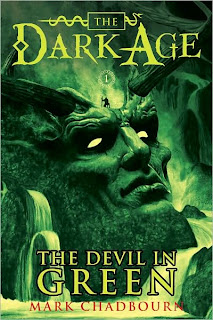
 is the beginning of "The Dark Age," his follow-up series to "The Age of Misrule," in which the ancient Celtic gods re-awoke and plunged the world into chaos (and, reading between the lines, megadeath). I probably won't read this myself -- I have a long-standing objection to contemporary or near-future books that use the mass murder of my family and myself to motivate its action -- but don't let my quibbles stop you. Pyr will publish The Devil in Green on May 4th in trade paperback -- and I wouldn't be surprised if the rest of the series follows quickly, since this was originally published in the UK in 2002.
 is one of those trendy "steampunk" novels, with a stylish bronze cover sporting the inevitable Zeppelin. On the other hand, it's also about a greeting-card writer imprisoned for life on that very Zeppelin, writing his memoirs and accompanied only by his love Miranda's disembodied voice and the cryogenically frozen body of Miranda's father Prospero. (If your name is Prospero, and you have a daughter, you must name her Miranda -- it's in the U.S. Code somewhere. I saw a similar case in the Times this morning, where Persephone, the daughter of an actress named Delphi, was getting married.) There are so few novels about greeting-card writers to begin with that I can't help but feel warmly towards this one, which was published in hardcover by St. Martin's Press in March.
Speaking of steampunk -- as I was -- Pinion
 is the third novel in Jay Lake's series about a clockwork solar system ruled by Queen Victoria, after Mainspring
 and Escapement
 . It was published in hardcover by Tor on March 30th.
 , which has a SF author as a main character but isn't, from what I've seen of Spinrad's public comments about it, SF itself. It was originally published in French close to a decade ago, and has been available in electronic editions in English (sometimes for free) since then -- but this is the first time that it's been in print in English. He Walked is the story of a stand-up comedian who claims to be from an eco-devastated future, sent back to warn all of mankind -- and I've heard widely varying reports of how well it all works. But now He Walks is free in the world, and we can all make up our own minds about it -- it was published by Tor in hardcover at the end of March.
 , by Phil Jimenez and John Wells, which has everything you'd ever want to know about Wonder Woman (versions I through XI, and including Wonder Tor and several versions of Wonder Girl) between two covers. It will be published by Del Rey tomorrow, April 27th, as a huge trade paperback. I don't know who needs to know this much about Wondy, but, if that's you, you're in luck.
Sunday, April 25, 2010
Movie Log: The Men Who Stare at Goats
 It's impressive when one of the major movie stars of our time is willing to be a complete goofball now and then. And George Clooney delivers another one of his marvelously unhinged portrayals of a complete nutbar in The Men Who Stare at Goats. Jeff Bridges is even spacier as Clooney's commanding officer, adding to the fun.
Men Who Stare at Goats is based on a true story, more or less -- it's based on Jon Ronson's nonfictional book of the same, name, but Ronson's been ironically both de-Briticized to an American reporter, and played by Scotsman Ewan MacGregor. The Ronson character is here called Bob Wilton, and he finds himself just outside Iraq during the run-up to the second Gulf War, desperately trying to get a great story, prove himself, and win back his philandering wife. What he finds instead is Lyn Cassady (Clooney), who claims to be part of a secret U.S. Army psychic-operations squad called the New Earth Army, trained and deployed during the Reagan years.
Much of Men Who Stare takes place in flashback, as Cassady explains their training under General Bill Django (Bridges) to the credulous Wilton. The present-day scenes, though, see Wilton and Cassady captured by random Iraqis and suffering other indignities -- Cassady does break up clouds by looking at them, and hurts Wilton with a small plastic thing called the "Predator," but otherwise his supposed "Jedi" skills don't come into play much.
And that's the joke, of course -- Men Who Stare is primarily saying "look at these insane military types, and what they believed," though it also wants to have it both ways: the military men are silly and misguided, but, dramatically, this Jedi stuff has to work now and then. So it's a lumpy, odd movie, full of over-the-top performances and scenes that don't necessarily go anywhere. It's enjoyable on its own level, but the neo-hippie vibe of the New Earth Army may lead the viewer to wondering if it would be funnier, and make more sense, if said viewer had indulged in certain substances before viewing....
----------------
Listening to: Basia Bulat - The Pilgriming Vine
via FoxyTunes
B&N Searches Bring Up E-books First Today
I'm not sure how long this has been the case -- or if this is the result of a deliberate change, or some glitch -- but this morning, on all of the books I'm looking up at BN.com, the e-book edition comes up first, with the print book afterward.
It's an interesting, if odd, development -- does B&N think consumers will accidentally buy the e-book and become so enamored of the format that they then immediately buy a Nook?
It's an interesting, if odd, development -- does B&N think consumers will accidentally buy the e-book and become so enamored of the format that they then immediately buy a Nook?
Book-A-Day 2010 # 81 (4/25) -- Hello, Again by Max Estes
 Estes is an American illustrator and cartoonist now living in Norway; this was his first book (back in 2005, before he moved to Norway), which I happened upon serendipitously recently. Hello, Again is a small-format drawn book, just slightly taller than wide, roughly 5" x 6".
It was Estes's first graphic novel, and it's five years old, so it would be cruel to be particularly critical of it -- and excessive, since Hello, Again may be a bit slight and obvious in its connections, but Estes has a wonderfully expressive drawing style (only slightly hemmed in by the small panels and pages he's working within here) and a fine sense of character.
Willy -- the guy on the cover -- is the super of an apartment building, and secretly having an affair with Delia, who is not only a tenant but the live-in girlfriend of his best friend, Aaron. Estes explicitly links this to a similar infidelity by Willy's father when Willy was young -- I'd say that's a bit too pop-psychology and on-the-nose for a book like this, but it's plausible. Willy has to face the morality of what he's doing when a specter from his past -- which may be just his conscience, or may be something more -- appears and begins to lightly harangue him about his failings.
Hello, Again is a small book -- in theme and scope as well as physical size -- but it's a zippy, cute one. Estes's story of infidelity and second chances probably doesn't have as much resonance as he'd hoped for, but it's a perfectly good debut graphic novel with very appealing art.
Book-A-Day 2010: The Epic Index
----------------
Listening to: Okkervil River - Bruce Wayne Campbell Interviewed On The Roof Of The Chelsea Hotel, 1979
via FoxyTunes
Saturday, April 24, 2010
Book-A-Day 2010 # 80 (4/24) -- The Muppet Show Comic Book: The Treasure of Peg-Leg Wilson by Roger Langridge
 Now, that's a long title! The second collection of Roger Langridge "Muppet Show" comics picks up right after the first one (which I reviewed in the middle of a long monthly round-up), and continues Langridge's eerily accurate evocation of the late '70s Muppet Show. As I said the first time, there was no reason to expect that this would work: the TV show was an odd, lumpy concoction in the first place, made up equally of old fashioned showbiz/British music-hall razzmatazz and quirky humor, cemented together by a cast of fine performers and their very expressive characters. A comic book can't rely on performers, or musical numbers, or puppetry, or the original Muppet Show's reliance on then-famous guest stars. And, yet, Langridge did it -- his first book felt like an adaptation of particularly good shows from that old series (though completely without any guest stars), and this second continues that evocation while also adding a stronger plotline.
Once again, we're at the Muppet Theater, wherever that may be. The chance discovery of a map -- from the titular Peg-Leg Wilson -- leads the rats and others to start searching the theater for his hidden treasure. Meanwhile, someone whom the reader is sure is not Kermit is wandering around in leather glasses and dark sunglasses, making flippant replies to everyone else's questions and requests. Animal has become unaccountably quiet and civilized, due to an unlikely experiment, though he still doesn't speak. And, all the while, the usual Muppet bits -- Pigs in Space, Bear on patrol, Professor Bunsen Honeydew and Beaker, the Swedish Chef, and various musical numbers (which, most particularly, should not work in comics, and yet do) -- continue, interspersed with the backstage story, again just like the old TV show.
Langridge continues to draw the Muppet characters not quite on model -- they're very close, but subtly Langridge-ized (particularly Fozzie). Even more subtly, Langridge's versions of the Muppets have somewhat more realistic facial expressions -- since they're pen drawings, and not lumps of fur and felt -- that adds to the sense that these are real characters that we should care about. (Despite their clearly closed-interior half-moon mouths and other artifacts of their puppet origins.) His page layouts still have his own comics version of the music-hall/vaudeville energy of the TV Muppet Show -- not to say that Langridge hasn't had that energy and flair for a longer time, since he has -- giving the whole enterprise a rollicking air.
The Treasure of Peg-Leg Wilson is published as if it were for kids, though I would be happily surprised to find out that its current audience was primarily too young to drive (as opposed to those of my generation who were kids for the original Muppet Show). On the other hand, I am going to pass this on to my own boys, and I expect they'll enjoy it. Come to think of it, I never asked them what they thought of the first volume....
Book-A-Day 2010: The Epic Index
----------------
Listening to: Yeah Yeah Yeahs - Heads Will Roll
via FoxyTunes
Friday, April 23, 2010
Book-A-Day 2010 # 79 (4/23) -- Rasl, Vol. 1: The Drift by Jeff Smith
 Lighting, contrary to the old saying, is actually more likely to hit in the same spot a second time -- that is, if it happens quickly. That's because the first bolt makes an easier path in the the air -- and here you'll have to pretend that I have a detailed explanation of ions and air pressure -- for that second strike to follow. And so lightning is a decent metaphor for publishing: one big hit can clear the way for another big hit...as long as the second strike comes quickly and follows the same path.
But if the second strike comes several years later, and is very different in tone and style -- well, then you're back out in the field with a metal rod, trying to coax down another random jolt of pure energy.
Rasl is Jeff Smith's follow-up project to Bone, and what it has in common with Bone are primarily a four-letter title, Smith's care and storytelling ability, and publication from Smith's Cartoon Books outfit. Like Bone, it starts off at its own pace, clearly the beginning of a longer story than a sequence of issue-by-issue individual stories. Call it "writing for the trade" if you want, but Smith is going to tell one story about Rasl, and tell it at his own pace.
The Drift collects the first three issues of the Rasl series; enough to show the outlines of the beginning of this story, but not really enough to give the reader a sense of where that story is going. It could almost be an artifact of a previous era in comics publishing: the "collected edition" rushed out to give a new series a presence on the graphic novel shelves, a book due to be replaced eventually by a more comprehensive, and better planned, reprinting of the series. Its giant size -- this book measures about 9" x 12" -- adds to that feeling, as if Smith realized that he had to give the readers something if he couldn't give them a large enough chunk of story, and decided to give them bigger pages instead.
In these three issues, we meet Rasl -- a ruffian of a cross-dimensional art thief, who was once a much more clean-cut (though still not overly moral) scientific researcher named Robert. And we learn that forces from "the Compound" are after him, for stealing the gear he uses to jump dimensions (or "drift," as he calls it) and sabotaging the research facility, to make it harder for anyone else to do it. But there's a lizard-looking man in a dark coat on Rasl's tail, and he's got his own dimension-jumping gear. And there are secrets in Rasl/Robert's past that haven't even been hinted yet. While Bone was mostly a gentle fantasy, with occasional mythic underpinnings, Rasl is a noirish SF thriller, with tasteful sex and obligatory violence.
The Drift is very early days for Rasl, and it would be premature to say much about the story at this point; these are the first three chapters of a longer story. Smith's supple, flowing line is familiar from Bone, though the characters and their actions here are very different. And his dialogue is tougher, more growly than Bone, without the earlier work's sense of fun and whimsy. Rasl's world is nastier than Fone Bone's was -- there's a major death in the second issue here, to underline that difference -- and his story will go in very different directions. But, for now, it's all potential -- we have to wait to see where this bolt of lightning will go.
Book-A-Day 2010: The Epic Index
----------------
Listening to: Emily Haines - The Lottery
via FoxyTunes
Quote of the Week: Leverage
"The banks were incredibly profitable not because they were doing anything better but simply because they were making bigger, riskier bets -- plunking down more money on the roulette wheel. That isn't just a metaphor, it's the actual conclusion of an academic study made by Andrew Haldane, the Bank of England's executive in charge of financial stability. Between 1986 and 2006, the average annual return on banking shares rocketed from its historic norm of 2 percent to 16 percent. Why? Because the banks were making bigger bets. There was no skill, efficiency, intelligence, or judgment involved, just riskier bets. In Haldane's exact words, 'Since 2000, rising leverage fully accounts for movements in UK banks' ROE [return on equity] -- both the rise to around 24% in 2007 and the subsequent fall into negative territory in 2008.' This is astounding stuff. Haldane is in effect saying that most of those bankers paying themselves monster bonuses were doing so simply as a result of making bigger bets -- and, as it turned out, it was we the taxpayers who, unwittingly and unwillingly, were bankrolling their ever-riskier wagers. This wasn't just looking for trouble, it was sending trouble a 'save the date' card, followed by a formal invitation, followed by nagging e-mails and phone calls just to make absolutely sure."
- John Lanchester, I.O.U.: Why Everyone Owes Everyone and No One Can Pay , pp.36-37
- John Lanchester, I.O.U.: Why Everyone Owes Everyone and No One Can Pay
, pp.36-37
Thursday, April 22, 2010
It's Not You, It's Me
When in the course of human events it becomes necessary for people to dissolve the personal bands which have connected them with another and to assume among the powers of the earth, the separate and equal station to which the Laws of Nature and of Nature's God entitle them, a decent respect to the opinions of mankind requires that they should declare the causes which impel them to the separation.
But who has the time to work up a detailed declaration of rejection every single time? I know I don't.
Luckily, there's now an alternative. As a promotion for the book Other People's Rejection Letters by Bill Shapiro, Crown has posted a Reject-o-Matic, which will automatically generate rejection letters suitable for all occasions.
Here's one example that I just whipped up.
The template isn't quite as sharable as I'd like -- it generates a page on the publisher's server, and a link to that page, rather than a discrete bit of code that can be embedded in any webpage -- but it's still a fun tool. Use it to reject all of your friends!
But who has the time to work up a detailed declaration of rejection every single time? I know I don't.
Luckily, there's now an alternative. As a promotion for the book Other People's Rejection Letters
by Bill Shapiro, Crown has posted a Reject-o-Matic, which will automatically generate rejection letters suitable for all occasions.Here's one example that I just whipped up.
The template isn't quite as sharable as I'd like -- it generates a page on the publisher's server, and a link to that page, rather than a discrete bit of code that can be embedded in any webpage -- but it's still a fun tool. Use it to reject all of your friends!
Book-A-Day 2010 # 78 (4/22) -- City of Spies by Kim, Klavan & Dizin
 City of Spies is the second graphic novel for young people (and about young people) from First Second in May about WWII, after Resistance, Vol. 1, which I reviewed earlier this week. But the two books aren't all that similar, really -- Resistance is set in France, while City of Spies is set in New York. See! Totally different! The fact that both take place in 1942 is just one of those wacky coincidences beloved in sitcom and manga.
All kidding aside, City of Spies looks very different from Resistance -- it has a Herge-ish clean line and flat color, as artist Pascal Dizin gives a modernist feel to New York -- and its story (from playwright Susan Kim and novelist Laurence Klavan) is different, as well. Evelyn is a rich pre-teen girl who just wants to be with her father -- she draws superhero comics that make that plot point over-obvious -- but is foisted off on her bohemian aunt for the summer while her dad runs off for a honeymoon with his latest wife. In her aunt's ritzy apartment building, Evelyn befriends Tony, the rambunctious son of the super, and the two of them -- inspired by Evelyn's comic-book adventures -- soon are seeing Nazi spies behind every corner. Of course, a book called City of Spies would be pretty boring if spies never showed up, so....
There is plenty of adventure before the end, though City of Spies stays on a light-hearted level to match the art; there's danger here, but it never feels particularly serious. The reader is pretty sure that these spies will be thwarted -- if not by Evelyn's creations Zirconium Man and his sidekick Scooter, than by Evelyn and Tony themselves, or a friendly policeman. It's not as obviously educational as Resistance is, but I expect City of Spies will be the favorite of more kids in the long run.
Book-A-Day 2010: The Epic Index
----------------
Listening to: The Wonder Stuff - Angelica Maybe
via FoxyTunes
Wednesday, April 21, 2010
Quote for the Day: Bug-Nutty People
"It's always a little sad to lose some stupid. I love people doing stupid things that I'd never do—different stupid things than all the stupid things I do. It reminds me that although all over the world we humans have so much in common, so much love, and need, and desire, and compassion and loneliness, some of us still want to do things that the rest of us think are bug-nutty. Some of us want to drive a Hummer, some of us want to eat sheep's heart, liver and lungs simmered in an animal's stomach for three hours, some us want to play poker with professionals and some of us want a Broadway musical based on the music of ABBA. I love people doing things I can't understand. It's heartbreaking to me when people stop doing things that I can't see any reason for them to be doing in the first place. I like people watching curling while eating pork rinds."
- Penn Jillette on the death of the Hummer in the Wall Street Journal
- Penn Jillette on the death of the Hummer in the Wall Street Journal
Book-A-Day 2010 # 77 (4/21) -- The Sorcerer's House by Gene Wolfe
 Gene Wolfe's novels are always tricky things, carefully constructed to provide the minimum amount of information the reader needs and artfully arranged to conceal that information from any readers not sufficiently engaged. It's a cliche to say that the reader does half the work of making a book come alive, but, with Wolfe, both the author and the reader are working much harder than they typically would. Sometimes, as with the breathtaking but utterly insular "Short Sun" books or in Wolfe's great novel Peace, the trip is more than worth the bother. And sometimes, as with the recent "Wizard Knight" duology and odd misfits like Free Live Free, the reader is left wondering why he bothered to put in so much effort. (Of course, it may be, in the case of those latter books, that the reader has not quite put in enough effort.)
The Sorcerer's House falls on the Wolfe continuum closer to the first group than to the second; it also falls on the other axis of Wolfeness -- determining how readily it gives up its secrets -- towards the end of clarity and transparency, with Pandora by Holly Hollander and There Are Doors. It's an epistolary novel, told entirely in the letters sent by a middle-aged ex-con, Baxter Dunn, and in the letters sent to Baxter by various others.
Baxter has recently left prison -- he was incarcerated for a crime he did commit, the details of which come out in the course of the novel -- and has landed in an unnamed town in what I assume is the Upper Midwest, sometime in the last few decades. He writes often to his twin brother George, the successful and conventional one. Baxter had been a scholar of some kind, firmly ensconced in some university somewhere, but the details of his past stay out of focus -- he's telling this story in letters to people who already know his past, and so he doesn't talk about that much.
Baxter notices a large empty white house on the edge of town, and quietly moves into it when his living situation at the local motel becomes problematic. And that soon leads to his entanglement with a series of very Wolfean women -- they're all somewhat flighty and deferential, very much small-town women from the middle of the last century, without much perspective or scope -- starting with the real estate agents Doris Rose Griffin (young, vivacious, recently divorced) and Martha Murrey (older, and possessed of many secrets). Baxter comes into the possession of that old house very quickly, and of other inheritances as well -- to such a degree that the reader begins to wonder, until Wolfe explains (in a typically Wolfean, sidelong way) later in the novel.
He also comes to explore the house, which is larger every time he explores it. (Of course Baxter doesn't actually say this -- as with most details in a Wolfe novel, it's there to be observed, but the reader must do the observing.) Also, many of the windows look out onto -- and, as Baxter learns before long, lead out onto -- a vast forest that does not surround the house in its usual place. The house, as Baxter learns, is called the Black house, after the mysterious man who used to own it -- who may or may not have also been known by another name, who is supposedly dead.
Baxter and George are not the only set of twins in The Sorcerer's House -- and I'm afraid I'm being very Wolfean myself with that statement; there are other sets of twins in the book, and one set, very significantly, turns up in the house itself.
But The Sorcerer's House is a novel that has to be read rather than explained; the plot is not the point here, since the plot consists of Baxter writing about people he met, their elliptically Wolfean conversations, and the strange things he has seen and done -- with a small sideline in some of those other people writing back to Baxter. The female characters here are not as central, and thus not as jarringly of a type (and an idiosyncratic, anachronistic type at that) as in last year's An Evil Guest, but Baxter is a very Wolfean hero: quietly competent at nearly everything he turns his hand to, very successful with those women, reticent to talk about himself, but a great talker otherwise. This is a mature Wolfe novel, full of sly secrets and offhand misdirection, but not as ambitious or major as his series work. Baxter is a mostly reliable narrator, as well -- and that's about as clear as one can ever get from Wolfe!
Book-A-Day 2010: The Epic Index
----------------
Listening to: Split Enz - One Step Ahead
via FoxyTunes
Tuesday, April 20, 2010
Movie Log: Couples Retreat
 I'd been under the impression that Couples Retreat was an utterly bland and mostly unfunny Hollywood "comedy" and so I came into it with low expectations. Perhaps that's what did the trick, because I enjoyed it -- oh, it is fairly bland (like the Des Moines version of Thai food), but The Wife and I found it to be actually funny most of the time.
Oh, sure, it's generic and obvious, a clearly contrived slab of Hollywood Product arrayed around a fistful of currently trendy jokes, personality types, problems, and talking points. But it is funny most of the time, in its non-threatening and renormative way.
But it's really not worth taking any more time or space that that -- it's the story of a bunch of attractive people who go to a more attractive place to do funny things and then remember why they Really Love Each Other. It could have used a bit more edge or point of view, but it does what it wants to do, and what it wants to do is generally admirable and pleasant.
----------------
Listening to: The Refreshments - Fonder And Blonder
via FoxyTunes
Book-A-Day 2010 # 76 (4/20) -- Changes by Jim Butcher
 Popular fiction series rely heavily on the indulgence and selective memory of the reader, particularly in the early going of a new book. All of the ungainly wheels of coincidence and danger need to be trotted back out, oiled, and set to work, while that reader rubs his hands together and remembers the Really Good Stuff from earlier books -- said Really Good Stuff typically coming at the end of a book, of course, where the series hero and a few plucky compatriots finally gather all of the information and maguffins and weaponry they need and activate the plan that's So Crazy It Just Might Work. And the reader knows something like that will be coming at the end of this book as well, so he settles in, trying not to be annoyed by the writer's ever-more-obvious tics and the weight of backstory that needs to be explained yet again (and which seems less plausible every new time the explanation is made).
Jim Butcher is a storyteller rather than a fine writer, who uses the same bricks of description, dialogue, and characterization in book after book -- they all worked just fine the first time around, so why change them? And that familiarity, as Harry Dresden declares, one more time, that he's going to stand up against the baddies to stop "people" from "being hurt," can either lead to the comfortable feeling of settling into a warm bath, or to a dull sense of deja vu.
Changes is the book where a lot of Harry Dresden's demons catch up with him, where he finally has to face up to the fact that his "I'll just save everybody, all of the time" attitude might not be precisely realistic, and that exercising power means hard choices. It also has an ending that I expect has already gotten fans of the series chattering madly -- there's the biggest magical confrontation yet, followed by a series of hard choices, revelations, and surprises, ending with the kind of cliffhanger that really has no place in a series of discrete novels. (It's a Two Towers-level cliffhanger, and I expect it will be a year before the next novel resolves it.)
In the first line of the novel, Harry -- once "Chicago's only consulting wizard," but latterly one of the mainstays of the wizardly White Council's police/enforcers/soldiers, the Wardens -- learns from his ex-lover Susan Rodriguez that the two of them have a seven-year-old daughter, Maggie, and that Maggie has been captured for nefarious purposes by the vampiric Red Court.
Cue a massive infodump, because Susan is a half-vampire -- infected but not turned by the Red Court, still somewhat human as long as she doesn't give in to her blood thirst -- who works for the Fellowship of St. Giles, a loose federation of half-vampires like her that battle the Red Court. Harry's had his own run-ins with the vampires as well, and the White Council only recently settled into an armistice with the Red Court after a very deadly war. But the Red Court has sent an envoy to the White Council to negotiate a peace treaty -- the very same high-ranking noblewoman who was behind the kidnapping.
Changes is a medium-length novel with a very simple structure -- Harry learns about the kidnapping of Maggie, immediately pledges to save her no matter what, and runs around at high speed, gathering all of the information and power and allies he can before the Red King (the inevitable millennia-old ubervampire) sacrifices her in a ritual that will kill and curse her entire family. As usual, Harry's status with the White Council has been reset with the beginning of each book, so they don't trust him at all, despite the fact that he single-handedly saved the Council and eliminated a sleeper agent from their shadowy opposition in last year's Turn Coat. Butcher allows some details to get away from him during this long stretch of the novel, but there are a lot of details at this point in the series, so that's mostly forgivable. But the bulk of Changes is a reunion tour of all of the important people and places from the earlier books, as Harry asks or cajoles or demands or negotiates help from them all.
There's never enough, power, though -- the point of Changes is to finally force Harry to make moral choices he doesn't entirely like, after he spent the first eleven books of this series utterly sure of his own righteousness and contemptuous of anyone who disagrees with his priorities. (Butcher's trying to have it both ways here, though -- he constructed all of those books precisely so that Harry was always completely on the side of righteousness, and shuffled the cards so that Harry could always save the innocents and defeat the nasties.) This time, he needs to ask for help, and accept conditions from, the kind of powers that he sneered at in previous books (and does so here, too -- the smartass persona of an urban fantasy protagonist is hard to leave behind).
In the end, of course, Harry and his personal Scooby Gang -- rag-tag enough, but pretty darn powerful -- confront the Red King and his court, battle hordes of vampires, and attempt to save the life of one little girl. Whether they succeed or not isn't really the point of Changes; this is a book in which Harry Dresden finally sheds his armor of shiny moral perfection and does things he feels bad about. (I might not have as much sympathy for him as Butcher hoped; I was doing things that I felt bad about afterward twenty-five years ago.) It's exciting to see Butcher stretch in that direction, even if stretching can leave the reader both wanting more (a closer eye on the prose; Harry's morality to be actually based on something other than "I know I am always in the right") and for things to go back to the way they were before. The next book in the "Dresden Files" should be really something; I can't wait to see it.
Book-A-Day 2010: The Epic Index
----------------
Listening to: Ingrid Michaelson - Die Alone
via FoxyTunes
Subscribe to:
Posts (Atom)
