


Penguin's marketing folks shot me an e-mail this week to let me know that they've put up a website for the hugely successful novel The Help by Kathryn Stockett. (Showing, yet again, the truism in publishing that it's much easier to sell the second million copies of a book that's already moving than it is to get something completely new to sell a hundred thousand.)
It looks very much the usual kind of thing -- pseudo-bloggy content (regularly updated, I hope) on the main page, reading guides for book groups, plenty of pictures of the author looking pretty, and lots of social networking connectivity.
Now, when I do websites for the books I work on, they tend to look like this. Or, if we're being really fancy, this. On the other hand, we don't publish a dozen novels that we paid a million-plus for (each), in the hopes that one of them will hit big and pay for all of those bets. So I suppose I shouldn't feel jealous.
Friday, May 07, 2010


Another Successful Sales Conference
I got back this afternoon, tired but energized, from Wiley's big May Sales Conference. It was even more festive than usual, because the head of our division -- no, the man who built our division from scratch over the past 25 years, with jaw-dropping organic growth and a number of huge acquisitions (Jossey-Bass, Hungry Minds) along the way -- was retiring, plus all indications are that the fiscal year just ended was a good one. (Official numbers aren't available yet, but they will be, before long -- Wiley is a public company, and will have the usual required reporting. I don't speak for the company in any capacity, so don't take my statements as anything official, blah blah blah insert boilerplate legalese here.)
I've worked with great teams before -- I'd stack up most of my book-club editorial colleagues over the years with the best of anybody in publishing -- but Wiley is that real rarity, a healthy and focused organization. It's a true joy to get together with colleagues from all over the world, and realize that we all have the same focus and goals -- such was not always the case, even for more closely-working teams, during prior parts of my career.
Anyway, I got to talk about some great books that are coming out later this year, and chat with a lot of great people from Sales about strategies and plans, what's working and what isn't. (And rather more frivolous things as well, especially when last night's end-of-Sales-Conference dinner/party ran well into the morning.)
But I hear you say: "Aren't you just gloating, Andy Wheeler? Surely this is good news for you, but why should we care?"
To which I reply: "Ah! But Wiley is currently looking for another Marketing Manager, for the Frommer's travel guides! If you have the right skills, you could join us! (One of us! One of us!) And don't call me Shirley."
I've worked with great teams before -- I'd stack up most of my book-club editorial colleagues over the years with the best of anybody in publishing -- but Wiley is that real rarity, a healthy and focused organization. It's a true joy to get together with colleagues from all over the world, and realize that we all have the same focus and goals -- such was not always the case, even for more closely-working teams, during prior parts of my career.
Anyway, I got to talk about some great books that are coming out later this year, and chat with a lot of great people from Sales about strategies and plans, what's working and what isn't. (And rather more frivolous things as well, especially when last night's end-of-Sales-Conference dinner/party ran well into the morning.)
But I hear you say: "Aren't you just gloating, Andy Wheeler? Surely this is good news for you, but why should we care?"
To which I reply: "Ah! But Wiley is currently looking for another Marketing Manager, for the Frommer's travel guides! If you have the right skills, you could join us! (One of us! One of us!) And don't call me Shirley."
The Business of Cover Art
 One of my authors -- the endlessly energetic and idea-rich Vinnie Mirchandani -- just wrote a blog post about the process that got us to a final cover for his book The New Polymath
 . I suspect most of my readers are more used to the process on the fiction side of things, and may be surprised at the amount of back-and-forth Vinnie describes -- but that's how things happen where I work; we always ask authors for their thoughts at the beginning of the process and try to accommodate their wishes.
(Of course, "try" can be a weasel word, or describe efforts at any point on a long continuum -- but our process generally continues until we have a cover that all parties are happy with. And that entails a lot more discussion with the author -- and, often, the marketing people at the author's firm -- than fictioneers are used to.)
One thing I do want to mention -- Vinnie lists me first, possibly because I was the one talking with him the most, but David Riedy is the actual designer of the cover, and deserves all of the credit. Vinnie and I (and others, like editor John DeRemigis) talked out what we wanted to do -- but David actually did it, and made it look great. (I've been really lucky in my career to work with some amazing art directors and designers, like Toby Schwartz and Ray Reynoso at BookSpan, and David is another wonderful colleague with a great eye.)
Book-A-Day 2010 # 93 (5/7) -- Meow, Baby! by Jason
 Tonight sees the biggest threat to Book-A-Day since it began three months ago. As I type this, it's late at night, and I'm not entirely at 100% after the alcohol-soaked Welcome Dinner at Wiley's Sales Conference (plus the cocktail hour before, and the Rolling Stones cover-band bar gig afterward). What's more, I might have used up all of my brainpower on the various meeting pitches I just typed out for tomorrow's meetings -- while I do deeply love you all, I'm afraid that blogging can never come before actual work.
To top it all off, the book I have to write about today is a series of mostly wordless strips by the Norwegian cartoonist Jason, with the same iconic cast of characters ringing changes on their iconic behavior in ways that are quite entertaining to read but rather more difficult to explain. So, now, let's see how much I can write coherently about Meow, Baby! (which I read in the recent Fantagraphics omnibus Almost Silent) before I give up and try to get some sleep before my early-morning meetings:
A caveman clubs a woman on the head and drags her off by the hair. A vampire chases another woman. A mummy chases yet another. A zombie shambles down the street in search of flesh to eat. Vampire-hunters, devils and angels, ambulatory skeletons, spacemen, Frankenstein's monster, a werewolf, Elvis, a Schwarzenegger wanna-be, and various "normal" people fill out the cast. These are the players, and some of the scenes, in Jason's collection of stories Meow, Baby!
Jason has seen the same movies you have, and the cartoons based on them, not to mention heard all of the jokes. He knows these cliches backwards and forwards, and so can treat these entirely iconic characters -- none of whom he ever names, nor needs to name -- as the repertory company in what amounts to a series of blackout sketches in comics form. He knows his punchlines, and uses them judiciously -- not every strip ends with one, though all of the strips are funny. He uses words equally sparingly; a dozen pages may pass before the next one appears, or is needed.
Jason knows the wellsprings of comedy: sex and death, embarrassment and familiarity. And he mixes and matches those elements, using his iconic cast, for a hundred and fifty wry and deeply amusing pages. I'm managed to avoid using the standard cliche to describe Jason's work until now -- I'm talking about "deadpan," of course -- but this is all deeply deadpan, and no pan could be deader than the graves his skeletons climb in and out of to smoke cigarettes, complain to each other about life, raid the refrigerator for a late-night snack, or rake leaves.
The reader has to be willing to accept Jason's Mojave-dry humor, and his simplified, pseudo-anthropomorphic characters, but -- for those who appreciate his wit and his instantly recognizable drawings, Meow, Baby! is a great introduction and a decently comprehensive catalog of his style, subjects, and strengths.
Book-A-Day 2010: The Epic Index
----------------
Now playing: Guadalcanal Diary - Where Angels Fear To Tread
via FoxyTunes
Quote of the Week: Opinionated
"The fact that an opinion has been widely held is no evidence whatever that it is not utterly absurd; indeed in view of the silliness of the majority of mankind, a widespread belief is more likely to be foolish than sensible."
- Bertrand Russell
- Bertrand Russell
Thursday, May 06, 2010
Book-A-Day 2010 # 92 (5/6) -- Causing a Scene by Todd and Scordelis
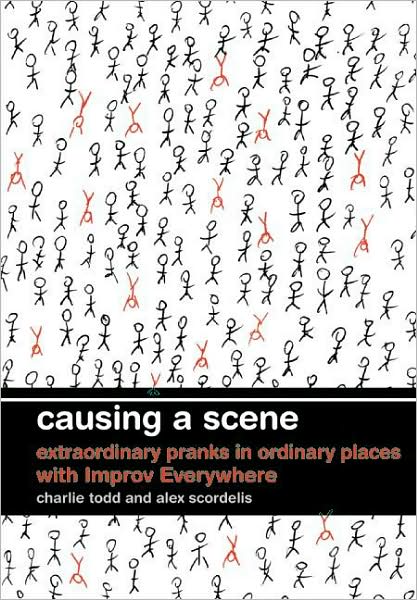 There are two main types of pranks -- the kind that are fun for everyone involved, and the ones that create humor for some by humiliating, exploiting, or frightening others. Every talk-radio host whose ever hosted a "morning zoo" is an expert in the second type, as are most of the fratboys of our nation -- overgrown and otherwise.
The first type is, of course, better in all possible ways, but it is much rarer. Improv Everywhere, a New York based group that creates odd scenes, moments, or experiences in public, always aims to create pranks of the first type. (Certain law-enforcement officials, assistant managers, and other officious types may disagree about their degree of success in particular pranks.) They're most famous for the annual No Pants! Subway Ride, but have also recently taken to staging musical numbers in public -- their work is surprising and wonderful, as if throwing onlookers and bystanders into a stranger and more interesting universe.
Charlie Todd -- the founder and head prankster of Improv Everywhere -- wrote this book, subtitled Extraordinary Pranks in Ordinary Places with Improv Everywhere, with Alex Scordelis, a fellow IE "agent" and professional writer, and William Morrow published it last year, either as a catalog of some impressive IE pranks from their first few years or as an inspirational manual for similar groups around the world.
Causing a Scene details a baker's dozen IE pranks, from several years of the No Pants! extravaganza to a small-scale prank on a single cabbie to a fake U2 concert on Todd's apartment building's roof to a bookstore reading and signing by famous dead playwright Anton Checkov. Some of those events caused consternation in various tight-assed authority types, and a few even led (briefly) to arrests. So these are not perfect Type One pranks -- not all of them, at least. But the intent was always there: IE's events are outbreaks of whimsy and joy in a bland, workaday world, and just reading about them goes a long way to restore a lapsed faith in mankind.
Even for those of us who don't expect to ever be involved with pranks like this -- whether you're a confirmed misanthrope like me, or for some other reason -- Causing a Scene is a refreshing and inspiring book. Todd and his compatriots have gone to a lot of time, trouble, and expense just to have fun -- and to inject a bit of fun and surrealism into other people's lives along the way. IE is, as they say these days, entirely made of Win.
Book-A-Day 2010: The Epic Index
----------------
Now playing: Matthew Sweet - We're The Same
via FoxyTunes
Wednesday, May 05, 2010
Book-A-Day 2010 # 91 (5/5) -- Bitter Seeds by Ian Tregillis
 Secret history and alternate history are the conjoined twins of speculative fiction -- it often depends on a particular reader knowing specific information to be able to definitively place a story as one of the other. But there's a seemingly bright-line distinction: a secret history is something that could have happened this way, in our world, without the experts knowing, or letting the public know. Secret histories have the power of truth to them, or of a strong conspiracy theory -- the Edward de Vere assertion is a classic secret history that escaped into the realms of ostensible non-fiction. But an alternate history is a story about a world that's different from our own -- where something, or some things, happened, and changed the world entirely.
For quite a while, Bitter Seeds lies right in that borderland, not clearly secret or alternate. The bulk of the story takes place in 1939-1941, but it begins with three short scenes on an October day in 1920, each with a boy on the verge of a new life: Klaus, a German war orphan delivered to a strange establishment; Raybould Marsh, a hungry and fatherless boy taken under the wing of a wounded RAF Captain; and William Beauclerk, younger son of a great noble family, and heir to a darker, more secretive inheritance from his grandfather.
When 1939 comes around, Marsh's benefactor, John Stephenson, is a power in the Secret Intelligence Service, and Marsh is an agent in the field during the waning days of the Spanish Civil War, tasked to deliver a German scientist, and his notes, back to England. The scientist is killed -- he bursts into flame, seemingly for no reason, in the middle of a cafe -- but Marsh does manage to get some of his notes and pieces of film back to Stephenson and the SIS. The film shows impossible things:
A shirtless man hovering twenty feet above an orchard. Half a second of nothing but a brick wall, then a nude woman standing before it with no transition. A young man with pale eyes laying his hand on an anvil, the film shimmering, the metal sagging. Another man standing halfway inside a wall, like a ghost. A muscular fellow on a leash (a leash?) scowling at a mortar emplacement that imploded upon itself. The ghost man standing in front of a chattering machine gun. The leashed man scowling at an upside-down tank. A soldier throwing something at the anvil man, and a flash.The subjects on the film, Stephenson's boffins explain, were the subjects of experiments conducted by Doctor Karl Heinrich von Westarp at the Reichsbehorde fur die Erweiterung germanischen Potenzials -- that much the SIS knows, but little more. The reader, though, knows that the "ghost man" is Klaus, whose power allows him to pass through objects (or vice versa) unharmed. The reader also knows that the most dangerous power of the REGP is not shown in that film -- it's Klaus's sister Gretel, who has an infallible ability to predict the future, and a malicious pleasure in twisting events to her own ends.
The subjects of the film wore belts with dark leads running up to their skulls; each and every one of them. (p.85)
But Britain is not defenseless against von Westarp's children -- Marsh calls on Beauclerk, who was his friend at university, and with whom he once shared a very strange moment in those days. For there's a secret tradition of magic among a few British families -- a long history of summoning multidimensional entities called Eidolons through the ur-human language, Enochian, and through blood sacrifice. And Beauclerk is now an initiate of that tradition -- so Marsh brings him into Project Milkweed, a super-secret project, under Stephenson's direction, to defend England from the REGP's powers -- and, more importantly, to smash Germany's ability to make more.
But the Eidolons aren't more than barely comprehensible to humans, and demand greater and greater sacrifices for their aid -- what they want, more than anything else, is the destruction of any life that isn't them. Beauclerk and his fellow mages can keep bargaining with the Eidolons to save England -- even after a much bloodier German offensive, led by the REGP's agents, and even after a vastly more disastrous Dunkirk, and even as the Luftwaffe systematically destroy all of England's human-scale defenses, all following the scenarios Gretel passes to Himmler and the SS.
On the other side of the war, Klaus sees his sister manipulate events herself -- until the reader begins to wonder if she's as bloodthirsty, as happy with pure death and destruction for its own sake, as the Eidolons themselves. And, by the time Bitter Seeds ends in late 1941, the reader knows two things: first, that this novel is definitely an alternate history. And second, that Bitter Seeds will not be the end of the story.
This is a compelling novel, a dispatch from one of the worlds where WWII was even worse -- at least for some populations -- than it was in our world. I expect things will get even bleaker, for everyone in this world, in the years to come -- the REGP's methods will be used much more widely, and I wouldn't be surprised if the Eidolons are called on more and more often to counter them -- with higher and higher sacrifices required each time. This may be Tregillis's first novel, but that doesn't show at all -- and I hope his second will follow as quickly as possible.
Book-A-Day 2010: The Epic Index
----------------
Listening to: The Builders And The Butchers - Raise Up Your Weary Hands
via FoxyTunes
Tuesday, May 04, 2010
Book-A-Day 2010 # 90 (5/4) -- The Professional by Robert B. Parker
 The Professional is the 38th novel by Robert B. Parker about his fictional detective Spenser, one of the most popular and enduring characters in modern detective fiction. And Parker himself recently died at his writing desk at the age of 77. So it's probably both rude and useless to say this, but...Parker had been phoning in this series, at least off and on, for the last decade or more.
Parker stripped down this series to its essence sometime in the early '90s, culling all unnecessary scenes, lines of description, and even characterizations -- the series was always Hemingwayesque, but it got doubly so at that point. Sometimes that style works for Parker -- I was pretty impressed with the last of these that I read, 2007's Hundred-Dollar Baby, for example -- and sometimes it just feels skeletal, as in this novel.
Parker's other stylistic tic lately is that his books have a tendency to wander, as a case is worked on and then back-burnered and then comes back. Generally, showing that kind of progression is good for a mystery novel, and adds verisimilitude -- cases don't necessarily run at speed for a few days and entirely come together with a bang at the end. But, added to Parker's current minimalist style, this kind of plotting can become very arbitrary and random -- as it does in The Professional.
Spenser -- as always, a Boston PI with a heart of gold and an unstoppable right cross -- is hired by a female lawyer to investigate a man calling himself Gary Eisenhower who has insinuated himself into the beds of four trophy wives and is blackmailing them all. Spenser quickly tracks down and confronts Eisenhower, but his code -- Spenser is a maniac about following his code, and he talks about it far too often -- won't allow him to rough up or kill Eisenhower, so that part of the plot fizzles. But Parker just keeps going -- perhaps because he knows he's nowhere near his word-count yet -- and events keep happening, more or less, and the same characters kept bouncing around until four of them are dead and the novel ends.
(I might note, parenthetically, that if Spenser's code allowed him to kill Eisenhower, those four other people would have still been alive. It's tough, having a code like that, particular for forty books straight.)
The Professional, like all of the Spenser books of the past two decades, reads very quickly and easily, with short bursts of dialogue and the standard scenes between Spenser and his sidekick Hawk and girlfriend Susan. It's as comforting and familiar as a warm bath, but the only thought it's likely to raise in anyone's head is a question about the title -- who, if anyone, is the professional in this book?
Book-A-Day 2010: The Epic Index
----------------
Listening to: Josh Ritter - Another New World (live)
via FoxyTunes
Monday, May 03, 2010
Book-A-Day 2010 # 89 (5/3) -- Pride and Prejudice and Zombies: The Graphic Novel
 I have to admit, up front, that I haven't read Pride and Prejudice and Zombies
 . Nor have I read Dawn of the Dreadfuls
 , the prequel. Or Sense and Sensibility and Sea Monsters
 . Or Abraham Lincoln: Vampire Hunter
 . Or Queen Victoria: Demon Hunter
 . Or Android Karenina
 . Or Adventures of Huckleberry Finn and Zombie Jim
 . Or any of the current stampede of mash-ups trampling the fields of the public domain under the heavy boots of various horror-movie tropes.
(And they are, entirely, movie tropes. The modern written horror genre has nothing at all to do with this brain-eating frenzy.)
But I have now just seen the adaptation of Pride and Prejudice and Zombies, turned into a comics script by the busy British serial adapter-to-comics Tony Lee, from the "original" novel credited to Jane Austen and Seth Grahame-Smith. The stylishly vulgar cover is by Roberto Parada, but it doesn't accurately show the art style within, which is by Cliff Richards. (Not Cliff Richard, note.)
Richards's art is light and sketchy, particularly with background details and smaller figures -- there's some mechanical-looking tone in spots, but no strong black lines, and the whole graphic novel has the appearance of being reproduced from tight pencils. (Which may be the case -- if so, it was not an inspired choice for this project, since it tends to flatten every panel into a diorama and give every page an unfinished look.) Richards is a solid professional, and he has clearly used excellent reference for most of the clothing here -- though some glimpsed undergarments look much too modern to my eye -- but his women's faces are entirely wrong for the period. The Bennett girls all look like modern TV actresses -- and they also look all too much like each other, as well, with very little to distinguish them from each other. Of course, perhaps that was the point -- I imagine Richards was chosen in large part due to his association with the Buffy the Vampire Slayer comic, since the primary joke of P&P&Z is "Jane Austen meets Buffy."
I may be utterly wrong, but I suspect Richards was asked to do this large, complex book -- 166 story pages, with a large cast of characters in detailed costumes, with historically plausible backgrounds and details, plus hordes of ravening undead -- on a tight deadline, to get it out before the fervor over these mash-ups collapsed. If so, his layouts and large figures show his utter professionalism -- there's no sign of rushing or corner-cutting there. Smaller figures and panels, though, often appear to be quickly sketched in, with just enough detail to make it vaguely clear who the people are and what they're doing.
The story is, I imagine, precisely the same as Grahame-Smith's novel, and mostly parallel to the Austen novel. This particular Regency England is at war -- not, as in Austen's original, with the entirely offstage and never-mentioned armies of Napoleon, but with the more cinematically popular "unmentionables," a thoroughly Romero-esque cerebrophagic horde that are mostly an annoyance rather than a serious threat. At least, they're no serious threat to the Chinese-trained killing machines that are these Bennett girls -- again, the primary jokes here are in taking the unstated assumptions of Austen and her era, and the social conventions designed to control women's "virtue" and fertility, and giving them a very pulpy modern explanation. (If it weren't so jokey and aggressively downmarket, it would be possible to read Grahame-Smith's ninja & zombie explanation for 18th century morality against similar reconfigurings of that era's social conventions in Fforde's Shades of Grey and Walton's Tooth and Claw.)
I presume that this read more entertainingly in the original, as pure prose; Austen's dialogue is awfully wordy and convoluted for comics in the first place, and only became longer once Grahame-Smith got his grubby mitts on it. This is intermittently amusing, but really enjoying it will require the kind of reader who starts to snort whenever the words "ninja" or "zombie" appear. If you are one of those readers, go for it.
Book-A-Day 2010: The Epic Index
----------------
Listening to: The Mountain Goats - Autoclave
via FoxyTunes
Reviewing the Mail: Week of 5/1
 When this post goes live, I will be somewhere in the air between New York and Florida, on my way to my employer's week-long Sales Conference, to spend a lot of time in meetings talking about the great accounting/tax/corporate finance books coming out this fall. Luckily for you, that's likely to be the most I'll tell you about those proceedings. I'll be back before next weekend, so "Reviewing the Mail" should see no interruption.
And, speaking of "Reviewing the Mail," just in case you're unfamiliar with this regular Monday-morning post, let me give you the ground rules: I get books in the mail. I write something about them here. I have not yet read them. Simple, right?
This week there were three single books and one larger package, so I'll deal with them in that order, starting with one of the odder things I've seen recently:
The Stuff of Legend: Book 1: The Dark
 reprints the first three issues of the "Stuff of Legend" comic-book series, written by Mike Raicht and Brian Smith, with art by Charles Paul Wilson III. And the elevator pitch for this series is something like "Toy Story meets Narnia" -- in 1944, the Boogeyman abducts a young boy into an otherworldly realm called The Dark, and his toys assemble to save him. The original comics series was published by Th3rd World Studios, but the book is coming from Villard as a trade paperback -- and it's scheduled to be in stores Wednesday, May 5th.
 Charles Yu's first novel is How to Live Safely in a Science Fictional Universe
 -- and that title signals some degree of metafiction, and Yu's credentials (Sherwood Anderson Fiction Award, National Book Foundation's 5 Under 35 Award for his collection Third Class Superhero) also suggests this is well toward the literary side. It also has the subtitle "A Novel," which I find amusing -- if the reader can't tell that something is a novel (given where it is in a bookstore, for example), that book has much larger problems that two little words will not solve. But that's a very common thing for literary publishers do do -- perhaps they have less faith in their reader's ability to discern categories than do the SFF publishers, who only very rarely will title something Novel: An Urban Fantasy. Yu's hero is a young man who fixes time machines for a living while he searches through time for his father, who invented the time machine. Pantheon will publish Live Safely as a hardcover in September.
 The second book of George Mann's "Newbury & Hobbes" steampunk mystery series (after The Affinity Bridge
 ) is The Osiris Ritual
 , coming from Tor in hardcover in August. It's very weird seeing steampunk -- which was always a fun vaguely disreputable corner of speculative fiction, populated by occasional oddball novels from writers like Tim Powers, James P. Blaylock, and K.W. Jeter -- blossom into a popular commercial genre suddenly. I have the sneaking suspicion that the popularity of steampunk is driven mostly by costuming, as well, which is also a weird path to fame. Still, clanking monstrosities and tight waistcoats do have a definite appeal, and anything that gets SF away from dreary unpleasant near-futures is a big positive in my book.
 And then comes the big clump of books -- four of them, sent to me by Charles Tan, who is the unofficial ambassador of Philippine SFF and comics to the outside world.
First comes Neil Gaiman Presents the Philippine Graphic/Fiction Awards Prose Anthology, which appears to be assembled/compiled/edited by Jaime Daez, the Managing Director of Fully Booked (a major Philippine bookseller). This book collects the winners and runners-up of the first three years of a contest inspired by Neil Gaiman's visit to Manila (an epic signing there) in the summer of 2005 -- about 350 pages of award-caliber stories by writers you probably haven't heard of, like Michael A.R. Co, Ian Casocot, Joseph Frederic Nacino, and Christelle Rhodamae Mariano. It was published by Fully Booked in the Philippines, so finding a copy of it in the States may be an adventure -- but, if we didn't like adventures, why are we reading SFF stories?
The eagle-eyed among you are waiting for the other shoe to drop -- noting that the book above is from the "Philippine Graphic/Fiction Awards" but is the "Prose Anthology" -- and that shoe is next: Neil Gaiman Presents The Philippine Graphic/Fiction Awards Comics Anthology. It's a larger-format book than the Prose Anthology, with twenty-three winners and runners-up from the three years to date of the contest. And you're probably not familiar with the work of the winners here -- Clara Lala Gallardo and Maria Gallardo, Andrew Drilon, Genevieve Go -- and all of the other creators here. This one was also published by Fully Booked.
(Those two books have the same cover art, with the only real difference, looking at them, being that Comics is physically larger and has the word "Comics" rather than "Prose" on it. I found images for both of them, and the Comics one was lighter and clearer, so I used that one to illustrate the look of both books.)
 Philippine Speculative Fiction 5 is the latest in the original anthology series, edited by Nikki Alfgar and Vincent Michael Simbulan, containing twenty-five new stories by Charles Tan, Isabel Yap, Dean Francis Alfar, Mia Tijam, and many more. It was published by Literature of the Fantastic.
But the most interesting Philippine object I saved for last -- I believe it's called Silent Comics 12, but those are the only words in English on it. (There aren't a whole lot of words on it in any language -- but all of the rest are in Tagalog/Filipino.) I believe, after intensive study, that all the comics here -- they're all clearly from one creator -- are by Manix Abrera. And they definitely are all silent. The cover has a gorgeous design, and the interior has a clean cartoony style that's also very appealing. Finding this book outside the Philippines -- it was published in October 2009 by Visprint -- might be even more difficult than the books above, but it looks really neat, and I can't wait to find time to actually read it. (Notwithstanding that I actually can't read the few words in it -- but comics, luckily for me, are a universal language.)
 ----------------
Listening to: The Builders And The Butchers - In The Branches
via FoxyTunes
Sunday, May 02, 2010
Book-A-Day 2010 # 88 (5/2) -- Animal Crackers by Gene Luen Yang
 Everybody has to start somewhere. And if where we start is far away from where we end up, that just shows that we've done some traveling along the way, right? So early, rediscovered works by acclaimed artists should be seen as an opportunity to map out that particular artist's path.
In that spirit, Animal Crackers reprints Gene Luen Yang's first two comics series -- Gordon Yamamoto and the King of the Geeks and Loyola Chin and the San Peligran Order -- adding a short related story in the middle, an afterword in comics at the end, and an introduction by Yang's sometime collaborator Derek Kirk Kim. The two stories take place in the same continuity, so they work well combined into one volume. Oddly, though, the first of those stories feels more complete and well-shaped than the second, as if Yang's travels took him at first through some unpromising byways before finally emerging to American Born Chinese.
Gordon Yamamoto, hero of the first story, is a highschool bully -- not a particularly malicious one, just a big guy who isn't all that smart and takes advantage of his natural abilities. Every year, he explains, he and his best friend Devon proclaim some particularly nerdy freshman "King of the Geeks" and torment him all year.This year, the chosen target is Miles Tanner, who's about as stereotypical a geek as you can get -- physical affect like a young Bill Gates, glasses nearly as big as his head, and a burly, surly, father who disdains him for being a "wimp."
Things quickly get weird from there, though, as Gordon and Miles have an unlikely connection to an organization of tiny robots called the San Peligran Order that sneaks up sleeping people's noses to use their brains for data storage -- and that's, in retrospect, not even the weird part. There's a rampaging literalized metaphor, but Gordon and Miles manage to stop it -- and, as far as we can tell from the end of the story, become friends.
When Loyola Chin's story starts, some indeterminate time later, Gordon is still in the same highschool, but Miles has moved away, out of the story, with his family. Loyola discovers that she can influence her dreams by eating different things just before going to sleep, and so finds her way to a high mountain peak, from which she can see the whole world. Already there is a man wearing only a loincloth and sandals, with black around his pupil-less eyes. He calls himself Saint Danger, teaches Loyola to squint to see everything, and reveals that he's the secret head of the world-spanning San Peligran Order. (Which turns out to have other capabilities on top of the nasal-data-storage business.) Loyola's story goes weird in a different, eschatological direction, and Yang bobbles the story towards the end as he drops into naked proselytizing -- though it's also very vague proselytizing, as if Yang assumes that merely mentioning his particular supernatural being of choice would explain everything.
But, then, these are early works -- we expected that. The art looks simplified and dull -- Yang's current style, by comparison, looks precise and controlled; he's still using about the same number of lines in a panel, but he's gotten much better at placing them just right. And the stories do have that early-work feeling of a creator who's just throwing all of his ideas down onto the page, to see what sticks and what really belong in this story. Yang's gotten much better since this, which is great for him. But he was creating entertaining comics from the beginning, with some very odd ideas. And that -- now that Animal Crackers is available to bring those stories back into print -- is good for us.
Book-A-Day 2010: The Epic Index
----------------
Listening to: The Builders And The Butchers - Golden And Green
via FoxyTunes
Saturday, May 01, 2010
Incoming Books: 1 May
 Today was both Free Comic Book Day -- how did you celebrate it? -- and the day my local library told me they had a stack of graphic novel special orders for me. So nearly a dozen new comical books wandered into my house over the course of a busy day, and they were:
B.P.R.D.: War on Frogs
 , the twelfth collection of the series. I'd thought -- from the title -- that this might be the big conclusion of the current story, but it's not: it's a flashback to about a decade ago, and collects a series in which each issue was illustrated by a different artist (Herb Trimpe, Guy Davis, John Severin, Peter Snejbjerg),, though all were written by creator Mike Mignola with John Arcudi. But a new B.P.R.D. is a nice treat, no matter what part of the story it's telling.
 Grendel: God and the Devil
 is part of Dark Horse's plan to reprint all of Matt Wagner's original Grendel series (from the turn of the '80s into the '90s) without at any time referring to that original publication or its publisher (Comico), other than the minimum required copyright notice. (It also tries to stand completely alone, providing no explanation of where it fits in the Grendel sequence -- which I'd say is a greater mistake.) This story originally appeared in issues 24-33 of Grendel, back in the dark ages, and is written by Wagner, with art by John K. Snyder III, Jay Geldhof, and Bernie Mireault.
Sir Edward Grey, Witchfinder: In the Service of Angels
 is another Hellboy spin-off, like B.P.R.D., but this launches what might be yet another sidebar series about a historical investigator of the supernatural -- this Grey chappie, who works for Queen Victoria in the 1870s. Mignola wrote this one solo, with art by Ben Stenbeck.
 Nil: A Land Beyond Belief
 is an allegorical story from James Turner about the titular nihilistic country. Turner's art is his usual quirky fun -- severe and precise black-and-white drawings that appear to be assembled in Flash or a similar computer tool -- and I'm willing to give his writing another chance, even though I wasn't overly impressed with Rex Libris.
Rick Veitch's graphic novel Can't Get No
 , from 2006, aparrently tells one story in its pictures and another in its captions. Veitch has always been one of the wild men of comics, and I've been interested in this since it was originally published -- now, I finally have it in hand and can read it.
 90 Classic Books for People in a Hurry
 , by Henrik Lange, retells the stories of 90 well-known books -- mostly novels -- on a single four-panel page each. It looks deeply, deeply quirky, and I can't imagine why my local library system picked this -- but they did, so I have to read it.
The Unwritten
 has been one of the most critically successful recent comics series (about a young man whose father made him the star of a massively successful series of fantasy novels when he was younger), so I decided to take a look at the first collection -- despite the fact that it's from Mike Carey and Peter Gross, whose Lucifer I bounced off a few years back.
 Mercury
 is a new historical graphic novel -- set in a couple of fictional Nova Scotia towns in 1859 -- from Hope Larson, whose Chiggers I liked quite a lot last year.
I know almost nothing about R. Kikuo Johnson's Night Fisher
 , but it's an original graphic novel published by Fantagraphics and I could get it from the library, so that's good enough to get me to try it.
I know possibly even less about Britten and Brulightly
 , since this graphic novel (by Hanna Berry) was published by Holt's Metropolitan Books imprint, which does not have a massive reputation for finding great comics. But it's a detective story that aparrently was highly accliamed when originally published in the UK, so why not read it?
 And last was Charley's War: 2 June - 1 August 1916
 , by Pat Mills and Joe Colquhoun, which reprints the beginning of a highly praised British series from the late '70s and early '80s about WW I. Sometimes old comics are heavily praised due to their age, or their power at the time, or some other reason that doesn't hold up decades later -- I hope that isn't the case here.
----------------
Listening to: Cordero - Sea Captain's Daughter
via FoxyTunes
Yet Another F-ing Website
Every so often, you come across something on the web that looks like a throwback to the early days -- say, 1995 or so -- a site that's quick, crude, direct, and tossed off randomly. That's a breath of fresh air on the overly designed and ultra-marketed "social web" of today, and it's even better if that site is somewhat useful.
So I'm happy I just discovered http://www.whatthefuckshouldimakefordinner.com/ today. It's very crude, and I have no idea how extensive its link database is, or how good the randomization is. But it exists, and it was made -- probably in a lazy weekend -- by two dudes. And I greatly appreciate that.
So I'm happy I just discovered http://www.whatthefuckshouldimakefordinner.com/ today. It's very crude, and I have no idea how extensive its link database is, or how good the randomization is. But it exists, and it was made -- probably in a lazy weekend -- by two dudes. And I greatly appreciate that.
Book-A-Day 2010 # 87 (5/1) -- The Umbrella Academy: Dallas by Gerard Way and Gabriel Ba
 This will be quick and possibly desultory; I want to get done so I can watch Sherlock Holmes with The Wife. Apologies in advance.
I discovered The Umbrella Academy about a year after everyone else, with the reprint trade paperback -- and even that, I had to practically be forced to read during the big Eisner read-until-your-eyeballs-fall-out weekend last year. (This was almost certainly because Umbrella Academy looks like a superhero book, and I had my fill of superheroes a long time ago.) But (in more or less the words of The Onion's A.V. Club), Umbrella Academy is like The X-Men played by the cast of The Royal Tenenbaums -- these aren't '60s "relevant" heroes, or '80 "gritty" heroes, they're modern indy-movie types, with neuroses and powers that could have come from the mind of Spike Jonez or Wes Anderson.
Dallas is the second Umbrella Academy story, picking up right after the first, Apocalypse Suite. (Though I was pretty sure at least one of the superpowered siblings was dead at this point.) There's a complicated backstory that writer Gerard Way doesn't bother to explain -- this is a superhero comic, after all, and one must always assume that the readers are continuity-porn fetishists -- but it doesn't particularly matter. There were once seven young superheroes, but Stuff Happened, and now they're all damaged in one way or another, and The Horror is completely missing (probably dead -- though I won't bet on it). They all have real names (rarely used) and current code names (distinctive and recognizable) and numbers (from their child-hero days, primarily for flashbacks), which would make for confusion if this wasn't a comic book with a bunch of very visually distinctive characters.
This is a time-travel story, though it doesn't really bother with paradoxes -- it's comic-book time-travel, so you just go, and do what you have to do, and the universe deals with the consequences as best it can. (Much like any other manifestation of superhero powers -- the universe in a superhero comic is endlessly malleable and impossible to break.) Everyone runs around entertainingly for six issues -- with some danger, more than a little violence, and loads of style -- until the plot to assassinate JFK comes to its inevitable end. It's just serious enough, but knows not to try to be too serious -- Way knows that this is "just comics," and both how much and how little that can mean. The end result is a slick entertainment that's just that bit hipper than the usual comic fan is used to, something close enough to regular superheroes to be palatable to the comic-shop masses but different enough to seem entirely new.
Book-A-Day 2010: The Epic Index
----------------
Listening to: Killola - This Is How The World Ends
via FoxyTunes
Read in April
Book-A-Day continued this month, which means that there won't be any capsule reviews below -- but there will be more links to longer reviews than there was for most of last year.
(I generally consider these posts to be mostly indices, which is why I bury them in the middle of the night.)
(I generally consider these posts to be mostly indices, which is why I bury them in the middle of the night.)
- Gilbert Hernandez, The Troublemakers (4/1)
- James Kochalka, American Elf, Book Three (4/1)
- Gene Wolfe, The Sorcerer's House (4/2)
- Mike Mignola and Duncan Fegredo, Hellboy, Vol. 9: The Wild Hunt (4/2)
- Stephenie Meyer; art and adaptation by Young Kim, Twilight: The Graphic Novel, Vol. 1
(4/5)
Look for my review in the August issue of Realms of Fantasy. - Megan Kelso, Artichoke Tales
(4/6)
Look for my review in the August issue of Realms of Fantasy. - Darwyn Cooke with Dave Stewart, DC: The New Frontier, Vol. 2 (4/7)
- Gene Luen Yang, Prime Baby (4/8)
- Eric Liberge, On the Odd Hours (4/9)
- Denis Kitchen & Paul Buhle, The Art of Harvey Kurtzman: The Mad Genius of Comics (4/10)
- Sue Grafton, U Is For Undertow (4/11)
- Svetlana Chmakova, Nightschool: The Weirn Books, Vol. 3 (4/12)
- George O'Connonr, Athena: Grey-Eyed Goddess (4/13)
- Yoshihiro Tatsumi, Black Blizzard (4/14)
- Carla Jablonski and Leland Purvis, Resistance, Book 1 (4/15)
- Susan Kim, Laurence Klavan, and Pascal Dizin, City of Spies (4/16)
- Jim Butcher, Changes (4/16)
- Jeff Smith, Rasl, Vol. 1: The Drift (4/18)
- Masashi Kishimoto, Naruto, Vol. 45 (4/19)
- Roger Langridge, The Muppet Show Comic Book: The Treasure of Peg-Leg Wilson (4/20)
- Masashi Kishimoto, Naruto, Vol. 46 (4/21)
- John Lanchester, I.O.U.: Why Everyone Owes Everyone and No One Can Pay (4/21)
- Max Estes, Hello, Again (4/22)
- Stephen Fry in America (4/22)
- Masashi Kishimoto, Naruto, Vol. 47 (4/23)
- Joann Sfar, Lewis Trondheim, Kerascoet & Obion, Dungeon: Twilight, Vol. 3: The New Centurions (4/26)
- George O'Connor, Zeus: King of the Gods (4/27)
- Gerard Way and Gabriel Ba, The Umbrella Academy, Vol. 2: Dallas (4/28)
- Ian Tregillis, Bitter Seeds (4/28)
- Gene Luen Yang, Animal Crackers (4/29)
- Jane Austen and Seth Grahame-Smith, adapted by Tony Lee, illustrated by Cliff Richard, Pride and Prejudice and Zombies: The Graphic Novel (4/30)
- Robert B. Parker, The Professional (4/30)
Subscribe to:
Posts (Atom)
