Wednesday, June 01, 2011

The Damned Busters by Matthew Hughes

I have to admit up front that I have unabashedly been in the tank for Matthew Hughes ever since I read Fools Errant over a decade ago. I loved his far-future Archonate universe -- from that first book, its direct sequel Fool Me Twice, the standalones Black Brillion and Template, and the trilogy about the Holmes-esque "freelance discriminator" Hengis Hapthorn starting with Majestrum, and others -- and especially the world-weary tone that Hughes used to tell those stories, made up of an amalgam of James Branch Cabell, P.G. Wodehouse, Jack Vance, and Arthur Conan Doyle that was nevertheless utterly Matt Hughes.

So I'm happy to see any new Hughes book, even ones not set in the Archonate, and I'm going to tell you right here that I want you to buy and love The Damned Busters because Hughes is that good. And, if you avoided the Archonate books because you're not fond of that tone or manner, you're in luck, because Damned Busters is entirely a different kind of book.

(I didn't find it as precisely calibrated to my tastes as Hughes' far-future books, but I've learned through long experience that my precise tastes are shared by vanishingly few people -- so I expect that Damned Busters will be more popular with more people than his previous stuff.)

Damned Busters, in fact, is the first of a contemporary fantasy series called "To Hell and Back," and it tells two stories in quick succession: first, the origin of our particular hero and his unusual powers (which is also told, in condensed, schematic form, in the excellent Tom Gauld cover art), and then his first adventure using his new abilities. Those two stories aren't as tightly integrated as I might have hoped, but Hughes turns Damned Busters into something like the first trade paperback reprinting the comics adventures of a new superhero: it starts off with his uncanny creation and then dives right into the action.

Our hero, though, does not at first look like someone made for any kind of action. Chesney Arnstruther is an actuary -- and, worse yet, enjoys it. He's quiet, methodical, good with numbers and bad with people...until the day he accidentally summons a demon, by yelling out what he thought was a random sequence of syllables after hitting his thumb (and drawing blood) while building a pentagram-shaped table. A simple mistake, he thinks -- and he's certainly not going to give over his soul to the demon who appears.

But that demon can't close out this job without a soul, and his compatriots in Hell -- already frustrated by their increasing workload, due to the growing (and ever-more-temptable) human population -- decide that this is the final straw. So they walk out -- all of the tempters of Hell lay down their tools and stop working.

(This portion of Damned Busters could have made an interesting novel of its own, if Hughes had wanted it to -- in his conception, humans won't do much of anything without a demon goading them into it. But this is still prologue to his real story.)

Eventually, Chesney, as the source of the problem, has to fix it. Hughes rushes this a bit -- he skips around noticeably throughout the entire origin section of Damned Busters, as if he was rushing it to get to his real plot -- but, in the end, Chesney brokers a new collective bargaining agreement between, on the one hand, the rank and file of Hell, and, on the other, their heavenly overseers.

Because of that role -- and due to some negotiations Hughes skips over quickly -- Chesney is granted Xaphan, a demon of his own, to provide him with superhuman abilities for a period of two hours a day. He, of course, uses this to become The Actionary, and sets out to fight crime. It's not that simple, of course, and Chesney quickly becomes embroiled in the schemes of the owner of the insurance company he works for, as well as caught up in the wiles of his inevitable beautiful, spoiled daughter. His day-job as an actuary gets mixed in with his night-work as The Actionary, and he soon learns, as we all do, that it's much easier to want to do good than it is to actually do the right thing. And, since this is only the first book in a series, there will be many more lessons for Chesley to learn, and many more aspects of evil to battle.

Hughes's dialogue is wonderful, and his characters are enjoyable -- though the contemporary setting does tamp down some of his more rococo tendencies there. But the plot putters along through very well-worn paths, which I would never have expected from Hughes. Damned Busters definitely has its quirks -- it's a modern superhero novel in which the hero is an actuary powered by demons, after all -- but its hero's motivations and actions are strongly generic, familiar from dozens of comics, movies, and novels about would-be superheroes. For me, that makes Damned Busters less uniquely Hughesian -- though Chesley Anstruther is still a character no one else could have created, and the demons are all wonderfully single-minded -- but it also makes it a book that, I sincerely hope, fans of superheroes, and of fantasy novels set in the modern world will find and enjoy and recommend to all of their friends. If any of that describes you, please do give Damned Busters a look.

Read in May

Earlier this year, I had a half-baked plan to make May the month where I'd only read books on my iPad -- since, as we all know by this point, digital is the wave of the future and print is for squares, man! -- but it didn't quite work out that way. My thought was that, since I was starting the month with a week-long business trip to Florida, wouldn't it be keen if I could manage not to take any books, and pack a little lighter?

It didn't quite work out that way -- I took one emergency backup mass-market on that trip, which I didn't open, but I also read two novels this month in library hardcover and close to a dozen graphic novels on paper as well -- making it about par for one of my plans.

But I did read four books entirely onscreen this month, and (as of the moment I'm writing this) about two-thirds of a novella-length report on the future of digital journalism, so I haven't entirely punted on that front.

And I do have plenty to read on the iPad, in a half-dozen reading Apps -- Kindle, OverDrive, Bluefire, Stanza, GoodReader, and iBooks -- to keep me going for several months if I wanted. But, unlike a printed book, my iPad can also play solitaire, or Angry Birds, or check my RSS feeds, or Twitter, or....so I'm much more distractable on it.

But here's what I did manage to read:
  • Joe Daly, Dungeon Quest, Vol. One (5/2)
  • Doug Savage, Savage Chickens (5/9)
  • Masashi Kishimoto, Naruto, Vol. 49 (5/11)
  • Matthew Hughes, The Damned Busters (5/11)
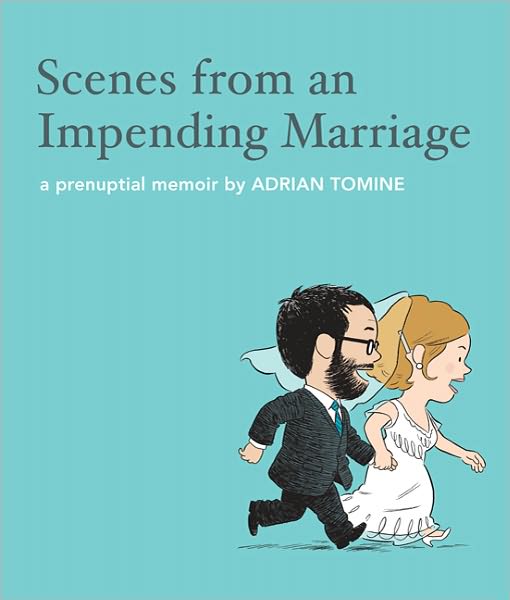
  • Adrian Tomine, Scenes from an Impending Marriage (5/12) Of all the books one might expect from Adrian Tomine, a cute little comedy-memoir about wedding preparations would be really far down the list. And yet -- perhaps showing that absolutely anyone turns to mush in those circumstances -- that's exactly what this book is: a collection of short comic strips about how Tomine and his then-fiancee, Sarah, planned their wedding and all of the funny/annoying things that happened to them along the way. Even less likely, the book Scenes from an Impending Marriage is a slightly expanded (by a six-page Epilogue) version of the actual favor given out to all of the guests at that wedding -- so, somewhere down the line, look for the super-rare "wedding edition" of this book to turn up on auction sites and on the wall of very particular comics shops. The book itself is sweet -- again, not what we've ever expected from Tomine -- and just long enough not to outstay its welcome; if you've ever gotten married or been in love, there will be plenty here that's familiar and raises a smile.
  • Masashi Kishimoto, Naruto, Vol. 50 (5/13)
  • Matt Fraction & Gabriel Ba, Casanova: Luxuria (5/16)
    I'm afraid this very stylish alternate-universe super-spy story didn't involve me as much as it has other critics -- this has been glowing reviewed all across the bits of the 'net that read comics -- mostly because the main character is so relentlessly passive, entirely acted upon and forced into other people's schemes. Ba's art is as crisply energetic as ever, and Fraction's story has plenty of action, quirky ideas, and complicated triple-crosses to keep it all humming along. But the whole thing felt like a lesser version of The Umbrella Academy -- another dysfunctional-family story, with borderline superheroes, the Fate of the World, and complicated matters of ontology and reality. But Casanova himself isn't interesting or active enough to really hold up the story himself, and everyone else here is deeply secondary. So the whole package was definitely stylish fun, but the substance, in the end, was lacking.
  • Dennis Lehane, Moonlight Mile (5/16)
  • Kevin Huizenga, The Wild Kingdom (5/17)
    Now this is...well, it's a thing. Definitely a thing. It's solid, taking up physical space -- you can pick it up, leaf through the pages, read the words, follow it from panel to panel. It's absolutely a graphic novel of some kind, featuring Huizenga's regular character Glenn Ganges, and tries to explicate some kind of complicated relationship between the natural world and the manufactured human world (particular as seen through mass advertising), though a sequence of mostly short, elliptical story-fragments, which don't directly follow each other in any obvious sequence. Yes, this is pretty aggressively art-comics -- even though Huizenga, as usual, draws in a clear, slightly cartoony style, and has a lot of text on his pages as well to comment on the images or ape well-known advertising slogans. It's not graphically artsy; it's conceptually artsy, a book about a subject that's difficult to describe clearly, and one that I really can't say if it was successful or not, since I'm utterly unsure what it was aiming to do. It's definitely less directly engaging and cooler than other Huizenga stories I've read, and I doubt anyone would want a steady diet of comics like this. But, once in a while, it's invigorating to see a creator light out for the territory at high speed like this.
  • Matt Howarth, The Downsized (5/19)
    Howarth spent the '80s and '90s putting out lots of odd comics in his distinctive thin-line Rapidograph style -- centered on the related series Those Annoying Post Brothers and Savage Henry -- and then, from what I can see, moved largely online and into downloadable forms, but kept up his high rate of production. (Unfortunately, I lost track of his work for most of that time, since I was still pretty focused on the ink-on-paper world.) This is one of his rare on-paper works these days, so I actually found out about it, bought it, and read it. Downsized is out of character from my experience of Howarth stories -- of course, I have to point out, again, that I haven't kept track of his work this past decade. But Downsized feels like Howarth doing late-period Eisner: it's a family story, centered around a big family reunion for some of the main characters' parents' fiftieth reunion, out in a big hotel. Howarth's work on such a down-to-earth book -- focused on interpersonal relationships, growing older, and lost opportunities -- is not entirely successful: his dialogue aims for naturalness, but often stumbles, and this is a story entirely driven by naturalistic dialogue. But his people are as lovingly depicted as always; Howarth excels at telling the stories of characters who are bundles of foibles and accumulated bad decisions, and those folks drive this story forward.
  • Roger Langridge, The Muppet Show Comic Book: Muppet Mash (5/20)
    This is the last collection -- at least for now; there are some uncollected and/or unpublished stories that still might see the light of day -- of Roger Langridge absolutely excellent work translating everything that made The Muppet Show such great TV into equally wonderful comics. (And I literally mean "everything;" Langridge's 22-page comics closely track a TV show of the same running time.) I've written about Langridge's Muppet work before -- see volumes one, two, three, and four -- so, this time, I'll just say that it's more of the same, and that it's still lovely, funny work that is certainly not just for kids.
  • Steve Dublanica, Keep the Change (5/24)
  • Diana Wynne Jones, Enchanted Glass (5/27)
  • Karl Shaw, 5 People Who Died During Sex and 100 Other Terribly Tasteless Lists (5/31)
    I read this, very appropriately, in the smallest room of the house, and wasn't disappointed. This is a conglomeration of lists from four separate UK books of Shaw's -- arranged into nine thematic chapters, covering religion, sex, death, food, entertainers, criminals, and so forth -- with this selection presumably chosen for the shorter attention span of the American audience. It was published over here just over four years ago. (I got it as a bound galley around the turn of 2006-2007; I'm still working through things I took home for the Bookspan giveaway shelf, and probably will be doing so for another decade at least.) The point of a book like this is to remember some of the horribly interesting facts and spring them on others at opportune times, but, sadly, I have a lousy memory for trivia like this. Still, this was very entertaining to read, and my mother-in-law has already asked for it once I'm done -- so I have to count this book as a major success.
And that was what I read in May. June, as I've already groused about several times here, will see me flying off to hither and yon, so we'll see how much reading I can get done along the way.

Tuesday, May 31, 2011

Working Accounting Hours

I just got the official exhibition hours for the middle conference of my back-to-back-to-back epic trip starting in just a couple of days, and, as usual, they're back-breaking:
Wed: 6:15 AM - 6:30 PM
Thu: 6:30 AM - 6:30 PM
Fri: 6:30 AM - 4 PM
The next time I'm at a SF convention and I hear some huckster-room vendor moaning about how hard it is to be up and functional at 10 in the morning, well -- somebody's going to get such a pinch, I can tell you.

The Infinities by John Banville

John Banville is far too subtle and sneaky for the likes of me; I'll read his books (and enjoy them, too), but I'm not going to pretend that I'm qualified to criticize them in any depth. And even though  The Infinities dabbles in the fields of the fantastic -- a piece of the literary landscape I usually would say I can cover reasonably comprehensively -- I'm still going to keep my comments brief and try not to make any obvious missteps.

This is the story of two families: one human and one divine. Well, I need to back up immediately: Banville does have gods tracking through the fields of The Infinities, but they're not "divine" in any conceivable sense of that word -- and that's likely one of his points. But the human family of noted mathematician Adam Godley has gathered in his large, isolated house -- in a quietly, subtly alternate world in which the British still rule North America and other, larger changes are only hinted at -- in the aftermath of a stroke that has left him in a coma and which they all expect will lead to Adam's imminent death. That family consists primarily of Adam's son and daughter, the son's new wife, the father's younger-than-you'd-expect wife, and a few hangers-on.

The other family begins with our narrator, who claims to be Hermes of the Greek pantheon, or to be an eternal, animating spirit that was once called Hermes. His father, Zeus, also takes an active part in The Infinities -- and anyone that knows how Zeus reacts to attractive young women can guess which part is primarily active in his case -- and Pan turns up, as well. They float through the lives of the humans, laughing at and commenting on their small lives and relationships, and Banville's novel takes its viewpoint from Hermes: it looks at its human characters like specimens anatomized on a table, seen from all angles and with no illusions.

I've described two of the three fantastic elements of The Infinities: it's set in an alternate history, and contains real gods that affect the action of the novel. But the physics of The Infinities is also different; the comatose Adam, in his younger days, was instrumental in creating a theory that proved Einstein wrong, and provided vast energy from sources Banville leaves vague -- hinting only that they are (one of) The Infinities of the title.

Like most of Banville's work, The Infinities is not a novel of plot; it takes place over a few days, and things do happen, but Banville's emphasis is on the angle of view, rather than the events in sight. And it would be profoundly frustrating to a reader trying to come at it from a speculative-fiction perspective. But for readers who can let Banville's -- and Hermes's -- point of view take over for them, it's a deeply thoughtful, immersive dive into the lives of a few people, seen thoroughly and without illusions.

Monday, May 30, 2011

Keep the Change by Steve Dublanica

There's a big difference between a writer and someone who's written a book. A writer is someone who can replicate that experience -- maybe not at will, maybe not without pain and effort and even failure along the way -- but no one is really "a writer" after only publishing one thing.

Steve Dublanica became a bestseller with his book Waiter Rant, which grew out of his experiences serving food at a ritzy restaurant in my stomping grounds -- the western New York suburbs -- and out of his pseudonymous blog of the same name. With Keep the Change, though, Dublanica moves from being a guy who wrote a book to be a writer, someone who can get out there, do his research, and put it all together in a form that people will want to read.
The book marketing manager in me admires the way Dublanica is extending his brand: Waiter Rant was purely about waiters, and attracted interest for its behind-the-scenes look at their world, but Keep the Change covers all kinds of services and the people that do them. Even more importantly, it covers all of those areas from a general consumer viewpoint: its central question is "Who are you supposed to tip, and how much?" And that's something we all sometimes wonder about, or get apprehensive about, particularly when there's someone who seems to have his hand out.

Keep the Change is one part consumer guide and one part the story of Dublanica's explorations of the various places people get tipped -- each chapter covers one venue, from restaurants to hotels to garages, brothels, strip clubs, tattoo parlors, and barber shops. That first mission of Keep the Change -- to detail how much various people should be tipped for performing whatever services they're performing -- could have been a chart, or at most a medium-sized magazine article. And the second part isn't overly exciting, either -- Dublanica is a pleasant writer, but not a terribly deep one, and his quick dealings with the service providers in all of these areas come off as mostly superficial.

But Keep the Change is more entertaining than just summing up its parts would make it seem; tipping is deeply rooted in American culture, and Dublanica's journey to find out how to do it right -- even if he does gussy that up with blather about wanting to be "the guru of the gratuity" -- is full of both interesting anecdotes and useful information. I'm not sure if I'll remember all of the people I'm supposed to tip, and how much to give them, but that's not Dublanica's fault: he's giving us everything we need to know in Keep the Change, so it's up to us to use it.

Movie Log: Megamind

There's nothing at all wrong with Megamind, but there's not as much right with it as there could have been. For a while, it flirts with being a demented remake of the first Christopher Reeve Superman movie -- or maybe just appropriates a few ideas from that film in the way all animated movies now shamelessly pander to the assumed tastes of the parents of the rugrats watching it [1] -- but it always settles back into the groove of Kid-Approved Plot #4: Misunderstood Loner Makes Good.

Megamind (voice of Will Ferrell, sounding like he's actually playing a character rather than doing the Will Ferrell thing, and that's good) has the funny version of Superman's origin: rocketed to Earth from a doomed planet, but landed in a prison. His nemesis, Metroman (voice of Brad Pitt, and in the movie much less than you'd expect from the ads), has the good-guy version of that origin, and so they fight, starting when they both go to the same little red schoolhouse as tots. The Lois Lane figure is Roxanne Ritchie (voice of Tina Fey, not really sounding like herself, either), who's feisty enough that you almost don't notice that her entire role in the movie is to be the girl that strong men will fight over.

The bulk of the movie, though, takes place after the Megamind-Metroman conflict has been permanently resolved, leaving Megamind at loose ends. And, since this is a movie for kids, his devotion to evil is purely based in liking to wear capes with dark colors and an appreciation for the stoner anthems of my childhood. To be blunt, he's not actually evil in any sense, and his nefarious schemes were all entirely devoted to killing Metroman -- not to stealing anything, or conquering the world, or any more traditionally evil doings.

And we all know that the ending has to have Megamind turning into a good guy and saving everyone, right? Even supposedly edgy and goofy animated movies these days have to be massively renormative in the end, and Megamind is no exception; everything turns out as nice as nice can be. It is pretty funny along the way, though -- even Megamind's random mispronunciations, which I was expecting to become horrible very quickly, stay few and funny, and even become an important plot point -- which is about what should be expected from a movie like this.  


[1] This movie has one particularly egregious example: all of the music in it is at least twenty years old, the songs we parents remember from our own youths.

Reviewing the Mail: Week of 5/28

Welcome to another week! (And I suspect any of you are reading this somewhat later in the week than usual, given that Monday is a holiday here in the US of A.) As always, this is a list of the books that arrive in my mailbox during the previous week, with whatever interesting facts or tidbits I can tell you about those books, even though I haven't read any of them yet.

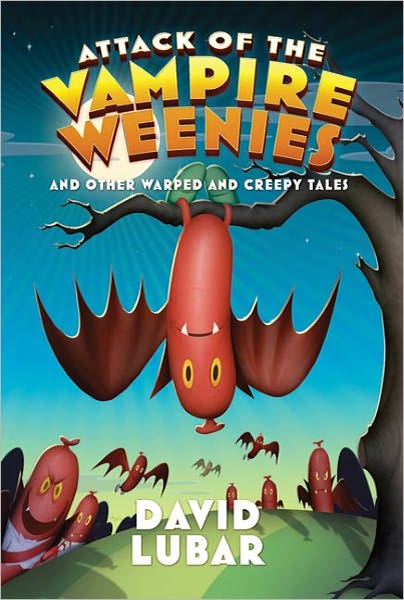
This time out, we start off with the new book of stories for younger readers by David Lubar, Attack of the Vampire Weenies. (Lubar's got a thing for weenies; this is his fifth collection of comically horrifying stories for pre-adults, all of which had weenies somewhere in the title.) There are thirty-three stories here in under two hundred pages; when you write for kids, you need to leave out all the stuff that's boring or unnecessary, since kids won't just skip it, they'll quite entirely. Vampire Weenies was published in hardcover last week by Tor's Starscape young-readers imprint.

The next book is aimed at slightly older younger readers -- the vast hordes of teenagers who insist that no one understands them, that their lives are utterly different and harder than anything that anyone has previously experienced, and that gobble down near-future dystopian novels about Teens Just Like Them. In the case of Marie Lu's debut novel Legend, the means a divided future America (with the Republic and the Colonies), the flooded remnants of Los Angeles, what seems like the usual secretly repressive and corrupt military dictatorship, and two fifteen-year-olds (a boy and a girl, naturally) from opposite sides of the tracks who meet when one is accused of murdering the brother of the other -- and, from there, they of course "uncover the truth of what has really brought them together and the sinister lengths to which their country will go to keep its secrets." Legend will be published by G.P. Putnam's Sons on November 29th, and there will, of course, be sequels following it.

Luckily, the next book I have is much less definable, or predictable: Five Wounds: An Illuminated Novel, written by Jonathan Walker and extensively illustrated by Dan Hallett. It's a heavily designed book -- inspired by the King James Bible, the cover letter says, and every sentence is numbered within chapters to prove it -- with both a section of vellum-finished plates and illustrations throughout the text, to tell the story of five orphans, all "marred at birth and forever cast out as outsiders in an uncaring world." The publisher helpfully notes that Five Wounds is "a densely layered tale for anyone who enjoys surreal and sordid graphic novels." (So I'm expecting all of the fans of The Rise of Arsenal to look for this one.) Five Wounds was published in the UK by Allen & Unwin, and is being distributed on this side of the pond by Trafalgar Square, starting in June.

And last for this week is Christopher Hart's Basic Anatomy for the Manga Artist, coming from Watson-Guptill on June 11th. I'm probably not the person to evaluate this -- I nearly failed a theater class in college when we got to the section where we had to draw scenery in perspective -- but Hart is definitely the guy to do it; he's written and illustrated several bestselling books of drawing instruction focused on manga styles, including the foundational Manga for the Beginner. And this book looks really useful for people who can actually draw, starting with the proportions of the typical manga-character skull and moving on through standard facial features, skeletons, muscles, motion and on to clothing, props, and so on.

Sunday, May 29, 2011

Dungeon Quest Book One by Joe Daly

Joe Daly tells stories about slackers with an obvious love and a clear eye; he's attuned to the oddball notions and unlikely turns that their lives take, and crafts stories about quirky people that don't turn into catalogs of quirks themselves. (Which is nowhere near as easy as it sounds.) He's also notable among newer cartoonists for not committing memoir; his stories might have some inspiration in his life (or not), but they're real stories, that live and breathe and go off in their own directions.

Daly is South African; he first came to the attention of a North American audience with The Red Monkey Double Happiness Book, which collected two related stories about two South African slackers and the weird events they got caught up in. (I reviewed it here about a year and a half ago, well after it was published in the US.) Since then, he's jumped into a big series in "Dungeon Quest," but, in what I'm hoping will continue to be typical Joe Daly fashion, his big series is funny and goofy and takes itself seriously only in the way that a very late-night conversation about the nature of the universe, fueled by various not-entirely-legal substances, can be serious.

In fact, I reviewed the second book of "Dungeon Quest" recently for the magazine Realms of Fantasy (the June 2011 issue, available right now from better purveyors of ink-on-paper entertainment), and liked it so much that I had to go back and find the first book, to see how Millennium Boy and his adventuring party got started. This is one of those stories that knowing exactly how it started doesn't add quite as much context as one might expect -- it really was just Millennium Boy being bored one day and deciding to go out on an adventure rather than do his homework, and gathering up a small group of equally bored, or willing adventurers to go with him.

The obvious comparison for "Dungeon Quest" is to paper-and-pencil RPGs; Daly gives his characters statistics (for intelligence, strength, dexterity, various weapon skills, armor, and so forth), and those statistics go up after combat (though health can go down with an injury, of course). Daly also is willing to be more than a little goofy and self-conscious; his characters know that they can grab "upgrades" from the bodies of their dead enemies, and comment on how their stats are increasing.

The names of those items are odd as well -- "woolen beanie of insulation," "steel-toed bovver boots of the armadillo," "light bow of the woodpecker," and so forth -- to continue the sense of "Dungeon Quest" as the record of a friendly RPG campaign, down in some smoke-filled basement, with a bunch of friends enjoying themselves and goofing off.

I still wish that the one female member of this adventuring quartet -- Nerdgirl, the ranged-weapons expert of the bunch -- had any definable personality, or ever spoke, since the group is otherwise very boyish, with similar personalities. But there's still adventures to come, and I can hope that she'll turn out to be as quirky and fun as her male adventuring companions.

Dungeon Quest is a goofy, silly series, and it's not for readers who need their comics-format violence to be deadly serious and full of clenched teeth. But for those of us who have grown out of that limited conception of comics yet still want energetic adventure stories that know how silly they are, it's just the thing.

Movie Log: Wild Target

The Wife and I have a running joke that there are only twenty working actors in the UK at any one time. It's not precisely true -- the real number is probably closer to thirty -- but we do seem to see a lot of small British movies, and we keep tripping over the same actors again and again. Remembering their names, though, can sometimes be more tricky.

So, as we were watching it, we were thinking of Wild Target as a movie in which the rockstar from Love, Actually was a hit man, trying to kill The Young Victoria, while the red-headed kid from Harry Potter sort-of became his apprentice, and Arthur Dent was hired by Rupert Everett (we instantly remember him; dunno why) to kill the first hit man. Oh, and Judith Starkadder was the first hit man's very supportive mother.

As I've noted before, I am precisely the audience for comedies about hit men -- as previously proved by You Kill Me, The Matador, and Grosse Pointe Blank -- so I wanted to see Wild Target as soon as I knew it existed. And it does what a comedy about hit men has to: it immediately gets the audience on the side of Victor Maynard (Bill Nighy) by immersing us in his world and seeing it through his eyes and his voice. So we want him to continue to succeed in his chosen career -- but that's a problem, since we also see young con artist Rose (Emily Blunt) finagle a complicated double-swap of a counterfeit Rembrandt to a not-quite-crimelord (Everett), and we'd prefer to see her succeed as well, or at least survive.

Unfortunately, they can't both succeed equally, since Everett's character hires Maynard to kill Rose, which he sets off to do in his usual professional manner. But her life is so chaotic and full of unexpected events that he can't quite do it, and, through the sort of unlikely series of events that movies like this are full of, Victor ends up on the run with both Rose and a young man named Tony (Rupert Grint), with another hit man named Dixon (Martin Freeman) after him and Rose. It all ends pretty much the way it should, and goes a lot of enjoyable places along the way.

Wild Target is fun and witty and entertaining, though there's something just slightly out-of-focus about it, particularly in Rose's characterization. (She takes risks reflexively, all of the time, just to do dangerous things, and there's no explanation or excuse or payoff for that -- she also asks every man she meets "how much do you weight," which equally leads nowhere.) But, for those of us who love comedies about hit men, it's a gem, and one easy to overlook.

Saturday, May 28, 2011

Incoming Books: May 27, 2011

I'm highly predictable: when my company closes early due to a long weekend -- as happened again yesterday -- I find myself shopping for reading material, generally in one of three places, The Strand, Midtown Comics, or Jim Hanley's Universe. [1]

Yesterday it was the last of those three: Hanley's. I've complained about their Byzantine shelving system before, so I'll omit a paragraph or two about my wandering around, trying to find what I was looking for, and get right to the books I bought:

Fred the Clown by Roger Langridge. I've admired Langridge's work in anthologies for ages and ages, and loved his Muppet Show comics. So I finally did have to buy a book of his original work -- it's long overdue.

iZombie, Vol. 1: Dead to the World. It's written by Chris Roberson and drawn by Michael Allred. If I'm reading comics anywhere near the American mainstream at all, I need to be reading this. But I've gotten out of the floppy habit enough to wait for the collection.

Approximate Continuum Comics by Lewis Trondheim. Trondheim is one of the giants of French comics -- and, by that, I mean "has written and drawn lots of great stories for various audiences that I've loved and want to see more of" -- and this is an series of autobiographical stories from the early '90s that I've been looking forward to since I saw Fantagraphics' catalog six months ago.

And last was Pascal Girard's Bigfoot, the graphic novel he created in between Nicolas (my review) and Reunion (my review).


[1] My excuse is that the company closes at 12:30, but the next train on my commuter-only line isn't until about 3:30, so I just have to take the PATH into Manhattan and catch a bus home. And, if I'm in Manhattan, how can I avoid going to a bookstore?

Movie Log: Harry Potter #7.1

The full title, of course, is Harry Potter and the Deathly Hallows, Part 1, since this is the movie that adapts the first half of the dullest and dreariest of the series of books by J.K. Rowling. (Not the longest book, nor the book with the most events, but I'm sure Warner Brothers is now kicking themselves and wishing they'd started splitting these back at Azkaban to make twice as much money.)

I haven't changed my opinion of the book -- which is, by far, the worst of the series, with a sag in the middle like a couch that Hagrid just sat on -- and the movie is as deeply faithful to the book in the way that this series of movies always has been...and that means, of course, that it's full of dull, dreary camping sequences, in which Harry, Ron, and Hermoine mope at each other for what feels like the full eight months the book covers.

(Somewhere in the middle of that, my younger son quietly stated that he wasn't having any fun and went up to his room to play. When your movie isn't more entertaining than playing alone with dominoes, you've got a serious problem.)

The plot makes as much sense here as it did in the book: which is to say, it's still the quintessentially English story about a boy who definitely isn't too smart for his station, but is indomitable enough to muddle through because his heart is true. Rowling has no interest in a resistance movement against her magical dictator, nor does she care about what's happening to the UK under Voldemort (much less the rest of the world, which nearly doesn't exist in the Harry Potter world), or even in depicting Harry Potter as any kind of leader or competent hero.

No, instead Deathly Hallows 1 is the story of three friends (who hate each other) hiding out in the woods instead of trying to find the seven magical Plot Coupons Horcruxes, which they need (along with three pounds fifty in coins) to send off to Rowling for an ending. And this movie doesn't even get them to the point where they actually start to accomplish their quest, so it's entirely ominous beginning and dreary middle. This is the movie you have to get through to get Deathly Hallows 2, and you'd have to be a stone Potter fan -- the kind unwilling to admit anything connected to Rowling is less than fabulous -- to strongly enjoy it as a movie in its own right.

Naruto 49 & 50 by Masashi Kishimoto

Yes, I'm still reading these. What can I say? I have to have some piece of violent serialized popular entertainment, I suppose -- don't we all?

I'm only a casual Naruto reader, though, and any serialized story that runs this long will tend to prefer dedicated readers to casual ones -- the story is only a bit shy of 10,000 pages long by this point, with more characters and details than I can honestly keep track of, some of the time. Luckily, Kishimoto isn't trying to tell a story just for the continuity nuts, but it is a reasonably complex world (five secret villages of ninjas, each with their own hierarchy and traditions, plus a raft-load of various semi-supernatural fighting techniques and abilities, including a lot of jargon), so getting back up to speed each volume can be tricky.

And Naruto himself is much more of an ensemble player now as well -- he's near the center of the story, most of the time, but there can be whole chapters of other people fighting or yelling at each other (still the two main modes of Naruto) in which the main character doesn't appear. I'm also finding it interesting -- and stereotypically Japanese -- how Naruto started off as the goofy oddball, loud and inappropriate and boasting, and has had most of his rough edges sanded off, bit by bit, to make him into the standard shonen hero: resourceful, smart, dedicated, and vastly more self-effacing than he was when he started. The Naruto of the early books would declare often that his goal was to be Hokage -- the leader and best ninja of his home. But the Naruto we see now wants to be, like every other shonen hero, a great salaryman, working as hard as he can for someone else and not asking for any more reward than more work. (Socialization can be a bitch.)

I still have hopes to make it to the end of this series, and I think that there actually will be an end, eventually -- Kishimoto's story has a definite shape, and things have been slowly coming together over the past thousand pages or so -- but it's entirely possible that this is only the halfway point of Naruto; there are lots of ways to extend a story and the manga industry is expert at all of them. No one is going to be in a hurry to end a cash cow like Naruto.

This was nothing like a review, since volumes 49 and 50 of anything are essentially unreviewable -- the only people with the standing to really look at them closely are so in love with the series that their opinions are unreliable, and those are the same people who could evaluate reviews, as well. But I spent the first three years of this blog insisting that I'd never really review books, and I suppose some of that spirit will still come out, now and then.

Friday, May 27, 2011

Quotes of the Week: Women and the Men Who Glare at Them

Hey, I forgot to do my usual early-morning quote post today. So, instead, have two very similar quotes late in the day:

"One can, to an almost laughable degree, infer what a man's wife is life from his opinions about women in general."
- John Stuart Mill

"Most men who rail against women are railing at one woman only."
- Remy de Gourmont