March. What's there to say about March?
Exactly. So here's what I was reading the last thirty-one days:
Lewis Trondheim,
Approximate Continuum Comics
(3/5) -- Trondheim is best known in the US for co-writing the
Dungeon series of graphic novels with Joann Sfar, but he's a major bestseller in France with several major well-known series. So his bibliography here has random holes and confusions -- for example, his recent stretch of autobiographical comics, originally published page-by-page on his website, have come out here only slightly delayed from the French as
Little Nothings (in four volumes so far). But this book -- nearly twenty years old, and Trondheim's first major stab at autobiography -- has only been available in English for a couple of years, appearing to be a follow-up to
Little Nothings rather than its distant father.
Approximate comes from the days when even classy Euro-comics first appeared in individual-issue form; it was a short series of six issues in the mid-'90s, but the issue breaks are silently elided here. (This is a series of episodes to begin with, so only someone counting pages will realize where one issue ends and another begins.) As he did in the later
Little Nothings, Trondheim draws his characters with animal heads -- he's a bird, and everyone else are various identifiable (and not) other creatures. And the style and matter are similar to
Little Nothings (
see my reviews), though clearly earlier and less polished: Trondheim's art is looser and less controlled, and his life is as well -- he's younger, less sure of himself, and more insecure in his neuroses than he would be later. So
Approximate is looser and wilder than
Little is; Trondheim is less sure of himself, his abilities and career, and is substantially younger and less settled. The stories here are bigger than those in
Little, just because Trondheim was more energetic in those days. All of them are good, insightful autobiographical comics -- but
Approximate has the energy and enthusiasm of youth to recommend it as well.
Lawrence Block,
Hit Me (3/5)
Richard Sala,
Delphine
(3/6) -- Sala is a cartoonist whose work runs very much to a type, which I find confounds criticism: once you've covered a typical work (as I did with
The Hidden) and maybe looked at something outside of his usual wheelhouse (such as
Cat Burglar Black), what's left is just a listing of the particular changes rung this time out, and I'm not interested in doing that. (Though the bulk of the comics-reviewing Internet is obsessed with precisely that: explaining and complaining and fulminating about whichever Big Two character is dead this week, which one has changed personality to meet Editorial dictates, and which one is savagely neglected.)
Delphine is a typical Sala work: in gorgeous, supple art, a somewhat callow young man comes to a mysterious town, following a strange woman he's obsessed with, and get ensnared by the odd and horrible things happening there. Sometimes Sala has a mildly happy ending -- more often when that young man is replaced by a spunky young woman; he's much harder on his male characters -- but, most of the time, once you find yourself in one of those creepy Sala towns, your fate is already sealed. A Sala story is dark, and thorny, and full of grotesques and goose-bumpy set-pieces, like a great '30s Universal monster movie. And
Delphine is a fine example of Sala in top form; for anyone who hasn't read Sala, it's as good a place to begin as anywhere.
Simon Rich,
What In God's Name (3/6)
R. Kikuo Johnson,
The Shark King (3/7)
Stella Gibbons,
Cold Comfort Farm (3/8)
Grant Morrison & Frank Quitely,
Flex Mentallo
(3/11) -- I read Morrison's
Doom Patrol as it came out, back when the world was young and Morrison only
thought he was a god, and hadn't yet utterly convinced himself of the matter. And I had the issues of this story, stuck away in longboxes that I hadn't taken out in close to a decade when a flood wiped them away. Reading it again, for the first time in over fifteen years, it's easy to see that Morrison's early infatuation with metafiction had already begun hardening into an obsession with
comics in particular -- and that means, as it has for the last thirty years, long-underwear characters with eerie powers that battle a childish '30s conception of evil, and primarily the DC/Marvel manifestations of that idea. Morrison hadn't quite gotten to the point of claiming that only comics matter and that comics are the best, purest artform ever in
Flex, but you could see that argument beginning to surface in his mind. It's still undertone here, to the benefit of the work -- Morrison is always at his best when he's building subtext and connections, rather than explaining his dull Jungian theories directly. Flex is a silly superhero, but Morrison can believe in superheroes
so hard that he can make Flex as heroic and believable as he needs to be for the space of this story, and the Morrison-insert comics-creator character (overdosed and possibly dying, at opera-diva length, in what is probably another universe or level of reality) meaningful and poignant and connected rather than pathetic and self-indulgent. A lot of the credit should go to Quitely's art; he has the underrated ability to draw bizarre things so that they look as solid and ordinary as dirt. So this
is a story of comics -- American superhero comics,
proper comics -- saving the world. But it's pretty good even given that.
Jared Axelrod & Steve Walker,
The Battle of Blood and Ink (3/12)
Gene Luen Yang & Thien Pham,
Level Up (3/13)
Matt Kindt,
Red Handed (3/14)

Craig Thompson,
Habibi
(3/17) This took me a long time to read, and didn't impress me as much as Thompson's previous big graphic novel,
Blankets, did. The fact that Thompson wanted to do a story about Islamic characters in an immersive setting does him a lot of credit; the fact that
Habibi ends up focusing almost entirely on sex in the least erotic, most otherizing, squickiest way possible mitigates that at least somewhat. It's a beautiful object, and Thompson clearly put a lot of time and effort into it...but, sadly, that wasn't enough, and
Habibi is borderline embarrassing. This is a graphic novel primarily for people who like looking at the art -- the pages are gorgeous just as art, not even counting Thompson's wonderful design sense -- since the story is a litany of misery and woe, punctuated by someone else's religion and set in a fantasy version of both medieval Arabia and modern-day Dubai. It is not
deliberately racist, but many readers will find it unpleasantly, subconsciously racist, which is substantially worse. If nothing else, it can stand as a signpost of how very difficult it is to write a story from
within someone else's culture.

Donovan Hohn,
Moby-Duck
(3/19) -- In 1992, nearly 30,000 rubber bath toys were knocked overboard from a cargo ship in an immense storm in the North Pacific. A decade later, journalist Hohn got obsessed with the story and ended up writing this book, about oceans, beachcombing, post-Panamax container ships, environmentalism, his own fears and doubts, and, most importantly, about plastic and what plastic is doing to our world. It's a decent non-fiction book, of the using-one-event-as-a-lens-on-the-whole-world style, but it's not as quirky as I hoped -- it reads like a sequence of magazine articles (which parts of it were based on) about Hohn's various voyages around the Pacific in search of various pieces of this story, without having a strong central narrative or spine to keep it all together. Still, any book about the Great Pacific Garbage Patch is worth reading.

The Oatmeal,
How to Tell If Your Cat Is Plotting to Kill You
(3/20) -- If you ask me, the answer to the title question is "you have a cat," but clearly the guy calling himself The Oatmeal (Matthew Inman) likes cats more than I do. I reviewed The Oatmeal's previous book,
5 Very Good Reasons to Punch a Dolphin in the Mouth (and Other Useful Guides) around this time last year, so see that post for more details on what it is The Oatmeal does. This is more of the same, on about the same level -- if you don't know what that is, check out
his website first. This book is cat-centric in a way the first wasn't, and is also a quicker read -- the first book had more of the long, research-heavy pieces, and this one gets to focus on his meme-ish looks at those furry monsters. If you like cats, and you like the Internet, this is the book for you.

Ellen Forney,
Marbles
(3/21) -- If you want to have a big hit in the regular literary world with your graphic novel, you'd better write a memoir, and, for an even better chance, you'd be smart to have overcome something serious, whether it be growing up in revolutionary Iran (
Persepolis) or getting breast cancer (
Cancer Vixen) or just being Vladek Spiegelman's son (
Maus). Ellen Forney is a fine cartoonist -- see my reviews of her very varied books like
Monkey Food and
Lust for an overview of what she's already done -- and she also was diagnosed as bipolar just over a decade ago.
Marbles tells that story, from Forney's life at the time of diagnosis (in retrospect, a really
really obvious manic phase) through years of tinkering with prescriptions and weekly therapy sessions up to the present day. (Spoiler: she found meds that worked and got to a place she's comfortable with and continues to do great comics work.)
Marbles is a loosely organized piece, turning from "comics" on most pages to more illustrative stretches/pages (including quite a bit of work Forney did at the time, included as a window into her mindset) to big chunks of hand-lettered text. It's smart and insightful and uplifting, the story of an important part of the life of a woman who's had a lot of life and knows how to turn it into a story.
Steven Gould,
Impulse (3/25)

Mark Siegel,
Sailor Twain
(3/25) -- If I'd seen this smart, thorny, deep graphic novel for review, I'd feel compelled to sit on it for a while, chewing over what I really thought about it and trying to write something to do it justice. But I was spacing out when it published a few months back, so I had to get it from the library like a
normal person, and so I'm free to react to it just like that normal person. It's the story of a steamboat crew on the Hudson in the late 19th century, the mermaid they find, and the nature of love. Siegel's backgrounds and layouts are precise and immersive, though I found some of his character designs distracting -- he has a cartoony feel, not unlike a lot of classic
manga-ka, for his protagonists, but his method of simplifying facial features turns several characters into Muppets, to my eye. (There's nothing wrong with cartoony characters in a mostly-realistic drawn world; plenty of creators have done that well. But when the cartoony characters break the plane of the story by seeming to become characters in
other stories, that can be a problem.) First Second has mostly been known for a bunch of great graphic novels for teens over the past few years -- and Siegel is Editorial Director there, as well as becoming one of his own authors with
Sailor Twain -- but this one is clearly and entirely for adults (and some older teens who can handle cartoon breasts). And it's damn good, even if the ending felt a bit elliptical to me.

Jason,
The Left Bank Gang
(3/26) -- Jason's graphic novels do not
precisely run to a type or formula, but there are definite points of continuity: blank-faced, animal-headed characters, whose motivations remain firmly locked in their own heads; random, unexpected violence, upsetting all plans, hopes, and lives; genre fiction elements, often mixed with supposed "high culture;" and a tight nine-panel grid, showing the action moving in lock-step towards its inevitable end.
Left Bank Gang is a 2005 Jason book, with all of those elements firmly in place -- the characters are the great Modernist writers of Paris in the '20s (Fitzgerald, Hemingway, Joyce, Pound), reconceptualized as comics creators in a world where that's the dominant art, and the plot circles around an ill-conceived plan to get rich through a bank robbery. Jason starts off telling the story straight, but the robbery is told and retold through the viewpoints of each character, each time adding more detail and nuance -- it's a great conceit, and works well for this kind of crime story. The fact that his characters are supposedly the great Modernists is really an affectation; aside from some quirks of dialogue, these guys could be anybody, and they really
are anybody. (Jason's work, I think, is best when he does stick to iconic or Everyman protagonists -- his style of distancing works better with A Guy or Frankenstein's Monster than with a real person with history and a bibliography to look up.)

Michael Popek,
Forgotten Bookmarks
(3/26) -- People leave odd things in books, and other people who work in bookstores find those things later on. Popek is one such bookstore clerk -- he's worked in a family used and rare shop for close to thirty years, since he was a kid -- and he decided to put some of those finds online, at a blog he named
Forgotten Bookmarks. Every decently popular blog becomes a book eventually -- the same way that every half-decent comedian got a book deal in the mid-'90s and every magazine got a thin parody book in the '80s -- and so this eventually emerged. It works very well as a book, since it's about bookish ephemera and will be of great interest to people who love the physicality of books. The book shows 150 or so of these items, from letters to photos to leaves to receipts to razor blades -- and shows each one with the exact book it was found in, which gladdens my persnickety heart. The particular items tend to have connections to upstate New York -- when Popek's establishment is located -- and tend to be 50+ years old, either because he deliberately chose older items or because he mostly sees old books. There's a short introduction, but not really any commentary: Popek is just presenting these materials, as he found them. I imagine this will live a long life as a gift from bookish people to each other, and it's very good in that role.

"The Waiter" (Steve Dublanica),
Waiter Rant
(3/28) -- We all want to know the secrets; it's why magazines like
National Enquirer have made so much money for so long. It's why there are intermittent explosions of anonymous blogs (tumblrs, twitter handles, etc.) from people that we're pretty sure
really are as connected and powerful as they pretend to be. And some of those outlets for secrets really are useful and smart and true, which keeps the whole thing going for another cycle. One such manifestation of the "let me tell you what's
really going on" impulse was the blog
Waiter Rant, started in 2004 by a man who called himself "The Waiter," and claimed to be the headwaiter/manager of a fine-dining establishment in the New York area. As such things usually go, The Waiter got a book deal, and this was the book, in 2008. (Waiter was outed during the publicity for the book as Steve Dublanica, and has since written a follow-up,
Keep The Change, about US tipping standards and culture.)
Waiter Rant isn't deep, but no one expected it to be: Dublanica tells stories about the behind-the-scenes life of a nice restaurant (later outed as the Lanterna Tuscan Bistro in Nyack), which are as bitchy as we expected, though thankfully not quite as unsanitary as we feared. As everyone has already said, this really is
Kitchen Confidential for the front of the house, and, if you're interested in that, this is the place to go. It's also amusing for those of us who don't care
that much about how restaurants run, but just want some good stories about interesting workplaces.
Everything I haven't yet written about was sent as a review copy, so I feel compelled to hold them for "real," separate posts. (Which may or may not happen; I can have great intentions, but that doesn't prove anything.) Those may appear in the near future, or not -- feel free to comment if you're desperate to know anything about
Impulse or
Red Handed or
Level Up, since I never know what will spark me to action.
And now we move on to another month, as always. Happy April to you all, and I hope you all see the other end of it as well.


 is Mary Robinette Kowal's third novel, continuing the story of a slightly alternate fantasy Regency period and of the two talented "glamourists" who met, married, and honeymooned in the first two books, Shades of Milk and Honey and Glamour in Glass (links go to my reviews on Antick Musings). Summer sees Jane and David (or, to be more period-appropriate, Mr. and Mrs. Vincent) return from Belgium to visit Jane's family, and then up to London with Jane's younger sister, Melody, in hopes of catching her a husband. Of course, international intrigue is also promised -- as in Glamour -- but I trust Kowal to keep it in scale with the domestic, personal, specific style of the series. Without a Summer is a Tor hardcover; it hit stores last week.
 I also have three books published by Yen Press this month -- all manga, since that what Yen does:
 continues the series by Jun Mochizuki that I have to regretfully note that I haven't actually read. The series is some kind of retelling of Alice in Wonderland, I think, perhaps mixed with other stories -- the back cover of this one promises Humpty Dumpty -- but I can't be much more of a guide than that.
 I'm similarly innocent of knowledge about Black Butler
 , whose thirteenth volume is here as well. Yana Toboso's series is set in a typically manga-fied Edwardian era, with a young nobleman and his omnicompetent butler, but, at this point, the main cast is on a ship which I believe is besieged by zombies.
 And the third Yen Press book I have this week is Doubt, Vol. 1
 , a big fat book launching a series by Yoshiki Tonogai. It's another game-come-to-life book, and also a distant descendant of Battle Royale and/or And Then There Were None -- a group of players of a popular mobile game decide to meet in person to play a live version, but find themselves kidnapped to the usual inescapable place, faced with a corpse, and forced to figure out which of them is the real killer.
 Walter Mosley has had an interesting little series going with Tor for the last couple of years, under the overall title "Crosstown to Oblivion." Each volume contains two ostensibly unrelated short novels, and the whole thing will add up to "entertainingly [explore] life's cosmic questions." The third and final book is Stepping Stone/Love Machine
 , which follows The Gift of Fire/The Head of a Pin and Merge/Disciple. They seem to be more thematically connected than otherwise, so a new reader could start as well with the third book -- just out last week in hardcover from Tor -- as with either of the previous two.
 Also from Tor -- coming at the end of the month -- is Freda Warrington's Grail of the Summer Stars
 , finishing up the "Aetherial Tales" trilogy that began with Elfland and continued with Midsummer Night. It looks like a loose series -- perhaps entirely connected by a common background, rather than characters or action -- in which the Aetherial folk (aka the fay, or fairies, etc.) come into the lives of normal humans -- in this case, the manager of an art gallery who finds a disturbing painting by her estranged ex-boyfriend. There are admiring quotes from Charles de Lint -- whose work may be one touchstone here -- as well as Liz Williams and Chaz Brenchley; this looks to be a smart fantasy rather than a purely generic one.
 I saw Paul Cornell's London Falling
 -- the beginning of a dark contemporary fantasy series about a group of London cops facing unexpected supernatural evil -- a few weeks ago, in a perishable advance-reader form, but it's back this week in final hardcover, as it will be published by Tor in another week.
 And last this time out is Bart Simpson: Big Shot!
 , the latest book reprinting the stories from Bongo Comics. This one reprints what looks like five random issues of Bart Simpson (plus a Simpsons Summer Shindig for spice), but all of the stories are standalone -- like in the good old days of comics, when millions of regular people read them all the time -- so that won't matter. There's work in here from Sergio Aragones, Carol Lay, Gilbert Hernandez, and other unexpected folks, too. It's an affordable trade paperback from Harper, officially hitting stores tomorrow.


 is a combination memoir and meditation on food -- with a few recipes
thrown in along the way, as all good food books must. She comes by her
food obsession the honest way: her mother was a chef and a caterer, and
she worked in a cheese shop herself for a while.
is a combination memoir and meditation on food -- with a few recipes
thrown in along the way, as all good food books must. She comes by her
food obsession the honest way: her mother was a chef and a caterer, and
she worked in a cheese shop herself for a while.
 , subtitled "My Ultimate African Safari" -- it's the story of one more journey, a trip through southern and western Africa, from Cape Town through Namibia, Angola, and nearly to the Congo. This one I do expect to read, and to begin quickly -- I only hope I can figure out what to say about it afterward.
 is the sixth urban fantasy novel from Faith Hunter about skinwalker Jane Yellowrock and her (vampire- and supernatural-infested) world, centered on Natchez, Mississippi. It's a mass-market paperback from Roc in April, and sees Jane chasing down some of those pesky rogue vamps.
 , the fourth in an urban fantasy series about a different world just like our own with hidden vampires. Our heroine here is Miranda Grey-Solomon, the Vampire Queen of the South, who this time out is dealing with the presumed death of her one true love (and Prime, whatever that is) -- he might not even return from I-can't-believe-it's-not-death in this book, if Sylvan is particularly daring and wants to delay it a book or two.
 completes the follow-up to the original Country of Hearts series, with a new Wonderland-with-gangsters-and-true-love-Japanese-style story. The story is by QuinRose, the art by Delico Psyche, and the scenario by Owl Shinotsuki -- any or all of those may be post-human uploaded minds, or studios, or corporate entities, as much as I know.
 continues the harem-manga story, full of "magikewl girls" and vampire ninjas and inappropriate violence and teen angst played for laughs and all of that other stuff. The credit on this one are even odder: Sacchi (comic), Shinichi Kimura (Original), Kobuichi & Muririn (character Design). I'm not googling right now, but that looks to me like it was a TV show or light novel series first.
 , which even I know was originally a light novel series by Nagaru Tanigawa. The manga has art by Gaku Tsugano, and also credits Noizi Ito with character design, since the people were visualized for other media before it hit manga.
 . If I remember correctly, this one is about a girl who can talk to ghosts and her ex-super-soldier buddy (and a dead soldier in a radio, right?) on a journey to somewhere to do something that might make their vaguely dystopian world better.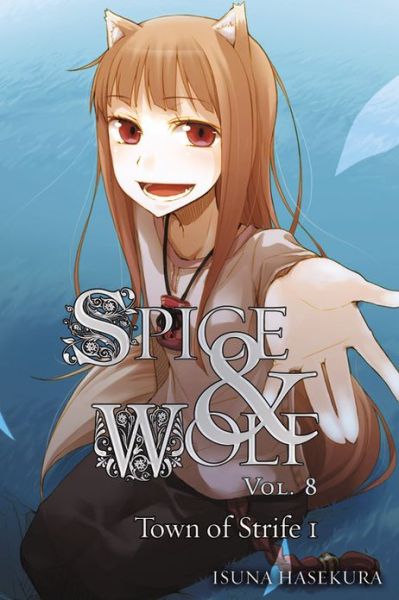
 . This one is about a harvest goddess (slash wolf girl) and her merchant boss/boyfriend/traveling companion/whatever (I really can't be relied upon to remember the fine points of character interactions in series I haven't even read). This time out, they're following a legend of a relic that might be from another god (presumably god), and, in the way of this series and absolutely nothing else in the world, that leads to a macroeconomics lesson.
 , the first in a series called The Forgotten Gods (although it was called Dog Faced Gods in its British incarnation) and set in a London either in the near future enough to have seen everything go to hell or just today seen through a particularly jaundiced eye. (Pinborough is a horror writer with over a dozen books under her belt, from solo novels to Torchwood spin-offs to a trilogy for younger readers as Sarah Silverwood.) This one hits stores tomorrow.
 , which Roc will publish in hardcover in July. It's set in a far-flung piece of a fantasy empire among a group of soldiers, and a has a guy in a black cloak with his back to the reader, all of which gives me a (possibly unwarranted) Gardens of the Moon vibe. But Wexler's milieu is more Victorian England than full-on secondary world, and it looks like magic will be more subtle and secret in this series than in some of its competition on the epic fantasy shelf.


