Tuesday, December 01, 2020

Tales Designed to Thrizzle, Vol. 2 by Michael Kupperman

Michael Kupperman has a deeply weird sense of humor, if his Tales Designed to Thrizzle comics are any indication. (And he'd be even weirder than that if he made funny comics like these that aren't based on his own sense of humor, if this was some odd attempt to deliver what he thought a mass audience wanted.)

One major running theme is the adventures of Twain & Einstein -- they look almost identical, get it? -- who fight crime or have other random adventures, usually in a vague "now" that corresponds to neither of their lives. (Which I don't think actually intersected, though they were both alive from 1879 to 1910.) Another is the duo of Snake & Bacon, an actual hissing snake and a presumably sentient piece of cooked meat that only says "I'm real bacon."

Anyway, Kupperman's comics are filled with surrealist nuttiness, which is why I'm back for Tales Designed to Thrizzle, Vol. 2. (I read Vol. 1 a couple of years ago, only about a dozen years late.)

I probably said most of what I could say about Kupperman's style the first time; writing about surrealism tends to deteriorate into listing the random references ("and there a one-page Odd Couple gag with vampires!", "and Quincy, M.E. plays a major role, as does Saint Peter, to the point that they appear in each other's comics!", "did I mention the pseudo-horror story about men who suddenly have sexy women's legs?") and that's not terribly interesting for the reader.

This is funny in its own way, deeply steeped in pop-culture references: Kupperman is from Gen X like me, so I stewed in much the same media world as him in childhood, and that may be important to fully appreciate what here might Thrizzle you. (If you're too much younger, a lot of this will seem entirely random, rather than references to odd things that were originally meant to be serious.)

I didn't find Vol. 2 quite as funny as the first one: maybe there's a bit too much Twain & Einstein here, and not enough of the really crazy stuff like sex blimps and criminal fingertalk. But it's definitely more of the same kind of thing for people who liked the first one, and is very similar in tone and style and art. (Kupperman draws like a grainy photocopier about half the time and colors with a garish cheap-printing palette almost all the time; his humor comics also look like nothing else.)

If you're looking for a Thrizzle, you will find one nowhere else.

Friday, November 27, 2020

Quote of the Week: Nobody Knows How to Merge, Either

People who are born in Los Angeles are different from those who come to it, because they're the only ones who have not chosen to be there; almost no one just winds up in Los Angeles. They choose to come to Los Angeles because their dreams and appetites are at once so huge and vague that it is the only destination that makes sense, since it is the city that, above all others, promises to provide them with what they want, or in case they don't know what they want, show them. It's only later people realize that, like New York, L.A. is run by people for whom denying other people their dreams is fun.
 - Steve Erickson, American Nomad, p.123

Thursday, November 26, 2020

Reading Into the Past: 1993

I am still planning on doing these "Reading into the Past" posts, digging out pages from my old reading notebooks and seeing what (if anything) I remember about books I read ten to thirty years ago. They may not go up on any clear schedule, since I'd prefer to write about books I just read (when I have just read a book), but there might be one most weeks for a while.

Or I could disappear for weeks at an end again: who knows!

This week, though, I'm burying this on what is traditionally one of the very lowest-traffic Internet days of the American year. And I'm looking pretty far back, to 1993, since that's what the RNG gave me. Here's what I was reading this week twenty-seven years ago:

I seem to be randomly hitting these weeks-of-mystery-book-reading consistently this time around with "Reading Into the Past," for whatever mysterious reason. I think I did read a lot of mysteries during the '90s, probably hitting a cluster like this at least quarterly, but it wasn't as common as it might seem. (Or maybe it was, and I'm forgetting? Maybe I really did read more than a hundred mysteries every year, and that's one reason I was able to read so much?)

Anyway, I read all of the first burst of Easy Rawlins books, and they were all marvelous. Like so many mystery series, remembering the details of which one was which is difficult, so I won't give more details here. But Devil was the very first Easy book, and I see I got to it three years late -- I was generally looking for mystery series with several books at the time, things I could continue with if I liked the first one.

What I remember most about this was that the entire SFBC office -- Ellen Asher, Moshe Feder, and I -- all agreed unanimously that the title of this book should be I, Asimov (with a comma, not a period) and kept bugging Doubleday about that (mostly Ellen, I think) almost up to publication. We did not prevail, obviously, but I still think we were right.

This was the third and last of Asimov's memoirs, published after his death. I still haven't managed to read the first two books, from the '70s -- In Memory Yet Green and In Joy Still Felt -- and probably never will at this point. So this one was mostly "here's what my life was like once I was relatively rich and famous and settled, and spent all of my time in my apartment writing books." It was not particularly exciting, but Asimov had a great writing voice, and that voice was always better-suited to non-fiction than stories anyway.

This is the seventh of the Garrett books, about a hardboiled PI in a fantasy world. I eventually became a fan of Cook's "Black Company" books (very dark fantasy, basically about a mercenary company after their boss Dark Lorded over the world), and clearly I was reading a lot of hardboiled mysteries, so maybe this seemed like it would be right up my street.

Although, looking at the publication timeline, I started working at the SFBC during the Black Company hiatus between Books of the South and Glittering Stone -- I've still never gone back to read the original trilogy and Books of the South -- so I probably didn't read a Black Company book until Bleak Seasons in '96.

Anyway: this looked like my kind of thing, and my memory is that the SFBC had done two 3-in-1s of the prior books (though Wikipedia claims that was later). I didn't like this series as much as I did the Black Company: it's more than a little jokey, and I don't recall Cook taking his setting all that seriously -- it's kind of a generic D&D fantasy world from the '80s. In those days, I was passionate about what PIs and fantasy world-building should be, and Garrett didn't really match. Still good books; still a lot of fun -- but Young Andy could not bring himself to entirely approve.

The ninth of an eventual eleven books -- Valin is not yet dead, but the last one was in 1995 -- about a PI named Harry Stoner in Chicago. I came to it only a couple of years after publication, so this was a series I was catching up with. I remember the "Chicago" thing, and that it was pretty dour -- my sense is that Valin was aiming for Ross MacDonald-style family stories, and at least got the misery and complication and craziness part down. Other than that, the Big River Bookstore tells me it's the one where Stoner drives to Cincinnati one snowy winter to investigate the disappearance of a rich guy's teen daughter. (I suspect there are a lot of mysteries about "the disappearance of a rich guy's teen daughter," and that most of them have not aged well.)

I'd never read Peake before -- and I don't think I've read the Gormenghast books since, either -- but I got through them in the fall of 1993. I finished Titus Groan on October 20, Gormenghast on November 13, and then this third, short one on the 24th. To emphasize just how damn much I was reading then, I got through fourteen other books between Groan and Gormenghast and then sixteen more before Alone -- including novels for SFBC like Diamond Mask (Julian May), Green Mars, Mirror Dance, and Larque on the Wing (Nancy Springer).

This, as we all know, is the third and least of those books, written while Peake was more-or-less dying. It doesn't match the first two, which are already pretty weird -- almost Victorian in their slowness and majesty, chilly and distant on purpose -- but, if you're reading the trilogy, you want to get to the end.

I'd like to think I'll read the Gormenghast books again someday, but I'd probably need to get to a point in my life where I'm reading at that speed again. And I really don't see how that would happen, absent the kind of injury that leaves me stuck in a bed for months on end. (Note: I am not looking for such an injury.)

The second of Brust's Dumas-inspired spin-offs from the Vlad Taltos books, which is one of the most marvelously puckish and ridiculous projects in all of SFF: Brust wrote five novel-length books, roughly following the Three Musketeers trilogy (yes, there are three books, and the third one is absolutely elephantine, basically a trilogy in itself), written in a self-consciously ornate style mimicking a 19th century translation of Dumas he loved as a child.

Yes: exactly. These books are not easy to read, but they are tremendously fun, and Brust has a wonderfully unreliable narrator telling us all manner of swordplay and derring-do, set only a century or so before the main Vlad sequence, and giving us a (albeit deeply unreliable) different view of that world, from the viewpoint of its masters. This is a series of books I do intend to re-read some day; I think I've gotten all of them again, after my flood, and someday it will happen.


Thanksgiving was the 25th that year, and I finished up three books that Sunday as well -- two comics (Mark Martin's oversized 20 Nude Dancers 20 Year One Posterbook and Daredevil: Love and War by Miller and Sienkiewicz) and the fantasy novel Witch and Wombat by Carolyn F. Cushman.

I blame the Internet: before doomscrolling, I just read books instead.

Wednesday, November 25, 2020

I, Rene Tardi, Prisoner of War in Stalag IIB, Vol. 2: My Return Home by "Tardi"

This is, obviously, a sequel. The first volume of Rene Tardi's WWII war memoirs, as interpreted, reimagined, and made into a graphic novel by his son Jacques, was published in French in 2012 and English in 2018. That one covered the bulk of the war: how Rene got into it, his capture and transfer far to the east to Stalag IIB, and the life of the camp through the end of 1944. (See my post on that book for more.)

My Return Home picks up the story from there: the first page has the POWs on the march, having already been herded out of the stalag by their posten (guards). It's late January in Northern Poland -- well, what is now Northern Poland; it was conquered Nazi territory then, part of the crumbling dreams of the greater Reich. Jacques begins deeply in medias res, giving no explanations for potential new readers. We don't even get a date for nearly a dozen pages, and if we've forgotten that Jacques is drawing his younger self (circa 1958 or so; he was born in 1946 and seems to be a tween here) as an interlocutor and interpreter for Rene's sketchy notebook account, there will be no relief to our confusion. (That's the two of them on the cover: Rene from 1945 and Jacques from about 1958. It doesn't make a whole lot of sense, frankly, but it works as a framing device.)

So: this is the story of a long forced march, of hundreds of French POWs (and some others, I think -- Jacques and/or Rene are not particularly clear on the makeup of the POW group), through Poland and northern Germany, for reasons that were not clear to Rene on the ground in 1945 and are no clearer to us now. The posten apparently thought they would be killed by the advancing Russian armies -- which is probably entirely true -- and perhaps were still dutiful or suspicious enough not to leave hundreds of former combatants, even ones broken down by four years of camp life, in their rear as they fled West. (It probably made sense to them at the time. Some of them likely even made it out to safety and survived the end of the war.)

Rene kept a skeletal diary of the march -- names of towns and kilometers on the road for each day, and a few other notes on river crossings and armies seen in the distance and similar events. That diary survived for Jacques to turn it into this book, but the reader has to be amazed at how much work it took for Jacques to go from those quick notes, which we can see on the endpapers, to three wide panels per page, full of landscape and men trudging through that landscape, with events and dialogue and endless marching.

In the end, though, My Return Home is more than a bit of a slog itself. We know Rene made it home, and the march is neither particularly interesting (another night in a random field! backtracking yet again to cross the same river!) nor horrifying (there are some moments, but it looks like nearly all of the POWs survived and only a few of them got up to anything that could be called seriour war crimes [1]). It's another war story, and war is hell: we know that already. My Return Home is about a hundred and fifty pages of men marching through dull terrain under duress: that's it.

Jacques' writing, or perhaps the translation by Jenna Allen, is a bit stilted in spots. Since Jacques's afterword is stilted, and fond of random exclamation points in the middle of the sentence the same ways, I'm inclined to pin it on him. His art is strong as usual, and his slogging POWs remind me of Mauldin's soldiers -- maybe just due to the era and my American biases.

There is a third volume, which was just published in the US, covering (I think) Rene's return to Germany as a civilian, years later. But, frankly, it's looking like there only needed to be one I, Rene Tardi, Prisoner of War in Stalag IIB, and that's the one when he actually was a prisoner of war in Stalag IIB.


[1] Rene did, as part of revenge against the remaining posten near the end of the march. It's mildly shocking in the story, but not surprising.

Tuesday, November 24, 2020

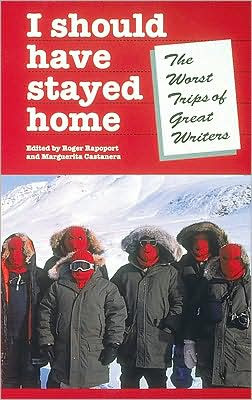
I Should Have Stayed Home edited by Roger Rapoport and Marguerita Castanera

Today I'm here to talk about keeping reading. This year I've had a lot of things that kept me from reading as many books I did in past years -- you may have had some similar distractions in your own life in 2020. But you're probably here reading this blog because you like books, like being the person who reads books for leisure, and want to reinforce that habit. So those distractions are doubly annoying: not just in themselves, as all distractions are, but because they push you away from doing something you really want to do.

This isn't the book I thought I was going to be reading next. I've gotten back into a rhythm, and am avoiding the anxiety of choice by going shelf-by-shelf through the unread books, picking one from this shelf and then one from the next. (Choosing among 35 books or so being much simpler than choosing among several hundred.) So I picked up what I think is still the newest novel by one of my favorite writers -- a bit longer than what I've been reading lately -- from the next shelf along and settled into a big chair, expecting to love it.

But it wasn't the right book, or I wasn't in the right mood. I got one chapter in, but it took most of a distraction-filled weekend day. For years, I didn't give up on books -- when you're reading professionally (and reading at the speed I was), you just power through to the end. Now, I'm quicker to realize time is limited and the world is infinite: so put down that book immediately if it's not what you need or want now. We all have options.

Another book on the same shelf was this one: I Should Have Stayed Home, a collection of short travel writings from 1994. It was shorter, made up of short pieces to begin with, and, most importantly, much closer to what it seemed like I wanted to read at the time.

So, instead of reading a novel by a writer I love, instead I read fifty essays by...well, let me be generous and say that some of them were world-famous travel writers. Others were loosely associated with the small Northern California press that published this book and/or the store Book Passage and its related travel-writing conference (which is still running), and several have the kind of bios in the back that made this former editor cringe.

I doubt any of you have ever heard of this book, will ever see this book, or would ever make any effort to find or read this book. But I bought it randomly at some point, it was sitting on that shelf, and it was a pleasant-enough thing that kept me from sitting with a bookmark in that novel (which I am never going to name) for the next six months.

I'm probably slandering I Should Have Stayed Home here. The pieces included -- they're all vignettes or short narratives rather than essays or fully-formed stories -- are almost all funny, all at least solidly written, and none of them outstay their welcomes. Sure, the subtitle "the worst trips of great writers" is slightly hyperbolic, but it definitely has a lot of bad trips (and bad in amusing ways) of many writers (at least a handful of whom are clearly great). So that's close enough for blurb purposes.

The famous here include Rick Steves, Paul Theroux, Tony Wheeler, and Jan Morris, plus a bunch of novelists (Isabel Allende, Joe Gores, Barbara Kingsolver, several others). There are also a lot of people who were writing travel pieces, particularly for San Francisco-area markets, in the early '90s, most of whom were not then great or famous and did not become so later.

But I'm not great or famous myself, so it's not a big deal. Editors Roger Rapoport (owner of the RDR Books that published this as well as a contributor) and Marguerita Castanera (one of the organizers of the conference and the person I suspect did most or all of the work making this book happen) did a good job of pulling together an entertaining themed collection. Most of the proceeds of this book were also donated to Oxfam America, which is a noble cause -- I don't quite see the connection to travel writing, but that's a quibble.

Again, I could have a lot of quibbles. It's a book made up largely of quibbles, and it was built from those quibbles over twenty-five years ago. The world has changed hugely since the trips chronicled in I Should Have Stayed Home happened -- that's the eternal issue with travel writing, that everything is different almost immediately everywhere.

It's a Heraclitean river, I guess. If you do randomly encounter this book -- maybe if it's the only thing in English to read in some youth hostel in a country foreign to you, as night falls and you're stuck far from home -- it can entertain you for the hours it takes to read. And that's definitely not nothing.

Monday, November 23, 2020

Reviewing the Mail: Week of 11/21/20

One book this time: it came from the library (and was actually sitting there, on the reserve shelf, since before the last batch of library books. Quarantine restrictions made things complicated, and I had to renew it before I even picked it up the first time!)

I hope anyone who knows anything about comics already knows about this book. If not, you likely have a deeply blinkered view of what "comics" is -- it won two Eisner Awards and was probably the bestselling work of comics last year.

So, anyway, I'm finally going to read Raina Telgemeier's Guts. It's her third book of graphic autobiography, after Smile and Sisters. This book has a younger Raina, I think, than even Smile: she's in late elementary school here, those years when the worries of the world start catching up with smart, thoughtful kids and they realize just how much is going on, and how little they control or understand. My understanding is that it's a story of anxiety. And anxiety has a long history in comics, of course:


Friday, November 20, 2020

Quote of the Week: Culinary Standards

The idea of getting something to eat in the subway, which is filthy and foul-smelling, struck me as insane, but I suppose if you are a New Yorker in a hurry, and do not care if you live or die, or perhaps do not believe in the germ theory, it's something you might do.

 - Daniel Pinkwater, Adventures of a Dwergish Girl, p.85

Thursday, November 19, 2020

Paper Girls, Vol. 6 by Vaughan and Chiang

I'm glad a I waited a year to finally read the end of the fun but overly-complicated Paper Girls series: I was basically hate-reading the earlier volumes, despite their many strong qualities (see my posts on volumes one, two, three, four, and five), and the extra year gave me some distance.

I mean, yes, Paper Girls, Vol. 6 is still obvious and jarring, full of elements that are thrown in seemingly because writer Brian K. Vaughan likes them or artist Cliff Chiang really wanted to draw them. The story doesn't track at all from beginning to end of Paper Girls, and this conclusion is largely driven by newly-arriving characters asserting things confidently that we the readers (and the main characters) have no reason to believe and every reason to doubt. But Vaughan and Chiang needed to end the thing, so they did, with all of the blood and thunder at their disposal.

Now, Paper Girls was always a great-looking series. Every page was glorious. The writing on a page-by-page basis was equally good, frankly -- it's just when those pages add up....or, more accurately, failed to add up in important ways...the overall story turns into less than the sum of its parts. Vaughan does the SFnal equivalent of the old Chandlerian "have two guys with guns come through the door whenever you get the plot confused" a couple of times in this volume alone, and it's probably the best metaphor for the series: Paper Girls is just groups of two guys with guns, coming through doors over and over again until finally it ends.

But it's just comics, right? As look as it looks cool and makes superficial sense -- and there's really cool ideas and images -- we don't care about little things like plot and story and believability, right?

(Maybe some of you.)

The best time-travel fiction makes the reader pay close attention and challenges her thoughts and assumptions. Paper Girls asks the reader to lay back and watch as a sequence of crazy stuff happens, and not to ask too many questions about how all of the crazy stuff connects in a coherent way. For readers who want kinda-OK time-travel fiction, that might be enough.

Wednesday, November 18, 2020

Giant Days, Vol. 7 by Allison, Sarin, Fleming & Cogar

I took a nearly two-year hiatus from reading Giant Days, patiently waiting for the publisher, Boom! Box, to put out more hardcover Not on the Test compilations. But as it has been two years, and no further hardcovers are showing up even on forward publishing plans, I have to assume that Boom! Box have done the all-too-common publishing thing of realizing Plan X was not feasible/profitable/possible and quietly scrapping it without telling anyone.

So I'm back to the trade paperbacks with Giant Days, Vol. 7, blinking in the light and trying to remember who everyone is and what happened in the last issues I read around Christmas 2018.

(See my previous Giant Days posts: Volumes one, two, three, and four, Not on the Test 1 & 2, Not on the Test 3, Extra Credit.)

This volume has stories set during the Christmas break of their second year (of three, in the British style) and through the dark days of winter immediately following. As usual, each issue has a self-contained story -- Giant Days has always been a series easy to drop in and out of, to pick up at basically any point. Sure, it's better if you know who the characters are and what they've gone through, but the action of any issue stands on its own; you never end up in Part 8 of the Great Grade-Fixing Scandal plotline.

So here we have an issue about the holidays, mostly with Susan and her bevvy of sisters, an issue mostly about McGraw and Ed's horrible housemate and his MMORPG love, an issue in which Ester's new enthusiasm is fighting The Man (specifically The Man as exemplified in a big corporation that owns franchised grocery stores), and an issue in which there are mysterious and frightening noises in the garage attached to the women's apartment, which exacerbates other interpersonal-problems but is solved via Cute Overload.

That should be vague enough that those of you who haven't read these issues won't be spoiled, I hope.

As always, John Allison writes zippy, fun dialogue and creates fully-rounded, deeply imperfect people. The artists (Max Sarin pencils, Liz Fleming inks, Whitney Cogar colors) give it a great dynamism, pushing the humor levers just far enough but not too far -- this is a funny series about people, rather than a pure humor book full stop.

So, yeah, this is still great, and I have seven more books like this to catch up on. Luckily, my local library system has all but one of them, so there will likely be a series of shorter and shorter posts about further Giant Days volumes over the next few months.

Tuesday, November 17, 2020

Nobody's Fool by Bill Griffith

It is an odd and interesting thing: the biography of someone whose life is badly-recorded and full of gaps. It's even more quirky when that person didn't really do anything in his life, and even the records of where that person was are messy and often missing.

But Bill Griffith, cartooning king of all things pinhead-related, wanted to tell the story of Schlitzie the Pinhead, the second-most famous real-world pinhead [1], even though Schlitzie's origins are disputed and his life basically consisted of being dragged around the US so people could gawk at him for fifty-plus years.

The result is Nobody's Fool, a graphic novel about a person who may have been born Simon Metz around 1901 in the Bronx, and definitely was buried as Schlitzie Surtees in 1971 in California. Schlitzie was male, but the characters he "played" on stage were more often than not female -- because that made the fake "savage" stories more shocking, because he was less than five feet tall, because it was a random carny idea that stuck, or for some other random reason, we don't know.

The list of things we don't know about Schlitize, though, are long. Well, "we" don't know much about any random person born in 1901 and dead since 1971 -- if that person did public things, they'd be recorded, but most of us live our lives in private, and those lives all die as the people we knew die. The people Schlitze knew are from a world that's been gone for over sixty years, and they were marginal people to begin with -- many of them with physical deformities or other health issues that shortened their lives, all of them living on the fringes of society, traveling from town to town to be exhibited as "freaks.".

And Schlitzie, who I have to guess had some kind of development disorder -- Griffith doesn't speculate, or provide an armchair diagnosis -- didn't leave any kind of records himself, and didn't live the kind of normal life (marriages, children, buying real estate, making business deals, joining clubs, working for companies) that generated the usual records. So we have third-hand stories and speculation and some informed guesses, random datapoints and decades-later interviews with people who knew Schlitzie.

It all gives Griffith a series of scenes, mostly of Schlitzie on stage or doing performance-adjacent tasks, since that's the parts of his life than anyone knows anything about, fifty years after he died. But what did he feel? What did he think? We don't know, and we'll never know. Griffith doesn't even try to define what Schlitzie could and couldn't do -- we know he liked to wash dishes, and that he had a larger vocabulary than other "pinheads" on the same circuit at the same time. But that's about it.

So what Griffith has here is a sequence of pictures, a sequence of events that probably happened, more-or-less. We get to look at Schlitzie, the freak, acting weird, performing in sideshows and in the 1932 movie Freaks. We're told stories about his origins that are probably more true than those told at the time -- last of the Aztecs! half-monkey, half-human!, the missing link! -- but aren't really "true."

This is still a sideshow. Schlitzie is still being paraded in front of a crowd to show off how weird and inexplicable he is. What he was like as a human being is still tertiary at best. Griffith cares about Schlitzie and his life, but he just doesn't have the materials to tell this as a story. It's just disconnected moments featuring someone with no agency and little understanding of anything that happened to him.

So this is a deeply sad book, even if it's about a person who seems to have been relatively happy, as humans go. In a hundred years, this may be all anyone ever knows about Schlitzie Surtees. And we'll still know nothing about Simon Metz.


[1] After Zip-the-What-Is-It, who seems by all accounts to have been a perfectly mentally "normal" African-American man who figured out a weird career for himself and ran it for all it was worth to the end of his life. That is probably a more interesting and meaningful story, but it's not a pinhead story.

Monday, November 16, 2020

Reviewing the Mail: Week of 11/14/20

This week, I have one book that actually came in the mail: that will come first. And then I have a box of graphic novels and comics that came in just after I'd written last week's post (late last Saturday, I want to say).

The Midnight Circus came in the mail: it's a new collection of short stories from Jane Yolen, and I guess something of a dark companion to 2017's The Emerald Circus. Yolen's introduction, titled "Who Knew I Was a Writer of Dark Stories?" makes the point of this collection clear: it's her darker, creepier work, or the best of that, at least. (It's not what Yolen is known for, but in fifty years of writing, you can do many things.)

So Midnight contains sixteen stories, originally published between 1974 and 2013, plus story notes, some poetry, and introductions by Yolen herself and Theodora Goss. It's published by Tachyon, and available right now in trade paperback. Yolen has been writing good fantasy stories -- usually but not always for younger readers -- for as long as I've been alive. And I mean that entirely literally, as I realized when I looked at her extensive card page -- her first young-readers novel, The Wizard of Washington Square, was published in 1969.

And now we get into the comics I bought myself, but first a consumer note. I started shopping at the online store belonging to a certain large comics shop located centrally in the large city nearest to me, but didn't quite find enough to get to their free shipping level. So I abandoned that cart, as we say in the marketing biz. A couple of days later, an email arrived, offering an additional discount. Now, I'm not saying to do this all the time to see if you can save some money...but it's worth trying.

The Handbook to Lazy Parenting is the fourth in Guy Delisle's loose series of small, funny books about his foibles as a father. The first three are The Owner's Manual to Terrible Parenting, Even More Bad Parenting Advice, and A User's Guide to Neglectful Parenting, all of which I've written about here. And I'm wondering what the deal is: the first three books came out between 2013-2016 in English (and slightly earlier in French, since the author is French Canadian, married to a Frenchwoman, and living in southern France). This one was published in 2019, but looks to have his kids at exactly the same ages as the earlier books, which -- as you know, Bob -- is usually not the case for children in any real world. So I'm not sure if Delisle came back to the same material five years later, if this was a collection of "the rest of" these strips, finally turned into a matching book, or something even quirkier. However it happened, Delisle is a funny cartoonist, and I expect this will be a lot of fun.

Department of Mind-Blowing Theories is the new (well, Spring 2020, so new-ish) collection of cartoons by Tom Gauld, generally on science-y topics. I believe most or all of these originally appeared in New Scientist, where Gauld has a weekly slot. It's in the same basic format as Gauld's earlier books Baking With Kafka (which had cartoons about literary figures, from The Guardian) and You're All Just Jealous of My Jetpack (both of the previous categories, plus more general work -- it was Gauld's first book of collected cartoons). Gauld is funny in a smart way -- probably the best science cartoonist since Sidney Harris -- and I expect this will be another excellent book, not the least because I've already seen a whole bunch of these go whizzing by on Gauld's Twitter feed every week.

Love and Other Weird Things is a book of single-panel cartoons by Rich Sparks, about whom I know very little. The cartoons here appeared in various places: The New Yorker, The Wall Street Journal, American Bystander, Weekly Humorist (the last two of which seem like fake names where the plucky rom-com heroine works in some movie, but I gather they are actually real and I shouldn't make fun of them) and probably others.

I'm kinda vamping here, since I don't have much to say, but I need to add some more text to balance out the image. Have I mentioned how annoying the new Blogger edit window is? It's another one of those late-web-era products that removes useful functionality for whatever reason, leading the users to conclude the product is either in a death spiral or just run by people who hate their users. Hey -- maybe both!

House of the Black Spot is a small graphic novel by Ben Sears, and I know even less about Sears than I do about Sparks. I got this for a few reasons: I want to read more new stuff, and I'm rarely in comic shops to actually browse books there. Sears has an interesting art style, which reminds me a little of Brandon Graham. It's published by Koyama Press, which has a great reputation for doing artsy comics, and I've never bought a book they published, as far as I can remember. And it was pretty cheap, too: list price is just twelve bucks. So all that added up to: might as well try it!

I recommend similar leaps in your own lives: find the next cheap thing over from stuff you like, and give it a try.

Next up is The Bus 2 by Paul Kirchner, continuing the loose theme of odd little books that I don't know a whole lot about. This whole shopping trip was made up of things that were crazy inexpensive after the discount That Comic Shop gave me, which led to a what-the-hell! feeling on my end.

So...I'm not sure if there ever was The Bus 1. That might be part of the joke. If it did exist, it probably was forty years ago. This book has a bunch of wordless strips about The Commuter (the bald trenchcoated guy on the cover) riding a '70s-era city bus, where surreal things happen.

I know I heard about this somewhere, but I forget why or in what context. It was published in 2015, so I've probably been vaguely looking for it since then. And, again, I'm not really sure why: but it does look quirky and specific enough to make me happy.

The Brontes: Infernal Angria is the opposite: a book I found through random searching on That Comic Shop's website, which I would have bought at publication (in 2018? I think?) if I'd know it existed. It also seems to have had a long, convoluted timeline, since it's copyright 1998-present and refers to winning a 2004 Xeric grant. Anyway, this is written by Craig Hurd-McKenney and drawn by Rick Geary, and it's a fictionalized (I think) version of the lives of the young Brontes, complete with actual interdimensional travel to the fictional land of Angria that (in the real world) they created in their juvenalia. 

It is not available on Big River Bookstore, where most of my book-buying links lead, but a digital version is available on their Comixology site, for those interested. This also does exist as a real physical book, since I'm holding it in my hands right now.

Royal City, Vol. 3: We All Float On is, I think, the ending of the series by Jeff Lemire, about a dysfunctional family in a hardscrabble blue-collar town that has seen better days. I'm coming to this slightly late -- I think this series wrapped up entirely in 2018, since Lemire is generally dependable and puts out his comics -- all of them, the seemingly millions of projects both indy and Big 2 that he juggles all the time -- on time. Anyway, I read the first two volumes -- Royal City and Sonic Youth -- in 2018, when they were published, but lost track when a big change in my working life coincided with the end of Book-A-Day 2018 and my reading crashed for an extended period of time.

So this is another series where I'm hoping I remember it well enough to finish up. But I've got faith in Lemire: I'm pretty sure he can remind me.

And last is one more Jeff Lemire book, because (as I just mentioned) I need to catch up on a lot of things. As far as I know, Frogcatchers is a standalone, so probably more in the vein of Roughneck and The Underwater Welder, The Nobody and the three stories of the Essex County trilogy. That Lemire is usually deeply dressive, all about men in left-behind parts of rural Canada and all of their troubles. Frogcatchers looks to be more SFFnal than most of those stories -- maybe somewhere in the vein of The Nobody, which had a fantastic element -- but I expect it will not be a terribly happy story. The stuff Lemire draws doesn't really lean towards happy.

Friday, November 13, 2020

Quote of the Week: We Gotta Get Out While We're Young

And when I talk about how boring it is to live there, and how I wanted to leave, that is not to say that, while boring, life there is not sweet. And I love all the Dwergs. It turns out you can love persons or a place and still find them or it boring, to the point of unbearable.

 - Daniel Pinkwater, Adventures of a Dwergish Girl, p.14

Thursday, November 12, 2020

A Fire Story by Brian Fies

Nobody would want Brian Fies's career, not matter how many books he sells and how many awards he wins. Two of his three major books to date have been pure "making lemonade" activities: he went through things no one wants to and came out the other side to write about them.

First was Mom's Cancer, which was about exactly what you're thinking it was. In between was the fictional Whatever Happened to the World of Tomorrow? And his new book for 2019 was A Fire Story, because his house burned down in the October 2017 series of wildfires in Northern California.

So if I say that I hope Fies's career takes a different tack in the coming years, that's what I mean: I hope he doesn't have any more tragedies that launch books. He's due for a happy book, or three, or five.

A Fire Story started out of immediacy: Fies wrote and drew a twenty-page version of this story a few days after the fire, when the pain was raw and he and his family had just realized what "we've lost everything" means. He posted it online, and it was seen around the world -- hundreds of thousands read Fies's comic, and a few million saw an animated version made by the San Francisco PBS station (which also won a local Emmy).

The book version of A Fire Story came about a year later, which means it's still pretty raw and immediate -- I have to imagine Fies writing and drawing this in temporary housing or rented houses, waiting and hoping to get back to the normal life that burned up.

The story here starts from those initial pages -- redrawn, cleaned up, expanded, but those first panels are all here in new forms. This is how Fies and his wife woke up in the middle of a Monday night, grabbed a few things, and fled a house that then burned down before the night was over. Fies expands that story in multiple ways -- he brings in more of his family, including the grown twin daughters who take in Fies and his wife after the fire; he adds the narrative of several other people whose houses were burned down, so this is no longer just his story; and he continues though the beginning of rebuilding, showing scenes of sifting the ashes [1] and dealing with the insurance adjuster.

A Fire Story is powerful, direct, and personal: Fies went through something horrible and had the skills to present its horrors clearly and precisely to the world. It's a book to be deeply ambivalent about: do we wish it never existed, because Fies's house was instead saved? Do we rationalize that there are always houses that burn down, somewhere, and at least this giant wildfire resulted in some great art?

I don't know how I feel about it. I'm glad Fies was about to squeeze this lemonade and still wish he hadn't had to. Maybe, at best, it can help those of us who have not lost everything understand it a bit better: I've been known to whine about my 2011 flood, which destroyed an entire basement but left the rest of the house intact; and that's minor compared to what Fies suffered.

But  A Fire Story is a major graphic novel, no matter what else. And Fies shows that he has not just the artistic chops, but the resilience and clear vision to do it. I just hope that his next project requires the chops and maybe the vision, but not the resilience.


[1] This is not a metaphor. One of his daughters is an archeologist, and uses a rocking screen on the site of their burned house.

Wednesday, November 11, 2020

Adventures of a Dwergish Girl by Daniel Pinkwater

I don't mean to alarm anyone, but it's been eight years since the last Daniel Pinkwater novel, Bushman Lives! It's yet another indication of how this really is the worst of all possible worlds: Pinkwater previously had a string of five novels in a little over a decade, starting with the excellent The Education of Robert Rifkin and then running through a loose series of books set in what Your Commentator likes to think is a fantastic version of Pinkwater's own childhood haunts.

Maybe that left him thinking he'd told that story; maybe he moved on to more interesting things for a while. Pinkwater is a wonderful, unique writer, who I've read with joy and eagerness for several decades, so I want to believe everything that happened was exactly because he wanted it that way, and that he's happy and productive in that fabled Hudson Valley house of his.

 Anyway, it's been too long. But Pinkwater is back with another novel for smart, quirky young readers -- and all of us who were those kids once upon a time and can still remember what that was like. Adventures of a Dwergish Girl is not set in the loose sequence of Pinkwater's novels of the Aughts, but dwergs were mentioned in those books, so...it's set in that loose shared Pinkwaterian world, definitely.

It's not super-clear when Dwergish Girl takes place: the closest thing to a timestamp is that our heroine's parents left their woodland home to go into the Big City once to see a Gidget movie, when they were young, and decided that was not for them. If that movie was new then, and it's now around twenty years later (Molly is sixteenish), then Dwergish Girl takes place in the early '80s. If not....not.

You see, dwergs are a clannish, reserved people who live in the woods of New York State's Hudson Valley, near Kingston, and have done so, in the same ways and places, for centuries. They're small in stature, large in feet -- homebodies who dig for ore and mint gold coins but have only slight contact with the outside world, mostly through various "Englishmen," human go-betweens. They're not dwarves or hobbits, but they're somewhere in that realm. And they know the woods better than any human could; their small village is so well-hidden that no outsider could ever hope to find it or stumble upon it.

This bores young Molly O'Malley. She's cosmopolitan for a dwerg -- made it through a year and a half of high school in Kingston, when most dwerg kids drop out earlier than that. And she wants to see more of the world than the trees around their village, to do more than marry some dwerg boy and spend her evenings humming for the rest of her life.

So she tells her parents what she's going to do, [1] gathers some things, and moves herself to Kingston. She gets a job cleaning up Babtunji's Authentic Neapolitan Pizza -- which is badly paid, but she's going to live in a field behind the restaurant and eat mostly free pizza, so it's paradise for her.

Dwergish Girl ambles on amiably from that point, as it ambled up to that point, strongly narrated by Molly. She's young and interested in the world but not part of it, being a dwerg. Since this is a Pinkwater novel, she will not be the weirdest thing going on in Kingston that year -- and she will have to be part of the solution to a particularly nasty weird thing.

But a Pinkwater book is not about plot, or tension -- Dwergish Girl less so even than many of his earlier books. It's a loose, wandering book, following Molly as she makes some friends and searches for a place in the world that could fit the particular dwergish girl she is.

I wouldn't say Dwergish Girl is one of Pinkwater's very best books: it's a bit too loose and quiet for that. But it's got a wonderful voice in Molly, and a clear point of view and a sequence of interesting people and places to look at. It's a fine book by one of America's most wonderful writers, and it's hugely welcome after such a long absence.

And, perhaps best of all, there's room for a sequel, or another novel about someone else that takes place after this one. Let's hope that happens.


[1] Yes, exactly. Pinkwater protagonists are always deeply sensible, no matter where they are or what they're doing. His world is smarter and better organized than our own, on top of being more quirky and full of wonders.

Tuesday, November 10, 2020

Be Prepared by Vera Brosgol

Unhappy childhoods make for more interesting books than happy ones: can we agree on that? I've seen several Boomer nostalgia vehicles that were basically "everything was for the best in the best of all possible worlds when I was free, white, male, and seven years old," and they're all deadly dull at best.

Unhappiness leads to better stories: writers don't have to suffer, but it definitely gives them better material.

Vera Brosgol has some pretty good material; she off-handedly mentions things both at the beginning (growing up poor among spoiled rich girls in Albany, NY) and the end (moving suddenly to London at the age of ten) of this book that look like they could be full graphic novels of their own. But Be Prepared is the story of one summer at camp...well, a little about the months leading up to that summer, and how she got to that camp, but all focused on ORRA.

Maybe I should back up slightly -- Be Prepared is the story of a girl named Vera, but Brosgol's afterword explains that it's not purely autobiographical. The general outlines are correct, but she went to the ORRA camp for two years, not one, and events have been shaped here to make a better story -- including details from other campers, such as her younger brother. Readers who demand absolute factual accuracy will be crushed; those who like stories about people will be much happier.

I fall into the second camp.

(Hah! "camp". Pun not intended.)

Brosgol is not a new hand at this -- her previous graphic novel Anya's Ghost also drew on her being-an-odd-Russian-kid-in-America childhood, but in a clearly more fictionalized and fantastic way. (The title is not a metaphor.) That was also a damn good graphic novel, just like Be Prepared. Brosgol is creating stories aimed at younger readers -- my guess is upper elementary school, maybe shading into middle, since the rule is that kids hate reading about anyone the slightest bit younger than themselves -- but they're smart, well-told stories that can only come from adult distance, and that makes them just as good for adult readers.

Anyway, young Vera feels like an outsider -- her friends are more affluent and "American" than she is. But there's a summer camp affiliated with her family's Russian Orthodox church, and so she thinks she wants to lean into being Russian -- that will be where she finds girls just like her, and the best friends of her life, right?

Unfortunately, wrong. Young Vera is introverted and a bit quirky -- like all the best people -- and the ORRA camp is cliquish in its own way, with traditions and history and skills she knows nothing about. Plus an outdoor latrine, which is a whole different kind of reality check.

So she's quickly writing letters home begging to be saved from the camp she spent so much time begging to go to. But her mother is busy, so that's not going to happen. Young Vera is just going to have to make it through camp -- find a friend on her own, find things that make her happy, find things she can be good at. She does: it works out.

It turns out this isn't the kind of unhappy childhood caused by outside events -- well, it is, partly, because being poorer than people around you is never a happy thing -- but mostly because young Vera is the kind of person who has trouble being happy. (I know that kind of person well; I'm one, myself.)

And, again, Be Prepared is published specifically for kids, and in particular kids who are their own flavors of weird, unhappy, different, and introverted, but Brosgol is a great storyteller. Her drawings have life and verve to them, with lots of clear emotion in her kid characters, and she structures the story well. I might even give this the highest praise: Be Prepared is a book even for those few bizarre kids who enjoyed camp.