Monday, December 20, 2021

Reading Into the Past: Week of 12/20/99

Some weeks, I get new books, and write about them here for a Monday morning. When I don't have anything new to mention, I write about old books instead, digging into my reading notebooks to see what I was reading "this week" sometime during the stretch when I was keeping track of books read but not cataloging those books in this blog. (That's roughly 1991 to 2007.)

This week, it's Option Two, and the year I'm heading back to is 1999:

Gregory Benford, Eater (bound galleys, 12/12)

I read this for work (I was Senior Editor at the SF Book Club at the time), and I'm pretty sure I bought it for work. I feel like I've only read Benford's more straightforward books - not the wide-scale, galaxy-spanning crazy-hair stuff, just the more near-future, serious-science books. (And I wonder how that happened, since my personal inclination is very much the other way.) This one is about a wandering black hole that comes into the solar system and turns out to be intelligent, or inhabited, or something like that -- I forget the exact details twenty years later. I think there was a lot of "political leaders argue about what to do," which is the failure mode for a lot of Hard SF: that's what would happen in most Hard SF situations, but it's deadly boring to read about.

Frankly, I have more memory of the packaging of this book than the story. Avon was experimenting with what I thought of as "non-SF" look for a lot of their books: usually small-format hardcovers, design-y covers without SFnal art. It wasn't trying to look like literary fiction, which is the usual thing - it was, I think, trying to make an entirely different visual identity for a certain kind of SF. I don't think it worked, in the end, but it was really interesting to watch them try.

James Lee Burke, Heartswood (12/14)

I thought this was a Dave Robicheaux book, since I read all of them up to about this point, but I'm wrong: this is from another, loosely related series about Billy Bob Holland, a defense attorney in Texas (not a on-and-off police detective in Louisiana like Robicheaux). I remember absolutely nothing about Billy Bob, not even that I read any books about him. I do have vague memories of Dave: he was an alcoholic, and some of the books about him walked the line between delirium tremens and magic realism in a really exciting way. (I want to say In the Electric Mist With Confederate Dead is the high point there, but my memory is not reliable.)

Billy Bob's books, as far as I can see, are more conventional than Dave's; that may be why I read fewer of them, as I slowed radically down on reading mysteries. The Dave books came closer to the borders of the kinds of genres I was still reading a lot of, so they stayed in the mix longer.

Linda Barnes, Flashpoint (12/16)

The title makes me think of the DC Comics crossover (which I never read), and that doesn't help bring this book to mind. This was a mystery novel, in a series about Boston PI (and cab driver, I think) Carlotta Carlyle, and I don't remember the details of this story. It was fairly new at the time; I probably got it through work.

Fred R. Shapiro, Stumpers! (12/17)

Stumpers-L was an internet group, made up of mostly reference librarians, that answered weird and hard-to-research questions for each other. Basically, some patron would ask how much German potato salad would be needed to fill Death Valley to sea level, or what was the name of Genghis Khan's third-favorite horse's sire, or something equally random, and it would get posted to that list, and someone would be able to give an answer.

The group became a book, as all things on the Internet - especially the early Internet - turned into books. This is that book; it was published in 1998 and covered queries from the previous six years.

It's sad and amusing to look back at what the Internet was and could have been before social media and commerce colonized it for all of the worst impulses of  mankind: this was the kind of thing we thought there would be a lot more of. Sadly, more people want to have their prejudices validated and to buy junk than to learn the truth about anything.

The Stumpers-L site now gives a "could not be found" error. Of course.  

James Frenkel, ed., Technohorror (12/18)

I'm pretty sure this was a reprint anthology of SFnal horror stories (or horrifying SF stories, depending on how you want to spin it). I read a lot of random anthologies in those days, because, although we said then that anthologies didn't sell, they sold better then than they do now. (Though less well than they had a decade before, and so on back to the early days of SF.)

According to ISFDB, it has 16 stories, including "Pretty Maggie Moneyeyes," "The Veldt," "That Hell-Bound Train," and "Descending." Looking at the TOC there, it's pretty much exactly the horror SF anthology you'd create in about 1999 if you had the budget and a bend towards the classic. It's more of a '60s-'70s-'80s anthology than something really current at publication date, but it looks really solid for that era even now.

Cathy Fenner and Arnie Fenner, eds., Spectrum 6 (12/19)

I definitely can't remember which pieces of art were in this one. I eagerly grabbed each of these annuals for nearly twenty years - for a few years after I left the SFBC, since I had a vain hope for a while that I could get back into the SF field. (You can never get back. Once out, there's no way back in.) I'm sure this was an awesome book: all of them were. This was a series of the best fantastic art across a wide variety of areas: advertising art, books, movies, and so on. They might still be awesome books; I'm not sure if they're still coming out. 

Friday, December 17, 2021

Quote of the Week: They Were All in Love with Dyin'

Long story short: I was secretly looking forward to the gun range experience. One of the big drawbacks with being left wing is that you aren't supposed to want to blow shit up, which is purely unnatural in any full-blooded Texas male. My feeling is, if you're a James Taylor/Simon and Garfunkel liberal, you definitely aren't allowed to pick up a gun, but those of us in the Sex Pistols/Butthole Surfers crowd get a little more leeway for random acts of violence.

 - Sean Stewart, Perfect Circle, p.86

Thursday, December 16, 2021

No Ivy League by Hazel Newlevant

Comics memoirs don't have to be about something life-shattering that happened when you were younger. It just seems that way sometimes. And, to be honest, any book should be about something important: one old piece of fiction-writing advice is that a story should be about the most important thing that ever happened to that person. [1]

Of course, not everyone has a father who survived the Holocaust, or fled their birth country when very young because of upheavals, or was unable to speak for months at a time, or had a major intestinal condition as a middle-schooler, or...so on. But everyone's life was changed, at least once. So everyone has at least that one story to tell.

Hazel Newlevant is a relatively young cartoonist, about a decade into their career. No Ivy League was their new graphic novel for 2019; my sense is this was a bigger book, maybe more of a breakout book, than Newlevant's previous work. I could easily be wrong: but the "Comics" page on Newlevant's site seems to mostly have shorter pieces. My sense is that cartoonists list all of their work until the list gets too long, and then prune down to book-length works and either just "Shorter Stories" or a couple of categories of those shorter pieces.

This is a story about a seventeen-year-old named Hazel. From the afterword, it's based on Newlevant's real life, with details changed for everyone else (like so many memoirs). Now, I want to apologize if I screw up pronouns from here on: Newlevant's site describes theirself as transmaculine and uses they/them pronouns, but the Hazel in the book presents as female and uses she/her. This is not a transition story: it's a story about a person who later transitioned, and I'm going to try to be precise in talking about Hazel (the seventeen-year-old character in the memoir) and Newlevant (the decade-older person who made the story).

Hazel is a high-achieving homeschooled kid in Portland, Oregon. She seems to be an only child, the kind whose parents poured everything they ever wanted into her upbringing, and that's the kind of homeschooling she had: the regular-schools-aren't-good-enough-for-my-awesome-child kind, not the keep-my-brood-away-from-secular-temptations kind. She has a small group of other homeschooled kids she hangs and works with regularly; they're making videos for a national contest to promote homeschooling with the hope of using that money to go on a road trip the coming fall to see the band Guster in concert.

Another making-money scheme is a summer job: Hazel gets hired into No Ivy League, a youth group that will spend the summer removing invasive ivy from Forest Park, a gigantic semi-wild area in the city. There she's thrown in with a large group of other kids her age for what may be the first time in a long time: certainly the most mixed group that she's ben part of, in race and background and outlook and life experience.

The bulk of the book is about Hazel's time with that group, for good and bad. She learns to play ultimate frisbee and gets sexually harassed; she works hard and has to deal with people very unlike those she's used to. There's no one lesson, no one big thing - she does get sexually harassed, but just once, briefly, and she reports it. The aftermath is messier, since it leads to her harasser being kicked out of the program, and everyone knows it was because of her.

(This is also mildly parallel to a very inappropriate flirting that Hazel carries on - one-sidedly, only from her - with one of the adult leaders. She says things to that leader arguably as bad as what was said to her, and does it over a longer period of time.)

The biggest piece of the experience is Hazel realizing how insulated homeschooling has made her, and how it's intertwined with her privilege. Like the grind she is, she tries to fix the situation by reading a bunch of books and learning better. (It's not the worst reaction, certainly! Frankly, it might be about the best possible one.)

No Ivy League is not about A Problem in the way so many memoirs are - or, if it is, the "problem" is vastly larger and ubiquitous. Hazel can't solve the problem, and it's not her problem the way it usually is in comics memoirs. She can learn more, and understand better, but all of her vegan living and good intentions won't change that most of No Ivy League is made up of "at-risk youth," and all of the ways that's coded, and all of the ways all of those kids have not been set up to succeed a tenth of the way she has.

Hazel does learn; she does do better. And one hopes the reader learns alongside her. I'm pretty sure that's why Newlevant chose this story to tell: it's a story about a young person learning more, and doing better. My sense is that No Ivy League is aimed at people like Hazel - young, well-meaning, probably more privileged than they realize, and in need of something to make them pop their heads up and look around.

Newlevant tells that story in a mostly quiet, naturalistic way. Their lettering is softly rounded, the art is watercolor but mostly in shades of greenish gray, the people are a little bit cartoony but their surroundings are precise and real. This is not a story that will hit you over the head; it will creep around the sides until you're right in the middle of it without realizing. Even if you're not a privileged seventeen-year-old, No Ivy League has a lot to offer.


[1] It's not perfect advice, obviously - what about series characters? But it's good new-creator advice, to focus on stories that really matter to your characters. And "your characters" are "you" for the autobio cartoonist.

Wednesday, December 15, 2021

Alternate Routes by Tim Powers

I missed this one, somehow. I've been a big Tim Powers fan - Stress of Her Regard was the first book I read new, I think, so I probably discovered him in the mid-'80s, highschool or college days - but I'm out of the loop this decade and his most recent books are coming out from Baen, of all places.

So I happened to notice recently that he had a two-book series - Alternate Routes, from 2018, and last year's Forced Perspectives - that seemed to be contemporary fantasy novels about cops in LA. (That's not exactly right, though the two main characters were, or maybe still are, in law enforcement, in odd Powersian ways.) They were shorter books than his usual, and came out more quickly than he usually does, which sound like good things from a reader's point of view.

Alternate Routes is a Tim Powers novel, with all of the expected ingredients: regret, broken lives, Catholicism, fantasy elements that are grounded and often unpleasant, something going badly wrong and a few damaged people who are in a position to fix it. I tend to think his historical books are weightier than his contemporaries: maybe it's that they take that much more out of him, in research and construction to make all of the tiny bits of history line up with his inventions. This is a contemporary novel, like its predecessor Medusa's Web and his '90s novels; like those, it's set in Los Angeles.

Sebastian Vickery was an LA cop turned Secret Service agent, until he accidentally heard something he shouldn't have and a secretive government agency tried to kill him. That was a few years ago; he's been hiding, off the grid, since then. He works as a driver for a woman with a collection of businesses that seem to be mostly technically legal but also largely caught up in the secrets of the ghosts generated by deaths on freeways.

Ingrid Castine works for the same agency that nearly killed Vickery, the Transportation Utility Agency (TUA), headed locally by a brilliant scholar who renamed himself Terracotta. Terracotta is clearly both just barely sane and intensely searching for some transformation/exaltation that is not exactly the goal of the larger TUA. Much of Castine's work is interrogating "deleted persons" (the TUA calls them that; others call them ghosts).

The book opens with the TUA finding Vickery, and trying to kill him again. Castine does not go along with it; she ends up on the run with Vickery. At first, the goal is to get her connected back to whatever of her old life she can continue; then, to help her make a new life off the grid. In the end, they have to save the world, from Terracotta and from the supernatural entity that has subsumed Terracotta. There's a lot of running around LA before then, a number of other interesting characters and quirky Powersian fantastic ideas, and more than one visit to the Labyrinth: the other side, the place where deleted persons live, what you might call Hell or Sheol or Purgatory or the land of shades.

It's all Powersian, but in a lighter way than usual. It almost reads like a treatment for a movie, or TV series, that would be "like Tim Powers, but not as weird." That's a criticism, I suppose: what's best about Powers is his depth and specificity and quirk and detail, and the thriller hugger-mugger of Alternate Routes, combined with its relative brevity, leave less room for that, and less room for detailed character development. Vickery is a damaged middle-aged Catholic man, as a Powers hero inevitably will be, but he's mostly a cipher otherwise, those bits of damage serving to be his personality. Castine is even less specific: a spunky, tough female cop who really needs a few more details to make her a fully rounded person.

So this is a bit disappointing. It has a Powers flavor, but more superficially than Powers fans want. I'll probably come back for the second book about these two, to see if there's some more depth there. But Powers embarking explicitly on a series does not seem, to my mind, to work to his strengths, so I'm not holding high hopes.

Tuesday, December 14, 2021

Asadora!, Vol. 1 by Naoki Urasawa

Manga have different paces than Western comics. The traditional take is that they're slower, but that's not always true - manga, in my experience, tend to start slower, and tend to have more pages available for any given story, but they can run at a breakneck pace once you're deep enough into the story and everything is set up.

So I try not to use the same criteria for manga as for superhero comics (or this-bad-thing-happened autobio stories, or YA dramas, or any of the other semi-discrete genres of American comics). Of course that begs the question: what criteria do I use for manga? Do I have enough knowledge of manga, and of specific manga-ka, to do that well?

Probably not. Let me stick a pin in that up top here. My reading in manga has been scattered and random, especially recently: I haven't read most of the big famous series (except Naruto, which I got through most of) and my interests tend to the quirky independent artists on that side of the world just as much as on this one.

And, for right now: I've read the first volume of Naoki Urasawa's Pluto twice, several years apart, and the second volume once, and I think a batch of Pineapple Army back in the '80s in the first manga boom. But that's about it.

Well, and now the first volume of Asadora!, which I gather is his still-current project. This first volume was published in Japan in 2019 (following serialization somewhere, I assume, but the book doesn't say so) and this English translation (by John Werry) came out at the beginning of this year. Five volumes have been published so far, and it doesn't seem to be done.

My sense is that it's going to be episodic: the story will cover several periods in one woman's life. My guess is that each of those episodes will be about a crisis, or an at least local apocalypse.

The evidence for that: the opening pages of this book show a city in flames, with the usual people fleeing in terror. Over that scene is the tonally distinct gigantic caption "This is the story of a nameless girl...and the fearless, graceful life she led...from the postwar years...to the present day." (Which sounds like a weird Jackie O biopic, or maybe an arch Givenchy ad.) And the second storyline seems to mostly be set during the 1964 Tokyo Olympics.

This book, though, is set in 1959, when a typhoon hit Nagoya. The girl on the cover is Asa - just Asa, in the book; I have no idea if "Asadora" is a longer version of her name here, something she will take up later, a diminutive, or something else - and she's twelve, the forgotten sibling in a big family of nine. (Nine as of shortly into the this book: her mother is in labor as the action starts.)

She is a spunky girl, of the type known throughout all kinds of fiction around the world: loud and pushy but lovable about it, honest and straightforward and entirely devoted to doing the right thing.

And the story is almost entirely about her: first she talks with a boy about her age, who is being groomed by his obnoxious family to compete as a runner in the aforementioned Olympics, and then Asa is mildly kidnapped for identity-confusion reasons. But most of the book is about her teaming up with the erstwhile kidnapper to help people in the aftermath of that typhoon, in ways that I expect will resonate and extend into those further episodes. (Airplanes. I'm expecting airplanes will be important to all of Asadora! Also, there is some kind of bull-horned Godzilla-sized thing that we will eventually see more clearly. Those are my predictions.)

As is often the case with manga first volumes, this is mostly set-up. Even this episode is not done yet, and there's a big cliffhanger at the end. We know Asa will live to "the present day" and have other adventures, but we wonder how SFnal this will get - so far it's just hints, but they're hints about something pretty darn gigantic and destructive.

So what we have is the character work and Urasawa's crisp art - which work well together; he defines characters well through their facial expressions and their body language. Urasawa's art is less "manga" than the image some readers may have: you do have to read Asadora! "backwards," but other than that, the panel-to-panel transitions and drawing conventions aren't obtrusive and should be easy to follow for Western readers.

Again, this is all beginning. But it's an interesting, promising beginning.

Monday, December 13, 2021

Reviewing the Mail: Week of 12/11/21

For this palindromic date (well, Saturday was, and that's how I date these posts), I have a big bunch of graphic novels that I got from a big sale from one of those big Internet comics shops. I think the sale was Cyber Monday-themed; it was around that time.

Anyway, some or all of these will get wrapped up to be Christmas presents, because that's how it works when you get to my age: you buy the stuff you want and then get other people to wrap it up for you.

Little Nothings, Vol. 2: The Prisoner Syndrome by Lewis Trondheim - the second (of four that I've seen in English) collection of his autobiographical comics. I wrote about it back the first time I read it.

Little Nothings, Vol. 3: Uneasy Happiness by Lewis Trondheim - same as the above, but immediately afterward. I also wrote about this one about a decade ago.

Skyscrapers of the Midwest by Joshua W. Cotter - I remember thinking this was great, but I haven't re-read it in a long time and I don't think I've seen anything else by Cotter since. (I might not have been looking, though.) I wrote about this one as well.

Joseph Conrad's Heart of Darkness by Peter Kuper - This is a graphic adaptation of the Conrad novel by Kuper, which is why there's a weird title.  (Rod Torfulson's Armada featuring Herman Menderchuck!) I'm not sure if that's weirder than the alternative: crediting the book equally to Conrad and Kuper, who lived a century apart and never met. There's also the "script by Shakespeare, additional dialogue by Sam Taylor" style, which is goofy in its own ways. Adaptations just lead to odd credits, I guess.

Alias the Cat! by Kim Deitch - One of his better books, as I remember it, filled with oddball old media and modern-day stories. I read it back in 2007, but just noted that in the very early days of this blog; I've never written about it at any length.


Steeple, Vol. 2
 by John Allison - I still have not read the first book, which I still need to find a copy of. But now I have the second one - I think as the third story is just finishing up in the webcomic, which I haven't read until I can get caught up. I've loved everything else Allison has done, especially in this universe, so I'm not worried about catching up.

Skreemer by Peter Milligan, Brett Ewins and Steve Dillon - I haven't read this in over twenty years, but I remember it being really impressive, from the era where Milligan was still a crazy icon-smashing Brit import rather than a relatively normal writer of Big Two comics. As I remember, it's a SF gangster epic with some literary ambition: isn't it loosely based on Finnegans Wake or something? Anyway, I'm planning to re-read it soon, now that I have a copy again.


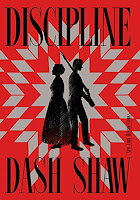
Discipline
 by Dash Shaw - this is his new graphic novel, and I don't know a lot more about it than that. I feel like Shaw made a big splash about a decade ago, with Bottomless Belly Button, BodyWorld, and the pseudo-collection The Unclothed Man in the 35th Century A.D. in quick succession, but has been quieter since then. Last thing I remember seeing from him was Cosplayers, which was pretty small. 

Return to Romance! is a collection of Ogden Whitney comics from the '50s and '60s (I think) edited by Dan Nadel and Frank Santoro. I know Whitney's work from the Herbie comic, which he only drew - I think this collection is comics he both wrote and drew. (Or maybe not: I'll find out.)

One Line by Ray Fawkes - I gather this is another in the line of his One Soul and The People Inside, somewhat formalist takes on using comics to tell multiple interlocking stories simultaneously. I was really impressed by the earlier two books - and, not for nothing, his Possessions series is also a hell of a lot of fun - so I'm back to see him do it again.

In by Will McPhail - a new graphic novel by a New Yorker cartoonist whose single-panel work I've liked. I don't know a lot about it: I gather it's contemporary, and probably some kind of comedy of manners.

A Treasury of Victorian Murder, Vol. 1 by Rick Geary - the original collection of short strips that grew into most of Geary's career for the last three decades. I notice that I wrote about this book just three years ago, so I suspect I may already have a copy of it. (I'm still all discombobulated from my 2011 flood: I'm never quite sure what I used to own and got destroyed, what I used to own and have bought again, what I bought since then, and what I never owned but read another way.)

Mr. Punch by Neil Gaiman and Dave McKean - One of the great books of this generation, but, again, I see I wrote about it in 2016, so I might already have a copy of it lurking about somewhere.

Friday, December 10, 2021

Quote of the Week: It's Definitely You

Each of my relationships ended a little more quickly than the one before it. This pattern reached full bloom in July, when I cleaned out my apartment on West Fifty-Eighth Street, Manhattan, sold or gave away almost everything I had left after the divorce, and crammed everything that remained into a Ford station wagon that was in no better shape than I was. I drove to Buffalo, where I was to move in with a blameless young woman with whom I'd been keeping company.

When I pulled into her driveway, she came out to meet me, a mask of concern on her face. "I don't think this is going to work," she said.

"Now you tell me," I said.

 - Afterthoughts, Version 2.0, "Ariel," p.12

Thursday, December 09, 2021

Sports Is Hell by Ben Passmore

Somewhere there is a Super Bowl, between the Birds and Big White. Those seem to be the actual team names, not nicknames - this is a world where everything is a little more obvious, more extreme.

This is also a world where the Super Bowl is apparently played at the home team's stadium, because we see both the stadium with the game and the fans pouring out of it to riot in the streets, as of course sports fans must do when their teams win or lose.

At the same time -- on the evening of the Super Bowl? in the same town? -- there is also a big BLM protest, where at least some participants are looking forward to violence and burning down as much of the city as possible.

(I should say, before I go much farther, that I'm the wrong audience for this book in several ways: I don't care that much about sports, and my political leanings are not that close to creator Ben Passmore's burn-everything-down stance.)

The game ends, apparently with a win for the Birds, whose fans, at least as we see them here, are mostly Black. But there was a flag on that final play, and a blackout immediately hits this city - it's not clear why, but here are a couple of pages of big BOOM!s all around the neighborhood, so I'm going to guess some combination of incompetency on the part of authorities and bloodthirstiness on the part of random revolutionaries. (Both of those things are always fair bets in Passmore's work.)

And of course there's a riot, which we see raging across this business/sports district. (The action of Sports Is Hell doesn't take place in residential areas, except at the beginning to set up characters.)

All of this is narrated, off and on, by two sports announcers, presumably the guys broadcasting the game and who then just segued into doing the same for the ensuing battles of more-or-less organized militias and other armed groups of murderous thugs who claim to be sports fans. They have a lot of death and destruction to talk through, in best play-by-play fashion. They do not explicitly call it a race war, but Passmore possibly would: an awful lot of those militias, maybe even all of them, are aligned by race.

We follow a bunch of different people, all of whom are horrible in one way or another: clueless white would-be-protestors, a Black protestor devoted to nonviolence (which in Passmore's world is the sign of an idiot), a couple of Black anarchists, and a more organized and better armed Black militia group. Many of them die horribly over the course of the book, as do dozens of others - from the narration, it's pretty clear at least hundreds and possible thousands or tens of thousands are getting killed, mostly by gunfire from these various militias, over the course of this night. 

I don't think Sports Is Hell is meant to be a nihilistic book, but that's what I took away from it: that people are horrible and evil, only one minor moment away from mass murder, every last one of them. I do think Passmore intended to connect the violence in the streets with the violence of a football game, but it didn't really click for me. The game happens almost entirely off-page; the story is about non-athletes, who mostly seem to want to kill each other. The sports feels arbitrary and unnecessary: these people would kill each other for less, or nothing.

So, yeah, maybe sports is hell. But in Passmore's comics, as far as I've seen, everything is hell, so I'm not quite clear on the distinction here.

Wednesday, December 08, 2021

Banned Book Club by Kim Hyun Sook, Ko Hyung-Ju, and Ryan Estrada

This is the story of Kim Hyung Sook.

No, not the same Kim Hyung Sook as the author.

Well, sort of. It's complicated.

South Korea in 1983 was under a military dictatorship that ruthlessly suppressed speech but was still generally popular - at least with older Koreans - because it and the previous regime had been successfully driving development of the country for a generation, and a good economy makes everything else less urgent. That year, a young woman named Kim Hyung Sook went off to college, and got caught up in the growing protest movement against that government, a movement almost entirely run by college students and painted by the regime as foreign and communist and evil...all of the usual slanders used by a deeply illegitimate regime to hold onto power as it realizes it will eventually lose.

That much is true of both reality and Banned Book Club. The book, though, takes some liberties with other people's lives: their stories are not Kim's to tell, so she (and her writing collaborator Ryan Estrada) have combined stories, obscured specific details, and set the whole thing at the fictional Anjeon University. Some of the people in this story are abducted by the police and beaten repeatedly over the course of days; the reader assumes the same, or worse, happened in real life. (I wouldn't be surprised at all if at least one person "disappeared" entirely; military dictatorships love to do that.)

So this is the story of a young woman: Hyung Sook are her given names. She goes to college to study literature in English, joins the banned book club thinking it will mean reading Fahrenheit 451 and The Scarlet Letter but learns they are reading really banned books: Che Guevara, Noam Chomsky, Betty Friedan, Paulo Freire, North Korean writers, global writers about revolution and oppression and what makes a government legitimate.

No one tells her that the personal is political. No one has to. She at first wanted to avoid being political in college, but all roads lead to protest: the regime is so corrupt, so oppressive, that the student population is largely unified in opposition. And so Hyung Sook learns the secrets of protesting in a regime that tortures and prosecutes and imprisons young people almost without bothering to choose them: dead drops, cell-based structures, masks for protests, the importance of having a member or two in every group who never engage in violent activities.

She does not topple the regime. She does make it through, as the real-world Kim did. And the book tells us how that regime fell, and how the survivors of the fictional group the fictional Kim joined met again, decades later, for another protest against another corrupt regime. (Lots of regimes are corrupt, as any American who lived through 2016-2021 knows well.)

So this is not just a good book, but a useful one: it tells readers what they can do, should they find themselves in an oppressive regime, and what they may have to face. And it, I hope, can give them the courage to face up to smaller-scale oppressive regimes: voting barriers and trans bans and "stand your ground" laws carefully crafted so they are always applied in favor of white people killing Black ones. Even if your President is not as deeply corrupt - well, this year - as President Park (either one) was, your governor may be, your school board may be, your town council may be. And it's good to remember that.

I've neglected to mention Banned Book Club's artist, Ko Hyung-Ju, up to this point. Ko's work is strong here, with lots of inky blacks and a good eye to differentiating the faces of a large cast. Korean comics creators often interestingly walk the frontier between American style and Japanese style, and Banned Book Club also sits well within that frontier, with some clear influences from both sides.

Tuesday, December 07, 2021

Book by They Might Be Giants, Brian Karlsson, and Paul Sahre

So this is named "Book," but, frankly, it's not really a "book" in the normal sense. It's not sold all by itself, it's not available at all through the usual book outlets, and the point of it is to be an extension of something else.

Book is the new record (album? what do we call a specific, organized collection of music by one artist in a mostly-digital world, when all of the old words are about the format?) by the band They Might Be Giants. It's available in various forms. The most baroque, complicated form is the one I have: a big red hardcover book, with the CD in a sleeve inside the front cover.

The book is the larger physical object, but it's really there to accompany the CD. It exists because of the CD.

What's in the book are the lyrics for that CD, plus other stuff. So, yes, it is a really overgrown lyrics booklet. I don't know if this is the biggest lyrics booklet - the world is wide and full of crazy people doing crazy things, and I bet some other band has had their lyrics engraved on titanium plates in an edition limited to ten and sold at ten thousand dollars a pop - but it's got to be in the top ten.

Actually, it has lyrics not just for Book but for two previous records: I Like Fun and My Murdered Remains. Does that disqualify it as a lyrics booklet for Book?

Those lyrics are not printed normally, since this is as much an art object as it is a useful thing. Actually, strike that: it's much more an art object than a useful thing; that's the point. The lyrics were typed out, on an IBM Selectric, in various design-y ways, by Paul Sahre, who is credited with book design here. And that's how he designed this book: he picked a font, popped the ball into a typewriter, lined up the paper, and typed stuff - over and over again, often overlapping and generally laid out on the page in quirky and not-exactly-designed-to-be-read-clearly ways.

Also in the book: photographs by Brian Karlsson, who is of the wandering-about-and-snapping-random-things school of photography. (As opposed to the hours-making-a-complicated-set-up-in-the-studio school, or the trying-to-get-candid-photos-of-celebrities school, or even the put-on-your-nice-clothes-and-go-to-the-mall school. Come to think of it, there are a lot of schools.) They are mostly quiet and arty, and I suspect they would work better on a gallery wall in isolation rather than juxtaposed with random lyrics in hard-to-read layouts. The photos do not seem to be chosen to illustrate specific songs, or even to comment on them: the photos seem to be a separate kind of art embedded in this one.

This is clearly a self-indulgent project: gigantic hardcover lyrics book by mid-rank rock bands can't be anything else. But it's a fun self-indulgent project, that is quirky and weird in a very Brooklyn way, and that's deeply appropriate for TMBG. I don't think I'm a huge enough fan of the band to have wanted to buy this all by itself, but as part of the huge secret package they did for this whole year, it's just swell.


Note: I wrote this on October 25, right after I read Book and almost three weeks before the album is due to be released. It will post on December 7th, and I suspect the big fancy red-book edition of Book will have sold out by then. But I really doubt anyone reading this will want to buy the thing; if you did want to buy the thing, you would have known about it already.

Monday, December 06, 2021

Reviewing the Mail: Week of 12/4/21

I got some stuff from the library this week, so I might as well tell you folks about those books, right? Here's what I have on hand right now:

Asadora!, Vol. 2 by Naoki Urasawa - I've read the first volume, and written a post about it. (Nearly a month ago, in fact.) But that hasn't gone live yet: you'll see it in another ten days or so. This book has absolutely no descriptive copy about the story at all; the flaps natter on at length about Urasawa, but that's it. From a quick glance, it seems to follow immediately from the first volume, though the first chapter seems to have a completely new viewpoint character. My understanding is still that the series as a whole covers a few discrete moments in this girl's life, so there will be big time-jumps....but I think that won't be until after the end of this book at the earliest.

Black Hammer: The Quantum Age by Jeff Lemire and Wilfredo Torres - But, Andy! you say: I'm pretty sure you haven't really liked any of the Black Hammer books you've read so far. Why are you keeping on with the series?

Well, it's a good question. The library has the books, they're in a specific order, and I don't hate them, I suppose: the series annoys me in ways that make me think about modern superhero comics, and has the bonus of doing that without having to read or buy anything owned by a giant multinational corporation. So I'm not anticipating exactly a hate-read: I try to be emotionally healthier than that. But there will be elements to hate, I'm pretty sure.

This also is the "Marvel 2099" of the series, which promises even more opportunities for me to dunk on silly concepts, so...how could I resist?

The Adventures of Tintin, Reporter for "Le Petit Vingeieme," in the Land of the Soviets by Herge - It's the first book in the boys-adventure series, and I've read all of the non-suppressed books at this point. This one is much longer, at nearly 150 pages. The art is much simpler - I might say "cruder," but I think a lot of the difference is that this book was drawn to reproduce in a newspaper. And I'm given to understand that it's much more right-wing propaganda than the later books, which I'm interested in examining. But there also seem to be lots of pages of our boy reporter running around, in grave danger, pursued by various nefarious personages. So I'm interested to see how this is different from the mature Tintin books, and just how lousy it actually is.

(The second Tintin book, Tintin in the Congo, is the racist one: it seems to be basically unavailable in any form right now.)

Sunday, December 05, 2021

Books Read: November 2021

Burying this on the first weekend of the month, as I usually remember to do, since it's really just an index for Future Me. Links will populate as the posts go live - all of them have been written at this point - so here's what I read this past month:

Hazel Newlevant, No Ivy League (digital, 11/5)

Dave McKean, Black Dog: The Dreams of Paul Nash (digital, 11/6)

Charles Forsman, Celebrated Summer (digital, 11/7)

Farel Dalrymple, It Will All Hurt (digital, 11/13)

James Albon, A Shining Beacon (digital, 11/14)

Fabien Vehlmann and Gwen De Bonneval, Saturday and Sunday, Vol. 1: Rock Heaven (digital, 11/20)

Matt Fraction and Chip Zdarsky, Sex Criminals, Vol. 6: Six Criminals (digital, 11/21)

Evan Dorkin, Benjamin Dewey, and Nate Piekos, Beasts of Burden: Wise Dogs and Eldrich Men (digital, 11/25)

Franck Biancarelli and Lewis Trondheim, Karmela Krimm, Vol. 1: Ramadan Blues (digital, 11/26)

Dan Abnett and I.N.J. Culbard, Wild's End, Vol. 1: First Light (digital, 11/27)

Evan Dorkin and Roger Langridge, Bill and Ted Are Doomed (digital, 11/28)


One interesting tidbit, since I've been reading a SFF novel more slowly than expected (and didn't manage to finish it this month), every last thing I did finish was read in digital format. This is mostly because I'm running through the app Hoopla and hitting everything my library system has access to; I'm expecting eventually things will tighten up so I'm taking advantage while I can.

Friday, December 03, 2021

Quote of the Week: What Would You Do For Love?

My cousin AJ was shot to death by her boyfriend when she was twenty-two. She burst out of their apartment at a dead run. A second later he followed, walking real slow. He held up a .38 caliber automatic, sighted over his arm, and shot her in the back. She dropped to the sidewalk like a bag of groceries. She tried to keep crawling but something was wrong with her legs. He walked up to where she was thrashing on the sidewalk and shot her again. Then he went back into their apartment to wait for the police.

In the middle of the might I woke up, sweaty and gasping, with one thought circling around and around in my head.

I had never loved a woman enough to kill her.

 - Sean Stewart, Perfect Circle, p.71

Thursday, December 02, 2021

Year of the Rabbit by Tian Veasna

To have a memoir, someone has to live through an event. That sounds trite, but think about it. If no one survives, there's no one to tell the story. We can never know the stories of the ones who didn't make it.

In Cambodia, in the late '70s, the Khmer Rouge regime, in a horrifically misguided, ideologically-driven push to transform the country entirely to an agrarian self-organized socialist society, killed or caused to die nearly a quarter of the country's population. Even in the context of the 20th century, even in contrast with other genocides of the era, it's horrifying: there was less of an emphasis on purging specific ethnicities, with instead a Procrusteanly purist flavor of communism requiring all of society to be transformed for its own supposed benefit and an assumption that no individual had any specific worth.

Year of the Rabbit is a memoir of the Khmer Rouge years, by Cambodian-born and French-raised cartoonist Tian Veasna. He was born three days after April 17, 1975, the day the capital, Phnom Penh, fell to the communists. His book covers the years until his family managed to get over the border into Thailand, in 1980. Again: it's a memoir of the years when Veasna was zero to about five, starting just before he was born.

This book is mostly the story of Veasna's father Khim, who was a doctor in Phnom Penh - and who fled, with his pregnant wife and a large portion of her family, out of that city almost immediately after it fell. The Khmer Rouge emptied out the city - the national capital, again - immediately after they conquered it, to force the entire population of the country back to "their villages," there to work on farms. The group sets out, first just to follow orders and find a place to regroup and figure out what next. That quickly turns into a plan to get to Battambang, near the Thai border, where they have more family and could, in the worst case they expected, get over the border to become refugees.

That is not the actual worst case.

Veasna's family ended up in rural Cambodia for the next half-decade, and the large family tree at the beginning of the book will be pruned cruelly by the version at the end. Most of Rabbit details what life was like under the Khmer Rouge: self-criticism circles, back-breaking farming, families deliberately shattered, and a relentless focus on what "angkar" (organization, the personification of what the Party wants) demands every day.

Rabbit has a large cast, with complicated relationships to each other: the core centers around Veasna's mother Lina and her six siblings. A reader might not always remember who all of the people are and how they're related to each other, but they're all family, and they're all trying to protect and help each other.

This is a memoir. The other thing "memoir" means is that something is over. Veasna, and his surviving family, did make it over that Thai border eventually, and we see that in this book. (We do not see any of them go to France, and only get quick glimpses in an afterword of their lives later on: this is a memoir of Cambodia, of the Khmer Rouge years, so it ends when they get away from those things.)

Veasna tells this story on pages that feel cramped, with thick black borders separating panels jammed right up against each other, with figures looming in the foreground nearly always. There's a lot of darkness, a lot of black - many night scenes, many storms. His lines are loose but detailed: faces are quick and precise, but stuff is more precise: bicycle spokes, details of building and fields and plants, piles of debris.

This is a horrible story, well told. Veasna tells it cleanly, as if he was an omniscient narrator watching his own family, his own baby self, as they go through all of this torment and strife. We do know he makes it out: that might be enough to make reading Year of the Rabbit bearable.

Wednesday, December 01, 2021

Black Hammer: Age of Doom, Part II by Jeff Lemire, Dean Ormston, and Rich Tommaso

OK, you know how in big superhero comics, everything needs to be back at status quo ante eventually? Worlds will live, worlds will die, Ultrafellow will be replaced by a disabled teen Latina, and the entire Evil-Fighting Gang will disband for good...but only until it all goes back to the way it was before.

Readers tend to assume that your modern passel of writers - the ones we respect, the ones who talk about loving punching-comics since they were five, the ones we sometimes think still wear Underoos to big shows - only do this because they are forced to do so by the evil rapacious companies, and that, given their druthers, they would Change Things Permanently, which Would Be Awesome.

So, under this assumption, all of those careful putting-things-back-in-the-box storylines, all of the big Events that undo the previous Event to reset for the next Event - those aren't the fault of their writers, those are all imposed on them by the evil, evil Suits in...what is it, Burbank, now? Burbank is funny, so let's say Burbank.

People assume that. They want to believe it. But is it true? Or do those writers just want to put all of their toys back in the box neatly, because they're still those five-year-olds playing with Star Wars dolls [1] at heart?

Why do I bring this up? Well, you can probably guess. But I'm spoiler-averse enough not to completely fucking spell it out for you right here.

So, he said, brightly, here's Black Hammer: Age of Doom, Part II, a creator-owned superhero comic that has been lauded by all of the Usual Suspects for the Usual Reasons. The series won the Eisner for Best New Series in 2017. It's written by Jeff Lemire, who also writes comics about real grownups who don't punch each other all the time, and drawn mostly by Dean Ormston, with a few issues in this book from the pen of Rich Tommaso. This particular collection gathers the end of the second main series, and - nudge nudge, wink wink - finishes up the main story begun in the first volume. (Here's what I've written about Black Hammer-verse comics so far: I warn you that I have perhaps enjoyed complaining about them more than I did reading them.)

Now, I like Lemire's non-superhero writing. I think he's one of the great talents in comics, with a deep understanding of human behavior and a willingness to tell serious, dark stories when that's the material he's working with. And flashes of that Lemire do shine through the cardboard walls of the superhero universe he's constructed here for his dolls to play in. Ormston is a solid artist in that spooky Dark Horse house style, and Tommaso has a quirkier thin-line style (here something like a '40s comic translated through a modern sensibility) that I quite like as well.

So these guys do good work. They can tell great stories. They just, from the evidence here, would prefer to move their dolls around a few very cliched sets and ape dialogue they loved as children.

This book opens on the cliffhanger from Age of Doom Part I: our heroes are about to go back to the real universe for the first time in a decade, which will allow Darkseid the Anti-God to make the skies red for twelve issues or so and then, presumably, to destroy everything everywhere. (We don't see him actually do anything like that: maybe the Anti-God just wants to go down to the shops and get a few things? He's never actually on stage, or doing anything. All we know is what his enemies say about him.) So, to save the world, Lemire deploys first one, then another Standard Modern Comics Plots.

First up, one of the character has to meet his maker, in best Grant Morrison fashion, with the usual panoply of forgotten/never-existed characters for added pathos. Then we get the Everything Is Changed World, where All of The Heroes Have Forgotten They Ever Were Heroes, because That Is the Saddest Possible Thing. Both of those plots get solved, obviously: that's how Standard Plots go in superhero comics.

And then...well, see my first few paragraphs. I'm not going to tell you exactly what happens, but if you read superhero comics, you know the drill by now.

This is deeply disappointing, and makes all of the Black Hammer comics up to this point completely pointless.

Now I've seen modern creators do "my favorite childhood comics, but with actual human motivations," and that's plausible. I've seen "how I would have handled my favorite story," which is hermetic but understandable. I've seen a lot of "this is the right way for Character X to behave, unlike what all those dum-dums said," which can be fun.

But this is something else. It's a like a long car trip through boring, familiar territory with a promise of something new at the end, only to turn a corner and suddenly be back home, only the house is shabbier by our absence. If this is what Lemire planned to do the whole time, I have a hard time understanding why he, or anyone, though it was a worthwhile thing to do.


[1] "Action figure" is a term made up so that American boys could play with dolls and not feel feminine in a way that their culture embarrassed them about. All action figures are dolls. Period.