Showing posts sorted by relevance for query urasawa. Sort by date Show all posts

Saturday, March 03, 2018

Book-A-Day 2018 #62: Pluto, Vols. 1 & 2 by Naoki Urasawa with Takashi Nagaskai

When I read a book, I care a lot more about who did it than I do about who owns it. (Since I read a lot of comics, I run up against the other kind of reader a lot -- Marvel Zombies and DC Shambling Hordes and Image Ghouls and the lot.) And, since I've worked in publishing, I know the names on a book cover don't necessarily reflect who actually did that work -- but the book itself can usually tell you, if you know where to look.

(Example: books by famous people without a listed co-author almost inevitably credit someone effusively in the acknowledgements as "helping to clean up my mess" or "brought order to my chaos." That is the person who actually wrote all of the words in the book, including that credit.)

So I'm not surprised that this manga series has the official title Pluto: Urasawa X Tezuka, or that it credits Osamu Tezuka (dead more than a decade before this was even an idea) equally with Naoki Urasawa, who actually came up with the story and drew all of the pages. Urasawa did co-write with his longtime collaborator Takashi Nagasaki, and Tezuka's son Macoto Tezka did some not-well-defined kibitzing (and who knows how many art assistants Urasawa had), but this story is primarily Urasawa's work. So that's how I'm going to refer to it, and how I do think of it: Pluto by Urasawa.

It does have a Tezuka connection, since it's a re-imagining of an Astro Boy/Mighty Atom story from the early 1960s ("The Greatest Robot on Earth") and was published beginning on the in-universe "birthday" of Astro Boy. But Pluto is no more a collaboration with Tezuka than a modern retelling of Hamlet is a collaboration with Shakespeare. Pluto was collected in eight volumes: I read the first two of them recently.

The world is near-future, or perhaps alternate present. Technology is more or less as it is today, except for intelligent robots. Some are humanoform, some are bipedal but clearly war machines, some can change bodies quickly and easily. There was some kind of civil-rights struggle in the recent past, but that's basically over: robots are equal to humans, and work alongside them all over the world. And there are seven "Great Robots of the World" -- better than their peers in some way Urasawa doesn't really explain in these volumes. But they are better, and known to be better. And the world has agreed never to make any more of them, presumably out of fear that humans will be replaced by them.

(Robots show no sign of replacing people otherwise; they seem to be a minority, and it's unclear how they are created. My best guess is that they're all one-offs, each uniquely created for a specific purpose, and assembly-line construction just doesn't work for robots for some reason we'll never know. But we do learn of one who was a beat police officer, so this explanation is only barely plausible.)

One of those Great Robots has just been murdered: Mont Blanc, a giant Swiss firefighter, killed in the middle of a violent, quick-moving fire. Investigating the murder is Gesicht, a police detective for Europol who is also one of the Seven. Gesicht is also investigating the murder of a European robot-rights activist, whose death scene was staged similarly to that of Mont Blanc. He quickly realizes there is a serial killer at work: attacking the Great Robots and their defenders.

That killer has strength and agility impossible in any human, and leaves no physical traces at the crime scenes. But robots cannot harm humans -- as far as anyone knows, only one robot ever was able to break that programming, and he's a broken, half-dead thing in prison. So the killer is impossible either way -- something unknown, one way or the other.

This is the kind of mystery where the detective has no serious clues or leads, and is reduced to warning the killer's possible victims and chasing after the mysterious killer. So Gesicht goes to see the other Great Robots -- he misses North No. 2, a war machine, but does see and warn two wrestlers (Turkish and Greek) and Atom, the Japanese boy robot in the Astro Boy role here. As of the end of the second volume, one of the Great Robots is still unknown -- presumably, readers of Tezuka already know who that will be. (And, equally presumably, they don't mind the utter lack of women among Great Robots, since this was originally a 1960s story for Japanese children.)

Urasawa builds an ominous atmosphere early, full of swirling confusion and danger, mimicking the whirlwind that the killer hides in to attack his victims. (I say "his" without knowing -- but Urasawa is rewriting a '60s story, so I'm comfortable with my assumption.) Urasawa's art is on the solid, realistic side of manga, with a strong story-telling flair. And his plotting and dialogue is equally strong: this is my first Urasawa story, but it's easy to see why he's considered a major creator.

I don't know the original Astro Boy story at all, so that lack is no problem. Pluto stands on its own, with only some wonkiness in the world-building pegging it as a structure built on someone else's foundation.

Thursday, November 25, 2010

Book-A-Day 2010 # 295 (11/25) -- Pluto Vol. 1 by Naoki Urasawa with Takashi Nagasaki

I read a lot of mediocre manga back when I was doing my regular "Manga Friday" columns for ComicMix -- the equivalent of spending a couple of years reading third-tier Batman and Wolverine books, to put it into a Western context -- so it's good to remind myself that there's some really strong material in the manga world, even in the more commercial end of it. To continue that tenuous metaphor, Pluto is the Japanese equivalent of Neil Gaiman's Marvel 1602: a reworking of classic genre material that doesn't try to take it completely out of the bounds of that genre (since that's where it works best) but which changes the entire context and creates a new, deeper story, as strong and supple as anything in the genre.

Pluto is a retelling -- a radical retelling, taking names and general outlines but not much more -- of Osamu Tezuka's Astro Boy story "The Greatest Robot on Earth." [1] But Astro Boy is not at the center of this story -- in fact, we first see a Japanese boy called "Atom" on the very last page of this first volume. Instead, the main character is the European detective Gesicht: smart, perceptive, driven...and one of the "seven great robots" of the world. He's also completely human-looking -- some robots are, and some look very much like robots. The humanoform robots can only be told from humans on sight by the extraordinary stillness.

Gesicht has two difficult murder cases on his hands: the universally beloved giant Swiss forestry robot Mont Blanc has died mysteriously during a forest fire, and Bernard Lanke, the mostly detested head of a robot rights organization, was brutally murdered in his apartment. Neither case has any obvious leads or evidence -- very strangely so, in Lanke's case, leading to the assumption that no human could have been in the room to kill him -- but the cases are not clearly linked, except for the fact that both corpses were arranged with makeshift horns on their heads.

Urasawa gives Gesicht's story the first three chapters, to see both murder scenes, to start puzzling through some of the unlikelier parts of the cases, and to question the last robot that broke the no-killing-humans law, eight years before. Urasawa has the ease and vigor of a creator long used to working with large-scale stories; these are clearly early chapters in a much longer story, but there's no infodumps or other expository lumps; this world flows out smoothly behind Gesicht and the people he deals with, and Urasawa is always in utter control of the story and its telling. A strongly unified manga series is a larger story than most forms allow -- it's on a level with a multi-season TV arc, or a closely-plotted multi-book prose series -- and Urasawa is one of the masters of that length, utterly comfortable with making his chapters both sturdy building blocks in the larger story and interestingly-shaped pieces of story themselves.

That ease and mastery is even more obvious in the following chapters -- Urasawa leaves Geischt behind to focus those three chapters on the aged, blind, and cranky film composer Paul Duncan, and his new robot butler, North No. 2, in Duncan's remote Scottish castle. The reader eventually realizes that North No. 2 is one of the great robots of the world -- and what that implies -- but the story at hand is of one many stuck in his artistic work because of unpleasant memories from his youth, and how his servant helps him to work past that. It's entirely a sidebar to the main story of Pluto, but it's also completely necessary -- it shows what kind of a person North No. 2 was, instead of just dragging him out as another victim of the mysterious killer.

That killer is still entirely mysterious at the end of this volume, and the list of great robots is quickly diminishing, with much of the story left to be told. (I see that there are eight volumes already published in English, and that may not be the end.) There's still no sense of the killer's motives, let along his abilities and origin -- but Pluto is already engrossing and fascinating, and I definitely want to see more of Gesicht.


[1] Tezuka's name is in the subtitle, but he was dead long before this story was written -- his credit here is in honor of the original story, and of all of the borrowings Pluto takes from his work. Pluto was written and drawn by the acclaimed manga-ka Naoki Urasawa, best known in the US for 20th Century Boys and Monster, with co-writing assistance from his longtime collaborator Takashi Nagasaki and oversight by Tezuka's son Macoto Tezuka (himself a noted filmmaker and visual artist).


Book-A-Day 2010: The Epic Index

Thursday, January 13, 2022

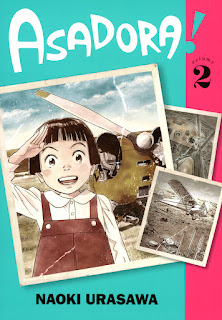
Asadora!, Vol. 2 by Naoki Urasawa

Middle volumes are tough to write about, particularly for a series that the reader expects will run for a while. For the fairly early books: how do you tell what will be really important in the end, and what's just scene-setting? For the books deep into the series: how do you even describe what's happening among characters with hundreds of pages of backstory?

Asadora!, Vol. 2 is a middle volume - the first middle volume of this series, he said puckishly. Like the first book, it's by Naoki Urasawa, a highly respected manga-ka whose work I'm only vaguely familiar with. My post on the first book is scheduled to go live in three days as I write this, so I am hoping I remember to turn some of the words in this sentence into a link. (If I didn't, I apologize. Use the search function.)

The series centers on Asa: she was about nine in the first book, set in 1959 during a massive typhoon. From some narration in that book, I believe the series will follow her up to something like the present day, likely hitting just a few major events years apart. And I think "events" will mostly be disasters. There's a Godzilla-sized monster that has not yet been clearly seen, lurking around the fringes of the story - it's a good bet to assume that will cause some more disasters.

In the aftermath of that typhoon, Asa teamed up with her kidnapper - it was a pretty weird mentor/mentee meet-cute, I guess, but Urasawa made it plausible - to semi-commandeer a small airplane to airdrop food parcels to people stuck in floodwaters. Urasawa depicted the authorities, at least the local cops, as either completely incompetent or just entirely overwhelmed, completely unable to cope with the size of the disaster. But one girl and one critically-injured thief, supported by a street of rice-ball-making shopkeepers, could feed a huge swath of Nagoya.

This second volume picks up in the middle of that rescue effort: it's a few moments later, on the same day, as the end of the first book. Asa and Kasuga (the kidnapper) are still air-dropping rice-balls to survivors, but other dramatic events interfere with that as the book goes on.

Well, actually, there's a chapter before we pick back up - a team of scientists are in a jungle somewhere, looking for something, and arguing fiercely about whether they should keep going or turn back. (It is a bit cliched, I have to admit.) And then they see a tree with a gigantic claw-mark - dun dun DUNNNNNN!

This book ends the 1959 episode, with Asa finding some survivors important to her and getting something that will be major in her life. That takes about three-quarters of the book; the rest begins a new episode, set in 1964. (The year of the Tokyo Olympics, in case we have forgotten.) Asa is now a teenager, and has somewhat different problems. Kaguya is still around, and his past is causing complications.

Oh, and the Godzilla-sized-thing is still out there: a few more scraps of evidence pop up just before the end of this volume, and there's a connection back to that squabbling-scientists first chapter.

At some point, Asa will be flying a plane around or above that monster, probably dropping something on it. But that has not happened yet. Maybe next volume it will attack the Tokyo Olympics!

This is zippy and fun, but it's not clear where it's going or how long getting there will take. Are we going to get ~350 pages for each episode, and will those episodes be set about five years apart up to the present day? If so, that would imply Asadora! could be as much as 7000 pages and thirty-five volumes. But those are massive assumptions; it could be a lot shorter. (It could, I suppose, actually be longer, too - manga is a format that is not afraid of multi-thousand-page stories.)

So far, there's a whole lot of mystery, a whole lot of spunky-girl stuff, and very few answers. That's fine for a beginning, but the balance will need to tip at some point: I hope sooner than seven thousand pages from now.

Tuesday, December 14, 2021

Asadora!, Vol. 1 by Naoki Urasawa

Manga have different paces than Western comics. The traditional take is that they're slower, but that's not always true - manga, in my experience, tend to start slower, and tend to have more pages available for any given story, but they can run at a breakneck pace once you're deep enough into the story and everything is set up.

So I try not to use the same criteria for manga as for superhero comics (or this-bad-thing-happened autobio stories, or YA dramas, or any of the other semi-discrete genres of American comics). Of course that begs the question: what criteria do I use for manga? Do I have enough knowledge of manga, and of specific manga-ka, to do that well?

Probably not. Let me stick a pin in that up top here. My reading in manga has been scattered and random, especially recently: I haven't read most of the big famous series (except Naruto, which I got through most of) and my interests tend to the quirky independent artists on that side of the world just as much as on this one.

And, for right now: I've read the first volume of Naoki Urasawa's Pluto twice, several years apart, and the second volume once, and I think a batch of Pineapple Army back in the '80s in the first manga boom. But that's about it.

Well, and now the first volume of Asadora!, which I gather is his still-current project. This first volume was published in Japan in 2019 (following serialization somewhere, I assume, but the book doesn't say so) and this English translation (by John Werry) came out at the beginning of this year. Five volumes have been published so far, and it doesn't seem to be done.

My sense is that it's going to be episodic: the story will cover several periods in one woman's life. My guess is that each of those episodes will be about a crisis, or an at least local apocalypse.

The evidence for that: the opening pages of this book show a city in flames, with the usual people fleeing in terror. Over that scene is the tonally distinct gigantic caption "This is the story of a nameless girl...and the fearless, graceful life she led...from the postwar years...to the present day." (Which sounds like a weird Jackie O biopic, or maybe an arch Givenchy ad.) And the second storyline seems to mostly be set during the 1964 Tokyo Olympics.

This book, though, is set in 1959, when a typhoon hit Nagoya. The girl on the cover is Asa - just Asa, in the book; I have no idea if "Asadora" is a longer version of her name here, something she will take up later, a diminutive, or something else - and she's twelve, the forgotten sibling in a big family of nine. (Nine as of shortly into the this book: her mother is in labor as the action starts.)

She is a spunky girl, of the type known throughout all kinds of fiction around the world: loud and pushy but lovable about it, honest and straightforward and entirely devoted to doing the right thing.

And the story is almost entirely about her: first she talks with a boy about her age, who is being groomed by his obnoxious family to compete as a runner in the aforementioned Olympics, and then Asa is mildly kidnapped for identity-confusion reasons. But most of the book is about her teaming up with the erstwhile kidnapper to help people in the aftermath of that typhoon, in ways that I expect will resonate and extend into those further episodes. (Airplanes. I'm expecting airplanes will be important to all of Asadora! Also, there is some kind of bull-horned Godzilla-sized thing that we will eventually see more clearly. Those are my predictions.)

As is often the case with manga first volumes, this is mostly set-up. Even this episode is not done yet, and there's a big cliffhanger at the end. We know Asa will live to "the present day" and have other adventures, but we wonder how SFnal this will get - so far it's just hints, but they're hints about something pretty darn gigantic and destructive.

So what we have is the character work and Urasawa's crisp art - which work well together; he defines characters well through their facial expressions and their body language. Urasawa's art is less "manga" than the image some readers may have: you do have to read Asadora! "backwards," but other than that, the panel-to-panel transitions and drawing conventions aren't obtrusive and should be easy to follow for Western readers.

Again, this is all beginning. But it's an interesting, promising beginning.

Tuesday, April 07, 2009

Eisner Award Nominees

The Eisner Awards released the official list of nominees for the 2009 awards today; I saw it posted first by Comics Reporter.

Edit, the next day: I've added some thoughts and comments, in italics after nearly every category. Short version: these are some really, really, good things, which I hope more people will search out and read.

And those nominees are:

Best Short Story
  • "Actual Size," by Chris Ware, in Kramers Ergot 7 (Buenaventura Press)
  • "Chechen War, Chechen Women," by Joe Sacco, in I Live Here (Pantheon)
  • "Freaks," by Laura Park, in Superior Showcase #3 (AdHouse)
  • "Glenn Ganges in Pulverize," by Kevin Huizenga, in Ganges #2 (Fantagraphics)
  • "Murder He Wrote," by Ian Boothby, Nina Matsumoto, and Andrew Pepoy, in The Simpsons' Treehouse of Horror #14 (Bongo)
The Chris Ware story particularly impressed me here; it's got all of the formal brilliance his work usually has but also hints of more positive, happy emotions, which is not typical.

Best Continuing Series

  • All Star Superman, by Grant Morrison and Frank Quitely (DC)
  • Fables, by Bill Willingham, Mark Buckingham, Steve Leialoha, Niko Henrichon, Andrew Pepoy, and Peter Gross (Vertigo/DC)
  • Naoki Urasawa's Monster, by Naoki Urasawa (Viz)
  • Thor, by J. Michael Straczynski, Olivier Coipel, Mark Morales, and various (Marvel)
  • Usagi Yojimbo, by Stan Sakai (Dark Horse)
Thor gets my nod as the best thing I was completely surprised by; I didn't have high hopes for mainstream superhero stuff, but it's a layered, complex story with interesting characters and art I actually liked. Maybe I should check out more by that Straczynski guy, huh?

Best Limited Series

  • Groo: Hell on Earth, by Sergio Aragones and Mark Evanier (Dark Horse)
  • Hellboy: The Crooked Man, by Mike Mignola and Richard Corben (Dark Horse)
  • Locke & Key, by Joe Hill and Gabriel Rodriguez (IDW)
  • Omega the Unknown, by Jonathan Lethem, Karl Rusnak, and Farel Dalrymple (Marvel)
  • The Twelve, by J. Michael Straczynski and Chris Weston (Marvel)
I'm beginning to think there's nothing that Joe Hill can't do; Locke & Key was deeply creepy and excellent.

Best New Series

  • Air, by G. Willow Wilson and M. K. Perker (Vertigo/DC)
  • Echo, by Terry Moore (Abstract Studio)
  • Invincible Iron Man, by Matt Fraction and Salvador Larocca (Marvel)
  • Madame Xanadu, by Matt Wagner, Amy Reeder Hadley, and Richard Friend (Vertigo/DC)
  • Unknown Soldier, by Joshua Dysart and Alberto Ponticelli (Vertigo/DC)
Best Publication for Kids
  • Amulet, Book 1: The Stonekeeper, by Kazu Kabuishi (Scholastic Graphix)
  • Cowa!, by Akira Toriyama (Viz)
  • Princess at Midnight, by Andi Watson (Image)
  • Stinky, by Eleanor Davis (RAW Junior)
  • Tiny Titans, by Art Baltazar and Franco (DC)
Aw yeah Titans! All of these are a lot of fun -- and Amulet is deeper and more complex than that -- but Tiny Titans is my sentimental favorite for its silly take on the DC Universe.

Best Publication for Teens/Tweens

  • Coraline, by Neil Gaiman, adapted by P. Craig Russell (HarperCollins Children's Books)
  • Crogan's Vengeance, by Chris Schweizer (Oni)
  • The Good Neighbors, Book 1: Kin, by Holly Black and Ted Naifeh (Scholastic Graphix)
  • Rapunzel's Revenge, by Shannon and Dean Hale and Nathan Hale (Bloomsbury Children's Books)
  • Skim, by Mariko Tamaki and Jillian Tamaki (Groundwood Books)
This is a really strong category, in my humble opinion; there's a lot of great books being published for younger readers these days. And most of these are just as good for most adult readers as well.

Best Humor Publication

  • Arsenic Lullaby Pulp Edition No. Zero, by Douglas Paszkiewicz (Arsenic Lullaby)
  • Chumble Spuzz, by Ethan Nicolle (SLG)
  • Herbie Archives, by "Sean O'Shea" (Richard E. Hughes) and Ogden Whitney (Dark Horse)
  • Petey and Pussy, by John Kerschbaum (Fantagraphics)
  • Wondermark: Beards of Our Forefathers, by David Malki (Dark Horse)
There was only one woman on our panel, and it may show the most in this category, where the rest of us might have overwhelmed her with our enjoyment of horribly funny books like Peter & Pussy. All of these books are really, really funny in their own way, and I'm happy at how diverse and odd this category turned out.

Best Anthology

  • An Anthology of Graphic Fiction, Cartoons, and True Stories, Vol. 2, edited by Ivan Brunetti (Yale University Press)
  • Best American Comics 2008, edited by Lynda Barry (Houghton Mifflin)
  • Comic Book Tattoo: Narrative Art Inspired by the Lyrics and Music of Tori Amos, edited by Rantz Hoseley (Image)
  • Kramers Ergot 7, edited by Sammy Harkham (Buenaventura Press)
  • MySpace Dark Horse Presents, edited by Scott Allie and Sierra Hahn (Dark Horse)
I'm very glad I was an Eisner judge this year; I got to read Kramer's Ergot 7 without having to worry about how to afford (or store) the darn thing myself. It's a monument to comics, in more than one way.

Best Digital Comic

  • Bodyworld, by Dash Shaw
  • Finder, by Carla Speed McNeil
  • The Lady's Murder, by Eliza Frye
  • Speak No Evil: Melancholy of a Space Mexican, by Elan Trinidad
  • Vs., by Alexis Sottile & Joe Infurnari
Speak No Evil is much, much better than that subtitle might lead you to believe. And I really need to take some time and dig back to the beginning of Finder one of these days. I struggled a bit with this category, since my preference in webcomics is gag-a-day stuff, and the Eisner category is explicitly meant to honor works that are more like comic books -- longer-form, usually laid out as pages rather than strips. (So I wasn't as ahead on my reading as I thought at first.)

Best Reality-Based Work

  • Alan's War, by Emmanuel Guibert (First Second)
  • Blue Pills: A Positive Love Story, by Frederik Peeters (Houghton Mifflin)
  • Fishtown, by Kevin Colden (IDW)
  • A Treasury of XXth Century Murder: The Lindbergh Child, by Rick Geary (NBM)
  • What It Is, by Lynda Barry (Drawn & Quarterly)
Another really strong category -- What It Is is an amazing, almost indefinable work, Fishtown is a really powerful true crime story; and I doubt I would have read either of them if not for the Eisners.

Best Graphic Album -- New

  • Alan's War, by Emmanuel Guibert (First Second)
  • Paul Goes Fishing, by Michel Rabagliati (Drawn & Quarterly)
  • Skim, by Mariko Tamaki and Jillian Tamaki (Groundwood Books)
  • Swallow Me Whole, by Nate Powell (Top Shelf)
  • Three Shadows, by Cyril Pedrosa (First Second)
A great, completely overstuffed category, in a great year. We probably could have chosen another five books, only slightly below these five. (And there's one particular book I know many people are suprised not to see here.) Swallow Me Whole in particular is more and more impressive the more I look back at it and think about it.

Best Graphic Album -- Reprint

  • Berlin Book 2: City of Smoke, by Jason Lutes (Drawn & Quarterly)
  • Hellboy Library Edition, Vols. 1-2, by Mike Mignola (Dark Horse)
  • Sam & Max Surfin' the Highway Anniversary Edition HC, by Steve Purcell (Telltale Games)
  • Skyscrapers of the Midwest, by Joshua W. Cotter (AdHouse)
  • The Umbrella Academy, Vol. 1: Apocalypse Suite, deluxe edition, by Gerard Way and Gabriel Ba (Dark Horse)
This category is for the package almost as much as the content, and it's another one with interesting juxtapositions of material. It was great to see Sam & Max come back into print -- great funny stories in a wonderful package. And Skyscrapers of the Midwest is, for me, easily one of the best books of the year.

Best Archival Collection/Project -- Strips

  • The Complete Little Orphan Annie, by Harold Gray (IDW)
  • Explainers, by Jules Feiffer (Fantagraphics)
  • Little Nemo in Slumberland, Many More Splendid Sundays, by Winsor McCay (Sunday Press Books)
  • Scorchy Smith and the Art of Noel Sickles (IDW)
  • Willie & Joe, by Bill Mauldin (Fantagraphics)
Another category full of great stuff, led by the absolutely stunning Willie & Joe (which looks better the closer you examine it; it's not only a great collection of important cartoons, but a lovingly designed book with a very appropriate design sense). Explainers is also a wonderful package of a toweringly important work.

Best Archival Collection/Project -- Comic Books

  • Breakdowns: Portrait of the Artist as a Young %@&*!, by Art Spiegelman (Pantheon)
  • Creepy Archives, by Various (Dark Horse)
  • Elektra Omnibus, by Frank Miller and Bill Sienkiewicz (Marvel)
  • Good-Bye, by Yoshihiro Tatsumi (Drawn & Quarterly)
  • Herbie Archives, by "Sean O'Shea" (Richard E. Hughes) and Ogden Whitney (Dark Horse)
Another category that shows the bredth of what's being published today, all in great, carefully-designed packages.

Best U.S. Edition of International Material

  • Alan's War, by Emmanuel Guibert (First Second)
  • Gus and His Gang, by Chris Blain (First Second)
  • The Last Musketeer, by Jason (Fantagraphics)
  • The Rabbi's Cat 2, by Joann Sfar (Pantheon)
  • Tamara Drewe, by Posy Simmonds (Mariner/Houghton Mifflin)
There's a lot of amazing work coming across the Atlantic these days, and I'm glad there's a category like this to honor it. This also reminds me that I really need to read more of Jason's work.

Best U.S. Edition of International Material -- Japan

  • Cat Eyed Boy, by Kazuo Umezu (Viz)
  • Dororo, by Osamu Tezuka (Vertical)
  • Naoki Urasawa's Monster, by Naoki Urasawa (Viz)
  • The Quest for the Missing Girl, by Jiro Taniguchi (Fanfare/Ponent Mon)
  • Solanin, by Inio Asano (Viz)
And we all know about the flood of manga -- most of it is entertaining but not particularly ambitious, but the fact of the flood has allowed quirkier, odder things to be translated and widely known as well.

Best Writer

  • Joe Hill, Locke & Key (IDW)
  • J. Michael Straczynski, Thor, The Twelve (Marvel)
  • Mariko Tamaki, Skim (Groundwood Books)
  • Matt Wagner, Zorro (Dynamite); Madame Xanadu (Vertigo/DC)
  • Bill Willingham, Fables, House of Mystery (Vertigo/DC)
I've already mentioned Hill and Straczynski, and I've read Willingham and Wagner on and off for a couple of decades now -- but discovering Tamaki and Skim was wonderful; that's a touching, closely imagined story told precisely the right way.

Best Writer/Artist

  • Rick Geary, A Treasury of XXth Century Murder: The Lindbergh Child (NBM); J. Edgar Hoover (Hill & Wang)
  • Emmanuel Guibert, Alan's War (First Second)
  • Jason Lutes, Berlin (Drawn & Quarterly)
  • Cyril Pedrosa, Three Shadows (First Second)
  • Nate Powell, Swallow Me Whole (Top Shelf)
  • Chris Ware, Acme Novelty Library (Acme)
Look at that line-up! It's the Murderer's Row of comics; there's no one you could pitch around here.

Best Penciller/Inker or Penciller/Inker Team

  • Gabriel Ba, The Umbrella Academy (Dark Horse)
  • Mark Buckingham/Steve Leialoha, Fables (Vertigo/DC)
  • Olivier Coipel/Mark Morales, Thor (Marvel)
  • Guy Davis, BPRD (Dark Horse)
  • Amy Reeder Hadley/Richard Friend, Madame Xanadu (Vertigo/DC)
  • Jillian Tamaki, Skim (Groundwood Books)
Best Painter/Multimedia Artist
  • Lynda Barry, What It Is (Drawn & Quarterly)
  • Eddie Campbell, The Amazing Remarkable Monsieur Leotard (First Second)
  • Enrico Casarosa, The Venice Chronicles (Atelier Fio/AdHouse)
  • Scott Morse, Tiger! Tiger! Tiger! (Red Window)
  • Jill Thompson, Magic Trixie, Magic Trixie Sleeps Over (HarperCollins Children's Books)
All of these people had really gorgeous, inventive art, on some very different projects.

Best Cover Artist

  • Gabriel Ba, Casanova (Image); The Umbrella Academy (Dark Horse)
  • Jo Chen, Buffy the Vampire Slayer, Serenity (Dark Horse); Runaways (Marvel)
  • Amy Reeder Hadley, Madame Xanadu (Vertigo/DC)
  • James Jean, Fables (Vertigo/DC); The Umbrella Academy (Dark Horse)
  • Matt Wagner, Zorro (Dynamite); Grendel: Behold the Devil (Dark Horse)
Best Coloring
  • Steve Hamaker, Bone: Ghost Circles, Bone: Treasure Hunters (Scholastic Graphix)
  • Trish Mulvihill, Joker (DC), 100 Bullets (Vertigo/DC)
  • Val Staples, Criminal, Incognito (Marvel Icon)
  • Dave Stewart, Abe Sapien: The Drowning, BPRD, The Goon, Hellboy, Solomon Kane, The Umbrella Academy (Dark Horse); Body Bags (Image); Captain America: White (Marvel)
  • Chris Ware, Acme Novelty Library #19 (Acme)
One of the things I was looking for in this category was work that didn't just color skies blue and grass green, but helped to set a mood or define characters -- coloring that was willing to choose unusual palettes and bold transitions of colors when that's what the story needed. Mulvhill and Staples did that particularly well, and Stewart's always been great at setting mood through color.

Best Lettering

  • Faryl Dalrymple, Omega: The Unknown (Marvel)
  • Jimmy Gownley, Amelia Rules! (Renaissance)
  • Scott Morse, Tiger! Tiger! Tiger! (Red Window)
  • Nate Powell, Swallow Me Whole (Top Shelf)
  • Chris Ware, Acme Novelty Library #19 (Acme)
I think it's pretty clear what we were reponding to in this category -- real drawn lettering that works as art, both in itself and as part of the larger page, instead of being imposed by a computer program. All of these people did great work in that area, with very expressive lettering that complemented and strengthed their stories.

Best Comics-Related Periodical/Journalism
  • Comic Book Resources, produced by Jonah Weiland
  • The Comics Journal, edited by Gary Groth, Michael Dean, and Kristy Valenti (Fantagraphics)
  • The Comics Reporter, produced by Tom Spurgeon and Jordan Raphael
  • Comics Comics, edited by Timothy Hodler and Dan Nadel (PictureBox)
Best Comics-Related Book
  • Bill Mauldin: A Life Up Front, by Todd DePastino (Norton)
  • Brush with Passion: The Art and Life of Dave Stevens, edited by Arnie and Cathy Fenner (Underwood)
  • Drawing Words and Writing Pictures, by Jessica Abel and Matt Madden (First Second)
  • Kirby: King of Comics, by Mark Evanier (Abrams)
  • The Ten-Cent Plague: The Great Comic-Book Scare and How It Changed America, by David Hajdu (Picador/Farrar, Straus & Giroux)
I'll say it again: DePastino's Bill Mauldin is a great biography. I won't say that it deserves to win in this strong and mixed category...well, maybe I will. (Maybe that shows that I still have a lurking sense that words are more important than pictures? I hope not.)

Best Publication Design

  • Breakdowns: Portrait of the Artist as a Young %@&*! designed by Art Spiegelman (Pantheon)
  • Comic Book Tattoo, designed by Tom Muller, art direction by Rantz Hoseley (Image)
  • Hellboy Library Editions, designed by Cary Grazzini and Mike Mignola (Dark Horse)
  • What It Is, designed by Lynda Barry (Drawn & Quarterly)
  • Willie and Joe, designed by Jacob Covey (Fantagraphics)

These are some stunning-looking books; What It Is is one of the most interesting comics objects in many years and Willie and Joe is simply amazing.

Any complaints can be addressed here; I was one of the judges this year. (And it was a very different experience from my previous judgeship, for the World Fantasy Awards in 2006 -- not merely because the Eisners have four times as many categories, either.)

More thoughts on nominees may follow, but there's a lot of great work up there; nearly all of it will reward the reading attention of nearly anyone.

Wednesday, December 01, 2010

Read in November

For the third year in a row, I had a big family vacation in early November, and theme-park frivolity wreaked its usual havoc on my usually steady reading schedule. But that's a trade-off I don't mind at all. And, of course, Book-A-Day was still chugging along, so all you will find below are links. But, for what it's worth, here's what I read this past month:
And what's next? Well, I'm reading Pratchett's I Shall Wear Midnight right now, so that should come up pretty soon.

Thursday, March 01, 2018

Read in February 2018

This is the second month of Book-a-Day, so, again, there should be a long list of books below, complete with links to individual posts.

I have gotten a little ahead, and I'm trying to drop multi-book things into single posts, so we'll see how far I can go with that. (You'll know I'm doing well if you see a post about the two Bacchus volumes by Eddie Campbell -- about 1200 pages of comics with a lot of words to the page -- or of the six volumes of the Alan Moore Swamp Thing. Both are sitting on the to-be-read shelves, mocking me.) Here's what I did get through this month:

Howard Chaykin's American Flagg!, Vol. 1 (2/1)

Jeff Lemire, Roughneck (1/2)

Brandon Graham, King City (1/3)

Paul Grist, Jack Staff, Vol. 1: Everything Used To Be Black and White (1/4)

Julia Wertz, Museum of Mistakes (1/4)

Katsu Aki, Manga Sutra, Vol. 2 (1/5)

Satoko Kiyuduki, Shoulder-a-Coffin Kuro, Vol. 4 (1/6)

Satoko Kiyuduki, Shoulder-a-Coffin Kuro, Vol. 5 (1/7)

P.G. Wodehouse, A Pelican at Blandings (1/7)

Kate Ascher, The Works: Anatomy of a City (1/7)

Howard Chaykin, Black Kiss (1/8)

Dan Piraro, Bizarro Heroes (1/9)

Howard Chaykin, Black Kiss 2 (1/10)

Tillie Walden, Spinning (1/11)

Ananth Hirsh and Yuko Ota, Lucky Penny (1/12)

Carla Jablonski and Leland Purvis, Defiance (1/13)

Carla Jablonski and Leland Purvis, Victory (1/14)

Diana Wynne Jones, The Pinhoe Egg (1/14)

Gabrielle Bell, Everything Is Flammable (1/15)

Brigitte Findakly and Lewis Trondheim, Poppies of Iraq (1/16)

Paul Hornschemeier, The Collected Sequential (1/17)

Santiago Garcia and David Rubin, Beowulf (1/18)

Jeff Smith, editor, The Best American Comics 2013 (1/19)

Naoki Urasawa with Takashi Nagasaki, Pluto, Vol. 1 (2/20)

Naoki Urasawa with Takashi Nagasaki, Pluto, Vol. 2 (2/21)

Haruki Murakami, Men Without Women (2/21)

Andy Warner, Brief Histories of Everyday Objects (2/22)

Zander Cannon, Kaijumax, Season Two: The Seamy Underbelly (2/23)

Terry Pratchett*, The Compleat Discworld Atlas (2/24)

Fanny Britt and Isabelle Arsenault, Louis Undercover (2/25)

Lorena Alvarez, Nightlights (2/26)

Georges Perec, The Art of Asking Your Boss for a Raise (2/26)

Kim Dong Hwa, The Color of Water (2/27)

Kim Dong Hwa, The Color of Heaven (2/28)


*Not really, but officially.

Monday, December 06, 2021

Reviewing the Mail: Week of 12/4/21

I got some stuff from the library this week, so I might as well tell you folks about those books, right? Here's what I have on hand right now:

Asadora!, Vol. 2 by Naoki Urasawa - I've read the first volume, and written a post about it. (Nearly a month ago, in fact.) But that hasn't gone live yet: you'll see it in another ten days or so. This book has absolutely no descriptive copy about the story at all; the flaps natter on at length about Urasawa, but that's it. From a quick glance, it seems to follow immediately from the first volume, though the first chapter seems to have a completely new viewpoint character. My understanding is still that the series as a whole covers a few discrete moments in this girl's life, so there will be big time-jumps....but I think that won't be until after the end of this book at the earliest.

Black Hammer: The Quantum Age by Jeff Lemire and Wilfredo Torres - But, Andy! you say: I'm pretty sure you haven't really liked any of the Black Hammer books you've read so far. Why are you keeping on with the series?

Well, it's a good question. The library has the books, they're in a specific order, and I don't hate them, I suppose: the series annoys me in ways that make me think about modern superhero comics, and has the bonus of doing that without having to read or buy anything owned by a giant multinational corporation. So I'm not anticipating exactly a hate-read: I try to be emotionally healthier than that. But there will be elements to hate, I'm pretty sure.

This also is the "Marvel 2099" of the series, which promises even more opportunities for me to dunk on silly concepts, so...how could I resist?

The Adventures of Tintin, Reporter for "Le Petit Vingeieme," in the Land of the Soviets by Herge - It's the first book in the boys-adventure series, and I've read all of the non-suppressed books at this point. This one is much longer, at nearly 150 pages. The art is much simpler - I might say "cruder," but I think a lot of the difference is that this book was drawn to reproduce in a newspaper. And I'm given to understand that it's much more right-wing propaganda than the later books, which I'm interested in examining. But there also seem to be lots of pages of our boy reporter running around, in grave danger, pursued by various nefarious personages. So I'm interested to see how this is different from the mature Tintin books, and just how lousy it actually is.

(The second Tintin book, Tintin in the Congo, is the racist one: it seems to be basically unavailable in any form right now.)

Friday, November 26, 2021

Books Read: October 2021

I forgot to do this at the beginning of the month, but that's fine, since no one cares. It's pretty much entirely an index for Future Me.

But here's what I was reading last month, anyway:

Henry McCausland, Eight-Lane Runaways (10/2)

Michael Allred, Steve Horton, and Laura Allred, Bowie: Stardust, Rayguns, and Moonage Daydreams (10/3)

Emma Byrne, Swearing Is Good For You (10/3)

Victoria Jamieson and Omar Mohamed, When Stars Are Scattered (10/9)

Walter Scott, Wendy, Master of Art (10/10)

Kristen Gudsnuk, Making Friends: Third Times's the Charm (10/11)

Ryan North, Derek Charm, and Rico Renzi, The Unbeatable Squirrel Girl, Vol. 12: To All the Squirrels I've Loved Before (10/16)

Lavie Tidhar, The Escapement (bound galleys, 10/16)

Jeff Lemire, Dean Ormston, and Rich Tommaso, Black Hammer: Age of  Doom, Part II (10/17)

Tian Veasna, Year of the Rabbit (10/23)

They Might Be Giants, Brian Karlsson, and Paul Sahre, Book (10/24)

Kim Hyun Sook, Ko Hyung-Ju, and Ryan Estrada, Banned Book Club (10/25)

Ben Passmore, Sports Is Hell (10/30)

Naoki Urasawa, Asadora!, Vol. 1 (10/31)

Tim Powers, Alternate Routes (10/31)

Tuesday, January 01, 2008

Read in December

This is mostly for my own record-keeping, so if you folks pass on quickly to more interesting posts (here or elsewhere), I won't mind. Besides, if a thousand authors can post daily details of their word-count, surely I can have one list of books read a month?

As always, links are to my reviews, here or at ComicMix. Anything that didn't get its own post here also gets an Amazon box down at the bottom, just in case anyone decides "it must be mine!" on the spur of the moment.
  • Lemony Snicket, The Latke Who Couldn't Stop Screaming (12/1)
  • Alan Moore & Kevin O'Neill, The League of Extraordinary Gentlemen: Black Dossier (12/3)
  • Hideaki Sorachi, Gin Tama, Vol. 1 (12/4)
  • Takao Saito, Golgo 13, Vol. 1: Supergun (12/5)
  • Steve Erickson, Zeroville (12/6)
  • Kentaro Yabuki, Black Cat, Vol. 1 (12/6)
  • Andy Runton, Owly, Vol. 4: A Time to Be Brave (12/7)
  • Dan Piraro, The Best of Bizarro, Vol. II (12/9)
  • Shaun Tan, The Arrival (12/9)
  • Mark Crilley, Miki Falls, Book One: Spring (12/10)
  • Pierre Bayard, How to Talk About Books You Haven't Read (12/11)
  • Mark Crilley, Miki Falls, Book Two: Summer (12/11)
  • Stewart O'Nan, Last Night at the Lobster (12/12)
  • Matt Diffee, editor, The Rejection Collection, Vol. 2: The Cream of the Crap (12/15)
  • Jeff Smith, The Art of Bone (12/16)
  • Kyo Shirodaira & Eita Mizuno, Spiral: The Bonds of Reasoning, Vol. 2 (12/17)
  • Susan Minot, Rapture (12/17)
  • Keiko Takemiya, story by Ryu Mitsuse, Andromeda Stories, Vol. 2 (12/18)
  • Naoki Urasawa, Monster, Vol. 2 (12/19)
  • Takehiko Inoue, Vagabond, Vol. 2 (12/20)
  • Kiyohiko Azuma, Yotsuba&!, Vol. 3 (12/21)
    When I read the first volume (and somewhat less with the second), I obsessed about the character of Yotsuba -- a little girl who is either a completely free spirit or has some sort of brain damage -- and finally decided that she's not meant to be a representation of a person with something mentally wrong. (And so I was able to enjoy the book for itself.) The series itself is light-hearted fun about a certain kind of everyday life; the kind of thing I enjoy in several media.
  • Craig Thompson, Carnet de Voyage (12/21)
  • A sketchbook account of two months spent traveling in Europe and North Africa in 2004, partially as research for "the next book" and partially touring to support Blankets. Thompson does incredibly detailed and specific sketches, so this is nearly as interesting as a less hurried book. It's a lot like a more in-depth version of Mo Willem's You Can Never Find a Rickshaw When It Monsoons, actually. (For the five people who have actually read the Willems book.)
  • Rutu Modan, Exit Wounds (12/23)
  • The Art of Bryan Talbot (12/24)
  • Michael Chabon, The Yiddish Policemen's Union (12/26)
  • Stephan Pastis, The Sopratos (12/26)
    More comics filled with puns and death from the strip "Pearls Before Swine." I'm glad I live in a world where this strip is in millions of people's breakfast reading; it's not something I expected but it's a nice bonus. (And this world has so many drawbacks that we do have to take the small bonuses where we find them.)
  • Ilya, editor, The Mammoth Book of Best New Manga 2 (12/27)
  • Neil Gaiman & John Romita, Jr., Eternals (12/28)
  • A perfectly respectable and readable retooling of a classic comics property (Jack Kirby's late '70s creations) for a new generation. There's nothing at all wrong with it, but it has a journeyman feel, which contrasts with Gaiman's superstar profile. (I'm sure Gaiman would say something about how every one of his projects is different, which is true -- but this felt like something the Gaiman of 1990 would do, or like something any dozen other writers could do. Most of Gaiman's recent work, on the other hand, couldn't have been done by anyone else.) It's no 1602, but it's fine for what it is. But the ending is purer comics than I've ever seen from Gaiman: it's practically begging for an ongoing series, and Gaiman generally is good at ending his stories (unlike most comics writers, who flee real endings like vampires and daylight).
  • Out of Picture, Vol. 1 (12/31)
Once again, it looks like too few "real books" this month. Maybe if I get away from the computer a little more often...


Sunday, January 02, 2022

Books Read: December 2021

And here's what I read at the end of 2021. As always, this list is mostly for me, as an aide memoire in the future.

Herge, The Adventures of Tintin, Reporter for "Le Petit Vingtieme," in the Land of the Soviets (12/4)

Naoki Urasawa, Asadora!, Vol. 2 (12/5)

Tom Standage, Go Figure (12/10)

Jeff Lemire and Wilfredo Torres, The Quantum Age (12/11)

Charles Stross, Dead Lies Dreaming (12/11)

Neil Gaiman and Dave McKean, Mr. Punch (12/12)

Rick Geary, A Treasury of Victorian Murder, Vol. 1 (12/18)

Kim Deitch, Alias the Cat! (12/19)

Peter Milligan, Brett Ewins, and Steve Dillon, Skreemer (12/22)

Joshua W. Cotter, Skyscrapers of the Midwest (12/23)

Debbie Tung, Happily Ever After and Everything in Between (digital, 12/24)

Shannon Wheeler, Why Did We Trust Him? (digital, 12/25)

Will McPhail, In. (12/26)

Jonathan Yardley, Second Reading (12/26)

Daniel Clowes, Patience (12/27)

Ray Fawkes, One Line (12/28)

Dash Shaw, Discipline (12/29)

Barry Windsor-Smith, Monsters (12/30)

Jason, Good Night, Hem (12/31)


Links will follow later; I've written posts for all of those books but I'm currently running about six weeks ahead. (Mostly so I have a buffer if/when the next bout of reading ennui hits.)

Monday, November 01, 2021

Reviewing the Mail: Week of 10/30/21

Three books this week, all of them from the library. I've already read one of them, so let's get right into it:

Banned Book Club is a graphic novel written by Kim Hyun Sook and Ryan Estrada and drawn by Ko Hyung-Ju, about a young woman named Kim Hyun Sook who goes to college in her native South Korea in 1983. There, she gets caught up in protests against the oppressive government, almost without realizing it, by joining the title group. It's not exactly the real Kim Hyun Sook's story - all of the other characters are composites - but it's broadly true, and closer than a work of fiction about the same years would have been.

Asadora! Vol. 1 is the first in a series by Naoki Urasawa, who is one of the big names in manga. (I've only read the first two volumes of Pluto myself, and maybe some Pineapple Army way back in the mists of time.) The book itself says nothing about the story, but it has a cute girl posing on the front cover and what looks like an apocalypse in the opening pages, so I have no idea what it's about. I'm sure I saw a recommendation of it somewhere.

Sports Is Hell is a short graphic novel by Ben Passmore about, as I understand it, the US fascination with the violence of sports and what that means culturally. Passmore is, how do I say this politely?, not a shrinking violet about his political ideas, which tend to be on the leftist end of things. So I expect a lot of opinions, strongly held - which is the point of a book like this. Passmore is also the author of Your Black Friend; that's probably where most people would know him from.

Monday, January 01, 2018

Welcome to Book-A-Day 2018!

I seem to do this every three to four years -- long enough for my reading and posting to ebb lower, and for me to get first annoyed and then energized by that -- so it's about time again.

Like 2014, this is planned to fill the whole calendar year. (I also had earlier stints of Book-A-Day in 2006-2007 and 2010-2011.) If you wonder what kind of books these will be, the 2014 Post-Mortem is likely to still match my current reading style pretty well. And my old post on how to read a book a day could also be informative.

I expect 2018 to closely match the 2014 model: I'm starting out with fewer books "saved up" to review (six), but the point is still to post a review of something every day for the whole year, and have that need for content force me to read more.

Below this point, an index will grow, as the year goes on and I actually read books and post about them. If history is any guide, I will double-count at least once.

Today's book post will go up sometime this afternoon (since I haven't written it yet), and after that I hope to settle down to my usual noon posting time. As always, plans are not guarantees.

The Index:

1: Inio Asano, A Girl on the Shore
2: Kaori Ozaki, The Gods Lie
3: Rick Geary, The Lindbergh Child and The Saga of the Bloody Benders
4: Deborah Blum, The Poisoner's Handbook
5: Paul Theroux, The Tao of Travel 
6: Tom Gauld, Baking With Kafka
7: Richard Sala, The Bloody Cardinal
8: Ben Blatt, Nabokov's Favorite Word Is Mauve
9: Michel Choquette, editor, The Someday Funnies
10: Frank Thorne, The Complete Iron Devil
11: Rick Geary, The Secret Room at the White House
12: Velhmann and Kerascoet, Satania
13: Peter Bagge, Fire!!
14: Mawil, Home and Away
15: Randall Munroe, Thing Explainer
16: Chris Achilleos, Amazona
17: Roger Langridge, Fred the Clown in "The Iron Duchess"
18: Cyril Pedrosa, Equinoxes
19: James Vance and Dan E. Burr, On the Ropes
20: Jonathan Barli, Vip: The Mad World of Virgil Partch
21: Steven Brust, Vallista
22: Matt Fraction and Chip Zdarsky, Sex Criminals, Vol. 4: Fourgy!
23: Jeff Lemire, Royal City, Vol. 1: Next of Kin
24: Kevin Underhill, The Emergency Sasquatch Ordinance
25: Mimi Pond, The Customer Is Always Wrong
26: Sarah Glidden, Rolling Blackouts
27: Teri S. Wood, Wandering Star
28: Stephen J. Sansweet and Peter Vilmur, The Star Wars Poster Book
29: Mike Mignola and Warwick Johnson-Cadwell, Mr. Higgins Comes Home
30: Michel Rabagliati, Paul Has a Summer Job
31: Colleen Frakes, Prison Island
32: Catel and Veronique Grisseaux, Bluesy Lucy
33: Lawrence Block, The Girl With the Deep Blue Eyes
34: Makoto Shinkai and Yukiko Seike, 5 Centimenters per Second
35: Greg Rucka and Matthew Southworth, Stumptown, Vol. 1: The Case of the Girl Who Took Her Shampoo (But Left Her Mini)
36: Jennifer Hayden, Underwire
37: Scott Rubin, Sean Crespo, and Mason Brown, editors, National Lampoon's Big Book of Love
38: Svetlana Chmakova, Brave
39: Shannon Wheeler, Sh*t My President Says
40: Nico Tanigawa, No Matter How I Look at It, It's You Guys' Fault I'm Not Popular!, Volumes 8 and 9
41: J.M. Coetzee, Waiting for the Barbarians
42:  Howard Chaykin's American Flagg!, Vol. 1
43: Jeff Lemire, Roughneck
44: Brandon Graham, King City
45: Paul Grist, Jack Staff, Vol. 1: Everything Used To Be Black and White
46: Julia Wertz, Museum of Mistakes
47: Katsu Aki, Manga Sutra, Vol. 2
48: Satoko Kiyuduki, Shoulder-a-Coffin Kuro, Vol. 4 and 5
49: P.G. Wodehouse, A Pelican at Blandings
50: Kate Ascher, The Works: Anatomy of a City

51: Howard Chaykin, Black Kiss and Black Kiss 2
52: Dan Piraro, Bizarro Heroes
53: Tillie Walden, Spinning
54: Ananth Hirsh and Yuko Ota, Lucky Penny
55: Carla Jablonski and Leland Purvis, Defiance and Victory
56: Diana Wynne Jones, The Pinhoe Egg 
57: Gabrielle Bell, Everything Is Flammable
58: Brigitte Findakly and Lewis Trondheim, Poppies of Iraq
59: Paul Hornschemeier, The Collected Sequential
60: Santiago Garcia and David Rubin, Beowulf
61: Jeff Smith, editor, The Best American Comics 2013
62: Naoki Urasawa with Takashi Nagasaki, Pluto, Vol. 1 and 2
63: Haruki Murakami, Men Without Women
64: Andy Warner, Brief Histories of Everyday Objects
65: Zander Cannon, Kaijumax, Season Two: The Seamy Underbelly
66: Terry Pratchett*, The Compleat Discworld Atlas
67: Fanny Britt and Isabelle Arsenault, Louis Undercover
68: Lorena Alvarez, Nightlights
69: Georges Perec, The Art of Asking Your Boss for a Raise
70: Kim Dong Hwa, The Color of Water and The Color of Heaven
71: Thu Bui, The Best We Could Do
72: Marjorie Liu and Sana Takeda, Monstress, Vol. 1: Awakening
73: Cecil Castellucci and Marley Zarcone, Shade the Changing Girl, Vol. 1: Earth Girl Made Easy
74: Jonathan Lethem, editor, The Best American Comics 2015 and Roz Chast, editor, The Best American Comics 2016
75: Stewart O'Nan, The Night Country
76: Batton Lash, The Soddyssey and Other Tales of Supernatural Law and The Werewolf of New York 
77: Ryan North and Erica Henderson, The Unbeatable Squirrel Girl, Vol. 3: Squirrel, You Really Got Me Now
78: Frank Miller, Brian Azzarello, Andy Kubert, and Klaus Jason, Batman: The Dark Knight: Master Race
79: Kyle Baker, Nat Turner
80: Paul Grist and Phil Elliott, Jack Staff, Vol. 2: Soldiers
81: Charles Forsman, I Am Not Okay With This
82: Pascal Girard, Nicolas
83: Eleanor Davis, You & A Bike & A Road
84: Bill Corbett and Len Peralta, Super-Powered Revenge Christmas
85: Sergio Aragones, Mark Evanier, and Thomas Yeates, Groo Vs. Conan
86: Jeff Lemire and Dustin Nguyen,  Descender, Vol. 4
87: Brian K. Vaughan and Cliff Chiang, Paper Girls, Vol. 3
88: Cassandra Jean, Reindeer Boy
89: Dan Wells, Nothing Left To Lose
90: Alan Moore and Kevin O'Neill, Nemo: Heart of Ice, Nemo: The Roses of Berlin, and Nemo: River of Ghosts
91: Ted McKeever, Meta4
92: Jeff Lemire, Essex County
93: Nina Bunjevac, Fatherland
94: Nick Bertozzi, Lewis & Clark
95: Mike Mignola, Chris Roberson and Paul Grist, The Visitor: How and Why He Stayed
96: Mike Mignola, Chris Roberson and Christopher Mitten, Rise of the Black Flame
97: Nicholson Baker, The Anthologist
98: Brian K. Vaughan and Fiona Staples, Saga, Vol. 8
99: Gretchen Edgren, The Playmate Book
100: Masamune Shirow, The Ghost in the Shell

101: Frederik Peeters, Aama, Vol. 3: The Dust of Mirrors
102: Mike Mignola, Chris Roberson, and various artist, Hellboy and the B.P.R.D.: 1954
103: Lynda Barry, Syllabus
104: Paul Levitz and Steve Lightle, Legion of Super-Heroes: The More Things Change
105: Tom Stoppard, Rosencrantz and Guildenstern Are Dead
106: Kyle Baker, King David
107: Gary Spencer Millidge, Strangehaven: Brotherhood
108: Mike Grell, Jon Sable Freelance: Ashes of Eden
109: Roberta Gregory, As Naughty As She Wants to Be!
110: Pierre Christin and Jean-Claude Mezieres, Valerian: The Complete Collection, Vol. 1
111: Herge, The Adventures of Tintin, Vol. 1
112: Jamie Hewlett and Alan Martin, Tank Girl, Vol. 1
113: Ryan North and Erica Henderson, The Unbeatable Squirrel Girl, Vol. 4: I Kissed a Squirrel and I Liked It
114: Lawrence Block, Borderline
115: Neil Gaiman, et. al.Free Country: A Tale of the Children's Crusade
116: Kurt Busiek and Brent Eric Anderson, Astro City: The Dark Age, Vol. 1: Brothers and Other Strangers
117: Laura Lee, Around the World in 80 Cliches
118: Marcel Beyer and Ulli Lust, Voices in the Dark
119: Julia Wertz, Tenements, Towers & Trash
120: Joe Ollmann, The Abominable Mr. Seabrook
121: G. Willow Wilson and various artists, Ms. Marvel, Vol. 5: Super Famous
122: Noelle Stevenson, Shannon Watters, and Carolyn Nowak, Lunberjanes, Vol. 3: A Terrible Plan
123: Jillian Tamaki, Boundless
124: Bruce Chatwin, In Patagonia
125: John Porcellino, The Hospital Suite
126: Roz Chast, Going Into Town
127: Tom King and Gabriel Hernandez Walta, The Vision (2 Vols.)
128: Brahm Revel, Guerillas, Vols. 1 & 2
129: Jamie Hewlett and Alan Martin, Tank Girl, Vol. 2
130: P.G. Wodehouse, Louder and Funnier
131: Stephen Murphy and Michael Zulli, The Puma Blues
132: Bruce Marshall, Building New York
133: Mike Mignola and various collaborators, Abe Sapien, Vols. 8 & 9
134: Mawil, We Can Still Be Friends
135: Dave McKean, Cages
136: H.P. Lovecraft and I.N.J. Culbard, The Dream-Quest of Unknown Kadath
137: Howard Chaykin and Jose Luis Garcia-Lopez, Twilight
138: Richard Gehr, I Only Read It for the Cartoons
139: Joe R. Landsale, Tim Truman, and Sam Glanzman, Jonah Hex: Shadows West
140: John Allison, Lissa Treiman, and Max Sarin, Giant Days: Not On the Test Edition, Vols.1 &
 2
141: Alan Moore and Kevin O'Neill, The League of Extraordinary Gentlemen: Century
142: Berkeley Breathed, The Bloom County Library, Vol. 4: 1986-1987
143: Jane Yolen and Rebecca Guay, The Last Dragon
144: Kate Leth, Brittney L. Williams, and Natasha Allegri, Patsy Walker A.K.A. Hellcat!, Vol. 1: Hooked On a Feline
145: Jackson Landers, Eating Aliens
146: Edward Lucie-Smith, Erotica: The Fine Art of Sex
147: Andi Watson, Skeleton Key (5 vols.)
148: The New Yorker Book of Mom Cartoons
149: Dennis O'Neil, Denys Cowan, and Rick Magyar, The Question, Vol. 2: Poisoned Ground
150: John Layman and Rob Guillory, Chew: The Omnivore Edition, Vol. 4

151: James Morrow, The Asylum of Dr. Caligari
152: Joann Sfar, Lewis Trondheim, and Christophe Blain, Dungeon: The Early Years, Vol. 1: The Night Shirt
153: Joann Sfar, Lewis Trondheim, and Christophe Blain, Dungeon: The Early Years, Vol. 2: Innocence Lost
154: Lewis Trondheim and Joann Sfar, Dungeon: Zenith, Vol. 1: Duck Heart
155: Lewis Trondheim and Joann Sfar, Dungeon: Zenith, Vol. 2: The Barbarian Princess
156: Joann Sfar, Lewis Trondheim, and Boulet, Dungeon: Zenith, Vol. 3: Back in Style
157: Joann Sfar, Lewis Trondheim, and Manu Larcenet, Dungeon: Parade, Vol. 1: A Dungeon Too Many
158: Joann Sfar, Lewis Trondheim, and Manu Larcenet, Dungeon: Parade, Vol. 2: Day of the Toads
159: Joann Sfar, Lewis Trondheim, Mazan and Jean-Christophe Menu, Dungeon: Monstres, Vol. 1: The Crying Giant
160: Joann Sfar, Lewis Trondheim, Stephane Blancquet and Andreas, Dungeon: Monstres, Vol. 2: The Dark Lord
161: Joann Sfar, Lewis Trondheim, Carlos Nine and Killoffer, Dungeon: Monstres, Vol. 3: Heartbreaker
162: Joann Sfar, Lewis Trondheim, Jean-Emmanuel Vermot-Desroches and Yoann, Dungeon: Monstres, Vol. 4: Night of the Ladykiller
163: Joann Sfar, Lewis Trondheim, Blutch and Bezian, Dungeon: Monstres, Vol. 5: My Son the Killer
164: Joann Sfar, Lewis Trondheim, Stanislas and Keramidas, Dungeon: Monstres, Vol. 6: The Great Animator
165: Joann Sfar and Lewis Trondheim, Dungeon: Twilight, Vol. 1: Dragon Cemetery
166: Joann Sfar, Lewis Trondheim, and Kerascoet, Dungeon: Twilight, Vol. 2: Armageddon
167: Joann Sfar, Lewis Trondheim, Kerascoet, and Obion, Dungeon: Twilight, Vol. 3: The New Centurions
168: Joann Sfar, Lewis Trondheim, Alfred, and Mazan, Dungeon: Twilight, Vol. 4: The End of Dungeon
169: Chris Offutt, My Father, The Pornographer
170: Charles Stross, The Delirium Brief
171: Jason Shiga, Demon (4 vols.)
173: Chad Sell and various writers, The Cardboard Kingdom
174: Mark Siegel, Alexis Siegel, Xanthe Bouma, Matt Rockefeller, and Boya Sun, 5 Worlds, Book 2: The Cobalt Prince
175: James Crumley, The Wrong Case
176: Jaime Hernandez, Maggie the Mechanic
177: Baboon Metaphysics and Other Implausibly Titled Books
178: Jason, On the Camino
179: Nagata Kabi, My Lesbian Experience With Loneliness
180: Peter Watts, The Freeze-Frame Revolution
181: Jacques Tardi, The Extraordinary Adventures of Adele Blanc-Sec, Vol. 2
182: Hartley Lin, Young Frances
183: Gilbert Hernandez, Heartbreak Soup
184: Taiyo Matsumoto, Sunny, Vols. 5 & 6
185: Robert Niles, Stories from a Theme Park Insider
186: Brian K. Vaughan and Cliff Chiang, Paper Girls, Vol. 4
187: Joan Aiken, The Wolves of Willoughby Chase
188: Jeff Lemire, Royal City, Vol. 2: Sonic Youth
189: Peter S. Beagle, In Calabria
190: Jaime Hernandez, The Girl from H.O.P.P.E.R.S.
191: Lewis Trondheim and Nicholas Keramidias, Mickey's Craziest Adventures
192: Jacques Tardi and Leo Malet, Fog Over Tolbiac Bridge
193: Richard Sala, The Chuckling Whatsit
194: Jason, Why Are You Doing This?
195: Matt Kindt and Tyler Jenkins, Grass Kings, Vol. 1
196: Peter Milligan, Chris Bachalo, and Mark Pennington, Shade, the Changing Man, Vol. 1: The American Scream
197: Gilbert Hernandez, Human Diastrophism
198: Massimo Carlotto and Marco Videtta, Poisonville
199: Guy Delisle, Hostage
200: Jason, Pocket Full of Rain

201: Howard Mohr, How to Speak Minnesotan
202: Alan Moore and various artists, Saga of the Swamp Thing (6 vols.)
203: Larry Gonick and Art Huffman, The Cartoon Guide to Physics
204: Jaime Hernandez, Perla La Loca
205: Bill Morrison, Roswell Walks Among Us
206: Greg Ruth, Sudden Gravity
207: Lewis Trondheim, Mister I
208: Kristen Radtke, Imagine Wanting Only This
209: P.G. Wodehouse, Over Seventy
210: Manuele Fior, Blackbird Days
211: Gilbert Hernandez, Beyond Palomar
212: G. Willow Wilson, Adrian Alphona, Takeshi Miyazawa, and Mirka Andolfo, Ms. Marvel, Vol. 6: Civil War II
213: Keith Giffen, J.M. DeMatteis, Kevin Maguire, and Joe Rubinstein, Formerly Known as the Justice League
214: John Stanley with Lloyd White, Tubby, Vol. 3
215: George O'Connor, Hermes: Tales of the Trickster
216: Michael Chabon's The Escapist: Amazing Adventures
217: James Alan Gardner, All Those Explosions Were Someone Else's Fault
218: Los Bros Hernandez, Amor Y Cohetes
219: Fran Krause, The Creeps
220: Jason Novak, Et Tu Brute?
221: Ryan North and Eric Henderson, The Unbeatable Squirrel Girl, Vol. 5: Like I'm the Only Squirrel in the World
222: Noelle Stevenson, Shannon Watters, and Brooke Allen, Lumberjanes, Vol. 4: Out of Time
223: Penelope Bagieu, Brazen
224: Hope Larson and Rebecca Mock, Knife's Edge
225: Jaime Hernandez, Penny Century
226: Matthew Hughes, The Commons
227: Russell Ash, It Just Slipped Out...
228: Hope Larson, All Summer Long
229: Marjorie Liu and Sana Takeda, Monstress, Vol. 2: The Blood
230: Eleanor Davis, Why Art?
231: Reverend Jen, Live Nude Elf
232: Gilbert Hernandez, Luba and Her Family
234: Warren Ellis, Chris Sprouse, Karl Story, and Colleen Doran, Ocean/Orbiter: The Deluxe Edition
235: Various writers and artists, Star Wars: A Long Time Ago...: Dark Encounters
236: Jaime Hernandez, The Dragon Slayer
237: Jamie S. Rich and Megan Levens, Ares & Aphrodite: Love Wars
238: The Pander Brothers, Girlfiend
239: Jaime Hernandez, Esperanza
240: Philip Gelatt and Rick Lacy, Labor Days 2: Just Another Damn Day
241: Cullen Bunn, Shawn Lee and Matt Kindt, The Tooth
242: Tom Perrotta, Mrs. Fletcher
243: Gabby Schulz, Sick
244: Linda Medley, Castle Waiting
245: Keith Giffen, J.M. DeMatteis, Kevin Maguire, and Joe Rubinstein, I Can't Believe It's Not the Justice League
246: Gilbert Hernandez, Ofelia
247: Benjamin Frisch, The Fun Family
248: James Thurber and E.B. White, Is Sex Necessary?
249: Frederick Burr Opper's Happy Hooligan
250: Labiano and Dufaux, Dixie Road

251: Roz Chast, The Four Elements
252: Dave McKean, Pictures That Tick 2
253: Gilbert Hernandez, Comics Dementia
254: Paul Grist, Jack Staff, Vols. 3 and 4
255: Chris Oliveros, editor, Drawn & Quarterly Showcase: Book Two
256: Dave Sim, Cerebus
257: Steve Erickson, Days Between Stations
258: art spiegelman, The Complete Maus
259: Kelly and Zach Weinersmith, Soonish
260: Jaime Hernandez, Angels and Magpies
261: Martha Wells, Artificial Condition
262: Simon Rich, Spoiled Brats
263: Mike Baron and Steve Rude, Nexus Archives, Vols. 1-9
264: Brandon Montclare, Amy Reeder, and Natchas Bustos, Moon Girl and Devil Dinosaur, Vol. 1: BFF
265: Kelly Sue DeConnick, Christopher Sebela, Dexter Soy, Emma Rios, and Filipe Andrade, Captain Marvel, Vol. 1: Earth's Mightiest Hero
266: Kage Baker and Kathleen Bartholomew, Nell Gwynne's On Land and At Sea


267: Gilbert Hernandez, Three Sisters
268: Pamela Ribon and Cat Farris, My Boyfriend Is a Bear
269: George Booth, Think Good Thoughts About a Pussycat
270: Nate Powell, Come Again
271: Jesse Sheidlower, The F Word
272: Ian and Tyson Smith, Oddjob
273: Kristen Gudsnuk, Henchgirl
274: The Hernandez Brothers, Love and Rockets: New Stories, No. 1
275: John Allison and various artists, Giant Days: Extra Credit, Vol. 1
276: Matt Fraction and Chip Zdarsky, Sex Criminals, Vol. 5: Five-Fingered Discount
277: Steven Brust, Good Guys
278: Ted Rall, Real Americans Admit: "The Worst Thing I've Ever Done!"
279: Grant Morrison, Steve Yeowell, and Jon J. Muth, Sebastian O/The Mystery Play
280: Brecht Evens, Night Animals
281: The Hernandez Brothers, Love and Rockets: New Stories, No. 2
283: Jeff Lemire and Dustin Nguyen, Descender, Vol. 5: Rise of the Robots
284: Barbara Ehrenreich, Nickel and Dimed
285: Dave Sim, High Society
286: Matt Furie, Boy's Club
287: Jim Ottaviani, The Imitation Game
288: The Hernandez Brothers, Love and Rockets: New Stories, No. 3
290: Herge, The Adventures of Tintin, Vol. 2
291: G. Willow Wilson, Mirka Andolfo, Takeshi Miyazawa, and Francesco Gaston, Ms. Marvel, Vol. 7: Damage Per Second
292: Ryan North and Erica Henderson, The Unbeatable Squirrel Girl Beats Up the Marvel Universe
293: P.G. Wodehouse, Young Men in Spats
294: Michael Kupperman, All the Answers
295: The Hernandez Brothers, Love and Rockets: New Stories, No. 4
296: Nick Drnaso, Sabrina
297: Molly Knox Ostertag, The Witch Boy
298: Howard Chaykin, David Tischman, Marc Laming, and John Stokes, American Century, Vols. 1 and 2
299: Carlos Fuentes, The Old Gringo
300: Christopher J. Moore, In Other Words

302: The Hernandez Brothers, Love and Rockets: New Stories, No. 5
303: Kyle Baker, I Die at Midnight
304: Carla Speed McNeil, The Finder Library, Vol. 1
307: Tony Horwitz, One for the Road
308: Andi Watson, The Complete Geisha
309: Gilbert Hernandez, The Adventures of Venus
310: Batman: The Jiro Kuwata Batmanga, Vol. 3
311: Liz Prince, Look Back and Laugh
312: Kelly Sue DeConnick and others, Captain Marvel: Earth's Mightiest Hero, Vol. 2
313: Pratap Chatterjee and Khalil, Verax
314: Dennis Lehane, The Drop
315: Philip Larkin, Collected Poems
316: The Hernandez Brothers, Love and Rockets: New Stories, No. 6
317: Martha Wells, Rogue Protocol
318: Anonymous, editor, Outrageous Tales from the Old Testament
319: Neil Gaiman and Kim Newman, editors, Ghastly Beyond Belief
320: Peter Bagge, Everybody Is Stupid Except for Me
321: Brian Wood and Ryan Kelly, The New York Four
322: Jason McNamara and Paige Braddock, The Martian Confederacy, Vol. 2: From Mars With Love
323: Gilbert Hernandez, Julio's Day
324: Kristen Gudsnuk, Making Friends
325: Alan Moore, J.H. Williams II, and Mick Grey, Promethea, Book 1
326: Noelle Stevenson, Shannon Watters, Kat Leyh, Brooke Allen, and Carolyn Nowak, Lumberjanes, Vol. 5: Band Together
327: Stewart O'Nan, The Odds
328: Jen Wang, The Prince and the Dressmaker
329: Shannon Wheeler, Memoirs of a Very Stable Genius
330: Gilbert Hernandez, The Children of Palomar
331: Michael Moorcock and Howard V. Chaykin, The Swords of Heaven, The Flowers of Hell
332: Grant Morrison, Richard Case, and others, Doom Patrol (3 and/or 6 vols.)
333: Svetlana Chmakova, Crush
334: Adam Resnick, Will Not Attend
335: Masamune Shirow, The Ghost in the Shell 2.0: Man-Machine Interface
336: Brennan Lee Mulligan and Molly Ostertag, Strong Female Protagonist, Book Two
337: The Hernandez Brothers, Love and Rockets: New Stories, No. 7
338: Matt Wagner, Mage: The Hero Defined
339: Matt Kindt, 3 Story: The Secret History of the Giant Man
340: Zander Cannon, Kaijumax, Season 3: King of the Monstas
341: Pam Smy, Thornhill
342: Jamie S. Rich and Nicolas Hitori De, Spell Checkers (2 Vols.)
343: Mike Mignola, John Arcudi, and James Harren, B.P.R.D.: Hell on Earth, Vols. 11-13
344: The Hernandez Brothers, Love and Rockets: New Stories, No. 8 (11/19)
345: Kyle Baker, You Are Here
346: Evan Dorkin, Dork
347: Keith Giffen, J.M. DeMatteis, Kevin Maguire, and Al Gordon, Justice League International, Vol. 1
348: Larry Marder, Beanworld Omnibus, Vol. 1
349: Matt Wagner and various artists, Grendel Omnibus (4 Vols.)
350: Dan Zettwoch and Kevin Huizenga, Amazing Facts and Beyond! with Leon Beyond

351: Marc Sobel and Kristy Valenti, editors, The Love and Rockets Companion
352: Jim Ottaviani and various artists, Fallout
353: Ryan North and Eric Henderson, The Unbeatable Squirrel Girl, Vol. 6: Who Run the World? Squirrels
354: Brian K. Vaughan and various artists, The Escapists
355: Jeff Parker and various artists, Batman '66, Vol. 1
356: Jay McInerney, Story of My Life
357: Herge, The Adventures of Tintin, Vol. 3
358: Gilbert Hernandez, Birdland
359: Michael Kupperman, Tales Designed to Thrizzle, Vol. 1
360: Claudio Persanti and Lorenzo Mattotti, Stigmata
361: Al Columbia, Pim and Francie: "The Golden Bear Days"
362: Joyce Farmer, Special Exits
363: Charles Forsman, The End of the Fucking World
364: Jeff Vandermeer, Annihilation
365: Gilbert and Jaime Hernandez, Love and Rockets, Vol. 4 (6 comics issues)
366: John Allison, Max Sarin, and Liz Fleming, Giant Days: Not on the Test Edition, Vol. 3
367: Evan Dorkin, Sarah Dyer, and Erin Humiston, Calla Cthulhu, Vol. 1
368: Chris Roberson, Francesco Biagini, and Stephen Downer, Michael Moorcock's Elric: The Balance Lost, Vol. 1
369: Matt Wagner, Mage: The Hero Denied, Vol. 1 (or maybe 5)
370: Brian K. Vaughan and Cliff Chiang, Paper Girls, Vol. 5
371: Brian K. Vaughan and Fiona Staples, Saga, Vol. 9
372: Nicholson Baker, House of Holes
373: Larry Marder, Tales of the Beanworld (Vol. 3.5)
374: C. Tyler, You'll Never Know (Vols. 2 and 3)
375: John Boswell and Dan Starer, Five Rings, Six Crises, Seven Dwarfs and 38 Ways to Win An Argument
376: Jim Woodring, Poochytown
377: Tim Truman, Scout and Scout: War Shaman (4 Vols., more or less)
378: Eddie Campbell, Bacchus (2 Vols.)
379: Kaoru Mori, Emma (5 Vols.)
380: Brandon Graham, Royalboiler
381: Martha Wells, Exit Strategy