Wednesday, August 17, 2022

Sheets by Brenna Thummler

Some books you read because you get a specific recommendation - an award win, a glowing review somewhere, it's made into a movie. Some you decide to read because it just feels like you've seen it too many times not to.

I think Sheets was Brenna Thummler's first book; it came out in 2018. I think I've been seeing it since then - maybe a list of recent YA graphic novels here, maybe personal recommendations there, maybe a display at the library...things like that. No one big burst, but it's been around; I keep getting the sense that a lot of YA readers have been finding and loving this book.

So I picked it up, even though I haven't been a Young Adult for a long time. And it is a little first-book-y, and has a few elements that seem particularly YA, but it's got a great soft color palette supporting clean confident art and a strong story told quietly and honestly.

Marjorie Glatt is holding her family together in the wake of a tragedy, as so many other girls have before her. I've seen some descriptive copy saying that she's thirteen, but I didn't see that in the book: she's clearly in middle school, and taking on more responsibility than she probably should, but the book itself is a bit vague on her age. Her family has a laundromat, by the lake in some small American city - my guess is somewhere on the Great Lakes, Michigan or Pennsylvania or thereabouts.

Marjorie is running the laundromat single-handedly, rushing after school to open it and take in laundry from customers and working into the night to get it all clean. It was her mother's shop, but her mother died quite recently. The details don't come out until nearly the end of the book, but her father is devastated: he seems to be capable of getting her younger brother to kindergarten and feeding the family, but that's about it. It's not clear what he did when his wife was alive, but he's doing vastly less now.

An obnoxious local, Mr. Saubertuck, has grandiose visions of building a spa on the waterfront in this town, and he seems to have seized on the idea of forcing out Glatt's Laundry, taking over their building, and getting the family to work for him for free in the new spa that he will have built... somehow. All of this, apparently, without spending a penny. That's the most YAish element here: the unpleasant adult whose badly-planned ideas might happen just because he is an adult. In a book for adults, Saubertuck's crude sabotage and transparent flattery of the locals would have no chance of success, without some financial chicanery underlying it - but, in a book for tweens, that adults will stick together and screw over kids is always plausible.

Meanwhile, in the land of ghosts, there's a relatively new arrival, a boy named Wendell. He tells a lot of transparently untrue stories about his past, and he's not really fitting in. I don't think I've seen ghosts handled this way before in graphic fiction, but it's brilliantly obvious: they are sheets, like in Charlie Brown cartoons and a million quick Halloween costumes, that define and enclose the energy of a dead person. They all look mostly the same, with accessories and flair to make them distinctive. Wendell has not been cleaning his sheet, so he's getting dingier and dirtier. He's not happy, and we're not sure why: every conversation he has is filled with his extravagant lies.

He takes a train back to the world of the living. He finds his way to Glatt's Laundry. And the combination of his goofy playing around and Saubertuck's sabotage nearly puts them out of business - but Marjorie does meet Wendell, eventually, and that's the beginning of some hope for her and for the business. That's where the main plot comes in, and I don't want to talk about the plot.

Sheets is a book about grief, at its core. About the kind of grief that's so large that you can't even say the word, so huge that it knocks almost everything else out of the world. Marjorie is grieving less than her father, maybe even grieving her mother less than Wendell is grieving himself, but she's still grieving all the time. But it's not an "issue book," not something just for librarians to give to kids that are grieving. It's a story about these people, and that's where they are: that's what's most important in their lives right now. Thummler threads that needle deftly to tell the story of a girl with a lot more on her shoulders that she should have, and who is almost able to handle all of it.

Tuesday, August 16, 2022

They Promised Me the Gun Wasn't Loaded by James Alan Gardner

I know this bothers me more than most readers, so I try to signpost it when it affects the way I read books. But I really hate books that murder me and my family to create the background for drama.

Oh, they usually don't do it specifically. But there are a lot of books that feel the need to clear the stage for their heroes by casually killing off billions of people via virus, nuclear holocaust, war, or alien invasion. I live near a major city; I am middle-aged and not specced for post-holocaust survival skills - ergo I would be among the numberless dead.

And, call me crazy! but I resent books that do that to me. I've got children, so I even resent it in books that push their apocalypse out past when I would likely already be dead.

Now, that's not really the issue with the book today. But maybe my grumpiness is spreading, because the underlying world in this James Alan Gardner series is deeply crapsack, in which normal people have no power or agency at all, in anything about how their world is run or even whether they'll manage to survive the day. And that was more disquieting in this second book than in the first, All Those Explosions Were Someone Else's Fault.

They Promised Me the Gun Wasn't Loaded is a superhero novel [1], set in the modern world - Waterloo, Ontario, Canada, to be precise, centered on the local University and featuring a brand-new superteam made up of four female roommates who got powers in the first book during the requisite Mad Science-amplified lab accident.

So: in this world both supernatural creatures (vampires, werewolves, etc. - looks to be every folkloric thing ever thought of is actually really real) and superheroes are real. The supernatural folks have been around secretly forever, but burst forth, IPO-like, about a generation ago, selling "the Dark Conversion" to anyone who's able and willing to pay. It's not 100% clear how directed this conversion is, if the rich bastards get to pick exactly what kind of supernatural thingy they become, but the buyers - by this point, everyone in the global 1%, aside from maybe a few holdouts with personal qualms - seem to all get overwhelmingly-positive benefits, including a vampire-esque ability to charm all normal humans all the time to do basically anything. [2]

Superheroes appeared soon afterward, driven by "the Spark" - which seems to be a different supernatural framework, opposed to the Dark in some deep, underlying, but not entirely comprehensible way. "Sparks" have the usual wide range of odd abilities, most of them focused on destruction or otherwise facilitating fighting with each other, and they seem to break down into the usual two camps: protectors of all that is good and pure, and fiends who use their abilities to steal and/or murder.

Sparks also all have the charm ability: the only people who don't, and the only ones who lack any ability to resist this, are normal humans.

You know: NPCs! [3]

So this is a world in which a small percent of the population controls everything all the time. Not only do they continually fight with each other, destroying vast swaths of infrastructure and murdering untold numbers of people, but they also can snap the will of any ordinary person they come in contact with, so they can never and will never be thwarted in anything they ever want, except by the powers of another member of the ruling class.

Gardner doesn't lean into the implications - he wants superhero drama, not deep world-building - but it's pretty clear every single political or business leader anywhere is either Dark, a secret Spark, or the puppet of one of them. There are simply no other options: normal humans are irrelevant in this world, except in as much as their deaths are used to count things. And the Dark are deeply dug into ownership and governance: they run all governments and own probably every global company. The only conflict that matters - the only conflict that is possible - is that among Darklings and Sparks.

And that's what kept me from fully enjoying this book. If I lived in this world, my best hope would be to keep my head down, get lucky enough not to be accidentally killed when Spark assholes threw tanker-trucks at each other randomly, and die quietly of something else. The CEO of my company would be some shark-totemed Aussie Darkling; my political leaders would be various kinds of  Jersey Devils, and so on. I hate worlds like that.

Gardner's plan was to have one book from the first-person point of view of each of the four characters, which I think has already foundered on the shoals of publisher expectations: this book is four years old, and a third has not yet appeared or been announced. But, as the first book focused on Kim/Zircon, this one focused on Jools/Ninety-Nine. Look, let me just copy in the paragraph from last time:

University of Waterloo undergrads and housemates Miranda, Jools, Shar and Kim become the superheroes Aria, Ninety-Nine, Dakini and Zircon (respectively), and all seem to be pretty far up the power-spectrum. Aria is a flying, sonic-powered brick. Ninety-Nine is basically the "best at everything" Batman-style hero at maximum human potential, with equivalent levels of instant knowledge and a healing factor only slightly less impressive than Wolverine's. Dakini has some mystical energy powers, like an eastern Dr. Strange. And Zircon, our viewpoint character, turns to a super-hard mineral as she shrinks and also has a kind of super-vision that covers 360 degrees and can be detached from her body.

Gun opens less than two weeks after Explosions, and similarly just covers a few eventful days. Jools is returning from Christmas break, just after New Year's, and gets shanghaied by Darklings posing as government agents - this part is never cleared up, but they might be secret government agents posing as regular government agents - into a scheme involving a superweapon possibly created by the supervillain who created the explosion that gave them their powers in the first place.

(Jools, and the rest, are publicly known to have been at the scene of their superhero origin, though the superhero-origin itself - that it happened at all, to begin with - is secret.)

A mostly-solo Jools novel follows, in which her teammates are mostly elsewhere or incommunicado, while the action circles on that superweapon. It may or may not have been made by the Australian supervillain Diamond, who is intermittently annoyed at the publicity, but doesn't take a major part in the action. An Aussie superteam, his great foes, wander around the edges of a few scenes, but are equally extraneous. More important is the superteam of Robin Hood and his Merrie Band, who rob from the rich (mostly Darklings, in this world) and claim to give to the poor, though the actual mechanism of giving is not public and thus often assumed to be nonexistent.

There are multiple superpowered fight scenes, as there must be, and Jool's super-healing gets a workout repeatedly. She spends much of the novel somewhere between a prisoner and a guest of Robin Hood, a charismatic asshole (no one in the book would call him an asshole, but my theory is that's only because his charisma power is that strong). I would characterize Robin as a serial rapist of the Purple Man type, but his powers overwhelm everyone - even other Sparks - so everybody is rapturously happy before during and after.

These were the scenes when my dislike of the world hardened into hatred, and the rant embedded at the beginning of this post started composing itself in my head. This is the kind of world in which someone needs to develop a foolproof Dark/Spark-killing device, and start eliminating all of them, for the good of the world. I don't care how nice any of them can be some of the time; they all need to die ASAP.

That attitude made it difficult for me to enjoy the ending of this novel, though justice is done as expected and Our Heroine avoids most of the Horrible Fates lurking around her. (I didn't even mention the casual "oh, we'll just wipe your memory" subplot, which also deeply squicked me out.)

Look, Gardner is a fun, energetic writer, and he's particularly good at writing women with strong, distinctive voices. All of his strengths are shown to good effect in Gun. But the more I think about it, the more I can't fucking stand the default superhero universe. Sorry.


[1] Has anyone seriously made the case that all superhero stories are horror for every character without superpowers? Gardner's world is a major supporting point for that argument.

[2] There could be an interesting book in the conflicts between the legacy supernatural creatures and the massive number of rich parvenus, but that is a million miles away from the stories Gardner seems to want to tell.

[3] This series is clearly based on a superhero RPG. You know how, in Quag Keep, the characters can see the dice rolling on their wrists during important moments? The reader can dimly perceive something similar in this book.

Monday, August 15, 2022

Reviewing the Mail: Week of August 13, 2022

This week I have two library books to write about. Remember how a week or two ago I said I requested two books? Well, I misremembered: it was three. The other two are here now, and these are they:

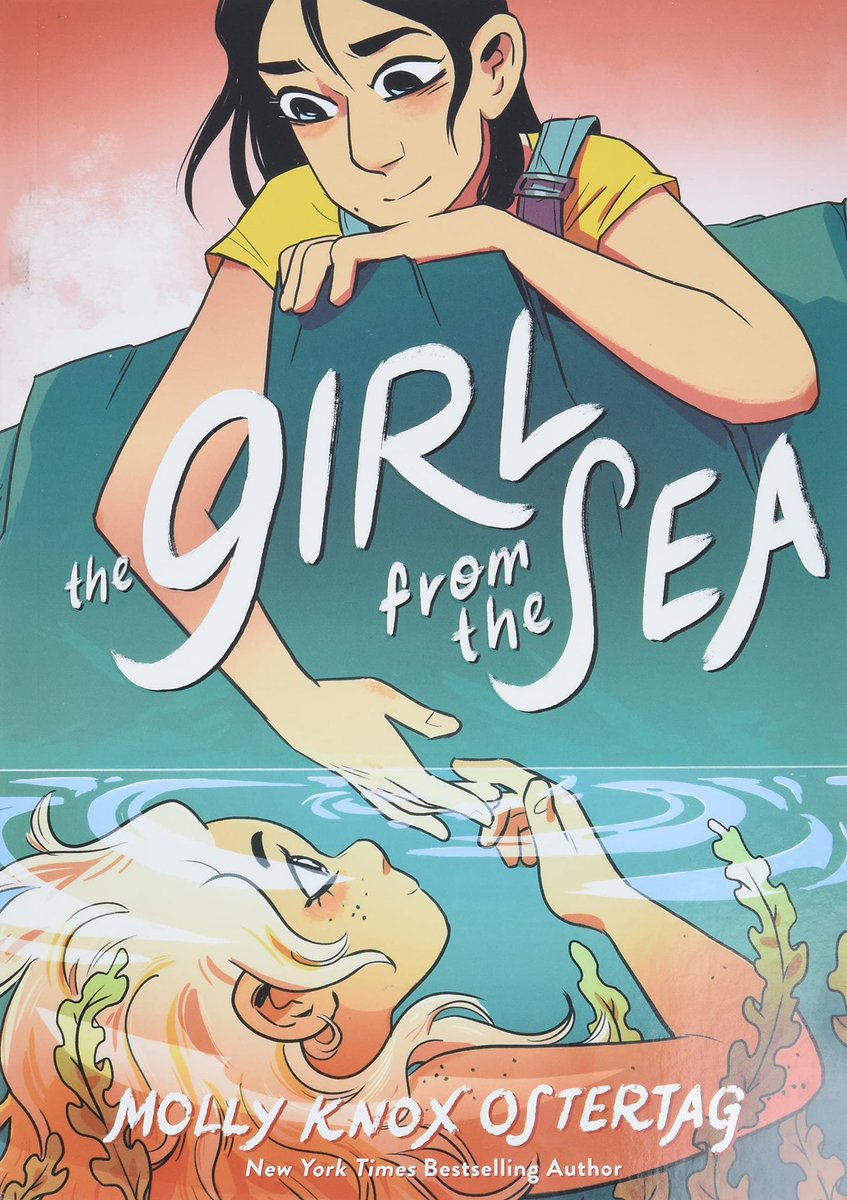
The Girl from the Sea is, I think, a standalone graphic novel for mid-grade readers by Molly Knox Ostertag, who did The Witch Boy and at least two sequels for the same publisher. (Scholastic.) (And, not for nothing, did well enough at it, and they published it well enough that this book has a "New York Times Bestselling Author" slug at the bottom of the cover.) I've read two of the three Witch Boy books, which are solid you-can-do-the-thing-you-want-to-do-young-human! books of the kind perennially necessary. I do like to see what Scholastic is putting out, since they're the real 800-pound gorilla of the comics world, making books that vastly more actual people read than any longjohns publisher. And Ostertag does nice work.

And The Good Asian, Vol. 1 collects what I think is the first half of a noirish story by Pornsak Pichetshote and Alexandre Tefenkgi set in 1936 San Francisco. I don't know much more than that, and haven't (as far as I can remember) read any work by either of those creators before. In fact, I'm not 100% sure I'm going to be able to find the back half of this story easily, so....there's that.

Friday, August 12, 2022

Quote of the Week: Not Our Sort

It was a face which at first sight meant nothing to Smiley, seeming to have neither the imprint of temperament nor the components of character. it was a shallow, ordinary face, inclining to plumpness, and lacking quality. It matched his short, ordinary body and his black, ordinary hair; it was suitably compressed into an expression of sorrow. As Smiley watched him turn into the centre aisle and take his place among the principal mourners, it occurred to him that Rode's entire walk and bearing successfully conveyed something entirely alien to Carne. If it is vulgar to wear a pen in the breast pocket of your jacket, to favor Fair Isle pullovers and brown ties, to bob a little and turn your feet out as you walk, then Rode beyond a shadow of a doubt was vulgar, for though he did not now commit these sins, his manner implied them all. 

 - John le Carre, A Murder of Quality, p.74-75

Thursday, August 11, 2022

Body and Soul by Gregory Mardon

Everyone who thinks about stories has a fondness for this structure: it's elegant and fun, and the kind of thing that people who make and analyze stories love. (Of the books I have never and will never write, several are like this.)

I don't mean that as dismissive: it's hard to do well, and it's complicated at its base. But it's a little bit of a cliché, too.

What I mean is the round-robin kind of story. You know, start with Character 1, who interacts with Character 2, who then interacts with Character 3, and so on - usually circling back to 1 eventually, and often doing the loop more than once or making more complex circuits through the cast before it's done. Done well, it shows character really well, and gives a picture of the whole group: a community, people involved in some particular thing, or (most usually) just a cross-section of this time and place.

Gregory Mardon's 2018 bande dessinee Body and Soul is exactly that kind of story, set in contemporary Paris and centered on one family (fiftyish doctor father and youth-obsessed mother, twenty-something free spirit daughter and teen grump daughter). Also part of the mix are the secretary at the doctor's practice and his best friend, an aspiring actor, plus an old lady only tangentially related to multiple threads and the twenty-something woman's scam-artist boyfriend/partner. They're all on the cover: if you read Body and Soul, the cover might be useful as a way to remember and place everyone and their relationships.

To give more details, I'd have to tell the story, and the story is not really the point: the connections, especially cross-connections, are the point, and how the reader discovers and realizes them while reading. Even telling you it's that kind of story might be a minor spoiler, I guess.

The cover makes it look like the older daughter is the center: that's her in the front. But her mother is more important in the end: she seems like a cliché at first, but she's on more pages and more deeply involved in more of the stories by the end. (Whether this is some kind of buried sexism - she's the mother, so of course she's the one who pulls everyone together - I'll leave for everyone to decide themselves.)

Body and Soul has no huge lessons to impart: it's renormative, in a minor way, but it's mostly just observing these people and their lives. It's neither sympathetic nor unsympathetic, I guess: it's just looking to see what happens next. And it is a good example of this kind of story, so if you're the kind of person who likes to analyze stories and who gravitates to the ones with interesting structures, this is definitely for you.

Wednesday, August 10, 2022

Fowl Language: Winging It by Brian Gordon

If there's only three books of something, and you read the first two and enjoy them, you're gonna come back and hit the third one. It's just one of those things.

I may not have anything new to say about Winging It, the third book collecting Brian Gordon's online comic strip Fowl Language, since I've already written about Welcome to Parenting and The Struggle Is Real since March.

Gordon's been doing this strip about a decade, and it's entirely about his family life: he draws a family of ducks (viewpoint father, mother, older boy and younger girl) who match, as far as the reader can tell, his actual family, although the ducks have (very sporadically) had their own names, which don't match Gordon's family's names. By the point of the strips in this 2019 book, the two kids were tweens: the obnoxious, demanding, argumentative years. (They're all obnoxious years, as parents come to learn - it's just different kinds of obnoxious as you go along.)

This one is more structured than the first two were, organized into a dozen thematic chapters, each one of which has a short intro by Gordon, laid out in a font that looks like the lettering in the strip so it's "handwritten." Those chapters loosely follow the kid-development timeline - at least as far as Gordon's own kids have gotten - starting with "Babies" and running through things like "Food" and "School" on the way to "Growing Up Too Fast." The intros are pretty close to the standard American "kids are wonderful and horrible" line of discussion, and don't really add much: I'm sure Gordon means all of it and is being sincere and honest, but we've all seen this a million times before. His strips are more distinctive and original, since they have to be quick and precise and funny.

As someone who has assembled books and planned out publication schedules, I have suspicions about this book. In particular, I would bet a medium-sized sum of money that it includes all of the usable early strips that didn't make it into the first two books, as a semi-housecleaning measure, along with some then-newer material. It was the "we have just enough for a third book, so we're making a third book" kind of third book, is what I think. And the intros were partially an effort to hit the sentimentalist sweet spot of the market and partially a way to generate new content for the book fairly quickly. (I would not be surprised if Gordon knocked them all out over a weekend.)

So this is the least of the three books to date, but it's still fun and funny. If you find it next to a cashwrap, or in a pop-up in your favorite online store, as your own kids are squabbling in the background, you will likely enjoy it only incrementally less than the first two. And that's just fine.

Tuesday, August 09, 2022

A Fistful of Drawings by Joe Ciardiello

This is not comics. Well, not exactly. It does have art on every page, and hand-written text to accompany and narrate the drawings. But they're not in panels - the sequence is all in the writing rather than the art. It's an illustrated memoir, I guess - the subtitle on the cover calls it "a graphic journal," which also works.

But it's a first-cousin to comics. It's doing a lot of the same things. It's close enough.

Joe Ciardiello has been an illustrator and gallery artist for several decades now; he was born in the 1950s on Staten Island to an Italian family and has lived in the general area since then. A Fistful of Drawings is a book loosely circling his love for Westerns (the real history and the fictional cowboy stories), his Italian heritage, and that childhood - especially the places where they intersect, such as the Italians who worked as cowboys and cowboy actors, and the spaghetti westerns of Sergio Leone and others.

Cardiello is a magnificent draftsman, with the loose energy of the best artists - every line here both looks quick and is absolutely perfect. So I don't mind that I suspect a lot of the art here was repurposed from other assignments. I think this book came together when Ciardiello was looking through his work and started seeing bigger themes that he could write the text about. Oh, I'm sure some big chunk of the art was new - these are all things Ciardiello loves to think about and draw - but so much of the art here is precise and odd that I have to assume it was an illustration job at some time in the past thirty years or so.

None of that matters: the building blocks of a book are mostly of interest to other architects and construction experts. What is important is the stories Ciardiello tells - the ones of his own life, the ones about the Old West, the ones about Italian cinema. They get pretty varied, and bounce around a lot: this is not a tight memoir, but a collection of reminiscences about things important to Ciardiello. (A Fistful of Drawings, so to speak.)

I think most of the audience for this has been fans of Ciardiello's marvelous art: his insights are interesting, but there's nothing revelatory here. He knows a lot of things and he presents them cleanly, in a compelling sequence - the book does tend to skip around among those same few touchpoints, but that's the point: it's about the interplay, how all of those elements formed Ciardiello's artistic sensibility and the world we all live in.

Monday, August 08, 2022

Reviewing the Mail: Week of August 6, 2022

Two books this time out, both of them things I bought from That Big Internet Retailer, both of them the next book in a series I've enjoyed. So this will likely be short....

Quillifer the Knight is the middle book of Walter Jon Williams's Quillifer trilogy (so far; I've seen at least one reference that Williams may have a plan for six books in mind), which is fantasy set in an secondary late-medieval world. I read the first one recently, though my post won't go live for another few weeks. Williams is one of the most criminally underrated writers in SFF; everything he's done has been excellent, and his range is breathtaking. So read his books, OK? Pick whichever one is in the genre you like best - he probably has at least one (space opera, historical sea fiction, cyberpunk, far-future urban fantasy, near-future thriller, humorous caper, and I could go on).

Trese, Vol. 4: Last Seen After Midnight is the fourth book in the comics urban fantasy series about supernatural investigator Alexandra Trese, by Philippine creators Budjette Tan and KaJo Baldisimo. I first saw this series a decade ago when it was first published in the Philippines, through the kindness of Charles Tan (the then, and maybe still now, greatest booster of the SFF works of that nation), and have been thrilled to see them finally published in the US. There's also a Netflix show, which I haven't seen, but that can't hurt the visibility of the books. Here's what I've written about the previous volumes: one and two (2009 ComicMix link, may be hijacked), three (2010), one (2021), two (2022), three (2022).

Saturday, August 06, 2022

Bonus Quote of the Week: World Without End

It's a bit far-fetched, but try and imagine a war between two sides: One's unimaginably stronger, and the other can't die. The strong one always wins, but he can never win. The weak one keeps getting shredded, but can't be defeated, not so long as he resists, Opposes, rather. There's got to be an opposition, even if it never wins a battle.

 - K.J. Parker, Inside Man, p.125

Books Read: July 2022

I do this post monthly, as soon as I remember, and update it with links eventually. It's an index more than anything else, for me more than anyone else. But here's what I read this past month:

Evan Dorkin, Veronica Fish and Andy Fish, Blackwood (7/2, digital)

Lewis Trondheim, Little Nothings, Vol. 3: Uneasy Happiness (7/3)

Koren Shadmi, Bionic (7/4, digital)

Maia Kobabe, Gender Queer (7/5, digital)

Jeff Lemire, Michael Walsh, and Nate Piekos, Black Hammer/Justice League: Hammer of Justice! (7/6, digital)

Frank Stack, Foolbert Funnies: Histories and Other Fictions (7/7, digital)

Paul Theroux, On the Plain of Snakes (7/7)

Carolyn Nowak, Girl Town (7/8, digital)

Yannick Pelegrin, Aldo (7/9, digital)

Peter Milligan and Duncan Fegredo, Girl (7/10, digital)

Lilli Carre, Heads or Tails (7/16, digital)

Andi Watson and Simon Gane, Paris (7/17, digital)

Walter Jon Williams, Quillifer (7/17)

Aude Picault, Amalia (7/23, digital)

Claire Bretecher, The Trials of Agrippina (7/24, digital)

J.G. Ballard, The Drowned World (7/24)

Jade Khoo, Zoc (7/30)

Lee Lai, Stone Fruit (7/31)

Algis Budrys, Michaelmas (7/31, in SF Gateway Omnibus)


Next month, I expect I'll read some more books. And, assuming I remember, I'll list them here.

Friday, August 05, 2022

Quote of the Week: Well, Obviously

- Darryl Cunningham, Billionaires, p.111 (two of six panels), referring to Charles Koch

Thursday, August 04, 2022

Alone in Space by Tillie Walden

A novel, prose or graphic, is one thing. You can grasp it in your hand, make big statements about it, sum it up in a few words. (Maybe badly, maybe incorrectly. But you can do it.)

A collection, on the other hand, is already multitudes. It flows through your hands when you try to define it: a little more over here than you first thought, oh wait maybe it's more like this, no no I've got it now it's totally thus.

Alone in Space is a collection: it's basically the first four years of Tillie Walden's comics career in book form.

Well, wait. Like all collections, I need to immediately back up. This does include work from about 2013 to 2018 - three published books and a bunch of shorter works. That timeline somewhat overlaps her first two "big" graphic novels, 2017's breakout Spinning and On a Sunbeam in 2018. So maybe the first thing to note, as I have before, is how hard and diligent a worker Walden is: this is a lot of pages, a lot of different stories, a lot of writing and drawing, to come out of one person in a short amount of time.

Another caveat: I say "career," but pretty much all of the short pieces here were schoolwork, assignments when she was studying at the Center for Cartoon Studies (CCS). And to caveat the caveat: so was Spinning. Schoolwork can become published work, and did.

But here's how I think the timeline worked. Walden made comics in highschool, and published them online, the way anyone can these days. Some of them may have been short stories; one of those stories is here. But I think what became her first book, The End of Summer, was in that mix too - maybe was most of that mix. The small British publisher Avery Hill - who also published this book - noticed her, and offered to publish her work. That must have happened right around the time she decided to got to CCS: she was there for a two-year program in 2014-15 and 2015-16. And her three books from Avery Hill were published in June 2015, November 2015, and sometime in 2016 - so all, I think, reached the print world while she was at CCS but largely was work done before that.

So these are stories from a young creator, one working very hard to get better and to tell stories the way she wants. They show a lot of variation and change, obviously: they're from someone going from age sixteen to twenty and studying how to do this.

I'm almost happy to say that I find the first book, The End of Summer, the least successful. It has real strengths, especially in characterization, but it tries to do too much, has too many characters who are all part of the same family and all look very similar, and is set in a milieu that I don't think Walden meant to be a honkingly huge metaphor but comes across that way. It's about an aristocratic family, a very dysfunctional one in quiet, buried, aristocratic ways, in a world where winters are years-long and killingly cold, and some of the events during one particularly eventful winter. Frankly, I think I missed large chunks of what Walden was trying to do here: I had trouble telling characters apart a lot of the time, so I'm murky on who, exactly, the more horrible members of the family are.

I Love This Part, though, feels like mature Tillie Walden right away: a love story set in probably middle school, with vignettes each on single-panel pages, often with surreal backgrounds, telling a bittersweet growing-up story about two girls who don't quite want the same things at the same moment.

A City Inside is even heavier on the surrealism, and may be one more step in that same direction. It's a dream vision of the future of one woman's life, or maybe a true premonition, or something else - a life as it is or was or could be, presented more poetically than naturalistically.

The back third of the book is the shorter pieces: one very dark story from highschool and then mostly a bunch of work for CCS classes. They are varied and different, sometimes working out the same kind of material as the longer stories, sometimes very clearly class assignments of the "talk about yourself in this way" or "do an X story in the style of something you like a lot" style.

Again, this is a collection: a bunch of work by one person over a few years. It's not thematically unified. It doesn't cleanly map out artistic development. It's a bunch of stuff, all of it at least reasonably successful, by someone ferociously talented and (this is more important) even more ferociously devoted to doing the work and getting better. If you've liked any of Walden's longer books, you'll find pieces to love here.

Wednesday, August 03, 2022

Inside Man by K.J. Parker

I think this is a sequel. It's isn't exactly coy about it, but it is, let us say, strategically vague on the subject. But all of the details line up. It might as well be a sequel. We can read it as a sequel.

Although....any book narrated by a demon must have some seed of doubt in it, right?

K.J. Parker's Prosper's Demon was the story of an exorcist, in an early-Renaissance world that was not our Europe, but was very parallel. (Monarchies turning into vaguer autocracies, almost steam-engine time, actual demons from actual hell possessing people and needing to be cast back out.) Our narrator was not a good man in any way, but he did have the power to compel demons to vacate human minds, which is both useful and rare. He tangled a lot with one particular demon, who he found in his mind before birth, as soon as he was aware of anything - and, as is the nature of an exorcist, always bested that demon.

Other things happened in that novella, but that's the through-line: one human exorcist, one immortal demon, scheming against each other, each other's best enemies.

Inside Man is...well, again, it's not officially a sequel. As in Demon, there is an unnamed human exorcist and an unnamed demon. They're not necessarily the same. We cannot prove it.

But they are. We assume they are; we believe they are. We read the story because they are.

This time, the demon is our narrator. And he, of course, has a different point of view than the exorcist did: he's embedded in a complex organizational structure, all the way up to the Highest, full of bureaucracy: the whole Screwtape thing we're all familiar with. He has no free will, you see; he has a pleasant voice and a sophisticated point of view, but everything he does is because of wheels within wheels, blah blah blah, ineffable something and unknowable something else, who art thou to etc., and so on to the fall of a sparrow.

That's a tough position for a main character: essentially powerless in an powerless world, caught up in chains of requirement that bind everyone and everything. It works for the course of a novella, but I don't know if I'd want to spend much longer than that: it's very constricting.

This demon has his jobs to do. Man, as far as I can tell, takes place primarily after Demon, but the big ending of Demon is never mentioned. But don't worry: there's a bigger ending here.

Much bigger, I could say. In implications, certainly.

I don't think I should say much more than that. I didn't find Man as much immediate, chortling fun to read as Demon, but it's thornier, more theologically detailed, and it delves into some things implied in the first book. This one is also not quite so quotable as Demon, or at least I didn't find it so. But it sticks the landing very well.

There may be a third, I suppose: never bet against a third. But I don't think so. I think there were two sides, and we learned both their stories. And now we are done.

Tuesday, August 02, 2022

Billionaires by Darryl Cunningham

Billionaires is a long, detailed book, with many more words than you'd expect for a graphic novel, and a long list of sources at the end - a well-researched and carefully-organized work of non-fiction. So my post here may be less detailed; any questions raised by the book will be best answered by the book.

Darryl Cunningham makes non-fiction comics, I think - the book I've previously seen by him was titled How To Fake a Moon Landing in the US (and less puckishly in his native UK), and his bio in this book lists several other similar titles. From what I've seen, he's not entirely serious - there's a thread of humor here, mostly in commentary about events, or in how he draws things - but his purpose is essentially serious, and, in this book, mostly a warning.

This is a book, broadly, about how massive concentrations of wealth tend to degrade and destroy both democratic institutions and human lives, and, more specifically, about four very very rich men and how they have demonstrably made the world worse while they also accumulated massive amounts of money for themselves.

The four are Rupert Murdoch, the media mogul and owner of Fox News; Charles and David Koch, the oil & gas magnates, libertarian nutbars and founders/funders of most of the most corrosive institutions of the American right wing; and Jeff Bezos, founder of Amazon and the single most destructive influence on the American working life of the past generation.

They're all horrible in their own ways, though I tend to think Cunningham has arranged them in order of decreasing horribleness. Murdoch is a nasty old bastard whose creation was central in the near-coup that is still resonating in American life, and which has been proven, repeatedly, to make its habitual viewers stupider, worse informed, and more prone to radical violence. The Kochs have an even longer-term corrosive effect, made worse by the intellectual sheen they put on the brute selfishness of their libertarianism, and have been important for decades in climate-change denial that may well lead directly to the deaths of millions of people worldwide. Bezos, by comparison, is just a normal unpleasant tycoon: driven, obnoxious, with stupid manias (space travel!) and the usual mix of arguable benefits to the world (get things in a day from one retailer anywhere!) that come with obvious unpleasant side effects (horrible working conditions for both white and blue-collar workers! destruction of myriad competitors who provided jobs and careers and ownership for huge numbers of people! low-key demands for government handouts for new offices!).

Cunningham also says, near the end, that he could have done a similar book about lefty billionaires, which I think is at least partially disingenuous. That book might be clearer on how any billionaires, even ones who try to support charity as they get older and mellower (see: Bill Gates) are bad for democracy and everyone poorer than they are, but it would not have the frisson of these four very horrible people doing their very horrible things. Evil billionaires make a better case than vaguely neutral ones, or even inadvertently-destructive ones. And at least three of these four are very much evil billionaires.

This book may make you want to sharpen your guillotine and start gathering cobblestones for barricades, which is no bad thing.

Monday, August 01, 2022

Reviewing the Mail: Week of July 30, 2022

One book this time, which came from the library. (I asked for two last weekend; one came through quickly and the other, I suppose, is still stuck in the gears somewhere.)

Stone Fruit is a 2021 graphic novel by Lee Lai, published by Fantagraphics, about three women and the kid they all connect to. I believe it's Lai's first major work - or maybe first long work - and I've seen it on some "Best of the Year" lists last year. I don't know a heck of a lot more about it that that, which is pretty much how I like to go into new stories: some people say it's good, I have a vague sense of genre (modern, kitchen-sink, family travails, in this case), and that's it.

I expect to read it before this post goes live, too. Call that a recommendation of a sort, if you like.