Thursday, September 22, 2022

The Drowned World by J.G. Ballard

I hope you've already heard of this book. I read the fiftieth anniversary edition ten years later: this is a 1962 novel by a writer who died, after a very long and distinguished subsequent career, in 2009.

J.G. Ballard started out in SF. He could have started nowhere else; SF was necessary for his work, but, eventually, it was no longer sufficient. But that's getting ahead of myself: for the potted Life of Ballard, see my obituary here or his last book, the memoir, Miracles of Life.

His first four novels were all apocalypses, published as if in the British tradition of cozy catastrophes, though they quickly got thornier and more complex than that. The one central thing about Ballard is that all of his writing was Ballardian; that may seem like a tautology, but it's deeper than that. His concerns and central images and character types and visions were remarkably consistent for fifty years, even as they were embedded in turn in SF short stories and SF novels and experimental fiction and mainstream novels and magic realists works and thrillers and less genre-typeable writings. A Ballard book could have been written by no one else, and will be filled with viewpoint male characters who are doctors of one kind or another, with ruined human-made structures and technology, with frighteningly charismatic Others, and with women who are more symbols than people. (Well, that last is very mid-century and not unique to Ballard.)

The Drowned World is Ballard's second novel, his first "serious" one, set a hundred or so years hence. The flap copy says 2145; I saw no dates in the novel and assumed it was sixty to seventy years on from when it was written: the transition to this world took that long and the pre-apocalypse world is clearly that of when it was written. This is a massively warmed world, though not caused by man: the Sun warmed up and has cooked the tropics to near-boiling. Landscapes have been transformed within a generation by meltwater dragging silt in its wake: this is a much shallower world but a wetter, steamier one, with nearly all of the great cities buried in mud and then covered in water.

Humanity is reduced to a few million in outposts in the Artic and Antarctic. With temperatures reaching 150 in places, I assume the two ends of the Earth can now never meet - but Ballard's characters live through higher temperatures than I thought possible. Here I should point out that Ballard did train as a doctor, and does always write in a mesmerizing tone of authority, but that all science in his books must bend to the force of his narrative and to the psychological concerns of the book - accurate science can be found, but not always consistently, and it's very much not the point.

Our viewpoint character is Dr. Robert Kierans, head of a small biology team in a traveling semi-military mission to explore those overgrown cities of Europe and, perhaps, bring some positive news back to the North. The book takes place in the lagoons and swamps above the ruins of one such city: the reader will guess which specific, important city before the novel makes it clear.

Drowned World is not exactly a response to Conrad's Heart of Darkness, but there are similar elements, and places where the two works rhyme or harmonize. Drowned World is much more overwhelmingly apocalyptic: this world has been utterly transformed, and the men left living in it are going through a destructive transformation of their own, which Kierans and the others characterize as evolution running backwards to recapitulate previous forms, both physically (giant insects and crocodilians) and psychologically in the human brain. The tone is Ballardian pessimism: the human race is not actually extinct yet, but hope is slim and opportunities to rebound nonexistent.

This is a short novel with a small cast set mostly in one place, primarily circling the same few concerns and obsessions. (But, then, I said it was a Ballard novel.) As the time to move on to the North approaches, some of the men feel irresistible urges, driven by unsettling dreams, to stay behind - even to head deeper to the South and the ever-hotter temperatures.

Kierans is not immune. No Ballard protagonist is immune; a Ballard protagonist is always at the heart of the transformation that book is about. I said the cast was small, but they are not all in place at the beginning of the novel. There will be changes in the lagoons above this dead city, new interlopers with their own demands and obsessions. There will be conflict. There will be death.

This is a Ballard novel, arguably the first truly Ballardian novel. This is where it all started, I suppose, though I could muster as strong an argument for a number of the stories as well. And the vision of a hothouse world that has driven humanity to the margins is vastly more relevant now than it even was in 1962. I recommend it. I recommend nearly all of Ballard, actually. If you're living in the 21st century, the classic SF writers you should know are Ballard and Dick: we live in their worlds.

Wednesday, September 21, 2022

The Trials of Agrippina by Claire Bretecher

It's important to know when a book came from, as well as where. Usually, the who is very obvious, but I suppose I should throw that in as well.

The Agrippina stories, about an unimpressed teenager in the "modern" world, were published from 1988-2008 in French. I've heard of them - I think most recently and clearly when their creator Claire Bretecher died in 2020 - but I don't think they've been available in English consistently or perhaps ever. Reading between the lines, Bretecher used an invented, baroque version of French teen slang in these books, and translating that to English was clearly a major hurdle. (Edward Gauvin translated this edition; I have issues with the text that I'll mention in a minute, but his translation is sprightly and amusingly idiosyncratic.)

So I finally read my first book of Bretecher's, 1992's The Trials of Agrippina (les combats d'Agrippine in French), which is presented as the first volume in this version from Europe Comics. But, unless something odd is going on with the titles, that seems to be the third book of the original series.

I go into this detail because, while reading, I kept wondering "when is this?" Agrippina and her friends don't have phones or computers: it felt more like my teenage years than those of my (now-adult) sons. My guess, during reading, was a vague '80s-'90s feeling, and I'm happy, I suppose, to see that I nailed it pretty closely: the first Agrippina book was in 1988, and it looks like the background stayed mostly consistent through the last book in 2008. (Just before the smartphone era, as it happens.)

The other thing I kept thinking while reading was "what does that say?" This is a French album, so originally on larger-size pages, but I read it digitally, since it was only published digitally. That shrinks everything to begin with. The text is lettered in a fussy, scripty font, I assume because it's all dialogue, and that makes it look quick and authentic. I also assume, without evidence, that is based on the lettering in the French originals; if this was a new creative choice, I am very angry at someone.

What's my point? This book is very difficult to read physically. The words are cramped and in a font that fights legibility. The phrasing is odd and quirky. The names are wordplays based on allusions to things French people in the '90s would recognize: Bergere Leprince, Morose le Hachis, Morphee Naumann.

And the humor is arch and mannered to begin with. Agrippina is a faux rebel, like all of her friends, aping ennui and obsessed with trivial things, while the older generation are the usual morally compromised losers in stories about teenagers. All of them are superficial in their own ways, nattering on at length about silly things - so the reader has to be able to scan the text, understand it on the surface quickly, and also make judgements about these characters on a deeper level.

The book physically fights against that from the first page. I found myself squinting around my glasses, blowing up individual panels, and making guesses about things like "Ben Zynsgzwa" (?) over and over and over again, making every last panel an effort of decoding and interpretation. If there's a better way to destroy any humor in a book, I don't know it.

Now, I think this book is also somewhat out-of-date to begin with, its concerns those of a previous generation, which doesn't entirely help. But it could be much better if presented properly, in a format that English-speaking people can understand quickly - a lot of the wordplay would have been really funny if I could have just read it rather than decoding it.

The substance of the book is a lot of short stories, most of them just one comics page, most often nine or twelve panels squashed up against each other without gutters, most often with a single Feiffer-esque viewpoint that's repeated in every panel. Bretecher's art is quick and light, which gives that bland layout some more energy and movement, but the style of this book is pretty old-fashioned.

All in all, you may guess that I was not thrilled with The Trials of Agrippina. The book design and lettering do their best to hide and obscure what is good and interesting about this work, and time has taken a few potshots at it as well. I may read Bretecher again, but I would want to make sure I can actually read it before diving in.

Tuesday, September 20, 2022

Amalia by Aude Picault

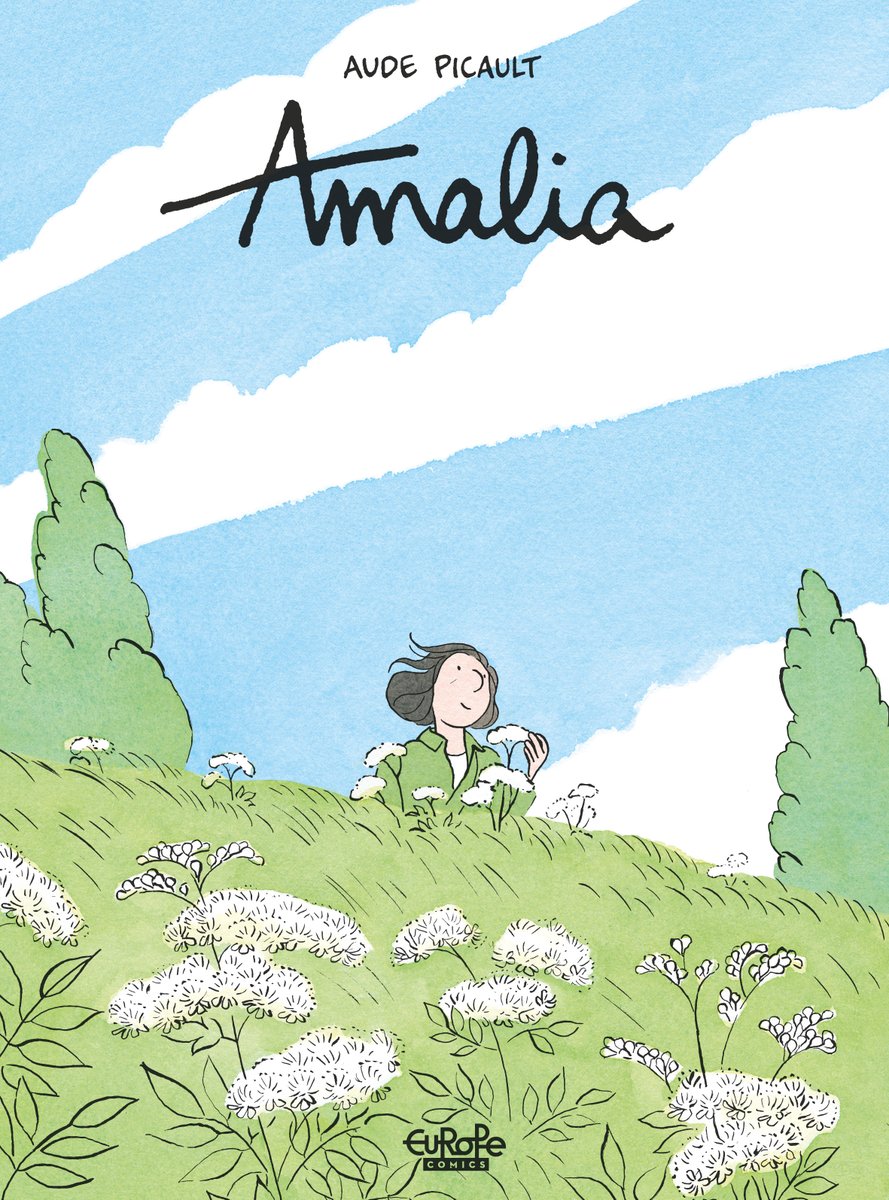
Amalia is stressed. Her job at Horizon Management - an account rep or phone support for some kind of B2B risk-management products - is hectic, so she's spewing happy talk at high speed to unhappy customers all day long. Her husband Karim is passive-aggressive when he's not yelling. Her preschool daughter Lili is loud and demanding and refuses to do what she's supposed to. And her teenage stepdaughter Nora is all drama, glued to her phone and obsessed with both following famous influencers and becoming one herself with endless makeup-application videos.

This is all in France, somewhere. Amalia drives through fields to go to work, but lives in what looks like an older city - my guess is it's a provincial city, maybe near the coast. It's just barely near-future; tech is exactly the same, but climate change is wreaking even greater havoc, with massive fish deaths and threats to the wheat harvest.

That last is another one of the stresses on Karim, who works at a Le Bon Pain factory, some kind of skilled bread-making worker but definitely not management.

In fact, they're all stressed, which titling the book Amalia might tend to hide for a while unless the reader pays attention. Amalia is central, but this isn't only her story. She's the one who breaks from the stress first, but that just makes her the vanguard. This is the story of Amalia, of her family, of their stresses, and what they do to make their lives more manageable - haltingly, tentatively, without clear direction and more than a little bit reactive to outside events. But we think they will make it through: more, we want them to make it through and we believe in them.

On the surface, Aude Picault's bande desinee is about the stresses of modern life, about needing to slow down, stop obsessing about little things, and find quietness. But it's also more specific than that: all of the stressors in Amalia's family's lives are because of modern capitalism, and the central ones are because of climate change in particular. This is not a strident book, not one that makes any political points directly, but it implies a lot more than it says: it points towards a solution to this kind of unsustainable life, and hints heavily that solution will require collective action and massive changes in how a lot of people live.

But it also says, in its quiet way, that everyone is already this stressed. Again, it's not just Amalia: she's just the one who breaks first. Picault is saying that we will all break, like this or differently, if this keeps going on. And so it can't keep going on.

This is an optimistic book, in the end: one that says we can fix these problems, that individuals can overcome stresses like this and confront big, systemic problems and maybe even solve them. I love it for that even as I think it paints an overly rosy picture.

Monday, September 19, 2022

Reviewing the Mail: Week of September 17, 2022

I have one book to write about this week, and it's a very small one.

Hellhounds is a novella - maybe novelette? - published as a book, by David Sandner and Jacob Wesiman, It's coming from Fairwood Press in November, and it's a sequel to their previous Mingus Fingers, about the famous jazzman of the title and whether he did or did not turn into a giraffe while playing. (I have a copy of the first book on the shelf but haven't read it yet - yes, I know the thing is only sixty pages long; there's a lot on the shelf - so my description may be incorrect in small or large ways.)

In Hellhounds, the main character of Mingus - the young musician with the seeing-giraffes vision - is missing, and his brother must find him, and it sounds like he may not be searching in the world of the living, if you get my meaning.

These books sound deeply weird in the best ways; I again insist that I will find time to read them.

Saturday, September 17, 2022

Quote of the Week: What the Ruling Classes Are Good At

There followed a massacre conducted in strict order of precedence, the second shot being taken by Berlauda's mother, the next by Floria firing her caliver from horseback, and so on. Such women as chose to fire seemed all to be practiced shots. The bracing scent of gunpowder floated free in the air.

I was not bothered by the bloodshed or the butchery, as I had grown up with animals being killed and cut up as a matter of course, and the difference between this and my father's occupation was one of degree, not intention. Yet in this ritual display that brought all of these glittering people to the killing ground, I felt there was more than assuring a supply of meat for the night's supper. I reflected on how these noble families had gained power, and for the most part it was war, as with Emelin who had slain other kings, or at least some form of combat, as with Roundsilver's ancestor who slew the dragon. The nobles had achieved preeminence through combat, and this ritual bloodletting wasn't sport only, but practice for war.

 - Walter Jon Williams, Quillifer, p.265-66

Friday, September 16, 2022

Quillifer by Walter Jon Williams

I'm vastly less likely to read tight series these days than I used to: I like short books with endings, now that finding time to read is tougher. So there's a whole horde of writers that I read enjoyably back in my SFBC days that I haven't touched since, mostly the trilogy-mongers roaming the wilds of the various fantasy realms.

But I can be pulled back in. Sometimes. For the right reason.

Walter Jon Williams recently finished up a fantasy trilogy about a rogue in a mostly realistic but entirely fictional world, somewhere in that rough territory between Late Medieval and Renaissance, and I'd had a copy of the first book, Quillifer, on my shelf basically since it was published. Williams has been a consistently excellent writer, no matter what he did: from the far-future science fantasy of Metropolitan to the elegant silliness of the Drake Maijstral books, from the widescreen Big Idea SF of Aristoi to the day-after-tomorrow thriller of This Is Not a Game, it's all been great. So I've been wanting to read Quillifer, but unsure when I'd have the time to do so.

I haven't read much of what Williams has done the past decade or so, mostly because he's been busy with series - the "Dread Empire's Fall" trilogy and related books, this trilogy, and even the two Not a Game sequels that I still haven't gotten to. So, eventually, towards the end of a vacation, I insisted to myself that I can't call someone one of my favorite writers if I don't read their books. (This may be a radical take, I admit.)

Quillifer is our hero and narrator, about eighteen as the book starts. He's smart and somewhat sneaky and fond of making up new words. He is also attracted to the ladies, in the focused, hyper-verbal way only a very smart man of eighteen can be. He's apprenticed to a lawyer, and seems to be good at that work, for all that he'd rather not sit in an office and scribble all day long. His father is a prominent local butcher, which implies this is a world in which the middle classes are emerging or maybe have emerged: Quillifer is a rising man, poised to jump into a higher social class than his parents while also doing well financially.

He lives in the provincial city Ethlebight, far from the court of his kingdom of Duisland. And something shattering happens very soon after the beginning of this book, which changes the entire expected path of his life.

All of the other events of Quillifer follow from that shattering event, so I'm going to avoid talking about plot. Quillifer is an enterprising, smart young man, who turns out to have a head for complication and to be almost as good at getting himself into trouble as in getting himself out of it. Which is good, because he is a commoner in a world in which they are considered lesser, in every possible context, than nobles, and a world where everyone's lives are contingent, frequently disrupted, and often short.

That world looks to be entirely realistic at the beginning, and for a long time afterward. But I will say that this is a fantasy novel: the second major change in Quillifer's life we see, around the half-way point of the book, makes that clear. The series as a whole may become more fantasy later, perhaps, but I don't expect it will: there is one element, one central thing, which will continue to affect Quillifer as his life goes on, and I think that's how Williams plans to leave it.

Quiller's story is hugely entertaining: he's somewhat of a rogue, but mostly not a criminal or scoundrel. His voice is more than a little self-serving, but not overly unreliable; we believe this is really what happened, though shaded to make Quillifer look better. And he does get into a lot of things before the five-hundred-plus pages of this book are over. It's somewhat picaresque, in that there's no strong central plot: this is about the Thing That Happens, how Quillifer adapts immediately, his travels coming out of that, and what he finds to do in the places he ends up.

Again, I'm being vague: I don't want to spoil the major plot elements. But Williams is a master; he does all of this well, from big action set-pieces - chasing over roofs or fighting a battle in a village - to character scenes with nobles and outlaws and friends and enemies. Quillifer is an adventurous good time; its world occasionally feints in the direction of grimdark but this is a somewhat lighter, happier book than that, centered around a young man who the reader thinks can probably handle anything this world throws at him as long as he doesn't get too confident or cocky about his abilities. 

Like everything else I've read by Williams, I recommend it highly: this is really good, and really fun. I'm looking forward to the two books that follow.

Thursday, September 15, 2022

Paris by Andi Watson & Simon Gane

I read this for almost entirely extraneous reasons, if that matters.

I'd seen the original edition of Paris when it was first published, and wrote about it for ComicMix. (Be careful with that link; much of ComicMix's back catalog seems to have been infested with hijackers, and there may be malware lurking about.) I vaguely knew that there was a newer, slightly longer edition, and had a perhaps even more vague idea of reading it, eventually, since I've been re-reading Andi Watson's books over the last few years.

This is written by Watson, by the way, but the art is by Simon Gane. It's the only time they've collaborated so far; Watson usually draws his own books. (Though they do have a new book together, Sunburn, coming up this fall.)

None of that is why I read Paris. And, looking back, it's completely random that I did read it, only five days after this new edition was released.

I was browsing through Hoopla, the app my library uses, trying to find something to read that day. I'd just come back from a movie The Wife dragged me to. Now, it was not a bad movie, in any sense, but it was predictable and obvious and thuddingly normalizing in all sorts of ways: a well-executed thing that I didn't mind watching but cared almost exactly nothing about. So I wanted something of a palate cleanser: something like that in superficial outlines, but more subtle, with better storytelling, and maybe something subversive about it. To be blunt, something with a bit of romance, maybe set in Paris in the 1950s, maybe without a moral of "common people are magical beings who make everyone's lives better with their cheeky clear-headedness".

Thus Paris. My original review covers the story (assuming you can navigate the "click Allow now!" pop-ups to read it): young American painter Juliet is in Paris, studying at the Academie de Stael in genteel poverty. Young British heiress Deborah is also in Paris, chaperoned by her horrible Aunt Chapman and having the most boring time possible in that city.

Juliet is hired to paint Deborah; they have a spark. Circumstances intervene to snuff out that spark, possibly before many readers have realized it is a spark, and not just a friendship. Will they meet again, and re-connect?

That's the story. There's some additional complications, such as Juliet's lusty roommate Paulette and Deborah's swishy brother Billy, but it's a story about these two women, and whether they can manage to get together despite everything.

Gane has a very detailed style, that, to my eye, is influenced by both mid-century illustration and the lanky grace of high fashion. I don't know if he always draws like this, but it's a lovely choice for this story, making the City of Light a place of glamor and bustling life, real in its own way but idealized, the perfect vision of a romantic city of the past.

Like most of Watson's work, the story here is low-key; you need to pay attention. It also helps to know a little French, since some phrases are untranslated until a set of notes at the end. But they're all clear in context to readers who do pay attention.

The first time around, I thought of Paris as minor Watson, but I've revised that estimation upwards this time around. Gane's art adds something unique and wonderful, and Watson is at his most subtle and allusive here, trusting his readers to see this story and not need to be told everything. You may need to read Paris twice to properly love it, but you don't need to wait fifteen years between readings as I did.

Wednesday, September 14, 2022

Heads or Tails by Lilli Carre

I like the fact that the comics field is vast and deep these days, I really do. But I'm not sure if I like it despite or because I can lose track of interesting creators for an entire decade.

Take Lilli Carre, for example - I read what I think were her first two books (in reverse order), The Lagoon and Tales of Woodsman Pete, back in 2009. Looking back now, my reviews were a bit mixed, but there was a lot of good stuff there, and Carre was clearly a creator I wanted to see more from.

And then...well, she at least had a collection of stories in 2012, because I just read it. My guess is that she has had other books in the past decade and a half. But I neglected to notice them at the time. That's mostly on me, and maybe partially on the way comics are sold into comics shops on a monthly basis - if you miss what's coming out that particular month, you might never hear about it again, especially in book form. It's a culture and a market designed for ongoing stuff, this month's adventures of Longjohns Man.

Carre is from a far different corner of comics. Heads or Tails collects 8 "long" stories and a bunch of shorter ones [1], plus some illustration work, all wrapped up in a stylish package. She draws in a distinctive style, closer to design than realism, and I tend to see a bit of Richard Sala in some of her figures. But mostly she draws like herself: lumpy people, only rarely drawn to be attractive, in equally lumpy, slightly cartoony surroundings.

Those people live uneasy lives; Carre's stories are about uncertainty and unexpected happenings, people who bounce off each other randomly. There may be a hint of Sala there as well, in the mystery and uncertainty, but Carre is entirely domestic: her people are stopping randomly in roadside carnivals or viewing their own lives from the outside, not being caught up in fiendish plots. There is oddness and strangeness, yes, but of the normal-life kind, the "what am I doing here" feeling, sometimes shown straight and sometimes transmuted into something nearly fantastical.

It's a territory entirely her own, I think: I've seen comics about the supernatural, and comics about the domestic, but no one else that builds her own uncanny valley out of the juxtaposition of the two.

These are strong stories, well-constructed and deeply thought through, full of electric moments and surprising drawings. And they're all more than a decade old: I have to wonder what Carre has been doing since this. I'll need to look.


[1] I think the first story here, "Kingdom," is only just slightly longer than some of the shorter pieces, but it sets the tone for the book.

Tuesday, September 13, 2022

Girl by Peter Milligan and Duncan Fegredo

There's all kinds of ways to build a creative program, but the two big ones are to follow a specific editorial plan (superhero comics, TV shows for teens & twentysomethings, R&B music) or to work with a curated group of popular creators and let them do their thing.

The first is most common; you tend to see the second in more highbrow media areas, like prestige publishing imprints and classical music...and, maybe, that means they're already in a sub-genre, but just don't like to think of themselves that way.

In the '90s, DC Comics' Vertigo imprint was undergoing a slow-motion transformation. It formed out of a cluster of very popular comics that were mostly Type One (superhero comics taken seriously!) but were often presented to the public as Type Two (all British writers! all the time!). But the core superhero universe was on its own path to take itself seriously, in a very different and much more tedious way (pouches! grimdark! no captions!), and the premise of Vertigo was being undermined by that, and by the relentless demand for ever-more-complex and ever-more-consistent continuity everywhere.

I don't know if Vertigo was consciously looking for a new Type One structure, but they eventually found it in High Concepts, SF and fantastic premises (Fables, Ex Machina, Preacher, Y: The Last Man) that were roughly Classy Television in comics form, typically owned by their creators rather than being sharecropped superheroes, and featuring enough FX that they wouldn't have been feasible in a filmed medium. It took a while to get there, though, so the '90s are an interesting period for Vertigo, full of quirky sub-imprints (Vertigo Visions! Vertigo Voices! Vertigo Verite! V2K! Vertigo Pop!), as the editorial team tried to figure out what their remit was and what kind of books they could do that would also be hugely successful.

Girl was in the middle of that searching: part of the Vertigo Verite burst, it was a three-issue miniseries from 1996 that I don't think actually got collected until this 2020 edition. Written by Peter Milligan, one of the core Vertigo writers (launch title Shade and a bunch of shorter-run things) and drawn by Duncan Fegredo, the same team from the three-years-earlier Enigma.

It's not a superhero comic. It's not fantasy or SF, either: pure realistic drama. And, despite the first issue feinting hard in the direction of "I'll tell you something crazy, and then tell you what was really going on," it settles down quickly to a more-reliable narrator, maybe because Milligan realized he only had seventy-two pages or so to tell the whole story. Or maybe not: there are some things here that are "real" at the time but retroactively not, or maybe vice versa.

Simone Cundy is a fifteen-year-old British girl, living in a crappy town (neighborhood? city?) she calls Bollockstown. She's one of those smart, prematurely cynical kids, and was born into a lower-class family happy to live up to all of the stereotypes. She, though, wants to Change the World, or at least Get Out. Or maybe just Do Something.

She's fifteen, living in an urban hellhole (at least: that's how she sees it. Everything here is how she sees it). So it makes sense.

Girl is the story of some stuff that happens to her. It's psychological realistic, though not necessarily realistic in the pure, kitchen-sink sense. It's pretty weird, I mean: not weird in the Weird Tales sense, but weird in the "weird kid" sense. Simone is a weird kid - I should say a weird young woman, since her story is largely about sex and death, as such stories often are.

I'm not convinced her story is entirely successful: there seem to be several warring story-structures that pop in and out of place as we go along, and it sprawls an awful lot for something less than eighty pages long. Also, Simone is very much a type, and that type was all over the place in that era: the depressed semi-Goth girl was as common as salt-water taffy for about a decade and a half.

And I'm not going to be any more descriptive about the things that happen to her, or that she causes: if you read this, you should discover them as you go.

Simone has a fun voice, even if it's a very familiar voice of the era. And this is a short book. So you might as well read it, if any of the above sounds intriguing: the Vertigo transition, the Goth-chick vibe, the weird story structures, the heavily-captioned style that was quickly going away by 1996.

Monday, September 12, 2022

Reviewing the Mail: Week of September 10, 2022

I needed to order something quickly, and that hegemonic retailer (you know the one) had a deal where if I spent $25 I could get free delivery that same day, and, well, I'm not made of stone, you know, so I found a book I would have bought eventually anyway to get up to that level.

This is that book; it may look vaguely familiar, since I got the second in the series (and posted one of these things about it) a month ago. I can also say my post on the first book in the series is coming up later this week.

But, for today, what I have is the third book in what I think is a trilogy: Lord Quillifer by Walter Jon Williams. It's secondary-world fantasy, first-person narration, and zero writers are better than WJW at his best, if I want to put it in a countdown format. I liked the first book well enough to buy two 500-plus page books within a month, even though I'm pretty much only reading 200-ish page books these days.

What else can I say? Williams has been one of our best writers for thirty-ish years now, always doing something new and interesting with each project, and I'm hoping to at least catch up with this series of his. (I see that the space-opera Praxis series, which I have entirely missed so far, is seven books long, so I have a much better shot here.)

Saturday, September 10, 2022

Quote of the Week: Choices

That was the best of Mexico for me - inexpensive meals that were delicious, cheap hotels that were comfortable, and friendly people who, out of politeness, seldom complained to outsiders of their dire circumstances: poor pay, criminal gangs, a country without good health care or pensions, crooked police, cruel soldiers, and a government indifferent to the plight of most citizens. I found that in these circumstances, the people I met overcame the infernalities by either being obstinate and wicked themselves, or in most cases being kind, in a mood of acceptance, understanding that voicing objections can get you hurt, or killed.

 - Paul Theroux, On the Plain of Snakes, p.187

Friday, September 09, 2022

Aldo by Yannick Pelegrin

Some stories are difficult to talk about because you don't want to give things away. Even saying "there's a twist" will change the experience, because then the reader will be waiting for that twist.

I may have said too much already. But that's why I'm going to try to be vague about Yannick Pelegrin's 2018 bande dessinee Aldo.

We meet Aldo at his therapist's office: it doesn't seem to be the first time he's been there, but he's still in the "tell me the basic details of your life" stage. Aldo's internal dialogue is honest: he's immortal, having been struck at the age of twenty-eight for three hundred years, for reasons he doesn't know. All of his family is long dead. He's not close to anyone. He doesn't tell the therapist this, but walks out instead.

We don't know what he does for a living. We don't really get a sense of his everyday life; the book is all in Aldo's head and focused on how he sees and lives in the world.

There are occasionally vignette pages, wordless, that break up the story Aldo is telling the reader. They could fit his narrative...at least at first.

He has a dog, Gustav, that he claims he's just dog-sitting for a friend, Oscar. And he goes to visit Oscar, the dog in tow - but Oscar is an old man, uncommunicative, in some kind of residential hospital or old-age home far out in the countryside. Aldo implies that he and Oscar were great friends, presumably some years ago when Oscar was young and Aldo was exactly the same age...and we see Gustav in some of those flashbacks.

If they are flashbacks.

Aldo goes on from there, heavily narrated by the main character, all about the weighty burden of being immortal in a world of mayflies - if you've read any SF, you know the drill.

Aldo sees something unexpected, takes a long journey to investigate - but the true journey of Aldo is entirely internal. And, as I implied at the beginning, there will be a twist.

This was Pelegrin's first book; he created it while in college studying how to make comics and published a revised version soon after graduation. We expect the young to take old stories and standard ideas, to build new on them - that much is expected. I don't entirely buy the ending, but it's set up well and Pelerin does play fair with the audience. This is an interesting, gnarly book that takes some well-worn ideas and uses them in different ways; I appreciate and like that about it. And I expect Pelerin will continue to make stories like this for a long time, which will also be a good thing.

Thursday, September 08, 2022

Girl Town by Carolyn Nowak

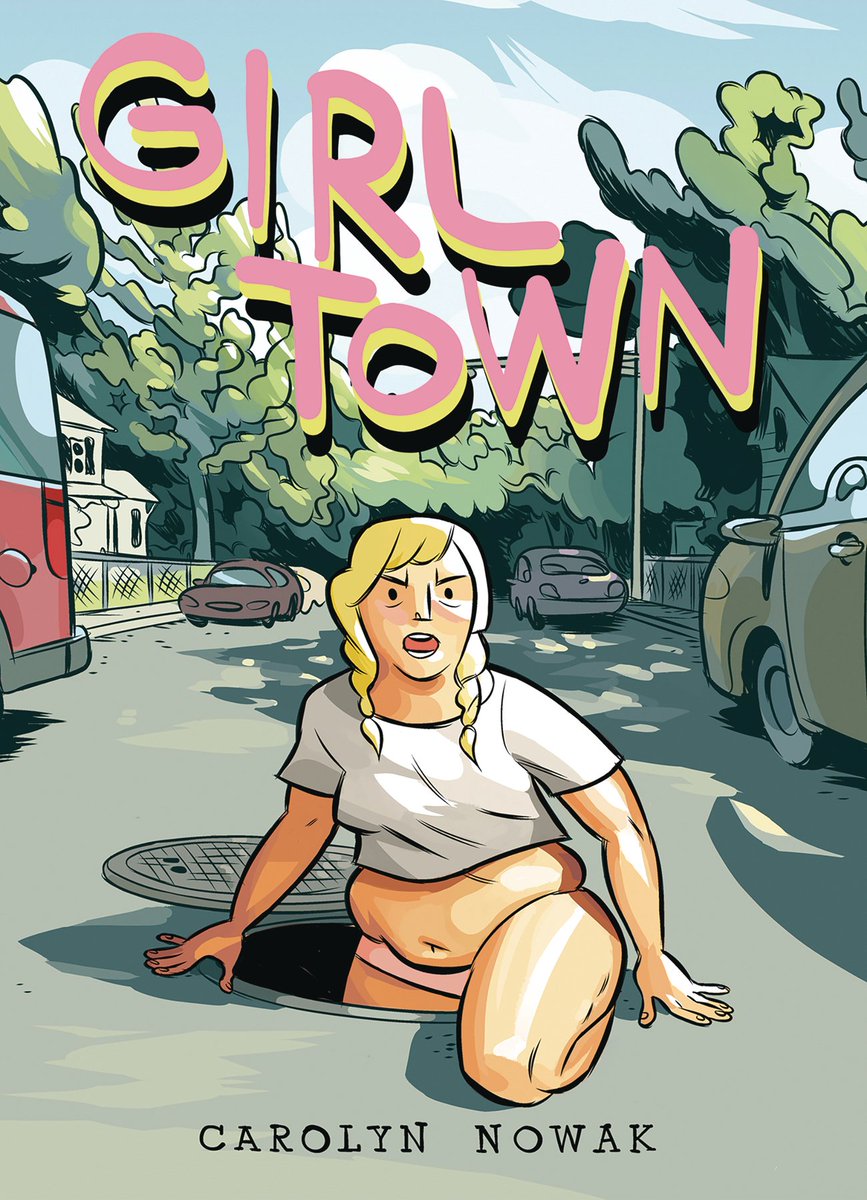
Girl Town is well-named: these are stories about women, centered on women, taking place in spaces mostly populated by women. Men are not absent - the longest story is about a "boyfriend," in a way - but these are not stories about men. And those women are all young, still at that age where they might uncomplicatedly call themselves, or each other, "girls," and not mean it dismissively.

I know some readers find that appalling - the focus on people who are not them, and not like them - so I might as well say it up front. If you're that kind of guy, this is not about you, and probably not for you. Maybe you can grow up and come back in a few years; I live in hope.

But for the rest of us, Girl Town is a deeply specific collection of stories, realistic in their core while being fantastic in their details, and a great introduction to the comics of Carolyn Nowak. (Other than this, she's worked mostly in other people's universes - Lumberjanes, Buffy the Vampire Slayer - and has, I think, put out a few more stories since this book was published in 2018.)

There are five stories here, one of which was original to this collection, and they're arranged in the traditional chronological order. I didn't notice any changes in quality; my sense is that Nowak was "mature" by the first story here, or that they're all from the same phase of her career.

The title story is first and oldest: it sets the tone well, with three female roommates feuding and interacting with three other female roommates living next door, in a subtly unusual world entirely centered on women and told in a quirky narrative tone.

The other stories continue, ringing changes but keeping to the same general territory: modern worlds, though not quite our own. Fantastic elements, techy or seemingly magical, that are just there. Women with strong relationship with each other. Discursive stories that wander rather than driving, stories about people and emotions rather than events.

Good stories. Strong stories. Stories, I think, that only Carolyn Nowak could tell, which are the kind of stories every creator should be aiming for.

Her art is supple and changing depending on the story; I think this is more changing to suit the needs of the story than artistic maturation, but who knows? You can only see the shape of something in retrospect; we'll only know a phase of Nowak's career clearly once it's over.

I hope this isn't over for a while: this is really good stuff, heady and rich and with subtle depths, stories that imply rather than tell and explore rather than define. We could use a lot more of this; I hope Nowak can keep doing it for as long as she wants to.

Wednesday, September 07, 2022

On the Plain of Snakes by Paul Theroux

Theroux's previous travel book, 2015's Deep South, saw him shift his mode of operations from trains to his own car and from foreign lands to his own USA, to reinvigorate his travel writing in his seventh decade and after the near-disaster of his last Africa book, The Last Train to Zona Verde.

2019's On the Plain of Snakes mixed up those two changes, with Theroux still using his own car, but heading even further south to once again get out of America and into foreign countries. This time, it was Mexico, where he'd spent some time during The Old Patagonian Express trip several decades earlier. But this time was a more specific trip - not the old "take the railroads as far as they go" trips of his younger years, but a deeper exploration of the whole land, starting with the border.

Plain of Snakes covers roughly a year of travel, 2017-2018, and Theroux presents it as continuous. There do seem to be some lacuna in his time, though, so I suspect his old "lives half the year on Cape Cod and half in Hawaii" popped up, with trips presumably to Hawaii, particularly for the last month or two of 2017. But it's pretty clear he drove his car south to the border, then the whole length of the border, and then on a number of trips deeper and deeper into Mexico, following the initial border section with a long stay in Mexico City and more journeys further south to Oaxaca and Juchitan, devastated by the recent Puebla earthquake. And then he drove that car back - the car made the trip the whole way, and never went anywhere else in the middle, even as Theroux made side trips by bus and plane and (perhaps, as I'm guessing) returned to the States here and there for other things.

Plain of Snakes is a book about ordinary life in the shadow of larger threats, mostly of violence: from the bizarre kabuki of the border, where everything real is entirely different from the rhetoric (this was 2017, remember: high season for "they're not sending their best")  to the lurking threat of the narco gangs everywhere in the country and their corrupt enablers in the police and military. Theroux came across a few mildly corrupt officials and cops - he doesn't make the point strongly, but I get the impression it was nothing unusual for someone who had traveled as widely as he has, just a few bribes here and there.

The book starts with that border, and the relationship with the USA permeates the book: how could it not, written by an American sojourning in Mexico? Theroux talks with dozens of people who lived and worked for a while in the USA - all of them, I think, illegally, probably all of them doing jobs locals wouldn't take, at wages equally illegal - and investigates how first NAFTA and then 9/11 completely transformed the border from a pleasant though mostly porous place where people travelled both directions and had strong connections into a militarized zone devoted only to commerce and where money flowed only to the criminals and the big businesses.

The first thing to know is that, though gringos seldom cross to any of the border cities and towns, tens of thousands of Mexican Americans and Mexican nationals cross every day, in both directions. They have visas and passports, or an ID that allows them access. Renting or buying a house on the US side is prohibitive for many, so a whole cross-border culture has developed in which American citizens of Mexican descent live in a house or an apartment - or a simple shack - in a Mexican border city, such as Juarez or Nuevo Laredo, and commute to work in El Paso or Laredo.

It is a fairly simple matter to walk to Mexico at any point, but there is always a crush of people - all of them with documents - waiting to enter the US to work, go to school, or shop. As the man told me in Tijuana, clothes and electronics are much cheaper in the US. A busy, bilingual Walmart can be found on the American side of most border crossings.

(p.34)

The Mexican side is also crowded, in those same border cities, with factories that sprung up after NAFTA, making goods mostly for the US market, mostly by people making a few dollars a day. Theroux is describing what he sees rather than critiquing capitalism, but the reader can very easily fill in the gaps.

The narco threat is more amorphous, the background of all life in Mexico, everywhere in that large, complex nation. The gangs fight with each other, sometimes fight with government forces - or seem to do so, the cynical might say - and massacre civilians in what seems a random fashion, a bus-load here, a group of protestors there.

Because in Mexico Mundo, life on the plain of snakes was so uncertain, every venture out of the security of the home could become dramatic and precarious. One of the more bizarre cruelties of the country, found in both its political and criminal culture - and of course the two often overlap - were sudden disappearances. As I found out from the humanitarian organization Caminos Oaxaca: Acompanamiento a Migrantes, hundreds of migrants disappeared en route to the border; the feistier journalists disappeared; the forty-three students from Ayotzinapa disappeared; virtually every day people went missing in Mexico, kidnapped, abducted, lifted, deleted, never to be heard from again.

(p.385) 

This is an oddly happy, positive book, for all of the upheavals and danger in the background: the border, the gangs, the earthquake that forms the background of much of the last hundred pages, even the Zapatista rebels Theroux spends time with near the very end. Mexico's people are strong and resilient, with a rich, deep vibrant culture, and Theroux presents them as rejuvenating him at a time in his life (mid-seventies, if I'm counting correctly) when he was feeling old and worn-out and useless. It is deep and rich and full of  interesting details, yet another masterful book of travel by a man who has been doing this well for forty years. I'm thrilled to see he's still going; if Paul Theroux can still head off to strange places and come out of them whole and with another thoughtful book, there is hope for all of us.

Tuesday, September 06, 2022

Foolbert Funnies: Histories and Other Fictions by Frank Stack

I'm not well-read in underground comics; they were mostly before my time and I often get the sense that you had to be there. If you weren't dropping out and tuning in, avoiding the draft and trying to make a coed, they're not talking to you.

But I try to dip in, now and then. I think I've mostly hit R. Crumb, as the best-known and most prolific guy in that space, but occasionally something else drops in front of my eyeballs.

So I came to the 2015 collection Foolbert Funnies, by the cartoonist named Frank Stack but who originally worked under the name "Foolbert Sturgeon," with a certain set of expectations and not a whole lot of background.

And I was wrong: this is largely not underground work. Stack was one of the original underground guys, at the University of Texas in the early '60s with Gilbert Shelton, but this book largely collects work from later - everything with dates is from the '80s and afterward - and only the first couple of sections fits in that mode.

Oh, the first half-dozen stories or so are quite underground, including a racist-caricature psychologist (Dr. Feelgood) who analyzes the dreams of the Stack-stand-in of those stories. Most of the early stuff, in fact, has a Stack stand-in, and a lot of it is about dreams, in a blunt '60s sex-and-drugs-and-violence style rather than a '80s wispy portents-and-ideas style.

But the middle of the book is taken up with a clump of very long stories that are mostly retellings or fictionalizations of historical events, including a tedious one about the secrets of Shakespeare, a more exciting speed-run through the major violent events of Caravaggio's life, and a clotted-with-words but mostly OK look at Van Gogh. Then comes the big fight scene: a 30-page, multi-chapter extravaganza in which Achilles and a small squad of Greek soldiers encounter a mounted Amazon scout group during the Trojan War, and fight. For thirty pages. With interludes of backing up to lick their wounds and talk a lot.

Did I mention Stack's comics have a lot of words? They have a lot of words. Lots of '60s psychobabble, lots of not-really-digested adventure-story stuff from an early-Boomer childhood (there are major stories here on both the Lone Ranger and the Phantom, and the cover is from a dream-story in which the Stack-stand-in is Superman, which devolves to the usual naked-in-public stuff), lots of just chatting to no real purpose. The overall affect is one of those gregarious Boomers who just won't shut up and who says "man" way too fucking much.

You might guess that I found this a bit tiring and not entirely to my taste; that's correct. This is post-underground work - you don't get to any of this stuff without starting from where Stack did - but it's far down a gnarled, idiosyncratic path, and not in a direction I was terribly interested in. Stack is an interesting artist who makes a lot of quirky choices - he was a professor of art at the University of Missouri for decades, which probably explains it - but I'm not impressed at all by his stories, by either what he chooses to tell or how he tells them. It doesn't even have that barn-burning nervous underground energy, outside of those first few stories: this is mostly much more measured stuff from a more mature creator, who was a young neurotic Boomer draft-dodger obsessed with cheap pop culture about guys in masks punching each other but somewhat grew up from that and decided to tell long look-at-me stories about historical figures.

My sense is that people who read comics for the art will find a lot to enjoy here. People who are aging Boomers - aging male Boomers; the underground world was always at least mildly misogynistic and entirely organized around male concerns, like everything else in their Boomer lives - may also find things of interest. The rest of us could quite profitably continue to avoid it.