Friday, November 03, 2023

Breakfast of Champions by Kurt Vonnegut

I thought I was going to read Cat's Cradle - that's the first or second most famous Vonnegut book, and I'd re-read Slaughterhouse-Five a few years back, so it seemed the obvious next step.

But what I had was a Library of America book, with Cat and Slaughterhouse and also God Bless You, Mr. Rosewater and Breakfast of Champions. So I poked at the beginnings of the other three novels, and ended up reading this one. Who knows why? The first pages were more open, maybe more purely Vonnegutian, and that hooked me.

So I read Breakfast of Champions, or, Goodbye Blue Monday! for the first time since the early Eighties. The novel that began Vonnegut's late period, if we're being polite, or his minor period, if we're being honest. I'm using the cover of the edition I read in paperback, way back when, instead of the current paperback cover, or the serious, bland LoA cover, just because.

Vonnegut was always discursive, and got more so as he went on - his early novels have plots and clear character development and all that, but, as he went on, his books turned more and more into mosaics, in which Vonnegut spoke directly to the reader about his concerns at the time, telling the story and interrupting it in turn. Well, I haven't re-read the novels after Breakfast for a long time: I have a sense this may have been the peak of that style, that he calmed back down a bit after this. So maybe I should focus on the novel I just read.

Breakfast contains a lot of Vonnegut's best paragraphs and sentences, and, in many ways, is the culmination of the ideas and concerns of the first two decades of his career. But the ending fizzles rather than snaps, and the overall impression is of a big shaggy-dog story, with the readers both the dogs and the audience. What it shows, I think, most of all, is that Vonnegut style - which seems so random and flowing, artless and immediate - is actually both carefully constructed and terribly fragile. When it works - and it does work, for most of the novel - it's immediate and overwhelming, the voice of truth and reality. But when it stumbles, everything it carries drops and the artifice is obvious.

Vonnegut says, early on, that this book will be swan-song for a lot of his continuing characters. Most of all, this was to be the final appearance of Kilgore Trout, the visionary science fiction writer - Vonnegut quickly sketches out, as an aside, the rest of his life and how he dies - who had wandered through several Vonnegut books before this one. This time, though, as Vonnegut puts it at the beginning of the first chapter:

This is a tale of a meeting of two lonesome, skinny, fairly old white men on a planet which was dying fast.

One of them was a science-fiction writer named Kilgore Trout. He was a nobody at the time, and he supposed his life was over. He was mistaken. As a consequence of the meeting, he became one of the most beloved and respected human beings in history.

The man he met was an automobile dealer, a Pontiac dealer named Dwayne Hoover. Dwayne Hoover was on the brink of going insane.

Not to anatomize too much, but "on the brink of going insane" is pretty close to the Platonic idea description of every Vonnegut protagonist. Dwayne, in particular, is poised for a psychotic break, and gets one after reading a Trout story in which the reader is the only real person in a universe constructed as an experiment. This happens in the very last chapter - Breakfast is all build-up and no pay-off - where Dwayne goes on a violent rampage during an arts festival.

Vonnegut's point is clear, and consistent from earlier books: human beings need to care about each other. Not doing so leads to ruin, he says, gesturing around himself. He says this over and over, in different ways, usually with a sense, buried or obvious, that it's already too late and that empathy would have been needed long ago. (See that "dying fast," above.)

It's a quick read, and, as I said, it's full of great Vonnegut sentences and thoughts. If you're at all in sympathy with his ideas, it will be a strong experience. But the ending is both deliberately telegraphed from the beginning and accidentally fumbled, which means it ends more quietly, less definitively than it should.

Oh, well. Or, perhaps I should say instead: so it goes.

Thursday, November 02, 2023

Maids by Katie Skelly

The most interesting creators are the ones you have to learn how to read. They tell stories their way, making their choices but not going out of their way to explain. And it can take reading a few books to figure that out: not all readers will want to spend that much effort.

I think I'm beginning to understand how to read Katie Skelly's comics. I'm getting more excited, more interested, with each new book I read, which is a good sign: creators should be engrossing, should be exciting, as you learn what they care about and how to see things through their angles. So I may not have quite clicked with My Pretty Vampire, but there was something unique there, which brought me back for The Agency.

And now I'm back again for Maids, Skelly's 2020 book. I think this is her most important book to date; it's also her most recent major graphic novel, which might be saying the same thing in a different way.

This is a true story, at its core - a true crime story. As I think is her standard, Skelly works in a cinematic fashion, connecting scenes through images and having a clear "camera" that views the action on her pages. Also as usual, she doesn't go out of her way to explain things: she's not one for captions, and her people talk to each other in the ways real people do; they're not going to explain themselves for your benefit.

It is 1933 France. Christine and Lea Papin are sisters, who grew up poor - dumped in a convent school by their mother. Christine has been a maid for the wealthy Lancelin family for some time; she's just gotten them to hire Lea as well.

The hours are long, the work both endless and tedious and never enough. The Lancelins - mother and daughter - are not actively oppressive or cruel out of proportion to their station and time, but that still leaves a lot of ground for oppression and cruelty. It is a horrible life for the young Papin sisters. They see no other options, no ways to get any better life. And Lea has visions or breaks; if she was living in the modern world she would probably get medical treatment, but a poor woman in 1933 just has to muddle through.

Skelly's work is about women, always. The murderers and victims here are all women; all the violence, in both directions, physical and emotional and economic, is from women to women. The anger and scorn and fear and disgust are all between women.

And I think Maids is the purest, most extreme expression of that so far from Skelly, the book where her cinematic eye and genre-fiction influences click together to tell one crisp story of death and revenge and oppression and horror. I don't know that I'd recommend this book for people who haven't read Skelly before, but I do recommend it.

Wednesday, November 01, 2023

The Doomsday Calculation by William Poundstone

This is likely to be either quite short (because there's not that much to say about a non-fiction book surveying an interesting field of knowledge) or way too long (because I give in to the impulse to complain at length about some underlying things the author explains). Let's see if I can avoid that specific Scylla and Charybdis this time....

The Doomsday Calculation is a 2019 book by William Poundstone, who has worked as a financial journalist, writing for various major publications, and also written a number of books mostly circling the intersection of business, popular science, and information theory. (He started off with a loose series starting with Big Secrets, about, roughly, trade secrets of consumer goods, in the '80s, and that's when I started reading him.) Poundstone is one of those writers that I think of as someone I read regularly, but the last book of his I mentioned here was Priceless in 2010.

Doomsday is about the possibility of the end of the human race, and related topics, mostly pitched at a philosophical or loosely statistical level. It covers a swath of intellectual history, roughly the last thirty years, starting from the question: given what we know now (age of the universe and of Earth, length the human race has existed, and some other considerations), can we estimate how much longer there will be a human race?

And the answer is, of course, yes. We can estimate anything. But the expected range can be quite large, and is hugely dependent on the numbers you plug into the assumptions. Most of the book is about the squabbling over assumptions, various theories about related things (from the Drake Equation to Bayesian statistics), and how this general idea can be actually useful when applied to events that aren't one-and-done, as human extinction would be.

I find that the arguments are typically pitched in the kind of thought-experiment mode I find deeply unrealistic, relying on the human equivalent of spherical cows to make them come out correctly. (I have a similar problem with the Monty Hall Problem, which doesn't come up here: my assumption of how that works in the real world is that Monty has discretion to open or not open a door, which throws the math utterly askew.) So they're all intellectually interesting, but I rarely find them convincing. They all depend on assumptions that don't match reality, and so extrapolating them to reality is a big leap - sure, the theorists want to make that leap, because it's interesting and provocative, but if you don't agree with the priors, it all falls apart.

Poundstone is a good writer for this kind of material, a born explainer, and he lays out the players and their theories clearly and succinctly. Doomsday is a fun, intellectually interesting book to read, even if (like me) you don't buy a whole lot of it.

OK, one last quibble: the last section is about AI, and it might seem to be more relevant now than even when Poundstone wrote the book a few years ago. And, again, Poundstone is clear and precise about what various people say and are worried about. But the idea of killer, self-bootstrapping AI is so vastly far away from the reality of Large Language Models and Machine Learning that even the doom-mongers have to assume a discontinuity - the singularity or something similar - to get from where we are to the doomsday scenario. What we have now are input-driven tools that generate plausible text (and other formats), but that are not self-directed. Getting from there to a computer mind that makes plans for itself and self-organizes is not even a path: it's just a bold assumption that it could happen.

Frankly, I blame the Turing Test, which built in the sleight-of-hand that anything that can fool a human should be considered human. That's a stupid metric; huge numbers of things fool humans, all the time. Half the animals in the world look like other things, human minds see faces in chicken nuggets and moon-craters - the human brain makes patterns out of things; it always will generate false positives from anything halfway close. So "if a computer program talks like a human, we can consider it equivalent to a human" isn't true in any useful sense - it's a nice benchmark, but that's about it.

Anyway, none of that can be laid at Poundstone's feet: he's explaining the state of things in this area of human knowledge, and, as always, some humans are conspiracy theorists, some are paranoid goofballs, and some are unimaginative math-heads. If you like arguing with books in your head, this is a great one.

Tuesday, October 31, 2023

Attack of the Stuff by Jim Benton

I haven't decided how far I'm going to go down the Jim Benton well. I discovered him through his gag cartoons for adults - Dog Butts and Love. And Stuff Like That. And Cats. and Man, I Hate Cursive; see also GoComics for the ongoing feed - and I'm solidly on board for one-off graphic novels for middle-graders. (There are days I feel like a middle-grader myself, still.)

But I don't know if I'm going to dive into the clear middle-grade illustrated-novel series, like "Franny K. Stein" - those seem a bit more like product, and might turn into diminishing returns for a middle-aged man pretty quickly. So far, I'm finding everything Benton does to be a hoot, and I don't want to break that streak. My aim is to check out all of the things I would find awesome, and quietly avoid the stuff that really is just for the ankle-biters.

So I liked Clyde (a standalone) a couple of months ago, and came back for Attack of the Stuff, also a standalone, right now, and thought both of them were great. But I'm looking at the rest of the Benton catalog and trying to figure out what would be next.

What I like about both Clyde and Stuff is how wacky and random they are from the jump: Benton works in weird ideas like Seurat works in paint, providing a surface that looks conventional at a glance but gets quirkier the closer you look.

Stuff is about Bill Waddler - he's the duck on the cover. This is the kind of world where everyone's an anthropomorphic something, ducks or pigs or bears or dogs or things that really aren't clear. Bill hears things talk: all kinds of things, all the time. His toilet LaToyat Toiletstein wants to be a movie star. His peanut butter and jelly complain they're allergic to each other. His clock radio complains that he snores when he sleeps. All his stuff whines and kibitzes at him all the time, and he's sick of it.

Even his job - he runs a small street-corner stand called Hey Man, where he sells hay for cash - isn't particularly rewarding. So, after a couple of bad days of filthy old guys ranting about nature and moderately-helpful orange-juice-store workers and pig customers who can't quite decide if they want hay, Bill gives up and runs off to "live in nature."

There, he is almost immediately attacked by a large number of snakes. It is not entirely clear if they are farting snakes, which he dreamed about previously.

Meanwhile, back in civilization, the Internet collapses three days later, and everything goes to chaos immediately. And the orange-juice-store guy, Kris, remembers that Bill can talk to things, and figures he might be able to talk to the Internet and find out what's wrong.

Kris finds Bill, who is no longer being attacked by snakes for reasons I will not spoil.

And of course Bill can talk to the Internet. And of course the Internet wants something - a hat.

In the end, the Internet gets a hat, Bill and Kris get a whole lot of stuff from the government for fixing the Internet, and everyone is happy.

Benton's line is loose and open, his pages flow quickly, and his dialogue is always zippy, amusing and at right angles to what the reader expects. Yes, it's all pitched at a level that will work for ten-year-olds - that might be a deal-breaker for some people - but unless that's a problem for you, Benton's cartooning is wonderfully specific, funny, and quick-moving. Hornswoggler says check it out.

Monday, October 30, 2023

This Year: 2013

"This Year" is a series of weekly posts, each about one song from one year of my life. See the introduction for more.

As I said the last two weeks, 2012 is a scratch, because I had two songs for 2011.

I may have done this entire series, the whole "This Year" sequence, just to put this down in words. It's been bouncing around my head for a few years now.

Songs affect us strongly, of course - every person (I hope I speak for everyone but I probably don't) has some songs that are personal or important or special, for different reasons and in different ways. We can't choose that, mostly. It happens. It hits us.

I'm not a visual thinker. My mind works in words, or concepts. But this song - it's like there's a video for it, that I could make. I don't see it - my mind just does not work that way - but I know how it would go, I know the beats, how it lines up with the music, I know the emotions and the story.

I could probably do an AV script for it - time it out to the second. If I could draw at all, I could storyboard it. It's all that clear. And it came out of nowhere, from listening to the song.

For 2013, it has to be Heat Death Infinity Splitter by 65 Days of Static. It's an instrumental. And, in my head, it's a SF story.

(Oh, I should also say, before I completely dive down my rabbit hole, that 65dos - that's the short form of their name, all internetty - is thoroughly awesome and has a bunch of other songs equally good. Radio Protector. String Loop. Weak4. Dance Parties (Distant). Come To Me. Those last two are the only ones I know with actual lyrics, if you need that to get into a band.)

You can quit here if you want; it will run long. It is hugely self-indulgent.

No one knows what is happening
There is a lot of danger out there, OK?

This is spoken, to open the song. From here, I'm going to tell you the story - again, it's my story, it's not official or "real" or anything. Just what came, full-formed, into my head from listening. (You may want to start the video below, as you read.)

There are two main characters: The Engineer and The Kid. The Engineer is that speaker; The Kid is, well, her kid. Ten, eleven, something like that. Boy or girl, doesn't matter. A kid, the child of an engineer, inquisitive, daring as any tween, smart.

We're on a big old spacestation, out in the depths somewhere. Lived-in, loved, full of people and life. We open with a longshot, the camera moving in and wandering around the surface as we hear The Engineer speak, as we move into the station and see her talk to The Kid. I don't think they're in person: she's talking over some speaker or comlink, already at work keeping the old hulk running when The Kid is ready to start the day.

We think The Engineer might be in charge of maintenance or systems. We see her bustling around, quickly, giving orders, looking at things, making fixes. We know this station needs a lot of attention to keep it going.

Cut to space: a ship is approaching: shiny, angular, inhuman.

Cut again: leaders of the station, assembling. Clearly nervous, some happy some apprehensive. Ready to meet the envoys. The aliens.

Interspersed: The Kid heading through the station. Purposeful, inquisitive. Going to see the big event. Snaking through crowds, going through sneaky ways. The Kid knows this station intimately: can get anywhere and see anything. Isn't going to miss this.

The music is quietly ominous as the alien ship docks. Doors open. At 1:10 the envoys start moving through the station, to that slow drumbeat.

They float. They are not humanoid at all. I see them as something like a Grant Morrison-era Doom Patrol creation: partially drapery and partially boxy, moving slowly, at a stately pace, down the corridors of the station. There is nothing human about them. There is nothing obviously organic about them.

The assembled human leaders see a feed of the envoys; they're unnerved, shuffling. But they're committed, it's going to happen. They swallow, collect themselves, whatever. They're professionals. They can do this.

The Kid is everywhere, sneaking around to see everything. Our viewpoint, our identification character. We are The Kid, in a way. We see it all through The Kid's eyes.

As the envoys move - more slowly than seems reasonable, painfully slowly, like the procession to the headsman's axe - the station is under stress. We know the envoys are doing it even if we have no idea how. Dials slowly turn into the red. Maybe steam comes from unexpected places. The Engineer and her team is working faster, keeping it all together - this is nothing new, it's what she does every day. As the song goes on, it gets harder (especially with that discordant note starting about 3:00 and getting louder thereafter, like a warning siren), but she's the best, she can do it. It's an old station; these things happen.

This all builds for what feels like far too long. Almost three minutes of the envoy's slow procession - we see them approaching the square or plaza where the human leaders wait; from our glimpses of The Kid we understand the layout of the station and the main route. Cutting from them to the human leaders, to human crowds watching from the fringes (shocked or surprised or increasingly frightened), to The Kid, to The Engineer.

Slow build. Slow burn. For three minutes.

The envoys reach the human leaders at 3:42. Everything quiets down. They stop. The camera shows us everything one more time, during that quiet, that waiting. Then, just before 3:59, the first envoy - slightly larger or shinier or boxier; clearly the leader - makes some sort of gesture. And all the dials around The Engineer crash into the red at once; everything shakes and is pushed to the limits.

The station is falling apart. It is doomed.

Mass panic: the crowds run, trample each other. The Kid is cool but clearly amazed, keeping clear of crowds, keeping an eye on the envoys, wondering what just happened and how.

The envoys turn. They don't interact with the human leaders at all. They head back to their ship, only slightly quicker than before. Maybe we see their ship leave, somewhere in the chaos.

The cuts are quicker, the action frenzied and chaotic. Everything is going to hell.

The human leaders are just as panicked as everyone else, heading to lifeboats or whatever. Trying to save themselves. We see mass panic and destruction for about forty seconds, as the music screeches the song of the destruction of this world.

The Kid reaches some kind of escape pod about 4:40. Closes the door, ejects - that cuts the volume of the music. Looks back towards the station. Sees, through some kind of window, The Engineer, in some decaying fragment or another, still at her duty station, even though it's now far too late. She is not dead yet, but she has no way out.

They share a glance. There's no way they can communicate. There's no way The Kid can save her. And, as the song ends, the fragment of the station rotates or bounces away, and The Kid sees The Engineer disappear forever.

That's the story this song gave me. Happy Halloween.

Saturday, October 28, 2023

Quote of the Week: Storm's A-Brewin'

Many of those who'd gathered at the beach scattered back to the street. The smart ones had already found someplace indoors to shelter. But others still lingered near the waves as they battered the shore. Lightning broke across the sky like cracks in an old silver mirror. The air was humming, and the earth rumbled. The violence of the storm burrowed into my bones, made me feel small. Rain kept pace with the wind, coming down in a torrent, gave the impression that everything people had built here could be broken into bits and disappeared from memory. We could all vanish tomorrow, and the ocean would continue to feed.

 - Josh Rountree, The Legend of Charlie Fish, p.119

Friday, October 27, 2023

Asterix, Vol. 1 by René Gosciny and Albert Uderzo

I'm going to try not to analyze too much here, but looking at sixty-year-old commercial properties, created for children, from another continent, can give one a lot of parallax to shove Deep Thoughts into. I do want to resist that urge. These were meant to be quick entertaining stories for a mostly young audience of French and Belgian Boomers - were they called "Baby Boomers" in Europe the same way as in North America? I realize I don't know - and I want to see them on that level, to be clear about what they're trying to do.

So maybe the way I lead off is by admitting there are a lot of silly names in Asterix, Vol. 1, the recent (2021) US omnibus of René Goscinny and Albert Uderzo's first three bandee dessinée of that series. Roman camps called Laudanum and Aquarium, major leaders named Vitalstatistix and Marcus Dontmesswithus, Goths named Rhetoric and Lyric and Satiric - that kind of thing.

They're amusing funny names: they work on the level they're aiming for. But a book that starts off with funny names for humor is not going to get sophisticated - it's going to be slapstick and alarums and goofy misunderstandings and a whole lot of stylized, punch-em-up, nobody-really-gets-hurt violence.

It's somewhat classier than the US version of that kind of comedy might be - I tend to think the US jumps right into stoopid humor like the Three Stooges when it descends to slapstick, and Asterix has more thing-everyone-knows-from-history jokes. Well, it would, wouldn't it?

Anyway, let me explain the set-up, for anyone unfamiliar: Asterix is the little guy on the cover. He's a Gaul, in 50 BC, living in the one small plucky village in Gaul (modern France, more or less) that was not conquered by the Romans. Roman camps circle that village; they have not given up. But the Gauls, our heroes, are smarter and sneakier and have powerful magic and are the protagonists, so they will always win. In particular, druid Panoramix makes a magic potion that gives drinkers super-strength, which Asterix (and probably others) use to beat up Roman patrols on the regular.

Gauls are plucky and have names that end with X. Romans are stern (if leaders) and vaguely cowardly and work-avoidant (if legionnaires) and have names that end with "us". There are some Goth (German) stereotypes later, and some people who seem to be Italian (I guess civilians and not from Rome itself) as well. I expect, as the series went on, we got Britons and Poles and Turks and who knows what else, with their characteristic foibles and quirky names, and that they were all always bested by our heroic Gauls.

The three books here originally appeared in French in the early 1960s, and have been translated by Joe Johnson for the 21st century in language that keeps the goofy, kid-friendly, mid-century tone of the originals. (Note my massive assumption there; I don't read French and have never seen "the originals" as such.)

First up is Asterix the Gaul, which sets it all up: small village, Romans circling, trying to find out why the Gauls have been able to hold out, that whole thing. A Roman soldier (Caligula Minus, aka Caliguliminix) infiltrates the village, learns about the potion and runs back to his centurion, Crismus Bonus. So the Romans capture Panoramix, to get the secret of the potion, but Asterix also gets himself captured and the two Gauls outwit the Romans repeatedly before finally "escaping" just as Julius Caesar himself shows up for the big ending.

Asterix and the Golden Sickle sees Asterix and his buddy Obelix (the usual giant soft-hearted guy, who has permanent super-strength from being dipped in the potion as an infant) heading to Lutetia to get Panoramix a new golden sickle from Mettallurgix. Of course it's not that simple: there are bandits and Romans and a sickle-market-control scheme, among other things. Asterix and Obelix are imprisoned multiple times, breaking out each time as soon as it's funniest. Obviously, by the end, they get the sickle they need, foil the bad guys and get Metallurgix back to his shop.

And then there's Asterix and the Goths, which also centers on Panoramix getting kidnapped, which seems like a weird thing to become a standard plot this early. He goes to the annual gathering of druids, yadda yadda yadda, and is dragged over the border by Goths who want to invade and were looking for a secret weapon to help them do that. Asterix and Obelix give chase, getting tangled with Goths and Romans and bandits along the way, before fomenting a massive all-against-all power struggle among the Goths and returning triumphantly with Panoramix.

Again, these are stories originally made for maybe middle-grade kids: quick, fun, with lots of appropriate jokes and physical comedy, set in a vaguely familiar historical milieu. They come across as slightly more highbrow to Americans, especially three generations later, than I think they did to the original audience. The current editions are a decent size, though smaller than the original album format - and I do think books like this, full of small panels and lots of dialogue, are best read at their original size. And, of course, if you like this one, there are a lot more - I think Asterix #40 was recently published, by a new generation of creators.

Thursday, October 26, 2023

The Man in the McIntosh Suit by Rina Ayuyang

The publisher describes this graphic novel as a thriller, but I'd put it solidly in noir - that may seem needlessly nitpicky, but if you're the kind of reader who has strong opinions on the location of the border between mystery and thriller, it may be helpful.

It's written and drawn by Rina Ayuyang in a soft, mostly blue palette - I am not an expert on art or tools, but it looks like some kind of art crayon or soft pencil to me, with lots of texture and shades of a few colors but relatively muted lines drawn with a quick, energetic hand.

It's 1929, somewhere in an agricultural field in Northern California. There's a group of fruit pickers, who seem to be all Filipino. They aren't exactly mistreated directly, but the larger white society is prejudiced against them, worker protections are scanty to begin with, and these guys do the poorest-paid, lowest-skill work: it's a hard life. They all, we think, came here to the US to make money to send back home, either intending to return once they made "enough" or to bring more family members over, one by one, to make a new life in the USA.

The story starts centered on three of the workers, but one quickly becomes central: Alessandro "Bobot" Juaňez, trained as a lawyer in the Philippines and married to Elysia, who he hasn't seen since he emigrated and hasn't heard from in longer than he's happy about. (The other two workers are Angel and Edison; they're not unimportant, but Bobot is our viewpoint character.)

Bobot is mercurial, with a strong sense of justice and a tendency to do things when they come into his head rather than thinking them through. He's clearly smart, but doesn't always let his smarts guide him. His life hasn't gone the way he hoped it would, but he seems to still be looking forward, planning a better life in California. But he wishes he would hear from Elysia: it's not clear if he even knows whether she's in the Philippines or America.

Bobot gets a delayed letter from his cousin, Benny, saying Elysia is in San Francisco; he steals Angel's fancy suit - this gives the book its title, The Man in the McIntosh Suit, though the suit itself isn't as important as the weight that title seems to give it - and heads out to find her.

And that's where it gets noir - or more so, since "migrant workers looking for better lives among prejudiced locals" can already be pretty noir, and there were hints of that plot in the first pages - as Bobot looks for Benny, and gets caught up in the local Filippino community in SF. He gets a job in a small restaurant, alongside Danilo and Dulce, who know Benny - he's away on some sort of trip, vaguely explained, when Bobot arrives.

He sees the woman Benny wrote him about: La Estrella, the star of the late-night Baranguay Club (probably a speakeasy of some kind, illegal in at least one way), the center of the nightlife of the Filipino ghetto. His impulses get the better of him, and he runs afoul of Renato, who runs the Baranguay and, as he says, pretty much all of the Filipino community in SF.

Bobot wants to get La Estrella away from the Club, and she's...not uninterested in him. But it's more complicated than it seems, and Renato might either just swat Bobot down or have work for him to do. And some other players have aims that are not entirely aligned with Bobot's - for instance, who did send that letter, and why?

All that adds up to noir: people living tough lives, with tough choices, random violence, and outbursts of anger. Men and women in relationships sometimes hidden, sometimes not what they seem. People not who they seem, hiding or mistaken for others. All of them looking for more, for better, and willing to go to extremes for it. And, above all, people making bad choices: that's the core of noir.

Bobot makes it out at the end of this book; the very last pages imply he will return again. Ayuyang is not done telling the story of this 1929. But McIntosh Suit tells a full story: it stands on its own. It's a deep dive into a murky world, focused on that essential noir hero, the man who can't stop himself from his impulses and keeps getting dragged deeper into problems.

Wednesday, October 25, 2023

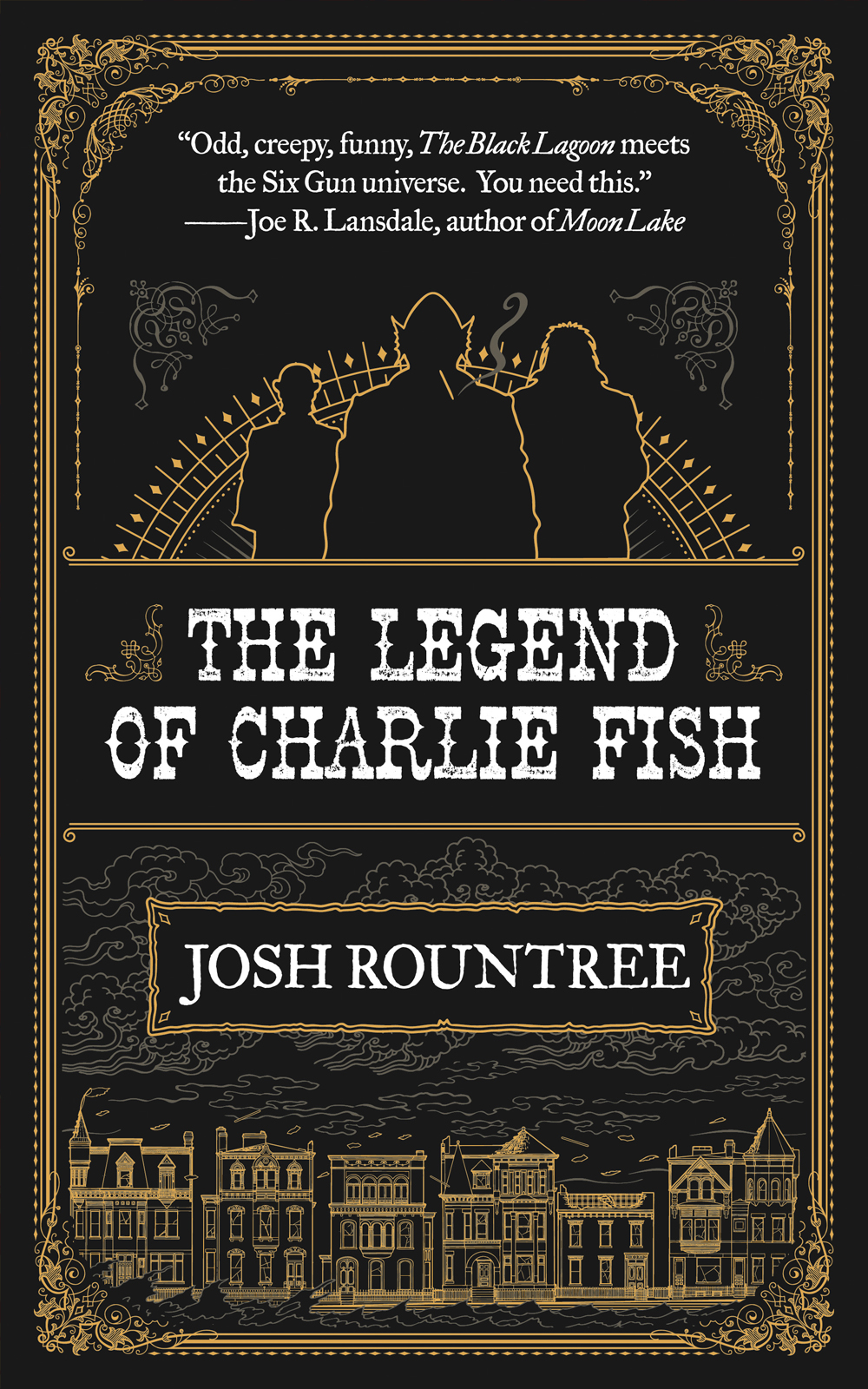
The Legend of Charlie Fish by Josh Rountree

There is a humanoid ichthyic personage in this story - he's in the title, this is not a spoiler - and people who know modern horror may expect him to be some variety of Deep One. But he isn't, really: he's much more of a Gill-Man, though one less inclined to sudden violence than his filmic counterparts, and part of a large diverse society in a way we don't see (as far as I remember) in any of those movies.

So, what I'm saying: this isn't Lovecraftian.

I know! It's rare and unexpected for anything roughly in the horror vein to have a trope that could be Lovecraftian but definitively isn't. Just for that, Josh Rountree deserves kudos.

He deserves them for more than that, though: The Legend of Charlie Fish is a remarkably assured first novel, with two different and believable first-person narrators, atmosphere to burn, a great story to tell, and a flair for telling that story just slightly slant to make it more interesting.

My TL; DR would be: I don't generally like horror, and nobody much reads Westerns these days. This is a great horror Western that's well worth your time, short enough to easily read in a day.

For the more-detail version: Floyd Betts is a carpenter in Galveston, in 1900. He mostly keeps to himself, is good at what he does, lives a quiet life in a boarding house. And he has to go out to Old Cypress to bury his father, a spiteful alcoholic he's been estranged from for decades.

Meanwhile, in Old Cypress, lives a young family: the mother is disliked by the town as a witch, though she's never done anything to hurt anyone. The father grew up there, but has been tainted by association. And the kids are Nellie, twelve, and Hank, nine.

Floyd finds Nellie and Hank in Old Cypress, orphaned, and decides to take them back to Galveston. Along the way they meet and save Charlie Fish: the reader knows all of that very early. I won't spoil who they save Charlie Fish from, or why those people want the fish-man back, but they do, and they follow.

Oh, one other thing. Ever heard of the Great Galveston Hurricane? It's on the way.

Rountree never says that Charlie's people have anything to do with the hurricane. He doesn't even really hint in that direction. But I want to believe it, for whatever apocalyptic reason: you may also want to believe that when you read Charlie Fish.

Oddly, this is a less quirky book than I expected, given the plot and the endorsement from Joe R. Lansdale. Nellie has a version of "the sight," so she can communicate, mostly empathically, with Charlie. But that, and Charlie's mere existence, are the only real fantasy elements. Rountree grounds all of the rest soundly in the mud and wood and heat of the time: these are realistic people in a realistic world, facing mortal danger from both nature and man, and living as best they can, according to their own lights and values. There's a surprising lot of philosophy for life in Charlie Fish, too, the hard-won standards of a life lived cross-grain to the people around you.

It's a short book that feels expansive, a Western that feels modern, a horror novel that feels hopeful. That's one hell of a Legend, and I recommend it.

Tuesday, October 24, 2023

Amulet, Book Eight: Supernova by Kazu Kibuishi

There was a big delay in this series, but it was after this book, not before it. If you care about this series, or middle-grade graphic novels in general, you probably already know that. If not: I'm getting to this 2018 book pretty late, but the concluding book in the series is not yet out; it's scheduled for early next year. (And a five-year delay is nearly infinite in a series for young readers; that's an entire elementary-school life.)

Amulet is a very popular series, though, so I expect all of the kids starting school over the past half-decade have seen the earlier books on the shelves, and a lot of those kids have probably read some or all. Fantasy about magical kids is always popular among kids who wish they were magical.

The series started in 2008, so the first kids that read it are now at least in college. The previous books were The Stonekeeper, The Stonekeeper's Curse, The Cloud Searchers, The Last Council, Prince of the Elves, Escape from Lucien, and Firelight. Looking back at what I've written, I've compared it to prose epic fantasy a lot, and it does have that kind of feeling. There's a large cast, which gets separated and reunited, there are Plot Tokens that need to be collected, several characters are Magically Chosen and/or Special, and the plot has ranged over the entire map provided in the first book - and even beyond.

And then, five years ago, came this eighth, penultimate (I don't think we knew that at the time) book: Supernova.

It's still more middle, like the previous six books, but it's middle that seems to be closing out things more than opening them up, which implies that the next book will indeed be last. (And, as I've said at least once before writing about this series: you can always end a series in the next book. Rocks fall; everyone dies.)

I could talk about the characters, I guess: this one is split roughly equally between the siblings Emily and Navin, our two most central characters, who are mostly separated here. And Emily does get a semi-confrontation scene with the Big Bad, who may not be quite as "Bad" as readers think.

But it's full of event and incident and action, including a random bike-race down a mountain chased by shadowy nasties. And we're at the point in a series where there starts to be a vague sense that all that activity is just waffling to fill up pages before the Actual Ending. The end is now in view, though, so we just need to hold on and get there.

This is still fun, and Kibuishi's art is mildly cartoony, easy to follow, and lively on every page, with great support by what seems to be an army of colorists. (The end credits page lists a dozen people under "colors and backgrounds" and another seven for "page flatting.") If anyone is waiting for this to be finished before starting: the wait is almost over. Anyone else contemplating reading the series: do you like the endless complication of epic fantasy? That's the core question to ask yourself here.

Monday, October 23, 2023

This Year: 2011b

"This Year" is a series of weekly posts, each about one song from one year of my life. See the introduction for more.

2011 is the second year with two choices, after 1982. Last week was 2011a, and next week will go right to 2013. I make no apologies for bending my self-imposed rules to fit my own fancies.

I could have put the two 2011 songs together into one post. There's enough thematic similarities, to my ear at least, to justify it. But the whole point of this series is to write about one song a week: why break that?

And I couldn't decide between the two of them. And I had nothing nearly as strong for 2012. So I'm here again, with another song from 2011.

This is another slow-build song, but it breaks out more directly. There's a moment where the guitar leaps forward, nearly three minutes in: almost screaming, screeching, crying out. The lyrics are over, the song has said what it has to say, and now is the time for sound. It's a magnificent moment, a great solo - I always love music willing to teeter on the edge of noise, unfazed by the possibility of falling over the edge.

My other song for 2011 is Civilian by Wye Oak. It's a love song...in the way a lot of the things I've been writing about are love songs. Which is to say: the twists and tangles of relationships, the complicated feelings and pasts we all bring to each other.

Perfectly able to hold my own hand
But I still can't kiss my own neck

There are things you just need other people for, no matter how much you wish you didn't. And things you need from other people because they're just not in you.

I know my faults
Can't live with them

The song doesn't explain why it's called Civilian. That's the last word of the lyrics, repeated: the first time, the only time we hear it. My guess is it's the usual thing with calling other people "civilians" - they're not part of this group, they haven't been through what we've been through.

If so...this is a song by a woman. I think it might be men who are civilians. All of us. All the time.

Saturday, October 21, 2023

Quote of the Week: Sensible Precautions

Trees are unchancy in Fantasyland. There are four kinds: …

4. Supernatural. These are: …

c) an Ash Woman. She will look exactly like a real woman and try to seduce any male Tourists lost in a Wood, but if you go round behind her you will find she has no back. She is the shell of a female imprinted on a bent piece of bark. Ash Women can be dangerous. If you find a strange woman in a wood, always go round behind her and check before getting seduced.

 - Diana Wynne Jones, The Tough Guide to Fantasyland, pp.207-8

Friday, October 20, 2023

The Tough Guide to Fantasyland by Diana Wynne Jones

I may have picked this book back up because I've been playing Skyrim lately, and some clichés seemed very familiar. Or maybe I only realized that while reading: I don't remember, exactly. But Diana Wynne Jones's dissection of epic fantasy tropes is not only applicable to book-format works: this is what I'm saying.

Anyway, I re-read The Tough Guide to Fantasyland, for what I think is the third time. If you read fantasy at all, I hope you've already heard about this book. If you read fantasy more than occasionally, I hope you've already read it. If not: you're in luck. It's not very long, it's funny on every page, and it's true in ways that will sour bad books for you forever - which is a good thing, since who wants to waste time on bad books?

(I saw - and will not link, since I don't want to pile on - a very very long "review" of this book on Amazon by a would-be writer who is exactly the kind of person Jones was writing about, who has completely missed the point of the book, and who complains that it doesn't have a middle or an end. So I can safely say that the reason for this book still exists.)

The origin of this book is legendary, and retold in a short afterword in the edition I read (a book-club edition of the 2006 Firebird revision). Jones was part of the editorial team for the first edition of Encyclopedia of Fantasy in the early '90s, and was getting fed up by the way that so many books were essentially the same. So she decided to write the travel guide to the country they all seemed to be set in: Fantasyland.

As that sad Amazon reviewer did not realize or appreciate, it's formatted as a travel book: map up front, then instructions on how to use the book and a page of helpful icons, then the main body of the book, in a series of alphabetically-arranged entries from Adept to Zombies.

For example:

Caverns are large underground systems with RIVERS running through them,. They can be entered from SECRET PASSAGES, behind WATERFALLS, and from holes in the hillside. At first there will be large grottoes with stalactites, followed, when your torch fails, by areas that glow on their own. Shortly you will come upon a major centre of population, which can be of Other PEOPLES or of troglodytic humans. Here you will be prudent to buy a BOAT (or steal one if the Cavern Dwellers are hostile), load yourselves, your wounded, and any provisions aboard it, and set off down the underground River. Your least favorite COMPANION will probably die at this point. After quite a few days you will come out in a Hidden VALLEY, often occupied by DRAGONS. This is the main way in which male Tourists get to meet Dragons and you should not miss the experience. Even if there are no Dragons, all Tourists must expect to spend some days in a Cavern at some point in the Tour. (p.32)

Jones keeps that tone crisp and precise throughout: she's authoritative and detailed while still keeping things short and punchy. The wit is dry and understated - that afterword refers to "jokes," but I wouldn't characterize most of the humor in Tough Guide that way: they're observations and pointed asides and cruel examples. Oh, let me throw in another bit I really like:

Missing Heirs occur with great frequency. At any given time, half the COUNTRIES in Fantasyland will have mislaid their Crown PRINCESS/PRINCE, but the Rule is that only one Missing Heir can join your Tour at a time. Yours will join as a COMPANION selected from among the CHILD, the TALENTED GIRL, or the TEENAGE BOY, and as part of your QUEST you will have to get them back to the Kingdom where they belong. This can be a right nuisance. (p.126)

Many readers will not realize that Tough Guide is satirical. Again, those are the people Jones is complaining about, particularly when they come to write seven-volume trilogies full of names punctuated by apostrophes and mountain ranges ignorant of rain shadows.

I suspect that the fantasy novel has changed and altered in the years since Jones published this in 1996. There may not be quite as much epic fantasy yardgoods now as there was in the '80s and '90s, or the clichés may have shifted in ways I haven't kept up with. So this might not be quite as obvious and pointed as it was at publication - or maybe it is; bad writing springs eternal. In any case, it's funny and smart and relentless in stabbing all of the stupid thoughtless ideas of bad fantasy writing of its era; it's an important book as well as a deeply entertaining one.

Thursday, October 19, 2023

I Was Their American Dream by Malaka Gharib

Identity is important in American life - the "what are you" question that probably can be asked politely, but rarely is. We're a nation that needs to put people into specific boxes, to celebrate or denigrate based on what your parents and ancestors were and did - or, more reductively, what you look like.

I'm sure similar things happen in other nations. But it's so central to American life, especially if you're not the default. As it happens, I am the default: male, Northeastern, very WASPy, and now middle-aged. But even people like me can see how it works if we pay attention.

So the result is: many, possibly most immigrant memoirs by first- or second-generation Americans boil down to: this is who I am, this is where I came from, this is what's important to me and my family, and this is why that matters. Those are the questions they keep hearing, so they answer them. Those are the things that are assumed to be central to an American identity: what's on the left side of the "something-American" hyphen?

Malaka Gharib grew up in a diverse city - Cerrittos, California, mostly in the '90s - and still had to deal with that question more than most of her peers, because her family wasn't one thing, like most of her schoolmates. (There's a page here where she shows a schematic of her highschool, with every group - Koreans, Taiwanese, Filipino, Pakistani, Portuguese, Mexican - in their clusters, and her all alone in the middle.)

The back cover of I Was Their American Dream, Gharib's debut graphic novel from 2019, is a very slightly different version of a page from the book asking that very question, in that blunt American way: "Malaka, what are you?" (And note, of course, it's always what, like a thing, and not who, like a person.) The book is her answer.

The short answer is that her mother was Filipino and her father was Egyptian; they met in California, fell in love, married, and had this one daughter before divorcing. Gharib tells that story here: that's the start of every American story, explaining who your people are. But Gharib has two kinds of people: the Filipinos and the Egyptians. She lives mostly with the extended family of her mother, but spends summers with her father in Egypt.

They're both part of her identity. She's different, special, unique. Which is not known for being a comfortable thing for a teenager.

American Dream tells that story - how she grew up, discovered she wasn't typical, and how that worked out for her through school and college and early adult life. (She was around thirty when she drew this book.) The voice is the adult Gharib looking back: this is a book that could be read by younger readers, but not one specifically pitched to them.

Gharib had a second memoir, the more tightly focused It Won't Always Be Like This, a few years later. That book is more thoughtful and specific, but American Dream is bigger - this would be the one to start with, I think. And Gharib has a mostly breezy tone and an appealingly loose art style throughout - she may be grappling with some serious themes, but not in a heavy-handed way. She seems to have had a happy childhood, and is celebrating that - comics memoirs so often come out of the opposite impulse that it's important to mention that. This is the story of a happy childhood, in large part because it was quirky and specific and filled with interesting, loving people from two different cultures.

Wednesday, October 18, 2023

Inside Moebius, Part III by Jean "Moebius" Giraud

This book is probably close to incomprehensible without its predecessors, so I might have just a short post today.

In the Aughts, Jean Giraud - a French cartoonist who worked mostly as Moebius (for a long sequence of SFnal and imagistic stories, from The Airtight Garage and the Incal stories with Alejandro Jodorowsky to a bunch of film conceptual work in the '80s) and as Gir (for the long, very popular, Blueberry western series with writer Jean-Michel Charlier) - wanted to quit smoking pot.

So he spent six years making a six-volume, roughly seven-hundred-page metafictional epic, mostly in a quicker, sketchbook style than his usual work, in which "he" ruled and/or explored "Desert B" (a complicated pun in French - it's pronounced the same as désherber, the slang term for quitting smoking, and also is an allusion to bande dessinée, the French term for comics), as his most famous characters remonstrated with him to give them more interesting things to do and his younger self also kibitzed, and a manifestation of the unconscious briefly looked to become an important character before disappearing entirely. The author stand-in on the page spent a lot of time flying through this barren landscape (bodily flying, by jumping off a roof and missing the ground, in best Douglas Adams fashion), and rummaging through random doors in a vast "ego-bunker" that led him to various places and times, mostly as pages of comics he created. Oh, and Osama bin Laden was also an important character, before he was turned into a sexy girl.

Yes, exactly.

Inside Moebius is quirky, deeply self-indulgent, and wouldn't have been published if Moebius were not Moebius. But he was, and so it was. It still took nearly a decade to get translated into English, where it was published as three two-in-one volumes, perhaps assuming an American audience could be induced to pay for this weirdness three times, but not more than that.

So earlier this year I read Part I and then Part II. (See those links for more details and my attempt to explicate the plot, such as it is.) Now I'm at the end, with Part III.

And I have to say the end is even looser and less focused than the beginning. The entire second half of the final book is made up of mostly single-page surrealistic illustrations, in Moebius's full-art style, of bizarre transformations and organic forms, mostly involving him. And what comes before that isn't much clearer and focused: this reads a lot like Moebius had gotten all of his random thoughts and ideas down on the page in the prior volumes, and was casting about for something else to do with them, some way to tie them up neatly and make an ending.

I don't want to call Inside Moebius a failure, because it's not aiming to do anything specific enough to define success. It is weird and borderline offensive in its beginning, bizarre and self-indulgent throughout, and descends into random second-hand mysticism and pure image at the end to force a climax. It is very much only for people who are already Moebius fans, those willing to see how far he will go when he has no bounds or controls or script.