Tuesday, April 21, 2009

Saturday Is Bond Day #7: Diamonds Are Forever

Diamonds Are Forever is where the Bond Movies tip over into self-parody; fittingly, this is the first movie to be made in the '70s. For all of the flaws of On Her Majesty's Secret Service -- and it certainly was flawed -- it was at least in the vein of the earlier movies, with a tough and steely James Bond. Diamonds is a premature Roger Moore Bond; Connery returns here four years after his last outing as Bond looking at least a decade older and slower. The tough, toned young Connery of the first five movies -- four of which were filmed within four years -- has softened, and there's a slowness in his step and a hint of gray in his hair. If the movie took note of that, or acted as if the last movie happened (other than Bond's monomania against Blofeld), that would be one thing. But it doesn't; it pretends that this is what Bond always was like.

There are those who prefer the half-seen Blofeld of Thunderball and From Russia With Love. There are those who admire Telly Savalas's hard-edged portrayal from Secret Service (though I found Savalas far too American, and far too different from the previous actors). And there are the wise, who know -- with me -- that Donald Pleasance as the facially-scarred Blofeld from You Only Live Twice is the epitome of the character. But I very much doubt if there's anyone now -- even if there might have been a very few in the early '70s -- who would give preference to Charles Gray as the multiple Blofelds of Diamonds. (For one thing, it's impossible to see Gray now and not see him spinning a globe and taking us on a strange journey.) Gray's Mao jackets -- though less embarrassing than some of the '70s wear sported by other members of the cast, and undeniably super-villain-esque -- are also not particularly intimidating.

The plot is silly and makes little sense; even Bond objects to his being dragged into a routine diamond smuggling case. And then the movie bogs down in Las Vegas for most of its length, including an inexplicable moon-buggy chase in the desert. The major henchmen -- Mr. Wint and Mr. Kidd -- are creepy in a bad way, and never seem to be a serious threat to Bond. (And the killer bimbos, Bambi and Thumper, are just hang-your-head embarrassing.)

It's a '70s Bond movie, and the template for the ones to come. Moore does this kind of Bond better than Connery does, and gets better set-ups to act against. But this was definitely the harbinger of things to come, sadly.

House of Many Ways by Diana Wynne Jones

Books for younger readers come in a near-infinite variety of age bands and formats, from plastic-coated books that shed the drool of infants up to the kind of novels that are marked "16+" and snatched up by thirteen-year-olds everywhere. But, once you get up into real novels, with the length and vocabulary of those for adults, there's only two kinds of books: those that tell kids that the world is just as bad as they're sure it is, and those that tell them that the world is just as wonderful as they hope it is.

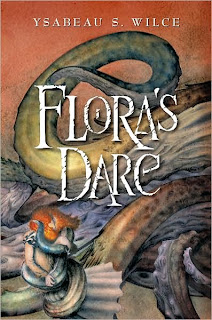
Flora's Dare, which I recently read, is an example of the first kind -- there's real danger, and the definite possibility of death for the young protagonist. The world is not fair, it's not kind, and stupid mistakes can be just as fatal as in our own world. (The Harry Potter books are another example of this, as are most of the stories in which teens feel put upon and downtrodden.)

House of Many Ways, on the other hand, is of the other persuasion: what danger that lurks in these pages is slight and easily dealt with, as the focus is on growing up into a trusted place in a loving world, with useful work lined up for the heroine and the bulk of the book given up to scenes of marvelous domesticity. Both kids of books can be equally as much fun to read, though one must admit that the first type -- which conforms more closely to the jaundiced view of the world held by most adults -- is usually given the edge as more realistic and true to life.

But let's leave that all aside for now, and travel back to the world of Jones's novel Howl's Moving Castle. It's now a half-generation later; Sophie and Howl have been married for some time, and have an toddler son, Morgan. But this book focuses on another girl, Charmain Baker, who's sent to housesit for her Great-Uncle William (the Royal Wizard of Great Norland), while he goes off to be cured of his serious but unspecified illness by the elves. She's thrilled to be getting out from under the thumb of her conventionality-loving mother -- the kind of pseudo-antagonist that shows up in books like these, usually in more virulent form than here, to deplore anything interesting, resourceful, or intelligent that a heroine wants to do as "unladylike" -- and expects to spend her time just sitting and reading as much as possible.

She does have to do a bit more than that, but she's not given a lot of work; the wizard's house runs itself most of the time, down to providing meals when given the proper orders. The dirty dishes and laundry, though, have been piling up in the kitchen in advance of her arrival...but Charmain, left to her own devices, would probably have never touched them. But then Peter Regis arrives -- he's the son of the Witch of Montalbino, and he's supposed to become William's apprentice -- and Charmain isn't allowed to loaf around quite so much as she might like.

She also runs into a lubbock -- a very nasty intelligent magical creature that plants its parasitic young in humans -- when an exploration of the house leads out a window high in the nearby mountains.

And, most importantly, the King of Great Norland -- who affects not an iota of pomp, as often happens in YA novels that tend to the wonderful -- replies to her note, saying that he'd love to have her help catalog the royal library. At the castle, she meets Sophie, Calcifer the fire demon, and, eventually, Howl, who is in a different form for most of the book for a reason that I must have skimmed over.

So Charmain is away from home, doing pretty much just what she pleases, and hobnobbing with a very friendly king. Along the way, she does have to save the kingdom, but that plot stays at the level of background details until the last couple of chapters, when the big threat to the kingdom and the danger of the lubbock is dealt with very quickly. House of Many Ways is a cozy fantasy novel, one without much danger, where the pleasure are imagining how much fun it would be to be in Charmain's place and in re-meeting old friends from Howl's Moving Castle. In my experience, Jones generally has more of a plot than this, and usually more tension and consequences. House of Many Ways is a big cream puff of a book; it's sweet and pleasant while you're reading it, but it doesn't linger long, and the reader wants a more substantial YA novel almost immediately afterward.

(Luckily, I had one: Adam Rex's The True Meaning of Smekday.)

Monday, April 20, 2009

Saturday is Bond Day #6: On Her Majesty's Secret Service

This was the hardest yet of the Bond movies to find; I ended up getting a VHS tape from a library after Netflix, Blockbuster, and several other libraries failed to get me a DVD on time. And that makes sense; On Her Majesty's Secret Service is easily the most obscure of the Bond movies and features George Lazenby's one-off appearance as Bond.

I also found it the longest and dullest of the movies so far; this may in part have been because there were two squirming boys on the couch opposite...but those squirming boys were also reacting to the movie, and hadn't squirmed like that for any of the previous films.

Lazenby isn't bad as Bond, but he's much more stolid and uninspiring than Connery was, and doesn't seem as lethal or focused as Connery could be. He's not quite carved out of a block of wood, but he might as well have been.

Telly Savalas picks up the role of Ernst Stavro Blofeld, and I didn't think he did it well at all. Savalas is essentially American, which doesn't suit Blofeld. He's also much too straightforward and hot-headed; Blofeld is a conniver and a schemer, always in the background and always two steps ahead. (Charles Grey, in the otherwise much worse Diamonds Are Forever, gets that part of Blofeld right.) Blofeld, to mention just one thing, would never ski down a mountain after Bond -- that's what minions are for.

Secret Service has two essentially separate plots, which touch each other only in occasional and unlikely ways: Bond falls in love with Countess/mob daughter Tracy (Diana Rigg, the best thing about the movie), and Bond pursues Blofeld, who has a silly plot to conquer the world through hypnotized gorgeous young women in an Alpine allergy-research facility. And they both take too long, and are unconvincing. Secret Service does end well, I must admit -- the last five to ten minutes are the best thing about the movie.

I suspect some Bond fans like Secret Service because it was the last of the serious Bond movies for a good twenty years, and because it's a plausible counter-intuitive choice as "best in the series." But it's really not all that good -- if it had Connery and Pleasance, a tighter hand on the screenplay and about twenty minutes cut out of it, it could have easily been the strongest Bond movie, since the material was there. But the Secret Service that was made squandered its potential, and the movie that actually exists is minor and bland in a dozen ways.

Missing Connections

Today, over at ComicMix, I just reviewed the Julia Wertz-edited comics anthology I Saw You...

Flora's Dare by Ysabeau S. Wilce

Now that I've been free of the treadmill of the SFBC for a while, I'm coming to see what my true tastes in books are -- the ones I pick up when I've got a choice. And first-person YA fantasy novels by women are coming in surprisingly strong, with this and Justine Larbalestier's How to Ditch Your Fairy within just over a month. It's not precisely what I expected, but they're both tremendously entertaining books, so I'll take it.

Flora's Dare is the second novel in a series -- I expect at least one more, from the hints and ending of this book, but not necessarily anything beyond that -- set in an magical alternate-historical San Francisco (called Califa here, and the capital of the same-named polity) where North America was apparently only discovered and settled (thinly, at that) by the Vikings. The first book was Flora Segunda -- which is where I suggest interested readers start -- and there have also been a number of short stories set in the same world, though these, as far as I can tell, don't involve Flora herself at all.

Flora's Dare is more successful than the first book; the world is already established, and now Wilce can just use it. There's also a nice example of "be careful what you wish for" plotting on Wilce's part -- in Segunda, Flora was trying to break her father Hotspur out of a several-years-long depression, and succeeded. And that would be wonderful, except that Flora was essentially free to do whatever she wanted while Hotspur was depressive -- her mother Buck is the head of the local military, and so away from home nearly all the time, and her one sibling is an older sister off in the military as well. But now, at the beginning of Dare, Hotspur has reasserted discipline in the household, and is making Flora's life very difficult with his incessant inspections and rules. (It's a very, very military family; he's ex-service as well.)

Flora, of course, thinks she's old enough to make all of her own decisions and go her own way -- and the reader sympathizes with her, because she is our protagonist and because we remember she was quite competent in Segunda. And all of the plot of Flora's Dare starts because Flora wants to go out to a concert that will run past her curfew -- partially because she just wants to see the concert, and partially because, after the events of Segunda, she has strengthened her desire to become a Ranger, and, to do that, she needs to study the magical language of Grammatica. Her parents dislike Grammatica and avoid it. The greatest adept she knows -- Lord Axacaya, refugee from the Huitzil Empire -- is detested by her family. So instead she's decided to approach Firemonkey, leader of the outlawed radical Eschatalogical Immenation, which is devoted to overthrowing Califa's loose client status under the Huitzils, and any other government they can topple. Firemonkey is also the lead singer of the band Horses of Instruction -- some things about California just don't change, no matter how alternate the world is.

Things quickly get more complicated and dangerous, as the concert is raided by the authorities right after Flora discovers a member of the band is the last person she'd expect. And then Flora learns of an imminent danger to the entire city, uses it as an excuse to talk to Axacaya -- and he asks for her help to stop it. And her best friend Udo not only has a new -- and utterly odious -- girlfriend, but is also hot on the trail of the outlaw Springheel Jack, who is worth a huge reward. (Though Jack is tougher to deal with after he's dead than either of them thought.) And, on top of all that, after the concert Flora is grounded -- confined to her room.

Will any of that stop a determined young woman of the ancient military family of Fyrdraaca? Perhaps not. But learning a long-hidden truth about that family just might.

Flora's Dare is sprightlier, more inventive, and moves faster than Flora Segunda did, and the stakes -- for Flora and for Califa -- might be even higher. It's the rare sequel that tops its predecessor, and the ending will make any reader wish that the promised third novel, Flora's Fury, was already available. The back cover may say "Ages 12 and up," but that ranges way up; this is a novel for Young Adults that even Not-At-All-Young Adults like myself can savor and love.

Reviewing the Mail: Week of 4/18

Every week, I get books in for review, and, every Monday, I list them here. Many of these books will get fuller reviews later, once I've read them, but many will not -- just because I won't have time to read and think and writer about all of them.

This is a light week: just three books. So typing this post should take much less time than it does some weeks...

First is The Sheriff of Yrnameer, a satirical SF novel by Michael Rubens, who used to be a writer and producer for The Daily Show with Jon Stewart. The hero is Cole, a "hapless space scoundrel on the run," who travels through various "advertising-saturated worlds" to deliver "freeze-dried orphans" to "Yrnameer, the last unspoiled and unsponsored world in the galaxy." And now I have to swallow down some knee-jerk condescension; from those facts I already have an image of Rubens as a Hollywoody carpet-bagger and his plot as a third-hand warmed-over version of '50s Galaxy. (Even if I'm being generous, his setting seems to owe a lot to Pohl and Kornbluth and Sheckley and Knight and Leiber and Brown and....) But I haven't read it, so I'll suspend judgment -- it could be wonderful, and it was obviously good enough to attract the attention of an agent (John Silbersack, who knows SF backwards and forwards) and the august bodies of Pantheon, which will publish this in hardcover on August 4th.

Stephen Baxter's new novel is Flood, about a world in which the oceans are rising much more quickly and inexorably than is true in our world. There's a hint in the flap copy that the oceans will -- for some unspecified reason -- also rise higher than should be plausible, high enough to drown every place in which human beings can live. That's a suitably dour background for Baxter, who seems to delight in finding new ways to make humanity insignificant, endangered, or simply extinct. Roc is publishing Flood on May 5th in hardcover, and it's perfect for those of you who don't have enough to worry about already, or who are fans of the grand British tradition of unlikely world-destroying events.

And last for this week is The Photographer, a graphic novel by photojournalist Didier Lefevre, cartoonist Emmanuel Guibert, and graphic designer and colorist Frederic Lemercier, based on Lefevre's first trip to Afghanistan as a journalist in 1986, traveling with a group from the international relief organization Doctors Without Borders. It was originally published in France in three volumes before Lefevre's untimely death in 2007, and has been translated by Alexis Siegel for this first English-language publication. First Second will release it as a large-format paperback on May 12th.

Sunday, April 19, 2009

J.G. Ballard, 1930-2009

British novelist J.G. Ballard has died this Sunday morning, April 19th, at the age of 78, reports the BBC. Cause of death was not mentioned, but Ballard was diagnosed with advanced prostate cancer in 2006, and that likely was the main cause.

Ballard was born in Shanghai in 1930, the son of a British industrialist, and grew up in the International Settlement there. Shanghai was occupied by the Japanese after the Pearl Harbor attack in 1941, and foreign nationals -- including the Ballards -- were moved to the Lunghua Civilian Assembly Center in early 1943. Ballard turned his experiences as a teenager in the camp into fiction in his most famous novel, Empire of the Sun, and wrote of that time more directly in his last book, the autobiography Miracles of Life.

After the war, Ballard went to England, where he completed school and then went on to study medicine at King's College, Cambridge. He abandoned those studies for reading English literature at the University of London, with hopes of becoming a professional writer. It was only after joining the RAF in 1953 that -- when posted in a airbase in Moose Jaw, Canada -- he discovered American Science Fiction magazines and decided that the stories he wanted to write could fit into that genre.

After returning to the UK after his RAF stint ended, Ballard's writing career began in the British SF magazines, starting with "Prima Belladonna" in New Worlds for December 1956. He continued writing SF short stories, and began to publish novels in the early '60s, quitting his day-job as an editor of a scientific journal almost immediately. His early novels -- The Wind From Nowhere, The Drowned World, The Burning World, and The Crystal World -- were SFnal novels, all stories of apocalypse that moved further and further from the traditional British "cozy catastrophe" as Ballard grew more and more confident with his own writing and voice.

Ballard's career turned to the avant-garde and political with the "condensed novels" collected in his collection The Atrocity Exhibition; many of them were published in SFnal outlets, but, in retrospect, this was the work that saw Ballard break with the SF field and continue his essential obsessions -- sex, death, the anomie of modern life, and a cool, detached viewpoint verging on nihilism -- into more direct and immediate channels based on contemporary life. The three following novels of the early '70s -- Crash, Concrete Island, and High Rise -- are the most uncompromising and fearless of his career, slicing with the detachment of the surgeon he nearly was at the psychological underpinnings of the world as he saw them.

Subsequent novels and works reiterated his central concerns and images, building up the quintessentially Ballardian landscape: drained swimming pools, carefully planned buildings fallen into physical or moral decay, aircraft in the air or crashed on the ground, the outer settings that mirrors the characters' inner worlds. His most successful novel of that period was Empire of the Sun, which explained the bases for so many of Ballard's key images while at the same time contextualizing them into a fine novel that was not simply a retelling of his own life.

Ballard's central concerns never varied, though the styles of his novels and stories did, veering from SF through the avant garde to more traditional literary novels and then into magic realism and the crime story an back out again. He was one of the great British writers of the 20th century, with a instantly recognizable style and matter and a endlessly fecund imagination watered ceaselessly by those same few wells.

He will be greatly missed, and he will now never be a SFWA Grand Master. But he'll still be read in a hundred years, when so many of his contemporaries and competitors are utterly forgotten.

For those who haven't read Ballard: SF readers should start with The Best Short Stories. Readers of mainstream fiction should try Empire of the Sun. And those who want to dive into the deep end should look at Crash or The Atrocity Exhibition.

Another Stack of Comics

Because I don't want to give all of these things their own entries -- partially because I still have hopes of keeping the length of the review of each of them down to something reasonable -- I'm shoving them together into one post, which will go up once I've read a whole bunch of comics, or the post has gotten too long, whichever comes first.

These will probably all be books that I got from the local libraries, as I ransack their somewhat hodge-podge graphic novel selections. (Example: in the entire system, they have Spirit Archives Vol. 17, but no others.)

Plastic Man, Vol. 2: Rubber Bandits by Kyle Baker (DC Comics, 2005, $14.99)

This collects the second clump of stories from Baker's well-regarded but short-lived Plastic Man series of 2004-2006 (20 issues, as far as I can tell). I looked at the first volume in late 2007, and wanted to like it better than I did.

And my reaction to this book is pretty similar. I laughed a lot while reading it, but I still wish Baker's panels at this point in his career weren't so blocky and so utterly separated from each other; it looks like he draws each panel individually and then sticks them together on the page. This is funny stuff, but it still looks a lot more like storyboards than comics, and that tends to damp the energy of his panel transitions. This Plastic Man is supposed to be manic and high-energy, but the discrete square panels and floating captions leech a lot of that energy out. Oh, it's definitely funny, but it comes across as less funny and goofy than it should, as if we're seeing all of the hijinks through a frame.

Ojingogo by Matthew Forsythe (Drawn & Quarterly, September 2008, $14.95)

I glanced at this over the Eisner Judging Weekend, but didn't get to read it then -- one of the other judges noticed that it was nominated as a webcomic in 2004 and then again in 2006, and the consensus of the judges was that we didn't want to just keep giving nominations to the exact same things every two years.

It's a pantomime comic -- well, there are tiny bits of possible dialogue that I suspect is in Korean, but that's very minor -- set in a surreal world among lots of very strange-looking creatures. The girl and squid on the cover are the central characters, though they're not precisely friends. No one seems to be all that friendly anyone else here, and everybody changes sizes at the drop of a hat, too.

It's too bad that Warren Ellis used up the sentence "this is one odd fucking book" on Skyscrapers of the Midwest; that's certainly somewhat odd, but Ojingogo races around the odd track five times while Skyscrapers is still putting its shoes on, and then runs up the side of the judging stand for a victory lap. This thing is pretty near indescribable; I can't even begin to characterize the entities in the story. It's worth looking at, and the cartooning is great, but I don't really know what to think of it.
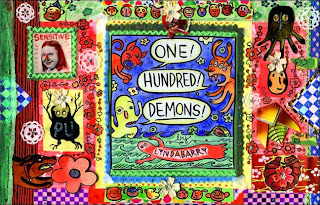
One! Hundred! Demons! by Lynda Barry (Sasquatch Books, 2002, $24.95)

After literally years of claiming that I didn't like Barry's work -- which I'd mostly seen as that alt-weekly strip with Marlys in it, which set my teeth on edge every single time I looked at it -- her introduction to The Best American Comics: 2008 and then the magnificent autobio/writing manual What It Is came as a huge surprise. But I'm big enough to change my mind, and I decided to look for more by Barry (but still avoid that Marlys creature if at all possible).

This is, I think, her book just prior to What It Is, a series of loosely-themed shorter strips that originally appeared on Salon -- in fact, a quick check shows me that they're still there -- in 2000. The book gives the strips a little more context, adding an introduction and collage-style title pages for each story (in the style that blossomed into the much more collage-heavy What It Is).

Barry was inspired by an old Zen painting exercise called One Hundred Demons, though I think the original exercise was just to paint the demons, not to tell stories about them. Barry's demons -- there are actually seventeen of them here -- are stories about things she regrets or can't forget, semi-fictionalized bits of her life. The book One Hundred Demons reprints each typical four-panel Barry page as two panels on each of two facing pages, making them larger and more inviting. (One of the things that annoyed me about Barry's work in the alt-weeklies was how many words she crammed into a tiny space -- reprinting the strips at a larger size keeps all of the words, but allows more space around them.) As in What It Is, Barry mines her own past for moments of universal relevance.

One! Hundred! Demons! isn't as all-encompassing and self-assured as What It Is, but the stories are engrossing and the cartooning is engaging. Barry is much more fun than I used to think she was.

Batman and the Mad Monk: Dark Moon Rising by Matt Wagner (DC Comics, 2006, $14.99)

It may be possible to pinpoint the moment when I decided that long-underwear comics just weren't worth it for me anymore, even if I was following a creator hither and yon across the fields of comics. (I apologize for that metaphor, but I'm feeling puckish tonight.)

I bought Matt Wagner's stylish Batman and the Monster Men -- yet another Batman-early-in-his-career story, beloved by all who want to avoid the morass of contemporary continuity and pretend that they're Frank Miller and David Mazzucchelli -- in 2006, but when this book was published, nine or twelve months later, I picked it up at my comics shop, heaved a sigh, and put it back.

But I've now read it, through the magic of the public library, and it's a very serviceable Matt Wagner entertainment, with appropriately moody coloring from Dave Stewart and a whole lot of Wagner drawings of Batman grimacing as he gets stabbed or sliced by things. It's the loose sequel to Monster Men, and Wagner appears ready to create Batman mini-series as needed for as long as he and DC are interested. And this is quite good for a Batman story, but it's still a Batman story -- derivative and attenuated, with most of its essential strength derived from the audience's long knowledge of these characters. Wagner's capable of much better than this, but I imagine that Batman is a more consistent way of paying the bills, so I don't begrudge him the work. But I will continue to save my money, almost all of the time, for cartoonists doing their own stories.

Tom Strong, Book 1: written by Alan Moore; art by Chris Sprouse and Alan Gordon with segments by a whole bunch of other people (America's Best Comics/Wildstorm/bought by DC and all of Alan's magic couldn't stop it; 2000; $17.95)

I'm not particularly well-read in Moore's return to superheroes of the late '90s; I've picked up Supreme but never read more than a few pages, and I was frankly bored with Promethea. It always looked like a retreat to me: I have no problem with Moore doing whatever work most interests him now -- and I'm even willing to accept that this is what most interested him in 1999 -- but a definite lack of ambition was visible from miles away.

But people have generally said good things about Tom Strong, so, when I had a chance to finally take a look at his adventures, I took it.

And it turns out I was right: this is pleasant, but very minor, and there isn't much ambition to it. Moore is writing modern Doc Savage stories about a big guy who's a great role model and always does the right thing. The result are perfectly acceptable adventure stories, with very slick, professional art from Sprouse and Gordon, but the format -- having a required flashback (or, in one case, a flashforward) in the middle of each issue -- gets a bit tedious, as does the relentlessly sunny tone of the villain-punching. The backstory isn't particularly interesting or complicated; Strong married his childhood sweetheart and had one daughter (who seems to still be a teenager in 1999, even though she might be seventy years old), and everybody is very friendly and happy.

Tom and his family never seem to be in much danger; they're always much more than a match for any threats that they confront. That makes for happy endings, but not for a whole lot of tension. Tom Strong is a kinder, gentler Alan Moore, and I found it awfully thin soup.

Will Eisner's The Spirit Archives, Vol. 17: ostensibly entirely by Will Eisner, though he had plenty of assistants whose individual contributions can no longer be traced (DC Comics, 2005, $49.99)

I've spent the last few years catching up on Eisner, whom I hadn't read much before that -- I've looked at The Best of the Spirit, Life, in Pictures, A Contract With God and related books, The Plot, and Will Eisner's New York. I think I've got a good handle on his modern graphic novel career, which has some real strengths (besides the mere fact that he was a pioneer at nearly everything he did) as well as some very glaring weaknesses. But I've read less widely in his Spirit stories, so I'm trying to look at those whenever I have a chance.

This volume is the single one that any of the libraries in my home county has; it seems a very odd and arbitrary choice, but at least this book -- collecting the weekly seven-page stories from July through December of 1948 -- is from what I understand to be the best period of the strip.

The things that annoy me in Eisner's later work show up in this phase of his career quite differently: the dialogue is much less ethnic (as are all of the characters), but his distinctive, and off-putting, way of E-M-P-H-A-S-I-Z-I-N-G words was just as intrusive in 1948 as it was forty years later. (I always want to read those words with dashes in them as if the speaker was spelling them out -- and I very much doubt that was Eisner's intention.) He had a quite different cast of stereotypes in the '40s: not the soap-opera pre-war Jews of his later work, but a Central Casting conglomeration of vaguely Mediterranean gangsters, a comic-relief black boy, upright Irish cops, and the obligatory "non-ethnic" WASPs at the center.

But his strengths were all fully formed in 1948 as well: a great sense of page layout and design (second to no one in the world at that time, and hugely influential even now); wonderfully expressive cartooning, particularly of figures in motion; and a masterful way with story, allowing him to shift from pure farce to near-tragedy in subsequent stories with the same characters. The Spirit stories are very much genre tales -- they're mostly crime-fighting stories only a step or two removed from superheroes, with some side trips into supernatural, sentimental, and even Western stories -- but they're all, at this point, exceptionally well-told stories, by a creator (and his uncredited staff) at the height of his energies.
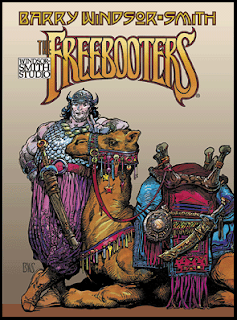
The Freebooters Collection by Barry Windsor-Smith (Fantagraphics, 2005, $34.95)

According to the cover, this is The Freebooters, or perhaps Windsor-Smith Studio: The Freebooters. There's a half-title page (though no title page, per se) that says Barry Windsor-Smith: Storyteller: 2005. But the copyright page says twice that it's The Freebooters Collection, so I'm going with that. The rest of the book has a bit of that air of uncertainty, as well -- when the reader comes to the end, he realizes that this isn't actually a complete story. For thirty-five dollars, what the reader gets is all of the "Freebooters" material that appeared in the nine issues of Barry Windsor-Smith: Storyteller of 1996-97, plus a twenty-seven page aborted beginning of the story from a few years earlier, plus another forty-eight pages of pieces of continuation of the main story (including various sidebars and diversions), plus notes on the story in a definite voice (which is neither Windsor-Smith himself nor otherwise specified), plus a reprint of an article about the storyline from the magazine Hogan's Alley. That adds up to nearly two hundred pages of art and story -- gorgeous, intricate Windsor-Smith art and engrossing story -- and other materials, but nothing at all like an ending and not even all that much middle; this is still all beginning and scene-setting.

So The Freebooters Collection is a monument, or perhaps a tombstone, for a dead story. There's no reason to think that we'll ever know what happens to any of these people; Windsor-Smith had intended that this story would run for several years (in tandem with the other two stories in Storyteller), but that didn't happen and never will. Maybe Windsor-Smith will get a chance to go back to this story eventually, but there's been no sign of that so far, and it's been over ten years. (This book, despite being published in 2005, doesn't seem to have any material from later than the original 96-97 run of Storyteller.)

I can't say much about the actual story of Freebooters; it was still gearing up when Storyteller shut down. (Storyteller's model -- three stories in one magazine-format monthly publication, with each story rotating between five-to-seven-page "backup" stories and a twenty-some-page "lead" story -- didn't help here, since every new installment had a different page count and thus was limited as to how much it could move the story forward.) The characters are interesting, and the plot is just getting started when the story cuts out. Perhaps that was part of the problem -- if, nine months into a series, a story is still setting up the situation, that's too slow for a lot of readers.

The other interesting aspect of Freebooters is Windsor-Smith's anger and bile at Dark Horse Comics, the original publisher of Storyteller -- he
still firmly believes that it was the almost total lack of advertising and marketing support from its original publisher (hereafter referred to as OP) that kept it completely invisible to an entire demographic of an adult market that had quit reading comics years before.
Yes, Windsor-Smith is mad that Dark Horse -- during the middle of the longest sustained downturn in the modern comics industry, when half of the comics shops went out of business, several publishers went under, and Marvel went bankrupt -- didn't spend unprecedented amounts of money to advertise it to people who don't read comics.

And what would it have attracted them to? A large-format, relatively expensive monthly periodical, sold in stores that those potential customers don't patronize, telling three entirely separate stories -- none of which were complete, or anything like it, in a single issue. Windsor-Smith is a wonderful storyteller, yes, but is thirty-two pages of three pieces of set-up going to be sufficient to convince a non-comic-reader to come back month after month? (Even assuming they can be convinced to come to a comics shop in the first place, which I'm very dubious about.)

Even now, ten years later, similar projects of much, much higher commercial potential -- like the Stephen King comics from Marvel -- can bring in an outside audience to comic shops once (for the debut issue), but sales drop quickly afterward. The audience for periodicial comics is entirely within the direct market; any creator who wants to reach beyond that needs to have a complete story to offer that potential "outside" audience.

So I think Windsor-Smith had very, very unrealistic aims for Storyteller, and that he chose the worst year possible to try to achieve them. If he'd picked one of the three stories, and told it straight through, he would have had a better chance. (But, even then, I expect that outside audience would only really have been interested once there was a single book, at a reasonable price -- this one doesn't qualify, since it's incomplete and not a reasonable price for that audience.) If he'd kept the book to a more typical size, he might have had better luck within the direct market -- and there was no serious chance of getting Storyteller distributed outside of that market, anyway.

It's a shame; I bought all of the issues of Storyteller -- and still have them, somewhere, though I had the same storage problems as everyone else -- and wanted to see it succeed. But, looking back at it, and with a lot more experience in publishing and marketing since then, I can't side with Windsor-Smith, as much as I'd like to. As far as I can see, Dark Horse made a heroic effort on behalf of a talented and demanding creator, and got absolutely no credit for it. (And probably lost a bundle as well.)

Saturday, April 18, 2009

Oops! I Forgot to Post!

I sat down here this evening to write a bit about the two graphic novels I polished off today, and probably shove out the post that would then cover seven of the suckers. Instead, I've just spent the last two hours reading through the first two-hundred-and-some pages of Darths & Droids, a fumetti webcomic by a bunch of Australian guys, along the lines of the great DM of the Rings.

Let me explain further: "fumetti" means that it's done with photographs, in this case screencaps from the movie Star Wars: The Phantom Menace. And the overall plot is that a gaming group is RPGing their way through this setting, starting with two players as Qui-Gon and Obi-Wan and expanding as other players join the group. (Like DM of the Rings, the assumption is that nobody has ever heard of any of this stuff before -- that this gaming session was how all of the twists and turns of the plot were determined.)

It's laugh-out-loud hilarious, both on the level of jokes and conceptually -- one of the best early bits is that Jar-Jar is a hastily rolled-up character to keep one of the guy's kid sister occupied when she came along to the second gaming session. You probably need to know a little bit about gaming to get the point, but only a very little -- I haven't role-played in twenty years (maybe more) and it was all perfectly clear.

It's exceptionally funny, has remarkably good characterization (both of the players and, when appropriate to them, their characters-in-the-game), and actually, in its demented way, makes the plot of Phantom Menace make sense. They've just started on Attack of the Clones in the last few weeks, and I'm adding this to my RSS reader immediately.

Friday, April 17, 2009

The Return of Manga Friday

After a long hiatus, I had a new "Manga Friday" post for ComicMix this afternoon, reviewing four first volumes of series about girls in sailor suits and short skirts: Sayonara, Zetsubou-Sensei, Gakuen Prince, Oninagi, and Negima!? Neo.

Next week, with any luck -- and if I don't end up in the emergency room again for what turned out to be utterly inadequate reasons -- I'll be back to my ostensible pace of three reviews a week. I might even get to the stack of Phillippine comics I've been looking at for three months...

One Reason I'm Quite Fond of the Library

I've currently got 19 books out, with a street value of over $384 -- and that's not counting the nineteen books my two sons collectively have out, or the two videos. (Or the new Daniel Pinkwater book waiting for me to pick it up tomorrow, either.)

Whenever the local libraries here in North Jersey started collecting graphic novels semi-seriously was a great day for both me and my wallet. (Not to mention my bookshelves.) I still wish they'd collect more seriously for adults, but I guess the Yoshihiro Tatsumis and Seths of this world are a minority taste.

(I'm thinking about this because we'll be going to the library tomorrow, so I have to gather up most of this stuff to take it back...which is not as easy as it might seem when there are forty items checked out and strewn across three floors of the house.)

Quote of the Week

"The Glenn Beck show has been drearily fascinating of late. It’s not often that we get to watch someone go insane on national television; trapped in an echo chamber of his own spiraling egomania, with apparently no one at his network willing to pull the plug and put him out of his misery, Beck has lately gone from being a mildly annoying media dingbat to a self-imagined messiah who looks like he’s shouldering more and more of the burdens of Christ with each passing day."
- Matt Taibbi, "The Peasant Mentality Lives on in America"

Note from the Hornswoggler: I don't actually watch Beck myself, so I'm not vouching for the accuracy of the description of him. From the snippets I've seen online, he does seem to be one of the more entertainingly insane TV ranting heads, but such clips are chosen for maximum lunacy to begin with. But I really like the quote anyway; Taibbi has a nice way of cloaking an all-out attack in phrasing that looks like commiseration.

Thursday, April 16, 2009

What Old Adventure Movies Should Tween Boys See?

As you may know, I have two sons, currently aged eight and eleven.

We've been watching various adventure movies together over the past couple of years, as I teach them about their heritage as white American males. We've seen the first half-dozen James Bond movies (and are continuing, probably to the end of Roger Moore), all four Indiana Jones films, and all but the last Star Wars movie.

But I'm sure there's more that we all would love that I haven't thought of yet. So I wanted to ask for suggestions.

I've been trying to stay at PG rather than PG-13 in most cases, but we're already well into the old-fashioned sex & violence with Indy and 007, so I may be guarding a barn door that's been open for a while.

Also, I haven't seen essentially any of the big blockbuster movies of the '90s and early aughts, so if you're thinking "Surely he's considered Spider-Man," the answer would be no, since I've never seen it myself.

Any suggestions are welcome, and stories about movies actually enjoyed by boys of that age this decade would be particularly helpful.

Wednesday, April 15, 2009

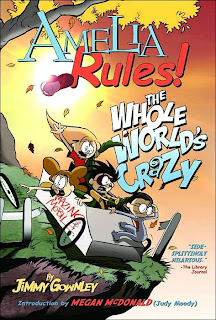
Amelia Rules! (three volumes) by Jimmy Gownley

One of the more surprising finds during my Eisner reading last month was the fourth volume of Jimmy Gownley's young readers series Amelia Rules! -- I'd thought it was minor and soaked in sentimentality (before I'd actually read it), but found it was better-written and more interesting than that. It's still an all-ages series about cute kids and the imaginative scrapes they get into in a mostly idealized small town, yes, but there was an unexpected emotional depth to the characters, so I wanted to check out the rest of the series.

It turned out that local libraries had all three of the earlier books, so I ran through all of the earlier stories in less than a week...and now I'm not quite as impressed by Amelia Rules! as I was at first. Part of that is because Gownley has been improving as he's gone along, so the first volume has the most obvious and heavy-handed of the stories. And when I jumped immediately from the fourth volume from the first, I went from his best Amelia Rules! stories to the least of them.

The Amelia of the title is Amelia Louise McBride, a girl of about ten whose parents have just gotten divorced as the series begins. Her mother has moved herself and Amelia back to her old home town in Pennsylvania from their home in New York City, and moved in with Amelia's aunt Tanner. The divorce is handled well; it never becomes as thuddingly obvious thematically as I suspected it might.

So Amelia is settling into a new town, and making new friends -- they keep accumulating as the books go on (which makes a much richer, more realistic picture of childhood than the typical "here's me, my two best friends who are always with me, the one comic relief and one bully" cast of too many entertainments for kids. There's Reggie, whom Amelia sort-of likes, and Rhonda, who also likes Reggie in that mostly secret way of grade-schoolers. And then there's Pajamaman, who is Reggie's sidekick, who never talks, and who always wears pajamas. (He's also the token really poor kid, and -- unlike the rest of the unpopular main cast -- friendly with the cute blonde girls at school, so he gets to be a whole constellation of "wacky friend" cliches.)

The first book is made up of short stories, as Amelia meets these new kids, starts at Joe McCarthy Elementary -- where the "school sucks! teachers are all evil morons, amirite?!" nudging gets tired very quickly -- and talks to the audience a lot. It does reach the level of true emotion, particularly by the end, but there's a lot of sentiment to wade through first.

The second book adds family members (dead ones, mostly) for Amelia, continues the love triangle, and has Amelia and Rhonda actually become friends instead of just loathing each other. The pretend-superhero stuff continues -- Reggie is obsessed with being a superhero, and drags all the rest along with him -- and the kids find their arch-enemies in a similar group of kids from across town who dress up as ninjas. Luckily, they're not just a joke; they actually become characters and continue to be important. We also learn more about Tanner's very unlikely past.

And then the third volume is one long story, in which Amelia meets even more new people, almost moves again, and finishes up fourth grade. Gownley also steps up his writing here; the focus is more tightly on the characters and their dialogue really rings true. (He manages to make the head ninja, Kyle, both a button-pushing little jerk and a sympathetic character, for one.)

Amelia Rules! is not the masterpiece some of the quotes on the book would have you believe it is. It's not the second coming of Peanuts in particular; Gownley is writing about essentially authentic kids (though they have a freedom of movement and action that real kids haven't had most places in the US for a generation or more, or never really had except in stories), and using them to write about the events in kids' lives. It's more of a book for adults looking back at their childhoods than for current kids, since the iron law of kids' books is that kids only read about people older than they are, and these kids are pretty young. For older grammar-school kids or tweens willing to flout that iron law, though, they could find some very enjoyable comics stories.


British Science Fiction Association Awards

Far away from Norwescon, another SFnal group was giving away its own awards -- the British Science Fiction Association, during Eastercon (in lovely Bradford, UK).

And those awards are:
I have no borderline-smutty things to say about these awards, but congratulations to the winners anyway.