Sunday, July 05, 2015
The Back Half of Scary Go Round by John Allison
First up was Bobbins, which I haven't made a serious study of yet, but was in the traditional newspaper strip-comic format and focused on the staff of Tackleford's City Lights magazine, with perhaps some supernatural eruptions. After Allison closed that down around the turn of the millennium, he launched a new series with a somewhat overlapping cast of characters called Scary Go Round, which itself ended in 2009. SGR was formatted like a comics page, which made it easier to collect in book form and (possibly) allowed Allison to write more complex stories and include more of his quirky humor and details in each update. It also was clearly fantasy: characters visited Hell, were turned into zombies, and battled giant monsters to save the world. (Though Allison's offhand tone and character-based plotting turned all of those elements into something very different from what you'd expect.) That strip was entirely collected into eight volumes, though -- in the way of the webcomic -- it's also still all available online, as are Allison's other strips.
For the next round of stories, Allison switched format again, to a double-tier newspaper style, which gave him a similar number of panels per page to SGR but with a more compact feel. That strip was called Bad Machinery, and it followed up the end of SGR to focus on two "teams" of tweens at the local school, who solve mysteries in competition with each other. Allison still includes supernatural elements, but they tend to be more subdued in Machinery than they were in SGR, making his stories better controlled and more focused on characters. He also clearly designed Machinery for eventual book publication, with long story arcs that each fit cleanly into a single book. (See my reviews of the three Machinery books to date: one, two, and three.)
Allison has also made a number of related print comics in various formats over the years -- including Expecting to Fly, which appeared online first -- and there's a 2013-2015 run of Bobbins, just to confuse things even more. Since Machinery in its turn ended last year, he produced a transitional story called "Space Is the Place" (with part of the Machinery cast going to a space camp in Wales). And he's also been writing a monthly comic called Giant Days -- confusingly, this is also the title of a major SGR storyline, plus an earlier sidebar print project -- for a different art team, which may or may not have a Tackleford connection. (I haven't seen it yet, since it's only in floppy form so far.)
So Tackleford is a place that Allison knows well, and has been telling stories about in a variety of ways for a long time. It's his Yoknapatawpha County or Castle Rock -- the core of a world that extends out to many places. With that said, though, Machinery feels more focused on Tackleford than SGR did -- maybe because the main characters of Machinery were kids, and limited in their ability to go other places and do other things.
I've been a fan of Machinery for a while, but only recently started diving back into Allison's archives. The first four SGR collections are currently unavailable to most readers in book form -- I believe ebooks are still obtainable in the UK, but not elsewhere due to a stupid recent tax law in that backwards country -- but books five through eight are still out there, most easily obtainable in the US from Topatco. And so that's how I got those books -- Great Aches, Ahoy Hoy!, Peloton, and Recklessly Yours -- and finally read a big wodge of SGR for myself.
What strikes me most about this slightly-less-formed version of Allison's world is how consistent he's been in his concerns: his stories have focused on smart, sarcastic women with a goal in mind -- Shelley Winters as the exemplar for SGR, Charlotte Grote for Machinery, with plenty of others including Amy Chilton and Dark Esther -- in a world of slightly slower, bemused men who end up along for the ride.
Unlike the Machinery books, each SGR volume collects a number of stories, adding up to about eleven months for each book. (More or less, to allow for full stories in each one.) Allison also includes notes on each storyline and some sketches and similar material at the end of each book, in the old way to entice freebie online readers to actually pay money for something.
These books, covering the strips from early 2006 through the end in late 2009, show serious growth in Allison's art style, from a cleaner version of the look he began SGR with in 2002, drawn on a computer, through a hand-drawn middle period and a brief "hand-drawn, but much bigger originals" period before settling back onto the computer. (Where I think he's stayed ever since.) The first story of Great Aches is in that early, flat-computer-color style, but everything else has a energetic hand-drawn look which well suites Allison's frenetic characters and zigzag pacing.
The stories are a bit sillier and more anarchic than Machinery, and Allison's notes make it clear that he spent this period making it up as he went along, diving into long stories without necessarily having a clear idea of how he'd get to the end. But even if the stories are somewhat shaggier and less formed, they're still Allison stories, with unlikely turns of plot and deflation always waiting in the wings. And his dialogue was whip-smart from well before this period, full of witty asides and great cross-talk that always feels plausible enough while still not conforming to the way real people ever did or would talk. (That is a good thing: people talk badly almost all of the time. Fiction is to make things better and more interesting.)
So, in conclusion: John Allison is awesome. Buy his books, read his comics, enrich him with your dollars and pounds and more exotic currencies. Start here, start with Bad Machinery, go crazy and drop all the way back to the beginning of Bobbins in 1998 to get the full John Allison experience from the beginning. It's all good.
Note: I'm not including the usual Amazon links this time, because that's a very bad way to read and/or buy Allison's older work. You can get the Bad Machinery books there if you want, but the others are available other places more easily. And, honestly, for a webcomic you should just read a bunch of it online first -- surely we understand that by now?
Sunday, May 20, 2018
Book-A-Day 2018 #140: Giant Days: Not On The Test Edition Vols. 1 & 2 by John Allison, Lissa Treiman, and Max Sarin
Time went on, and Allison reconfigured Bobbins into Scarygoround, to feature longer stories and shift the cast of characters somewhat. One of the major characters of Scarygoround was Esther De Groot, a pale teen and half of one of Scarygoround's great love stories.
But time continued to go on, and Allison set his stories in time. So Scarygoround, in its turn, ended, and, as part of that ending, Esther left the main narrative to go off to Sheffield University -- name changed slightly, I think, to underline it is not exactly the University of Sheffield -- and appeared in three self-published print comics by Allison under the title Giant Days. But Allison's major follow-up project focused on a new, younger generation of Teckleford folks: Bad Machinery, in which six originally-tweens solve somewhat supernatural mysteries and take the piss out of each other.
And time? Yeah, it kept going on. And Allison came back to Esther, and Giant Days, with what was originally planned to be a six-issue miniseries drawn by Lissa Treiman. Today I'm looking at two big hardcovers that reprint the first sixteen issues of that now-ongoing series -- issue 38 has just hit as I write this -- so once again one of Allison's creations has surprised him and us and gone in unexpected new directions. (Which is, obviously, entirely a good thing -- repeated serendipity is something to look for in a creator.)
Treiman left the book after those first six issues, and was replaced first by Max Sarin alone and then Sarin inked by Liz Fleming. Whitney Cogar has provided colors for all of these issues. (And, yes, all of the creators besides Allison are women -- Giant Days is a story about women, something unusual in the boy's club of print comics.) In the way of comics, Giant Days was first collected into paperbacks, with four issues each -- and then, when those were successful, two paperbacks were jammed together along with additional material (so far, one of Allison's self-published Giant Days stories in each, plus variant covers and sketch pages) to make the Giant Days: Not On the Test Edition. Volume One came out last summer and Volume Two in January, with a third big hardcover scheduled for November.
The two books are subtitled with a semester: Fall and Winter. Since actual British universities generally only have Fall and Spring semesters, the titling may be slightly off -- and I'm curious to see how they'll handle the second and third year without being completely confusing. But, since the end of this second book seems to be close to the end of the actual second semester at Sheffield, my current estimate is that with three years of college, two semesters a year, and eight issues per semester-book, Giant Days could potentially run to 48 issues. (If a year has three or four "semesters," that will stretch things out somewhat, obviously.) Since all of Allison's previous projects actually ended, I'd expect Giant Days to run its course and stop as well.
I've already written about all of the pieces re-collected in these two books -- the original paperback volumes one and two and three and four -- as well as writing longish posts about the related Allison projects Scarygoround and Bad Machinery (collections one and two and three and four and five and six and seven), and this post is already quite long, even without actually mentioning anything that happens in these books. But let me explain..no, no, there is too much. Let me sum up.
At Sheffield, Esther (goth, drama magnet) quickly fell in with Susan (studious, sensible) and Daisy (home-schooled, innocent), who live on the same hallway. Male hangers-on comprise Ed Gemmel (quiet, nice, at first infatuated with Esther) and McGraw (good at building things, has a history with Susan). They do the usual young-people-in-college things -- studying, dating, fighting corrupt student administrations, taking tests, attending balls, making films for a contest, obsessing about where to live the next year -- with Allisonian twists on them.
It's good; it's mostly focused on women and their lives and is a great entry-point into the larger John Allison universe, since the quirky supernatural stuff is almost entirely absent. Allison writes great dialogue and sets up naturalistic but silly plots, while first Treiman and then Sarin (and then Sarin + Fleming) give it an expressive, open art style that rhymes with Allison's own work but doesn't try to imitate.
Look: if you read comics about anything like the real world, particularly the parts of the real world that actually have believable women in them, you need to check out Allison. And Giant Days is one of the best, easiest ways to do that. So do it.
Friday, January 30, 2026
The Great British Bump-Off: Kill Or Be Quilt by John Allison and Max Sarin
For some bizarre reason, John Allison is not a giant of world comics, beloved by millions, even though he has been making wonderful, smart comics with zippy dialogue, quirky plots, and fascinating characters for around thirty years now. In my darker moments, I think of that as yet another indication that we are a fallen race, and that we simply can't have nice things. More realistically, Allison can be quite British, which may have limited his appeal to the segments of the American public who have trouble breathing with their mouths closed. (Oops, there I go again with the cynicism.)
What I might grandly call the mainstream of Allison's work generally involves each new series having a few characters from the last series, doing something new with a somewhat different cast. Thus Bobbins turned into Scarygoround, with a cluster of the same people, and then a couple of those people turned up as background characters in Bad Machinery. The Bad Machinery kids are young adults now, and so they're popping up in their own series - fan-favorite Lotty Grote in the print-comics series Wicked Things and then Solver stories on the web was first.
But her mystery-solving compatriot Shauna Wickle has also gotten a spin-off: first The Great British Bump-Off, in which the mystery-loving young woman competed on a reality show whose real-world analog you may be able to figure out from the title.
And, about a year later, Allison and artist Max Sarin (with colors by Sammy Borras and letters by Jim Campbell) brought Shauna back for a sequel: The Great British Bump-Off: Kill or Be Quilt. It keeps the title of the first miniseries for continuity, but Shauna is not on that reality show, or any reality show, this time, nor does anyone actually get bumped off.
Instead, Shauna has borrowed a narrowboat for the summer, to wend her way down the canals and rivers of Jolly Olde and have some fun minor adventures. Unfortunately, her first stop is in Barton-on-Wendle, where her lack of knot-tying acumen leads to the boat getting free and gaining a very expensive scratch down one side. So she needs to get a job to pay for that repair, which drags her into the intrigues of the two quilt shops of Barton.
The proprietors of those shops hate each other, and accuse each other of trying to sabotage their shops - which is plausible, since the EV of one of them bursts into flames right after Shauna arrives and the other's shop has an extensive flood caused by a deliberately-blocked drain soon afterward. Shauna works in both shops, as an undercover spy for both proprietors against both proprietors, as she tries to figure out the villain behind the mayhem.
It all comes to a head at the big annual quilt convention in town, and Shauna does solve the mystery - and bring the quilting community of Barton-on-Wendle back into harmony, with the aid of the traditional feisty old lady quilter - in the end. It is lighter-hearted than some of Allison's stories - as I noted above, nobody gets murdered in this one, and there's no supernatural element, unlike Bad Machinery - and has a lovely ending, including return visits by many of the Bad Machinery cast.
I tend to be slightly old-school with Allison: I think no one draws his comics quite as well as he does. But Max Sarin is a very close second, with similar body language and faces. And drawing is, of course, time-consuming - an Allison who writes more than he draws can make more comics, which is a major enticement. So now I just have to figure out how to make an audience of millions fall in love with all things Allisonian, so that he will have to increase production to fill the massive demand.
If you haven't yet read John Allison's work, perhaps you can help? Buy one of his books, or, if you prefer free samples first, either this page or this one offer lists of currently-available Allison projects on his website. And then tell all your friends, so they can tell tell all their friends....
Wednesday, December 30, 2020
By Night, Vols. 2 & 3 by John Allison, Christine Larsen, and Sarah Stern
(No, I don't quite see it, either. I'm thinking some old mill town in western Massachusetts would be better, or somewhere in coastal Maine, but I am an East Coaster to begin with.)
In case that's confusing: John Allison writes sprightly, fun stories with various levels of fantasy elements, set mostly in the English Midlands, often centering around the quirky town of Tackleford, first as a series of webcomics (Bobbins, Scarygoround, Bad Machinery, and see these posts of mine) and increasingly as floppy comics that people actually pay money for (most famously Giant Days). A couple of years ago, he launched a series called By Night, with many Tacklefordian flourishes, set in, as I said, the distant town of Spectrum. The comic was drawn by Christine Larsen and colored by Sarah Stern, who also provided variant covers.
I covered the first collection here back in May, and now I have the rest of the story: Vol. 2 and Vol. 3 collect the rest of this twelve-issue series. So far, it doesn't seem to have spawned a sequel.
And I still find it basically the same kind of thing as the first volume: fun, but subtly off and not quite as enjoyable as Allison's stories set in a greener and more pleasant land. The dialogue often falls somewhere between Allisonly snappy and actually colloquial American, as if he were trying to stretch to speak in a foreign tongue and not consistently succeeding. Nothing is actually wrong here: it's a fine adventure comic, with snappy dialogue, quirky characters, and a plot that bounces around and makes things happen. It just feels like someone trying to "do John Allison in the USA" and subtly missing the point.So: former friends Jane and Heather have discovered a portal into a fantasy world, and of course intend to monetize that...by making a documentary film about it. (Allison is always quirky, even when he's trying to be American about it.) This is slightly hampered, first, by their being driven out of the fantasy world by the authorities there, and, secondarily, by the increasingly heavy-handed tactics from authorities here related to the corporation that built the portal and then went bankrupt, pauperizing the town.
These two volumes feature a lot of running about, and an array of colorful characters, from drug dealers to a small green troll-like fantasy-world person, from aged (and possibly insane) scientists to salt-of-the-earth vermin-extermination working men. There are nefarious plots from both ends of the portal, surprising revelations, applied mad science, semi-random murder, and pulse-pounding board meetings.
All of the ingredients are fine, and By Night could seem really awesome to someone not familiar with Allison's other work. (Or to someone violently allergic to anything non-American, I suppose: goodness know we do have those.) It's not one of his best works, but that is a very minor quibble on my part -- this is a better run of comics than nearly anything cover-featuring a person wearing a mask and published in the last eighty years.
I still think most readers would be better served as an introduction to Allison by diving into Bad Machinery or Giant Days (depending on their preferences), but what do I know?
Tuesday, August 10, 2021
Bad Machinery, Vol. 9: The Case of the Missing Piece by John Allison
But I love Allison in particular as a cartoonist. Like a lot of comics creators, he's just better when he's drawing his own material: he knows the jokes and characters, and probably adjusts things while drawing to make it all just that bit better. It's not that there's anything wrong with other artists; they just don't live in John Allison's head.
And so his webcomics have been the purest and best of his works: the most Allisonian, the funniest, with the most intricate plots and great character details. (And I say this while still avonding his currently-running Steeple because I haven't read the published-as-floppies beginning yet.) Bobbins and Scarygoround saw him get better and better over more than a decade, but Bad Machinery hit when he was already fully himself: I'd call it the first Allison work that was mature and entirely successful from the beginning.
Of course it's over now; Allison writes about people who live in time, and his stories usually have those people at a specific time in their lives. (Typically young enough to do crazy things, just getting old enough to know they shouldn't: late teens to mid-twenties most of the time, with some variation on either end.)
The Case of the Missing Piece is the ninth of ten Bad Machinery stories - I recall there were some uncollected bits, especially at the end, but Allison is currently upgrading his main site, so the extensive archives (including story details) are down at the moment. See my post on the eighth volume for some context, and then dig back further to volumes one to seven, and even to Scarygoround, for an unnecessarily large amount of context.
The series started out being about a group of kids at a local British school in the fictional city of Tackleford. (I think it was a "public" school, meaning not run by the government, but it seems to be more "competitive and moderately good" than "ultra-posh," for other Americans trying to set their expectations. More like the decent parochial school in your town, if you have one, than like Choate, where one of my college buddies went.) There were three girls and three boys, all tweens, and they solved mysteries: sometimes together, but more often competitively. Those mysteries often had a vaguely supernatural component; Allison's stories are generally realistic but he's not finnicky about consensus reality if it gets in the way of a fun story.
By this point, it's several years later, and they've mostly stopped solving mysteries actively. It's something they talk about, and vaguely think about doing again, like that sport you gave up last year because it interfered with your other activities. This book is not about a mystery, exactly.
Shauna is at the center: her mother is getting married to her long-term boyfriend (this is mostly a good thing, but a cause of change and stress), her older brother Darren has just gotten out of prison, she may finally get a chance to meet her father, and she's taken it upon herself to befriend Blossom Cooper, a frighteningly large and dangerous girl of their year. But Linton is mopey about never having had a girlfriend, Claire is going through her own love convolutions, with a boyfriend breaking up with her because his family is returning to Ireland (though not as quickly as the reader would expect), and the rest of the cast (especially Charlotte, who can always be counted on to barge in) circle around the main action. Oh, and the veteran teacher who handled discipline for the school is out after a health crisis, and there's a new face with new, modern ways. (Quote: "I don't do 'bollocking,' Linton. I thought maybe we could listen to some music...just rap about what's going on with you. Do you like the Beetles?")
All of those things stew around and with each other over the course of about an academic term, and it all comes to a head at Shauna's mother's wedding, as things do. Well, that's only about the halfway point of the book - the first major crisis. There will be more.
A lot of Allison's best works are about people realizing they're not who they used to be and that they need to rethink what they want and what they should be doing. This, like the end of Giant Days, is one of those stories. It's smart and witty and full of colorful characters, it's amusing and thoughtful and drawn with an energetic line.
Again, pure Allison is the best Allison. This is pure; this is one of his best. And he's one of the best. QED.
Friday, January 01, 2021
2020 In the Rear-View
For most of the Years of this Blog, I had several standard posts on the first of the year -- a listing of my favorite books of the prior year, a meme-ish thing where I linked to the first and last sentences of each month, and occasionally other things (launching or ending a Book-A-Day run, the weekly Reviewing the Mail post when it was a Monday). That hit a peak for the Book-A-Day run of 2018, but last year's beginning saw just one white-flag-waving post to say that I wouldn't post a list of favorites, since I read too few books to feel comfortable doing that.
This year was slightly better, but (as I type this on December 28th) it still looks like I'll end the year having read about 75 books, which is about half of what I thought of as my latter-day nadir. In the '90s and Aughts, I usually read 300+ books a year, topping out at 419 in '93. That dipped into the 140-180 range mostly for the last decade, with bumps for the Book-A-Day years of 2014 (383) and 2018 (433).
So I'm still not comfortable saying, "I read six dozen books, and here are the one dozen best ones!" And I will not be doing that here.
But I also neglected to do my monthly lists of books read this year, for all of the same ennui and way-too-much-work and did-you-notice-it-was-2020? reasons. So instead I will list everything I read last year, linking to their posts, and maybe include a sentence or two about the ones that would be Favorite Candidates in a better year.
So my favorite books of the year are contained in the list below, and it may even be clear to the reader which they were. But you're probably better off checking out someone who read more books (particularly new books) during 2020 if you're looking for serious recommendations.
(You may also note that I began the year rather, um, slowly. And it may be quite obvious what days I was on vacation this year. Reading during working days was a thing that basically didn't happen in 2020.)
Adam Hart-Davis, Eurekaargh! (2/6)
Gideon Haigh, The Uncyclopedia (4/20)
Joseph Heller, Catch-22 (5/3)
Charles Burns, Free Shit (5/4)
Doug Gray, The Eye of Mongambo, Book One (5/5)
John Allison, Christine Larsen, & Sarah Stern, By Night, Vol. 1 (5/6)
Jason, O Josephine! (5/7)
Rick Geary, The Wallace Mystery (5/8)
Jaime Hernandez, Is This How You See Me? (5/11)
I'm glad I don't have to calculate the Top 5 Jaime Hernandez L&R storylines, because that's a thankless task. These days, I think "Love Bunglers" is #1, but does "Death of Speedy" come next? Or "Flies on the Ceiling?" Or something else? The main story in this book tries its best to muscle into that company, and arguably does so. Jaime's one of the few whose "Top 5" needs about ten entries.
Box Brown, Tetris (5/12)
Landis Blair, The Envious Siblings and Other Morbid Nursery Rhymes (5/16)
Kevin Huizenga, Glen Ganges in: The River at Night (5/25)
A masterwork of comics and of literature in general, from a creator who keeps finding new ways to get better.
Caitlin Major and Kelly Bastow, Manfried Saves the Day (5/29)
Ian Frazier, Hogs Wild (6/28)
Kim Deitch, Reincarnation Stories (6/29)
Martha Wells, Network Effect (7/3)
An actually new SF novel that I read quickly and can highly recommend. Pity you've all already heard of it....
Ulli Lust, How I Tried to Be a Good Person (7/5)
Ken Jennings, Because I Said So! (7/10)
Jasper Fforde, Early Riser (7/26)
Another excellent, and still reasonably new, book from a quirky author. He might not need my recommendation, either, but he does have it.
Calvin Trillin, Killings (8/6)
Steve Erickson, American Nomad (8/23)
More people should read Erickson's two non-fiction books about American presidential campaigns, Leap Year and this book. They won't, but they should. Erickson's visionary style gets at essential truths in a way nothing more straightforward can.
Jonathan Bernstein, Knickers in a Twist (9/1)
Kage Baker, The Anvil of the World (9/2)
Jason Lutes, Berlin, Book Three: City of Light (9/3)
Rick Geary, Carrizozo: An Illustrated History (9/4)
Lawrence Block, The Night and the Music (9/5)
John Allison, Bad Machinery, Vol. 8: The Case of the Modern Men (9/7)
Elaine Dundy, The Dud Avocado (9/13)
P.G. Wodehouse, Uncle Fred in the Springtime (9/26)
Nick Hornby, Juliet, Naked (10/2)
John Kessel, Corrupting Dr. Nice (10/11)
Daniel Pinkwater, Adventures of a Dwergish Girl (10/18)
Lawrence Block, A Time to Scatter Stones (10/24)
Vera Brosgol, Be Prepared (10/29)
Amal El-Mohtar and Max Gladstone, This Is How You Lose the Time War (10/31)
Another book I got to slightly late (post-several award wins). Just about as good as everyone says, but I may be souring on the entire idea of "these people are really good at violence, which is wicked kewl, and so now they will kiss."
Brian Fies, A Fire Story (11/7)
Bill Griffith, Nobody's Fool (11/8)
John Allison, Max Sarin, Liz Fleming, & Whitney Cogar, Giant Days, Vol. 7 (11/9)
Brian K. Vaughan and Cliff Chiang, Paper Girls, Vol. 6 (11/12)
Roger Rapoport and Marguerita Castanera, editors, I Should Have Stayed Home (11/16)
Jacques Tardi, I, Rene Tardi, Prisoner of War in Stalag IIB, Vol. 2: My Return Home (11/21)
Michael Kupperman, Tales Designed to Thrizzle, Vol. 2 (11/22)
Aaron Renier, The Unsinkable Walker Bean and the Nights of the Waxing Moon (11/23)
Raina Telgemeier, Guts (11/25)
Paul Kirchner, the bus 2 (11/26)
Lavie Tidhar, Central Station (11/27)
Gina Siciliano, I Know What I Am: The Life and Times of Artemisia Gentileschi (11/28)
Tom Gauld, Department of Mind-Blowing Theories (11/29)
This probably would have made it onto my list -- Gauld's writing is smart and funny and his art is stylish and precise, all things I love.
Rich Sparks, Love and Other Weird Things (11/30)
If I wasn't doing the only-one-book-per-month thing I usually do -- which would have been unusually punishing in 2020, where I had three separate months where I didn't finish a single book -- this might have also made it onto the list. Sparks is both unique and consistently funny, in his ideas and his drawings, which is a really big deal.
Guy Delisle, The Handbook to Lazy Parenting (12/2)
Jack Vance, The Dying Earth (in Tales of the Dying Earth, 12/2)
Ben Sears, House of the Black Spot (12/3)
Craig Hurd-McKenney and Rick Geary, The Brontes: Infernal Angria (12/4)
Tillie Walden, Are You Listening? (12/5)
A book both quieter and more impactful than it seems at first, and another big graphic novel from one of the strongest (and most prolific) new talents in the field.
Gou Tanabe, H.P. Lovecraft's At the Mountains of Madness: The First Volume (12/6)
John Allison, Max Sarin, Liz Fleming, & Whitney Cogar, Giant Days, Vol. 8 (12/7)
John Allison, Christine Larsen, & Sarah Stern, By Night, Vol. 2 (11/9)
Riad Sattouf, The Arab of the Future 3 (12/11)
Jon Rivera, Gerard Way, Michael Avon Oeming, & Nick Filardi, Cave Carson Has a Cybernetic Eye, Vol. 1 (12/12)
Gou Tanabe, H.P. Lovecraft's At the Mountains of Madness: The Second Volume (12/13)
Riad Sattouf, The Arab of the Future 4 (12/19)
John Baxter, A Pound of Paper (12/19)
John Allison, Christine Larsen, & Sarah Stern, By Night, Vol. 3 (11/20)
John Allison, Max Sarin, Liz Fleming, Jenna Ayoub, & Whitney Cogar, Giant Days, Vol. 9 (12/21)
Cecil Castellucci, Marley Zarcone, Ande Parks, Marguerite Sauvage, & Kelly Fitzpatrick, Shade the Changing Girl, Vol. 2 (12/22)
Herge, The Adventures of Tintin, Vol. 4 (12/23)
Ryan North, Erica Henderson, & Rico Renzi, The Unbeatable Squirrel Girl, Vol. 7: I've Been Waiting for a Squirrel Like You (12/24)
Susanna Clarke, Piranesi (12/25)
Proof that 2020 was not entirely horrible (as, in its own way, was November 3rd). I hope writing this gave Clarke whatever she needed to keep writing more stories -- Jonathan Strange was a great book, but I'm greedy enough to think she could be a great writer, with many more books in her. Piranesi is a fine signpost, giving me reason to think that's true.
Seth, Clyde Fans (12/26)
Jeff Lemire, Royal City, Vol. 3: We All Float On (12/27)
Jeff Lemire, Frogcatchers (12/28)
Lawrence Block as Jill Emerson, Threesome (12/29)
Barry Blitt, Blitt (12/29)
Edward O. Wilson, Jim Ottaviani, & C.M. Butzer, Naturalist: A Graphic Adaptation (12/30)
Michel Rabagliati, Paul at Home (12/31)
If I did have a Favorites list, this would certainly be on it -- a great new book from a master of cartooning, grappling with life in later middle age when the troubles and changes start to stack up hard and fast. And the fact that I read it on the last day of the year is something I'd call out to validate my eternal "the year's not over until it's over" instance.
As I type this, I have seven books that I've read and haven't written about, though a few are in series that I will clump together. And I have posts scheduled through mid-January, on my new, weekdays-only standard. So I expect I will come back and fill in the missing links (ha ha) once those go live.
I also note that I read more books in November and December than the previous ten months. That seems to be a good sign, but I have no idea if it means anything.
But this is what I read last year, and, if there's any lesson, it's this: unexpected crap happens. Life is weird and twisty. You can figure out how to deal with it and head in the direction you want. You may not get as far as you want. You may not go as quickly as you want. You may suddenly be hit by a nasty unexpected disease, as nearly 20m Americans have been. You may even die from it, as almost 350k Americans have. (I don't want to be a Pollyanna here: we will all die, some sooner than others, and everything we want to do past that point will be gone.) But you can at least adapt and keep your goals in mind in the time you have.
This lesson is more widely applicable than to your reading life.
Tuesday, October 06, 2020
Bad Machinery, Book 8: The Case of the Modern Men by John Allison
I mean, on the one hand I can just say go read the webcomic already, which is perfectly legitimate. But it makes for a very short post, if nothing else.
Or I can delve into the history of Bad Machinery, linking to my posts on the previous volumes (one, two, three, four, five, six, seven), talking about how it was the follow-up to creator John Allison's previous webcomic Scary-Go-Round (q.v.), and possibly even sidetracking into a discussion of the only-vaguely-related Giant Days (viz.).
It is a puzzlement.
So, instead, I'll pretend to consider both options while actually putting them both in this post, and then dive into the current book: The Case of the Modern Men, the eighth case of the Tackleford Mystery
This story combines French exchange students with the thrill of the Mod lifestyle, in clothing and scooters and the music of The Whom. (Allison's world is much like, but not exactly the same as, our own.) Lottie's family hosts Mimi; Little Claire's hosts Camille. Those two young women had a previous conflict which flourishes quirkily in the fertile Tackleford soil. There is a fabled scooter that may perhaps be cursed, so that every rider becomes King of the Mods and is eventually beheaded.
The Mystery Teens do not exactly try to solve the mystery as try to help their friends, to stave off a riotous Rocker-Mod conflict throughout the surrounding borough, and to foil one of those French young women in her fiendish plans. In the end, at least no one is beheaded, and there have been some kisses exchanged.
In retrospect, this (or possibly the prior story, The Case of the Forked Road) is where Bad Machinery started coming apart. Allison always sets his stories in something like real time, so his cast will inevitably grow and change -- and he tends to write about young people (tweens, teens, twenties), so they have a lot of changing to do, and can do it very quickly. So when I say "coming apart," I mean the premise -- kids solve crimes -- rather than anything on the story level.
Here they were no longer kids. After an event in this story, solving crimes had much less appeal. And that's clear from the Bad Machinery page on Allison's site: right after this case, there was a sidebar story about Lottie and Shauna called "Space Is the Place," then one more case, then another sidebar (more of a Bobbins story, actually) under the ominous title "The Big Hiatus," and then the final Bad Machinery case.
Some creators -- naming no names here -- are content to keep their characters exactly the same age, in exactly the same relationships, for decades at a time, and many of them rake in buckets of sweet, sweet syndication money. (Or the trusts established to keep their descendants from ever working again do, in some cases.) John Allison will have no truck with that, and his work is vastly stronger for it. Every Allison story is set in a moment that will not recur -- just like every moment in each of our own real lives.
So I'm sad, even re-reading half a decade later, to remember that Bad Machinery must inevitably end. But all things must inevitably end. Allison is just better at the process along the way than many others.
Thursday, September 26, 2024
The Great British Bump-Off by John Allison and Max Sarin
The fictional town of Tackleford was central to his webcomics from Bobbins to Scarygoround to Bad Machinery, but the last decade has seen that world expand to include a fictionalized version of Sheffield in Giant Days (with first Lissa Treiman and then Max Sarin on art), a fictional town in Cornwall in Steeple, and (less successfully to my mind, and perhaps not really in the same world) a small US town in By Night.
Allison started in that halcyon early-Internet era when you could just do a webcomic and (as I understand it) basically live on the proceeds, but that time seems to have passed: the market power of Google has driven the revenue flow of ads down massively and the subscription model for individual strips that aren't primarily about tab-a-into-slot-b never really worked. So my sense is that the Bad Machinery books were relatively successful, and Giant Days definitely a hit, but both of those stories hit their natural end. Allison has been poking around with other concepts since them - I've already mentioned Steeple, which was awesome but seems to have ended due to lack of publishing support, and By Night, which was an interesting experiment. His cast already has mixed and reshuffled across properties - one of the main characters of Giant Days had been important in Scarygoround as a teen - so several of those ideas are largely "what comes next for This Person?"
So Charlotte Grote, from Bad Machinery and a few guest turns in Giant Days, had a Wicked Things miniseries and turns up in occasional Solver stories on Allison's site. And now her compatriot in supernatural detection, Shauna Wickle, does what every young person worldwide seems to want to do these days: goes on a TV reality show.
The show is UK Bakery Tent, and the story of her time there is The Great British Bump-Off, written by Allison and drawn by Max Sarin. It was a four-issue miniseries from Dark Horse about eighteen months ago, and then collected into this one volume late in 2023.
As you can guess from the title, the show here is a version of "The Great British Bake-Off," and there is...a murder! Well, an attempted murder, at least. And The Show Must Go On, so someone has to solve the murder - and that will be Shauna, if she has anything to say about it. (With the aid of two of her fellow contestants - the nana and the quirky guy.)
There's a fairly large cast - a dozen contestants/suspects, the hosts of the show, and a couple of production people as well - and all of them except Shauna are new Allisonian creations. Even though Shauna is officially "the quirky one," I have to say they're all quirky, in amusing and entertaining ways - each, as I've implied, cast by this show to be a "type" and to fill a specific role.
(One member of the cast, who works in IT, has a complex model of all of the types with detailed predictions about how long each will last in the competition.)
Shauna runs around, trying to balance high-pressure baking competition with also high-pressure snooping, hindered by the fact that most of the contestants don't know the truth about "the accident." But she is a John Allison heroine, with endless reserves of energy (and sass, though that seems too American a word in this context) and so of course she does solve the mystery in the end, and succeeds in not being eliminated in the first week.
The book ends with the equivalent of the credits sequence explaining everyone's fate in later life - "later life" here meaning "the rest of the competition." Like everything else Allisonian, it is quirky and specific and a lot of fun.
I don't know if we're going to get more Shauna Wickle stories - this seems awfully like a one-off, unless she turns into the kind of "influencer" whose career is going on reality shows - but it's an amusing Allison romp with great energetic Sarin art, so anyone jonesing for more Giant Days (or something not too far from it) should be very happy.
Saturday, April 03, 2021
Books Read: March 2021
Three months in, I think this is the model: I type this up the weekend after a month ends, and then mostly fill in the links the next month. As always, it's mostly for my own use, as an index of this blog. Here's what I read last month:
Allie Brosh, Solutions and Other Problems (3/2)
Kurt Vonnegut, Ryan North, and Albert Monteys, Slaughterhouse-Five: A Graphic Novel Adaptation (3/6)
Joe Sacco, Paying the Land (3/7)
Mariko Tamaki and Rosemary Valero-O'Connell, Laura Dean Keeps Breaking Up With Me (3/13)
P.G. Wodehouse, Money for Nothing (3/13)
Eleanor Davis, The Hard Tomorrow (3/14)
Ryan North, Erica Henderson, and Rico Renzi, The Unbeatable Squirrel Girl, Vol. 8: My Best Friend's Squirrel (3/19)
John Allison and Max Sarin, Giant Days, Vol. 11 (3/19)
John Allison and Max Sarin, Giant Days, Vol. 12 (3/20)
John Allison and Max Sarin, Giant Days, Vol. 13 (3/21)
John Allison and Max Sarin, Giant Days, Vol. 14 (3/21)
Noelle Stevenson, The Fire Never Goes Out (3/27)
Andi Watson, The Book Tour (3/28)
Wednesday, July 01, 2015
Read in June
I'm writing and posting this late, but you'll only realize that if you're me or if you're paying way too much attention to my blog. (Seriously: get a life, buddy!)As usual, this is a list of books I read this past month. And my methodology is pretty much what's it's been for a while: I list everything here, link to any posts I've already written, and then start writing about the books that haven't gotten posts yet. If that writing gets to the vague "substantial enough" standard, I pull it out and set it to post separately. If I get too tired or distracted, I might post this before I've managed to write something about every book. But, eventually, there will be at least a sentence or three about every one of these books, so, if you're reading this sufficiently far in the future, you will have an opinion you can argue with. (Because what else are opinions for?)
This was the first full month of the new job, so there's a lot of train reading -- though my new line into NYC is more crowded and hectic than the Hoboken train was, because everything must become worse over time. I've been trying to read batches of things and then write about them that way, but I've also been tired and unmotivated (a 2-hour commute each way can do that to you), so there's another large stack of books staring at me at the end of this month.
Mike Mignola, John Arcudi, and Tyler Crook, B.P.R.D.: Hell on Earth, Vol. 8: Lake of Fire (6/1)
Mike Mignola, John Arcudi, and James Harren, B.P.R.D.: Hell on Earth, Vol. 9: The Reign of the Black Flame (6/2)
Mike Mignola, John Arcudi, Laurence Campbell, Joe Querio, and Tyler Crook, B.P.R.D.: Hell on Earth, Vol. 10: The Devil's Wings (6/3)
Mike Mignola, John Arcudi, Sebastian Fiumara, Tonci Zonjic, Kevin Nowlan, Joe Querio, and Wilfredo Torres, Lobster Johnson, Vol. 3: Satan Smells a Rat (6/4)
Richard Ford, A Piece of My Heart (6/4)
Mike Mignola, John Arcudi, and Tonci Zonjic, Lobster Johnson, Vol. 4: Get the Lobster! (6/5)
The BD-influenced Parisian thief is back with another lovely souffle of an adventure, following Bandette Presto! This one threatens to become more serious, with a deadly hitman called the Strangler stalking our sunny heroine, but the tone stays light-hearted and there's no sign that anything in the world could ever harm or even more than mildly deter either Bandette or her great friend/rival in thievery, Monsieur. This is a deeply artificial world, in which victims meekly wait for the Strangler to kill them one at a time even though they are supposedly tough gangsters with guns and in which a rough-hewn police detective endlessly and fruitlessly pursues Bandette, but all of its artificialities work well together: it's a particular kind of fictional world that doesn't pretend to be real, and is all the more lovely and enchanting for that.
Andi Watson, Princess Decomposia and Count Spatula
This one is a graphic novel for younger readers -- the world Watson has been working in for close to a decade, probably because that audience is interested in stories about wider topics than which long-underweared steroid case is punching which psychotic murderer this week -- but it's longer and somewhat deeper than his last few books for the pre-adult set. As the cover suggests, there is a hint of romance between the harried Princess Decomposia and her new chef, Count Spatula, though it's all entirely above-board and very chaste. Decomposia is the heir to a great kingdom in the underworld, supposedly run by her hypochondriac father, King Wulfrun, who clearly has not done any real work in years and whose capricious dietary requirements have just driven off yet another chef on the day of a major banquet. She hires Spatula, who also teaches her how to relax and enjoy life, as the loved one in a romantic comedy always does. Wulfrun objects to what he thinks is a romance -- though it isn't actually anywhere within country miles of a romance at that point -- overreacts, causes huge problems, and ends up sparking that aforementioned very genteel romance at the very end. Watson has done deeper and more thoughtful books than this, but his panels are full of expressive close-ups and great quirky character designs and his dialogue is joyful and real as ever. Huge Watson fans might be slightly disappointed, but I hope this will help solidify him in the minds of a million younger comics-readers -- and I still think he could have a Raina Telegemeier-level great book for that audience in him.
John Darnielle, Wolf in White Van (6/9)
G. Willow Wilson, Jacob Wyatt, and Adrian Alphona, Ms. Marvel, Vol. 2: Generation Why
The second major plot arc continues the tone and style of the first, in good and bad ways. (See my review of the first book for some unpacking of that.) The attempts at relevance can be a bit cringe-inducing -- the evil mastermind of the moment, The Inventor, is brainwashing local teens to power his machines Matrix-style with their brains by telling them he's going to fix global warming and the evil grownups aren't -- and the required Marvel Universe Synergy Moments slow down the story and steal focus from Kamala. (Especially when we learn that she's an Inhuman, because that's the hobbyhorse Marvel is riding this decade.) But Kamala is a great character, even if she is basically a distaff Peter Parker with a few details changed up. (Or maybe more a female Richard Rider, since Kamala is reasonably smart but not the Braniac nerd Peter is.) And the art team continues to present her stories in a style that can function in the Marvel Universe but looks distinctive, as if it doesn't quite belong with all of those shiny men in skintight spandex.
John Allison, Great Aches (6/15)
John Allison, Ahoy Hoy! (6/16)
The Art of Doug Sneyd
Sneyd is a gag cartoonist, whose work is usually in gorgeous watercolors. He's probably worked for other outlets -- who hasn't? -- but this book focuses entirely on his work for Playboy, where's he's had a full-page color piece nearly every issue since 1965. He's the one of the sleek women with big toothy grins, and the rat-faced men always on the prowl. Given Sneyd's style and the source -- all Playboy, all the time -- one would expect there to be a certain similarity of gags here, and one would be entirely correct. (One gets a cookie. Good one!) But Sneyd and his gag writers ring a lot of interesting changes on the standard setup, and Sneyd, in line with the Playboy philosophy, generally has his women as interested in and happy about sex as the men, which makes them sunny gags rather than mean ones. It's also amusing as a series of time capsules about the manias and fads of the last forty years, since Sneyd wasn't shy about using the newest hot idea as the hooks for his gags. (And there's an index detailing where each cartoon originally appeared for those who want to pinpoint each fad, or work through Sneyd's career in chronological order.) Interestingly, this book also has an introduction from Lynn (For Better or For Worse) Johnston, who is about the last cartoonist I'd expect to have been influenced by Sneyd -- but I think she knows him from their mutual Canadian-ness, and wrote the intro out of fellow-feeling for a brother toiler in the realms of frozen tundra and Bristol board.
John Allison, Peloton (6/18)
John Allison, Recklessly Yours (6/19)
Mike Mignola, Scott Allie, John Arcudi, Sebastian Fiumara, and Max Fiumara, Abe Sapien, Vol. 3: Dark and Terrible & The New Race of Man (6/22)
Mike Mignola, Scott Allie, Sebastian Fiumara, and Max Fiumara, Abe Sapien, Vol. 4: The Shape of Things to Come (6/23)
Mike Mignola, Scott Allie, Sebastian Fiumara, and Max Fiumara, Abe Sapien, Vol. 5: Sacred Places (6/24)
Daniel Handler, We Are Pirates (6/24)
Mike Mignola & Richard Corben, Hellboy: House of The Living Dead
Hellboy goes to Mexico in the '50s, in a short but stuffed story that seems to exist mostly so Corben can drawn masked wrestlers, vampires, werewolves, and Frankenstein monsters in their requisite busy laboratories filled with mysterious machinery. (Or, more specifically, because Mignola wants to see Corben draw all of those things -- Mignola's stories have always been driven by the things he wants to draw as much as anything else.) I've warmed up to Corben's art over the years -- seeing it with Dave Stewart's coloring helps a lot, unlike the jaundiced look his work had in Heavy Metal thirty-some years ago -- and he is definitely a good artist for a Hellboy story. I could wish this one was more substantial, or connected to other pieces of the larger saga, but this is fine for what it is, and I'd honestly be happy with a series of mostly one-shot stories about a young Hellboy wandering around and punching monsters, drawn by Mignola or Corben or whoever.
Mike Mignola, Gabriel Ba, and Fabio Moon, B.P.R.D.: Vampire (6/26)
Ted McKeever, Eddy Current, Vol. 1 (6/29)
Ted McKeever, Eddy Current, Vol. 2 (6/30)
And after that comes July, in which there will be more books. It's a good world that has so many books in it.
Wednesday, April 27, 2022
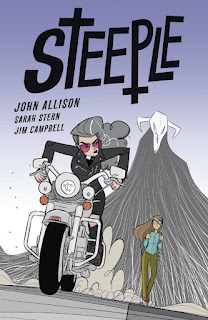
Steeple by John Allison with Sarah Stern and Jim Campbell
The other theory is more straightforward: in every generation of Allison protagonists, there is a female character who embodies chaos, around whom reality itself sometimes bends, who is a force of nature, who both the complications of the narrative and the audience love. Shelly Winters, Charlotte Grote, Esther De Groot - that kind of character. The Allison stories that feature one of those characters are the best ones.
Steeple is a contrasting-two-people story, and neither of them (yet?) have risen to the level of an Allisonian Chaos Magnet. So I might perhaps say at this point that it's not quite as zany as his best work, but that might also be said, in a different way, that it's more accessible and less likely to hare off in random directions for no obvious reasons.
This story is set in the same universe as Tackleford - though, like Giant Days, it touches other parts of that world only very lightly. We are in the small town of Tredregyn, Cornwall - that's in the far Southwest of England, for those geographically challenged, about as far you can get from Tackleford's Yorkshire and still be in the same country. In Tredregyn, there are two churches. And, in each of those churches, there's a young woman with good intentions.
Just arriving at the local parish - I think it's CoE, and I think it's St. something-or-other's that only gets mentioned once in the book and which I can't find now - at the beginning of the book is the new parson Billie Baker, to help out the Rev. David Penrose.
On the other side of town, there is a Church of Satan, run by Magus Tom Pendennis and Warlock Brian Fitzpatrick - though I had to look up their full names online; they're just "Tom & Brian" in this book - where Maggie Warren does what she wilt as the whole of the law when she's not slinging pints at the local pub. (First lesson: God pays better than Satan. Maggie needs a side job; Billie does not. Who knew?)
Billie and Maggie meet cute when Billie arrives in town, and become friends, even though their lives are deeply opposite to each other.
So that's one major conflict: they're friends but they work for (to put it mildly) competing organizations.
The other major conflict is weird supernatural stuff, as it often is in Allison: Tredregyn is in danger from a race of aquatic monsters who want to drag the town and surroundings back beneath the sea whence it came, and apparently they could be successful in this if the local priest doesn't spend his nights punching said monsters in the cemetery. Penrose keeps asking for strong, burly assistants to aid him in biffing the salty foe, but his superiors keep sending him thin and weedy types. Like Billie, for example.
Now, those sea monsters are said to be sent from the devil, but they don't seem, at least in this first storyline, to have any connection to the Church of Satan. So it may be that the devil has legions who know naught of each other, or perhaps the sea beasties are actually the spawn of Cthulhu or Belial or some different evil entity. Or perhaps the Church of Satan is the modern, free-living kind of Satanism, and has mostly or entirely sworn off actual evil in the sense of conquering the world and dooming souls to eternal torment and suchlike.
This first volume of Steeple stories - it doesn't have a "Vol. 1" anywhere on it, though a second volume has since appeared, and a third is coming this summer - collected five comics issues, written and drawn by Allison with colors by Sarah Stern and letters by Jim Campbell. Each issue is basically a standalone story, mostly along the lines of Giant Days, so my assumption is that the hope was to do a few issues, assess, and then do more issues for years and years. That did not actually happen; subsequent Steeple stories have appeared on Allison's webcomics site, so my guess is that the American comics market continues to Be Difficult.
As I said, both Billie and Maggie are pretty sensible, though they are in one of those weird Allisonian towns. I could wish for a bit more mania and craziness from both of them, to juice the stories up, but these are early days yet. These five adventures are quirky and fun, and the status quo gets upended pretty seriously at the end, which I hope will lead to odder, stranger stories for the next batch. So far, I'm counting this as solid B+ Allison, with signs that it could ascend to the top tier quite easily. And it's entirely standalone, thus being a good entry point for new readers.
[1] Potential counter-argument: what about things like Bobbins and Scarygoround, which have larger casts around whom the plots circle? How do they fit into this schema? There I pull out a timeline, and argue that the count of Allison's central characters for a given story tend to diminish over time, and so, therefore, in about 2030 he will publish a comic featuring no central characters!
Thursday, April 15, 2021
Giant Days, Vols. 11-14 by John Allison, Max Sarin, & Whitney Cogar
But that still doesn't mean I'm happy to see a long-running story that I like come to its ending. I get that "what do you mean, there isn't any more?" feeling. It's just that I know it has to happen.
Giant Days is now over. It was the story of three young women at a particular point in their lives, while they were undergraduates at the fictional Sheffield University, and undergraduate life in the UK only lasts three years. Writer John Allison and his artistic collaborators - originally Lissa Treiman as the primary artist, then Max Sarin for most of the run, and Whitney Cogar on colors the whole time - spun out fifty-four issues of the main series and a handful of one-offs over the course of four years of comics, so the comic took more time than the actual life would have.
Now, some artistic teams would have kept Esther, Susan, and Daisy in college for decades or longer - if it was an American comic book or syndicated newspaper strip, they could still be in their first year until at least 2050, or the heat death of the universe, whichever came first. But - and, again, this is important - stories don't work like that. You can put out product in which nothing important ever changes, in which no one ever grows or learns, but you're a hack and you know know it. Allison and Treiman and Sarin and Cogar are not hacks, and they want to tell stories that matter about real people that change.So this was inevitable: they would graduate, their days at Sheffield would end. It doesn't mean we won't get more stories about some of them, in some permutation, in the future: remember that Esther was a major character in Allison's webcomic Scarygoround for nearly a decade even before Giant Days. But this time is over.
For most people, it ended a couple of years ago. I'm just catching up on the back quarter of the series now, since I finally gave up waiting for more of the Not on the Test hardcovers to emerge. So I read Volumes Eleven and Twelve and Thirteen and Fourteen all together, a year's worth of comics in a day or two. It's not a bad way to read an episodic humor comic, I have to say: stories based on characters get better with familiarity with the characters, so reading a big chunk all at once can be really resonant.I'm not talking about the specific issues here, because there's more than a dozen of them, and that's really not important. Each one is a small story, one moment in this larger story, and they add up together to Giant Days, all fifty-some of them. They're all good, they're all stories, they center on various parts of the cast - mostly Esther and Susan and Daisy, but some McGraw and even enough Ed and Nina to make me wish I got a lot more of that. (Hey, John Allison! If you randomly read this, Ed & Nina in the Big Smoke together could be fun, at least for a short-run thing. Maybe other people than me would even like it!)
I read these because I wanted to know if Giant Days ended well, and it does. (Well, also because I was enjoying it a lot, and why give up in the middle on something you like?) If you've managed to avoid Giant Days for the last six years, I don't know what I can say here to convince you: it might just be not to your taste. But it's a smart, fun, well-written, colorful, amusing, true, real, occasionally laugh-out-loud series of stories about people I think you will recognize and like, and if that's not what you're looking for I frankly have to worry about you.