Showing posts sorted by relevance for query matthew hughes. Sort by date Show all posts

Sunday, October 07, 2007

The Spiral Labyrinth by Matthew Hughes

Whimsy is a tough sell these days. Even something that isn't really whimsy, but can look like it in a dim light, has a difficult time. Witness Matthew Hughes's career in fantasy.

He wrote two wonderful, very funny, very Jack Vance-influenced novels for Warner Aspect, both set in the very far future. (Not quite as far forward as Vance's Dying Earth, but nearly so; Hughes's Earth was aged, out-of-breath, and perhaps living in a complex with good nursing care, but was not quite "dying" per se.) Those novels, Fools Errant and Fool Me Twice, were among the funniest novels of any type published those years and were a pure delight and a joy to read. They sank almost without trace; even a 2-in-1 bookclub edition didn't help their profile much.

Hughes dusted himself off and moved over to Tor, who published his next novel, Black Brillion -- set in the same milieu, with some characters in common with the "Fools" books, but a completely different plot. It was utterly transparent for a new reader, and, again, a thing of pure enjoyment from beginning to end. (By this point, the obvious Vance parallels had receded a bit into the background and other influences, such as P.G. Wodehouse and Arthur Conan Doyle, had become apparent. Even more, the essential Hughesness of Brillion shone through.) As if to prove the relationship between merit and popularity is purely negative, Black Brillion made even less impression on the slack-jawed reading public than his first two SF novels. (You see how the frustration drives me to insults? Hughes rightly should be rich and famous for writing books as entertaining as these.)

And so Hughes packed his literary bags again, ending up at Night Shade Books, a young press that has been growing by leaps and bounds and which is lean and energetic enough to take a risk on a great writer with some bad breaks. They published The Gist Hunter and Other Stories, which collected two series of stories set in the same world as Hughes's novels (as well as some purely individual stories). One of those series focused on the cases of the freelance discriminator Henghis Hapthorn, the finest mind of detection in Hughes's far-future, and a master of empiricism and the scientific method. This, unfortunately, is a problem: the universe periodically shifts from being ruled by the laws of science and probability to being ruled by those of sympathetic association and willpower. One of those great shifts will soon take place, bringing the powers of magic back into ascendance. It's the last thing Hapthorn wants...but he can't do anything to stop it.

Hapthorn moved into novel length with Majestrum, Hughes's second book for Night Shade, and was ever more entangled with the rising power of magic. Now, Night Shade has made it to a third Hughes book with this second Hapthorn novel, The Spiral Labyrinth. (And the card page up front promises a third Hapthorn novel, Hespira, in the near future, which I hope means that Hughes will now be able to stick with one publisher and build more of an audience.)

Spiral Labyrinth is more obviously a sequel to Majestrum than a purely standalone novel; the plot is entirely separate, but we find Hapthorn entangled in the problematic situation that Majestrum left him in (divided in himself and in his assistant). I found it easy to pick back up, but fastidious readers may prefer to start with Majestrum.

Spiral Labyrinth is a slightly more successful novel than Majestrum; the latter is written in Hughes's eternally readable prose, but the plot is a bit more dark and complicated. This is merely a matter of degree; Majestrum is splendidly entertaining, but Spiral hangs together a bit better and has a more satisfying ending. The perfect solution for a new reader would be to get both of them at once and read them straight through -- that would be the best of both worlds. I highly recommend that course of action.

Thursday, March 18, 2010

Book-A-Day 2010 # 43 (3/18) -- Hespira by Matthew Hughes

Matthew Hughes is one of the best examples modern SF has of the power of second chances [1], with two books from what was then Warner Aspect -- the very amusing and light-hearted Fools Errant and Fool Me Twice -- followed by a single novel for Tor, Black Brillion, and then a spray of titles from smaller presses in the years since. For some incomprehensible reason, neither the two Fool books nor Black Brillion were notably successful; I can't see any reason why the SF audience would avoid a writer as witty and endlessly pleasurable as Hughes, but they certainly didn't buy all that many copies of those books. But Hughes has kept writing, adding new wrinkles to his Vancean far future with each book and becoming one of the most entertaining writers the modern genre has to offer.

(I'm not at all unbiased when it comes to Hughes; I loved the Fools books and did a 2-in-1 of them at the SFBC when I was there, and bought Black Brillion for the club as well. And I've enthusiastically reviewed the first two books in the Hengis Hapthorn series from Night Shade -- Majestrum and The Spiral Labyrinth -- as well as the standalone Template.)

Hespira is the third novel about Hengis Hapthorn, the foremost freelance discriminator of Old Earth in its penultimate age. Hengis is a man entirely of the age of science, a firm believer in logic and the essential rationality of the universe. So it was a hard blow for him when he learned that the laws of the universe oscillate between rationalism and sympathetic association -- what less educated types might term "magic" -- and that the end of his age, and the rise of a new age of magic, was imminent. He learned of this quirk of the universe in Majestrum, and was dragged bodily into the world to come in Spiral Labyrinth, but Hespira opens with Hapthorn back in his own time, with things mostly back to normal. OK, his AI "assistant" shows an upsetting degree of humor and independent thought, a vestige of its period spent incarnate as a magical familiar. And the formerly internal part of his mind that worked by intuition has been reified into the body of Osk Rievor, an researcher into the growing power of magic that Hapthorn still consults as he used to do when it was part of his mind.

Hapthorn is in a dark mood as this novel opens, taken to thinking about whether it would be best to end his own life before the rational world is replaced by one ruled by willpower. His current case was far below his ability; he was acting as a go-between for a rich man to ransom some valuable property that was stolen from him. Unfortunately, that rich man then scandalously broke the rules of proper conduct in such matters by attempting to follow and assassinate the thief, which led both sides to widen their battle (through the sort of criminal cannon fodder that rings of thieves already employ and rich men can hire) and both of them to incidentally decide to eliminate Hapthorn along the way.

At the same time, Hapthorn came into contact with an amnesiac young woman, Hespira. She's not conventionally pretty -- Hapthorn points out that she's nearly the opposite of his tastes in that area, and grumpily sour to boot -- but he feels a strong desire to protect and help her. So he takes her off-world to trace her origins -- if nothing else, it will be a workout to his investigatory skills. The path of Hespira's true name and path is not a simple one, of course -- it wouldn't be worthy of Hapthorn if it were -- and it leads through several human-colonized worlds before it brings them back to Old Earth for the denouement. And, unpleasantly for Hapthorn, sympathetic association is involved.

Again, I can be reliably counted on to call each new Matthew Hughes novel a triumph; he writes wonderful books that I enjoy massively. The Vancean flavor of the Fool books have been mixed with a dash of Wodehouse, a couple of jiggers of Conan Doyle, and a shot or two of Wolfe to form a bracing cocktail that is nothing but Hughes. Hespira in particular builds on its two predecessors to make a satisfying end to a trilogy -- and what SFF reader can resist a trilogy? Hughes is the writer I invariably mention whenever the question of modern underrated writers comes up; he writes the kind of wonderful, funny, thoughtful, exciting, zippy novels that should be massively popular and winning him shelves-full of awards.


[1] The other, to me would be Kage Baker, who was rescued from the wreck of Harcourt's quirky SF program by Tor close to a decade ago. And anyone who likes Baker would probably greatly enjoy Hughes, for that matter.

Book-A-Day 2010: The Epic Index
----------------
Listening to: Haley Bonar - Holiday In Outer Space
via FoxyTunes
 

Wednesday, June 01, 2011

The Damned Busters by Matthew Hughes

I have to admit up front that I have unabashedly been in the tank for Matthew Hughes ever since I read Fools Errant over a decade ago. I loved his far-future Archonate universe -- from that first book, its direct sequel Fool Me Twice, the standalones Black Brillion and Template, and the trilogy about the Holmes-esque "freelance discriminator" Hengis Hapthorn starting with Majestrum, and others -- and especially the world-weary tone that Hughes used to tell those stories, made up of an amalgam of James Branch Cabell, P.G. Wodehouse, Jack Vance, and Arthur Conan Doyle that was nevertheless utterly Matt Hughes.

So I'm happy to see any new Hughes book, even ones not set in the Archonate, and I'm going to tell you right here that I want you to buy and love The Damned Busters because Hughes is that good. And, if you avoided the Archonate books because you're not fond of that tone or manner, you're in luck, because Damned Busters is entirely a different kind of book.

(I didn't find it as precisely calibrated to my tastes as Hughes' far-future books, but I've learned through long experience that my precise tastes are shared by vanishingly few people -- so I expect that Damned Busters will be more popular with more people than his previous stuff.)

Damned Busters, in fact, is the first of a contemporary fantasy series called "To Hell and Back," and it tells two stories in quick succession: first, the origin of our particular hero and his unusual powers (which is also told, in condensed, schematic form, in the excellent Tom Gauld cover art), and then his first adventure using his new abilities. Those two stories aren't as tightly integrated as I might have hoped, but Hughes turns Damned Busters into something like the first trade paperback reprinting the comics adventures of a new superhero: it starts off with his uncanny creation and then dives right into the action.

Our hero, though, does not at first look like someone made for any kind of action. Chesney Arnstruther is an actuary -- and, worse yet, enjoys it. He's quiet, methodical, good with numbers and bad with people...until the day he accidentally summons a demon, by yelling out what he thought was a random sequence of syllables after hitting his thumb (and drawing blood) while building a pentagram-shaped table. A simple mistake, he thinks -- and he's certainly not going to give over his soul to the demon who appears.

But that demon can't close out this job without a soul, and his compatriots in Hell -- already frustrated by their increasing workload, due to the growing (and ever-more-temptable) human population -- decide that this is the final straw. So they walk out -- all of the tempters of Hell lay down their tools and stop working.

(This portion of Damned Busters could have made an interesting novel of its own, if Hughes had wanted it to -- in his conception, humans won't do much of anything without a demon goading them into it. But this is still prologue to his real story.)

Eventually, Chesney, as the source of the problem, has to fix it. Hughes rushes this a bit -- he skips around noticeably throughout the entire origin section of Damned Busters, as if he was rushing it to get to his real plot -- but, in the end, Chesney brokers a new collective bargaining agreement between, on the one hand, the rank and file of Hell, and, on the other, their heavenly overseers.

Because of that role -- and due to some negotiations Hughes skips over quickly -- Chesney is granted Xaphan, a demon of his own, to provide him with superhuman abilities for a period of two hours a day. He, of course, uses this to become The Actionary, and sets out to fight crime. It's not that simple, of course, and Chesney quickly becomes embroiled in the schemes of the owner of the insurance company he works for, as well as caught up in the wiles of his inevitable beautiful, spoiled daughter. His day-job as an actuary gets mixed in with his night-work as The Actionary, and he soon learns, as we all do, that it's much easier to want to do good than it is to actually do the right thing. And, since this is only the first book in a series, there will be many more lessons for Chesley to learn, and many more aspects of evil to battle.

Hughes's dialogue is wonderful, and his characters are enjoyable -- though the contemporary setting does tamp down some of his more rococo tendencies there. But the plot putters along through very well-worn paths, which I would never have expected from Hughes. Damned Busters definitely has its quirks -- it's a modern superhero novel in which the hero is an actuary powered by demons, after all -- but its hero's motivations and actions are strongly generic, familiar from dozens of comics, movies, and novels about would-be superheroes. For me, that makes Damned Busters less uniquely Hughesian -- though Chesley Anstruther is still a character no one else could have created, and the demons are all wonderfully single-minded -- but it also makes it a book that, I sincerely hope, fans of superheroes, and of fantasy novels set in the modern world will find and enjoy and recommend to all of their friends. If any of that describes you, please do give Damned Busters a look.

Tuesday, August 14, 2018

Book-A-Day 2018 #226: The Commons by Matthew Hughes

I have to admit it: I've gotten really lazy in my reading life. I've said repeatedly that Matthew Hughes is one of my favorite writers -- and it actually is true, not just something I like to say -- and yet it took me a decade to get to this 2007 fix-up of his Guth Bandar stories.

In my defense, there are a lot of books in the world, and I have intentions of reading multiple thousands of them. (And actually own multiple hundreds, which should be a subset of the books I intend to read -- though we all know that's not how it actually works.) I might have had a copy of this before my 2011 flood: I lost a lot of books then, and don't remember what all of them were [1].

I also vaguely remember thinking at the time that the premise of this series of stories wasn't quite as appealing as Hughes's earlier Archonate work -- I don't remember exactly why I thought that, but I think it had something to do with seeing a vague description and thinking it sounded a bit woo-woo. [2]

Anyway: The Commons is a fix-up of six stories about Guth Bandar, at first a neophyte noonaut from the Institute of Historical Inquiry in the vastly distant future of Old Earth, where everything has been known, forgotten at least once, and rediscovered again. The Institute mapped the noosphere -- the landscape of the collective unconscious, which we all enter in dreams and trained explorers can navigate at will -- ages ago, and continues on in the way that academic organizations do, even though their purpose was achieved long before. So it trains explorers to understand and map the noosphere, even as it teaches that there can be nothing new to map, and any scholarly work will be on very precisely defined small topics that have certainly been covered many times before in the previous thousands of years.

Guth's career, though, is one of discovery: the noosphere, or "the Commons," as it is vulgarly known, still has secrets, and he will be the one to learn them. And, of course, if on one side you have a large and powerful academic organization that has codified all of the knowledge in its area for hundreds of generations, and on the other side you have one young and eager researcher who claims that everything they know is flawed...well, how do you think that conflict is going to go?

So Guth starts off as a promising novice in the Institute, on a major fieldwork mission with his mentor, in the first story incorporated here. But he learns something thought to be impossible -- that it's possible to break through from the Commons of one intelligent species to that of another, causing serious mental disruptions to sapients on both sides -- and loses that mentor to mental instability because of it. In the next couple of stories, Guth is still advancing in the Institute, but not as strongly as he was before, and the weight of revelations eventually stymies his progress and makes his goals impossible.

On the other side, that collective unconsciousness may have a need for Guth -- which is frightening in two ways. First, being a thing that a greater power wants to use rarely works out well. Second, the collective unconsciousness is supposed to be unconscious -- according to everything the Institute knows, it can't know or want anything.

But it does, and it has plans for Guth Bandar. They will roll out overt the course of his life, as chronicled in the stories that Hughes has mildly edited to turn into a novel here.

Hughes's Archonate stories are witty and amusing, usually with a world-weary, fatalistic air -- they're set in an Age where everything that could happen, save only the end of all things, has already happened. Guth's tales are more active and adventurous than most of those, given that they take place mostly in the Commons, a world where mythic stories retell themselves every day, and noonauts can get caught up in them. One of the slyer joys of this book is recognizing the "ancient myth-patterns" that Guth finds himself in as folktales or classic literature.

Until the last novella, Guth is mostly in the Commons, and so Hughes doesn't have much scope for his love arch dialogue -- which I did miss, a little. But that may make The Commons an easier way into Hughes's great post-historical work for many readers: it's full of incident and adventure, and not quite as mannered as some of his work it. (Again: I love the mannered stuff better, but I realize that my tastes may be uncommon.)


[1] It's hard to have personal memories of everything when you lose about 250 linear feet of books all at once.

[2] Woo-woo is a technical publishing term, used to describe books mostly bought by very nice and terribly gullible people that explain how to tune their chakras and align their pyramids and avoid the body-fluid-stealing aliens of the Bermuda Triangle and hum their way to cosmic peace. You know the kind.

Wednesday, September 05, 2012

Costume Not Included by Matthew Hughes

It's not easy being a superhero in the best of circumstances, so pity the poor man whose powers derive from a demon -- and whose mother is dating one of the nation's leading evangelical preachers. And when that young unfortunate's name is Chesney Arnstruther, well...that's someone whom you would not want to switch places with.

Chesney is the superhero of Costume Not Included, second novel in a trilogy called "To Hell and Back" -- though it means that more puckishly than most fantasy books would -- and I'll direct you to my review of the first novel, The Damned Busters, for the precise details of how and why Chesney made that deal with the devil, how he did it without forfeiting his immortal soul, and why an actuary wanted to be a musclebound superhero in the first place.

There are two kinds of trilogy-middles: the ones that lose the energy of the first volume and mark time until the finale, and the ones that are happy to have gotten the scene-setting out of the way and leap into creating ever more complications to keep things interesting. Costume, luckily, is of the second type: the first book took a little while to get going, but this one hits its wry tone right up front and charges forward at exactly the right pace.

Really, how could you put down a novel that begins like this:
"I thought you weren't speaking to me," Chesney Arnstruther said into the phone.

"I'm not speaking to you," said his mother. "I'm telling you something for your own good, is what I'm doing."
I've spent the last several years haranguing anyone who wanders into Antick Musings about how essentially funny and entertaining a writer Matthew Hughes is -- see my other reviews of Hughes books, all of which you should buy, read, and love, in approximately that order: The Other, Hespira, Template, The Spiral Labyrinth, and Majestrum -- so I'll leave that part as read: Hughes came into the SFF field writing Vance-inspired far-future books, but his influences were always deeper than Vance (not that being able to write as smoothly and sardonically as the great Jack Vance isn't a monumental achievement to begin with), and he's since shown that his essential qualities shine through in a variety of subgenres.

So, anyway: Chesney is a superhero, and he's been doing well at it. Too well, actually: he's wiped out pretty much all of the Golden Age-style street crime (guys in suits and fedoras robbing banks, muggings, and so forth) in his city, and his deal only extends so far. He can't directly stop the sources of crime -- which, in best superhero fashion, lies with a shadowy cabal that secretly runs that city -- and his put-everything-into-the-right-boxes mind is not happy leaving a job undone. (His new girlfriend, Melda, is also pushing him in slightly different directions; she's like to see him have a higher media profile and perhaps make some money from being the Actionary.)

Adding to the complications is that his mother's new boyfriend -- that noted thriller writer turned TV evangelist, Reverend Hardacre -- has his own new, and very odd, theory about the secret cosmology of the world, and it's becoming more and more clear that Hardacre is right. And the Devil is not entirely happy with the deal with Chesney -- that lack of a soul coming his way vexes him, and the Devil's whole raison d'etre is to trick and twist and sneak -- and the Devil has deal with other folks who may help him cause trouble for Chesney.

So complications -- very idiosyncratic, unique complications, of the kind only Hughes could create -- proliferate, until Cheney finds himself chased closely by a smart police detective, meeting a Jesus Christ, (not the Jesus -- not the current one, at least -- but a prior, historical version) and having himself proclaimed as a new prophet by Hardacre. But Chesney still has Melda, and his demon Xaphan, on his side, plus his own inextinguishable drive for truth and justice. And there's still one book to come in this trilogy.

Not to sound like a broken record, but Matt Hughes is a great, wonderfully entertaining writer -- his dialogue pops, his people are quirky and real, and his situations could be written by no one else in the world. If you don't like his work, there's got to be something wrong with you.

Thursday, December 31, 2009

Template by Matthew Hughes

In a better world, Template would have been the immediate follow-up to Hughes's engaging novel Black Brillion, which became a solid hit and generated a serious fan following for Hughes' witty and quietly cutting tales of the far future of the Archonate. Sadly, this is not that world, and none of those things happened -- Black Brillion was a wonderful book that readers inexplicably avoided, and Template sat on the shelf for a few years, only to emerge from a small British house, PS Publishing, in this handsome but limited edition last year. (A trade paperback, which I hope will reach more people, will be published by Paizo sometime in 2010.)

Hughes's work often tends towards the Vancean, and Template is firmly in that mode; it's set so far in the future that the planet called "Old Earth" may not even be the one we're on now, and in a society where humanity has spread throughout an entire arm of the Milky Way. It's a slightly old-fashioned future, pre-Sterling and Vinge, in that all of those humans are apparently physically identical to humans today, and their divergences -- which are many, and one of the underlying themes of Template -- are entirely cultural, not physical.

Conn Labro is a gladiator of sorts, a master of physical combat on the world Thrais, where every contact among humans is governed by pure commerce. But he will find himself traveling through many different worlds of The Spray of humanity -- all the way to Old Earth, with stops along the way -- and find that each world has a very different set of expected behaviors. Template is, on one level, the story of Conn's adventures as he investigates the death of Hallis Tharp, an old man with whom he used to play the game of paduay, and those adventures are colorful and exciting. But Template is also the story of how Conn learns to appreciate and live with those very different cultures -- including, or especially, that of the young woman Jenore Mordene, originally of Old Earth herself.

Hughes's writing is both supple and subtle here; his dialogue is allusive and amusing in that dry, understated style that he shares with Vance, and his descriptions are precise and specific. Template isn't a long novel -- it tops out at 250 pages -- but it's full of wonders and thrills, deeply amusing and thoughtful in turns, a fine mature work from one of the best writers that SFF has today. I can only hope that his audience will increase; we need more Hughes novels, and a world with a legion of Hughes fans would be a wonderful thing.

Friday, December 30, 2011

The Other by Matthew Hughes

I could pretend that I was trying to spare you folks getting the same spiel from me too often...but you wouldn't believe that, would you? So I don't really have an excuse for why I didn't review Matt Hughes's newest far-future SF novel, The Other -- which was published by Underland Press in early November as a very reasonably-priced trade paperback -- soon after I read it in mid-September.

Look, Matt Hughes is one of the most entertaining writers in the SF/fantasy field, now or ever -- his writing is reminiscent of Jack Vance at his lightest, P.G. Wodehouse at his least cow-creamer-focused, and Arthur Conan Doyle at his most frivolous. This is not my opinion; it's a fact. See my reviews of his previous novels The Damned Busters, Hespira, Template, The Spiral Labyrinth, or Majestrum for more details -- or, better yet, just pick up one of his books, start reading a bit, and see if you can stop. I'll bet that you can't.

(Wait a minute! You can read the beginning of this very novel, as I am reminded by an e-mail from the author way back in October, on his website. So you don't need to go anywhere, or do anything but click that link, to be exposed to the full glory that is Matt Hughes.)

If you actually want to know something about this novel, well, let's see what I can remember of the details, these three months later. Luff Imbry is a rich and successful con man on the Earth of the far future -- it's not quite Vance's Dying Earth, but Hughes's Earth is definitely on a restricted diet from its physician and watching its level of exertion closely to stay on this side of health -- whom we met previously in Hughes's novel Black Brillion, and he is kidnapped and abandoned on a far-away world. Even worse, Fulda -- the planet in question -- is not only low-tech, and almost completely cut off from the greater interstellar Spray of humanity, but is home only to a fanatical sect devoted to perfecting the human form -- that is, to remaining absolutely identical with each other. The corpulent and unique Imbry could no more hide among them than he could stand behind a grain of sand, and so his troubles begin.

On the other hand, Imbry is intelligent, clever, and entirely able to take advantage of every last opportunity that comes his way -- and, better yet, he has Matt Hughes on his side. The Other is a sparkling, wonderfully amusing novel, full of great dialogue, odd situations, and quirky characters; it's a lovely, masterful souffle of a book, and I can think of no reason why any reader wouldn't love it.

Wednesday, October 19, 2011

The Amazing Belated Sixth Anniversary Razzamatazz!

Six years (and two weeks) ago, I first inflicted Antick Musings on the world. It was intended to be my training-wheels blog, since I was expecting to very soon begin to blog for my then-employer. Well, "very soon" turned into "many months later," and then my then-employer turned into my former employer, quite against my will. But Antick Musings still continues, though exactly what it contains has changed quite a bit -- I avoided writing directly about the SFF world (in particular, I scrupulously avoided seriously criticizing the books in the field, which may seem impossible to some of you now) while I worked in that field, much as I studiously avoid ranting about the business-book world and the headaches of my current day-job here now.

Last year, I missed the big fifth anniversary, for reasons I no longer remember precisely -- but it probably had to do with the fact that I was hip-deep in my year-long Book-A-Day project, and had no time for any other blogging. This year, I nearly missed my blogiversary, but I'm invoking the Retroactivity Clause in my blogging contract, and pretending this is the post I would have made on October 4th.

Since this is going to be a long, links-filled post, I'll begin by looking back at those older anniversary posts: first, second, third, and fourth.

Come to think of it, I think this post will have to cover the last two years, at least desultorily, just to catch up. That will mean it's even longer and filled with more links, but I've never been one to shy away from doing something exactly the way I insist it must be done.

I've begun in past years with the Reading of the Statistics, since that's the kind of guy I am. So here's the post counts for the first six years of Antick Musings:
2010-2011 -- 445 posts
2009-2010 -- 711 posts
2008-2009 -- 880 posts
2007-2008 -- 834 posts
2006-2007 -- 841 posts
2005-2006 -- 809 posts
Looking at those raw numbers, one might want to diagnose the dreaded Blogger Fatigue, and there probably is a bit of that. But I should also point out that much of that 2009-2010 period was taken up with the previously mentioned Book-A-Day project (which began 2/4/10 and ran through 2/3/11), so there may have been fewer total posts, but there were a lot of longer, more essay-like posts (one every single day for 365 days, in fact).

And the other reason for the drop in posts is that I started up a second blog, Editorial Explanations (devoted to making fun of and criticizing editorial cartoons), the moment that Book-A-Day ended. In fact, Editorial Explanations began with a post on this blog on the very day after Book-A-Day ended, even though I'd specifically said that I wasn't launching another bloggy project immediately.

(Clearly, I am not a reliable reporter of my own intentions. This may explain why I like Lawrence Block's books so much, since all of his protagonists seem to be eternally trying to figure out just what they'll do in a given situation -- I know that feeling.)

Anyway, I only posted here 445 times over that year, but I've also posted 810 times at Editorial Explanations in just a little over eight months, so imagine a Roger Maris-like asterisk in that most recent number of posts.

And, as long as I'm talking about other blogging I do, I should mention my shared items -- which come into a sidebar here as "Hornswogglets" -- which has become the outlet for most of my hey-look-at-this-thing link-blogging. (And there are dozens of those, many of which might have become full, if short, posts in past years.) Links to posts here and the shared items also flow into my Twitter account, which in turn flows into the mighty river of Facebook. (Does it seem like I'm desperately trying to prove how engaged and au courant I am, to deny the possibility that I'm souring on blogging? It's possible....)

I just mentioned Book-A-Day, which took over this blog almost entirely for a year, so let me start the intensive link-a-licious part of this post with some of the pieces from that string that I think hold up best, arranged in reverse-chronological order to be that much more blog-ical:

Before I started Book-A-Day -- but after that fourth-anniversary post two Octobers ago -- there were a few notable book-review posts that might still be entertaining now: Thy Neighbor's Wife by Gay Talese, Poison Penmanship by Jessica Mitford, This is Me, Jack Vance!, Matthew Hughes's Template, Jo Walton's Half a Crown, Josh Lieb's I Am a Genius of Unspeakable Evil and I Want to be Your Class President (which I may manage to cajole Thing 2 to read in the near future), How I Became a Famous Novelist by Steve Hely, Mark Stein's How the States Got Their Shapes, Lev Grossman's The Magicians, Justine Larbalestier's Liar, and Shades of Grey by Jasper Fforde.

And then there were more reviews of books after Book-A-Day ended -- almost as if I were obsessed with books, or as if I worked in the field or something! -- including very nasty reviews of the Hugo nominees Blackout/All Clear by Connie Willis and Feed by Mira Grant. Other notable reviews here in the last nine months include the third volume of E.C. Segar's Popeye strips, Let's You and Him Fight!; Spy: The Funny Years; Mary Robinette Kowal's Shades of Milk and Honey; P.J. O'Rourke's Don't Vote: It Just Encourages the Bastards;  Steven Brust's Tiassa; Jasper Fforde's One of Our Thursdays Is Missing; Among Others by Jo Walton; Patrick Rothfuss's The Wise Man's Fear; Michael Chabon's The Final Solution; Jennifer Egan's A Visit from the Goon Squad; Dennis Lehane's Moonlight Mile; John Scalzi's Fuzzy Nation; Matthew Hughes's The Damned Busters; Juxtaposition: Two Books for Younger Readers with Words and Pictures;  and Catherynne M. Valente's The Girl Who Circumnavigated Fairyland in a Ship of Her Own Making.

And I also chose my favorite books for those years -- 2009 and 2010 -- which somewhat overlaps with the links immediately above. (But not entirely, of course -- I'm also linking to books I loathed, since, like all critics, I believe that I'm endlessly entertaining when I'm full of bile.)

(And I wrote fitfully for other people as well -- I dropped out of writing for ComicMix sometime early in this period, though I still think of myself as just pausing between posts there -- as well as writing a graphic novels column for the bi-monthly magazine Realms of Fantasy. I can't link to the latter, since it's a real, ink-on-paper magazine, but I'll point you to what was one of my last, and probably best, ComicMix reviews: The Walrus Is Batman.)

I even write about books I don't finish, which is incredibly arrogant of me, I know. Abandoned Books posts that I think are worth not abandoning include Michael Shea's The Extra and Dalton Conley's Elsewhere, U.S.A.

As to the other blogging I do here, well, the most popular posts (judging from aggregate numbers of hits) are the Monday-morning Reviewing the Mail series, in which I write about whatever books arrived in the previous week's mail despite the handicap of not actually having read them.

I intermittently write about movies, as well -- less so recently than I used to, particularly during and after Book-A-Day -- but there are still some things I'm willing to remember: Absurdistan, Anvil! The Story of Anvil, The Fantastic Mr. Fox, The Duchess, In the Loop, Whip It, Kenny, Pirate Radio, The American, The Cannonball Run (which gets a surprising number of hits on a regular basis), A Life Less Ordinary, Tales from Earthsea; Wild Target; How Do You Know?. And then I got out of the habit of writing about those movies and had to catch up on six months with one huge post.

I also occasionally pretend to be a journalist -- or, to be more honest, like a hack columnist -- particularly when something interesting is going on in the publishing world. These will all be pretty dated a year or two later, but they're among the most time-intensive blogging work I do, so I'm damn well going to link to them! British-Style Book Price Wars Come to the US. Amazon and Macmillan. More on Amazon-Macmillan. Myths of Amazon-Macmillan. Behold! There Is a Straw-Man Argument, and It Is Good! Are E-Book Readers the New Web Browsers? Goodkind's Plethora of Three-Book Deals. Reading by ARC Light. Amazon Algebra. Comment on Promo Quantities. Publishing Brands. In Which the Sky Has Not Fallen. Of Bestsellers, and Their Lists.

In a similar vein, I brought back my very intermittent series Book Marketing 101 for a post on Getting Into the Right Shelf Category.

It was during this period that I actually codified my Social Networking Policy.

Things that I was grumpy about during these two years included -- but was not limited to! -- the post-Thanksgiving shopping frenzy, gender presentation and youth sports, and how I hope I'm not really all that smart.

I'm very rarely positive about anything, and I'm sad to say it takes something like impending death to bring it out, but, it did: An Appreciation of Kage Baker.

I am semi-shamefully an Amazon affiliate, though it never adds up to much money. (Though, if I were really mercenary, I'd do some sob story now about how I'm trying to rebuild my library after the flood, and, oh-please-sir, won't you use my Amazon links to help a poor drowned library?) And, half the time, I'm more interested in making fun of the idea of selling things anyway, which is remarkably twisted even for me. That impulse hit its height at Christmas 2009 with a series of posts I called Twelve Days of Commerce, which I think are pretty damn amusing. (But, then, I would.)

I try to avoid having Big Ideas, but they can strike any of us -- even when we're drinking a lot of fluids and resting our feet as much as possible -- and I was struck with one last February: A Modest Proposal for E-Book Pricing.

I had another one this June: Characteristic Ages of Genres.

One of my very few public-service activities is gathering together all of the various unbelievable news stories each first day of April, and I did that in both 2010 and 2011.

I've done fewer and fewer "memes" as the years have gone on, but I did catch a few: The Periodic Table of Women in SF. SF Masterworks. Book Title Meme. Every Goddamn Animated Movie Ever Made. Decade Meme.

I had to finally shut down my apparatus for stalking David Itzkoff -- for several years, the utterly incompetent reviewer of SF for the venerable (but clearly either stupid or easily duped) New York Times -- when they hired a replacement, the incomparable Jeff VanderMeer.

I wrote something like an obituary for Diana Wynne Jones, who wrote a lot of great books, not enough of which I've read yet.

After seeing my SF-awards blogging ebb lower and lower over the previous years -- I missed the World Fantasy winners entirely in 2010 and also neglected to do my usual grumpy "Handicapping the Hugos" post that year -- I lept back into the Hugos with both muddy, oversized feet and produced a series of long, complaining posts about all of the award categories, Hugo Thoughts. I also (later) posted an annotated list of the Hugo Winners. I've done other fitful Award blogging over these two years as well, but, in general, my position has been that, no matter what just won whatever award, it's a giant travesty. And, finally, I posted the list of thing that I Would Have Nominated for the Hugos If I Wasn't Such a Goober.

I'm probably not the right person to do it, but I did give Advice to a Would-Be SF Writer. I also reprinted my own ten-years-old advice How to Write a Novel, again, without any reason for anyone to consider me an expert on the subject.

Speaking of old things about topics outside my area of expertise, I also shared my outdated Syllabus for a Non-Existent SF Course.

Although I would like to think I do have something worth saying about What Makes a Good Review, if I say so myself.

Don't ask me why I thought anyone would care about my Zen Koan for People in Fabric-Covered Boxes.

I expanded a quick thought far beyond any reasonable length in Anatomy of a Tweet.

I didn't aim my firehose of sarcasm at consultants quite as often as I might have, but I did attack Seth Goden at least once.

And I keep saying that I should blog more about music, but I rarely do. Practically all of those occasional posts: Slow Burn Songs. Josh Ritter Redux. In Which I Express Admiration for a Band With a Long, Odd Name. My Favorite Song As of This Exact Moment. (I also posted a series of Mountain Goats lyrics during a patch when I was feeling particularly cheery.)

When my younger son was selling popcorn for Cub Scouts (at almost exactly this time last year -- come to think of it, he's supposed to be selling popcorn right now, but, in the flood aftermath, it's not really a priority) I shamelessly tried to enlist the ravening hordes of the Internet to sell vast quantities. (To no result, of course.) I also keep thinking that I should blog more often about the things my family does -- as I did in the first couple of years of Antick Musings -- but the only recent example is Parenting: Harder Once You Actually Do It.

I kept one eye on the doings of all of the other Andrew Wheelers in this world, for we are legion and we are all devastatingly good at what we do.

About six weeks ago, the waters rose in my little New Jersey town, and, though I'd never gotten more than a little water in my house before that, this time it turned out to be a full evacuation and six feet of water in my basement. I was not happy. I'm slightly happier now -- or at least resigned, since it's now solidly in the past. But I expect I'll be thinking (and writing, and talking) about things I lost for years to come: it was a great mass of stuff, books and comics and sentimental junk and random storage and more, and it all had to be pulled, ruined, from floodwaters and thrown away.

More annoyingly to both of us, I had way too many posts about how I wasn't blogging enough, or promising to blog more, or just ruminating out loud about my bloggy impulses, but those are all better left to moulder in the archives; they're of their moment, if anything. Besides, I think that's plenty enough links now, isn't it?

So that's what I've been doing online (mostly here) for the last two years. It looks like I'll keep up this bloggy thing for some time more, and thanks for reading so far. Since the actual end of the sixth year, I've done the usual stuff -- a big review post on Dan Wells's "Mr. Monster" trilogy, a look at the B&N/DC Comics fight, and so on -- and I expect to keep doing it until someone physically stops me.

Wednesday, March 13, 2013

You Have Another Chance to Buy Matthew Hughes Books

Honestly, folks, if you haven't bought Hughes's excellent far-future SF/fantasy mysteries Majestrum, The Spiral Labyrinth, and Hespira -- a fine series of freestanding novels concerning the greatest discriminator of the penultimate age of the Earth -- I'm not sure how many more times I can tell you how excellent they are or burble once again about Hughes's sparkling prose.

But would the fact that you can now get those books in electronic form for the low, low price of only $2.99 entice you? Even better, it's direct from Hughes himself, so if you're the kind of reader who obsesses about fairness and wants to see the author get the best deal, this is exactly the offer you want.

So what are you waiting for?

Monday, April 05, 2021

Reading Into the Past: Week of April 3, 2006

There were no new books coming into the house last week, which means that I fill the Monday slot on this blog by digging into my old reading notebooks and seeing if I can remember the books I read at the same time in some random year from 1990 to 2010. The RNG this time gave me 2001, so here I go:

Matthew Hughes, Fool Me Twice (bound galleys, 3/28)

I read Fools Errant, the first book, the day before, and eventually turned the two into an omnibus for the SFBC (as Gullible's Travels). Hughes at the time looked a bit like the second coming of Jack Vance - which itself would be an amazing and wonderful thing, since he really did live up to that - and has since broadened his palette and written a lot of great books that not enough people have bought.

These two are Hughes in his most purely Vancean mode and his lightest, funniest style - I think they're wonderful and I really should re-read them one of these days. They're books set perhaps an era before the Dying Earth: the Earth is not yet on its deathbed, but is definitely getting up there in years, needing regular colonoscopies and winded by going up a short flight of stairs. The hero is a young man with a good heart, bad luck, and perhaps not quite as many brains as he needs, doing the will of his uncle, the utter master of this depleted, bizarre world.

You all need to read more Matt Hughes, and so do I: I have an electronic proof of his authorized sequel to "The Demon Princes" that I could be reading instead of typing this.

Kazuo Koike and Goseki Kojima, Lone Wolf & Cub, Vol. 7: Cloud Dragon, Wind Tiger (3/29)

Every so often I get pissed off all over again about my 2011 flood: when I realize I probably would have re-read all 28 volumes of Lone Wolf & Cub at some point in the past decade, straight through, is one of those times. I obviously have no idea what happened in this particular volume: I assume Ogami Itto slaughtered a whole lot of people in slow-motion beautifully, but the context is what matters. Someday I hope I will have an excuse and a chance to re-read the whole series, but I doubt it will be this decade.

Jim Mullen, It Takes a Village Idiot (bound galleys, 3/30)

Before I google for it, I'm going to guess it was a quickie humor book - maybe related to the 2000 election - and that I got it from the groaning giveaway shelves at what I think was called Bookspan at that moment in time.

Nope: I was wrong. (Well, it probably came from the giveaway shelves, but that's a gimme.) This was a "I moved to West Bumfuck, and was way out of place there" humor book, written by the guy who did "The Hot Sheet" for Entertainment Weekly for more than a decade and other funny stuff (including a column named after this book) before and since. I started out in suburbia, never managed to live in any city, and have remained stuck in the same small starter tract house for twenty-seven years, so the "selling a Village apartment, too small but convenient to everything in the world, in order to move to a big interesting house in the land of Colorful Rustics" is appealing to me from both ends of the equation. This was a finalist for the Thurber Prize and I tend to remember books I hated, so my guess is that it's both good and pretty funny - humor often doesn't remain long in the memory.

Loren D. Estleman, Sugartown (4/2)

I miss reading mystery novels the way I used to. I miss reading as much as I used to, but working in a business does really help prioritize doing things related to that business. This one was the fifth in Estleman's series about Detroit PI Amos Walker, originally published in 1984 and reprinted in 2001 by ibooks. (Which had a great design sense and some real editorial flair, especially on the reprint side, though Byron Preiss, the founder and animating force, was always...um, should I say divisive?)

There's no way I can tell you what the plot is after twenty years: Amos investigated some mystery, probably some people got killed and Amos was hit on the head at least once, femmes did some fatale-ing but Our Hero was stalwart, and all was made right in the end: that's my best guess. This is a solid series, and there's a lot of books in it, so I do recommend it for people like me who like that kind of meat-and-potatoes American PI style.

Eric Garcia, Casual Rex (bound galleys, 4/4)

Surely I didn't read this for work, did I? I guess it counts as speculative fiction, but I thought it was published way out of genre and the SFBC would have looked down-market and declassee to the publishers. (Although: money is never declassee.) This series - this is the second of three books - was published as mysteries-slash-mainstream, and were about the secret society of dinosaurs living in the modern day in complicated human-suits, focused on our PI hero. They were deeply goofy, in a way I appreciated, but were not books to be taken seriously in any way, shape or form. I vaguely remember that Garcia had Hollywood ties and...I just deleted two lines about how crazy the idea of filming these would be once I realized it happened in 2004, with a backdoor pilot for a Skiffy Channel series that never happened once the adults woke up and realized what they had done. My god: a movie of this book exists. I will never, ever watch it.

So what happens in this book? I dunno. It's the second published but chronologically first, and it has a bunch of secret dinosaurs living in modern LA in meat-suits: wacky stuff, I assume. Totally wacky.

Saturday, December 09, 2006

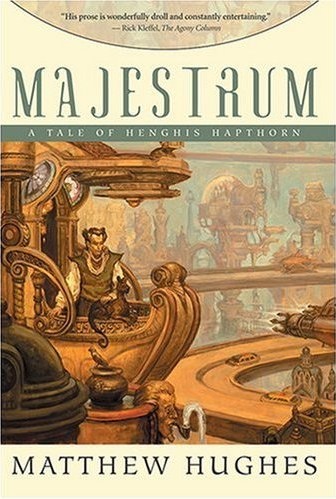
Book-A-Day #145 (12/8): Majestrum by Matthew Hughes

I really wish more people would buy Matt Hughes's books. He's gotten called "the new Jack Vance" a lot, which is a great compliment (hardly anyone can write like Vance, even if they try), but it does tend to make him sound more like a slavish imitator than he actually is. (And his books have been getting less specifically Vancean as he's gone along; this one felt purely Hughesean to me.)

This is the fourth novel (and the fourth-and-two-thirds book, if you count most of The Gist Hunter and Other Stories) set in Hughes's very, very loose far-future series. (The first two books, Fools Errant and Fool Me Twice, have the same main character, but Black Brillion is mostly unconnected to any of the others.) Majestrum is loosely connected to the Fool books, in a way that doesn't require you to know anything about those books (and the ties don't actually come in until most of the way through the novel, anyway). It's more closely tied to the earlier stories of Hengis Hapthorn, Old Earth's greatest freelance discriminator (collected in Gist), but I don't think you need to have read those, either. Basically, Majestrum is a detective novel set on an extremely far-future Earth. It's not deadly serious, but it's not as funny as the earlier books -- I do miss the funny stuff a bit, but I guess you can't be silly all the time.

And I suspect there will be more Hengis Hapthorn novels (I probably wouldn't have to suspect, if I could remember what the Night Shade Boys had told me), so you'd better start buying them now, when there's just one and it's easy to remember the title. Trust me; it's just easier this way.

The Fabulous Book-A-Day Index!

Monday, January 02, 2006

Other Books Read in December

I was trying to work down the pile of comics/art books/assorted large-format stuff, so there were a lot this month. This is a massive list, so let's just dive into it:
  • New York Girls by Richard Kern
  • Go, Dork, Go! by John Kovalic
    I'm not a gamer, and haven't been for ages and ages, so I shouldn't enjoy the Dork Tower comic as much as I do. But Kovalic is a great cartoonist (yes, his art style is simplified and sometimes grotesque; that's what "cartoon" means), and his comics just make me laugh.
  • B.P.R.D.: The Dead by Mike Mignola, et. al.
    Hellboy is cool. Even Hellboy comics without him in them are cool. Even ones that Mignola didn't really have all that much to do with.
  • In the Eye of Heaven by David Keck
    I've already mentioned this in my "Best of the Year" post; it's a major fantasy novel for 2006 and probably the first novel to beat in the genre.
  • The Cat That Changed My Life by Bruce Eric Kaplan
    A weird book by a New Yorker cartoonist; there are drawings of fifty cats, accompanied by what's supposed to be an excerpt from an interview of each cat, about the other cat that was most influential on the subject's life. I really can't tell if it's a tone-perfect parody of this kind of Po Bronson/Dr. Phil blathering or if it means to be serious. It actually works either way, which is quite odd.
  • Ex Machina: Tag by Brian K. Vaughan, et. al.
    I don't know if I've ever seen a really successful SF comic before this one. Fantasy, sure -- but nothing has really felt science-fictional in any way that could compare with even mediocre prose works. This, on the other hand, is damn good. (So good that I'm afraid I might have to check out that stupid Y: The Last Man comic by the same writer, even though I can't stand the premise.)
  • Women by Stefan May
  • I Can't Believe It's Not the Justice League by Keith Giffen, et. al.
    Sue Dibny is alive (but not pregnant!) Maxwell Lord is silly. DC Comics cannot convince me otherwise. This is a wonderfully funny comic, with gorgeous art; it's the kind of superhero comic functional adults can actually enjoy. Take a stand against women in refrigerators and buy a thousand copies.
  • River of Gods by Ian McDonald
    The kind of big, ambitious SF novel, with lots of intersecting plots, that supposedly nobody does anymore. Really impressive.
  • Smax by Alan Moore, et. al.
    Moore isn't slumming quite as much as you might think, but he does seem to have drifted into doing two-finger exercises this decade. And I really wish the economics of comics would let Zander Cannon continue his excellent comic The Replacement God rather than pencilling someone else's stuff (no matter how good). Sigh.
  • The Gist Hunter and Other Stories by Matthew Hughes
    I've loved Hughes's three novels to date (although I've heard, from another editor, that the most recent one was a severe disappointment sales-wise, which is really depressing). This is his first story collection, and it's divided into three sections. The third is "Other Stories," and it's the least impressive; they're all solid stories with nothing wrong with them, but any one of a hundred writers could have written them. The second group of stories are about the noonaut Guth Bandar, and are set in the same "penultimate age of the earth" milieu as his novels. They're overly philosophical and Jungian for my taste, but Hughes's Vancian prose is wonderful as usual. The first section of the book is the longest, and has the best stuff (which is why I left it for last): here are the first few adventures of that great detective, Hengis Hapthorn. The Hollywood description of these would be "Jack Vance writes Sherlock Holmes," and I loved them.
  • Doom Patrol, Vol.3: Down Paradise Way by Grant Morrison, et. al.
    Morrison was starting to repeat himself here (how many times can a bizarre pseudo-artistic secret society try to destroy the world, anyway?), but the stories were still fun.
  • Dahmane by Dahmane
  • Red Lightning by John Varley
    It's the sequel to Red Thunder, set a generation later, and is Varley again trying to write a Heinlein juvenile for the modern era. It's just as breezy as the first book, though the plot is a bit disjointed and Varley seems to picked up Stan Robinson's Mars Trilogy-era idea that the people of Earth are irredeemably corrupt and bad. Varley's prose is as supple and engaging as always, though I wish he was still writing books like Steel Beach and Golden Globe.
  • The Lord of the Rings Sketchbook by Alan Lee
    Gorgeous art related either to the Centennial Edition of The Lord of the Rings (which Lee illustrated about a decade ago) or that movie trilogy. I didn't used to like Lee's art all that much -- I found it all atmosphere and no subject -- but watching a million DVD documentaries over the past five years have made me a fan of his work. It's still a lot of light pencil sketches and moody watercolors, but now I like it.
  • Dilbert: Thriving on Vague Objectives by Scott Adams
  • Samurai Executioner, Vol.6: Shinko the Kappa by Kazuo Koike and Goseki Kojima
  • Flashman on the March by George MacDonald Fraser
    If I can be half as cool as Fraser when I'm 80, life will be more than worth living.
  • Doonesbury: The Long Road Home by G.B. Trudeau
  • Black Hole by Charles Burns
    Burns is the only comics artist who can come close to Chris Ware in the depressing sweepstakes. I missed the first issue or two of this ten years ago, and ended up waiting for the "trade" (though this is actually a hardcover). That was a good decision; this is one of those books that seems to be a mood piece (because not all that much happens), but it all comes together at the end.
  • Agent to the Stars by John Scalzi
    I haven't read Scalzi's other two novels, but this is a light but fun first contact novel about alien blobs and Hollywood agents.
  • Mad Night by Richard Sala
    Sala does neat creepy comics about cute barefoot girls and hideous deformed ghouls. They're all pretty similar, and this is a good representation of his stuff. If he put out books more often, it would probably pale, but one a year or so is just about right.
  • Astro City: Local Heroes by Kurt Busiek, et. al.
    This is the only meant-to-be-taken-seriously superhero book I can still read, but even it gives me agida now and then. Anything that's too obviously someone else's characters done right (as in this book's not-Lois and not-Clark story) is particularly annoying, since those end up being mostly realistic stories about mostly realistic people acting in utterly stupid Mort-Weisinger ways. I like stories about realistic people in worlds that contain super-powered folks; what I don't like is attempts to make the standard generic superhero furniture make serious dramatic sense. That works so rarely that it's not worth trying anymore; you either need to accept superheroes as non-humans with their own idiosyncratic motivations and psychology, or think up believable ways for super-humans to act and interact with society.
  • The ACME Novelty Library Final Report to Stockholders and Saturday Afternoon Rainy Day Fun Book by F.C. Ware
    I have to admit that I didn't manage to read every single teeny-tiny printed-sideways, faux-advertising word in this book. But I don't think anyone ever does; we all read the comics and skim the text features. Ware's world is, as always, utterly devoid of happiness and even the illusion of happiness. At some point in his career, he's going to have to develop another tone; his art is exquisite and his stories are heart-wrenching, but it's all exquisite and heart-wrenching in exactly the same way as everything else, and that, eventually, won't be enough anymore. I don't think he's quite hit that point yet, but it's starting to loom on the horizon.
  • The Flash: The Secret of Barry Allen by Geoff Johns, et. al.
    If this is what good "mainstream" comics looks like these days, I'm glad I'm not reading them. The art isn't as silly as the mid-90s heyday of Liefeld and his ilk, but this is relentlessly talky (both in captions and dialogue) and just dull; the people have very little in common with human beings besides a general body plan.
  • The Armies of Memory by John Barnes
    A really good SF novel by a writer I tend to forget about between books, though he impresses me each time (and I'm usually very happy to read his books when I see he has a new one).
  • The Stardragons by Bob Eggleton and John Grant
    Love Bob's art, as usual, but the story seemed to mostly be there just to keep the book from being too short. On the other hand, I did mostly just skim it.