Monday, December 07, 2009

Ligament-Lashing Literature in the Curious Classics Custom!

Today for ComicMix, I swotted up on three recent collections of adaptations of classic works: The Raven & Other Poems, by Edgar Allan Poe and Gahan Wilson, from the new Classics Illustrated line; Graphic Classics: Louisa May Alcott, the latest in the series edited by Tom Pomplun; and R. Sikoryak's more satiric and allusive Masterpiece Comics.

There may be more later in the week; I've learned not to make promises.
----------------
Listening to: The New Pornographers - The Bleeding Heart Show
via FoxyTunes

Twelve Days of Commerce # 5: Netbooks

Amazon is quite interested to let you know -- yes, you, personally; they were quite specific -- that they have a selection of netbooks loaded with Windows 7, the operating system that, according to all accounts, does not suck very much at all, in hopes that you will buy one or several, either for yourself or as stocking stuffers.

If you're enthralled enough by Windows 7, you might also be interested in a book by the man who led the team that developed it. Or maybe a squeaky duck. Or even a Weiand 7263 Chry 392 Hemi D/Q Hi.

(Hey, I don't know what you want. I'm just trying to help here.)
----------------
Listening to: The Pharmacy - Little Toys On A Shelf
via FoxyTunes

Reviewing the Mail: Week of 12/5

Well, we're all one more week closer to death since the last time I typed one of these posts, which means it's time to do it all over again. As usual, this is a list of books that came in the mail last week -- which means that I haven't read any of them. But I have glanced at their covers, and the press releases/cover letters (where applicable), and I in many cases have a previous knowledge (cursory or not) of the author or series. So here's what I can say about some books that just showed up on my doorstep.

(This week is less art-heavy than usual; two of the four books this week are bound galleys from Tor in March, and neither of them has cover art posted anywhere on the web that I can find. Given what I know about publishing schedules, I'm going to blame somebody's ONIX feed. One of the two bits of art here I had to scan myself from the book, since it, too, isn't anywhere on the web I could find.)

Kage Baker's "Company" series, about time-traveling immortal cyborgs -- though it's much better, and more fun, than that makes it sound -- officially ended in 2007 with The Sons of Heaven, after eight novels and two short story collections. Well, maybe it's not completely done, since Tor will be publishing a sidebar novel, Not Less Than Gods, in March. It's the story of Edward Fairfax, who isn't one of the Company's cyborgs but is not precisely human, either, and his adventures in "a secretly steampunk version of Victorian England, and in a Europe filled with covert and hidden advanced technologies." I'm looking forward to this one.

The other Tor bound galley is another book to look forward to: Gene Wolfe's new novel, The Sorcerer's House, a contemporary fantasy about a man who mysteriously inherits a magic house. Of course, since this is Wolfe, the story won't go in any obvious directions. Even more interesting, this is an epistolary novel -- told entirely in letters. Wolfe does sometimes get too hermetic and convoluted for his own good, but he's also one of the few writers who could really do a great, modern epistolary novel.

The one book this week that actually had an accessible cover online is the final book in Mike Resnick's "Starship" series, Starship: Flagship, which Pyr will officially publish tomorrow. I haven't read any of the earlier ones, but I'm sure it's the kind of serviceable space adventure that we've all come to expect from Resnick, probably with at least hints of the greater depth that he shows now and then.

And last for this week is a new edition of a book I sold many copies of back at the book clubs: Luis Royo's second collection, Malefic. Royo's work is definitely stylized, and I know many people will consider that his "sexy" shades pretty heavily into "sexist." (I don't agree, exactly, though I can see the point.) I've always liked his work, both aesthetically and with a publishing insider's appreciation of how it can really help a book sell like crazy. This edition is "remastered" -- whatever that means in book publishing, particularly applied to a book from 1996 that likely was digitally produced to begin with -- and has a new cover. It will be published by NBM -- which has published nearly all of Royo's work in North America for two decades -- in February.
----------------
Listening to: Local H - Lovey Dovey [Live]
via FoxyTunes

Sunday, December 06, 2009

Twelve Days of Commerce # 4: Demand Your Videos

Now, I'm old and crotchety enough that "video on demand" makes me immediately think "I want my MTV!" and then start ranting about how, when I was young, they actually played videos, before wandering off on a tangent about how I wouldn't listen to anything MTV plays today -- if they played any videos, which of course they don't -- on a dare, and eventually frothing at the mouth and falling over while yelling at those kids cutting across my lawn.

Eventually, if you were polite and determined enough -- though I can't possibly imagine why you would want to be -- you might manage to explain to me that "video on demand" means asking for some particular TV show or movie or other shard of pseudo-entertainment, getting it in downloadable form, and paying through the nose for the privilege of not having to get off one's arse (which one should really think about doing slightly more regularly -- really, I'm only saying this as one's friend) and go actually get a physical medium containing said video.

If you think "video on demand" is a good idea, then you just might be the sucker individual that Amazon is looking for. They've got a selection of zippy (and pricey) Panasonic televisual boxes and players of bluish rays that should be right up your alley, and they've authorized me to offer you a $30 credit for their Video On Demand service with purchase of said devices, which absolutely has not been bundled into their prices. (No sir!)

Why? Well, I told them about your lovely blue eyes, and they were touched. Really. So go buy an expensive flatscreen, won't you?
----------------
Listening to: Dragonette - Jesus Doesn't Love Me
via FoxyTunes

Movie Log: The Duchess

We expect our stories to be carefully formed, these days -- but we also often demand that those stories be "true." That can cause problems, since real life very rarely shapes stories to fit human standards. Let's take, for example, the recent movie The Duchess, about the life of Georgiana Cavendish, Duchess of Devonshire -- the advertisements and trailer promised the usual "triumph of love over circumstances," but the reality of her life was quite different. And the movie, to its credit, follows the reality.

Georgiana (played in the movie by Kiera Knightley) was married to William Cavendish, the 5th Duke of Devonshire, in June of 1774, when she was 17 and he was 28 -- though, as played by Ralph Fiennes in the movie, he appears notably older. (This, of course, is deliberate -- he's the stern, authoritarian, forbidding villain of the piece, and so has the wig and manner of an older man.) William is so unconnected to anything human, so utterly uninterested in Georgiana (and, seemingly, any other person in the world), that I commented about halfway through the movie that he seemed to have a case of Asperger's Syndrome.

Aristocratic marriages early in movies are always disasters; if they weren't, there would be no movie. And so it is for Georgiana and William -- she spends her time making stump speeches and hosting salons for the Whigs (particularly their young and dashing leader, Charles Grey, played by Dominic Cooper in the movie), while William...well, we don't see what William does when he's not with Georgiana, since it's her story. His purpose here is to be an ogre -- he doesn't love her, he doesn't want to spend time with her, and his repeated demands for a son grows more frustrated and angry when her first two children are daughters. Presumably, the real-world William had some interests and pastimes, other than his dogs, but The Duchess avoids any discussion or even mention of them.

And so the marriage, based on position and advantage and the demand for an heir to begin with, is never particularly strong, and gets worse as it goes along. William is cold and formal, as bad aristocrats always are in movies, while Georgiana is warm and open -- presented as a modern woman in a very different society. (I have my own very strong doubts that either of them were much as they are portrayed in the movie; they seem to have been much more complex figures, and much more of their time.)

Georgiana befriends a woman whose husband has driven her away, Bess Foster (Hayley Atwell), and takes her in. William, showing in interest in humanity that has been alien to him up to this point in the movie, immediately seduces Bess and openly makes her his mistress. (There's a line of dialogue afterward that establishes that William has had mistresses during the marriage before this, but there was no previous sign of this in the movie. One also does not get the impression from the movie that Georgiana has had any affairs up to this point, which may not be entirely believable.)

The back half of the movie then has Ms. Knightley emoting furiously, as she bangs her ladylike little fists against the stone wall of her husband (to no avail), begins an affair with Grey, and finally is forced to give up her and Grey's illegitimate daughter to his parents. Watching the movie, as a modern audience, we expect Georgiana to find a way to escape William and be happy -- either with Grey or without, but somehow.

That is not the ending The Duchess has, because it's not the ending Georgiana had. She died in midlife, still married and tied to William, who then went on to wed Bess. Unfortunately, The Duchess is organized as a standard costume drama, so the ending comes as a surprise and a disappointment; the story the movie has presented up to that point doesn't lead, in the modern popular consciousness, to an ending like this. And The Duchess shows no other sign of wanting to be subversive or of attempting to undercut such expectations; it plays along with all of the genre tropes right up to the point where it realizes that it doesn't have a happy ending up its sleeve and lamely trots out the ending it does have.

The Duchess is thus an object lesson in better organizing one's content, and in telling the story you actually have from the beginning; if the American public's favorite thing is a tragedy with a happy ending, this is the opposite: a costume drama with a return to tradition and propriety at the end. Most of the parts of The Duchess are good, but they don't add up to make either the kind of movie that it wanted to be or a realistic account of Georgiana's life. (And less of a focus on Georgiana, and some more time and attention on William and Bess, could also have helped.)

Saturday, December 05, 2009

Twelve Days of Commerce # 3: Intangible Gifts

I've always said that there's nothing better for gift-giving than a gift card -- which requires you to deal with that one retailer, and be tied down by all of their petty rules -- for something intangible and personal like MP3s. Really, I do say that. I'm not just being sarcastic. (OK, maybe I am.)

Anyway, Amazon agrees with me to the extent of creating a whoppingly huge banner to promote the concept. Wasn't that nice of them?

----------------
Listening to: Creature - Brigitte Bardot
via FoxyTunes

Friday, December 04, 2009

Manga Friday Saunters In, Trying to Pretend He Hasn't Been Away

My increasingly erratic "Manga Friday" column for ComicMix returns today with a look at the second volumes of the series Sumomomo, Momomo, Jack Frost, and Nightschool: The Weirn Books.

For next week...I'm not going to make any predictions.
----------------
Listening to: Quitzow - What Time Is It?
via FoxyTunes

Twelve Days of Commerce # 2: Musical Earworms

Amazon would like you to know that there is no escaping intrusive and overly-cheerful holiday-themed music this season. So don't bother to try. Love the Computer!
----------------
Listening to: The Pogues - Fairytale of New York
via FoxyTunes

Quote of the Week

'I hear the faint cacophony of many distant cell-phone rings in the train car -- snippets of Mozart and hip-hop, old-school ring tones, and pop-song fragments -- all emanating out of minuscule phone speakers. All tinkling away here and there. All incredibly poor reproductions of other music. These ring tones are "signs" for "real" music. This is music not meant to be actually listened to as music, but to remind you of and refer to other, real music. These are audio road signs that proclaim "I am a Mozart person" or, more often, "I can't even be bothered to select a ring tone." A modern symphony of music that is not music but asks that you remember music.'
- David Byrne, Bicycle Diaries, p.22

Thursday, December 03, 2009

Twelve Days of Commerce # 1: Downloadable Games

Well, my posting pattern still seems anemic, and Amazon is sending me e-mails about all the swell stuff they wish I'd tell people about, and we're all supposed to spend a lot of money to help the economy this year, so....

I'm going to post one banner or other way-too-obvious shilling device a day until I hit #12, collapse in shame, or run out of things to link to. My hope is that I can make the blatant pimping at least briefly entertaining.

Today, to start off with, have this lovely banner about downloadable games. According to the ad -- and we all know that ads never lie, don't we? -- you can try all of these games for free, which is as good a way to waste time as any others on the Internet. And, if you happen to see something you like, and buy it, your friendly neighborhood Hornswoggler will get a small piece of the action.

----------------
Listening to: Gram Rabbit - American Hookers
via FoxyTunes

Wednesday, December 02, 2009

Books To Keep the Rugrats from Bugging You for Five Minutes or So

Today, over at the ComicMix, I reviewed three books of interest to younger readers: Tiny Tyrant: Vol. One: The Ethelbertosaurusby Lewis Trondheim and Fabrice Parme; Adventures in Cartooning by James Sturm, Andrew Arnold, and Alexis Frederick-Frost; and Cat Burglar Black by Richard Sala.

All of 'em are pretty good, actually, though they're suitable for different kids.

And, since the title of that Sala book inevitably reminds me of the Tilly and the Wall song "Pot Kettle Black," I see no reason not to forge that linkage in your minds as well -- download the song (for free, legally!) here if you like it.

Saturday Is Bond Day, #19: Tomorrow Never Dies

My sons are not particularly invested in the Bond movies at the moment -- this time more than even last week, since they'd just gotten new rental video games (the reward for getting all As and Bs on their report cards) that morning. So I was the only one who saw Tomorrow Never Dies straight through, and even I had a laptop in front of me most of the time.

It seemed to be a serviceable Bond movie, and my general impression was that it was stronger than Goldeneye in nearly every way -- Jonathan Price makes a splendid villain, not quite chewing the scenery but acting with gusto and energy; Michelle Yeoh is possibly the toughest Bond Girl ever, not actually sleeping with Brosnan's Bond (unless I missed something, which is possible) and beating up nearly as many henchmen as he does; and the chases were slightly more realistic, including some great motorcycle scenes.

However, Brosnan's Bond still does get beaten up an awful lot -- the bad guys get the drop on him repeatedly, and he survives mostly because the plot needs to be explained to him before he's killed. And Brosnan does have difficulty looking tough enough for the part; he comes across as a lightweight who needs his semi-automatic rifles to compensate for his weaknesses in traditional spycraft (and possibly other areas).

The title makes absolutely no sense, but it sounds like a Bond title, which I suppose is sufficient. I bet I would have liked this better if I'd given it more attention, but I was making lunch and having boys running in and out during the running time -- as I discovered the first time around, watching movies at lunchtime on Saturday is not the best time.
----------------
Listening to: My First Earthquake - Meat Pies
via FoxyTunes

Tuesday, December 01, 2009

A Selection of Spring Accounting Covers

Since I'm spending this week mostly in meetings as part of Wiley's seasonal Sales Meeting -- we don't do "Conferences," for whatever reason -- I thought I might as well inflict some of those books on you as well.

Wait, wait, don't run away. I'm just going to post some of my favorite covers from the Spring season. Since this is my blog, I'm only going to post covers for my books, though there are some nice inventive ones for other marketers' books (I quite like The Death of Capital and Credit 911, for example).

I don't have the names of the designers at hand right now -- I'm writing this from home -- but I hope to add them, eventually, once I'm both back in the office and have a little time to spare for something frivolous like a blog post. (I think I know who designed each of these, but I don't want to misattribute anything.)

First is How to Measure Anything by Douglas Hubbard -- it's not a flashy cover, but it's very readable, and (I think) intriguing. I also expect the flood of mostly white covers over the past several years will lead to a similar flood of mostly-black covers, so I'm happy to get this one out before the rush.

Then comes one of the covers that I'm most proud of having been involved with -- Anatomy of a Fraud Investigation
by Stephen Pedneault. The concept was mine; I can admit that, since it was a very obvious concept, visually referencing Saul Bass's iconic movie poster for Anatomy of a Murder. The idea was simple, but it took a real book designer to take my vague "why don't you make it look like Saul Bass?" plan and made it work as a cover on its own.

My covers are never going to be flashy, but I like the starkness and authority of this cover for Janice Roehl-Anderson's IT Best Practices for Financial Managers. Additional points, at least as I count them, because this is actually a two-color cover.

(I'm sparing you my dozens of series covers, since they all look pretty much the same. I hope you appreciate it!)

Three Random Graphic Novels

I've read them recently, and I want to start clearing the decks to end the year square -- so they get shoved together, even though they have nothing in common:

The Red Monkey Double Happiness Book by Joe Daly (Fantagraphics, October 2009, $22.99)

My master plan had been to review this and Shane White's Things Undone together, under a headline something like "No Way, Dude! Two Books About Slackers." But then, on further reflection, I decided that it wasn't at all fair to the protagonist of Things Undone to call him a slacker -- he has his faults, like any of us, but he clearly worked hard and cared about his career. So that put the kibosh on that idea.

The main characters of Red Monkey, on the other hand, definitely are slackers. Dave is a freelance designer with an unfortunate tendency to anthropomorphize his work -- he's put faces on bricks on the first page of this graphic novel, which his client does not appreciate -- who hates working for "mundane people" and would rather be smoking weed. His buddy Paul doesn't even have the semblance of a day job; he's just a mooch who sometimes makes a few bucks selling craft items to other stoners. Dave is the red monkey of the title -- he has feet like hands, which allow him to climb very quickly. "Double Happiness," on the other hand, is the name of an off-page Chinese restaurant run by one of his neighbors; it's mostly in the title to show that there are two separate stories here --"The Leaking Cello Case," which was serialized in SL magazine and published separately (presumably in South Africa) in 2003; and the much longer and new "John Wesley Harding."

Both stories see Dave and Paul get involved in vaguely shady -- but entirely weird -- dealings. These are basically stoner crime stories, with Dave and Paul as relative innocents who get caught up in hallucinogenic toad trafficking, or secret microwave generators that destroy wetlands. Daly doesn't rely too heavily on stoner humor, thankfully, but Dave and Paul are discursive and occasionally addled, and they wander through the stories with the good-natured nonchalance of men who've got a lot of good bud behind them. Daly keeps these as stories about stoners rather than as stoner stories -- this isn't the way Dave would tell the story (thankfully); it makes more sense than that.

Dungeon: The Early Years, Vol. 2: Innocence Lost written by Joann Sfar and Lewis Trondheim with art by Christophe Blain (NBM, October 2009, $12.95)

The Dungeon series continues to expand and proliferate; I've reviewed parts of it several times but I'm more and more coming to believe that I should be putting all of these books onto a single shelf and then reading them all in "order." (Internal chronology is almost certainly not order of creation, though, and it's difficult to determine the latter with an ocean and a language separating me from those original publications.)

This volume continues the story of young Hyacinthe, who eventually became the Dungeon's creator and Keeper. As is becoming typical, each sub-series sees a young and (more or less) idealistic hero having more and more adventures, and facing down more or life, until he becomes the "evil" -- or perhaps monstrous is the better word -- background figure of the series set later in time. As Herbert became the Great Khan, so we see that the Keeper was once young Haycinthe.

Many of the other books were suitable for younger readers -- not for the youngest, but generally good for tweens and particularly teens -- but this volume is darker and more obviously sexual. (To quote one blunt conversation -- "He told you he loves me?" "I've subtly deduced it." "On the basis of what observation?" "He pays for whores whom he dresses in thigh boots. And when he makes love to them and shouts 'Alexandra! Alexandra!'") It's also, as I hinted above, becoming more and more clear that Sfar and Trondheim are weaving a very large tapestry, and are willing to bounce back and forth in their timeline to place each thread in its proper place.

The Dungeon series looks like a satire of swords & sorcery, and may have begun that way, but it's turned into a deeper and more resonant work than that; Dungeon is about, at its core, the eternal battles between individual and society, between youthful vigor and mature wisdom, between hope and experience. The adventure has always been tinged with more darkness than a similar American series would have allowed, but it's broadened into the neighborhood of tragedy now -- or, if not tragedy in particular, than the sadness inherent in the inevitable decay and end of everything.

Trotsky: A Graphic Biography by Rick Geary (Hill and Wang/Serious Comics, September 2009, $16.95)

Hill and Wang's "Serious Comics" imprint hasn't gotten the attention of the similar forays into graphic storytelling by Scholastic and Villard, and it doesn't seem to have been as commercially successful, either. This may because of the limits of the market (the shelf is only so big, and consumer's wallets so open), or of the limits of Serious Comics's remit -- only biographies of famous Americans -- but there isn't any notable buzz over the line. (The fact that its official blog had only one entry doesn't help.)

I reviewed Geary's previous book for Serious Comics, a biography of J. Edgar Hoover, which was the usual well-researched and strongly told historical story we've come to expect from Geary (as this book also is). But I also note that the covers of both books were assembled from interior art, implying that Serious Comics didn't pay for (or just didn't ask for) a separate cover. The graphic treatment of those covers is fairly strong, given the limits of black-and-white comics panels, and I can see that a display of many Serious Comics titles could be very impressive.

Publishing tea-leaf-reading aside, Trotsky is a well-researched and engagingly told (if, inevitably, very wordy) graphic account of the life of the loser of most of the great Communist power struggles on the early 20th century. I have the vague sense that the audience for books like this are mostly schoolchildren looking for the subjects of a report, but I'd be surprised if school systems in at least half of this country would be particularly amenable to a book on Trotsky. (Of course, that assumes they remember Trotsky, which I doubt anyone to the right of Teddy Kennedy does, these days.) Geary is excellent with historical material as always, though I do miss the sly humor of his early short strips. Perhaps some enterprising publisher can hire Geary for a project that merges all of his strengths -- maybe a story about the mole-men's invasion of the Columbian Exhibition or something equally unlikely?

Books Read in November

Just like last year, I disappeared on vacation for the first week of November, which made the rest of the month overly crowded with incident and left me with less time for reading and blogging than I have most months. Still, having a vacation to get entirely away from everything is still wonderful; I recommend it to everyone.

Here's what I managed to read this month; most of the titles are directly linked to my reviews of those books, either here or elsewhere. There are also capsule reviews below of Fierce Pajamas: An Anthology of Humor Writing From The New Yorker, A. Scott Berg's mid-'70s biography Max Perkins, Editor of Genius, Ken Grimwood's World Fantasy Award-winning novel Replay, and John Kelly's grim and gripping history of the Black Death, The Great Mortality.

This is as good a place as any to mention that I intend to clear the slate at the end of the year, and post something about every last book I read in 2009 before 2009 is done. Some of those may be short and malformed, but I want to clear my desk and sail into 2010 ready for new challenges. This will probably mean a flurry of posts during the last week of the year, but we'll see how it works out. As I write this, though, there are over two dozen books on the checklist, including two that I read in January!
  • David Remnick and Henry Finder, editors, Fierce Pajamas: An Anthology of Humor Writing from The New Yorker (11/4)
    This came out in paperback in 2002, when I got it. I read some of it then -- I remember taking it to one of my family's many Christmases, which was probably '02 or '03 -- and some of it at odd moments over the next half-decade. And then I took it along to The Mouse and finally finished it; mostly late in the evening down in the hotel lobby. (My sons and The Wife went to bed at about 9; I tried that the first night and woke up, fully awake, at 4:30, and so took my extra solo hours in the evening after that point.) It's difficult to review humor in the first place, since it's so subjective, and it's equally difficult to talk about an anthology -- so this book, with 139 pieces by dozens of contributors, makes me throw my hands up. It's got fine work from all of the people you would expect -- from E.B. White and Dorothy Parker to S.J. Perelman and Robert Benchley, from Woody Allen and James Thruber to Ian Frazier and Calvin Trillin -- divided into a handful of archly-titled categories, like "The Writing Life" and "The Frenzy of Renown." It's definitely not a book to read straight through, but it is a vital book for anyone interested in the strain of literate, elite humor that The New Yorker embodied in the 20th century.
  • Will Eisner, A Family Matter (11/10)
  • Will Eisner, Minor Miracles (11/11)
  • A. Scott Berg, Max Perkins, Editor of Genius (11/13)
    Note, first of all, how that title can be taken two ways -- depending on whom one considers to be the genius. (Second, puckishly, note that this is not the Scott Berg, but merely A. Scott Berg.) Perkins is probably the most famous book editor in the history of the world -- most famous as an editor, I mean -- but he's still not all that famous. Berg, probably astutely realizing exactly what the audience for a book like this was, concentrates almost entirely on Perkins's professional life. That means that Max Perkins reads almost like a group biography of Hemingway, Fitzgerald, and Thomas Wolfe, with occasional digressions on Ring Lardner and a few others. Berg skips Perkins's childhood almost entirely, only sketches his (apparently tumultuous) relationship with his wife, and mentions their daughters only for color or when one of them is getting married. Max Perkins is organized semi-chronologically, which came to seem a mistake -- Berg keeps getting ahead of himself while running through Perkins's work with one author, and then has to back up and fill in on other aspects of his life. Perkins will probably never get another biography, but I think the materials here, and Berg's aims in writing this book, would have been better served if Berg had organized it by author, and written much more obviously a book about Perkins's working relationships, rather than writing what looks like a biography that spends so little time on its subject's actual life. Max Perkins is a fine book, both about what it means to be an editor specifically, and what kind of life a dedicated man in any line of business is likely to have -- one defined entirely by the work he does, and interesting only insomuch as that work is -- but it substitutes Homeric catch-phrases about "Yankee reserve" for a deep examination of Perkins's character and personality.
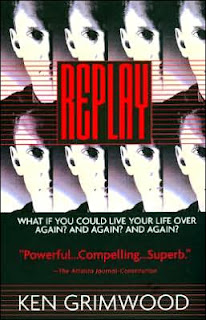
  • Ken Grimwood, Replay (11/14)
    In any other month, I'd probably try to break out Replay and write a full review of it -- it's a great book, a classic of the SFF field, and one that's not as well-known as it could be -- but, according to my checklist, I'm still twenty-five books behind with barely a month to go in the year (and that's after writing about nine books in the last twenty-four hours). So Replay is going to get short shrift, unfortunately. It's a timeslip fantasy, but a more personal one than, say, Time and Again -- its hero, Jeff Winston, dies of a massive heart attack in 1988, at age 43, and wakes up in his own eighteen-year-old body, twenty-five years earlier. Jeff (and others) come up with various explanations for his "replaying" over the years, but there's never any clear evidence -- there's no way to tell why this is happening. So, like all of the rest of us, Jeff Winston has to live his life -- but, unlike you and I, Jeff has to do it again. And again. And again. Sure, he knows what's coming up -- he can make a quick fortune betting on sports and parlay that into a bigger fortune in the stock market -- but all that means is that only he can surprise himself. Grimwood hit upon a great idea in Replay, and he methodically covers it from every angle -- Jeff gets to live his life over and over again, correcting his mistakes, and then correcting those mistakes, and so forth, but there's never going to be a life free of mistakes. No life is perfect, and being able to do it over doesn't make it better -- more, having to do it over, and over, makes each iteration more of a slog. Grimwood does introduce other complications along the way -- and I'll leave it to those who haven't read Replay yet to discover them for themselves -- but it all has the structure and heft and inevitability of a great tragedy. (Not to say that Replay is a tragedy itself -- I won't say anything about the ending, other than that it's absolutely perfect.) I've had many "replay" fantasies myself, wishing that I could go back to this age or that, and undo things I did, or do things that I avoided -- I'm sure we all have. Replay uses those longing feelings to weave a masterful story of what a life can be, and what it should be. It's one of the great fantasy novels of our time, and everyone should read it, during one of their lives.
  • Donald E. Westlake, The Cutie (11/15)
  • Lawrence Block, Killing Castro (11/17)
  • Josh Lieb, I Am A Genius of Unspeakable Evil and I Want to Be Your Class President (11/17)
  • Rick Geary, Trotsky: A Graphic Biography (11/19)
  • John Kelly, The Great Mortality: An Intimate History of the Black Death, the Most Devastating Plague of All Time (11/24)
    This is a book that was engrossing to read, and which taught me many things -- most of them at least faintly horrible and mildly disgusting -- that I didn't already know. But it's not a book I want to think about and grapple with for an extended period of time, so it's not getting a fuller review. Besides, it's a nonfiction book from 2004, which I bought after it was remaindered, so I'm quite late to begin with. It is, as the subtitle explains, a history of the Black Death, covering the various places in Europe that it devastated, starting with the Crimean town of Caffa in the late spring of 1347, and continuing through Anatolia, Sicily, Italy, France, England, and other points until the plague reached Moscow (seven hundred miles nearly due north from Caffa in 1352. It's inescapably an episodic book; each chapter covers one general region, with subsections on different towns and areas, organized generally chronologically. And those sections all tell very similar stories: plague hits, huge numbers die, but life goes on in one way or another. Kelly's strengths are in marshaling a large array of primary and secondary sources, in having those at his fingertips and being willing to jump from one to another (particularly when they contradict each other), and in pulling out the telling details and statistics along the way. This is a book about five years in which the population of Europe dropped by a third, and where some regions lost much more than that; it's inevitably a book about death, both in general, individually, and en masse. But Kelly isn't ghoulish; he remains devoted to pulling the human details even in the midst of mass graves and ferocious pestilence. This is a valuable book for anyone interested in the transition out of the medieval era, for students of human communities under stress, and anyone who wants to know what people are like when the worst happens.
  • Roger Zelazny, The Dead Man's Brother (11/25)
  • Will Eisner, Life on Another Planet (11/27)
  • R. Sikoryak, Masterpiece Comics (11/29)
  • Tom Pomplun, editor, Graphic Classics: Louisa May Alcott (11/26)
And that was November -- my hope is that December will be slightly less hectic.