Showing posts sorted by relevance for query drew friedman. Sort by date Show all posts

Wednesday, November 03, 2010

Book-A-Day 2010 # 273 (11/3) -- The Fun Never Stops! by Drew Friedman

Reading Drew Friedman's 2010 book Too Soon? reminded me that I'd missed his 2007 comics collection, The Fun Never Stops!, so I had to remedy that situation as quickly as possible.

As Too Soon? collects Friedman's illustration work for the last two decades, The Fun Never Stops! does the same for his comics, hoovering up most (if not all) of his strips after the periods covered in Any Similarity to Persons Living or Dead Is Purely Coincidental and Warts & All. After a short appreciative foreword by Dan Clowes and a much longer introduction (giving a good account of Friedman's entire career) by Ben Schwartz, Never Stops divides itself into seven possibly-thematically organized sections, all titled "The {some manner of enjoyment} Never Stops!"

Not all of those sections entirely make sense to the outside observer -- "Frolic" is obviously the Duke of Eltingville section, but otherwise they each are a general Friedman goulash, filled with some illustrations and more short stories about minor, mostly aged, celebrities seen semi-sympathetically (if not always coherently) and contemporary celebrities treated somewhat worse, as the latest extrusions from the sausage factory. Friedman always prefers the bizarre juxtaposition, like "America's Love Affair With Ethnics Hollering One Word Over and Over" (9 panels of famous movie moments in which someone yells the same thing twice) or "A Very Jerry Year" (a prediction of several unlikely things that would happen to Jerry Lewis in 2005) or "Fred & Ricky Join NAMBLA" (in which Mr. Mertz and Mr. Ricardo "make love to young boys") or "Everybody's Buddy" (Buddy Rich as a hair-tempered madman) or, at the non-celebrity extreme, "Retired N.Y.C. Elevator Men Theorize on the Assassination of President John F. Kennedy."

There are no individual copyright dates -- a few stories have a date incorporated into the art, but the book doesn't provide any list of dates -- but I get the impression that the comics in this book skew much more towards the 1991 side of the subtitle than the 2006 end. (That's hard to determine, though, particularly since Friedman's interests are always with the old and obscure anyway -- a Jerry Lewis strip could be from any time at all, since it's really about the '60s Jerry.) The illustrations may skew somewhat later; Friedman's gotten vastly more illustration work over the past two decades, and 1991 is when that started ramping up.

Drew Friedman comics have to be experienced rather than described; he has a distinctive, warped sensibility, intensely steeped in old pop culture but with an almost literary detachment and a relentless tropism towards ugliness, unlikely connections, and random cultural detritus. What sells it is that unflinchingly realistic drawing style -- when you look at a Drew Friedman picture, you know it must be true in some way, because a fake could never look that good. Never Stops! isn't quite as zany as Any Similarity, nor does the new book have the startling punch that the weight of his early work did. But that's partly because we live in the world molded by Friedman and his fellow travelers in '80s comics and humor -- from Spy magazine to Peter Bagge. He can't shock us as he did simply because it's not the early '80s anymore, and Drew Friedman illustrations have been quietly mocking celebrities from the pages of the biggest publications of the world for two decades now -- in the battle of Friedman vs. the world, the world lost long ago.


Book-A-Day 2010: The Epic Index

Thursday, July 23, 2026

Drew Friedman's Chosen People

Can reading a book be an experiment? I thought of this one that way, but that may just be me being precious about something minor.

I've read previous books of Drew Friedman's art digitally, on my old tablet - a ten-year-old jobbie, 9.7 inches I think - and noted that the art was smaller than the real-world book size, so I didn't recommend that. (See my post on Heroes of the Comics in particular; the other relevant Friedman books are All the Presidents, Schtick Figures, and Maverix and Lunatix.)

But I had a birthday recently, and got myself a newer, fancier, bigger tablet. (I'm still getting used to holding it, since it seems to be approximately the size of a coffee table - they say it's 13 inches but it feels larger than that.) And I'm seeing how digital comics look on this new screen: so far, better and clearer, not just larger.

And so I read the 2017 collection of portraits Drew Friedman's Chosen People, and, I have to say, it looks just fine on a big tablet. This slab of metal and glass is close to the size of the real-world book, so the experience is close to the same. If you have a big-ass tablet, as I do now, even large-format books of art and comics look pretty good there.

And I'm glad I had that consumer note to give you because, otherwise, what's there to say about this book? It collects at least a decade of mostly editorial illustrations by Friedman, and is entirely miscellaneous. Friedman has put out some books that were specific projects, with pictures of people with some connection to each other, like Presidents and the Old Jewish Comedians books and the ones of comics-makers, but he also has done books that collect the other stuff he does that pays the bills, like this and Schtick Figures.

There is a section of potted bios in the back to explain who the people are. You might think that would not be difficult, since each page has the person's name, but Friedman often draws very obscure people, either because they intersect with his hobbies and loves (Forrest J. Ackerman, Max Asnas, Richard Deacon, Friedman's own father, grandfather, and brother) or for reasons that cannot be discerned from the book (e.g., Franklin Longbone and Carl P. Sodiwater, both of whom I vaguely suspect of being fictional).

The main section of the book has 117 full-page pictures. The front matter adds an additional picture of Shemp (there are two more later), plus Al Lewis, Friedman's wife Kathy, introducer Merrill Markoe, and Alex Gard, something of an inspiration for the whole project. In the back is a self-portrait with Friedman's bio and a nine-panel grid of a group of people in front of the American flag, which is not explained in any way. (The front cover is Muddy Waters and the back cover is Chris Ware, but both of those also appear inside.) So it tops out at 140 pictures of people, most of whom are "famous" in some way or other.

By the way, "chosen" here means "chosen to have Drew Friedman do their pictures." The person choosing may be Friedman himself much of the time, but also includes editors of various mostly New-York based publications, especially the New York Observer. The potted bios list (consistently? always?) where the illustrations first appeared, with notes on about half of them.

Friedman has a detailed, immersive style - his people look real and grounded. He's never gone out of his way to draw pretty people, and he tends to make them less pretty than they might like - he's an artist of jowls and dewlaps and ragged hairlines, laugh lines and creases and extra chins, scowls and smirks and incredulous glances. This is a fine book of a whole bunch of those drawings, some in color and some in his distinctive black-and-white stippled style, including some people you will recognize and some - no matter who you are - that will be a mystery to you.

Wednesday, February 12, 2025

Schtick Figures by Drew Friedman

Drew Friedman might have run out of themes for his big books of warts-and-all portraits. I say that because this, his most recent book, declares itself to contain "over 150 comedians, writers, humorists, musicians, actors, journalists, cartoonists, illustrators, editors, publishers, one art gallery owner, one magician, one photographer, two wrestlers, and one movie memorabilia store owner."

If that sounds like a coherent theme, I'll eat my hat. And I don't own a hat.

On the other hand, "Drew Friedman portraits" is arguably enough of a theme in the first place, and this book has, as mentioned, over 150 of them. They are miscellaneous, they are arranged in (mostly) alphabetical order, and they are glorious in their fleshy magnificence.

Schtick Figures came out this past summer, from Friedman's long-time publisher Fantagraphics, and I suspect it is the book that collects everything else he's done over the past decade or so - that it wasn't a specific project like Heroes of the Comics or Maverix and Lunatix. The pictures are presented full-page, captioned only by the name of the person - or, in a few rare cases, the project - with a section of short potted biographies at the back for those of us who don't know who (picking a few pages at random) Imogene Coca, Pigmeat Markham or Frank Kelly Freas are. (Friedman puts "Kelly" in quotes for Freas, which is weird and I think wrong, but oh well. There's also at least one entry in the bio section that doesn't have a portrait in the book, and a couple of places where the bio section is in a slightly different order than the portraits.)

The bios also contain occasional notes about the source of the image - there are a few commissions, mostly for the people pictured (which explains some of the weirder ones in the list up top), some covers for Mineshaft (whatever that is), work for Mad and The Village Voice and probably some other publications I don't recall right this second, and a few other oddities. Most are uncredited, which could mean Friedman has forgotten or wants to forget where they came from, that he doesn't have to mention original publication for those, that he drew them for this book, or that they came to him in a vision from the Man in the Moon.

Whatever: 150 Drew Friedman pictures. Mostly of people you will recognize, if you know who Drew Friedman is and have a passing acquaintance with 20th century pop culture. (Especially the odder, horror- and humor-tinged sides of it.) This book is a good thing, and it's fun to poke through. I may wish Friedman was still doing comics rather than single images - as I lamented when I wrote about his book The Fun Never Stops! some years back - but it's better for his health and bank account and probably life in general, so I can't kick too hard.

Monday, October 11, 2010

Book-A-Day 2010 # 250 (10/11) -- Too Soon? by Drew Friedman

One of the consolations of being obscure is the knowledge that you'll never have to wake up in a world where Drew Friedman has caricatured you. Friedman's pen is relentless and his eye is merciless: every foible, every wrinkle or blush or spot is seen clearly and depicted precisely. Even when his figures have grotesquely misshapen heads -- and pray that you're never famous enough to have a giant Drew Friedman head -- they're obviously who they are.

The only other caricaturist who worked so widely and was so perfect at capturing his subject's essence was Jack Davis -- but there was always a sunniness in Davis; he may have poked fun, but it was a gentle, friendly poke. When Friedman pokes, he uses a boathook. Friedman's entire career is based on his pitiless gaze: he sees famous people (politicians, actors, singers, comedians, random pop-culture figures) as if his drawing board was Dorian Gray's painting, and every sin or flaw was immediately visible.

Too Soon? is the first book to focus exclusively on Friedman's illustration work; he's been a major commercial artist for more than two decades -- after starting off doing his own comics [1], and then apparently realizing that he could get paid several times as much for the same effort by turning from comics panels to individual illustrations -- but this is the first retrospective of that illustration work. (The Fun Never Stops!, three years ago, did a similar fifteen-years-under-one cover look at Friedman's comics work.)

Too Soon? opens with a section of political cartoons, starting with Bill & Monica and running up to the present day, and some of Friedman's least flattering portraits -- and that's a very competitive category -- are here, from Bush and Gore down to who-was-that-again? types like Bill Lann Lee, Joschka Fischer, and Charlotte Beers. Even such a supposedly hagiographic portrait as a shot of Obama in full G. Washington mufti -- for the cover of The New Yorker on the eve of his inauguration -- shows a grumpy, scowling man in what must be an itchy wig, and it only gets less deferential from there. Just before the halfway point, Too Soon? switches over to "Showbiz," where the pictures -- some of them, at least -- are more loving and less gimlet-eyed. (Friedman, as always, has more affection for famous people who are either older than him -- Frank Sinatra, Dean Martin -- or are already pretty funny-looking in real life, like Bob Dylan, the Three Stooges, and Arnold Stang.)

Throughout it all, it's clear that Friedman is mostly working to editorial request -- with a bizarre "Four Horsemen" picture for Swedish Playboy or a jumbled "Oscar season" illustration for the Washington Post -- so Friedman's own sensibility (except in those inimitable faces) is often absent; these are pictures that someone was willing to pay him for, often on very short deadlines, and so Friedman worked quickly from some photo reference. The end results might be bizarre, but one has to assume the commissioning art directors expected that going in, and even aimed for that outcome. But Friedman's illustration work -- gleefully scabrous as it often is -- still comes second to his excellent comics, where his sensibility controls the entire package.

Still, there hasn't been a book like Too Soon? before, and it's been needed. So the answer to the question's title is: no, not at all. If anything, it's long overdue.


[1] Sometimes solo; sometimes from scripts by his brother Josh Alan Friedman.

Book-A-Day 2010: The Epic Index

Thursday, November 27, 2025

All the Presidents by Drew Friedman

I still wish Drew Friedman was making comics regularly. Oh, sure, his ultra-detailed stippled style takes an immense amount of time, and I have to imagine it's not great for his health to crane over a drawing table making all of those little boxes for hours on end.

But his comics were something unique, a stew of curdled weird pop-culture and photorealism, all filtered through a unique, funny sensibility - not to mention that magnificent, unparalleled art. His portraits have the same artistic strengths, but the bizarre storytelling of his comics is mostly absent.

The Fun Never Stops! will be probably the last book of Freidman comics; that was almost two decades ago. It now looks like comics is something Friedman did in his early career, mostly the '80s and '90s, before he moved into work that paid better and didn't require the same insane level of back-breaking effort. And, again, I completely understand. My wish is more that the universe isn't different - that comics weren't so remunerative that Friedman had to keep doing them, a few stories a year, and hadn't been seduced by the One Big Head model of drawing.

All the Presidents was right in the middle of Friedman's (still ongoing) One Big Head period, from 2019. It followed the three Old Jewish Comedians books, two books of Heroes of the Comics, and Drew Friedman's Chosen People (covering Jews who were not necessarily comedians, though still largely old). Since then, he's put out Maverix and Lunatix (basically a third Heroes of the Comics, focusing on the underground generation) and the very miscellaneous Schtick Figures.

And Presidents is just what it says it is: full-page headshots, drawn by Friedman in his inimitable, labor-intensive stippled style, of the first forty-five presidents, each opposite a page of their vital statistics. (Just the very basics: dates of birth and death, party, term in office, age at inauguration, and one "fun fact.")

This is possibly the least of the One Big Head Friedman books: most of them, for one thing, have more full-figure portraits throughout, but this is entirely One Big Head. It looks like a review of the money of a slightly sweatier and more disreputable world. Friedman doesn't have a personal connection to most of the Presidents - just JFK on - so it is somewhat a long succession of funny-looking dead guys with various outdated permutations of facial hair and jowls.

It can be amusing to poke through and turn up interesting coincidences - did you know Grant was the youngest President ever at the time? All those 19th century guys looked prematurely old, so it was a surprise to me. But the joys of  Presidents are slighter than the other Friedman books; keep that in mind if you dive in.

Friday, June 16, 2023

Heroes of the Comics by Drew Friedman

I try not to let the best be the enemy of the good. Something can be just fine even if it's clear that it could have been much better if only one aspect was slightly different.

But when it's my own choice that downgrades something to "good," I have to at least point it out.

I read Drew Friedman's 2014 book Heroes of the Comics electronically, on a standard-size tablet.

Don't do that.

This is an oversized book, meant to be read at its real size. Even more so, the point is to be able to see the full-page portraits while you're reading the text on the facing back, glancing back and forth from one to the other. In a digital format, none of that is available.

Friedman has been making books like this for about two decades, starting with Old Jewish Comedians in 2006. The three Comedians books were pretty minimalistic, without much text and only a couple of dozen portraits in each. His books on cartoonists - I've previously read his later book on the underground scene, Maverix and Lunatix - are much larger and expansive.

Heroes has eighty-three full-page portraits of Golden and Silver Age creators and industry professionals, from Malcolm Wheeler-Nicholson to Alex Toth, Will Eisner to Marie Severin, Al Feldstein to Lou Fine. If you don't know who any of those people are, this is not a book for you.

They're all presented in mid-career - not as the Young Turks they mostly were when they mostly did the stuff we remember them for, but as middle-aged or on the cusp of retirement. Friedman likes drawing distinctive, damaged faces, of course, so this is not a surprising artistic choice. And they are all identifiable to anyone who knows what they look like in the first place. That depends on the reader and the subject, obviously - there are very few people who have any idea what Max Gaines looked like, while Jack Kirby (our cover boy) is very recognizable.

So this is a book of pictures of mostly white-haired, mostly white, often Jewish guys sitting and smiling at the "camera," as if in a publicity still or heroic portrait, over and over, with a potted biography on the facing page. Even though they all did some great work, and were instrumental in the rise of a major American art form, it all gets pretty samey and potted by the time the book is over. There's only so many times you can say "this guy started out in the Eisner/Iger Studio."

This is an interesting book. I'm glad it exists; I'm glad Friedman has a career making his unique portraits, and that he's been able to catalog so many areas of pop-culture that he cares so much about. But, frankly, it's a little boring. It might be best sitting on a coffee table, so you can pick it up randomly, look at one or two guys, and put it back down.

Tuesday, March 21, 2023

Maverix and Lunatix: Icons of Underground Comix by Drew Friedman

I keep discovering new categories of books that don't work as well in digital form. I was a somewhat reluctant convert to digital - I very rarely read prose that way, and have been consuming a lot of comics digitally largely because the library Hoopla app has scads of good stuff, including what looks to be the entire output of Europe Comics - so this is not surprising to me, but it is vaguely annoying when I momentarily overcome my prejudices only to discover I was correct after all.

Anyway: this is not a great book to read digitally. Anything large-format fits in that category, obviously, and a book of full-page portraits even more so. And yet I persevered.

Maverix and Lunatix: Icons of Underground Comix is the latest "bunch of full-page portraits" book from Drew Freidman, who I think now has not worked as a cartoonist in at least a decade. It follows several books on Old Jewish Comedians, one of famous Jews who were not necessarily comedians, a couple on Golden Age comics-makers, and one with all the US Presidents. Of those, the only one I've seen was Old Jewish Comedians, the very first - I was a big fan of Friedman's dark, celebrity-tormenting comics all the way back to the 1980s, but he mostly transitioned from that work to much better paid illustration work over the course of the '90s. (For the comics work, see The Fun Never Stops! And for the illustration before he started doing the themed-portraits books, see Too Soon?)

This book is explicitly a follow-up to the two books of Golden-Agers; it has a hundred-and-one of those full-page pictures on right-hand pages, each one with a short potted biography of the subject (by Friedman, I assume) facing it, tastefully printed knockout on black, as if it were a gallery show or index of the deceased. All of the portraits are of makers of comics, all people (mostly men, a few women) who were active in underground comics from 1967-1975. There's also a short section at the end with much smaller head-only illos of major underground publishers of that era, though many of these are also in the main section, since that's the kind of scene it was.

That's what it is. But what's important is that it's all drawn by Friedman, the master of the realistic grotesque, who draws lumpy, sweaty, hairy, specific people in amazingly characteristic poses in that stunning photorealistic style (which I don't think he still does by stippling, as he did in the '80s). He seems to have worked from photographs, but not by copying photographs. These are all new images, of these hundred-plus people in their prime, presented each when they were at the peak of being underground comics-makers.

Look, I still prefer narrative to portraiture. I'm a story guy. So there's a small part of me still somewhat sad Friedman left the worlds of narrative for portraiture. But he's so good at it - so incisive, so particular, so super-real - that this is obviously what he should be doing.

Any of Friedman's books are more interesting and resonant the more you care about and know the people involved. That's been the case way back to his goofy comics about Joe Franklin. So you do have to know and care, at least a little, about the underground comics movement and some of the major figures in it, to get much out of Maverix and Lunatix.

But if you do have any connection, to any of Friedman's books, they're like a distorted mirror, more real than photography, that reveals true faces. I do recommend you read them in physical books, though: that's a better experience.

Friday, May 01, 2009

Read in April

I got to settle back down this month, after the storm of Eisner reading that ended March, and just read things because I wanted to. But Eisner reading had sent me off into some interesting tangents, and I was still thrilled with the potentials of inter-library loan (I ask for a book online, and they find it and send it to my library! and then I can read it for free!), so a lot of this stuff has already left my house.

Though, given the many full bookshelves I already have, that's no bad thing.

This month I'm also getting rid of the trackless waste of Amazon boxes at the bottom -- they took too long to load, and I don't think anyone ever actually clicked on them. I've instead put little, less-intrusive links right next to the books -- anything that says "(buy it?)" goes to Amazon, for purchase or other reviews or just to get the hell away from this blog.
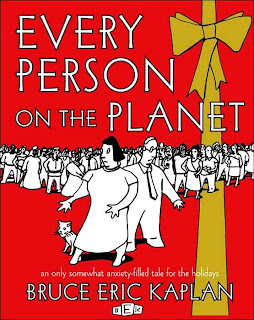
  • Bruce Eric Kaplan, Every Person on the Planet (4/5)
    When I read Edmund and Rosemary Go To Hell last year, I had no idea that, as Crow would say, "Hey! this is a sequel to something!" But it was, and Every Person on the Planet is the book to which Edmund and Rosemary is a sequel. It's another slight cartooned story, in a gift-book format, like its sequel, about two New Yorkers and their holiday plans. Edmund and Rosemary want to throw a holiday party, but then the guest list keeps growing and growing until, finally, they give in and decide to just invite everyone on the planet. Because it's that kind of book, everyone both accepts and attends -- but, luckily, because it is that kind of book, they all fit in the apartment with only the usual party problems. (And, somewhat less luckily, also because this is the kind of book it is -- or maybe just because its by Kaplan -- the couple is vaguely unhappy both before and after the party.) Kaplan is a great, cutting cartoonist when it comes to single panels, but these two books -- both fables, I suppose -- are less involving and vital.
  • Koji Kumeta, Sayonara, Zetsubou-Sensei: The Power of Negative Thinking, Vol. 1 (buy it?) (4/6)
  • Jun Yuzuki, Gakuen Prince, Vol. 1 (buy it?) (4/7)
  • Jim Butcher, Turn Coat (4/7)
  • Akira Ishida, Oninagi, Vol. 1 (buy it?) (4/8)
  • Shaun Tan, Tales From Outer Suburbia (4/8)
    Tan is the author of the fabulous wordless graphic novel The Arrival (which I reviewed for ComicMix some time ago); this is a collection of illustrated stories, some of which nudge over the border into being comics rather than stories with both words and art. There are fifteen stories here, most of them quite short, and all are somewhat surreal takes on Tan's Australian suburban milieu for younger readers. His words aren't quite up to the level of craft of his pictures here; the stories are sometimes a bit leaden or obvious, while his art is marvelous, in different, deeply individual styles for each story. And don't get me wrong: Tan is a perfectly acceptable writer, with only a few infelicities -- it's just that he's a much better artist, and is coming off something like a masterpiece. So I may be judging this quirky little collection more harshly than I should.
  • Kyle Baker, Plastic Man, Vol. 2: Rubber Bandits (4/8)
  • Ken Akamatsu & Takuya Fujima, Negima!? Neo, Vol. 1 (buy it?) (4/9)
  • Drew Friedman, Old Jewish Comedians (4/9)
    Some books just are what they say on the tin; this is a perfect example. The back cover says "An Illustrated Gallery of Jewish American Comedians, Comics, Comic Actors, Clowns, and Tummlers Depicted in the Sunset of Their Years," and that's precisely what this is -- twenty-eight full-page monochromatic Drew Friedman paintings of old joke-tellers of the Hebrew faith. (Plus a few extras in the front matter and a center two-page spread with the three important Marx Brothers.) There's also an foreword by Leonard Maltin on the subject of The Old Days of Show Business. But the point is the Freidman paintings, and, if you know Friedman (and you should by now), you can guess at how unflinching those portraits are. It's a severely quixotic enterprise to begin with, but that's what Friedman does, and I'm glad to see that he's still around. However, I was really surprised to find that one of the libraries in my county had bought this; budgets must have been pretty flush in 2006.
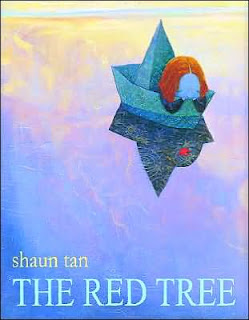
  • Shaun Tan, The Red Tree (4/9)
    This is a picture book from the author of The Arrival (and of Tales from Outer Suburbia, just above); I'd had it in the back of my head to track down more of Tan's work for a while, and I finally did it in my current reserve-a-lot-of-things-at-the-library frenzy. This is gorgeous and touching, but more obviously a book for children than The Arrival. I think I'll see what my own boys think of it now; I hope they like it, too.
  • Mark Alan Stamaty, Who Needs Donuts? (4/13)
    A picture book -- you know, the kind that kids like -- from the early '70s by an illustrator whose work I enjoy. I'd been looking for it, at least vaguely, for a while, and I finally just checked to see if I could request it from the library. I could; I did; I got it. It's fun, but it's clearly an object from the '70s. Luckily, that's when I was a kid, so kids' books from that era look particularly correct to my eye. My boys -- who surpass even me in their love of donuts -- have already found and read it, and they agree heartily with the pro-donut agenda of this book. (Ignore any insinuations that Who Needs Donuts? actually comes down on the side of the repressive forces of anti-donutism. Who needs donuts when you've got love? I do, because I'm hungry.)
  • Stephen Leacock, Nonsense Novels (4/16)
    I have the vague sense that I've been hearing good things about this book of parodies for a very long time -- I know I've had it on my list for quite a few years. (Though not as long as I could have, since it was originally published in 1911, well before I was born.) Leacock was a Canadian writer and political science professor at McGill University, and this is, I believe, his most famous book. There are ten parodies here, and -- despite the word "novels" in the title -- they're all of short-story length. They're all -- with one exception, which I'll mention in a minute -- still sparklingly funny even a hundred years later. (A moderately famous quote comes from the story "Gertrude the Governess" here -- "Lord Ronald said nothing: he flung himself from the room, flung himself upon his horse and rode off madly in all directions.") A cliche was a cliche even then, and Leacock had a good eye for noticing them and a good pen for poking them. The one story that doesn't work as well -- the last one, "The Man in Asbestos," in which he attempts Bellamy-esque science fiction -- is lumpy and unfunny precisely because Leacock is dragging his personal politics into it, and they, sadly, were a bit reactionary even for his time. But the other nine stories, parodying Sherlock Holmes, psychic fiction, sea stories, the tales of Highland Scotland, and several others, are all still very funny, and even a modern reader can see and enjoy the targets of Leacock's barbs. Nonsense Novels might be just humor, but it's funny, and a book that's still funny a hundred years later is to be treasured.
  • David Rose, editor, They Call Me Naughty Lola (4/17)
    About ten years ago, the London Review of Books decided to start running personal ads. The New York Review of Books -- seemingly a very similar publication -- had a very successful lonelyhearts section, so the editors in London thought they'd be able to help make some love connections between various tweed-suited lecturers and bluestockings. However, they'd failed to take into account the essential character of the educated Briton: depressive, self-deprecating, overly judgmental, and all too often obsessed with their mothers. ("You should know that by placing this advert I've lowered my expectations considerably. Now even you're in with a chance. Don't blow it by mentioning your mother and your predilection for bluestocking NAAFI-types. Woman, 46, accustomed to disappointment, but not that much.") And so the LRB personals became very entertaining to read, as a catalog of the neuroses and idees fixes of the chattering classes, but perhaps not as useful a pathway to true love as might have been hoped. ("Bald, short, fat and ugly male, 53, seeks short-sighted woman with tremendous sexual appetite.") The resulting adverts are tremendously entertaining, though I do have to wonder why any of these people seriously thought that saying these things would be at all helpful at finding anyone. ("I am not afraid to say what I feel. At this moment in time I feel anger, giddiness, and the urge to dress like a bear and forage for berries at motorway hedgerows.") If you're not reading the personals with the usual purpose, these are hilarious.
What do you think, sirs?

Monday, November 01, 2010

Read in October

This was the month when I completely forgot about Antick Musings' fifth anniversary -- and I'm not going back to catch up, so I'll let any interested parties troll through the archives themselves -- in my pursuit of Book-A-Day. (Even more so, since I was pushing to get far enough ahead for my November vacation to look seamless -- I'm almost there as I write this, and it looks like Book-A-Day will continue to chug away even while I'm not around.)

And, since I was still doing Book-A-Day, this is, once again, just a list of links:
As you read this, I'm probably on a theme-park ride. Hope you're doing something equally exciting.

Sunday, December 29, 2024

Reviewing the Mail: Week of December 28, 2024

I'm typing this on Friday, which means I may yet get mail today or tomorrow and have to revise this post. Such are the dangers of being a blogger.

The list below, at the moment, is all things I unwrapped this Wednesday, on the usual hegemonic festive winter holiday of my people. Several of them I bought for myself - as I've said before, it's the one way to be sure you get what you want - and I'm not going to tell you which ones.

Acceptance is the third of the original Southern Reach trilogy by Jeff VanderMeer from a decade ago - he has a new book in the same world that just came out a few months ago. The first two are Annihilation and Authority, and I'm reading them slowly enough, I'm sorry to say, that I got Acceptance in a completely different cover design than the first two, which physically pains me. I'm sure I'll live. And I'm going to try to read this relatively quickly; I'm vaguely trying to catch up on VanderMeer, even though he's pretty prolific.

My Brother's Keeper is a newish novel (from 2023) by Tim Powers, and sees him return to Stress of Her Regard territory with the untold secret history of the Brontë sisters. I'm a long-time fan of Powers, though I have to admit I did look a bit askance when he moved to Baen a few years back and had a three-book series about the same characters (I've read the first one, Alternate Routes). But writers gotta eat, and want to write stuff and get it out into the world, and sometimes you dance with whoever's willing to dance. So I guess I'll keep reading Powers books unless he starts going overly Baen and includes rants about the Trilateral Commission or something.

The City and Its Uncertain Walls is the new novel from Haruki Murakami, who I've been reading since Wild Sheep Chase - almost everything he's had translated into English at this point. (There's a short book about music I haven't gotten to yet, and the bug-crusher 1Q84 sitting on my shelf and mocking me.) The City is shorter than 1Q84 - most books are - so I might tackle this one first. What's it about? Probably the same quirky things as any Murakami novel - which is to say, anything. I'll figure that out when I read it.

High Tide at Midnight is the sixth book in the Trese series, about a supernatural detective in the Philippines. I'm really happy to see that this attempt to bring the series to the US market seems to be working better than the first try did, years back - I saw the first two books way back in my SFBC days, and then there was a long drought before I saw more, even though new material was being published in the Philippines at least intermittently over those years. (There was an animated TV series a year or three back, which probably helped the books' profile - TV, even in these latter days, hits a vastly larger audience than any book.) Anyway: great series, great atmosphere, great art, really interesting supernatural world.

And last is Schtick Figures, the new book from Drew Friedman from this year. It collects over a hundred and fifty of his portraits - looks like comedians are the largest group, but with lots of random others as well. My sense is that this is the "odds & sods" collection, with all the Friedman work that didn't get into his more tightly-themed books. (US Presidents! Old Jewish Comedians! Comics pros! Great Mailmen! Well, maybe not that last one.)

Sunday, May 07, 2023

Books Read: April 2023

Here's what I read this past month. At some point, once the posts go live, there will be links. Not today. though.

Nicolas De Crecy, Glacial Period (digital, 4/1)

Josh Sladek, Tik-Tok (in SF Gateway Omnibus, 4/1)

Jim Benton, Dog Butts and Love. And Stuff Like That. And Cats (digital, 4/2)

Gipi, MBDL: My Badly Drawn Life (digital, 4/8)

Michael Swanwick, Stations of the Tide (4/8)

Maximilien Le Roy and A. Dan, Thoreau (digital, 4/9)

Liniers, Macanudo: Welcome to Elsewhere (digital, 4/15)

Jordan Crane, The Last Lonely Saturday (digital, 4/16)

Jack Vance, Cugel's Saga (in Tales of the Dying Earth, 4/16)

Vaughn Bodé, Cheech Wizard's Book of Me (digital, 4/21)

Joe Daly, Scrublands (digital, 4/22)

Bong Redila, Meläg: Town of Fables (digital, 4/23)

Flann O'Brien, At Swim-Two-Birds (in The Complete Novels, 4/23)

Neil Gaiman, P. Craig Russell, and Troy Nixey, Only the End of the World Again (digital, 4/29)

Emily Dickinson, Selected Poetry (4/30)

Drew Friedman, Heroes of the Comics (digital, 4/30)

Gene Wolfe, A Borrowed Man (4/30)


Next month: more books!

Sunday, November 02, 2025

Books Read: October 2025

I do this every month, mostly for myself. This is what I read last month. I'll add links once the posts go live. As usual, I do it largely because I've been doing it for a long time: it's somewhat useful and very familiar, and I guess that's good enough.

Robin Enrico, Life of Vice (10/4)

Art Bathazar & Franco, ArkhaManiacs (10/5)

Brian Doherty, Dirty Pictures (10/5)

Yves Chaland, Freddy Lombard, Vol. 5: F.52 (digital, 10/11)

P.G. Wodehouse, The Mating Season (10/11)

Matt Kindt & Wilfredo Torrres, Bang! (10/12)

Drew Friedman, All the Presidents (10/18)

Loren D. Estleman, Infernal Angels (10/18)

Séverine Vidal & Kim Consigny, George Sand: True Genius, True Woman (10/19)

Dashiell Hammett, The Thin Man (in Complete Novels, 10/19)

Alexandro Jodorowsky & Mœbius, The Incal, Vol. 2: The Luminous Incal (digital, 10/24)

Zach Worton, The Disappearance of Charley Butters (10/25)

James Thurber, The Last Flower (in Writings and Drawings, 10/25)

Manuelle Fior, The Interview (digital, 10/26)

Dino Pai, Dear Beloved Stranger (10/27)

Kim Newman, Something More Than Night (10/27)

In November, I will continue to read books, and, if I'm not hit by a bus, I'll list them here in time.

Tuesday, November 06, 2012

An Avalanche of Books from the Top Shelf

Top Shelf Productions is one of my favorite comics companies -- not least because they have periodic awesome sales like the one I blogged about in early September. And the aftermath of a great comics sale is a big pile of comics, and the aftermath of that is a bunch of books to review.

So let me dive right in....

Gingerbread Girl was originally a free webcomic -- in fact, it's still up, so you can read part or all of it before buying if you like -- by husband-and-wife team Paul Tobin and Colleen Coover. (I knew Coover from her sweetly sexy comic Small Favors, and Tobin has been writing comics for some time as well.)

It's the story of perky young twentysomething Annah Billips -- and that name is so self-indulgent that she just might have chosen it for herself -- who is one of those oh-so-cute girls who can skate along on charm, winsomeness, and a twinkly smile for the first thirty or so years of their lives. (It can be even easier if you're both bisexual, like our Annah, and living in a forgiving, liberal city like Portland.) Her story is told -- directly to the reader, with surprising regularity -- by Annah, by the people she knows and meets, by random passers-by, by pigeons and dogs, and covers the course of one long evening and one (of two potential) dates she had. It also circles the question of Annah herself: she deeply believes she have a twin, created by her scientist father from the Penfield homunculus in her brain, and either this is true or Annah is seriously mentally ill.

Gingerbread Girl will not tell you which is true. But it will circle around an interesting, very quirky character for a hundred pages, with cute art from Coover and some very thoughtfully entertaining words from Tobin.

As long as I'm talking about what things aren't, I should say that Ed Piskor's graphic novel Wizzywig is definitely not the true story of famous hacker Kevin Mitnick. The central character of Wizzywig is Kevin Phenicle, who just happened to do nearly all of the things that Mitnick was famous for, in pretty much the same order and in the same places, for basically the same reasons, and went to jail the same way with a very similar controversy surrounding him.

I have no idea why Piskor decided to fictionalize Mitnick's story, or -- after that decision -- why he then stuck so very close to the real facts for most of the book. Perhaps he felt it necessary to give Mitnick's life a more conventionally novelistic arc -- Phenicle's life in prison is more eventful, and the telling of it more cathartic, than Mitnick's actual life would have been. But, still: Wizzywig is basically Mitnick's story up until Phenicle's arrest, and then diverges.

Piskor tells that story in a complicated round-robin style derived (possibly) from Dan Clowes. (His art, too, is somewhere in the broad region defined by Clowes, Bob Fingerman, and the later Drew Friedman.) There's a Greek chorus of random people who regularly chime in about Phenicle -- or, more often, his mysterious hacker alias "Boingthump" -- plus stories about Phenicle, his childhood best friend and later strongest defender Winston Smith (nudge nudge, wink wink!), and the crusading newsman Ron Shumway, who made Boingthump one of his major bugbears.

It's fun and energetic and thrilling, but it's glossier and more fictional than it needed to be -- Mitnick's real story is at least as interesting as this one, and remains behind the story Piskor does tell like a shadow on every page. Wizzywig is a fine graphic novel, but it could have been better if it had decided to either tell Mitnick's story for real or to tell an entirely fictional story.

The Lovely Horrible Stuff is the newest book from Eddie Campbell, telling another semi-autobiographical tale to follow up the long series of "Alec" stories he's produced for about thirty years. (The bulk of them are included in the recent, and absolutely essential, compendium Alec: "The Years Have Pants", and I point you at my review of that book to explain what's so good about it.) Campbell transmuted the often barely fictional Alec MacGarry into the slightly more factual Eddie Campbell at the end of The Years Have Pants, and Lovely continues in the same vein: the Eddie Campbell character here is Eddie Campbell himself, and the style and tone of the stories continues as before.

This time out, though, Campbell is working in color, as he has in his recent books (The Fate of the Artist, The Amazing Remarkable Monsieur Leotard, The Playwright), which gives these stories a subtly different texture than the black-and-white-and-tone work that most of the Alec work had.

Campbell's work is as puckish as ever -- after an abandoned project on the history of humor, Lovely is an examination of the world of money. Campbell, as always, isn't interested in a complete picture, so Lovely covers two things in its two chapters: his own history with money (mostly as a freelancer trying to get money out of the people who hired him), and the story of the Pacific island of Yap, where giant circular stones (quarried on a different island, quite some way away) are the most valuable and important kind of money.

It really doesn't matter what Campbell's ostensible subject is, though: the joy is in seeing him wander around and through it, thinking about this bit and then complaining about that bit and then digressing into a bar full of literary figures all complaining about their unpaid bills. Campbell is an artist in full control of his impressive talents; his pages are smart and funny and interesting and the stories they make up are equally so.

But comics don't need to be serious and thoughtful; comics can also be rip-snorting adventure. And a great example of that is Kevin Cannon's Far Arden, the tale of hard-living, hard-drinking Army Shanks, late of the Royal Canadian Arctic Navy, and his adventures in the far north of Canada.

Shanks gets caught up in the search for the fabled island of Far Arden -- by legend, a tropical paradise in the far north. Along the way, he encounters boys dressed as wolves, semi-friendly bears, creepy circuses, femmes fatales both out of his past and new, clean-cut college students, professors with mysterious plots, scheming local politicians, RCAN sailors both honest and not, secret messages, hidden maps, lecture tours, bar fights, long voyages in open boats -- not precisely "fencing, fighting, torture, revenge, giants, monsters, chases, escapes, true love, miracles," but a very similar list.

Shanks's world is cold and dangerous, though; Far Arden has many of the characteristics of a romp, but it's not entirely one. But it's a fat book (in a small, fits-neatly-in-the-hand size) with a quirky sensibility and a plot that charges forward in unexpected directions on every page, and the voyage is well worth the price of admission. It's not quite pure adventure, but it's only diluted very slightly with regret and mystery and tragedy, which makes a heady drink.