Sunday, May 31, 2009

There Was No Post Today

You didn't miss anything; I did.

I try to post here daily, but it just didn't work out today. However, tomorrow will see the auto-posting of my usual weekly and monthly round-ups of books coming in and books read, which I hope counts for something. See you after that for possibly more substantive blogging, particularly if anything happens that's worth fulminating about.

Saturday, May 30, 2009

Competitive Physics

I spent the day at BEA, and may write a bit about that tomorrow. But, for today, I'm tired. So, instead, I reached into the vaults for this bit of frivolity. It had very little to do with the thread on the Straight Dope Message Board in which it appeared in 2000, and it has even less to do with whatever posts will surround it here. But I wrote it, and I still think it's funny, so...

[voiceover]
Hello and welcome to the 2000 Niels Bohr Open. It's a sunny day here in Los Alamos, where thirty of the world's top physicists have gathered to compete for the most coveted award in all science: The Golden TOE.

First up will be Tsatsumaya, from Case Western. He's chosen a very difficult opening, the Kip Thorne superstring variation, but he looks to be in good form. His arm is racing across the whiteboard, but wait! Oh, no -- he can't cancel the infinities! And Tsatsumaya is out of the competition!

Next up will be Jorgensen of Caltech, but first, a word from GE...

Friday, May 29, 2009

Picking Up Girls -- a Controlled Experiment

Two British guys recently realized that their success (and the success of men like them) in attracting women was directly related to whether they had a puppy with them at the time. So, clearly, women respond to men with puppies, but they wanted more data -- they wanted to find out which breeds women responded best to.

So, with the aid of a phone that automatically takes a picture when it detects a smile, they devised an experiment to test the "puppy pulling power" of ten different popular breeds in the UK.

I'm sure there's something deeply dubious, sexist, and otherwise horrible about this, and the various Humorless Forces of the Internet will soon put their boot in -- but it's also a wonderful example of using geeky advantages to counterweight geeky disadvantages, and I have to salute that.

(I also note that there's a distinctive posture of the young women as they lean over to pet the dog -- I'm uncertain if capturing that was part of the point, or a serendipitous bonus. One excellent example is below.)

[via Geekologie]

Free MP3s!

And these are the legal kind, too!

If I weren't crazy busy right now -- which, of course, I am -- I'd be poking through this selection of free MP3s (from Amazon, of course, who have proven themselves masters at hooking consumers with low prices and then landing them with higher prices once that hook is firmly set) for stuff I like right now.

If you have more time than I do, click this banner. (Amazon seems to think I might make some money if you do, which seems like an Underpants Gnome Scheme to me, but what the heck. I could use a blog post tonight to prove I made it home safely.)

Quote of the Week

"Never miss a chance to have sex or be on television."
- Gore Vidal

Thursday, May 28, 2009

Report from the Land of Certified Valuation Analysts

Yesterday I was in the exhibit hall at the ungodly hour of 6:15 AM -- when it was supposed to open -- only to find it already populated by accountants, some of whom (my colleague told me) had been there when he arrived at 5:55. I know not what breed of creature these strange "CVAs" are, but I am sure that they are not men.

Business in the hall ebbed and flowed with the rhythm of sessions and breaks, as always, and we'd made an encouraging amount of sales when we closed up at 6:45 PM. (I was in that hall, more-or-less continuously, for over twelve hours. When I wasn't selling books or rearranging books, I was mostly catching up on e-mail.) Then we went out to dinner, so I got back to my hotel room at about 9:30.

Today was pretty much the same, except the hall didn't officially open until the princely hour of 7:00. I was there five or ten minutes early to find it already full of CVAs eating breakfast. Again, sales were encouraging; we have a shot at beating last year's meeting.

Tomorrow I've got another 7:00 start, though the hall supposedly closes at 4:00. (Nobody's been pushing people out the door so far, though, so it might not happen that way.) Then we get to pack up everything, mark it for shipping via two different carriers, and bug out. (And that, for me, means driving straight home so I can get to BEA Saturday.)

I hope to do nothing more strenuous than spreading cream cheese on a bagel on Sunday. If I feel really ambitious, I may drag the family out to see Up. But maybe not.

Wednesday, May 27, 2009

It Must Be True -- It's Science!

In case you haven't seen it yet, an earth scientist explains exactly How Gay Marriage Causes Earthquakes.

I'm looking forward to a similar explication of the mechanism on the East Coast, which is less well-known. But I believe the love waves from Christopher Street cause flooding in Central Jersey.

Tuesday, May 26, 2009

Never Drive a Car When You're Dead

Here's my day so far:
  • Get up late. (Sleep until almost 7 AM!)
  • Finish packing, check e-mail, walk kids to school.
  • Drive four hours to Boston.
  • Spend nearly two hours getting our boxes released from the bowels of the hotel.
  • Spend over two hours unpacking boxes and newfangled computer system and arranging them pleasingly on tables in the basement of said hotel.
  • Answer work e-mails for another two hours or so.
Here's what I'm looking forward to:
  • being back in that hotel basement at 6:15 tomorrow morning for the opening of this conference
  • working through breakfast and the morning break
  • running over for a meeting at eleven elsewhere in Boston
  • running back for the hoped-for lunchtime rush
  • working through a couple of afternoon breaks and trying not to fall over before the end of the evening reception at 6:30
I may perk up and type something substantial here before I go to bed in a couple of hours, but I tend to doubt it. So this post serves to note that I am in Boston and tired, and that I expect to be tired until sometime on Sunday, at best. And I really hope these valuation guys buy books this year like they always have before....

Monday, May 25, 2009

Nation by Terry Pratchett

The last book Terry Pratchett wrote outside of a series was Good Omens, with Neil Gaiman, about twenty years ago. (Although, if one is being nitpicky, one could count Only You Can Save Mankind from two years later, which wasn't a series for nearly a year until a sequel appeared.) The vast majority of his output has been in the ever-unfolding Discworld series, and the few times he's ventured outside that -- the three Johnny Maxwell books, the Bromeliad trilogy -- it's been to write books in sets of three for young readers.

Nation is positioned as a book for young readers, but it shows no sign of being the first of three; it tells its story definitively and has an ending that doesn't leave much room for more stories about these particular characters. Given Pratchett's history, it might be dangerous to be too definitive, but Nation is, and I expect will stay, a single novel.

The tone is very similar to the recent Discworld books; that's Pratchett's mature voice, and it invests everything he writes. He's wry and thoughtful and quietly omniscient, as usual and as always. Nothing is a surprise to the narrative voice, which gives a sense of inevitability to everything that happens. It's a tone derived from the classic British books for young readers, from Nesbit and Lewis and the rest, shorn of most vestiges of talking down -- Pratchett only talks down to his readers as a god talks down to humanity -- but still with those undertones of knowing best and just simply knowing. The narrative voice in a Pratchett novel is never surprised or perturbed, no matter what happens.

Nation is a mildly alternate history, set in a world that's very much like our own in the 19th century, with many names changed, some probably altered geography, a few unfortunately silly names, and a convenient tsunami to start the plot. There's nothing there that Pratchett couldn't have worked around in the real world -- there were major tsunami in 1833 and 1883 -- but perhaps the habit of fiction is just too strong with him at this point. It's unfortunate, though, because the small shards of alternate history push Nation away from the realistic novel it's mostly trying to be and towards the realms of Fantasyland, where anything can and does happen according to the author's whim.

That tsunami I mentioned hits the Nation, an island somewhere in the unfortunately named Mothering Sunday chain -- it's never a good thing when you can hear the author guffaw at his own joke -- and the sole survivor of the natives is Mau, a young man who was in the process of becoming a man at the time. Since he was on his way back from Boys' Island, site of the usual vision quest, the tsunami's wave lifted his canoe and battered him senseless, but didn't actually kill him.

It did kill everyone he'd ever known -- his entire village, his entire island, his entire Nation. He paddles back to discover the carnage, and, not completely sane, to bury the dead while trying not to think about what he's doing. These early chapters are the most powerful in the book, and Pratchett does an excellent job of portraying Mau's shell-shocked disassociation and his gradual return.

There's another important survivor of the storm: Ermintrude Fanshaw, a young woman who was a passenger on the English ship Sweet Judy. The Sweet Judy found itself tangled in the trees of Nation, and, through the kind of happenstance that Pratchett has always made careful use of, every single sailor on that ship was cleanly killed and Ermintrude was left untouched. Ermintrude is also Very Important, and that fact is vitally central to the novel -- it's the whole basis for the alternate history, so Pratchett must have decided that she must not only be a young woman from another culture on the other side of the world from Mau, but that she also have social and political responsibilities and a position he could barely understand. (This reader started suspecting Pratchett of stacking the deck at about this point.)

So Mau meets Ermintrude (who, once they have any words in common, calls herself Daphne, joining the long Pratchett tradition of women who name themselves). They start to communicate, with the usual wry Pratchettian commentary on miscommunication and disparate worldviews. They begin to build a new community, as other damaged survivors, from other islands and places, come to join them in ones and twos. Pratchett is a traditionalist, so this is all much more Robinson Crusoe -- stolid, serious, constructive -- than Blue Lagoon. (One never goes to Pratchett for romance.)

Nation could have been the story of two young people meeting after a vast tragedy and finding each other, but that would have been too inwardly-focused for Pratchett: his work is essentially focused on societies than on individual people, and he takes the importance of the eucatastophe much more seriously than most. So it instead is the story of the rebirth of civil society in the wake of destruction and anarchy, and all of the events of the novel line up according to that schema.

The writing is supple and powerful, and the characters -- particularly Mau and Daphne -- are fully realized and deeply rendered. But there's a definite feeling, especially as Nation rises towards its climax, that this is a novel of the old school, teaching a moral that would not have been out of place in this world's 19th century. The great failing of Pratchettian societies is that every person has a place in them -- one place. It's not fair to argue with a novel's premise, but Nation's left a vaguely unpleasant taste in my mouth. Pratchett does make the ending feel inevitable, but it's the bad kind of inevitable -- the one predicated by a world in which horrible things like tsunami happen, and where humans must bend under the storm. Our own world is one such, and it's not inappropriate for fictional worlds to be the same way. But when those fictional worlds have places named the Mothering Sunday Isles, and plucky girl heroines who change their names to Daphne, and two teenagers who can found an island nation and outwit nasty pirates, that tightening of possibilities in the last act feels like a demand of the author rather than of the world.

Nation is a fine standalone Pratchett novel, and very suitable for younger readers. (In fact, my objections to it are mostly in the ways that it's "suitable for younger readers" in an old-fashioned way.) Again, it exemplifies all of his mature strengths and weaknesses -- it's a fine yarn by a great storyteller that wants to be more inevitable than it organically should be. The old Empire is not quite dead as long as Pratchett is still writing, and I hope he continues to do so for years to come.

Reviewing the Mail: Week of 5/23

This was a good week, leaving me with an interestingly varied -- and not too tall -- stack of books to write about this week. To explain, once again: these books all came in the mail, from their publishers, for me to review. But time is limited, so I know I won't manage to review all of them. And thus I note all these books as they come in, with some brief thoughts, every Monday morning.

First is the new novel by Kage Baker, The Empress of Mars, which is an expansion of her novella of the same name and a sidebar to her "Company" series. (There weren't any immortal time-traveling cyborgs in the novella, since they all stayed on Earth.) Baker is a writer who at her best can effortlessly blend wit and adventure, so I'm looking forward to this one. (Though I still haven't read her novel from last year, The House of the Stag; Baker isn't a particularly rigorous SF writer but I do like best her stories with a SFnal patina rather than a fantasy one. I expect I'll get to this one before Stag, though I do want to read Stag eventually.) Tor published Empress in hardcover on the 19th of this very month.

Switching gears entirely, I also have here Wicked Lovely: Desert Tales, Volume 1: Sanctuary, a manga-sized and -styled volume (reading left to right, though) written by Melissa Marr with art by Xian Nu Studio. Marr has written three contemporary fantasy novels -- for young-adult readers, I believe -- about fairies in the modern world, and Wicked Lovely is the first of them. The books look to be from the gritty side of faerie -- like Holly Black's Tithe and sequels -- though I suspect there's a dose of romance-novel in them, to judge from the yearning look Female Figure is giving Male Figure on the cover of this one. This volume is a Tokyopop/HarperCollins co-publication, one of a number that I've noticed lately, and came out at the beginning of this month.

Also from the manga world is the first volume of Yokai Doctor by Yuki Sato, beginning a series about a doctor for yokai -- spirits or demons. This one was published by Del Rey Manga on the 19th, and it's rated for 16+, which means, I imagine, a lot of panty shots.

Publishing in June from DAW is Faery Moon, the third contemporary fantasy in the "Tess Noncoire" series by P.R. Frost. Now, I haven't read any of these, and what I can vaguely remember about what I knew about the first book (Hounding The Moon) are not only hearsay but not positive, so I'll just assume I'm misremembering. These are stories about both convention fandom and real faeries -- and look to be serious rather than silly -- which means they probably wouldn't be too my tastes. But if you really like one or both of those things, try it and let us know your take.

The seventeenth book in the"Graphic Classics" series, all edited by Tom Pomplun and published by his Eureka Productions, is Science Fiction Classics, coming in June. This is the first volume of the series to be printed in full color -- and it's gorgeous color -- and it contains adaptations of Wells's The War of the Worlds and shorter works by Jules Verne, Stanley G. Weinbaum, Arthur Conan Doyle, Lord Dunsany, and E.M. Forster. (All safely out of copyright, I note -- but that's the point of the series to begin with.) And the comics creators involved here include Pomplun himself, Roger Langridge, Ellen L. Lindner, and Johnny Ryan (!).

Personal Effects: Dark Art is a "multi-platform transmedia experience" by J.C Hutchins (previously author of a "podcast trilogy") and Jordan Weisman (a designer of alternative reality games -- wait, aren't all games an "alternative reality?") and only looks like one of those creaky, old-fashioned words-on-paper novels. There is a book in here -- with pictures, too, so the consumer doesn't have to be shocked by a trackless expanse of words -- but also a sheaf of other documents (IDs, photos, official documents, and so forth) and references to websites and voicemail messages. So it's a high-tech thriller version of Griffin & Sabine, I suppose. St. Martin's Press is publishing this collection of media objects on June 11th -- many of them are free if you can find them, but the physical object of the book and documents is the central element of whatever-you-call-this-kind-of-thing. (Oh, and there's a quote from a TV producer on the front cover, saying that this is the future of storytelling -- which kinda sucks for him as well as for novelists if it's actually true.)

Next is a collection of manwha (Korean comics) stories by Byun Byung-Jun, called Mijeong. Byung-Jun also is the creator of the graphic novel Run, Bong-Gu, Run!, which I haven't read. Mijeong has a heavily textured art style that doesn't look much like the Asian comics we mostly see over here, and looks to fall more on the literary than the popular side of comics. NBM ComicsLit will release it in July.

And last for this week is a Seth-o-rama from Drawn & Quarterly -- two books of classic comics for kids that he designed, and then a new collection of the Seth strip that recently ran in The New York Times Magazine.
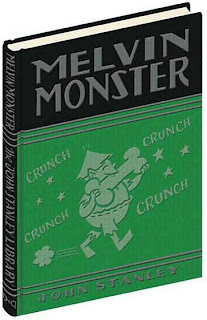
Melvin Monster is a volume in D&Q's ongoing "John Stanley Library" -- which aims to reprint a lot (most? all?) of the work of Stanley, a comedic writer/artist active in comics from the '40s through the '60s. This book reprints the first three issues of the 1965 Melvin Monster comic-book series, about a monster kid. I think that Stanley both wrote and drew the stories here; the biography in the end of this book mentions only Stanley's writing, but no other artist is credited. (The book also has that faux-old-timey look that I loathe in classic comics reprints; the page appears age-browned, as if the reader were actually looking at the old comics issues.) The front matter is very heavily designed -- it's attractive, but it doesn't mesh all that well with the pseudo-naif presentation of the comics stories, or the old-fashioned juvenile virtues of those stories themselves. Melvin Monster was published in April.

Taking a closer look, I'm now not sure Seth had anything to do with Moomin Book Four: The Complete Tove Jansson Comic Strip. On the other hand, it's from D&Q, so it's certainly possible. I know Jansson's Moomin empire is deep and vast, encompassing comic strips, novels, and probably tea-towels, biscuit tins, long underwear, and decorative ropework, but I've never encountered any of it before. This is the fourth (probably of five) volumes reprinting the comic strip, which the Scandinavian Jansson ran in a London newspaper for most of the 1950s, concurrently with her ten novels for children about the same characters. It was published earlier this month.

Last and largest is the book by Seth -- George Sprott (1894-1975), which was also published in May. It's an expanded version of the story from the NYT Magazine -- a quick glance through found a lot of new pages -- but the focus looks to be the same: a series of snapshots from the life of a (fictional) minor Canadian TV personality from mid-century.

Sunday, May 24, 2009

Saturday Is Bond Day #11: Moonraker

Bond Day fell on a Monday this week, since that's when Moonraker arrived in the mail from Netflix. The boys had a good day at school -- if it's been a bad day, all electronic devices are disallowed -- so we settled in to watch the very obviously post-Star Wars part of the Bond canon.

It was a crowd-pleaser in that room, but I'll tentatively say -- before seeing For Your Eyes Only next week -- that this is where the Roger Moore Bonds teetered over into self-parody. As I noted briefly in the last entry, Moonraker is one part Star Wars and one part photocopy of Spy Who Loved Me: space battles, a tough competitive female agent as the Bond Girl, a world-destroying villain with a secret lair to top the last one, and so on. In fact, the only obvious thing for a big 1979 action movie that it doesn't have is a monorail in the villain's lair. (I explained my theory of villain monorails to the boys when we saw You Only Live Twice -- which has the platonic idea of a lair, with not only a monorail, but a volcano, space-launch capacity, and Blofeld -- and Thing 2 has joined me in my love of all things monorailian.)

Michael Lonsdale as Hugo Drax is a surprisingly good villain, and Lois Chiles is a decent Bond Girl even working under the snicker-inducing name "Dr. Holly Goodhead." But this movie really belongs to Richard Kiel's Jaws, who was brought back from Spy either as part of the general transplantation or because of his popularity. Either way, Moonraker almost turns into his story, and he not only gets a girl, but also gets his own face turn near the end and a happy ending. Speaking of happy endings, Moonraker exactly matches Spy's ending as well, making this viewer wonder when, precisely, cheap Xerox machines reached the offices of United Artists.

Watching Moonraker soon after Spy inevitably diminishes it, as does watching it with any solid knowledge of physics. (The "zero-gee" space scenes are particularly painful, or laughable, depending on your tolerance for such things.) This is where the Moore Bonds lost their tenuous attachment to consensus reality and started floating away into their own realm, which was fine as long as Moore could sustain them. He still could, this time. Next up is For Your Eyes Only, and we'll see how he did there.

And I'll end with a question for the audience: how far into the series should we watch, myself and my two sons (aged 8 and 11)? I'm committed to running through the last Moore, A View to a Kill, and I'm tentatively planning on including Never Say Never Again (the tepid return of Connery in an unofficial film) and The Living Daylights (the first Timothy Dalton, in a script only mildly changed for him). I'm pretty definite that we'll miss License to Kill, the bloody and depressing second Dalton film, but I'm unsure whether to queue up any of the Pierce Brosnan movies. Any opinions on their suitability for two boys who will have seen all of the Connery and Moore films by then?

Saturday, May 23, 2009

OMGWTFBBQ!

(I've always wanted to use that particular initialism, but never before found the appropriate place.)

Yesterday's "Manga Friday" column at ComicMix, written by yours truly, reviewed the first volumes of three manga stories about (and, presumably, for) schoolgirls: Orange Planet, Ichiroh!, and 13th Boy.

Movie Log: Zack and Miri Make a Porno

Every so often -- maybe once a decade or so -- Kevin Smith makes a movie that I think I can watch with my wife. Chasing Amy was the last one, but I thought I had a good chance with Zack and Miri Make a Porno. (It's not all of the Kevin Smithian sex I think she'd object to; it's the endless, pointless conversations among emotionally stunted man-boys who swear every other word that would drive her to throw heavy objects at my head. Well, that and the obligatory smirking juvenile grossouts like the donkey show in Clerks II.)

The title explains it all here: Zack (Seth Rogen) and Miri (Elizabeth Banks) are ten years out of high school, stuck in dead-end jobs, living platonically with each other, and chronically out of money. When all of their utilities are cancelled over Thanksgiving, they decide to break out their last-ditch money-making scheme: to have sex with each other and film it as a porn movie. (They're also somewhat inspired by meeting the gay-porn-star boyfriend of an old high school friend, played way against type by Justin "I'm a Mac" Long.)

So they assemble their cast, including such nudges to the viewer as ex-porn star Tracy Lords and current porn star Katie Morgan. And then most of the movie is a "hey, let's put on a show!" plot, renowned on stage and screen for at least the past eight decades. It's a Kevin Smith movie, so there's plenty of cursing and a few disgusting supposed-to-be-funny moments, but the actual funny luckily outweighs the supposed-to-be-funny this time. But he's still not a master of pacing, so Zack and Miri lurches from scene to scene arbitrarily, and wanders away from itself several times.

It's a big shaggy lunkhead of a movie, as Smith's better films are, and it's got a fair bit of heart, for which Smith never gets enough credit. But there's still something essentially juvenile about Zack and Miri; it's the joke told by that AV Club geek behind his hand in the lunchroom. If you can be satisfied with that, Zack and Miri is cute and even approaches honest emotion at times.

Quiet Disappearances

Sometime in the last six months or so, the ghost of my other blog -- and the ghosts of its sister blogs, all done for that company that changes its name about as often as I change my socks -- quietly disappeared from the Internet. (There are echoes of it on the Wayback Machine, but I doubt it's all there. And it was mostly linkblogging, so it's not anything that needed to be saved in the first place.)

Yesterday is the two-year anniversary of my final post there -- and of the unpleasant meeting I had that very same day, which led to lots of good and bad things in subsequent months. The lesson from that is that all things pass -- and I hope that the current crop of the laid-off in the publishing world can take a little comfort from that. Things do get better -- they get different, too, but they do get better.

Great Moments in Bullshit

Writing about art always has dangers for the unwary, and never more when it's modern works being rhapsodically described. Here's one unfortunate partial paragraph by Peter Schjeldahl from the May 4, 2009 New Yorker:
If any single work at the Met show ["The Pictures Generation," of '70s and early '80s work] could stand for all, it would be one of a series executed with minimal labor, in 1979, by the artist Sherrie Levine: fashion ads from glossy magazines trimmed to the contours of the profiled heads of George Washington or Abraham Lincoln, and framed. Looking at them, you register the sainted Presidents and the soignee models -- and the forms of silhouette and of color photography -- in stuttering alternation. Your brain can't grasp both at once. Nor can your heart. The images aren't neutral. They come loaded with political and social associations, bearing on notions of "America." With diabolical efficiency, Levine made good on a claim commonly advanced for Pictures art: spurring consciousness of how, and to what ends, representations affect us.
Uh huh. Sure they do.

(Example one. Example two.)

Friday, May 22, 2009

Incoming Books: 22 May

Because of the holiday, my company's offices closed at lunchtime today. And, since my train line runs almost entirely during rush hours, the easiest way to get back to where my car was parked was to take the PATH into New York, and then a bus back out to the appropriate part of Jersey.

But with an afternoon free, and being in NYC...I ended up at the Strand, one of the great bookstores in the world, and of course I didn't walk out empty-handed. I bought a Garfield book for the boys, and a whole stack of good things for myself:

Death By Laughter, a collection of cartoons by Harry Bliss, all on the subject of death. I like dark humor, I like Bliss's work, and I hadn't even suspected that this book existed -- it's all good.
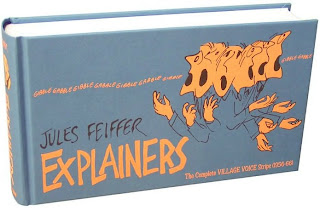
Explainers: The Complete Village Voice Strips (1956-1966) by Jules Feiffer, collecting the first decade of his cartoon for The Village Voice. It's great work, and I've read in this book without having a chance to run straight through it yet. Another interesting thing -- and one that proves there truly is nothing new in the world -- is the fact that Feiffer drew these cartoons for free for the first eight years of his run. Yes, folks, he did it to get exposure and to generate other work, which of course it did. So don't let anybody tell you that no creator ever did anything for free before this newfangled Internet thingy.

The Idler's Glossary by Joshua Glenn and Mark Kingwell, designed and illustrated by Seth. It's a cute little book with definitions of lots and lots of word about work and the shirking thereof. I don't detect any specific connection with the periodical The Idler, but I might have missed it.

Poems and Translations by Ezra Pound, the Library of America edition from 2003. I've given up on the LoA at this point -- I've joined a couple of times in the past decade, but I end up getting one book and then they mysteriously (and silently) cancel that membership without sending me any of the books I wanted to pay real money for -- like this one. And Pound is a writer I've meant to read for a long time.

A Mess of Everything by Miss Lasko-Gross. Lasko-Gross is a major up-and-coming cartoonist, and I didn't read her first book, Escape from "Special." And I've seen short work from her that was impressive, so I grabbed this new book of hers. And about her name: I've heard, but don't know for sure, that "Miss" is actually her first name, and that people who know her call her "Missy."

Sounds of Your Name collects early comics by Nate Powell, author of the amazing and powerful Swallow Me Whole. (Vote for it for the Eisner, if you're eligible!) This was published by a tiny press three years ago, and I'd never heard of it before -- but it was on a shelf at the Strand next to a couple of copies of Swallow (which I almost bought, since I only have a galley and not a finished book). This is early work, and a variety of shorter pieces, so I don't expect it to have the ominous, overwhelming impact of Swallow, but I'm eager to read more of Powell's stuff.
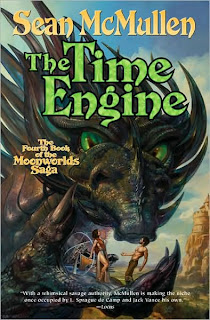
The Time Engine by Sean McMullen, the fourth book in the "Moonworlds Saga," an extraplanetary fantasy series set on worlds of humanoid non-humans on the moons of a super-Jovian that may be sometime in the far future. I'm quite fond of this series, and I'd listed it (among many others) on the Tor publicity checklist a few season back, when it was published. (And what that teaches, as if I needed to learn it, that it's the publicity folks who decide how many books to send out and to whom. As a reviewer -- or a "media outlet," as we tend to call them on the other side -- what I do is ask nicely and be happy when I get free stuff.)
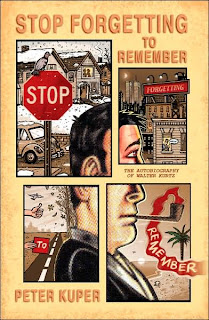
Stop Forgetting to Remember by Peter Kuper -- a well-reviewed semi-autobiographical graphic novel from a couple of years ago that I missed at the time.

And last was The Blue World by Jack Vance, in a classy Gollancz SF Collector's Edition from earlier this decade. I might already have this in a crappy mass-market, and I'm not sure I've read it, but this one is definitely an upgrade. (And I have to mention that I didn't spend much time in the Strand's SF section -- or mysteries, for that matter. I don't know if it's the setting, or the selection, or what, but those sections just feel like they're packed with disposable, horrible junk compared with the books they're surrounded by. So don't go to the Strand for genre fiction.)

Tomorrow is a trip to the library, which may mean another book or two for me. And then I need to write up what came in for review this week -- including two Seth-intensive boxes from D&Q today -- for my Monday-morning post. In short: there are a lot of books here, and that's wonderful. I hope your lives are equally filled with good books.

Movie Log: I Do: How to Get Married and Stay Single

I'm still seeing mostly short and funny movies, though I don't care where they come from -- I Do: How to Get Married and Stay Single is a French film, with an original title of Prête-moi ta main (Lend Me Your Hand).

Alain Chabat is Luis Costa, a professional "nose" who develops perfume and is utterly under the thumb of his widowed mother and five sisters. So much so that when they decide that it's time for him to get married -- he's in his early forties, and presumably has had some relationships, but we see no actual sign of them -- that he doesn't know how to say no politely.

So, instead, he hires the younger sister of a friend from work to pretend to be his fiancee and then dump him at the altar -- then, he's sure, his family will let him wallow in his sadness in peace. Unfortunately, the women in his family immediately prefer Emmanuelle (Charlotte Gainsbourg) to him, and so they blame him when she doesn't show up at the wedding.

Another plan follows, intended to make the Costa women hate Emmanuelle, but, of course, this movie really is the story of two things -- first, how Luis finally grew up and stood up to his family, and, second, how he and Emmanuelle finally fell in love. He does, and they do, but none of that really happens until very late in the movie -- it's not a conventional Hollywood rom-com, which is a very good thing.

I Do gets silly at times -- very early on, it telegraphs that it will not be overly serious when, in a flashback, Luis cannot remember if he was in one of two musically-named phases, with the appropriate over-the-top costumes for each. It means well, and it has fun along the way, but it's not out to do anything but entertain, which is just fine.

The one way I could fault I Do is to say that, for a French movie about love, there's vanishingly little sex in it. Most people could watch this movie with their aged mothers or maiden aunts without raising a blush. For many, this may be a positive -- but, when I see a French movie, I expect a bit more joie de vivre.

We Have Ways of Making You Have Fun

Amazon has an Outdoor Fun Store this year, and you know what that means -- you must have fun, and you must do it outdoors, and you must purchase the appropriate implements of fun to do so.

Your e-commerce overlords trust that only one notice will be necessary....

Quote of the Week

"There is a superstition in the book trade that all books about Lincoln sell, that all books about dogs sell, and that all books by and about doctors sell. Ergo, say the publishers and booksellers, the crafty inkster who can combine these favorite subjects, and produce a book about Lincoln's doctor's dog, is going to clean up."
- Vincent Starrett

Thursday, May 21, 2009

Housekeeping/Travel Announcements

1) I'm spending most of next week at the NACVA annual Consultant's Conference, which, oddly enough, will be held in a very familiar hotel, the Westin Boston Waterfront. (So it's kind of like I made it to Boskone, only six months late.) I'm not trying to make plans with any local people because I expect to be busy the whole time; this is one of my most frenzied conferences, and I think I'll have business dinners every night. But blogging may be light next week -- as if it hasn't been this week -- and that will be why.

2) Immediately after that -- as in, I'll be driving back from Boston starting at 5 or 6 on Friday night -- I'll be going to BEA a week from Saturday. If you'll be there, drop me a note and I'll try to come and say hi. (Or, more likely, I'll just run into people in the aisles, as always.) I don't expect that I'll come back in on Sunday -- but, if there's a good reason why I should, let me know.

3) I am going to Worldcon this year -- I've bought my membership and booked a hotel, so I'm committed. This is early days, but the plan is to drive up on the Friday (starting as early as I can stand) and come back on the Monday (trying not to bug out as early as possible, which is my usual tendency). Again, I'll be trying to see everyone, but, if we should schedule something specific, let me know.

I'll also be in Las Vegas in July for another conference, but I'm trying to block that out of my mind, so I'll leave that vague for now. (I also might be in San Francisco once or twice in the fall, but that's far enough in the future to be not determined yet.)

Wednesday, May 20, 2009

On Michael Moorcock, and the Millennium/White Wolf Reprint Series Thereof

This has been another one of those days where I didn't manage to write a real post, partly due to laziness, and partly due to busyness at work and a parents' orientation for Thing 1's middle school in the evening. And so I dig into the archives...in late 2002, on the Straight Dope Message Board, someone asked the assembled greatest minds of our generation about the works of Michael Moorcock. A thread emerged, and this was my contribution to it:

Oh, you certainly can go looking for depth in his work -- and you'll even find it....Just not in the Elric books, or in his heroic fantasies in general (at one point, he wrote so fast that he could write a whole book in a weekend -- and it shows). If someone wants serious Moorcock, try The Brothel in Rosenstrasse, Gloriana (my favorite) or Mother London.

The series of omnibuses, as published in the US (the UK titles, order and contents are somewhat different) are:

The Eternal Champion -- the UK edition is better, since it collects the three "John Daker" books together, but Daker/Erekose is one of the better EC avatars, and the odd novel thrown in here (The Sundered Worlds) isn't bad, though it doesn't really fit.

Von Bek -- contains two not-exactly heroic fantasies from the '80s about Ulrich Von Bek, which are quite good and somewhat more weighty than pure hack-and-slash, and the third John Daker book (which was in volume 1 in the UK, where it belongs).

Hawkmoon -- four novels set in a far-future fantasy Europe; this is probably Moorcock's least interesting series. It's pure adventure, but pretty unexciting; I'd leave this for last, or not read it at all.

A Nomad of the Timestreams -- three alternate-worlds novels about Oswald Bastable, featuring various odd and implausible alternate histories that are closely related to late 19th century British adventure fiction. (Fans of the comic The League of Extraordinary Gentlemen would probably like this.)

Elric: Song of the Black Sword -- collects the first three (by internal chronology) Elric novels as of the time the omnibus was put together. I think the Elric novels should really be read in the order of publication (as others have said, Moorcock killed off Elric early, so practically all of the other novels are flashbacks in the first place), but that can be hard to do, since they've been reshuffled so many times.

The Roads Between the Worlds -- Three weird SF novels that have very little, if anything, to do with anything else in the series. Worth reading if you like Moorcock's '60s writing style, or want pulpy SF adventure.

Corum: The Coming of Chaos -- the first trilogy about Corum, last don't-call-him-an-elf, who goes off to kill three gods (the same ones Elric worships, interestingly). I personally like Corum better than Elric, because he's otherwise very similar but whines less, but this series is less popular than the albino's.

Sailing to Utopia -- Four more novels that really don't belong; at some point Moorcock obviously saw this series as a way to get his whole backlist into print. What I said about Roads also applies here.

Kane of Old Mars -- a very pulpy trilogy that is also a very obvious homage to Edgar Rice Burroughs. Fun if you like that sort of thing, but not much to do with the EC.

The Dancers at the End of Time -- one of Moorcock's better series, though also very unrelated to the EC. It's about decadent immortals at the end of time, and features some of his best writing. (It's light-hearted and fun, too.)

Elric: The Stealer of Souls -- the rest of the Elric novels as of the early '90s. It has Stormbringer in it, the best of those novels and also the book in which Elric kicks the bucket.

Corum: The Prince With the Silver Hand -- another trilogy about Corum, in which he wanders off to another world and has to save it, too. Fun but a bit formulaic, though still miles above Hawkmoon.

Legends from the End of Time -- collects two books related to Dancers -- one weird novel and a collection of good short stories. Well worth checking out if you liked Dancers.

Earl Aubec -- an unabashed short story collection, without much to do with the EC.

Count Brass -- the second Hawkmoon series, which is better than the first.

The UK series also had, somewhere in the middle, The New Nature of the Catastrophe, an anthology of stories edited by Moorcock, all about Moorcock's anti-hero Jerry Cornelius (who has his own series, mostly in the literary/confusing mode, which intersects the EC mega-series in occasional and tangential ways).

Basically, Moorcock has been trying to tie every single word of fiction that he's ever written together for the past two decades or so. A few books still roam free, but most of his work is, really or ostensibly, tied together in some way. So, if you find that you like his writing, it can be fun to dive into it and see how random things connect with each other. But if you only like one side of Moorcock (either the unabashed speed-writer of fantasy adventure or the would-be literary lion), it can be tougher to pick out the stuff you'll like.

Tuesday, May 19, 2009

Movie Log: Vicky Cristina Barcelona

My wife was very surprised when I told her that Vicky Cristina Barcelona was a Woody Allen movie; her image of him -- and that of most people, I suppose -- is of his "earlier, funny" movies starring himself in a prominent role. But he's been knocking off a movie a year for about three decades now, so I guess he's done a lot of things by this point. (I haven't seen most of those movies; every so often I get the urge to watch my way through the Woodman from the beginning, but that urge has always gone away when I subsequently lie down with a damp towel over my eyes.)

The second surprise of Vicky Cristina Barcelona is how heavily narrated it is; Allen has the voice of Christopher Evan Welch bring us up to speed quickly on the two young women of the title as the movie opens, and his voice returns regularly, to explain what we're seeing or speed through scenes that Allen would rather not dramatize. (I wonder if that narration was in the original script, or if Allen added it afterward -- it feels like an overlay, so it could have been the latter.)

Anyway, Vicky (Rebecca Hall, dark, collected, engaged to be married) and Cristina (Scarlett Johansson, blonde, desperately free-spirited and equally desperate to be "artistic") are staying for the summer in Barcelona with a friend of a friend (the wonderful and nearly ubiquitous Patricia Clarkson). Vicky is finishing up a Master's degree she may never use; Cristina is casting about for something to do that would make her special. And, one day, they run into the painter Juan Antonio Gonzalo (Javier Bardem), who throws a hail-Mary double seduction attempt by asking the two of them to fly off with him, on an hour's notice, to a small, gorgeous town he knows to spend the weekend.

And in no movie in the history of the universe does a major international movie star walk up to the leads of the film, make a proposition, and then walk away unfulfilled -- so you can guess what happens next.

Sadly, it doesn't quite go according to Juan's lofty erotic plans -- he was strongly angling to get both of them into bed at the same time, a serious feat even if you do look like Javier Bardem -- but, as the movie goes on, he bags first one and then the other. The rest of the film is the working out of what those trysts actually meant to both of the young women, particularly when Juan's ex-wife, the fiery and homicidal/suicidal (she's tried to kill both herself and Juan) Maria Elena, comes back into his life.

I didn't engage with Vicky Cristina Barcelona the way I think Allen meant me to; I identified early and strongly with Vicky, who struck me as the one grown-up in the movie, and stuck with her even as the movie desperately tried to throw dirt on her choices and worldview. (Her fiancee, Doug, shows up and is soon on a quest to see just how boorish and ugly-American he can be.) I also found Juan to be purely a player -- saying only and entirely what was most likely to get the girls to sleep with him -- until Maria Elena came into the movie, so I had no respect or sympathy for him. (A bit of admiration, sure -- it's a great act, and I'm sure the "fly with me to the real Spain" has bagged him cute American girls by the pair in the past -- but no sympathy.) So I was arguing with the movie for most of the back half, and paying attention to its manipulations rather than being carried along by them.

It's a fine movie, with great performances from its women (Bardem is OK, and Chris Messina does what he can with the stiff-shirted Doug, but the four women do much better work), but it does require a certain romantic tendency in its audience, and that was utterly missing from me.

Monday, May 18, 2009

Saturday Is Bond Day #10: The Spy Who Loved Me

For me, The Spy Who Loved Me was always "the one with the underwater car." But my sons were looking forward to it since they knew Jaws was in it. (Though they didn't get the visual pun at the end, when the Richard Kiel villain Jaws was dropped into a tank with a great white shark. Ah, youth!) In the end, we all liked it -- even The Wife, who joined us for a special Friday evening installment of "Saturday Is Bond Day." (I'm hoping to make the change permanent; there's so much else to do on a Saturday afternoon, and I want to see more movies as a whole family.)

Spy Who Loved Me is a big flashy Roger Moore James Bond movie, complete with a villain with plans to destroy the world -- Curt Jurgens as fish-lover Karl Stromberg -- and a tough Bond Girl who's plenty capable in her own right in Barbara Bach as Russian agent XXX, aka Anya. (The next movie, Moonraker, tries to push all of the same buttons, but is more ham-fisted in doing so.) Bond chases Stromberg around the world, trying to figure out his plot and avoid being killed by him (or his hired killer, Jaws) and bumping into Anya repeatedly along the way. The Maguffin this time is very similar to several earlier installments: Stromberg has captured two nuclear submarines in a way amazingly similar to the methods used by SPECTRE to grab spaceships in You Only Life Twice. But Bond movies have never been afraid to re-use a good gimmick.

I still like The Man With the Golden Gun better as a movie -- it's got Christopher Lee, and Herve Villechaize, and one of the least typical villain's lairs -- but I'll concede that The Spy Who Loved Me is the quintessential Moore Bond film; it encapsulates all of the things the series did well in his era, and shows all of the flaws of the Moore years as well. (For the former: style, energy, set-piece action scenes and the honest feeling of being larger than life. For the latter: cartooniness, plots that turn into a mere sucession of locations thinly tied together, and an emphasis on style over substance. Oh, and a large dose of '70s sexism.) If you only watch one Moore Bond movie, it should probably be this one.

Smile and Smile and Be a Villain

Today for ComicMix, I reviewed the new collection The Eternal Smile by Gene Luen Yang and Derek Kirk Kim.

Yes! I had a review on a Monday, as I always plan to, but haven't managed to accomplish for several weeks. Now let's see if I can catch up on the eleven already-read books I have stacked up on my printer to review here.

A Quiz from the "If My Head Were Veal" File

I wandered over to this quiz because John Scalzi was discussing cannibalism today -- as one is wont to do, of course -- and someone linked to this "what would you taste like if you were eaten" quiz.

What would you taste like to a cannibal?

Created by Recipe Star

Reviewing the Mail: Week of 5/16

As I say every week, in one way or another: I get books in the mail, since I review those books. (Not as many as I hope to, not, too often, as quickly as I hope to.) But I won't manage to read and review everything, so I do these posts, every Monday morning, to note all of the books at least once and say whatever I can about them from a quick glance or prior knowledge.

Speaking of being behind in my reading, the first book reminds me that I still haven't read the author's last book. Alastair Reynolds's new novel is House of Suns, coming in hardcover from Ace in early June. But I still haven't managed to get to his previous novel The Prefect, which means Reynolds has now lapped me. (And he has the much harder job, too -- actually writing the novel, and not just reading it.) House of Suns is based on Reynolds's novella "Thousandth Night," which originally appeared in the anthology One Million A.D., edited by Gardner Dozois (and published by a certain book club generally known by its initials, with which I was then associated). And now I have two big Reynolds novels to read, so I'd better jump into one of them soon.

The most minimalist fantasy cover I've seen in a long while sits on top of thew new anthology Swordplay, edited by Denise Little for DAW Books and the Tekno Books/Marty Greenberg empire. Swordplay has seventeen original stories -- all pretty short, as you'd guess, since they all fit into a three-hundred-page mass-market paperback -- by writers like Kristine Kathryn Rusch, Nina Kiriki Hoffman, John Alvin Pitts, J. Steven York, Loren L. Coleman, Phaedra M. Weldon, and even a few poor souls who can be adequately covered by only two names. The stories are all about swords, though you smart folks will have realized that by now.

Publishing next week is Black Jack, Vol. 5, continuing Osamu Tezuka's long series -- the American publication will eventually number seventeen volumes -- about a renegade, unlicensed surgeon with a scarred face and near-supernatural abilities. It's a deeply melodramatic series that revels in its own outlandishness, and has some very definite pleasures -- I reviewed the first and second volumes for ComicMix last year.

I tend to think of Kate Elliott as still being in the middle of her immense "Crown of Stars" series -- probably because it was running for so long -- but it ended a few years back, and she's actually finishing up a new trilogy, as well. Traitors' Gate is the third and final book of "Crossroads," and it's coming from Tor in hardcover in August. (What I'm looking at right now are the bound galleys, or "advance uncorrected proofs" as they call themselves these days.) I haven't read this series, so I have no personal opinion on it, but I do know my old boss liked the first book (Spirit Gate), if that means anything.

A Grey Moon Over China is Thomas A. Day's first novel -- originally published by the small Black Heron Press in 2006 and being republished in hardcover by Tor this week. It's a dystopian SF novel about a mysterious "quantum-energy battery" whose discoverer uses it to blackmail the world into launching a hugely expensive space-colonization scheme. The plot does not sound overly plausible in flap-copy form, but the novel was critically acclaimed in its first publication (though all of the quotes are from non-genre media outlets like Kirkus Reviews, Library Journal, and Entertainment Weekly), and it's never fair to blame a book for what other people say about it.

Undead and Unwelcome is the latest (eighth) book in MaryJanice Davidson's "Queen Betsy" series, about a young woman named Betsy who woke up dead one day and found herself queen of the vampires. It has a cover that I really hope the sales reps and target audience like, because I find it more than slightly garish (though it definitely is eye-catching; I'll grant it that). This series comes from the romance sensibility rather than the fantasy genre, so expectations need to be adjusted appropriately. I also thought it was funny, but this book is about Betsy dealing with an angry pack of werewolves after one of her best friends (also a werewolf) died from a bullet meant for Betsy -- and there's also something about her half sister (the daughter of the devil) causing trouble. So these books may have become more serious while I wasn't paying attention to them. Unwelcome is a June hardcover from Berkley Sensation.

Tanya Huff has a new contemporary fantasy novel, The Enchantment Emporium, coming from DAW in June. It doesn't look to be connected to any of her previous books, and this one doesn't claim to be the first in a series -- but plans have been known to change. A young woman from a magical family has to move to Calgary to run the titular magic shop and find out what happened to her "Gran" (who had the shop before her). The magical background here looks to be mostly folkloric -- leprechauns, the fey, that dragon shadow on the cover -- and not of the furry or bitey forms that are so popular these days.

I also got two things that aren't books in the mail this week, two pieces of ephemera (in the technical sense) that I wanted to mention:
  • First is A Reader's Introduction to Essex County, a booklet about Jeff Lemire's three-book comics series that includes some sample pages, lots of laudatory quotes, and the welcome good news that the trilogy will be republished as a single volume (both in hardcover and paperback) in August 2009. So those of you who haven't read Tales From The Farm, Ghost Stories, or The Country Nurse will have another chance.
  • And I also got a Fall/Winter catalog from Fantagraphics Books, one of the better comics publishers around. They've got All and Sundry, a book of shorter pieces from Paul Hornschemeier (the comics creator with the hardest name to spell); another volume of The Complete Peanuts for the 1973-1974 strips; a collection of Steve Ditko's early horror stories, Strange Suspense; the classic early European graphic novel You Are There, finally translated into English; a novel by Monte Schulz; a gigantic collection of Gahan Wilson's cartoons for Playboy; a new book of Robert Williams art; a new edition of Basil Wolverton's Culture Corner; new issues of Hotwire, Mome, The Comics Journal, and the ongoing reprintings of Krazy and Ignatz and Dennis the Menace; plus a couple of dozen other things. Start saving your pennies now.
There's a huge library by now of things titled "The Gathering Storm" -- Monty Python made a joke about that, in a different context, about forty years ago -- but there keep being more of them. (And I'm not even talking about Brandon Sanderson, this time.) The one in hand right now is a book with the following words, in this order, on its cover:
Based on the original novel in the New York Times
bestselling universe starring Harry Dresden
Jim Butcher
The Dresden Files
Storm Front
Vol. 1 The Gathering Storm
Adaptation by Mark Powers
Illustrated by Ardian Syaf
That changes to "Jim Butcher's" on the half-title and title pages, as if it was part of the title, but the copyright page drops back to The Dresden Files: Storm Front Volume One: The Gathering Storm, spelling out "Volume" but moving the colon I think should be between "Storm Front" and "Volume One" a few words later in the sequence. Anyway, this is a collection of a comic book series that adapts the beginning of the first book in the series of contemporary fantasy novels by Butcher. If you've read the book, now you can see it in pictures. If you haven't read the book, now you can read part of it without bothering with so many fiddly words. The Gathering Storm is the first of two volumes adapting Storm Front; it's publishing June 9th, with the second volume presumably to follow once the comics series finishes up the adaptation.

The third book is Simon Green's "Eddie Drood" series of contemporary supernatural fantasies is The Spy Who Haunted Me, a June hardcover from Roc. I also note from this book's flap copy that this series is set in the same world as his "Nightside" series, so fans of the one who haven't looked at these books may want to start.

And last for this week is Syncopated: An Anthology of Nonfiction Picto-Essays, which was originally self-published by editor Brendan Burford (comics editor at King Features Syndicate) in 2002 and is now being reissued by Villard next week. It has comics by creators such as Rina Piccolo, Nick Bertozzi, Nate Powell, Sarah Glidden, and Paul Karasik, all on non-fictional subjects.

Sunday, May 17, 2009

Publishing Light-Bulb Jokes

It's been another weekend of low content; partially due to press of other stuff. Yesterday I took the boys to see Gamarjobat, the current show at the New Victory Theater in New York. (And, if you're anywhere nearby and think you might have any interest at all in two very high-energy Japanese guys doing a mix of mime, comedy, physical theater, and less definable stunts, go ASAP, because they are damn, damn funny.) Today was supposed to be the Soap Box Derby, but it got scrubbed again due to the weather; the current hope is to reschedule in September. So today I actually did laundry (difficult without a dryer, but I'm now surrounded, here in my obligatory bloggers' basement, with all of the clothes I own at various levels of sogginess), rode my new bike with Thing 2 a couple of times, wrote the usual "Reviewing the Mail" post for tomorrow morning, wrote a review for ComicMix to be posted tomorrow, and read parts of two other comics-type things to review once I actually finish them. So I didn't manage to write anything to post here today, and thus I dig into the archives.

I didn't originate this list -- it's possibly older than my publishing career, if not my actual life -- but I did post them a decade ago on the Straight Dope Message Board, which could make them mine in some jurisdictions.

Q: How many art directors does it take to screw in a light bulb?
A. Does it HAVE to be a lightbulb?

Q. How many editors does it take to screw in a lightbulb?
A. Only one; but first they have to rewire the entire building.

Q. How many managing editors does it take to change a lightbulb?
A. You were supposed to have changed that lightbulb last week!

Q. How many cover artists does it take to change a lightbulb?
A. Why is there...an eggbeater, I think?...sticking out of this light fixture?

Q. How many copyeditors does it take to change a lightbulb?
A. The last time this question was asked, it involved art directors. Is the difference intentional? Should one or the other instance be changed? It seems inconsistent.

Q. How many proofreaders does it take to change a lightbulb?
A. Proofreaders aren't supposed to change lightbulbs. They should just query them.

Q. How many marketing directors does it take to change a lightbulb?
A. It isn't too late to make this neon instead, is it?

Q. How many sales directors does it take to screw in a lightbulb?
A. (pause) I get it! This is one of those lightbulb jokes, right?

Q. How many agents does it take to change a lightbulb?
A. Only one, but he keeps 15% of the light put out by the bulb over its lifetime.

Q. How many writers does it take to change a lightbulb?
A. But why do we have to CHANGE it?

Q. How many publishers does it take to screw in a lightbulb?
A. Three. One to screw it in, two to hold down the author.

Q: How many Production people does it take to change a light bulb?
A: One.

Q: How many Production people does it take to change a light bulb?
A: Damn it! I can't believe they're changing the freakin' lightbulb AGAIN!!!

Saturday, May 16, 2009

How Have You Been? It's All Right, We Know How You've Been

Yesterday my "Manga Friday" column for ComicMix reviewed three books about discovering new places and/or people: Cirque du Freak, Welcome to Wakaba-soh, and An Ideal World.

And it took me more than twenty-four hours to remember to post about it here.

Friday, May 15, 2009

Quote of the Week

"It was at that moment that I realized something essential about American travel: Americans drive across the country as if someone's chasing them. They tend to move across Europe at the same pace. Traveling in Europe, some of them may give up counting miles and start counting cathedrals, or even countries. For anyone who has ever made good time on Interstate 70, there aren't enough miles in Europe to make any difference."
- Calvin Trillin, Travels With Alice, p.6

Thursday, May 14, 2009

Movie Log: Last Chance Harvey

It's nice to see Emma Thompson in a romantic comedy role, even if they've got her looking old enough to be a plausible match for Dustin Hoffman. Unfortunately, it's in Last Chance Harvey, a solid slab of Hollywood schmaltz (set mostly set in London).

Hoffman is Harvey Shine, an aging writer of commercial jingles, on the verge of being kicked out of his job by the usual young whippersnappers. (The one we actually see, though, is pleasant and friendly, almost deferential.) At some time in the long past, his marriage with Jean (Kathy Baker) ended, and Jean decamped to London with their daughter Susan (Liane Balaban), eventually having a successful second marriage with Brian (James Brolin). And now Harvey is flying over to London for Susan's wedding; it's never explicitly said, but he clearly hasn't seen her for a long time and probably was completely absent from her life. Harvey is played by Hoffman, so he's a little too forward, chatty and in-your-face, particularly for the UK.

Meanwhile, Thompson is Kate Walker, an aging spinster caring for a mother, Maggie (Eileen Atkins), who is increasingly worried that her nice Polish neighbor is burying bodies in the back yard. Kate works at Heathrow quizzing travellers, and she bumps into Harvey there...but he brushes her off.

This is more of a "how Dustin Hoffman finds love" movie than a "here's the story of these two people" one, so the focus is on Hoffman except for brief moments here and there. It also takes its time about getting them together -- Hoffman has to suffer through a rehearsal dinner at which he's the umpteenth wheel, and then dive out the back of the wedding ceremony right at the good bit -- and then doesn't manage to generate much chemistry for a long time. They meet at an airport cafe, and Harvey is annoying and self-centered; Kate merely tolerates him, and then takes pity on him.

They wander off into London together, still without any spark. Harvey isn't trying to pull Kate -- the idea is more that he's desperately lonely and reaching out to the only person he can -- but this is all driven by the needs of the plot, and it's difficult to see what Kate sees in Harvey (since she, unlike the audience, doesn't know he's Dustin Hoffman, movie star). They do have some good scenes towards the end, but they don't seem to plausibly like each other until about an hour into a ninety-minute movie.

I like the idea of a late-in-life romantic comedy, and both of these actors are good at what they do, but Last Chance Harvey, despite being a pleasant stroll, doesn't take much advantage of its material. And Emma Thompson can be much funnier than this -- and look vastly better (it was fifteen years earlier, but check her out in Much Ado About Nothing for great examples of both).

If You Want to Read This Blog on Your Kindle...

You may have heard that Amazon has announced that they're allowing blog owners -- out of the pure goodness of their hearts -- to sign up for a program in which those blogs will be available, for pay, to Kindle owners, and Amazon will get 70% of the revenue.

Well, I'm not going to do that -- I see no reason why anyone would want to pay for Antick Musings, so I'm not going to charge for it. But, if you do want to read this, and other blogs, on your Kindle, I've heard good things about calibre.

Wednesday, May 13, 2009

Amazon Is Selling Music and Babies

Wait, I think I need to look at that more closely. Oops, baby products. Sorry.

Anyway, Amazon is trying to muscle in on iTunes's domination of selling downloaded music, and one way they're doing that is by picking fifty albums -- do you whippersnappers still call them "albums" these days? -- every month to sell for the low low price of $5. And, inevitably, there's a banner to go with it:


(If I wasn't wedded to having actual CDs as back-ups, I'd probably be jumping to buy the new Neko Case record from them.)

They've got plenty of other discount prices and lists of famous/important/good records up as well, for those of you who have made the jump to buying their music purely digitally. And, as I recall, Amazon is relatively DRM-free in this area, unlike their Kindle ebooks.

If you need baby stuff, Amazon sells that, too -- at this point, they seem to sell just about everything from fancy shoes to car parts -- and they're running a contest through the end of the year to encourage customers to set up baby registries with Amazon. One lucky customer each month will win a $3,000 "Dream Baby Registry", and the rest of you will at least get the chance to guilt friends and family into buying you baby stuff.


This concludes our commercial messages; we return to The Antick Musings of G.B.H. Hornswoggler, Gent., already in progress.

Movie Log: Frost/Nixon

Frost/Nixon is a filmed play that at times flirts with being a fake documentary -- even though most of its scenes clearly couldn't have been filmed at the time. So there are "interviews" with some of the major characters, presumably done months or years after the main action of the movie, and the camera generally avoids obvious movement to maintain a "fly on the wall" feeling.

This is, of course, the story of David Frost's interviews with President Nixon, which took place in early 1977, three years after Nixon resigned rather than be impeached. The movie elides those three years in its first ten minutes, running from Watergate into the negotiations for the interviews as if they were only a few months apart. Frost was a minor British TV personality; he'd been kicking around the media world for more than a decade -- he actually had a fawning interview with Nixon a decade before, which the movie doesn't mention -- and had recently lost some fairly high-profile TV work, so he was looking to revitalize his career.

There's a mythology about these interviews, and both the play Frost/Nixon and this movie version of that play entirely buy into that mythology -- that this was a confrontation that only one man could "win," and that Frost was overmatched by Nixon's superior experience, guile, and pure lungpower until the very last day of filming, when Frost pulled out a newly-discovered smoking gun and finally won by getting Nixon to apologize for Watergate and to say "When the president does it, that means it's not illegal." (This is yet another manifestation of the American tendency to see every aspect of life as if it were an athletic contest.) It's not entirely true, but it's a story, and people love stories.

Frost/Nixon also is a political movie in the tradition of All the President's Men, so a secondary focus is on Frost's team -- played by Sam Rockwell, Oliver Platt, and Mathew Macfayden -- as they plow through documents and argue with each other like Woodstein.

So there's quite a lot of shiny surface to Frost/Nixon; it's a well-planned and -executed Hollywood product, finely acted and lit and sound-designed and cinematographed and probably craft-tabled, too. This story has now been doubly dramatized: once for the stage and then again for the screen, and it's gotten larger and more templated each time as it's gotten a bit farther away from the reality. But it's still reasonably close to the reality, and it's good to see a movie that really does focus on two actors (Michael Sheen as Frost and Frank Langella as Nixon, both reprising their roles from the play) talking at each other.

Hitting that Horse One More Time

"The whole thing feels less like viewing a romance and more like losing an argument with your Mom."
- Tom Spurgeon of The Comics Reporter on Lynn Johnson's last collection of For Better or For Worse strips, Just a Simple Wedding

For Fans of "Garfield Without Garfield"

There's another webcomic that transforms Garfield for its own purposes: Garfield: Lost in Translation. It features actual Garfield strips with all of the text auto-translated into Japanese and then back.

They're not precisely funny, most of the time, but they certainly are weird, and I appreciate that.

Tuesday, May 12, 2009

Saturday Is Bond Day #9: The Man With the Golden Gun

I remembered The Man With the Golden Gun fondly, and I wasn't disappointed when I saw it again. (Though I'd forgotten just about everything about it except for Christopher Lee, his desk set-cum-pistol, and the unlikely funhouse atmosphere of his island lair.)

This is Roger Moore's second Bond movie, and one of his best. He'd seemed a bit effete and weak in Live and Let Die -- particularly when contrasted with the variety of Southern/Caribbean stereotypes that he came up against -- but he's more physical, even cruel in this movie. (He twists one young woman's arm to get her to talk to him -- not admirable behavior, but just what to expect from a cold licensed-to-kill operative like Bond.) Moore has more fight scenes in this movie as well, which helps to establish his Bond as physically accomplished as well as debonair.

Lee, of course, is Scaramanga, the million-dollars-a-death international hit man, and the plot is kicked off by the arrival on M's desk of one of Scaramanga's bullets, carved with "007." This is taken to mean that Scaramanga -- whose identity and likeness are unknown, though oddly the entire world knows he has a third nipple -- has taken on a job to kill Bond. So Bond goes after Scaramanga, tracking him through the man who cast the bullet and then, eventually, Scaramanga's young girlfriend Andrea Anders (Maud Adams).

Adams is the False Bond Girl in this movie; there hadn't been many of them in the last couple of films, but they've been around since Dr. No (when Ursula Andress, as the True Bond Girl, only shows up in the last half-hour once Bond reaches the island of the secret lair). The True Bond Girl this time out is another British agent, Mary Goodnight (Britt Ekland), who is not notably efficient or useful at her job. (She's not even as good at what she does as the similar character of Strawberry Fields in Quantum of Solace, who meets a grimmer fate to prove to the audience once again that the Daniel Craig Bond is dark and tormented and that Bond movies are now not allowed to have any fun in them at all. The more of the earlier Bonds I re-watch, the lower the entertainment value of Quantum drops.)

Anyway, you know how it must end: Bond confronts Scaramanga on his isolated island home, with Scaramanga's manservant Nick Nack (Herve Villechaize) kibitzing. Bond wins, as he has to, but he does it well, and the ending of Man With the Golden Gun is more suspense and less action sequence than most Bond movies. Moore's tenure as Bond ended weakly a decade later, but his mid-70s movies were perfect examples of their type.

Monday, May 11, 2009

Movie Log: Flirting With Disaster

I've seen the trailer for Flirting With Disaster so many times, over so many years -- the movie's from 1996 -- that I wasn't quite sure if I'd ever seen the movie itself. Since it was short and funny -- my current movie mantra most of the time --I got it to check. And, lo and behold, I hadn't seen it.

Ben Stiller -- when he was still "that guy with the failed TV show" rather than "the dweeb in those huge movies" -- stars as Mel Coplin, who is very much in the post-Woody Allen tradition of neurotic New York Jewish men. His particular neurosis is focused on the fact that he was adopted (by George Segal and Mary Tyler Moore) and knows that, if he can only find his birth parents, everything in his life will snap into place.

And it had better snap soon; he and his wife Nancy (Patricia Arquette) had a baby almost six months ago, but haven't managed to name the little nipper due to Mel's family issues. But Mel has contacted the adoption agency that placed him, and their employee Tina (Tea Leoni) is going to travel with Mel and Nancy (and the baby) to find his birth parents, and film it for some kind of documentary. (The filming subplot is quietly dropped a couple of reels in, and never is important -- the movie never dives into the documentary footage, for example.)

So they fly to San Diego to meet the woman who gave birth to Mel, but wacky comedy hijinks ensue, and the cast keeps getting increased by other characters, and Mel & Tina & Nancy find themselves visiting several other parts of the country.

Flirting With Disaster is a David O. Russell movie, from the middle of the '90s indy-movie scene, but it's really an old-fashioned Hollywood comedy, with broad characters, pratfalls, and a heaping dose of the comedy of confusion. It looks like it's going to take itself pretty seriously at the start, but it settles down into being serious only every fifth minute or so for most of its length. It's not one of the great comedies of all time, but it's a fun movie filled with interesting actors (I haven't mentioned Lily Tomlin, Alan Alda, Josh Brolin, or Richard Jenkins) that's worth watching.

Reviewing the Mail: Week of 5/9

The mail was light this week, with some things I've mentioned before and some things that I have less to say about, so this post may be shorter than usual.

(As I say every week: I do these posts so I at least take notice of everything that come in for review, since I know I won't get to review everything, for various reasons. I haven't read any of this stuff yet, and I'm generally looking it over as I type here, so these posts are often unalloyed first impressions.)

First this week is the paperback edition of P.Craig Russell's comics adaptation of Neil Gaiman's young adult novel Coraline (you know, the one that was also made into a movie recently?) I read this just a couple of months ago -- reviewing it towards the end of this long post -- and didn't like it as much as the novel and the movie, despite being a long-time Russell fan. (I generally thought his art wasn't the best choice for the material.) This paperback edition was published by HarperTrophy on May 5th.

I also got an unusual number of tie-in books this week; possibly because the summer (with its freight of big dumb movies) is coming up. The first two are both about the same property and by the same writer, so they'll get combined into this one paragraph: Transformers: Revenge of the Fallen and Transformers: The Veiled Threat. Both are by Alan Dean Foster and published by Del Rey; the former is the novelization of the movie coming along in a month or so, and the latter is a prequel to the movie. Veiled Threat is in stores in May, but you'll have to wait until June for Revenge of the Fallen.

Along the same lines, I also have here a book called G.I. Joe: Above & Beyond by Max Allan Collins, which is a prequel to that summer movie. (The one with "G.I. Joe" in the title, for the slower among you.) It's also coming in May from Del Rey, and has an impressively muscled and black-clad ninja (do I remember right that this would be "Snake-Eyes"?) with very silly headgear on the cover.

Yet another tie-in! Star Wars: The Clone Wars: No Prisoners is based on the animated TV show with the title that's the same up to the second colon, and written by Karen Traviss, who's written quite a bit about those clone dudes by this point. It's also from Del Rey, and will be in stores on May 19th. Unlike the last three tie-ins, this one is a trade paperback, which means it's bigger, more expensive, and on nicer paper. But you clones can afford it.

Last this week is a book that isn't the extension of something in a different medium, for a change: The Best of Michael Moorcock, which was edited by John Davey with Ann & Jeff VanderMeer and published this month by Tachyon Publications. I mentioned it a couple of months ago when I saw a bound galley, but it's a real book now, available in stores for purchase and everything.

Saturday, May 09, 2009

Movie Log: Annie Hall

Yes, I admit it: I'd never seen Annie Hall before. I'm not a neurotic New Yorker -- I may well be neurotic, but not in that precise way -- nor did I ever date or marry one, and I was awfully young when it came around originally. (And the last time I tried to catch up on the "early, funny" Woody Allen movies I'd missed, I got Manhattan, which was good, but I'm pretty sure this is the one I was aiming for.)

I hadn't known about Annie Hall's structure before -- it's a complicated movie that doesn't move directly through its plot, but flashes backward and forward (and drops into less directly representational scenes a couple of times as well, such as one brief animated scene) -- but it gives the movie a weight and inevitability that most romantic comedies lack. (On the other hand, there's a bigger way that this is different from the average romantic comedy -- the audience knows from very early on that this relationship isn't going to, in fact didn't, work out.)

So Woody Allen plays a character named Alvy Singer -- who's Allen himself, possibly a little less successful, but otherwise the same -- and Diane Keaton, of course, is the corn-fed Midwestern girl Annie Hall who he falls for, gets even more neurotic about, and eventually breaks up with. Singer narrates the story -- at times addressing the audience directly, or stopping the action, or dropping back to his childhood to explain things.

Look, you don't need me to tell you this is a good movie -- it won the Oscar for best picture, despite being a 93-minute-long comedy starring Woody Allen. So I'm really just saying that I finally saw it, and I agree with everybody. But I'll probably want to see it again before another thirty-nine years pass.

Other Things Amazon Wants You To Buy

The vast and humorless minds at Amazon unveiled their billboard-sized electronic-file-reading device this week, at a price to make Morgan gulp and a monochromatism reminiscent of the great tabloids of the '40s. I've seen speculation elsewhere on the web that the real purpose of that device is to make the regular Kindle seem inexpensive and portable, which would be fiendishly inventive if true.

But all I know is that Amazon has other stuff to sell, and that they keep sending me e-mails about it. So let me unload some banners & such on you folks, early on a quiet Saturday:

Amazon may be trying to kill the magazine with the Kindle, but their other hand is trying to sell magazines, and they have a special promotion running for the next couple of months, with discounts on a wide variety of magazine subscriptions. I still think buying magazine subscriptions from an e-commerce website is a weird model, but why listen to me when you can get two years of Sunset for thirty bucks?

Speaking of magazines, you can also get the "commemorative" issue of Entertainment Weekly tied to the new Star Trek movie at half price. EW is as thin as a standard American comic these days, so half-price might be just the right level for it.

Amazon would also, really, really like you to think of them first when buying really expensive things like jewelry, diamond engagement rings (at 40% off, no less!), and luxury watches (which they hope you'll buy for Father's Day out of guilt over what the old man did for you).

So your choice is clear: sit on your hands, and watch the economy continue to nosedive, or spend more money than you have to restart the frenzied consumerism of the mid-90s. Decisions, decisions....

Friday, May 08, 2009

The First Rule of Manga Friday Club Is...

...that you tell everyone about Manga Friday! But it is still all about fighting this week, as I review Maid War Chronicle, Samurai 7, Black God, and Sumomomo, Momomo in my weekly round-up of manga for ComicMix.

A Small Feeling of Happiness

It can now be told: my employer is the 12th best large company to work for in New Jersey.

Next year, we hope to shoulder Amper, Politziner & Mattia LLP aside and maybe, just maybe, even break into the top ten!

(And, interestingly for my current work, five of the top eleven large firms to work for are accounting practices.)

Another Quote for Good Luck

"It's quite a commentary on our so-called scientific progress that while we can send men to the moon (well, possibly you can, even if this correspondent can't), getting stuck on the high fell road between Scotch Corner and Carlisle is just as liable to happen now as it was in the sixteenth century. In some ways it's worse nowadays, when your carburetter's flooded, not a call-box in sight, and nothing for it but a ten-mile walk; in the 1590s you could always huddle up in a corner of your satin-lined luxury coach, swathed in silks and furs, beguiling your impatience with peach brandy and sweetmeats o' Peru, while outside in the raging blizzard your lackeys heaved and whimpered to get the show on the road, and Coachman Samkin clumphed around giving futile instructions to the grooms, like "Keep them nags in low gear, the chestrnut's over-revving!" -- assuming, of course, that you weren't just any old wayfarer, but the pampered and wealthy Lady Godiva Dacre, proud flower of the nobility, owner of half East Anglia, and accustomed to having every whim, let alone crisis, attended to instanter by droves of head-knuckling servitors."
- George Macdonald Fraser, The Reavers, pp.22-23

Quote of the Week

"Driving around in a little bitty car is like being one of those sensitive girls who writes poetry. Life is just too much to bear. You end up staying at home in your bedroom and thinking up sonnets that don't get published until you die, which will be real soon if you keep driving around in little bitty cars like that."
- P.J. O'Rourke, "How to Drive Fast on Drugs While Getting Your Wing-Wang Squeezed and Not Spill Your Drink," in Driving Like Crazy, p.5

Thursday, May 07, 2009

Because No One But The Wife Has Heard Me When I Said This To The TV For The Past Two Days

"You keep using that word [1]. I do not think it means what you think it means."

[1] Hookup.

Driving Like Crazy by P.J. O'Rourke

The most debilitating disease that can strike an aging writer isn't cancer or alcoholism or writer's block -- no matter how many writers each of those has felled over the years -- but the insatiable desire to argue with and correct his own younger self, the urge to redo and fix all of the things he now thinks he did wrong the first time through. That urge led Wordsworth around in circles, endlessly bulking up The Prelude while avoiding work on the much longer work it was supposed to be a prelude to. It led Asimov and Heinlein and many others to tie up loose ends -- much better left loose -- in earlier works, and countless others to clean up and rewrite and expurgate books that suddenly didn't look as exciting and vibrant as they had when they were written.

And now the same fever has struck P.J. O'Rourke; Driving Like Crazy is a collection of his writings on cars -- mostly from the early 1980s -- rewritten and reorganized and stuck together to resemble a book with a single narrative...which, of course, it can't be. He was smart enough to know that he couldn't touch his classic essay "How to Drive Fast on Drugs While Getting Your Wing-Wang Squeezed and Not Spill Your Drink" -- which leads off this book, after the new, depressive introduction, "The End of the American Car" -- but he throws in a new piece on essentially the same subject immediately after it to take a few jabs at his younger self, and, more subtly, to point out to the reader that the younger O'Rourke is not to be trusted and wasn't having nearly as much fun as he said he was.

O'Rourke then dives into a series of at least moderately rewritten and updated magazine pieces, mostly about races and adventures in Baja California -- and the reader remembers the lesson he's just learned, and wonders how much of this he's meant to believe, both the original gonzo adventures and the world-weary grumpiness an older O'Rourke insists on shoehorning in around the edges. O'Rourke doesn't seem to realize what he's done here; by explicitly calling into question his earlier self, he leads every reader to wonder if anything O'Rourke tells us can be trusted. As long as O'Rourke is entertaining, which the young O'Rourke was consistently, it's a moot point. But when the voice of the older O'Rourke rises up, throwing in wilted jokes from last year's campaign and flabby day-old meat for the kneejerk Republican die-hards, Driving Like Crazy becomes dull and tedious.

The new O'Rourke, sadly, is mostly doing two things: complaining about his younger self (whom, unfortunately, the reader comes to like much better) and assembling some off-the-shelf anti-liberal boilerplate that reads like the bits dropped from a Joe the Plumber speech opening a Wal*Mart. Now, I certainly don't expect O'Rourke to go all tree-huggy and left-wing on us at this point in his life, but he used to be much more specific, original, and pointed in his criticisms. He's also a guy who's gone a lot of world traveling, so hearing him drag out the tedious repetitive "lock up your daughters! Obama and his socialists are coming!" spiel is particularly galling -- he's seen socialism (and even Soviet communism), and written well about it. He's always been a right-winger -- and a great one, at that -- but he's always before gone his own way; it's sad to see that he's drunken so deeply of the Generic Republican Kool-Aid, and I still have hopes he can flush it from his system.

But, if you can hack through the new-O'Rourke overgrowth -- or are enough of a red-state dead-ender that you like to hear all that stuff one more time -- the old O'Rourke is still there, and still as funny and outrageous as ever. Driving Like Crazy collects a bunch of articles, mostly from Car and Driver, which haven't been seen in a quarter-century. It would have been much better if O'Rourke kept his modern comments separate -- perhaps as introductions or afterwords to the older pieces -- but he didn't. Still, it's pretty easy to detect the shift in tone from snotty young O'Rourke to bilious old O'Rourke as you read. And, for those of us who grew up on Republican Party Reptile, it's still worth it to dig out the nuggets of that crazy O'Rourke kid inside.

Update, 6/19: Someone from the Cato Institute -- fighting to free Americans from the tyranny of government for thirty years, whether that tyranny be the Clean Water Act, the SEC, "socialized medicine," or probably roads paid for by public funds -- kindly let me know that they've posted a video of O'Rourke reading the introduction to his book at a Cato function. That will give you the tenor of Driving Like Crazy better than any of my words could.

(And I tease the Cato Institute -- they say that they stand for lots of things that I agree with, but I only ever seem to hear about them when they're claiming that the government has no right or reason to inspect slaughterhouses, or stop ex-felons from carrying automatic weapons into elementary schools, or things like that.)

Point/Counterpoint

Point: Chuck Asay, in this cartoon, sums up one often-mentioned objection to government-controlled healthcare: that it would inevitably end up moving resources from one person to another. In this case, that's from someone relatively more healthy to someone relatively more sick -- but this doesn't seem to be the point Asay thinks he's making. The point he seems to be trying to make is that healthcare will always be scarcer than the places it is needed, which is true but not in dispute -- to quote Churchill out of context, "we already know what you are, madam, now we're just haggling over the price."

Counterpoint: Australia Montoya, who lived not too far from me, died at the age of 43 last week after a long battle with cancer. During that battle, her health insurance -- the rah-rah free market kind of thing Asay and his cohorts thinks will solve all problems -- cut her off after she'd maxed out her benefits, causing an interruption in treatment. There's no proof of anything, of course, but her insurance company certainly didn't help her survival by kicking her to the curb.

So here's the thing: a system that moved expensive machines around to benefit sicker people would be notably better than our current system in some ways. What, precisely, is the objection of Asay and his fellow-thinkers to it? "I've got mine, and you're not taking it"? That relatively poor black women aren't worth saving in the first place? Or that they simply prefer abusive private organizations to abusive public ones?

Simon & Schuster Childrens Reorganizes, Eliminates Two Top Jobs

Publishers Weekly reported yesterday that new head of S&S Kids Jon Anderson has finished his inaugural re-org, which gave new or different responsibilities to many of his direct reports and other top people as well as kicking Frank Totaro (VP and deputy publisher of Little Simon and Simon Spotlight) and Kevin Lewis (editorial director of SSBYR and editor of the Spiderwick books) out of the company entirely. PW believes that "several other jobs" have also been eliminated -- presumably including the individuals previously filling those jobs -- but couldn't get any details from S&S.

Movie Log: Elegy

Elegy is one of the few movies I've seen that's based on a book that I've actually read; it comes from Philip Roth's novel The Dying Animal...which, sadly, I don't remember well enough to be clear on the ways it differs from the movie. I have the sense that the feel of the two are very similar, but some of the details in the movie seemed faintly off -- not wrong, exactly, but different.

Ben Kingsley is David Kepesh, a professor of English at Columbia and a medium-rank literary lion; his best friend is his colleague, the poet George O'Hearn (played by Dennis Hopper). It's only implied in the movie that, at the end of every semester, he seduces one of his female students, though Kepesh (the narrator of both versions) admits that readily in the novel.

And his conquest this time around is Consuela (Penelope Cruz, looking gorgeous as ever but slightly too old to be an undergrad). She, however, both gets under his skin -- so that he doesn't want to move on -- and sees something of interest in him herself. So their relationships stumbles on for a while, undermined by Kepesh's neediness and disbelief, as O'Hearn acts as the Greek Chorus telling Kepesh to break it off while he has some dignity left. (And, meanwhile, Kepesh has a longstanding sex-only relationship with high-flying businesswoman Carolyn -- Patricia Clarkson -- who drops in on him for a booty call whenever she's in town but, strangely or obviously, becomes possessive herself once it seems that Kepesh has another woman in his life.)

Elegy moves at a deliberate pace over a timeframe that's left somewhat vague -- several years pass between the two ends of the movie, but their passing is not the point. There's not a lot of plot per se, but Kepesh and Consuela's [1] relationship goes through a number of changes.

This is not a romantic comedy, so the ending has more possibilities than that more constrained form. And the title -- both of the original novel and of the movie -- hint that it will not be a happy ending. But that change in title is intriguing: The Dying Animal clearly refers to Kepesh, while Elegy is less specific.

It's a quiet, thoughtful, moving film, with strong performances from all of the people I mentioned above. And, for those with tastes like myself and The Wife, there's a particularly lovely shot of a recumbent Cruz about halfway through.

[1] Yes, I know that I'm calling the man by his last name and the woman by her first name; this is deliberate, since the movie sees them in essentially those terms and that difference in power is important to the story.

Wednesday, May 06, 2009

Why, I Can 'member 1910 As If It Wuz Yestidy

Over at the ComicMix today, I look a gander at a big ol' comic book with the jaw-crackin' title The League of Extraordinary Gentlemen Volume III: Century #1: "1910."

It was by those two owlhoots Moore and O'Neill, if'n yer innerested.

Trade Paperbacks: Threat or Menace?

This is another comment from somewhere else repurposed as a post here, but it needs more context than most. First, Diamond -- essentially the only distributor to the Direct Market of comic-book stores in North America -- declared in January that it was tightening its minimum sales requirements for products it carried, as part of a general cost-control project.

Since then, news has dribbled out, one project at a time, about things that Diamond has declined to distribute. And this has led to much wailing and gnashing of teeth. On the one hand, it's justified, because Diamond really does have an effective monopoly on this market. On the other, it's hard to argue seriously that a business must continue unprofitable lines of business. So the discussion has run round and round in the same tightening circles.

The current issue arose late last week: SLG publishing announced that Diamond had declined to carry a mini-series called The Warlord of IO by James Turner. The report was picked up in the comics press, which led to an essay by Tom Spurgeon of The Comics Reporter about this particular case and the larger problem, and that led Brian Hibbs (a comics retailer of long standing as well as a blogger and writer about comics) to examine the issue at The Savage Critics. Hibbs has what I consider an unreasonable attachment to the necessity of regular periodical distribution for the comics form, so I commented on that post:
"ONCE YOU BREAK THAT PURCHASING HABIT, it is extremely hard to get it going again. If you're only looking once a year for something, then you're just as likely to only think of it every 18 months, 24 months, whatever."

You've just described the world in which "real books" have operated for at least two hundred years. (And which movies operate in. And music. And stage plays. And just about every other art form other than superhero comics and TV shows.) Most creative types, in most media, don't provide a steady product month after month. And yet Stephen King, Stephen Spielberg, and Stephen Sondheim all manage to have successful careers and fans who follow their work. The Wednesday Crowd might be your main current audience, but it's not the only possible audience out there -- and it's an audience that has been shrinking and getting ever more ossified for a generation now.

Yes, there is a need to make the buying public aware that a new project by one of their favorite creators (novelists/bands/directors/graphic storytellers/etc.) is available. We call this publicity and marketing, and other media have learned many lessons in doing this that comics could pick up very easily...if they only realized that they needed to.

There's nothing uniquely snowflake-special about the comics form that requires it to be delivered weekly in thirty-two page packets; that's just an accident of history. And the business model based purely on that weekly delivery is already damaged -- probably beyond repair -- by the actual preferences and behavior of current comics readers. Those consumers are not going to go back to buying a huge stack of cheap comics every week like they did in 1985, and wishing that they would is not a viable business strategy. Figuring out how to profitably provide them with stories they'll love in the formats they prefer is.

Movie Log: Nick and Norah's Infinite Playlist

I'm still watching short and funny movies -- and probably will be, off and on, for the next six months or more -- so I decided to get this one, since the reviews are pretty good, and I haven't watched a decent movie about teenagers in love for at least ten years. Nick and Norah's Infinite Playlist had the additional advantage, for me, of being set in Manhattan (and a bit of Jersey), so The Wife and I could nitpick the geography and settings.

Michael Cera is Nick, doing a slightly less twitchy and needy version of his usual I'm-a-geeky-gawky-teen routine and deeply pining after the girl (Alexis Dziena's Tris) who just broke up with him. Kat Dennings is Nora, who goes to school with Tris and wants to meet the guy who gave Tris so many great mix CDs. (Guess who that is?)

And they're both heading into the city to see a band they both love -- Where's Fluffy? -- who will be playing a secret concert somewhere, sometime that night. Thousands, seemingly, are searching frantically for Where's Fluffy? by following cryptic random messages, which makes Nick and Norah's Infinite Playlist, in a twisted way, something of a wet dream for musicians.

They Meet Cute at a show Nick's band is playing early in the evening -- Norah wants to show Tris that she has a boyfriend, and grabs Nick semi-randomly -- and then wander around the city for the rest of the night, together and apart, chasing Norah's drunk friend Caroline, Nick's gay bandmates Thom and Dev, and, of course, Where's Fluffy? It's a movie full of incidents, but the plot is very simple: these two are falling in love as all this other stuff happens.

It's a romantic comedy, so of course it ends well. And it's pleasant along the way, with -- as is to be expected -- a bunch of good, mostly new, music. The leads are oh so very young, though, which will make some viewers feel particularly old.

Tuesday, May 05, 2009

Shambling Towards Hiroshima by James Morrow

I had high hopes going into Shambling Towards Hiroshima -- possibly unsustainably high hopes -- based on the power and clarity of Morrow's great short novel City of Truth, the last time he committed the novella-as-book. Astute readers have already assumed my conclusion -- no reviewer starts off by talking about "high hopes" and then goes on to be thrilled that they were met. (It's in the little blue rulebook we're all issued -- #385.)

Shambling Towards Hiroshima shows definitively that Morrow never gives up on any of his obsessions; he's still as concerned with the Cold War and nuclear annihilation as he was in This Is the Way the World Ends, twenty years and a whole world ago. This time, instead of imagining the bitter, battered end of the Atomic Age, he's reconfigured the beginning of it.

It's 1945, but not our 1945. V-E day has already occurred, and it's only June. Monster-movie actor Syms Thornley is deep into filming for his latest Corpuscula movie, playing an animated corpse who, this time out, gets super-intelligence. But he's soon to get the biggest role of his life -- a secret acting job for the Department of the Navy.

In this world, the Army's Manhattan Project isn't the only superweapon under development -- and isn't even the one closest to completion. The Navy has its own Knickerbocker Project, designed to create mutated, fire-breathing giant iguanas as weapons of mass terror. Yes, you read that right. Morrow can be very funny, but he plays this one straight -- the idea is funny, but the execution is dead serious.

Even with that, there's another, uniquely Morrowian twist: there is to be a demonstration of the destructive power of giant mutant iguanas to a Japanese envoy, but that demonstration can not, for reasons of secrecy, be done with a full-size giant iguana. And the juvenile iguanas are docile and loving, unlike their ferocious full-size forms. So the destruction of a carefully-constructed model of a Japanese city must be done by a man in a suit -- though the Japanese can never suspect that. And Thornley, being the finest man-in-a-rubber-suit actor of his generation, is tapped by the FBI to become that model-sized killer giant iguana.

On top of the giant-iguana stuff, there's a more typical Hollywood plotline, with Thornley's screenwriter girlfriend, her greatest script, and the usual unscrupulous and unpleasant movie types. But the book is essentially about Thornley playing not-Godzilla to end WWII and save the lives of hundreds of thousands or more Japanese. But Morrow has never been known as a master of the happy ending, and it's never safe to bet against the apocalypse in his novels.

The whole story is narrated by Thornley many decades later. He's sitting in a hotel room, immediately after receiving a major honor at a convention in Baltimore, madly typing away to get the whole story out so he can then dive towards the pavement, presumably out of guilt at his actions. (As with many Morrow heroes, he feels immense guilt for things that he didn't do or aren't his fault.)

The transformation in Shambling Towards Hiroshima -- re-fusing Godzilla and the atomic bomb, and swapping their roles -- is audacious, but not entirely successful. The Navy's plan is, frankly, utterly insane, and Morrow sells it as well as he can, but he doesn't have the fevered prose style that might possibly make it believeable. And, unfortunately, the Hollywood material has very little to do with the giant-iguana plot, leaving the book to shift gears between two nearly independent stories repeatedly.

Shambling Towards Hiroshima is a deeply Morrovian book: no one but Morrow could have thought of it or written it. And the concept is breathtakingly audacious. But it doesn't come together as it needs to, for all of Thornley's Method acting inside the Gorgantis suit, smashing a perfect model of Tokyo. It's definitely worth reading for Morrow fans, but first-timers should dig up City of Truth, Towing Jehovah, or Only Begotten Daughter.

Movie Log: Lars and the Real Girl

The "short and funny" regime continues, though I'm not dogmatic about it -- Lars and the Real Girl counts both ways even though it's about an hour and three-quarters and not a comedy. (It is funny, now and again, and ends well, so it's a comedy in the Shakespearean sense, at least.)

Ryan Gosling is Lars, a very introverted young man living in a small community somewhere cold and snowy -- I don't think the movie ever says, exactly, but I had a Minnesota-ish feeling. (Though it could be Manitoba or Ontario; it seemed to be North America, and the accents pegged it somewhere in that general area.) He does something unspecified in an office, and lives in a few rooms attached to the garage of his brother Gus (Paul Schneider) and sister-in-law Karin (Emily Mortimer). Karin and Gus live in the old family homestead, having moved back into it a few years back when Gus and Lars's father (whom Lars was living with and caring for) died.

In fact, Lars is probably clinically something-or-other -- I'm not a doctor, so I won't be specific -- since he says, later in the movie, that it physically hurts him when other people touch him. Conversation and emotional closeness don't seem to give him immediate pain, but he doesn't like them much, either. So he keeps to himself almost all the time, despite the efforts of Karin and a co-worker, Margo (Kelli Garner), to draw him out.

But then one day Lars learns about those life-size ultra-realistic sex dolls, and -- we don't know his through processes -- decides to order one. She arrives , in a box like a coffin, and he declares to Gus and Karin that she's his girlfriend, Bianca. And there's some resistance -- from Gus, and then other men in the town -- but, before long, the whole town is treating Bianca as if she's real.

Under the pretense of treating Bianca, Lars starts seeing the local doctor, Dagmar (Patricia Clarkson), and she draws him out bit by bit. And then the bulk of the movie is the engrossing, fascinating process in which first Bianca and then Lars become part of the real life of this town -- how they both are drawn into these small-town social circles. Bianca is elected to the school board, and gets various volunteer jobs -- all with everyone else in town pushing her around in a wheelchair, because Lars says she's sick.

And, eventually, Lars finds ways to cope with himself, and can finally open up to real people. Lars and the Real Girl has the premise of a wacky comedy, but it's about as far from that as can be imagined -- it's a quiet, touching story of socialization and the deep, lasting strengths of people who really know and care about each other. Everyone I know who's seen it has loved it [1], and I did, too.

Edit: [1] Except Joshua. (see below)

Monday, May 04, 2009

Barack Obama is no longer a fan of Iraq

Some frivolity for a Monday morning -- this was published in the middle of last week, but I just saw it: Obama's first 100 days as a Facebook news feed.

Reviewing the Mail: Week of 5/2

This is the usual Monday-morning listing (with brief commentary) of the books that arrived in the mail last week. As usual, I want to say at least a little something about everything I see -- every book has something to celebrate, or of interest to someone -- and I know that I won't manage to give all of these books a full, real review. So this means they'll all be mentioned at least once. (But do remember that I haven't actually read any of these books -- I call this "reviewing the mail" because that's how Chuck Klosterman characterized music criticism in one of his books, and I liked the phrase.)

This is the week the big box from Yen Press came in, so most of this list will be mad up of the books they're publishing in May. In fact, if I don't say otherwise, assume that every book below is a manga trade paperback from Yen in May; it will save my typing all of that about a dozen times.

But I'll start off with something else -- a big shiny book that I didn't expect at all. It's The Collected Doug Wright: Canada's Master Cartoonist: 1949 to 1962, and it's the first of two volumes celebrating the life and work of someone I'd never heard of before. (Apparently, that's not uncommon; Wright was little-known in the US to begin with, and his work hasn't been prominent even in Canada since his 1983 death.) Collected Doug Wright is an oversized hardcover, in a very similar format to the Fantagraphics Popeye books, with an almost luminous foil-red cover, complete with bellyband (for the title) and a die-cut to reveal a discrete embossed figure on the endpaper. I haven't started to read it yet, but the package is gorgeous and classy; impeccably well-designed by Seth. Wright was best-known for a pantomime strip called Nipper, about a little kid and his family, and Collected Doug Wright contains lots and lots of Nipper strips, along with samples of his earlier work, an introduction by Lynn (For Better or For Worse) Johnston, and a long biographical essay by Brad Mackay (director of the Doug Wright Awards for Canadian Cartooning). The Collected Doug Wright will be published on May 26th by Drawn & Quarterly -- and I have to say that I haven't yet seen a D&Q book that wasn't excellently designed and entirely worth reading. If there was such a thing as a subscription to a publishing company, I'd have one with them.

(By the way, that's not my photo of the book -- I grabbed it online after I realized it wouldn't fit in my scanner and noticed that all of the online "bookshots" were pre-publication mock-ups.)

Mark Chadbourn's "Age of Misrule" trilogy -- originally published in the UK but never released over on this side of the pond -- finally arrives from Pyr in May with World's End, the first book. (The rest of the trilogy will follow quickly over the rest of the year.) It's one of those ancient-gods return stories, with the entire Celtic pantheon (and all of the associated folkloric creatures) suddenly appearing in modern England and causing utter chaos. The stunning cover is by John Picacio.

The books from Yen this month -- once I cast a close eye over them instead of seeing them as a mere undifferentiated pile -- fall into three general categories: later volumes in series, new series launching out of Yen's magazine Yen+, and the more miscellaneous new series. I'll start with the first clum, since I can link to my old reviews and thus say less:

Higurashi When They Cry: Cotton Drifting Arc, Vol. 1 is the first book in the second series (after the two-book "Abducted by Demons Arc," which I reviewed for ComicMix as it appeared in the first three issues of Yen+) of a series that's somewhere between creepy-little-town horror and goofy harem farce, by Ryujishi07 and Yutori Houjou.

Zombie-Loan, Vol. 6 comes from the Peach-Pit collective, and tells the story of a few resurrectees -- they're not "zombies" in any conventional Western sense, though that's what they're called -- who work for a loan/bounty hunting company targeting their own kind to pay off the huge debts of their resurrection. And the plot only gets more complicated -- mostly with off-the-shelf manga furniture, admittedly -- from there; I reviewed volumes two and three and four for ComicMix before finally deciding I wasn't saying anything new.

Black God, Vol. 6 is a baroque superbeings-among-us series, in which superpowered "motosumitama" bond with humans by swapping body parts and then run around having the usual high-speed, ultra-violent battles (depicted stylishly, if very graphically, by artist Sung-Woo Park). It's written by Dall-Young Lim, and I reviewed, again, volumes two and three and four.

The Melancholy of Haruhi Suzumiya, Vol. 3 is -- if I've got this right -- the manga version of a character that started in light novels and has been most famous in anime, and is credited to Gaku Tsugano (art), Nagaru Tanigawa (story), and Noizi Ito (characters). I reviewed the first volume of this one as well, though I have to admit that I'm sure I didn't get the point.

And then there's Atsuchi Ohkubo's B. Ichi, Vol. 3, latest in the series where "dokeshi" have limited superpowers limited in very odd ways -- our hero, for example, gets the power of animals when he bites their bones, but only so long as he performs at least one good deed every day. I reviewed the first book about six months ago, and found it energetic but more than a little confusing.

Last of the stuff I can link to past reviews is Goong, Vol. 5, a series set in a mildly alternate world in which Korea still has a royal family and our very young heroine has married into it, with much attendant drama. (More in the daytime-TV sense of the word than in the classical-theater sense.) It's by Park SoHee, I reviewed the second volume, and I expect thousands of teenage girls worldwide like to sigh over it.

First of the books launching out of Yen+ this month is Sumomomo, Momomo, which I liked enough when I read the first few chapters in the magazine that I'll even forgive it that hard-to-spell title. It's by Shinobu Ohtaka, and it's a parody of all those "destined hero" manga, particularly those with lots of martial arts -- the hero is from one of those venerable fighting families, but is forsaking the family business to be a lawyer. (And we see that he's dedicated and serious at that, if more than a bit full of himself.) But then the girl he was engaged to when they were both infants appears, and she is the super-warrior type -- though also being a cute and scrawny little girl in a sailor outfit, since that's required. What I read of it was quite funny, so I'm looking forward to a whole book of it.

I also covered the first chapters of Jack Frost in the above-linked Yen+ review, though I wasn't as uniformly positive about it. Jack Frost is a solo project by JinHo Ko, whom I've previously seen as the artist on Croquis Pop, and it's nearly the most violent manga I've ever seen. (I except only Fist of the North Star, and leave myself a little wiggle room in case I've forgotten something else.) The main character is a teenage girl who can't die because her blood has special powers -- which means that she spent much of the stories I read as a severed head.

And the third series launching from Yen+ this month is Nabari No Ou, which is pretty much a straight version of Sumomomo, Momomo -- young man blah blah blah secret ultimate ninja power and so on. It's by Yuhki Kamatani, and it's more entertaining that I'm probably making it sound.

And then the miscellaneous stuff from Yen starts off with Cirque Du Freak, Vol. 1, which starts an adaptation of the popular young adult dark fantasy novel series by Darren Shan. Shan writes the manga version as well -- though the main character is also named "Darren Shan," so it's entirely possible that it's a house name to begin with -- and the art is by Takahiro Arai, in right-to-left manga style.

Next is Welcome to Wakaba-soh, Vol. 1 by Chaco Abeno, which starts another highschool sex comedy. The hero changed schools to get close to his one true love, only to find (according to the back cover) that she's on a leave of absence. He's also "stuck in a dorm full of girls" -- it's unclear whether it's just a co-ed dorm or a full-on Love Hina stuation.

Then there's Ichiroh! Vol. 1, by Mikage. This one's a four-panel manga with slightly older (and female) characters -- they're all cramming to get into good colleges, but the book seems to mostly be about their distractions. (Because page after page of drawings of young women reading books and taking notes would be very, very boring, I suppose.)

Also on the female side is 13th Boy, about a Korean girl (Hee-So) who has just been dumped by her boyfriend (Won-Jun). He's her twelfth boyfriend, even though she seems to still be in highschool -- and she's not ready to move on to #13, because #12 was (clearly) the love of her life. It looks wacky, and it's by SangEun Lee.

And last from Yen is The History of the West Wing, which has nothing at all to do with the West Wing that just came into your mind. (No, not that one, either.) This one is a full-color graphic novel, translated from the Chinese, by Sun Jiayu and Guo Guo from a classic play by WangShifu, and it's about a roaming scholar who must convince his love's mother to let him marry her.

And last for this week is Ian C. Esslemont's Night of Knives, the first Malazan novel by that empire's other creator. The first, of course, is Steven Erikson, who has already written eight massive novels set in the world he and Esslemont created in 1982 for RPG adventures. Night is set in the center of the empire, unlike Erikson's novels; they've divided this world geographically -- and, according to Erikson's introduction, did so a long time ago. I started this, in the British edition, a couple of years ago, but had to put it down for other reasons. So about the only thing I can say about it is that Esslemont certainly writes shorter than Erikson does; this is less than three-hundred pages long, and would barely be one of the half-dozen "Books" in one of Erikson's novels. (And I'm not complaining; I generally prefer short books.) Night of Knives will be published in the US and Canada this month by Tor in trade paperback.

Sunday, May 03, 2009

Spade & Archer by Joe Gores

Joe Gores is one of the few -- perhaps the only -- private-eye writer who walked the walk before he talked the talk; he spent twelve years working for a detective firm, and then moved sideways into writing novels. He's also the author of the most authentic series of PI novels, the DKA Files, which dramatize the PI's life without turning it into the parade of dames, murder, and crusty tycoons that characterize less rigorous books. And he's also the author of the well-regarded historical mystery Hammett -- which he wrote thirty years ago, so it's itself semi-historical at this point -- about, of course, the guy who created the Continental Op and Sam Spade.

So he would have been the obvious choice to write a prequel to Hammett's famous The Maltese Falcon. But the obvious only works out about one time in ten, so it's great to see that Gores did get the job to write this book -- that the rights-holders were smart enough to go to him, and Gores was inspired enough to want to do -- and that Spade & Archer came out as a good historical mystery, rather than as the bit of extruded mystery product that it so easily could have been. (Two words should be sufficient: Poodle Springs.)

As the cover indicates, this is a prequel to Maltese Falcon; it ends with the first few words of Falcon. But it begins seven years earlier, in 1921. Sam Spade is at the end of his rope working for the large Continental detective firm -- too much time chasing cheating spouses and strong arming strikers for his blood -- so he opens a one-man shop in San Francisco. He hires Effie Perine to be his secretary and makes an arrangement with a lawyer, Sid Wise, who has offices on the same floor.

Spade & Archer is in three sections, each essentially a separate novella -- Spade has a case in 1921, one in 1925, and a third in 1928, right before the events of Maltese Falcon. The three tie together, of course, particularly because they have the same mysterious villain behind them all. (As the flap copy accurately describes the plot: "The next seven years will see him dealing with booze runners, waterfront thugs, stowaways, banking swindlers, gold smugglers, bumbling cops, and the illegitimate daughter of Sun Yat-sen; with murder, other men’s mistresses, and long-missing money.")

I imagine a lot of the fun of Spade & Archer lies in seeing all of the elements of Maltese Falcon come together in Spade's earlier life -- how he comes to take Miles Archer as a partner (and to start sleeping with Miles's wife Iva), his relationship with Sid Wise (and with the cops), and so forth. I'd thought about re-reading Maltese Falcon immediately after Spade & Archer, but that's not its appropriate place -- it should be read (or re-read) before diving into Spade & Archer.

Gores's new book is a solid detective story with great '20s atmosphere; don't get me wrong. But it also reads a bit like a list of crossword puzzle answers, and that puzzle is Maltese Falcon. Any reader of Spade & Archer should be intimately familiar with Maltese Falcon to get the full effect.

On Discworld Non-Fiction

Someone asked about the plethora -- a slightly smaller plethora then than now, but still plethoriffic -- of nonfiction books related to Terry Pratchett's "Discworld" series, back in 2003 on the Straight Dope Message Board. As a friendly local and a then-SF editor, I replied, helpfully:

The maps are fun, but get somewhat less interesting (or perhaps have less to say) as they go along. Ankh-Morpork was the first and best, and it's quite engrossing. Discworld Mapp is also nice, and the kind of thing you think about framing and putting up on your wall (but, then, you think, I'd have to buy another copy of the map for the bookshelf!) Tourist Guide to Lancre isn't as interesting or useful as a map (since it's of a much smaller area), but the little booklet that comes with it is amusing. And Death's Domain is the most disposable -- it's a pleasant little read, but probably not worth what you'd have to pay for it in the States.

As others have said The Science of Discworld is one-half a Pratchett story and one-half an odd popular science book; both halves work well. Science of Discworld II: The Globe is not as successful, and can be avoided without missing much.

The Discworld Companion is really for the very serious fans, but it's pretty big, and fairly useful if you find yourself wondering which books have references to Bloody Stupid Johnson. There's a new second edition just out in the UK (which I haven't seen yet), which I assume is much like the first edition, only bigger. Given the cost of getting a hardcover from the UK, this is probably only for the more fanatical Pratchett fan, though it is excellent for what it is.

It is possible to cook from Nanny Ogg's Cookbook, but I wouldn't recommend it. The ingredients and measurements are all English, so there are instructions such as "Take a swede and set your gas cooker to three." On the other hand, it's often screamingly funny, with such recipes as Carrot and Oyster Pie ("Carrots so's you can see in the dark and oysters so's you've got something to look at"), Bloody Stupid Johnson's Individual Fruit Pie and Nanny Ogg's Maids of Honour ("take your eyes off 'em and they end up as tarts.").

The back cover also has one of my favorite Nanny Ogg quotes: "They say that the way to a man's heart is through his stomach, which just goes to show they're as confused about anatomy as they gen'rally are about everything else, unless they're talking about instructions on how to stab him, in which case a better way is up and under the ribcage. Anyway, we do not live in a perfect world and it is foresighted and useful for a young woman to become proficient in those arts which will keep a weak-willed man from straying. Learning to cook is also useful."

This is being distributed in the US by Trafalgar Square, so you might be able to find it in larger bookstores or the on-line sellers (or you could try to special-order it).

The yearly desk diaries have a little bit of text (two dozen or so pages) and some good black & white illustrations by Paul Kidby (who also illustrated the Cookbook, the Maps and the new Companion, as well as doing the art for The Last Hero). But what they are, really, is a desk diary, so I'd only recommend getting the current year (at best), and then only if you actually need a desk diary.

If you do go after them, you can often get UK books cheaper in the US by ordering them from a Canadian bookseller -- indigo.ca and Amazon.ca are possibilities.

Saturday, May 02, 2009

A Typically Busy Weekend

Today, to celebrate Free Comic Book Day, Thing 1, Thing 2, and I visited...
  • two different comics shops
  • two different libraries
  • two places where letters & packages are dispatched
  • the local grocery store
  • a bank
  • a Friendly's restaurant for lunch (after burning two frozen pizzas in our oven and realizing it was broken)
  • and the super-secret shed where the High Paraphernalia of Cub Scouting are kept
...on our way to my mother's house, where we met with The Wife and her younger sister for a fine and only very slightly '70s-seeming dinner of pizza fondue.

On top of that, it's the twenty-third anniversary of the first date of The Wife and myself. (Her prom -- long story.) And tomorrow is the Soapbox Derby, when young boys in blue uniforms -- including Thing 2 -- will strap themselves into jury-rigged contraptions of plywood nailed atop little-red-wagonwheels and hurtle down the road next to the First Aid Squad in pursuit of glory.

So I don't have a lot of time for blogging this weekend. I hope to get some serious pounding-the-computer-keys time tomorrow, but that may be a vain hope. And today is already gone. So I'm going to drag something out of the deep freeze and schedule it to post tomorrow morning, just in case.

And this will have to stand for today's post.

Friday, May 01, 2009

Tatsumi Drifts Through Life

In my Manga Friday column for ComicMix this week, I reviewed Yoshihiro Tatsumi's massive A Drifting Life, an eight-hundred-plus page memoir of his life and work in the world of early manga.

Another Quote for Lunchtime

"The classic Claremont pose is either a character, head hung in shame with two enormous rivers of tears running down the cheeks as he or she delivers a self-loathing monologue, or a character with head thrown back and mouth open in a shout of rage, shaking tiny fists at heaven and vowing that the whole world will soon learn about his or her feelings."
- Grady Hendrix, I Heart Wolverine, 4/30 on Slate.com

Quote of the Week

"People in general do not willingly read, if they can have anything else to amuse them."
- Samuel Johnson

Read in April

I got to settle back down this month, after the storm of Eisner reading that ended March, and just read things because I wanted to. But Eisner reading had sent me off into some interesting tangents, and I was still thrilled with the potentials of inter-library loan (I ask for a book online, and they find it and send it to my library! and then I can read it for free!), so a lot of this stuff has already left my house.

Though, given the many full bookshelves I already have, that's no bad thing.

This month I'm also getting rid of the trackless waste of Amazon boxes at the bottom -- they took too long to load, and I don't think anyone ever actually clicked on them. I've instead put little, less-intrusive links right next to the books -- anything that says "(buy it?)" goes to Amazon, for purchase or other reviews or just to get the hell away from this blog.

  • Bruce Eric Kaplan, Every Person on the Planet (4/5)
    When I read Edmund and Rosemary Go To Hell last year, I had no idea that, as Crow would say, "Hey! this is a sequel to something!" But it was, and Every Person on the Planet is the book to which Edmund and Rosemary is a sequel. It's another slight cartooned story, in a gift-book format, like its sequel, about two New Yorkers and their holiday plans. Edmund and Rosemary want to throw a holiday party, but then the guest list keeps growing and growing until, finally, they give in and decide to just invite everyone on the planet. Because it's that kind of book, everyone both accepts and attends -- but, luckily, because it is that kind of book, they all fit in the apartment with only the usual party problems. (And, somewhat less luckily, also because this is the kind of book it is -- or maybe just because its by Kaplan -- the couple is vaguely unhappy both before and after the party.) Kaplan is a great, cutting cartoonist when it comes to single panels, but these two books -- both fables, I suppose -- are less involving and vital.
  • Koji Kumeta, Sayonara, Zetsubou-Sensei: The Power of Negative Thinking, Vol. 1 (buy it?) (4/6)
  • Jun Yuzuki, Gakuen Prince, Vol. 1 (buy it?) (4/7)
  • Jim Butcher, Turn Coat (4/7)
  • Akira Ishida, Oninagi, Vol. 1 (buy it?) (4/8)
  • Shaun Tan, Tales From Outer Suburbia (4/8)
    Tan is the author of the fabulous wordless graphic novel The Arrival (which I reviewed for ComicMix some time ago); this is a collection of illustrated stories, some of which nudge over the border into being comics rather than stories with both words and art. There are fifteen stories here, most of them quite short, and all are somewhat surreal takes on Tan's Australian suburban milieu for younger readers. His words aren't quite up to the level of craft of his pictures here; the stories are sometimes a bit leaden or obvious, while his art is marvelous, in different, deeply individual styles for each story. And don't get me wrong: Tan is a perfectly acceptable writer, with only a few infelicities -- it's just that he's a much better artist, and is coming off something like a masterpiece. So I may be judging this quirky little collection more harshly than I should.
  • Kyle Baker, Plastic Man, Vol. 2: Rubber Bandits (4/8)
  • Ken Akamatsu & Takuya Fujima, Negima!? Neo, Vol. 1 (buy it?) (4/9)
  • Drew Friedman, Old Jewish Comedians (4/9)
    Some books just are what they say on the tin; this is a perfect example. The back cover says "An Illustrated Gallery of Jewish American Comedians, Comics, Comic Actors, Clowns, and Tummlers Depicted in the Sunset of Their Years," and that's precisely what this is -- twenty-eight full-page monochromatic Drew Friedman paintings of old joke-tellers of the Hebrew faith. (Plus a few extras in the front matter and a center two-page spread with the three important Marx Brothers.) There's also an foreword by Leonard Maltin on the subject of The Old Days of Show Business. But the point is the Freidman paintings, and, if you know Friedman (and you should by now), you can guess at how unflinching those portraits are. It's a severely quixotic enterprise to begin with, but that's what Friedman does, and I'm glad to see that he's still around. However, I was really surprised to find that one of the libraries in my county had bought this; budgets must have been pretty flush in 2006.
  • Shaun Tan, The Red Tree (4/9)
    This is a picture book from the author of The Arrival (and of Tales from Outer Suburbia, just above); I'd had it in the back of my head to track down more of Tan's work for a while, and I finally did it in my current reserve-a-lot-of-things-at-the-library frenzy. This is gorgeous and touching, but more obviously a book for children than The Arrival. I think I'll see what my own boys think of it now; I hope they like it, too.
  • Mark Alan Stamaty, Who Needs Donuts? (4/13)
    A picture book -- you know, the kind that kids like -- from the early '70s by an illustrator whose work I enjoy. I'd been looking for it, at least vaguely, for a while, and I finally just checked to see if I could request it from the library. I could; I did; I got it. It's fun, but it's clearly an object from the '70s. Luckily, that's when I was a kid, so kids' books from that era look particularly correct to my eye. My boys -- who surpass even me in their love of donuts -- have already found and read it, and they agree heartily with the pro-donut agenda of this book. (Ignore any insinuations that Who Needs Donuts? actually comes down on the side of the repressive forces of anti-donutism. Who needs donuts when you've got love? I do, because I'm hungry.)
  • Stephen Leacock, Nonsense Novels (4/16)
    I have the vague sense that I've been hearing good things about this book of parodies for a very long time -- I know I've had it on my list for quite a few years. (Though not as long as I could have, since it was originally published in 1911, well before I was born.) Leacock was a Canadian writer and political science professor at McGill University, and this is, I believe, his most famous book. There are ten parodies here, and -- despite the word "novels" in the title -- they're all of short-story length. They're all -- with one exception, which I'll mention in a minute -- still sparklingly funny even a hundred years later. (A moderately famous quote comes from the story "Gertrude the Governess" here -- "Lord Ronald said nothing: he flung himself from the room, flung himself upon his horse and rode off madly in all directions.") A cliche was a cliche even then, and Leacock had a good eye for noticing them and a good pen for poking them. The one story that doesn't work as well -- the last one, "The Man in Asbestos," in which he attempts Bellamy-esque science fiction -- is lumpy and unfunny precisely because Leacock is dragging his personal politics into it, and they, sadly, were a bit reactionary even for his time. But the other nine stories, parodying Sherlock Holmes, psychic fiction, sea stories, the tales of Highland Scotland, and several others, are all still very funny, and even a modern reader can see and enjoy the targets of Leacock's barbs. Nonsense Novels might be just humor, but it's funny, and a book that's still funny a hundred years later is to be treasured.
  • David Rose, editor, They Call Me Naughty Lola (4/17)
    About ten years ago, the London Review of Books decided to start running personal ads. The New York Review of Books -- seemingly a very similar publication -- had a very successful lonelyhearts section, so the editors in London thought they'd be able to help make some love connections between various tweed-suited lecturers and bluestockings. However, they'd failed to take into account the essential character of the educated Briton: depressive, self-deprecating, overly judgmental, and all too often obsessed with their mothers. ("You should know that by placing this advert I've lowered my expectations considerably. Now even you're in with a chance. Don't blow it by mentioning your mother and your predilection for bluestocking NAAFI-types. Woman, 46, accustomed to disappointment, but not that much.") And so the LRB personals became very entertaining to read, as a catalog of the neuroses and idees fixes of the chattering classes, but perhaps not as useful a pathway to true love as might have been hoped. ("Bald, short, fat and ugly male, 53, seeks short-sighted woman with tremendous sexual appetite.") The resulting adverts are tremendously entertaining, though I do have to wonder why any of these people seriously thought that saying these things would be at all helpful at finding anyone. ("I am not afraid to say what I feel. At this moment in time I feel anger, giddiness, and the urge to dress like a bear and forage for berries at motorway hedgerows.") If you're not reading the personals with the usual purpose, these are hilarious.
What do you think, sirs?