Tuesday, June 30, 2009

A Mild Case of Amnesia

Over at ComicMix, I reviewed Peter Kuper's Stop Forgetting to Remember. Now, you might be saying to yourselves, "Hey! That book is two years old! Is this some kind of re-run?" but the answer is no. It's a brand-new review of a two-year old book, just because.

Movie Log: Waltz With Bashir

When Waltz With Bashir ended, The Wife said -- off-handedly, but with a slight edge -- "that was neither short nor funny." I pointed out that it was short, because it is, but I had to admit that there's nothing at all funny about it.

Ari Folman is an Israeli documentary filmmaker; like nearly all Israelis, he served in the Army when he was young, and Folman's service was as a combat soldier during the 1982 war with Lebanon. For about twenty years after, that didn't matter to him; he'd forgotten entirely about his war. But then -- in the semi-fictionalized timeline of this movie, in 2006 -- a conversation with a fellow ex-soldier started a series of dreams, or nightmares, or hallucinations, in which he and two other young soldiers rise naked out of the dark sea, walk into a Beirut shattered by shells and illuminated by slow-falling flares, getting dressed as they walk, and then run into a wave of wailing women.

So Folman decided to investigate his own war experiences -- to make a documentary about himself -- and he set off to interview various friends and comrades from that era. And, as he did so, his memories of the war came back -- but not the most important thing. He really wanted to know where he was during the Sabra and Shatila massacre (carried out by Lebanese Christian Phalangist forces under the winking eye of the Israeli army).

Waltz With Bashir is a sequence of talking head scenes, intercut with hallucinations and memories of the 1982 war -- but what makes it striking is how those scenes are presented. Folman animated the whole thing, in a crude web-style limited-animation mostly using Adobe, and gave it a palette that manages to be both washed-out (all grays and blacks) and high contrast (all yellows and blacks). In fact, the striking visuals almost manage to cover the fact that Waltz With Bashir has no real through-line and stops rather than ends, borrowing gravitas from old news footage -- shown as live action, unlike the rest of the movie -- before quietly stepping off-stage.

The title doesn't mean much, thematically -- it's from an interesting scene, near the end, but it doesn't refer to Folmer or his search...or the movie, or the massacre, or anything of real importance to the movie. It's the high point of someone else's life, I guess.

So Waltz With Bashir is an amazing-looking movie that doesn't quite live up to its visuals; Folmer never tells us what he learned about his possible complicity in the massacre, and perhaps he will never know. It's definitely worth seeing, but it tries to bury the fact that it doesn't answer its own question, which is bad form for any movie.


----------------
Listening to: State Shirt - Up Up Up Up Up
via FoxyTunes

Monday, June 29, 2009

All of the Awards I've Neglected to Mention

It's running into Awards Season, over on the ol' SFF Homestead, and I've been remiss in posting about them here. So I'll now round up all of the ones I can find, to have them in one convenient location, because I love my readers so much. (Or because it's getting near the end of a month, and I'm so obsessed with useless statistics that I'm trying to inflate my post count -- you guess which.)

John W. Campbell Memorial Award: (tie)
Theodore Sturgeon Memorial Award: "The Ray Gun: A Love Story" by James Alan Gardner (Asimov's 2/08)

2009 Locus Awards:
David Gemmell Legend Award: Blood of Elves by Andrzej Sapkowski (Gollancz)

2008 Bram Stoker Awards:
2009 Ditmar Awards:
Novel: Tender Morsels, Margo Lanagan (Allen & Unwin; Knopf)
(And I'll just link to the rest.)

Compton Crook/Stephen Tall Award:
Singularity's Ring by Paul Melko (Tor)

And did I ever mention the Clarke Award? (Was I slacking as far back as April?) Oh, what the heck, let's throw it on the pile:

Arthur C. Clarke Award:
Song of Time by Ian R. MacLeod (PS Publishing)

Congratulations to all of the winners, and, to all of the runners-up: you were robbed, mate!
(All via Locus Online, where you would have gotten this news much, much sooner.)

----------------
Listening to: A Camp - Love Has Left the Room
via FoxyTunes

Reviewing the Mail: Week of 6/27

This is a listing, with some comments, of books that arrived in La Casa Hornswoggler last week, primarily those mailed to me for review. I know I won't manage to review everything, so I do these lists to give a little attention to all of the books. And, as always, I appreciate comments from anyone who knows more about any of these books than I do.

And I'll start this week with a novel I probably should have read by now, but haven't -- Emma Bull's Bone Dance. It was originally published in early 1991, which means it got into the Science Fiction Book Club just a month or two before I did, and so I never read it professionally. It's subtitled -- at least in this new trade paperback edition from Orb -- "A Fantasy for Technophiles," and it was one of the earliest works to mix the then-just-bubbling-up rush of urban/contemporary fantasy with a neo-cyberpunky near-future. As the back cover notes, it was nominated for the Hugo, Nebula, and World Fantasy Awards, which is not peanuts. And this new edition will be officially available on July 7th.

On the other end of at least one spectrum from Bone Dance is my next book, G.I. Joe: The Rise of Cobra, a novelization of the upcoming movie by Max Allan Collins. (To clarify: the movie isn't by Collins -- the writing credits alone list five people -- but the novel is.) As I've said before, I really don't know who buys the novels of big summer movies these days, since it'll be on BitTorrent in two hours and home video in two months. But somebody must be buying them, because here's another one. It's a mass-market paperback from Del Rey, and should be available wherever movie tie-in books are sold right about now.

I've also seen the first four issues of a self-published comic called Broken Lines by Tom Pappalardo, which is partly in comics panels and partly in stretches of illustrated prose. I won't try to characterize it further until I actually read it; this looks weird and completely idiosyncratic. These four issues are all currently available; the website for the series is here.

And then I have a few manga from Yen Press, coming in July and August:
  • Cat Paradise, Vol. 1 (July), by Yuji Iwahara, about a girl who has just arrived at a fancy private school to learn that she and her talking cat will be battling a nasty cat-demon as part of a generations-old curse. (For those of you playing Manga Bingo at home, be sure to mark the "private highschool," "ancient curse," "talking cat," and "spunky heroine" boxes.)
  • Tena on S-String, Vol. 1 (August) by Sesuna Mikabe, which is less likely to help your bingo card: a young music teacher was hit by a car, and comes out of his coma able to hear music everywhere and see notes surrounding people. So he's then accosted by "a haughty young girl decked out in frilly Gothic Lolita clothing," who demands that he serve her -- though she will, eventually explain the whole seeing-music thing. And I just bet that they go on to help various people with the troubles in their lives, as expressed in their musical accompaniment, like some odd Rock Band/A-Team mash-up.
  • Dystopia: Love at Last Sight (August) is that most unusual of manga: a stand-alone single story. This one is from Judith Park, who I believe is an ethnically Korean creator who lives in Germany and does comics in the Japanese style. This one has an awfully doom-laden title for a teenage love story -- the main character is a seventeen-year-old girl whose best friend is in love with her older brother. I expect there will be drama, but I'm not sure how it will add up to "Dystopia."
  • Cirque Du Freak, Vol. 2 (July) continues the adaptation of the first novel in the young-adult series by "Darren Shan" (the name of the main character). As with the first volume -- which I reviewed -- the story is credited to Shan and the art is by Takahiro Arai. And the subtitle of this volume, "The Vampire's Assistant," might give you a clue as to what young Master Shan is up to in this series.
  • One Thousand and One Nights, Vol. 8 (August) by Han SeungHee and Jeon JinSeok is...a series I've never read, and don't know much about. It has a vaguely Arabian Night feel and some manner of baroque love triangle in it; I know that much.
And then there's Wicked City: Black Guard, the first in a ten-volume supernatural horror series by Hideyuki Kikuchi, source of a classic anime movie and of an American remake currently in pre-production. (Kikuchi is also the creator behind Vampire Hunter D.) From a quick glance through, it looks like there's a lot of sex and violence in it -- and violent sex, and sexy violence, plus supernatural transformations and probably the inevitably naughty tentacles -- for those of you who like such things. It's coming from Tor/Seven Seas as a trade paperback in October.

I also have a neat-looking picture book here (you know, for kids!) called Billy Twitters and His Blue Whale Problem. It was sent to me because the author, Mac Barnett, has connections to the McSweeney's empire, and they'd heard of me when I reviewed Michael Chabon's Maps and Legends (an absolutely gorgeous book, by the way, one well worth owning even if it didn't have a bunch of thoughtful essays inside it). But I'm also happy to see Billy Twitters because the art is by Adam Rex, writer-illustrator of the poetic picture book Frankenstein Makes a Sandwich and the young-readers novel The True Meaning of Smekday. And this book? Well, let me quote the flap copy -- "A blue whale is longer than thirty dogs lined up nose to tail. It's tongue weighs as much as four hundred cats. Blue whalkes make terrible, horrible pets. Just ask Billy Twitters." It was published this month by Hyperion, and it looks like a lot of fun.

In March, I saw the first two books of Mark Chadbourn's "Age of Misrule" trilogy -- World's End and Darkest Hour -- and now I've just seen the third book, Always Forever. All three have really snazzy John Picacio covers, and they've been attracting fans of contemporary dark fantasy in the UK for the last decade, so why should this side of the Atlantic be immune to their appeal? Always Forever will be published in trade paperback by Pyr on July 7th.

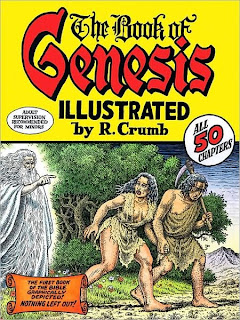
And last for this week is a blad -- remember blads? they're pre-publication book-shaped pamphlets, eight or sixteen pages long, with sample pages from an upcoming book -- of The Book of Genesis, as adapted and illustrated by R. Crumb. The actual book will be published in October as a hardcover by W.W. Norton, and I imagine you'll all hear a lot more about it then. But, in the meantime, a few of us publishing insiders have the cover and ten random story pages to look at, so you must grovel before us.
Sunday, June 28, 2009

Incoming Books: Comic Shop(s) Trip

I hadn't been to my usual comics shop in close to two months, so I decided to hit it on Friday -- but, first, I checked out their competition -- Jim Hanley's Universe, on 33rd Street across from the Empire State Building. (I think Hanley's might be a better store for me in a perfect world -- it's organized as aisles of shelves, with books and comics mostly in alphabetical order by title, instead of having The Wall of new comics and everything else being secondary -- but it took me a while to figure out how it was organized or to find anything. It's a store desperately crying out for some signage.)

I went to Hanley's because there were a number of things -- three of which are listed below -- that I'd neglected to pre-order at my usual shop (Midtown Comics) and which I never ever saw there. So I finally got tired of waiting, and bought them at Hanley's. As life must always be ironic, though, there were a couple of books that I saw at Hanley's -- notably The Fart Party, Vol. 2, second collection of Julia Wertz's very funny webcomics -- that I didn't buy there, because I decided to let Midtown have my business on those...and then they weren't there, either. (You just can't win.)

Anyway, I went to two comic book stores within an hour, buying a pile of stuff for my sons and these things for myself:

Scott Pilgrim Versus The World, the second in the series by Bryan Lee O'Malley -- I liked the first one, so I figure I might as well catch up with it.

The Complete Peanuts 1971-1972 by Charles Schulz, of course. How could I quit now? This is one of the ones I've been waiting to find at Midtown -- I've even asked about it once or twice, but I'd never actually seen it in person.

Little Nothings, Vol. 2: The Prisoner Syndrome by Lewis Trondheim. Again, I really liked the first volume of this series -- this collects diary comics by the French comics creator, originally published (in French) on the web and then collected (in France) and then eventually translated for us monoglots. Again, I never saw it at Midtown despite looking a couple of times.
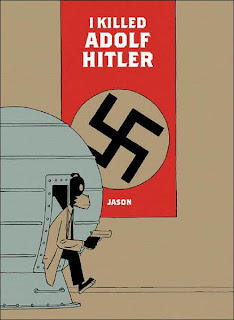
I Killed Adolf Hitler by Jason -- after reading Low Moon in the New York Times Magazine and The Last Musketeer during Eisner deliberations, I thought it was about time I read some more Jason. And this is supposed to be his best book, so why not? I suspect I'm going to have trouble swallowing the background -- it's a world in which murder-for-hire is as common and legal as plumbing-for-hire, which strikes me as something that only really works in satire -- but I like Jason's deadpan wit, so I'll give him an advance on suspension of disbelief.

First Time written by Sibylline with art by various folks -- arty European comics about sex. I'm going to pretend that I'm a massive Dave McKean completest, and so I bought this for his story at the end of this book. Everyone else in the book seems to be identified only by first names, so either they want to distance themselves from this work or Euro-cartooning is utterly overrun by creators (like Jason, above) who have dispensed with the need for a surname. I wonder which it is?

----------------
Listening to: Rilo Kiley - Accidental Deth
via FoxyTunes

Buy Windows 7 Now and Avoid the Rush

I'm hoping that Windows 7 will be more successful than Vista, partly because I assume I'll be using Windows 7 at some point and partly for professional reasons I can't go into quite yet. Early reports are pretty good, so I'm quietly hopeful.

And it looks like the shipping date has stuck and will remain firm, which is usually a good sign. So, all in all, I think everyone reading this blog should click on the below banner and buy some expensive software that does exactly what their computers are already doing, only somehow nebulously "better." (Except for those of you, like me, on Macs -- Windows 7 is pointless to us.)

But here's that banner anyway, just in case:


Go buy it, or not, as you please. It looks like it's cheaper now, as a preorder, than it will be later, which may help you make a decision.

----------------
Listening to: Sinéad O'Connor - I'll Tell Me Ma
via FoxyTunes

Stiff by Mary Roach

Stiff was Roach's first book; she's since written Spook and Bonk, settling into a career as a writer of science books about odd things (after a previous career as a travel writer for magazines). Spook was about the afterlife, Bonk about sex, and Stiff investigates the various things that can happen to a human body after death -- in all cases, for primarily scientific purposes.

Roach has a jokey tone throughout, whether she's writing about the forty decapitated heads for a plastic surgery refresher seminar or the phenomenon of "beating-heart cadavers," brain-dead bodies kept alive so that their transplantable organs can be removed and implanted into other bodies. Cadavers, and pieces of cadavers, get shot, smashed in car wrecks, dissected by med students, burned, buried, treated to a "water reduction process," crucified, and even eaten as Stiff runs through its fairly comprehensive list of scientifically-useful things that can happen to a dead body. (Along with a few that are less scientific, along the way.)

I wouldn't suggest Stiff for anyone of a nervous disposition, or with a weak stomach. Roach doesn't traffic in gross-outs, but this is a three-hundred page book about dead bodies, and all of the consumers of cadavers she writes about here use cadavers because one can do various traumatic things to a dead body without killing it. So, strictly speaking, there's very little gore -- since blood is drained from these bodies, as Roach explains in an early chapter -- but a lot of blunt-force trauma, careful incisions, and examinations of the innards of a large number of the formerly living. Roach is a lively writer who can whistle past the graveyard for her country, and she does so here -- you may be disconcerted or made uneasy by parts of Stiff, but you'll never be bored.


----------------
Listening to: Oingo Boingo - Fill The Void
via FoxyTunes

Saturday, June 27, 2009

An Old iTunes Meme Dug Up

Perhaps because I just finished writing a post about a book on corpses (Mary Roach's very entertaining Stiff) and perhaps because I saw that someone chose today to land on the version of this meme I did three years ago, I decided to revisit it, and see how different my answers are now from September of 2006:

Total number of tracks: 18,731 -- it was 14,262, which means I've added nearly 4500 songs in less than three years. I have been on a music-buying tear, I guess.

Sort by song title:
  • First Song: "A-Hunting We Will Go" by Hem (Eveningland)
  • Last Song: "( )" by They Might Be Giants (Then: The Earlier Years, Disc 1) -- this is the conversation between Gloria and her friend about the Kiss Clinic and intellectuals meeting with other intellectuals.
iTunes seems to have changed its alphabetization algorithm in the last three years, because the old version had numbers at the beginning and foreign characters at the end, and it''s quite different now.

Sort by time:
  • Shortest Song: "Kangaroo -- SFX" by Carl Stalling & the Warner Brothers Orchestra -- 4 seconds (the same -- though iTunes said it was three seconds long in 2006)
  • Longest Song: "Pelleas und Melisande" by Arnold Schoenberg and/or Pierre Boulez directing the Chicago Symphony Orchestra -- 40 minutes, 20 seconds (also the same, and it hasn't changed length)
Sort by album:
Top 10 Most Played Songs:
(It's not quite as bad as it was a year ago, when the boys were on a huge Fountains of Wayne kick, but that band currently has seven of the top ten slots, which would make thus list very boring. So I'm going to elide additional songs by the same artist -- any repeat artist -- in the interests of having a more interesting list.)
This is entirely different from 2006, though there were 2 FoW songs on that list.

Search:
  • "sex" -- 147 songs
  • "love" -- 717 songs
  • "you" -- 1701 songs
  • "death" -- 137 songs
  • "hate" -- 56 songs
  • "wish" -- 47 songs
  • "monkey" -- 54 songs
I am officially a Boring Old Married Guy, if I can't find anything better to do with my time on a Saturday evening than this....

Update: Added links to as many of the songs as I could find, to make this slightly more interesting to those of you who don't already know these bands.

----------------
Listening to: The Police - On Any Other Day
via FoxyTunes

Waiting for Itzkoff

The Book Review arrived with my New York Times this morning, the latest issue not to feature the "Across the Universe" science fiction column by Dave Itzkoff.

This marks the 36th week without Itzkoff, a new record.

I'm confident that Itzkoff can continue his amazing record of not writing reviews for a long time to come, so I'm going to track the lack of Itzkoff in the coming weeks and, maybe -- just maybe! -- we can see the first anniversary of No Itzkoff, which will arrive on October 25.

Of course, to break the streak, all Itzkoff needs to do is read a SF book and write a review of it -- and that shouldn't be too tough, should it?

Saturday Is Bond Day, #15: A View To a Kill

Well, now I'll have that Duran Duran song stuck in my head for five years again. Luckily, I have a lurking fondness for DD -- my guilty-pleasure tastes as a teen tended to the more baroque end of the New Wave to begin with.

A View to a Kill sees the final appearance of Roger Moore as Bond, which even his greatest fans will probably admit was two movies and at least four years later than it should have been. (If Moore's movies had come out as quickly as Connery's early movies did, it might have been different -- but he was three years older than Connery to begin with, and Bond really shouldn't look like a man in his mid-fifties.)

But View to a Kill holds together better than I remembered; it's a better movie than Octopussy, all in all, even if Grace Jones (as Mayday, one of the rare villain's top henchman/Bad Bond Girl roles) hasn't mastered any acting more subtle than a growl at this point. Christopher Walken is the main villain, a microchip tycoon/racehorse breeder named Max Zorin who has a complicated backstory that mostly serves to drag in a cute blonde KGB agent for Bond to bonk in the middle of Act 2.

And the horse-breeder aspect is another example of the pointlessly elaborate plotting of the late Moore Bonds; it's as if they had a series of hats with kinds of scenes -- posh expensive sporting event, party in sumptuous location, unlikely villain's lair, chase with unusual vehicles, interaction with comedy-relief local, escaping death-trap, and so on -- picked one from each hat, and only then figured out a way to get the movie to thread through all of them in turn. On the other hand, the late Moore Bonds do have the vague overall plot involving M (Bernard Lee and then Robert Brown) skirmishing with his KGB opposite number, General Gogol (Walter Gotell), which is a nice bit of continuity and helps to ground the series. Well, as much as it can be grounded.

So, once again, Bond wanders around the edges of something nefarious, trying to figure out exactly what the bizarre plot is this time, shooting thugs and bedding wenches and just generally being dashing as he goes. Moore was 58 at this point, and he seems to be even slower than he was in Octopussy; the action is mostly shooting and climbing rather than hand-to-hand combat.

And the plot is even more bizarre than normal: Zorin intends to blow up the bottom of San Andreas Lake, using that water and a bomb placed on the "lock" of the fault -- yes, I don't think geology works that way, either, but let it pass for now -- to destroy Silicon Valley, corner the world's microchip market, and possibly go into the waterfront property business with Lex Luthor for all I know. That leads to an oddly flat and extended climax, in which we get to watch Zorin slaughter faceless mine workers (which is a metaphor for American capitalism if I ever saw one) while Bond and the utterly useless Good Bond Girl (Tanya Roberts, as the simpering blonde excuse for a geologist this movie calls Stacey -- and why did action-movie heroines suddenly get so wimpy in the mid-80s? I claim a trend, counting Stacey here and Willie in Temple of Doom.) run away from Mayday for a while, then fight the flood, and then get separated for plot purposes.

Stacey is pulled up from somewhere by Bond approximately once every five minutes throughout the last forty minutes of the movie, which is blatant enough that the entire group I watched the movie with -- as usual, my two sons, Things 1 and 2, and The Wife -- noticed it, and began commenting MST3Kially on that and other silly aspects of the end of View to a Kill.

(For another example, Stacey is run down by a blimp, and then pulled up...by Zorin! It's like she has a sign on her back that says "please pull my outstretched arms.")

It's very hard to take the end of View to a Kill seriously, and the mine sequence ends up being a disappointment -- no race down the tracks, only minor explosions -- but it's fun and good-natured, with a decent use of the Golden Gate Bridge for the final confrontation. View to a Kill does tend to end the Moore years with a whimper rather than a bang, but I still think it's better than Diamonds Are Forever, so he wins that particular battle with Connery on points.

And, from here, I'm going to be seeing Bond movies for the first time -- I stopped watching this particular style of dumb movies for nearly twenty years for no obvious reason, and so I missed the Dalton and Brosnan movies. It'll be interesting to see what I missed.

Friday, June 26, 2009

Just in Case You Had a Yen for Manga Friday...

...because Manga Friday has a Yen for you!

Four Yen, in fact!!!

(You'll have to imagine a drum rimshot here, as if punctuating a bottom-of-the-barrel lounge-comedian's act in 1963.)

The four Yen in question were Jack Frost, Pig Bride, Nightschool, and Maximum Ride; I reviewed the first volumes of all of them at that link above. If you can stand my very tedious sense of humor, go check it out.

----------------
Listening to: Tom Waits - Diamonds On My Windshield
via FoxyTunes

Quote of the Week

"I regret to say that we of the FBI are powerless to act in cases of oral-genital intimacy, unless it has some way obstructed interstate commerce."
- attributed to J. Edgar Hoover

Thursday, June 25, 2009

Two Quotes on The Way We Live Now

Both of these are from Nick Paumgarten's epic-length article "The Death of Kings" in the 5/18/09 New Yorker:

1) On p.45, quoting an e-mail from bond salesman Colin Negrych:
Folks were shocked to find the U.S. government unwilling to throw good money after bad at Lehman. This discovery caused market participants to question whether the government would support other large financial entities which they knew to be, or strongly suspected of being, in financial distress, when this support had previously been taken as a given.
2) On pp.48-49, directly from Paumgarten:
[Investment-fund manager Simon] Mikhailovich reserves his greatest scorn, however, for the ratings agencies -- principally Moody's, Fitch, and Standard & Poor's -- the ones that determine a debtor's creditworthiness. Their work is necessary; no one would be able to root through the contents of every C.D.O. on his own. Banks and bondholders need food tasters. But the ratings agencies were paid by the packagers of the C.D.O.s to issue the ratings that made the C.D.O.s attractive -- and they routinely put AAA, or almost zero-risk, ratings on tranches of C.D.O.s which consisted of loans or mortgages that soon went bad. It is true: the peddlers of the chicken shit paid to have it magically pronounced chicken salad, a conflict of interest that most investors ignored. The recipe may have originated in the mathematical models of the banks, but it acquired its irresistible allure with the acquiescence of the raters, whether it was winking or pie-eyed. "They were the ultimate fulcrum, the enablers." Mikhailovich said.
----------------
Listening to: They Might Be Giants - Bastard Wants To Hit Me
via FoxyTunes

Unfortunate Word-Choice Theater Presents...

A direct quote from something currently in my work in-box:
This eMail is your notification that you have been assigned the role of Sub for the convention indicated below.
Bold italics, no less.

Um.....OK, I guess. If it's for the good of the company and everything.

Wednesday, June 24, 2009

Alastair Reynolds, The Million-Pound Man

Various blogs and Twitterers have been asking What It All Means over the past two days, since news came out that Gollancz has signed Alastair Reynolds to an "unprecedented" ten-book, ten-year deal for a million pounds. And so I'll tell you what it means.

But, first, "unprecedented"? There have been deals that would last ten years before (Steven Erikson's big deal with Bantam Press for the Malazan series, for one), and there have been deals for ten books before (ditto Erikson). There have been lots and lots of deals totaling a million pounds or more. It's true that Reynolds hasn't gotten a deal this size before, but he's only been in the book-writing business for about a decade, so the fact that he hadn't signed a ten-year deal before doesn't mean much.

Now -- What It All Means. This means that a) book publishing is not dead, which anyone with two brain cells to rub together knew already. It also means that b) Gollancz sells Reynolds books in quantities that they're quite pleased with, and that they want to stay in the Reynolds business for a long time. It may imply c) that Gollancz is concerned that Reynolds's asking price may rise in the next decade, so they're locking him in at a possibly thrifty hundred-thousand per book. It definitely implies d) that Gollancz intends to stay in the SF business for the next decade, and wants everyone to know it. And that e) they have the money (though it will likely be paid out in the usual publishing dribs and drabs, so much for delivery and so much for publication of each book) to spend on an author they believe in.

Another thing it means, which is more important and encouraging to all of us readers, is f) that Reynolds is definitely going to be writing ten more novels, which we will then get to read. And that means I probably should catch up on The Prefect or House of Suns or both.

Book Marketing 101: An Introduction

Nobody likes marketing, but everybody likes to find the things they want and for the things they produce to get out into the world successfully. So everybody needs marketing.

As it happens, marketing is what I do for a living -- I market business books, mostly but not exclusively complicated technical books to high-end professional audiences, such as accountants in public practice and corporate finance officers. Before that, I worked for various book clubs as an editor, which mostly involved picking books for a specific audience and then promoting those books to that audience -- so it was pretty marketing-intensive, despite the title.

I've picked up a few things along the way, I hope, and I find that I spend quite a bit of time telling authors what I'll be doing for their books, and, more importantly, what they can do. I'm going to try to encapsulate those conversations -- and some of the other things I know about marketing books -- into this series of blog posts, to help inform authors, readers, and anybody else interested in the world of publishing. If all goes well, these posts will go up weekly, on Wednesdays.

Next week will be a look at Amazon, which looms large in my world and is a major player for all kids of books in the US market. Further weeks will either go through topics as I think of them, or as they're suggested by readers. I'll also try to cover questions in this series -- please leave any in comments here or e-mail them to me at GBHHornswoggler at gmail dot com.

But this time I want to talk about something very basic -- channel mix. It's deeply wonky, I know, but at the core of the business of selling books is knowing where and to whom you're going to sell. A "channel" is a way to sell books, and there are more of them than you think.

It's easy to get blindered in the book world, and to assume that the big chain stores are the only way books get to readers. It's more true for fiction than for non-fiction, but there are still more options than you think. This is a non-comprehensive list:
  • Brick & mortar book chains -- this is the obvious one. B&N, Borders, Books-a-Million, Indigo/Chapters up in Canada, and Hastings if you want to count them. All of these are chains of stores that sell lots of books, and have books as their main product category.
  • Online booksellers -- it's not just a euphemism for "Amazon," though Amazon is huge. BN.com does decent business and Borders.com is trying to grow, and there are plenty of others, many of which are more specialized. The books I do, for example, often sell through 1-800-CEO-READ, and Indigo is still a major online bookseller in Canada.
  • Independent book stores -- there are still a couple of thousand of them, and they can be very effective with some kinds of books: particularly the exquisitely-written literary novel. There is also a lot of mythologizing around these stores, mostly by people who should know better; they have much greater nostalgic head-space than they have market share.
  • Big-box stores -- the Wal*Marts and Costco's of the world. They take only a few different books at any one time -- many, many fewer books than any bookstore would, making competition incredibly fierce -- but typically sell a lot of copies of those books. This is a particularly good channel for brand names of one kind or another -- from Nora Roberts to Betty Crocker.
  • Mass-merchandisers -- not all that different from "big-box stores," really, since they also take a few books and distribute them widely. Think of the spinner rack at a drug store, or the display of books in a supermarket, or similar placements -- typically, this was a channel for high-volume books in low-priced editions (generally mass-market paperbacks). This channel isn't the powerhouse it was in the post-war years, partially because there's been such a growth of bookstores and other outlets selling books.
  • Affinity organizations -- these typically sell books to their members through their websites or at their in-person meetings, or both. This channel is strongest for professional books, obviously -- molecular biologists won't find the materials they need at the front of their local Borders -- but there are opportunities for all kinds of books on all kinds of topics.
  • Corporate sales and training programs -- sometimes companies want to buy 50 copies of a single book at once. Sometimes it's because their CEO wrote that book and sometimes it's because they're using the book to teach a roomful of new management trainees about Six Sigma. And so publishers have sales reps that sell directly to those companies.
  • Direct sales -- selling to consumers one-on-one, via phone or mail or electronically. A few publishers, like McSweeney's and Fantagraphics, have even set up real-world storefronts, where consumers can walk in and browse. The outlets I've listed above have been known to get tetchy when publishers try to sell directly "too much," but it can be very useful -- again, particularly for books for a specific, definable market.
  • Non-book stores -- fabric stores carry books on quilting; outdoor-gear places carry books on hiking and camping. Books of local history often move best at the gift shop of the biggest attraction in that area. Fiction doesn't fit into this slot as neatly, but it can work in some cases.
If you're an author, your publisher will have a marketer thinking about these channels (or the subset of them that publisher has an effective salesforce to reach), and -- if you're lucky -- your editor will also think about this as well. But that doesn't mean you should ignore it; the author is always the best expert on her book, so you can help by suggesting possibilities.

(Authors often have unrealistic hopes, which you should keep in mind. It's not always the author's fault -- some authors are monomaniacs who think their book on cheesemaking in Scandinavia will be a major Oprah pick, but most are just optimistic people who think that the Society for Shadetree Management would really, really like a new middle-grade novel about Becky Balsam, Forest Ranger if they only took a look at it. So be careful about pushing your suggestions too forcefully. Make suggestions, but also listen closely to what the people at your publisher tell you.)

The author's responsibility is, first and foremost, to the book -- making it as good as it can be. But the second responsibility -- and one that's shared with most of the rest of the publishing ecology, from agent and editor to publicist and marketer -- is to find ways to get that book into the hands of the people who want and need it.

I know it can be difficult for many authors to characterize those people; too many authors will just say "my novel is for everyone in the whole wide world, even the ones who don't speak English." But even the biggest bestsellers have definite audiences, and huge groups of readers will not be in that audience -- have you ever heard the snark James Patterson gets? -- so you need to think about what other books are like yours, and what kind of people typically read books like that. (It will also help if your "author like me" isn't Dan Brown or Malcolm Gladwell -- look for writers and books at a medium level of success.)

Now look at those books, and think about where you see them. If you write sexy paperback romances, do you see those in Wal*Mart? (Probably not.) But do you see them in the supermarket? (That may be more likely.) This is what your marketer is doing, more or less.

The ways you can help out are most importantly in the more esoteric channels -- do you have a connection to an organization that's related to your book? do you have a mailing list you can promote the book to? is your book one your employer will want to buy for all of the mid-level managers based in Muncie? Let your marketer or editor know about these, and work out what you can do together.

And, most importantly, remember that having your book on the front table at B&N is certainly very nice -- but it's not the only nice thing, and it might not even be the best nice thing that could happen to your book.

Update: I'm going to add other sales channels (ones I missed the first time, and either remembered or was reminded by commenters) here, in a vain hope of being comprehensive one day:
  • Education -- this is actually at least two different, quite separate, channels: Higher Education (college & grad schools) and K-12. Both are immense, and both can be very specific and picky about what they'll take. Higher Ed in particular likes books that come packaged with all of their ancillary materials -- test bank with separate answers (electronic if at all possible), handouts, PowerPoint slides, etc. If you can get a book into this channel solidly, it can mean guaranteed sales every term for the life of the book, so publishers and authors both salivate over it.
  • Libraries -- and not just public libraries, either, but also corporate and academic libraries. Public libraries buy pretty much the same books that the big bookstore chains do, and for the same reasons. Other kinds of libraries collect to fit their particular missions, which may include the topic of your book.

Tuesday, June 23, 2009

They Call Him...Johnny Hiro

ComicMix posted my review of Fred Chao's Johnny Hiro today, which I think was darn nice of them.

----------------
Listening to: LP - Coming Home
via FoxyTunes

Movie Log: Slumdog Millionaire

It's been in my Netflix queue for a long time, and Slumdog Millionaire finally arrived late last week, so The Wife and I saw it last night.

And my God it's a melodramatic movie. I was reminded of Dickens at least a dozen times, and it's very rare that a modern movie reminds me of him even once. It's also frenetic and a bit dizzying, since it's shot mostly with hand-held cameras in narrow places -- and often at high speed, as well.

Everyone who has any interest has probably seen it by now, but, just in case, it's set in India (mostly in Bombay/Mumbai), over the last fifteen years or so. A young man, Jamal, is on the local version of Who Wants to Be a Millionaire?, despite having grown up in the slums and now working as a "chai wallah" in a call center. (Every single character is astonishingly classist, which is another touch reminiscent of the 19th century; being poor is a fatal moral failing.) And he's winning really big, so of course he must be cheating -- no poor kid could possibly know anything! -- and so he's kidnapped and tortured overnight, unashamedly, by the police to reveal his methods.

The cops eventually cut Jamal down, shove him in a chair, and let him sit there do-eyed between the flashbacks, which explain how he learned the answers to the questions. (The movie implies -- though I believe inadvertently -- that Jamal knows essentially nothing else but these few facts.)

We're barely five minutes in, and the movie already has its thumb so heavily on the scales that the other balance has hit the ceiling. I haven't even gotten to the part where a rampaging Hindu mob kills Muslim Jamal's mother in front of him when he's about five. Nor the point where a local gangster/Fagin tries to put out the eyes of Jamal's brother Salim, to make him a better beggar. And so on, and so on.

Crowds in India have rioted over the horrible picture this movie paints of their country -- which is deeply ironic, given that there's a murderous riot early in Slumdog -- and I certainly can't blame them. If there was a worldwide hit movie directed by some random foreigner that depicted the USA as blackly and rabble-rousingly as Slumdog does for India, I might very well have been out there hurling trashcans at plate-glass windows myself.

I can see why Slumdog was popular, but it's a horribly obvious and manipulative movie, and physically hard to watch (due to both the shaky camerawork and the horrible things happening on screen). I didn't hate it, but I didn't really enjoy it, either. And I imagine it will be deeply embarrassing to all Indians for as long as it's remembered.


----------------
Listening to: Richard Thompson - Small Town Romance (Live)
via FoxyTunes

The Empress of Mars by Kage Baker

The Empress of Mars is not one of Kage Baker's "Company" novels; that series is over. Sure, it's set in the same universe as those books, and at least one character (probably two) show hints of being a secret immortal cyborg...but those stay as hints, as the story stays on Mars, far away from the Dr. Zeus company and its machinations.

So this is a sidebar novel -- very much off to the side, telling a separate story that just happens to be set in the same universe -- to that long series. It's also the expansion of the novella of the same name, which was a book of its own from Subterranean Press Night Shade Books in 2004, which will confuse bibliographers, book-collectors and librarians from this point forward. The novella is roughly the last third of this novel, so the story is essentially the same, only with a lot more set-up.

It's the early 24th century -- or perhaps the late 23rd; dates are thin on the ground here, perhaps in an attempt to make it harder for the Internet Nitpicking Squad to detect any possible discrepancies between The Empress of Mars and the main Company sequence -- and the increasingly placid and old-maidish Earth has been shipping off as many of its oddballs and malcontents as possible to Mars as a workforce for the British Arean Corporation. But the initial terraforming plans proved to be too ambitious, and the BAC has radically downsized.

And so one castoff from the BAC, biologist Mary "Mother" Griffith, decides to open Mars's first bar, staffing it at first with her three comely daughters and then increasingly with the quirky but surprisingly useful flotsam of Martian society -- and that bar gives The Empress of Mars its title. That's all backstory; this book is solidly in the SFnal tradition of bar tales in that evil forces are continually trying to shut down the Empress but her regulars and workers always manage to save it and take it to greater heights. (There are no stories told by people at the Empress in this book; in that one way, it does diverge from many similar bar stories of the past.)

Like the original novella, The Empress of Mars is the story of the triumph of pluck over adversity and of pints over prissiness. It's not one of Baker's most ambitious works, but it's an amusing story full of colorful characters, with a SFnal skin (that it does not do to think too closely about, in common with most of Baker's SF). If you've ever enjoyed lifting a pint, you'll find something to enjoy at The Empress of Mars.

Correction: The 2004 novella version of The Empress of Mars is from Night Shade; the 2009 limited hardcover of this version is from Subterranean. Screw future bibliographers; it's confusing me right now.

Monday, June 22, 2009

Wrench in the System

Last year, I gave away bound galleys of a book I was marketing, free to anybody who would blog about it. That book was CauseWired, a great book by Tom Watson about the increasingly interlinked worlds of social networking, philanthropy, and social/political causes. (And that book is even more relevant in a month when solid news of the Iranian crackdown is only getting out via Twitter -- so take a look at it on Amazon, will ya?)

I've got another book that I'd love to share with people, on a different topic by a different great writer and thinker: Wrench in the System by Harold Hambrose. Hambrose is the founder and CEO of Electronic Ink, a design consultancy for information systems. What he mostly does is work on making enterprise systems work -- tweaking those gigantic computer systems that are supposed to control all of the functions for an organization and every once in a while end up shutting the whole place down for months. (As in the famous implementation of SAP R/3 at Hershey's a decade ago, which stopped them from shipping $100 million worth of candy for Halloween.)

I may have just confused those of you who aren't programmers. (The programmers, on the other hand, are probably muttering about how I don't know anything about what I'm talking about -- and, compared to them, I probably don't.)

Big companies have big computer systems -- gigantic databases, massive inventory management operations, huge customer-service systems. And those all have to interface with their human users as well as with each other -- sometimes very well, and sometimes in ways that makes us yearn for the days of Microsoft Bob or "Clippy" the helpful paperclip.

Another way to put it -- my jokey title for this book, when the editor and Hambrose were working it into shape, was Your Portal Sucks: Why IT Investments Fail. That's what it's about, and what Hambrose has been doing for a couple of decades -- helping companies design their computer systems (or, sometimes, their processes, if you want to get really consultant-speak about it) in ways that their users will not only be able to use, but will want to use -- will find it easier to use a new computer system than to do it the old way.

So Wrench in the System is an examination of the ways design -- old-fashioned, art-college design, as well as fancier modern kinds -- can help IT, with lavish illustrations and examples. And I'd like to get it into the hands of people who are going to read it, think about it, and write about it in public. If you're interested, e-mail me at awheeler@wiley.com with details of the blog where you usually write, and maybe (if you want) an indication of what interests you about Wrench in the System.

I Wish I Could Have Heard the Conversation With His Editor

Terry Goodkind's new not-at-all-fantasy novel, The Law of Nines, will be published in September by Putnam. I just read the Publishers Weekly review (close to the top of this page) and noticed that it's set in the modern world with connections to a fantasy world.

Sounds like a good choice for a writer trying to move from secondary-world fantasy to contemporary thrillers; so far, so good.

But his hero is named Alex Rahl, and he lives in Orden, Nebraska -- which is either an indication that this novel isn't as separate from the "Sword of Truth" books as it seems to be, or that Goodkind likes to nudge his readers very very heavily in the ribs. Very curious....

Perseus Lays Off 20, Cuts Exec Pay, and Calls for Furloughs

The publishing bad news had slowed down in recent months, but it hasn't stopped -- this morning Publishers Weekly reported that the Perseus Books Group is cutting twenty jobs and requiring both furloughs and pay cuts for employees this summer.

Reviewing the Mail: Week of 6/20

First, the explanation: since I review books, publishers send me books to review. I never quite manage to read everything -- I'm looking at my "read for review" stacks right now, which number five and are each at least ten books deep -- but I want to call some attention to every book I can. So I post about the mail once a week, with as much as I know or can surmise about these things without having actually read them.

This week I'll lead off with Rick Geary's new book, Famous Players, the second in his "A Treasury of XXth Century Murder" series, after The Lindbergh Child. (And that series is itself a "sequel" to Geary's "Treasury of Victorian Murder," which ran for nine volumes.) Geary's murder books have been uniformly well-researched, carefully-constructed examinations of fascinating cases, done with his usual wit and intensely detailed line-work, and I expect this one -- the story of the death of a director in early '20s Hollywood -- to be equally as engrossing. Famous Players will be published in August by NBM.

I also have here the second volume of Faust, an original anthology series -- mostly fiction, with some illustrations and comics pages, and some essays as well -- from Kodansha in Japan via Ballantine/Del Rey here. Faust 2 was published in 2004 in Japan, and this English-language edition -- with work from Takeshi Obata, Ueda Hajime, NISIOISIN, Katsuhiro Otomo, take, Jatsuya Terada, and others -- will be available June 30th.

One of the best cover blurbs I've ever seen appears on Stuffed! by Glenn Eichler and Nick Bertozzi: "This book reminds me a little of myself, in that I love it." -- Stephen Colbert. How can you resist a book that Stephen Colbert loves nearly as much as he does himself? Stuffed! seems to be the first graphic-novel work from Eichler, a TV writer who created Daria and currently writes for -- surprise of surprises -- a certain Mr. Colbert. Bertozzi is the cartoonist of The Salon, among other works. It's a dark comedy about two brothers dealing with their recently-dead father's collection of oddities -- particularly an African-warrior statue -- and it will be published, by First Second, in September.

Omnibuses sometimes have awkward titles, unfortunately -- I always tried to avoid that when I was putting them together (usually one nearly every month) back at the SFBC, but sometimes it couldn't be avoided. And so it is with the mouthful of Bauchelain and Korbal Broach: Three Short Novels of the Malazan Empire, Volume One. It collects the three short novels about the title characters -- as you might have guessed -- Blood Follows, The Lees of Laughter's End, and The Healthy Dead. All three were originally published by PS in the UK (which also did an edition of this omnibus, I believe), and then were reprinted, in somewhat less limited and expensive editions, by Night Shade Books here in the US. Bauchelain and Korbal Broach are minor characters in Erikson's huge "Malazan" saga, a pair of necromancers who inevitably find, or bring, trouble wherever they go. Their book -- the first of two planned, since there's supposed to be three more novellas-as-books about the pair eventually -- is now being published by Tor as a trade paperback in September.

And last for this week is a book that I saw once before, in bound galleys -- Goats: Infinite Typewriters, the first major-publisher collection of the popular webcomic by Jonathan Rosenberg. Del Rey is bringing this out, in full color (something I didn't realize from the galleys) on June 30th, for old and new fans of the online version.

Sunday, June 21, 2009

Sue Townsend's Adrian Mole Novels

Today has been Father's Day here in the US, which meant I was busier than usual for a Sunday -- I had to have breakfast in bed, and then go out bowling with the family, and then have lunch at a restaurant on the way back from bowling, and then go biking in the park with Thing 2, and then, a few hours later, go out to a big restaurant dinner for the father-in-law. So I haven't gotten nearly as much done today as I wanted to, and I didn't write anything to post today. So, instead, I'll dig into the archives...

For obscure reasons, I
found myself explaining Sue Townsend's Adrian Mole novels in early 2001 on the Straight Dope Message Board. (I believe there may have been a book or two since then, which, of course, I did not know at the time.) And this is what I said then:

Just because I'm compulsive, this full listing, in chronological order, of the series (all books by Sue Townsend):
The second book seem to be available in the USA only in an omnibus of the first two entitled The Adrian Mole Diaries. The rough UK equivalent is Adrian Mole: From Minor to Major, which also includes some material from True Confessions.

True Confessions and Wilderness Years seem to only be available in the USA in an omnibus volume (which might include material not in True Confessions, but which also seems not to include the other characters from that book) called Adrian Mole: The Lost Years.

And that seems to be where we are to date (not including TV tie-ins, playscript versions, and other oddities.) Amazon.co.uk lists as coming in October of this year a book called Adrian Mole: A Comic Novel (I assume that subtitle is just a tentative placeholder).

Anyway, on to personal thoughts. I've read the American versions of the earlier books (Diaries and Lost Years), but not yet Cappuccino. I liked the two books in Diaries quite a lot when I read them -- I thought Adrian seemed real and human. (I'm close to his age, but I only read the Diaries in the mid-90s, so I didn't have much direct identification with Adrian (though I'm pretty sure I would have if I'd read them in the early '80s).

To encapsulate: the first two are wonderful looks at the world through the eyes of a particular kind of smart but unworldly kid, and the tone is perfect. Anyone who was a smart, weird teenager in the early '80s will probably love them.

Lost Years, which I just read last month, I had more mixed feelings about. The True Confessions material takes a scattershot approach, and drags Adrian from young adolescence and the early '80s into young manhood and the Gulf War. Unfortunately, it also take a lovable "might-be" into an obnoxious loser. He keeps the same personality traits, but they're much less endearing when he's 20 -- I started to feel, part-way through, that I was meant to be laughing at Adrian rather than with him. All sorts of unpleasant things happen to him, and he doesn't seem to learn anything -- he seems to turn into a rather dim adult from what was supposedly a bright teenager.

He does grow up a bit by the end of Wilderness, but there's some tough slogging in the middle. There were things I laughed at and felt horrible for laughing at, as if I was personally making Adrian that miserable and unhappy. It's the sign of a pretty good writer, sure, but that's not the reaction you want to get from a light comic novel. All in all, I'd say to stick with the first two.

Saturday, June 20, 2009

Saturday Is Bond Day, #14: Never Say Never Again

The boys and I caught the second half of 1983's Bond double-feature this afternoon, and discovered that Never Say Never Again is as thin and tired as Octopussy, but in slightly different ways. Connery was actually younger than Roger Moore in 1983 -- as in every other year -- but his '83 entry is constructed as a story about an older Bond, perhaps a step slower but still deadly. (The official series, though, never notices that its Bonds get older and craggier before they change entirely.)

This is a remake of Thunderball, with many of the plot elements -- SPECTRE, a villain named Largo, the gorgeous Domino (Kim Basinger this time), the hijacking of two nuclear missiles and consequent blackmail -- basically intact. This time Blofeld is played by Max von Sydow in the deep background -- as in Thunderball -- though he oddly seems to be channeling George Bernard Shaw the whole time. Klaus Maria Brandauer is Largo, and is suitably Teutonically menacing when he needs to be. But his boat's name has been translated from Disco Volante to Flying Saucer, presumably to chase falling American intelligence levels, and the plot doesn't work nearly as well. The seven-day deadline for the blackmail payment to SPECTRE is essentially forgotten, and this becomes another one of those poorly-plotted films where Bond just pokes about and waits for things to happen instead of seizing control of events.

Connery is trying harder here than he was in Diamonds Are Forever, but he's still a bit old and doughy and slow for the part. Never Say Never Again is a C-minus Bond movie: it's watchable but equally forgettable, and the lack of the usual trappings (Desmond Llewellyn as Q, Lois Maxwell as Moneypenny, the John Barry theme music, the iris-and-shot cold opening) turns it into something more like a generic early-'80s action movie than a real Bond film.

Friday, June 19, 2009

I Don't Mind

...other guys dancing with my girl. (That is, I wouldn't mind if I had a girl, which I don't, being married to a woman and having only sons.)

Well, anyway, can I interest you in a review for ComicMix with the title -- which you may have already guessed -- of The Kids Are Alright? It's not "Manga Friday," true, but it's what I did for this Friday.

There, I reviewed five books for kids (more or less) -- Courtney Crumrin and the Prince of Nowhere, Salt Water Taffy: The Legend of Old Salty, Salt Water Taffy: A Climb up Mt. Barnabus, Dungeon Zenith, Vol. 3: Back in Style, and Dungeon Monstres, Vol. 2: The Dark Lord.

----------------
Listening to: Tom Waits - Jersey Girl
via FoxyTunes

Quote of the Week

"No poet or novelist wishes he was the only one who ever lived, but most of them wish they were the only one alive, and quite a number fondly believe their wish has been granted."
- W.H. Auden

Thursday, June 18, 2009

Veeps by Bill Kelter and Wayne Shellabarger

History books are, by long tradition, deep, weighty tomes, heavy with their own significance and importance and a sure-fire cure for insomnia in their readers. (Sure, that hasn't been always so for at least two generations -- if it ever was generally true -- but it's the cliche of history, and most readers at least half-believe it.) Veeps is a custard pie in the mush of that mindset; it revels in the trivial and the scandalous as it romps through a few selected high points in the careers of the forty-six men who have been Vice Presidents of the United States of America.

The VP is the second-highest office in the land, supposedly -- though the Speaker of the House, Senate Majority leader, some of their lieutenants, several governors, and possibly even the Mayor of New York have grounds for disagreement -- but the Veep only actually has as much power as his President doles out to him. And, in most of these cases, that's exactly none.

Veeps gives each of those men -- and a few of the also-rans of the last four decades, in a short section at the end -- a full-page portrait by Wayne Shellabarger, in a semi-19th century pen-and-ink style that brings out every character foible and unlikely detail of physiognomy, a box of "Fun Facts," and a thousand or two words about each Veep's accomplishments, or lack thereof. (Kelter is the writer here, and Shellabarger the illustrator.)

Kelter writes, in his introduction, that he expected to write a "cheeky hatchet job," but that his conception changed as he did more research into the
decent and intelligent men who languished in the glorified dungeon of the Vice President's office, either wishing they'd kept their original day job, or biding their time until they could achieve legitimacy by the will of the voters (mostly a fool's wish, as history has shown) or as the lucky beneficiaries of someone else's mortal tragedy. Upon closer examination, most of these men engender more sympathy than scorn or ridicule.
Kelter clearly came to like most of the oddballs, overripe politicians, corrupt ward-heelers, and nonentities that have held the office -- "a buffoon's gallery of rogues, incompetents, empty suits, abysmal spellers, degenerate golfers, and corrupt Marylanders" -- and Veeps is immeasurably better for his change of heart. It's not hard to mock and scorn, but it's much more difficult to find the humor in someone you pity. Kelter always does, though -- each of these men has something humorous about him, and some of them have little else.

Also on the positive side, this is probably the only book to feature William Almon Wheeler -- veep to Rutherford B. Hayes and possessor of the finest surname in Christendom -- as its cover model in at least a century. On the negative side, Veeps could have benefited from a more careful eye during copyediting; it's understandable, since Top Shelf is otherwise exclusively a publisher of comics, but there are a number of obvious and easily correctable errors in this book.

But that's only a small blemish on a otherwise impeccable volume. Veeps doesn't set its sights very high: it aims to be a collection of humorous anecdotes about the VPs of the USA, mildly disparaging the entire institution, and completely succeeds. There may well be a more scholarly and better-researched books on the veeps in my lifetime -- though even that would not be easy; Kelter has worked hard to unearth his frivolities -- but there will not be a funnier nor a cheerier one. Veeps becomes an unlikely paean to America, the land where even these men can succeed, where failure is rarely final and even obscurity has a cockeyed nobility. All hail to the Veeps!

Several Questions for the Hive Mind

This blog has had the same design (decent, but perhaps a bit boring) since it started, but I've been thinking about various kinds of overhauls. Since everything in this bright and shiny 21st century, I've been reliably informed, will be entirely free, online, and crowdsourced, I figured I'd throw out my half-formed thoughts and see if any of you have any ideas/experience/suggestions to share.

1) I'm thinking about getting a dedicated URL for this blog. What registrars have you folks used? Any problems with any of them? How complicated is it to register a URL with one company and then have someone else host the actual site?

2) I've also thought about moving to another blogging platform, possibly TypePad. (I don't have a server cabinet of my own, and I'm not really interested in doing my own hosting, so I think WordPress and MovableType are out of the running.) Anyone have any experience there? Or are there places I can find a wider variety of templates for Blogger? (I've wanted to go to a three-column layout for a long time now.)

3) What about Google AdSense? No big deal or horribly intrusive and always untargeted? (I've avoided them because I find them ugly and I expected I'd only get about a nickle a month, but I've been tempted lately for other reasons.)

Please also feel free to use this as an excuse to tell me What the Hell Is Wrong With This Blog (besides my opinions, which aren't likely to change much with a redesign).

Wednesday, June 17, 2009

The Reavers by George Macdonald Fraser

George Macdonald Fraser's last novel wasn't one of the Flashman Papers, which is a minor sadness -- but we fans of the series knew at this point that Fraser would never live to tell all of the sordid and fascinating tales of Flashy's very long, disreputable life. But The Reavers isn't a "good enough" book: it's a rollicking adventure, in a milieu Fraser knew well (the Scottish Borders in the reign of Good Queen Bess) in a mode he pioneered with his fine novel The Pyrates: a Hollywood Historical, the literary equivalent of a great old swashbuckling movie, with enough attention to accuracy to warn the reader when it was going completely off the rails and enough panache and style to keep that reader from ever minding.

The Reavers is an entertainment, and Fraser makes it clear, early on and repeatedly throughout the novel, that it's not to be taken seriously. (He knows his history, even if the book doesn't.) So he mixes authentic Elizabethan details and words with stage directions and business, keeping his eye the whole time on the fact that he's telling a story. (As the foreword starts off, "This book is nonsense. It's meant to be.")

Fraser also has harsh words for a kind of reader often encountered in the SFF world:
...we shall tell them that it befell on a certain February 2 -- but make no mention of the year, save that it was sometime between the foundation of Kiev University and the discovery of Spitzbergen, and they can make what they will of that, my masters. Why such reticence? Because the moment a romantic story-teller starts committing himself to actual years, and similar pretensions to strict historical fact, his character is gone, being at the mercy of nit-picking critics who will take gloating delight in pointing out (for example) that Attila the Hun couldn't possibly have studied Monteverdi's second madrigal book, because it hadn't been published in his day, see? Nor were pretzels available in the '45 Rebellion, Out upon them, pedants. (pp.4-5)
I wish more writers would include similar disclaimers; it might not stop the Legion of Internet Whiners, but it would make them seem even more petty and silly, and I'd settle for that.

In any case, at the center of The Reavers is Lady Godiva Dacre, the requisite fiery redhead (accompanied by her faithful handmaiden, Mistress Kylie Delishe, a slightly shorter and more voluptuous version of the same general idea, upholstered in blonde for contrast), who is traveling to one of her far-flung possessions, Thrashbatter Tower, on the disputed English-Scottish borders. Of course bandits strike, and of course Lady Godiva has to be rescued by a mysterious rogue...who turns out to be more roguish than he appears at first.

Soon Godiva is torn between two men, both dashing and accomplished and each the deadly secret agent of a monarch (England's Elizabeth and Scotland's James) -- Archie Noble and Bonny Gilderoy. And all three are racing to foil a dastardly Spanish plot -- complete with an oily monk, devious courtier, violent Highland chieftain, murderous dwarf, calculating wizard, and mysterious femme fatale -- to replace King James with an impostor and wreak general havoc.

Much derring-do ensues, along with a lot of humorous dialogue in cod-Elizabethan and copious sidebar commentary by Fraser. It's impossible to take The Reavers completely seriously, but it tells a romping great yarn with yards and yards of style and wit. Best of all, there's no chance at all of inadvertently learning anything, so The Reavers is a perfect beach read.

Tuesday, June 16, 2009

Box Brown's Old Peculiar

ComicMix posted my review of Box Brown's Xeric-winning (I forgot to mention that in the review, didn't I?) Love Is a Peculiar Type of Thing today.

So this week I'm 2-for-2 on ComicMix reviews. How long can the streak extend?

Scalzi and the Interns

John Scalzi is absolutely right -- defined, as usual for me, as "says exactly what I would have said, to a larger audience, in better words" -- writing about interns earlier today.

I've thought, more than once, that there's no chance I could get a job in publishing these days if I was starting out -- I needed to have real jobs every one of my college summers, to pay for college, and couldn't afford to waste valuable earning time being an unpaid office grunt. And that seems to be the only path in these days. Looks like publishing isn't the only industry with that problem; it's a pity.

An Evil Guest by Gene Wolfe

Gene Wolfe is one of the finest and most subtle writers in the SFF field, but he hasn't been particularly noted for the depth of characterization and feeling of his female characters. An Evil Guest may be an attempt to remedy that, but, if so, it's not entirely successful. (Though, since Wolfe is such a slippery, allusive writer, it can be dangerous to make any categorical statements about his novels -- it's easy to miss something important, mentioned by implication and buried, that proves that assumption wrong.)

An Evil Guest is the story of a young, vain actress a hundred years in the future -- a future that has been carefully constructed to be very much like the 1930s, with a very few standard-SF emendations and many holes where we expect to find the standard furniture of our own society. She's a stage actress in a provincial New England city -- never named, though I suppose one is meant to assume it's Arkham, Massachussets -- which, in this world, is something one can earn at least a poor living from, unlike our own, where such theatricals are the hobby of amateurs.

Her name is Cassie Casey, and she's a bit of a ditz -- not overly so for an actress, particularly in the '30s mode Wolfe is emulating, but her head definitely contains more than the government recommended amount of air. She's pursued, for her gorgeousness and massive sex appeal rather than any more intellectual or even thespian qualities, by both Gideon Chase -- a private detective with high government connections, uncanny abilities, and ties with the only known extrasolar intelligent race -- and Bill Reis, the obligatory ridiculously rich and powerful man whom no one dares to cross.

Through a series of long but frustratingly undirected conversations and scenes that always seem to move the plot forward without quite bringing it into focus -- I did say this was a Gene Wolfe novel -- Cassie obsesses about her weight, becomes immensely famous as a stage actress in a minor city, is abducted and imperiled the requisite number of times, is maneuvered into bed by both of the above men and comes to intermittently believe she's in love with one or the other of them, and utterly fails to have any direct effect on any of the actions of the novel, which remain murky. (Note which of those verbs are active and which passive, and what that implies about Cassie and her role in the plot: she's decorative and desirable, like a valuable antique vase.) That's all par for the course for Wolfe; we don't read him for clear plots, conversations that remain on point and provide valuable information, liberated or even active female characters, or endings that make perfect sense the first time through.

Behind Cassie's story is some larger series of events, which have a slight Lovecraftian flavor, particularly near the end. But those events never come into the center of this book, and we're left, as so often with Wolfe, to figure them out from hints and lacunae in the story we thought we were reading.

An Evil Guest is wryly funny much of the time, and deeply pleasurable to read on a sentence-by-sentence level. But readers must adapt to the standards of a Wolfe novel if they want to avoid excessive grinding of their teeth during the reading, and some -- particularly women and those who enjoy direct, linear plots -- will have particular trouble doing so. This is not a major Wolfe novel, but it's successful on its own terms, and would, like most Wolfe, reward re-reading for those who can find enjoyment in it the first time around.


----------------
Now playing: Elvis Costello - All This Useless Beauty
via FoxyTunes

Monday, June 15, 2009

Think About Your Father For the Five Minutes It Takes To Send Him a Gift Card Electronically

And it could be even quicker if you're notably decisive, have zippy fingers, or have turned on "1-click"!

Let's face it, Father's Day only exists because greeting-card companies saw their Mother's Day profits and got greedy. I'm not going to say I'm against it -- I hope to lounge in bed and not do anything substantial this coming Sunday, after all -- but it's not one of your more important holidays. And we generally acknowledge that: there's no substantial market for complicated, expensive Father's Day gifts, because, as we all know from popular culture, all fathers are rude, stupid and uncultured buffoons who don't appreciate anything or understand anything more elevated than college basketball.

So there's no reason not to go with the quickest, easiest, most mindless option -- if you've decided to give your father anything at all. And that's where Amazon comes in: they give you the opportunity to say to Dear ol' Dad: "Pops, I know you must want something, and I bet Amazon sells it. But I don't know, nor do I care, what that actual thing is. So buy yourself a gift, and pretend it came from me. Oh, and let me talk to Ma, again."

Amazon accomplishes this through their amazing Gift Cards, which I will encapsulate in the below banner, because I love you all dearly:

Please note that Gift Cards are suitable for all mindless gift-giving occasions, and not just Father's Day; they're available any time you want to say "Hey! At least I gave you something."

----------------
Listening to: Elvis Costello - Battered Old Bird
via FoxyTunes

I Will Not Be Pushed, Filed, Stamped, Indexed, Briefed, Debriefed Or Numbered!

But I will be rated, just for a lark:

OnePlusYou Quizzes and Widgets

Created by OnePlusYou - Free Online Dating


I think I did this meme once before, and got the same result -- but this time I got it from Mark Evanier. Though I don't entirely trust it, since I'm sure I've thrown in a "fuck" or two somewhere.

Just Look at this Mess!

Hey, remember when the Hornswoggler reviewed Miss Lasko-Gross's A Mess of Everything for ComicMix?

Man, those were some good times, weren't they? Did he ever get the stain out of the carpet? Dude, I was so wasted that day!

Reviewing the Mail: Week of 6/13

As always, I make these Monday-morning posts to give some attention to all of the books I was sent for review (and, occasionally, other things), since no human man could read and review them all. I haven't read any of these books yet (with one exception this week), so my comments are based on hearsay, informed speculation, and half-formed memories of earlier books by the author and/or publisher.

With that said, here's what I saw this week, which turned out to be a big one for mail:

Charles Stross's new short-story collection Wireless is the one exception to my usual "haven't read it" rule -- I saw it in galleys a couple months ago and I'm poking away at a review right now. The last Charles Stross book -- last year's entertaining but gloomy and not completely successful late-Heinlein pastiche Saturn's Children -- got me to write a review that was generally misunderstood. (Which means I wasn't as clear as I should have been.) Wireless has given me another Unified Field Theory -- Stross's fizzy and intellectually-dense books just affect me that way -- which I am currently trying to bash into better shape than last year's theory. Further updates may appear in this space; I'm hoping to post the review on Wireless's official hardcover publication date of July 7th.

The rest of the stack for this week is organized by size, with mass-market paperback on top and the biggest stuff on the bottom, which is as good an organization as any.

So on top is Kristin Landon's The Dark Reaches is the third in her SF series, after The Hidden Worlds and The Cold Minds; Ace is publishing it in mass-market in July. Despite the cover, I'm pretty sure it's not actually the story of two devastatingly stylish bouncers in Iceland.

Gamer Fantastic, an original anthology edited by Martin H. Greenberg and Kerrie Hughes and published by DAW in July. It has thirteen short skiffy stories about video games -- written by names like Ed Greenwood, Jody Lynn Nye, S.L. Farrell, Kristine Kathryn Rusch, and Bill Fawcett -- and is this month's entry in the Tekno Books anthology-of-the-month club.

Also from Ace as a July mass-market, Patrice Sarath follows up her debut novel Gordath Wood with a sequel, Red Gold Bridge. It's a portal fantasy with a horse on the cover, and that about exhausts my knowledge of it.

A week earlier from Ace -- coming in mass-market on June 30th -- is Marjorie M. Liu's Darkness Calls, the cover of which features extensive use of the kind of shiny foil intended to signal chain-store buyers that this is a big big book that they should stock in depth at all locations. (Liu's previous book in this series, The Iron Hunt, was a New York Times bestseller -- as far as I can tell, hitting the extended list at #35 for one week -- which is even more likely to make those buyers take notice.) The astute browser can see that the heroine of this novel (Maxine Kiss, a demon hunter -- it's another one of those contemporary fantasy novels that we used to call vampire-shaggers) is remarkably tough, since she is clutching her shiny shiny foil-sword by the blade rather than the handle. Plus, she has a lot of tattoos on her half-naked back and is wearing a lot of leather. So don't mess with her. Plus, of course, she's a demon hunter, so presumably the likes of you and me wouldn't even make her raise a sweat.

Charles de Lint's new book Medicine Road -- coming from Tachyon as a trade paperback in July -- has a 2004 copyright date, so I suspect it appeared in some other form, probably with a more expensive package, in that year. (de Lint mentions Bill Schafer in his acknowledgements, so I suspect it was from Subterranean Press, so let me check Amazon -- yep, that was it.) Anyway, this is the story of bluegrass musicians Laurel and Bess Dillard, touring the American Southwest and meeting mysterious, magical strangers, as it was in 2004 (for those people, unlike me, who noticed at the time), but now it's available for much less money, and will likely be available, and known, to more people. It's also handsomely illustrated by Charles Vess, but those illustrations look to be picked up from the original edition, so it's not a net plus. Still: cheaper and not out of print are very nice.

Pyr is publishing James Barclay's fantasy trilogy "Chronicles of the Raven" in back-to-back-to-back months, and I have the first two of them in front of me right now: Dawnthief and Noonshade, coming in trade paperback in September and October, respectively. "The Raven" is a group that the back cover refers to as "six men and an elf" -- I think I saw that movie! (One of them, I see from the dramatis personae, is even named "The Unknown Warrior," but I doubt it's the one who I used to watch wrestle back in the late '80s.) This is secondary world adventure, somewhere between David Gemmell and R.A. Salvatore, the kind that always makes me wonder if the author is or was a gamer. There are also a bunch of glowing quotes from various UK media -- Barclay has been published long enough over there that this series has already had the eye-gougingly vivid covers and then the tasteful, subdued ones -- though of course readers always claim that quotes and reviews and the recommendations of taste-makers never ever influences their own buying decisions, uh-uh, no way.

And then there's Harry Potter's Bookshelf: The Great Books behind the Hogwarts Adventures, written by John Grander, whom Ace bills as "renowned Potter pundit" and whom has been riding Rowling's gravy train for some time now. I have no idea who buys these pseudo-academic explications of the purported influences on major pop-culture icons, but someone must, since they keep being published. I am vaguely surprised to see this one coming from Ace; it looks like a Citadel book all the way. But, if you want this, it'll be available in trade paper with a carefully non-infringing cover on July 7th.

From AdHouse, a small comics publisher that does some really interesting, quirky stuff, comes Ace-Face: The Mod with the Metal Arms by Mike Dawson, who also did the book Freddie & Me (which I reviewed in the middle of this long post). It's about...well...a '60s era British superhero who has cyborg arms, and who is, in fact, a mod. (Rather than a "rocker," for those of you who have thankfully forgotten or never knew that particular cultural chasm.) There seem to be some other strips in here as well, all by Dawson but featuring other characters from the same fictional world, including the Face's non-superheroic son and two wild talent grade-schooler brothers who seem to spend all their time and talents in tormenting each other (which certainly rings true to this father of two grade-school boys). Ace-Face was published in April.

Also from AdHouse, and also a sideways take on superheroing, is Remake by Lamar Abrams, which seems to be about that little superhero (kid?) on the cover. His name is Max Guy, and it looks like this book has both superhero-y adventures and more mundane "real-life" stories about him. This one was published in May.

Not actually a comic, but based on one, is Greg Cox's novelization of Countdown, the huge DC weekly comic that ran from the summer of 2007 to the summer of 2008 as the transition between two major crossover events that I'm trying not to waste brain cells remembering. I'm not sure why anyone thought this story required novelization in the first place -- probably because enough people bought the previous similar books by Cox (Infinite Crisis and 52), if I had to guess -- but here it is. It's an Ace trade paperback on July 7th, and if you want to read about a lot of superheroes running around punching things but are allergic to actual comics, it will be perfect for you.

I've never read a novel by Nancy Taylor Rosenberg -- she writes thrillers that usually have an audience more female than male, sometimes with women- or children-in-danger plots -- but I used to sell her books regularly back when I ran a bookclub for large-print readers. So I'm familiar with her name, though I didn't expect to see her new book, The Cheater, show up in my mailbox for review. The Cheater returns to one of Rosenberg's most popular characters, Lily Forrester, the heroine of her first novel Mitigating Circumstances (and also Buried Evidence, if my research is correct). This time, Lily is a judge who has to deal with her husband being arrested for a rape he swears he didn't commit, plus the investigation of a serial killer who targets cheating men. It was published by Forge on June 9th in hardcover.

Rift in the Sky is the third novel in "Stratification," which is also part (if I'm following this correctly) of a larger series called "The Clan Chronicles," and it's by Julie E. Czerneda. My old boss, Ellen Asher, used to grab Czerneda's books as soon as they came in to the SFBC, so I've never read her -- Ellen and I more-or-less split the field down the middle, though in no obvious way. She's also the Master of Ceremonies at this year's Worldcon, which I think means that all Canadians are now required to buy and/or read her books. (Though I'll have to check the by-laws to be sure.) Rift is a DAW hardcover in July.

And last for this week is another graphic novel from AdHouse, Fred Chao's Johnny Hiro. It's set in New York, and looks to have both ronin, giant lizards, and touching domesticity. The first story, in fact, is titled "Big Lizard in My Backyard," and I'm strongly inclined to love any book that leads off with a Dead Milkmen reference. This one was published in June, and I should note that the original Johnny Hiro series -- which this book collects, along with much new material -- was nominated for four Eisners in 2007.

Sunday, June 14, 2009

Sixty Million Frenchmen Can't Be Wrong by Jean-Benoit Nadeau and Julie Barlow

There's a faint whiff of the position paper wafting through this book, which was funded by a foundation called the Institute for Current World Affairs (which sounds like a front organization for either somebody's secret service or SPECTRE) and researched during the authors' two years of living in France from 1999 to 2001.

(And, I have to say, "go live in the capital of a major European country for two and half years, do stuff, and write a book about it" is a great job. How does someone go about getting jobs like that, anyway?)

Nadeau and Barlow are a Canadian couple who have worked and written for NGOs before, but Sixty Million is generally a pleasant read, even if it does have facts and figures stuffed into the margins every now and then. Its thesis is basically that, according to North American standards, France's society and government shouldn't work at all -- and yet they do, with France being the world's fourth-biggest economic power (despite legally mandated thirty-five hour work weeks and an average of seven weeks of paid holidays a year) and the French being remarkably more healthy than Americans (despite smoking, drinking, and eating "worse" than even Americans). There are more ruffles and details to the book than that, but that's the big central question: why and how are the French so wealthy, happy, and healthy when, according to how we think the world works, they shouldn't be?

Nadeau and Barlow have divided the book into two large sections -- Spirit and Structure -- each of which has eight or ten chapters about various aspects of French life, society, and government, and then a shorter section at the end about the ways in which France is "now" (circa 2003, when the book was published). Spirit is about how "[t]he traditions of the French, their peculiar understanding of privacy, their love for grandeur and rhetoric, and their peculiar brand of political intolerance are the founding pillars of their society," and Structure is mostly about that gigantic, invasive, often-infuriating French bureaucracy of a government, and why the French want and keep it that way.

Sixty Million was published just before "French" became a slander word for the American right for no good reason, and partially because of that, it's primarily focused on France in itself rather than France as others see her. And that's all to the good; a similar book done a year or two later would feel much more dated now.

This book is a pleasant read and filled with interesting facts about a great country -- one which confuses and even infuriates its friends on a regular basis. Nadeau and Barlow mostly set out to examine particular obvious aspects of French society, so the axe-grinding quotient is fairly low. They do both clearly enjoy and appreciate France, which will annoy the crowd that would never be interested in a book titled Sixty Million Frenchmen Can't Be Wrong in the first place. But, for anyone who's ever wondered why France works -- or if or how it does -- this is a fine, useful book that provides a lot to think about.


----------------
Now playing: Pink Floyd - Us and Them
via FoxyTunes

Saturday, June 13, 2009

Sentences I Never Thought I'd Hear Myself Say

"{Thing 1}, don't just stand naked in the hallway scratching your butt!"

----------------
Now playing: The Breeders - Don't Call Home
via FoxyTunes

An Idle Thought

Has anyone done any work -- serious or popular -- into analyzing the different standards of "hunting" in the US and UK and using those to explain the characters of the two countries?

Here's what I mean:

In the US, "hunting" can be social, but the essentials of it are individual: hunters mostly go out alone, carefully camouflaged to sight and smell, to hide in the woods or quietly stalk their prey. That prey typically is large; the standard hunted animal in North America is the white-tailed deer. (For the hunters out there, I'm ignoring bird hunting for the purposes of this discussion.) A successful hunter then has to bring his kill out of the woods, which is no small job and has been the source of many useful gadgets. Hunters see themselves as part of a tradition, one that reaches back to the 18th and 19th century frontiersmen and even to Native Americans; those most serious about that tradition often avoid modern technology -- using black-powder weapons or bows -- as much as possible to focus on their skills and be more "fair." It can be a very expensive hobby, but the essentials of it -- a long gun, tough outdoor clothing, and a permit -- are within the reach of nearly every rural person, and already part of the lives of many of them.

In the UK, "hunting" is immensely social and ritualized, organized into centuries-old Hunts with severely aristocratic overtones and requiring serious expenditure and gear, including large numbers of dogs and horses. (Again, American hunting sometimes uses dogs, but mostly for bird hunting, which I'm ignoring to make the distinctions clearer.) The dress code is also very regimented. The standard hunted animal is a fox -- once a serious agricultural pest, but now existing mostly to be hunted -- which provides only sport, not food, unlike the American deer. Obviously tradition is very important to British hunting, but it's a civilized, aristocratic tradition rather than one related to food-gathering or individual expertise. (One can show oneself well in a British hunt, but it's the dogs that get the fox -- an American hunter makes his own kill from start to finish.)

Has anyone ever used that as a way to write about the differences in the two nations? I'd be interested in reading that book. (Said the man who spent five years editing a book club for American hunters.)
----------------
Now playing: Guadalcanal Diary - (I Wish I'd Killed) John Wayne
via FoxyTunes

An Exact Replica of a Figment of My Imagination by Elizabeth McCracken

This is a memoir of the year between the birth of McCracken's first son and the birth of McCracken's first son. As she writes, "this is the happiest story in the world with the saddest ending."

In April of 2006, McCracken was living happily in semi-rural France with her new husband Edward, pregnant with a boy they were calling Pudding until he was born. This wasn't at all the life she'd expected; a couple of years previously, she'd thought to live out her days as a "spinster" (her word) and she was satisfied with that. But she met and married Edward, an Englishman, and found herself in Savary, in the southwest of France, both of them writing for a few months before an expected trip to England in the summer and teaching jobs in America in the fall.

But then, on her "French due date," Pudding died. Two days later, McCracken went through labor for her stillborn son. Soon afterward, they left France forever. In early May of 2007, in Saratoga Springs, New York, McCracken's son Gus was born, healthy and as happy as a newborn ever is.

An Exact Replica of a Figment of My Imagination tells the story of that year, from the latter days of the first pregnancy to the early days of baby Gus, in precise, devastating language and dozens and dozens of short, unnumbered chapters. It's a short book with a huge punch; it made me (nearly) cry on the train several times, and I never cry from books. It's powerful and true and paradoxically both raw and carefully measured in its words. McCracken, whom I hadn't read before, is an amazing writer; I'll have to track down her novels.

Don't read An Exact Replica if you're currently pregnant, or may be so soon. But if you can stand to read a story like this, McCracken is as good as it comes in telling it, and she makes it both crushing and uplifting -- sometimes both at once.

Friday, June 12, 2009

Saturday Is Bond Day, #13: Octopussy

Bond Day is turning into a movable feast; this week it came on Thursday. By Octopussy, Roger Moore is definitely getting too old and the movies too silly; this is what we all think of when we think of the Moore Bond.

Interestingly, though, this time he's paired with two women who are also notably older than the usual run of Bond Girls -- the False Bond Girl is Magda (Kristina Waybourn, 33 when the movie was released) and the True one is the titular Octopussy (Maud Adams, returning after being the False one in The Man With the Golden Gun a decade before, and now 38). Sure, even Adams is a good decade-and-a-half younger than Moore, but at least she's not 22.

Octopussy is a step slower than the grounded and stylish For Your Eyes Only, and a return to the more cartoonish saving-the-world of the previous movies: Octopussy is the head of a large international jewel-smuggling ring, in cahoots with Kamal Khan (Louis Jourdan, who is not the most threatening Bond villain one can conceive of), though their actual modus operandi is more complicated than I could follow. (It involved a bloodthirsty Soviet General, Orlov, sneaking out Faberge eggs and other priceless treasures so that Khan's pet jeweler -- whom we never properly get introduced to -- can copy them, and then either the originals or the copies are then sold, or smuggled, or something.)

Bond gets caught up in this when agent 009 -- not otherwise named, and unrecognizable under clown makeup in his only scene -- is killed while investigating Octopussy's circus somewhere in Europe. But the trail doesn't lead him to her for quite a while; this is one of the Bond movies where the plot is just an excuse to stitch together scenes that Cubby Broccoli or the director, John Glen, wanted to put in: various chases (including one with elephants), Indian palaces, and of course a bevvy of female eye candy.

Moore is still game, and the technology behind the stunts is improving enough that it's not always obvious that he's in front of a blue screen, but he's obviously older and slower and the script gives him ever more jokey one-liners and silly scenes (such as a battle among Indian fakirs, where all of the cliches you are thinking of right now are deployed one by one).

Octopussy is fun as long as you don't take it seriously, and it's difficult to take it seriously with a lightweight like Jourdan as our world-threatening villain. (I might have missed it, but there doesn't seem to be any explanation of why he wants the Soviets to conquer Western Europe.) Steven Berkoff as Orlov is nastier and crazier, but he has only a few scenes. The only real reason to watch Octopussy these days is if you're a huge Maud Adams fan or if you're making a point to watch all of the Bond movies.


----------------
Now playing: The Judybats - Down In The Shacks Where The Satellite Dishes Grow
via FoxyTunes

The Unexpected Return of Manga Friday

I didn't announce it ahead of time, since I was sure that would jinx it, but this week I had the intent of going back to thrice-a-week reviewing for ComicMix -- which I still think of as my standard, though I've missed it more often than I've hit.

And I did make it with today's "Manga Friday" column, which reviewed three quite different books from South Korean and China: Mijeong, The History of the West Wing, and Step, Vol. 1: Dynasty Tang.

No promises for next week; I've learned not to promise what I'm not sure I'll deliver. But I do have a big stack of books I should review, and an even bigger one of books I still need to read, so I'll be beavering away at those, and we'll all see what comes out of it.

----------------
Now playing: Richard Thompson - No's Not A Word
via FoxyTunes

It's Definitely Twisted, But Not How You'd Think

Have I ever mentioned Bent Objects here? It's a quirky blog that doesn't fit into any obvious category -- someone named Terry in Indianapolis makes little sculptures out of wire and found object and then arranges them into little tableaus -- but it's very inventive and usually quite clever.

This form -- whatever you'd call it -- is particularly good for turning metaphors into something physical, which impresses me when it's done well. And today's entry (as seen to the left) is one of the better ones.

Quote of the Week

"The novelist, afraid his ideas may be foolish, puts them in the mouth of some other fool, and reserves the right to disavow them."
- Diane Johnson

Thursday, June 11, 2009

The One Millionth Word!

Mashable reports that there's a group called the Global Language Monitor -- which sounds like the villains in a minor Grant Morrison comic, by the way -- that is claiming that "web 2.0" is the one millionth word in the English language. There's some controversy surrounding the claim, of course, since apparently the GLMs didn't count every single word and wait for the millionth one to walk by, but just decided it's about time for a millionth word, and this is the one they like.

Given that words don't come in ones and twos, but in phalanxes and divisions, there's never going to be the single "millionth word," so just picking one random zeitgeisty word is as reasonable a method as any. But there are two problems with "web 2.0" even in that formulation.

First, as Mashable and others have been saying, "web 2.0" sounds old and tired now. If we're going to do something zippy and Internetty, surely "tweet" is more modern?

But what I haven't seen anyone mention is that "web 2.0" can't be the millionth word in the English language because it isn't a word. It's a phrase. Surely we all realize the difference between a word and a phrase? (And the English language already has well over a million phrases, as anyone with the bare minimum of mathematical literacy can quickly realize.)

A Time-Sink for Word-Lovers

There's a new meta-dictionary online, called Wordnik. It has definitions, usage statistics, examples, pronunciation, and other details to help writers find precisely the correct word...or spend the next two hours poking about instead of writing the next page.

Since I'm competitive, the first thing I did was look up words off of the top of my head until I found one I was the first to search for -- it was faw, as it happens. Other words no one had searched for yet included hornswoggler, pilote, and embracery. Sadly, antidisestablishmentarianism, my all-time favorite word, is not (yet?) in their dictionary.

And now I'm closing that window firmly, to get back to work.

[via GalleyCat]

Wednesday, June 10, 2009

It Was A Dark and Stormy Night

Just watch -- that'll be the title of the next one.

I reviewed a graphic novel with the unwieldy title of Jim Butcher's The Dresden Files: Storm Front, Vol. 1: The Gathering Storm today for ComicMix.

Getting Married? Why Not Buy a Ring Over the Internet?

Yes, Amazon has found yet another thing that they'd like to sell you at a distance -- they think that they can help you choose just the right engagement ring through the medium of a cold, impersonal web browser.

If you think that would work for you, click on the below banner:


If you're looking for a regular jeweler, I can recommend Neil Diamonds of Ridgewood, NJ -- I got The Wife's engagement ring there about sixteen years ago. (I think they did the wedding band I'm wearing right now, too.)

----------------
Now playing: The Kinks - Acute Schizophrenia Paranoia Blues
via FoxyTunes

Whooga!

A website called Whooga -- it sells sheepskin boots -- has just gotten in touch with me, out of the blue. They're offering $30 off any order from their site to folks who use the code ANTICKMUSI.

I get no kickback from this one -- and I have no connection to this site other than the fact that they just e-mailed me -- but I'll pass it on to you out of the goodness of my heart. If any of you are looking for sheepskin boots, check 'em out.

The Sleeper Wakes: A Mind Meld

SF Signal has a new "Mind Meld" up today, with suggestions for books for a person who self-identifies as a SFF reader but hasn't read anything newer than 1974. (And the more I think about that, the more I believe the only plausible explanation involves coldsleep.)

I'm one of the people who replied, and, as usual, I spent most of my space arguing with and contemplating the premise. My fellow melders this time include Tony Daniel, Jeffrey Ford, Jennifer Stevenson, Felix Gilman, and Adam-Troy Castro. Also as usual, I'm probably the most verbose and least helpful. (Sometimes I'm beaten out on those counts, but John C. Wright wasn't part of this one.)

Home Game by Michael Lewis

Every man is an expert in his own life, which can cause trouble when he writes about things he shares with millions of other men -- he can find that his experiences aren't as universal as he thought, or that what he has to say about them isn't as profound as he hoped.

I've only previously read Michael Lewis when he was writing about financial topics, and there he has a massive lead on me, and on most of us, in knowledge and expertise. Home Game, though, is a memoir of parenting (lightly adapted from a series of columns he wrote for Slate), which means Lewis is opening himself up to the Monday-morning quarterbacking of nearly every reader. And though Lewis's voice is as casually authoritative as ever, when the reader can check it against his own life, it holds substantially less real authority.

For example, he protests far too much, both about the fact that men of his generation (meaning him) are expected to actually do some of the caring for their spawn, and about how very, very hard he and his wife have it, with the children waking up at night, and making it hard to work, and so forth. For the latter, I should mention that we're talking about Lewis, at least comfortably well off as a writer of books, and who works at home on his own schedule, and his wife Tabitha Soren, who seems to have retired from her original career of being the smart, grounded person on MTV to be a full-time wife and mother, who at the beginning of the book jetted off with their then-only child to live for a few months in Paris for no particular reason.

Lewis does wring some humor out of the standard set-pieces of the daddy memoir, but he also mentions off-handedly that he and his wife got full-time help with the kids at some point, which rather diminishes his achievements in the eyes of readers who may have worked one (or two, or three) jobs outside the home without the benefit of even one full-time person in the home.

Home Game also focuses mostly on Lewis's kids -- Quinn, Dixie, and Walker -- at their least distinctive, when they're infants. (And, even then, Lewis is more interested in his own reactions to them than to the things that they're actually doing and learning -- this memoir is firmly locked up inside Michael Lewis's skull throughout.) Lewis does tell entertaining stories, and his voice is as engaging and smooth as ever, but Home Game feels even slimmer than its 190 pages.

Home Game
is one of those short, inoffensive books published every June, presumably for children who don't really know their father's tastes but still want to give him something for Father's Day. It doesn't bear much sign of having been rethought or expanded substantially from those old Slate columns; it's really a series of short essays on being *M*i*c*h*a*e*l* *L*e*w*i*s* and learning to cope with a succession of babies. Its applicability to those of us who are not Michael Lewis will be slight, but it is often funny, and your father will make a pleased noise if you give it to him a week from Sunday. But, if you really love the old man, try to get him a better Michael Lewis book -- preferably one he hasn't already read.

Tuesday, June 09, 2009

Fantasy Writer Quiz/Meme

James Nicoll took this quiz, and so I had to, as well. And it turns out, not all that surprisingly, that we had the same result:

Your result for Which fantasy writer are you?...

Mary Gentle (b. 1956)

15 High-Brow, 17 Violent, 3 Experimental and 23 Cynical!


Congratulations! You are High-Brow, Violent, Experimental and Cynical! These concepts are defined below.

Mary Gentle is a UK author whose work has received some acclaim. Her great break-through came with 1984 fantasy novel Golden Witchbreed, which depicts the travels of a UK envoy on a planet, Orthe, where the inhabitants have, by choice, abandoned a high-tech society for a seemingly less advanced way of life. Though nominally science fiction, the novel is generally called fantasy, partly because Orthe has the feel of a fantasy world. Nothing is what it first seems to be on Orthe, however, and the envoy's journey across the planet gradually reveals a vividly imagined alternate society, where nothing is ever over-simplified or, for that matter, easy. Gentle revisited Orthe in 1987, when the sequel Ancient Light was published.

Since then Gentle has written the White Crow sequence, starting with Rats and Gargoyles (1990), which has received some acclaim, not least from other writers; China Miéville, for example, put it on his list of "50 science fiction and fantasy novels socialists should read". She has also written Grunts! (1992), a novel set in a Tolkien-like fantasy world, but told from the point of view of the orcs, as well as several other books.

Gentle is not one to shun away from difficult issues in her works and is equally unafraid of discussing and depicting violence. Neither has she settled to writing the same kind of story over and over, and, while being at her best a great entertainer, she has the ability of twisting and bending fantasy environments and themes at her will, making unafraid a key-word of her career as a writer.

You are also a lot like Gene Wolfe.
If you want something more gentle (no pun intended), try Philip Pullman.
If you'd like a challenge, try your exact opposite, J K Rowling.

Your score

This is how to interpret your score: Your attitudes have been measured on four different scales, called 1) High-Brow vs. Low-Brow, 2) Violent vs. Peaceful, 3) Experimental vs. Traditional and 4) Cynical vs. Romantic. Imagine that when you were born, you were in a state of innocence, a tabula rasa who would have scored zero on each scale. Since then, a number of circumstances (including genetical, cultural and environmental factors) have pushed you towards either end of these scales. If you're at 45 or -45 you would be almost entirely cynical, low-brow or whatever. The closer to zero you are, the less extreme your attitude. However, you should always be more of either (eg more romantic than cynical). Please note that even though High-Brow, Violent, Experimental and Cynical have positive numbers (1 through 45) and their opposites negative numbers (-1 through -45), this doesn't mean that either quality is better. All attitudes have their positive and negative sides, as explained below.

High-Brow vs. Low-Brow

You received 15 points, making you more High-Brow than Low-Brow. Being high-browed in this context refers to being more fascinated with the sort of art that critics and scholars tend to favour, rather than the best-selling kind. At their best, high-brows are cultured, able to appreciate the finer nuances of literature and not content with simplifications. At their worst they are, well, snobs.


Violent vs. Peaceful

You received 17 points, making you more Violent than Peaceful. Please note that violent in this context does not mean that you, personally, are prone to violence. This scale is a measurement of a) if you are tolerant to violence in fiction and b) whether you see violence as a means that can be used to achieve a good end. If you are, and you do, then you are violent as defined here. At their best, violent people are the heroes who don't hesitate to stop the villain threatening innocents by means of a good kick. At their worst, they are the villains themselves.

Experimental vs Traditional

You received 3 points, making you more Experimental than Traditional. Your position on this scale indicates if you're more likely to seek out the new and unexpected or if you are more comfortable with the familiar, especially in regards to culture. Note that traditional as defined here does not equal conservative, in the political sense. At their best, experimental people are the ones who show humanity the way forward. At their worst, they provoke for the sake of provocation only.

Cynical vs Romantic

You received 23 points, making you more Cynical than Romantic. Your position on this scale indicates if you are more likely to be wary, suspicious and skeptical to people around you and the world at large, or if you are more likely to believe in grand schemes, happy endings and the basic goodness of humankind. It is by far the most vaguely defined scale, which is why you'll find the sentence "you are also a lot like x" above. If you feel that your position on this scale is wrong, then you are probably more like author x. At their best, cynical people are able to see through lies and spot crucial flaws in plans and schemes. At their worst, they are overly negative, bringing everybody else down.

Author picture by the talented artist "Molosovsky". Visit http://www.flickr.com/people/25360041@N06/ for more!

Take Which fantasy writer are you? at HelloQuizzy

Compared to other takers

  • 74/100 You scored 15 on High-Brow, higher than 74% of your peers.
  • 89/100 You scored 17 on Violent, higher than 89% of your peers.
  • 53/100 You scored 3 on Experimental, higher than 53% of your peers.
  • 83/100 You scored 23 on Cynical, higher than 83% of your peers.

How everyone did

  • High-Brow Distribution High-Brow
  • Violent Distribution Violent
  • Experimental Distribution Experimental
  • Cynical Distribution Cynical

Movie Log: Eulogy

Last year, The Wife and I saw and really enjoyed a movie called Death at a Funeral, an ensemble comedy set at a funeral in England. Eulogy is another ensemble comedy set at a funeral, so I thought it could be an American version of Death at a Funeral.

Which it definitely is...if by "American" one means trite, obvious, and heavy-handed. (And, let's be honest, that's often a good shorthand definition of the word.)

Eulogy isn't a bad movie...well, let me back up slightly. It isn't a horrible movie, but it is incredibly shallow. If that fish-bowl to the left was a true metaphor for this movie, the water would barely be lapping around the characters' ankles. Everyone in Eulogy has one or two character traits, which they embody well, but that's about it. And then they bounce off of each other, to create sitcom-level humor and some attempted pathos.

Rip Torn was the patriarch of this family -- I'm not going to bother to mention any character's names, since I didn't care about them and neither will you -- but he recently died, leaving his widow Piper Laurie, and four children. One son (Hank Azaria) is a failed actor -- he was in one well-known commercial when he was a kid, but now works as a non-sex actor in porn films. (He has a college-aged daughter, Zooey Deschanel, who is the mushy center of the movie.) The other son, Ray Romano, is a vaguer, slighter version of an early-'90s Tim Allen male stereotype, with twin tween sons who are more obviously, and humorously, Neanderthalish. One sister, Kelly Preston, has become a lesbian, and brought her wife-to-be, Famke Jansen, with her. (Preston, I'm afraid, gets very little characterization beyond the fact of her orientation, and Jansen only gets a few lines herself.) And the other sister, who I was surprised to realize was Debra Winger, is a demanding and controlling wife and mother (of three silent children) who also relentlessly harasses Preston for the very fact of being a lesbian in head-scratchingly outrageous ways.

So they get back together in the requisite Big Old House, and Laurie tries to commit suicide a couple of times for what seems like purely comedic reasons, and Deschanel meets up again with an old friend, Jesse Bradford, whom she fell into bed with (and then ran quickly away from) the last time she saw him.

Eulogy has a lot of stuff, but most of it doesn't become plot -- it's just a series of events happening to a group of people over a short time. Many of those events are somewhat funny, though rarely as funny as they're supposed to be. Eulogy wants to have a serious core, but it's too badly shaped -- full of lumpy dialogue and cliched interactions -- to be taken seriously. And it has a lot of fringe -- lots of lines of dialogue or bits of business that set up things that never pay off. It would be a perfectly adequate movie to watch on a plane, and it does have a lot of decent actors in it -- I didn't even mention Glenne Headly as a nurse with an unexpected connection to the family or Rene Auberjonois as the requisite pastor who didn't know the deceased -- but it's nothing to seek out.

Miracles of Life by J.G. Ballard

Ballard has written stories inspired by his own life before -- it's an open question whether he's ever done anything else, actually -- but he's never before written that story straight out as autobiography.

Miracles of Life is an old-fashioned autobio, written quickly in 2007 after Ballard was diagnosed with prostate cancer and covering Ballard's life from birth to the time of writing. It was published in the UK in early 2008, and hasn't seen a US release so far -- sadly, since a year has already passed, it probably won't see a US edition. This is also definitively Ballard's last book; a further project, Conversations with My Physician, was cancelled quietly after his death since it had barely been started. So this is all we have to sum up Ballard's "real" life -- though, of course, we have the books from The Wind From Nowhere through Kingdom Come, which are what he will be remembered for.

As usual with biographies (and particularly autobiographies), Ballard's childhood provides the bulk of the book, and most of the interest. Miracles is divided into two parts: the first third covers his childhood through the end of WWII -- his Shanghai years, the ones that gave him the material he reworked so thoroughly and compellingly for decades, and that gave him the detachment and cold eye to make best use of that material -- and the rest of the book covers his adult life, in diminishing detail as he gets older and more settled and successful. That's a common pattern for biographies of all kinds; early struggle is always more interesting than the fat years.

Ballard's early childhood was one of privilege, but of course he didn't know that at the time: it was just his life, and the servants and parties of the Shanghai expatriate community were all he knew. WW II began when Ballard was nine -- old enough to notice -- and it marked the beginning of his fall from grace. All children have that fall, of course -- they will all inevitably learn about the real world -- but Ballard both had a higher position to begin with and a steeper drop. As he writes on p.16, "By the time I was 14 I had become as fatalistic about death, poverty and hunger as the Chinese. I knew that kindness alone would feed few mouths and save no lives." And that attitude -- detached, clinical, interested in the foibles of mankind without being charmed by them -- characterized his writing ever afterward.

Ballard, with his family and most of the Europeans, were interned at Lunghua for the end of the war, with increasing privations and dangers as Japanese supply lines became strained and their captors became hungrier and less willing to worry about foreign prisoners. And that was only the beginning -- after the war, Ballard found himself in an England he had never seen before, essentially alone in a cold, alien country devastated and impoverished by the war and hardened against others' suffering even more than the ex-internee was. Ballard grew to manhood in that England, the bleak postwar land that had just lost its empire and hadn't yet decided that anything else was worthwhile, and studied there, for a while, to be a doctor -- a psychiatrist, to be precise. But he realized that wouldn't suit his literary ambitions -- even then, he wanted to write stories for a living -- and so he first turned to editing and then enlisted in the RAF.

It was on that RAF tour -- sent to an even colder, bleaker land, on an airbase far off in the wilds of northern Canada -- that Ballard discovered American SF:
These [magazines like Galaxy and Fantasy & Science Fiction] I seized on and began to devour. Here was a form of fiction that was actually about the present day, and often as elliptical and ambiguous as Kafka. It recognized a world dominated by consumer advertising, of democratic government mutating into public relations. This was a world of cars, offices, highways, airlines and supermarkets that we actually lived in, but which was completely missing from almost all serious fiction. No one in a novel by Virginia Woolf ever filled up the petrol tank of her car. No one in Sartre or Thomas Mann ever paid for a haircut. No one in Hemingway's post-war novels ever worried about the effects of prolonged exposure to the threat of nuclear war. The very notion was ludicrous, as absurd then as it seems now,. Writers of so-called serious fiction shared one dominant characteristic -- their fiction was first and foremost about themselves. (p.166)
Even from this point, his career and life weren't on an easy upward slope. Ballard fit well at first in the SF genre, but he was pushing at its edges as soon as he determined where they were. Closer to home, his wife died of a sudden illness during a 1964 family vacation in Spain, leaving Ballard the single father of three young children at just the time when his successful writing career allowed him to be at home and care for them. And that was the last element of the essential Ballardian world-view cemented into place: that the world is, and always will be, cold and unfeeling and cruel, with bitter ironies around every corner. Ballard's characters sometimes battle against that coldness, and more often accommodate themselves to it, but it is always there.

Like so many biographies, Miracles of Life is most gripping and moving in the early chapters; as Ballard gets older, he gives less and less space to more and more years, collapsing decades into a few chapters and skipping lightly over his personal and interior life. But that's really the point of the autobiography -- we've already read the works, so we want to know what made the man who wrote them. We care mostly about the childhood, and read the rest of the book out of the same sense of duty that led the author to write it -- one always wants to be complete. Miracles of Life will never be one of Ballard's most important books, but it's a fine Ballardian story, full of drained swimming pools, combat airplanes, and cutting prose, and gives us the man behind the stories, telling us, as best he could, how he came to be the man who could write them. If there had to be a last book from Ballard, this is a perfect one.

Monday, June 08, 2009

Behold: Canada's Master Cartoonist!

Today over at the ComicMix, I reviewed the very large and very red The Collected Doug Wright:Canada's Master Cartoonist, which mostly reprints a wordless strip about a very naughty little boy.

Speaking of naughty little boys, I haven't had a review at ComicMix for far too long, which I can only partly blame on my recent birthday and business trip. I hope to have more reviews -- both here and there -- in the next few weeks to catch up, but we all know what happens when you hope in one hand and do something in the other one.

Nick Mamatas Tells It Like It Is

"If Roma (or Indians, or the less intimidating sort of Will Smithian black folk, or woppy old ladies or whomever they give powers to in movies these days) had magical powers, they really wouldn't have problems. You know who'd have the problems? White fucking people would have the problems."
-- in a review of the movie Drag Me To Hell posted yesterday

Reviewing the Mail: Week of 6/6

As I say every week: I list all of the books I get for review, because I know I won't manage to read all of them. Some, in fact, I have no real interest in reading, and that's perfectly fine, because -- starry-eyed wanna-be writers to the contrary -- no book is for every reader. But the corollary of that fact is that every book has its particular audience, and I like to help those books find that audience, even if that isn't me. So I try not to be as snarky as I could be, and to, as best I can from looking at a book that just arrived, figure out what's interesting or distinctive about it.

This week starts off with Warbreaker, the new book by Brandon Sanderson. I have to admit that I've never read Sanderson, so anything I can say will be secondhand. Warbreaker is a standalone epic fantasy from the guy who's completing Robert Jordan's "Wheel of Time" series, and I can't imagine a better recommendation in that field than the most popular writer of the last two decades thinks you're the guy to finish up his magnum opus. Warbreaker is also of traditional epic fantasy dimensions -- nearly 600 pages of medium-sized type, even as a 6" x 9" hardcover -- since that audience seem to prefer to buy their books by weight. There's also a quote from Michael Moorcock on the cover, as well as the "Sci Fi Essential" imprimatur from that TV channel that recently changed the spelling of its name. So a lot of people -- including a certain agent whom I know reads this blog -- think Sanderson is a really exciting storyteller in a very popular area, and my opinion (which is unformed and essentially nonexistent) unnecessary. Warbreaker is a Tor hardcover, officially publishing tomorrow.

Somewhat different is E.E. Knight's "Vampire Earth" series, which is a near future post-alien-invasion military SF series with a dark fantasy flavor -- the aliens, the Kurians, are immortals who feed on the life force of their slaves. Winter Duty is the ninth book in the series -- far enough in that the book itself hides the length of the series by avoiding a card page ("Other titles") and calling itself "A Novel of The Vampire Earth." Assuming that this stands alone -- and I have no idea, at this point, whether that is true -- that subterfuge is no more of a problem that it would be for a book in a long-running detective series. Anyway, this book is set in the winter of 2076, when series hero David Valentine and his battalion are in deep trouble in what used to be Kentucky. I probably won't read this -- I have a long-standing aversion to SFF books that murder me and/or my family for backstory -- but, for those of you less bothered by such things, it's available as a Roc hardcover on July 7th.

Back in the land of epic fantasy, I also have Kristen Britain's second novel First Rider's Call, which is the sequel to her first novel, Green Rider. It was originally published in 2003 -- and there's been a third novel in the series, The High King's Tomb, since then. It ran through hardcover and mass-market paperback, but is only hitting trade paper in July from DAW. (Though they probably should have taken off the reading line "The long-awaited sequel to Green Rider" from the cover, since it stopped being long-awaited about five years ago.)

One of L.E. Modesitt, Jr.'s periodic SF novels, Haze, is coming this month -- he's amazingly prolific, but only gets out a SF book every other year or so, in between the two or three fantasy novels (in several series or standing alone) that appear every year. I read only one of his books, well over a decade ago, so I'm no good judge of his work, but he's been recommended by people I trust. This book is about one of those mysterious planets -- Haze, of course -- surrounded by millions of nanotech satellites and containing the secrets of a high, and very alien, technology. Haze is a Tor hardcover, and it should be in stores already.

And now for something completely different: The Passion of the Hausfrau is the illustrated -- actually, it's illuminated, more or less; with sidebar illustrations in a medieval manuscript-by-way-of-webcomics style -- story of the life of author Nicole Chaison, in particular that part of her life after she got married and had two children. Chaison is a writer who publishes a small 'zine called Hausfrau Muthah-zine, in which many of these stories originally appeared. (She's also the creator of that frightful thing, a one-person show -- hers had the same title as this book.) The Passion of the Hausfrau will be published by Villard in hardcover on June 16th, and I'm very much afraid that some unoriginal reviewer will soon thereafter call Chaison "the new Erma Bombeck."

Last this week is a book I got as a birthday present, so it wasn't for review at all. However it's here, it has a great title, and I might just read it soon, so I'll throw it out there: Installing Linux on a Dead Badger and Other Oddities by Lucy A, Snyder. It's a collection of short humorous stories, originally appearing on Strange Horizons and The Town Drunk and various other places. I expect I'll miss some of the more computer-specific jokes, but this looks very funny. A small press called Creative Guy Publishing brought it out in 2007.

Sunday, June 07, 2009

Movie Log: Up

The critical consensus on Up, Pixar's tenth movie, seems to be that it has an immensely powerful first act but wanders a bit after that -- but I don't agree. It may be that I'm blinded by sentiment -- and I do admit that I had something in my eye a very unlikely number of times during Up -- but I found it a strong and mostly unified film. (The "villain" is a bit underdeveloped, but that's as far as I'd go.)

The last few years have been a bit uneven for Pixar, with the pure triumph of Ratatouille bookended by the derivative and bland Cars on one side and the mostly sublime Wall*E, which was handicapped by an intrusive theme and a silly ending. Up isn't quite as successful as Ratatouille, but it works at least as well as The Incredibles, and its flaws are less serious than Wall*E's. I'll have to see it a second time to definitely slot it in, but my initial impression is that it's one of the top-tier Pixar movies, along with the two Toy Story films and Finding Nemo.

As you may have heard from a million other places, the main character of Up is Carl Fredrickson -- he's about seven as the movie opens (in the '30s), but immediately meets the love of his life, Ellie, and then their life together is collapsed into a montage that lasts about five minutes and is one of the best, most moving pieces of cinema I've ever seen. (Wall*E had a similarly strong first act, but Up is Ginger Rogers to Wall*E's Fred Astaire -- it's doing the same kind of thing, but better, more quickly, backward and in high heels.) At the end of the montage, Carl is somewhere in his seventies, and Ellie is dead. Worse, his house -- their beloved house -- is the one hold-out in a construction project going at high speed all around him.

Ellie and Carl had always wanted to go to a hidden plateau in South America, but never managed to make it -- and, after Ellie's death, Carl looks to just want to die quietly himself. But, after an unfortunate incident with one of the construction crew, Carl is going to be sent to a retirement home. And so he attaches a huge number of balloons to his house -- he worked, all his life, as a balloon seller in a zoo -- and his house is pulled off of its foundations and into the sky. He's off to Paradise Falls, the name given to that plateau long, long ago by a '30s explorer named Charles Muntz, whose newsreels were what originally brought Carl and Ellie together.

(Yes, the balloon flight is impossible. But it's a wonderful, necessary impossibility, and it makes possible one of the most elegant and touching concretized metaphors I've ever seen later in the movie. And why on earth are we interested in fiction if we can't stand a little bit of the impossible?)

Accidentally along for the ride is seven-year-old Wilderness Scout Russell, who has his own issues -- his parents are apparently divorced, and he wants to get one last merit badge so that his father will come to the ceremony making him a Senior Wilderness Scout. Carl doesn't like Russell at first, but he does quickly take responsibility for Russell, and starts to take care of him.

So the two reach Paradise Falls -- or, rather, get into the vicinity of the falls, though on the other end of the plateau. Russell points out that they can walk there, towing the still-buoyant house as they go. And so they set off, and soon the rest of the movie happens to them. The spectre of Charles Muntz comes back into the movie, as does the creature that he came back to Paradise Falls to catch. (His story could be deeply tragic if it were the center of the movie -- Muntz spent his entire life, all alone, trying to prove that he wasn't a cheat and a liar, and we the audience know for certain that he wasn't, and we also know what happened to him by the time this movie is done.)

As usual in Pixar movies -- and in many kinds of entertainment -- Carl has to learn a lesson before his story is over, and he does learn that lesson. But he also learns to be happy again, and to look outward into life again. It's not just a joy to see a grouchy old man as the hero of a movie for families; it's a joy to see him grow out of being a grouchy old man when he has reason to do so. Up is a lovely, triumphant, touching movie -- I can't remember ever tearing up as many times during a movie as I did during Up. It was wonderful and special enough that we sat, my whole family and I, until the end of the credits just to stay in that world a little bit longer, which never happens. It's just a great movie.

Talking Right by Geoff Nunberg

Back at the beginning of this blog, I wrote about a book by Nunberg called Going Nucular, a collection of his writings from NPR, The New York Times, and other places about specific words and their modern uses -- particularly in partisan political contexts. I liked that book quite a bit, and expected to keep an eye out for new books by Nunberg. Well, I missed or overlooked this one when it was published in 2006, but I caught his name again recently, since his new book The Years of Talking Dangerously will be published imminently.

Since I was thinking about him already, and the new book wasn't available yet, I dug up a copy of this one -- which turned out to be more partisan, and probably more time-bound, than Going Nucular was.

Talking Right is part of a great tradition in American political books; it was one of the Democrat's "where did we go wrong?" books following the 2004 election. (A similar wave of books from Republicans have already started, and should peak early next year, to influence the midterm elections.) Its long subtitle -- you can read it on the book; I won't re-type it here -- explains the purpose and point; this is a book about framing issues from a linguistic point of view. It already feels old-fashioned, because it presupposes a world in which Republicans are politically dominant and Democrats are marginalized; in retrospect, the 2004 elections were the high point for the current version of the Republican party, and the Dems have been on a tear since then.

Talking Right is also based on previous writings, as Going Nucular was, but Nunberg has reorganized this book more thoroughly and integrated it into a thirteen-chapter examination of how conservatives have presented the issues -- to benefit their side, of course -- and how liberals might be able to use their own strengths to re-cast things in a different way. Nunberg is of course against what the conservatives did, but he has a certain grudging admiration for them, particularly when he notes how the conservative movement has been incredibly good at staying on-message: there really was a unanimity of voice that helped set the tone for a whole political generation.

Nunberg still does have some lurking sense of equanimity, though, and he often fails to delve as deeply into the hidden Republican message as he could. The one big point he never quite notes, though he does dance around it several times, is that Republicans had deliberately and systematically framed their positions in masculine language and Democratic ones in feminine terms. (Not that the Dems hadn't helped along the way, and this is something that's been going on since Nixon.) He mentions the way conservatives equate liberals with "soft" things -- white wine, Brie cheese, France -- but doesn't take that to the natural conclusion. Conservatives say, in their code, that they are Real Men with Big Dicks who can get the job done, and that their opponents are wimpy women who will just get hysterical and try to talk through the problem. To be perfectly blunt, Ann Coulter's real message is that she has a bigger dick than any Democrat, and that she can fuck them (over) with it.

Nunberg is too nice to go for the jugular, which is refreshing in political speech but not necessarily the best thing for his message and audience; he could have used with a bit more partisan vigor. And Talking Right is almost a historical document at this point -- sure, it's only three years old, but politics moves fast. He is quite good, most of the time, at examining the words that are used to talk about politics, and working out what they both mean and imply, and I expect his books, including this one, will be invaluable to future generations of historians trying to work out just what we were talking about when we talked about bias and people of faith and liberal elite and red state and real American.

Saturday, June 06, 2009

Step by Step by Lawrence Block

Block has long been both one of the most naturalistic plotters in the mystery world and a writer with a keen eye for the contradictory and half-hidden motivations of his characters, so it's an intriguing, eye-opening experience to see him turn his talents to a memoir and to examine his own life and behavior. As it turns out, his natural voice is a lot like that of Keller or Matt Scudder, and Block is as surprised by some of the things he's done as those fictional characters ever were. He uses the word "intuitively" a lot, to describe his life in general, his writing in particular, and specific decisions and periods in his life; and his description of his own life contains a number of comments like this one on page 108:
As of the first of June, I'd no longer have a place to live, or rent to pay. Nor would I have any pressing reason to hunt for a new apartment for the next three months or so. What a perfect opportunity, then to go see something of the country -- and, while I was at it, run across as much of it as possible.
Step by Step is subtitled "A Pedestrian Memoir," and it's at heart a story of Block's walking life. He had a short stint as a runner and marathoner in the early '80s -- as that quote above indicates -- but knee pain ended that after only a few years. Before that, he was a kid born in 1938 who didn't learn to ride a bike until he was fourteen, long after everyone else and long after everyone else's prime bike-riding years. A few years after his marathoning career ended, he took a long pilgrimage in Spain, walking for three months with his wife Lynne. Even later, starting in 2005 and continuing up to the point he finished this book and turned it in, he came back to competition and marathons as a racewalker.

Block has written nonfiction about writing before -- four books, mostly in the '80s, when he was also deeply involved in seminars and a column for Writers' Digest -- but only glancingly talked about his own process and style then. Step by Step isn't a book about writing, except metaphorically -- but it is a book about the life of a writer, covering another aspect of his life that he does compulsively, for reasons he only partially understands, and which is very important to him...though he's given up both at various times.

Block has always kept his professional and personal lives separate; he's talked about many of the surface details of his life, but only very rarely gone into any depth about his emotional life. He goes further here than I've ever seen him, but, still, this is Block presenting one aspect of his life, and he specifically avoids talking about his writing. Step by Step is not a tell-all, thankfully; I don't think Block has it in him to write the modern style of nakedly emotional memoir. (He "express[es] contempt for one such imaginative memoirist, a contempt shared by Oprah Winfrey" on the first page of the book -- though his contempt is specifically for that other memoirist's fabrications, not his honesty.)

The writing has the engaging and wry tone of Block's mature voice, and it's a joy to read. Whether Block is describing his youth, a trek across Spain, or the details of a twenty-four-hour race in Houston, he keeps it all equally interesting, even compelling. It would be very, very easy to take the substance of this book -- a lot of it, particularly towards the end, is taken up with describing in great detail his experiences in specific races over the past four years -- and write a very dull book that only other long-distance racewalkers would care about. Block hasn't done that; the reader gets caught up in his training regimen, the telling details of the different courses, and Block's ambivalent determination to keep going.

Most of all, what makes Step by Step readable is Block's fearlessness: he focuses on a particular aspect of his life, but he looks at that relentlessly, questioning his own motives and continually trying to understand his own motives and drives. Perhaps no man can truly know himself, but Block certainly tries, and that honest, brave, fascinating effort comes across on every page of Step by Step.

Friday, June 05, 2009

Quote of the Week

"I read a good deal of criticism, but only as a vice, not so good as reading science fiction, rather better than reading mystery stories."
- Gore Vidal

Thursday, June 04, 2009

I Shall Wear The Bottoms of My Trousers Rolled

Today is the 40th birthday of the man who hides behind the very thin mask of "G.B.H. Hornswoggler," and it wouldn't be blogging if I didn't crow loudly about pointless personal minutia. No congratulations are necessary; all I did was manage not to die for another 365 days. (And I hope to keep that streak up for a long time to come.)

So: I am now officially old, and will soon be sitting in a folding chair next to the highway, shaking my cane at passing cars and hollering at the local kids to stay off my lawn. I hope to look more and more like a George Booth cartoon as time goes on; every man needs a hobby.

Wednesday, June 03, 2009

A History of the World in 6 Glasses by Tom Standage

There were a blizzard of short smart histories earlier this decade -- each purporting to explain the whole world (or at least a big piece of it) through salt, or the binomial theorem, or stamp-collecting, or something similarly arcane and esoteric. They've mostly ebbed at this point, since no trend lasts forever, but A History of the World in 6 Glasses was one of the later books of that wave.

Standage's background is in technology journalism; he had previously written The Victorian Internet (a history of the early years of the telegraph with a "sexy" contemporary spin) and The Turk (the story of the famous 18th century chess-playing "automaton"). But the technology in 6 Glasses is of a much older kind -- Standage here tells the story of all of human civilization through six exemplary drinks: beer, wine, spirits, coffee, tea, and Coca-Cola.

It's inevitably a quick and superficial history; each drink gets two chapters and about forty pages to cover its particular period. So Standage writes about the rise of cities and agriculture -- along with a potted history of Mesopotamia and Egypt -- for the chapters on beer, moves on to Greece and Rome for wine, and so forth. Standage does repeat a few of his stories in different chapters, particularly covering coffee and tea, but there's enough here that the book doesn't feel padded. It's short, and clearly can't cover the history of human beverage consumption in anything but superficialities, but who would want to read the complete history of everything people ever drank?

6 Glasses is pleasant and breezy, the kind of book that goes well with a comfortable chair somewhere outdoors in nice weather and a glass of one's own favorite beverage. Standage tells engaging stories about his six chosen quaffs -- though he doesn't work very hard to link any of them to each other, so the book feels more like a collection of writings on drinking than like a single narrative -- and makes a solid case that these six, in this order, are the important drinks of man. And that's what you'd want from a short history, so 6 Glasses does precisely what it sets out to do.

Saturday Is Bond Day #12: For Your Eyes Only

This week Bond Day fell on a Sunday, since Saturday was BEA (for me, at least) and Friday evening was taken up with a four-hour drive back from Boston. But we did all assemble, as night fell on the end of the weekend, to watch Roger Moore drop Blofeld (or a double) down an industrial chimney as For Your Eyes Only began.

That got the boys excited -- they're always up for more Blofeld -- but it had nothing to do with the rest of the movie, as usual. (It does function as a wink from the filmmakers to the audience, saying that they realize that Moonraker was too far over the top and that things need to settle down to earth -- and that leads into one of the smaller-scale Bond stories, without a world-destroying villain or a cartoonish sidekick.)

The actual plot of For Your Eyes Only starts with more typical spycraft: a disguised British spy ship off the coast of Armenia hits an old mine and goes down -- too quickly for the crew to self-destruct a secret encryption system. And then both the Soviets and the British send cut-out assets after the sunken ship; the British have an undersea archaeologist supposedly examining a Greek temple on the seabed, while the Russians send a killer to get rid of him.

Both Bond and the eventual Bond Girl -- Melina Havelock (played by Carole Bouquet), the daughter of the dead archaeologist -- go on the hunt for that killer, and Melina hits him with a crossbow bolt (allowing James to escape; he'd been captured, yet again, by the villain). They cross paths again a couple of times across Europe, as Bond traces the money towards those Russian overlords and teams up with Melina to retrieve the surveillance device from that sunken ship.

The villains are mostly mid-level Euro-thugs -- a guy with octagonal glasses, an East German biathlon champion, and the usual faceless minions -- with a mastermind whose identity is actually kept murky for most of the movie, in a nice touch. It's a smaller movie in terms of the stakes, though there's still the usual panoply of ski chases, underwater battles, and seduction of countesses to make it as Bondian as any other movie in the series.

Moore is starting to look old by this point, though -- he's in his mid-fifties, and a step slower than he was a decade before when he took on the role -- and his sophistication does tend to harden into aristocratic disdain, which is the wrong attitude for Bond. But, still, he's a better Bond than I'd thought he was (not having seen these movies for twenty years), and For Your Eyes Only is a quite good spy movie that's about as realistic as any Bond movie should ever be.

Tuesday, June 02, 2009

Movie Log: Saving Face