Saturday, December 09, 2006

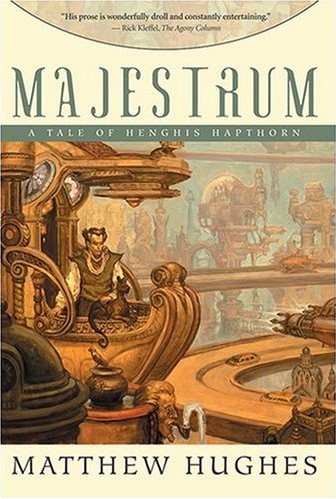
Book-A-Day #145 (12/8): Majestrum by Matthew Hughes

I really wish more people would buy Matt Hughes's books. He's gotten called "the new Jack Vance" a lot, which is a great compliment (hardly anyone can write like Vance, even if they try), but it does tend to make him sound more like a slavish imitator than he actually is. (And his books have been getting less specifically Vancean as he's gone along; this one felt purely Hughesean to me.)

This is the fourth novel (and the fourth-and-two-thirds book, if you count most of The Gist Hunter and Other Stories) set in Hughes's very, very loose far-future series. (The first two books, Fools Errant and Fool Me Twice, have the same main character, but Black Brillion is mostly unconnected to any of the others.) Majestrum is loosely connected to the Fool books, in a way that doesn't require you to know anything about those books (and the ties don't actually come in until most of the way through the novel, anyway). It's more closely tied to the earlier stories of Hengis Hapthorn, Old Earth's greatest freelance discriminator (collected in Gist), but I don't think you need to have read those, either. Basically, Majestrum is a detective novel set on an extremely far-future Earth. It's not deadly serious, but it's not as funny as the earlier books -- I do miss the funny stuff a bit, but I guess you can't be silly all the time.

And I suspect there will be more Hengis Hapthorn novels (I probably wouldn't have to suspect, if I could remember what the Night Shade Boys had told me), so you'd better start buying them now, when there's just one and it's easy to remember the title. Trust me; it's just easier this way.

The Fabulous Book-A-Day Index!

Book-A-Day #144 (12/7): Pearls Before Swine: Sgt. Piggy's Lonely Hearts Club Comic by Stephan Pastis

This was from my emergency back-up reading pile; I'd read most of it a few months ago and put it down there for a rainy day. The rains, as it turned out, hit on Thursday, when, because of taking Friday off (so I didn't read at lunch on Thursday as I tried to get two days' worth of work done in one day) and going to the Spectrum Literary Agency's Christmas party (so I was on a different bus, and didn't read there mostly due to inattention on my part as I tossed my bag onto the upper rack and settled into a window seat without a book), I didn't manage to finish Matt Hughes's Majestrum then.

(And that's the kind of sentence I can put together if I really put my mind to it -- I'm wasted in this century, I really am.)

I read a smaller Pearls Before Swine collection -- Nighthogs -- as Book-A-Day # 36 -- and what I said there about Pastis's style and appeal still holds true. But this book is a "treasury edition," which usually just means that it reprints all of the strips from two smaller collections with Sundays now in color. But, in this case, Pastis has a long introduction about the genesis of the strip, and a large number of comments about individual strips, scattered throughout the book. That's the kind of thing you usually only see in career retrospective collections (like Scott Adams's It's Not Funny If I Have to Explain It or Gary Larson's The PreHistory of The Far Side), but it's nice to see earlier in a cartoonist's career, when he can still remember things clearly. If you're at all interested in Pearls Before Swine, this would be the book to start with; it collects the first couple of years, and has interesting extras.

The Fabulous Book-A-Day Index!
Stalking the Wild Itzkoff, Part Two

Continuing the incestuous Usenet-to-Blogger connection from Stalking the Wild Itzkoff, here are some more posts of mine on the subject...

Johan Larson remarked that there were probably dozens of people more qualified than Itzkoff to do his job, and I replied tersely:
To get a job at the Times, you first need to be someone known to the Times. I don't think most SFF types qualify.
Johan then suggested (being a voice of reason) that the Times should have advertised in Locus. I'm not a voice of reason -- I'm a cynical bastard -- so I shot back:
You're assuming the Times knows -- or cares -- about Locus. Or that they advertise for any reviewing position. Or that, even if they did advertise a reviewing job, they'd consider the skiffy beat worthy of that. All completely unwarranted assumptions.

Remember, the Times is real -- it's "the paper of record." Things are important because they say they're important, and so the things they ignore are by definition unimportant.

We are the outsiders; they are the insiders. If we complain, they're sure it's because we are outsiders, and it only solidifies their image of us.
Johan replied again, and Mike Schilling got into it, too (the whole discussion is interesting; you should go and read it), and, well, here's me again:
Exactly. Read the NYTBR's introduction to Itzkoff, and Itzkoff's first column -- they explicitly say that his job is to find the "good" stuff in our very, very "geeky" genre, and present it so that "real readers" will try it.

In short, you could say that we're being condescended to if there was any reason to believe they cared what we think at all.
And Johan, following that up, asked if there was any metric by which Itzkoff was succeeding (and didn't, himself, think there was a major one). This very evening, I spake thusly:
I think the NYTBR editors are probably pretty happy with Itzkoff; he's choosing relatively populist things that have some lit-snob appeal (without calling anyone's category definitions into question), and presenting them in a cheery, lookie-what-I-found way.

They gave him the cover for a SF-related book, which has got to be some kind of seal of approval.

Again, we're not the people they're talking to. They don't seem to care what the people who already read SF think.
And that's the state of play right now.

Friday, December 08, 2006

Quote of the Week

"When in doubt, have two guys come through the door with guns."
- Raymond Chandler

I Was Told I should Blog This...

So last night I went to the annual Christmas party thrown by the Spectrum Literary Agency -- they've been inviting me for years, but I am a wretched, unsociable creature, so I've never been before -- and someone said to me the words "you should blog this."

(Is this good or bad news? I can't say. But I guess my label as "a blogger" is sticking pretty firmly at this point.)

So, since I am nothing if not deferential to my audience:

I was in Eleanor Wood's office, chatting with a group of people. Jeremy Lassen (the always-dapper -- well, if your definition of "dapper" is a '30s pimp -- alphabetically-first half of Night Shade Books) was in a chair with a gaggle of attractive young ladies (who are also, I must stress, all serious and high-powered editors who could break you like a red pencil) standing around him. (Note to self: there may be something in this '30s-pimp look. Must investigate.) I was leaning in a doorway to stage right. On the other side of the room, Jason Williams (the other half of Night Shade) and David Hartwell (surely I don't have to explain David?) were deep in conversation about something presumably of world-shattering importance.

I was wearing a festive tie, featuring a snowy scene with the tasteful figure of a Grinch at the bottom. And this brought about the wondrous moment.

Remember -- I am in a room with both Jeremy Lassen in full-dress mode and David Hartwell (whose tie, I have to admit, was fairly restrained, for him). But several people commented on how swell and nifty (probably not in those words; I was out of my head on praise and can't recall exactly) my tie was.

And then Liz Gorinsky told me I should blog that moment. Now I have, and I can die happy.

This Is The Year That Was In Hornswoggling

Michael A. Burstein wasn't sure if this was a meme or not, but I figure if people pick it up from each other, then it has become a meme. So I'll pick it up from him, and make it that much more meme-like in the process.

What to do: post the first sentence of the first post from each calendar month of this year, with links.

January:
Rolling three dice for the second time, and I get a 4.

February:
Do you ever stop adding people to your list?

March:
SF Site has just put up their list of the Best SF and Fantasy Books of 2005:

April:
"Life is short, art long, opportunity fleeting, experience treacherous, judgment difficult."
--Hippocrates

May:
I've kept out of the Kaava Viswanathan muddle mostly because I didn't have anything in particular to say.

June:
Into every life a little utter frivolity must fall, and this was my dose last night.

July:
I might seem to be a nice person (not here, I mean, in real life -- if you're one of the few Antic Musings readers who actually know me in real life), but, really, I'm not.

August: I love randomness (at least in small, controlled doses, for purely research or scientific purposes), so I had to do another version of the "set your playlist to random and answer these questions" meme.

September:
Patrick Nielsen Hayden linked to an online Asperger's quiz recently (well, not all that recently, but I was poking though his LJ this morning, and I noticed it).

October:

I spent a few hours yesterday reading the first hundred-or-so pages of a SF novel I was quite enjoying, but, one of the times I came up for air, I had to ask myself the dreaded question "But can I get SFBC members to buy it?"

November:
A collection of cartoons (mostly five apiece) from about thirty New Yorker cartoonists -- but these are all cartoons rejected by The New Yorker.
(Please Note: I do realize that the above is not actually a "sentence" in the strict grammatical sense. Stuff happens.)

December:
"Diplomacy is the art of saying 'Nice doggie!' until you can find a rock."
- Wynn Catlin

It says much more about my posting style than I want to accept on a Friday morning...

Thursday, December 07, 2006

Hey, I'm a "Usual Suspect"!

From Ansible #233:

JAMES GUNN will be honoured as SFWA Grand Master for 2007 at the Nebula Awards weekend next May. [SFWA] The usual mutterings of `shouldn't X be honoured first?' were heard from the usual suspects.

I feel so important.

One More Quick Peeve

Another thing to remember: all of the people you dislike are not necessarily friends with each other. Just because you hate them all equally does not mean that they have any aims in common.

As a matter of fact, thinking that all of your enemies are part of a complex interlocking conspiracy is halfway to a solid diagnosis of paranoia.

I'm looking at you, Dinesh D'Souza...but you've got a lot of company over there in Psychoville.

If This Goes On...

I know everyone loves that idea, but it's really lazy.

Take that trend you see now; the one you're extrapolating out forty years? (Either the trend you like or the one you loathe; it works both ways.) It will be either over, or utterly different, within ten years. Guaranteed. Guaranteed. Everything that rises does not converge, and it will probably stop rising and wander off to the left for a while as well.

I'm not saying what triggered this, but I'm looking at you folks through narrowed eyes from now on. Stop being so intellectually flabby. Whatever you think things are like, they're more complicated than that. (Yes, that goes for me, too.)

If the extrapolation actually is funny, I'll give it to you. (Actually funny, not just attempted funny.) Otherwise, it's just lazy lazy lazy. Cut it out.

Wednesday, December 06, 2006

Book-A-Day #143 (12/6): Spectrum 13 edited by Cathy Fenner and Arnie Fenner

After thirteen years, if I have to tell you what these books are, I weep for you. If you're an artist, art director, or editor in the SFF field, you already have (or should have) a shelf of these; they're pretty much the standard record of the art of the field.

With a book that's almost entirely art, you'd think there wouldn't be much design involved, but you'd be wrong -- and the Spectrum books are very nicely designed and laid out (and the art organized so that it flows well on individual pages from from page to page).

Spectrum got noticeably larger a couple of years ago -- a larger pagecount and slightly expanded trimsize. (The paper seems to be thicker than it was before, too.) So there's even more art goodness for those of us who are trying to figure out who to ask to do the cover for the five omnibuses we're trying to buy this month.

Again, if you care at all about SFF art, you probably already buy these books. If not -- what are you thinking?

The Fabulous Book-A-Day Index!

Tuesday, December 05, 2006

Book-A-Day #142 (12/5): Midnight Tides by Steven Erikson

{heaves large sigh}

I do enjoy these books immensely, but they take forever to read. It took me six days to get through the first third of this one (I always seem to dawdle through the first couple of hundred pages of a Malazan novel, looking things up on websites and referring to the glossary and cast of characters every half-page), then the afterburners kicked in: I read the middle third over the weekend and the last 270 pages yesterday and today. (And, as usual with a book like this, I hit the end at a pace that could easily have knocked off another fifty to a hundred pages today.)

This is book five of the absolutely gigantic "Malazan Book of the Fallen" epic fantasy series, which manages the rare trick of having doorstop-sized books (900 pages or more in paperback) that each tell a complete, semi-independent story with a cast of thousands. The Malazan books are not the story of the adventures of a pig-boy and his buddies across a strange and wonderful land; they're the tales of hordes of people (about half of them from various non-human races -- though Erikson tends to describe all those non-humans as a similar mixture of: tall, slim, has too many joints, nearly indestructible, uses immensely powerful sorcery, deadly in combat) across an entire world, on all sides of several major and minor wars. There will be ten books -- Erikson announced all ten titles some time ago -- so this is the half-way point.

Oh, before I forget: above is what the book I was reading looked like. Down here is what the US edition will look like, in April.

Anyway, I'm very fond of these books. They read a little bit like the bastard child of Moorcock's world-weariness and ambition and Glen Cook's military fatalism. Each book does take a bit of work to get into, since there are so many plot threads going on, but -- for a reader who can stand any kind of epic fantasy -- they're definitely worth it. (In my SFBC blurb for the last book, House of Chains, I said that the Malazan books are what you move up to when you're tired of regular epic fantasy -- or that normal epic fantasy is what you train on to get yourself in shape for Malazan.)

Midnight Tides starts a completely new plot; it's set on the other side of the world from the previous books, several years before the previous earliest book, and only has a few obvious ties (some Crimson Guard show up late in the book, and a viewpoint character here had already appeared in House of Chains; that kind of minor thing) to the earlier books. If you have read the earlier books, it's not a complete departure, but it's still mostly new stuff. (And this after the first four books ranged over big swaths of two continents and nearby islands!)

This is epic fantasy in the big-stakes sense, but no one is on a quest for plot tokens here; Erikson organizes his plots, as usual, around a war. We have viewpoint characters on both sides (loyalists and traitors), as well as plenty of characters who are only on their own sides. And he's perfectly willing to kill characters -- though it's sometimes hard to stay dead on this world.

If you're going to do epic fantasy, this is the way to do it.

The Fabulous Book-A-Day Index!

Stalking the Wild Itzkoff

There's a thread currently running on rec.arts.sf.written about The New York Times's SF columnist, Dave Itzkoff. As someone who can't keep his mouth shut when Itzy is mentioned, I've stuck my head in a couple of times. And, since content has been a bit light here lately, I'll Frankenstein them together for your possible amusement.

First, Johan Larson asked how this fellow Itzkoff got the job, and I replied:
The "Up Front" column in the Book Review with Itzkoff's first column (March 5, 2006) talks about how geeky he thinks he is, but doesn't shed any light on how he got the job.

He was an editor at Spin before the Times gig; he's doing a lot of reporting for the Times, so I suspect he's on staff there (probably officially as a music guy).

"Man writing monthly column for the Book Review" is a job that pays, I expect, mostly in "glamour" -- book reviewing is not very remunerative.
There was the usual Usenet back-and-forth, and a personage with the quintessentially Internet monicker of "Pumpkin Escobar" asked if Itzkoff was on a more regular schedule than the last Times reviewer, Gerald Jonas. I replied:
I think Itzkoff gets a full page roughly once a month -- it's a larger space than Jonas got, more often than Jonas.

Let's see if I'm right:

Neil Gaiman, November 5.

Dune, September 24.

Stross/Robson, July 9.

Nebula Awards, June 11.

David Marusek, March 5.

Well, that's only five columns in nine months -- ten if you count his front-page review of Julie Phillips's James Tiptree, Jr. -- which is more like every six weeks.

That's about as often as Jonas was in the Book Review. And Jonas always reviewed at least three books, which Itzkoff doesn't do. Draw your own conclusions...
Since I'm link-happy today, here are the previous installments of "Pickin' on Itzkoff" -- the Holiday Books Issue, the Gaiman column, the Dune column, the Tiptree review, the Stross/Robson column, the Nebula column, the Itzkoff vigil, and the Marusek column.

Here at Antick Musings, if Itzkoff says anything about SFF, we'll be there to make fun of it -- that's our pledge to you.

Monday, December 04, 2006

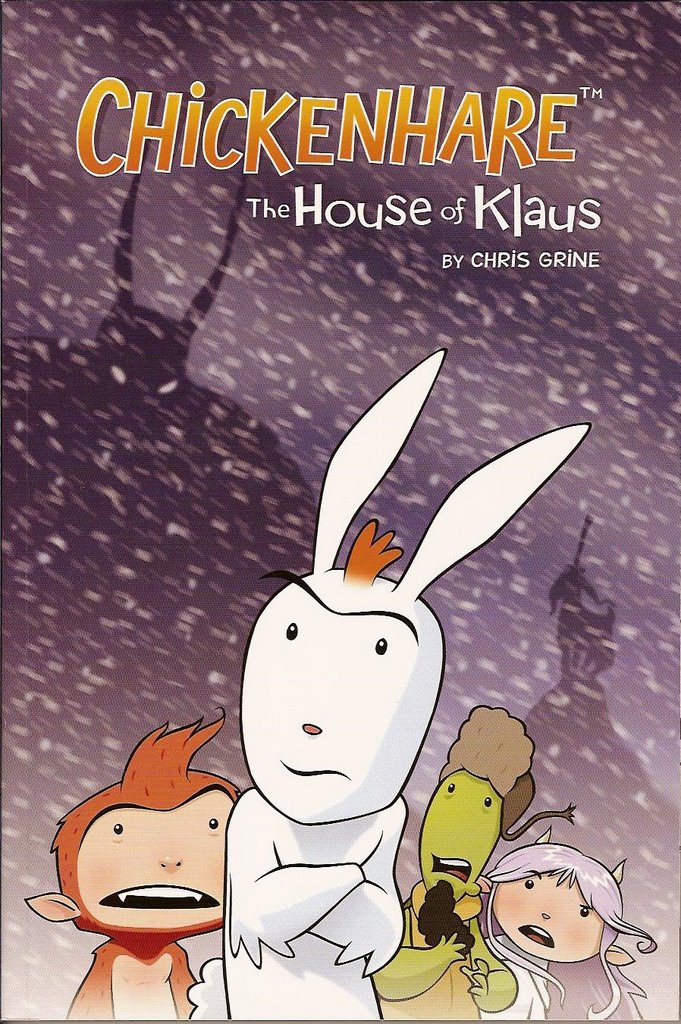
Book-A-Day #141 (12/4): Chickenhare: The House of Klaus by Chris Grine

This is an "all-ages" graphic novel that I found on a giveaway pile at work (have I mentioned recently that I love my job?) and read tonight because I'm not quite done with Midnight Tides (Definitely tomorrow, though.)

I thought this would be something I could pass on to Thing 1, but, having read it, I don't think I will -- it may say that it's for "all-ages," but the lower end of "all," in this case, is about ten.

Our hero, Chickenhare (half-chicken, half-hare, in a world with both talking animals and normalish humans -- no explanations of any of this, which is fine) has been caught and sold to an evil taxidermist, who plans to kill and stuff him. He escapes with some other odd animalish creatures, meets some nasty little snow guys and the ghost of a goat, and eventually give the taxidermist his comeuppance.

The whole thing is drawn in a Jeff Smith-ish style, but it's a bit too nasty for little kids. (There's no major violence on-panel, but the taxidermist will be scary to kids, and the ending has a number of gruesome bits for kids who think about them.) I'd hoped this would be a good "if you liked Bone" book, but it isn't. The sweet spot here is probably tweens; I imagine teenagers would find it too cartoony-kiddy. The art is quite accomplished, and the story is fine; Chickenhare is just a bit too scary for little kids and a bit too cutesy for teens. (What Jeff Smith does looks easy, but you can tell how hard it is when other people try to do the same thing.)

The Fabulous Book-A-Day Index!

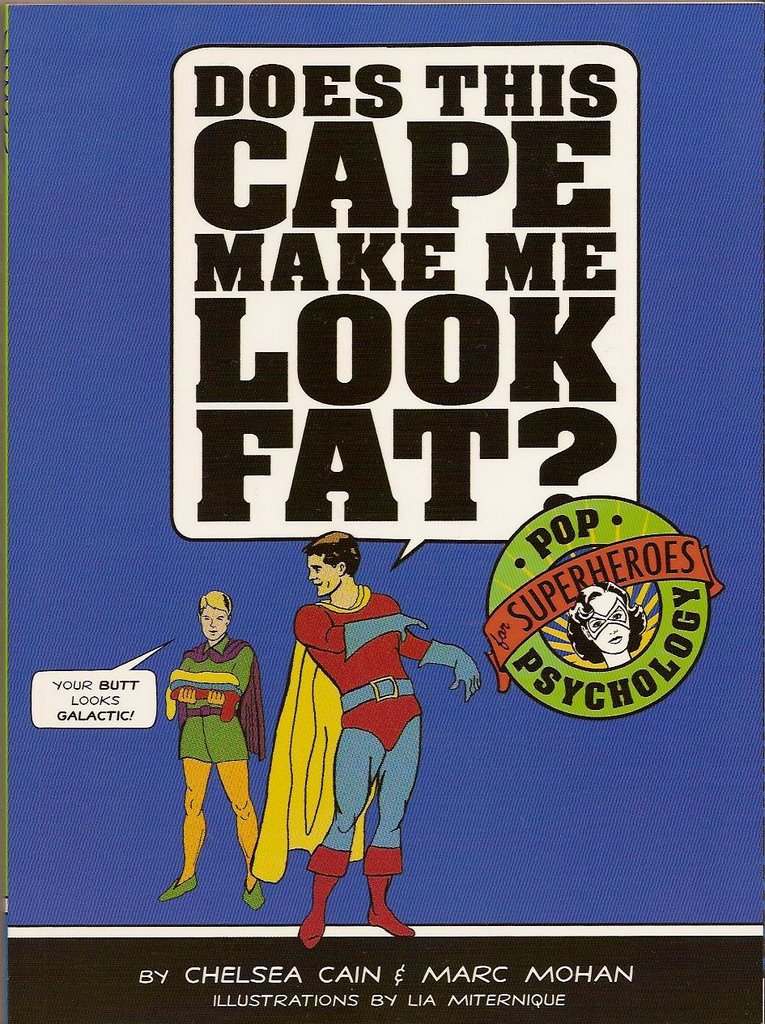
Book-A-Day #140 (12/3): Does This Cape Make Me Look Fat? by Chelsea Cain and Marc Mohan

I got this for free on a giveaway shelf at work; it's a short, design-heavy humor book with the subtitle "Pop Psychology for Superheroes." Everything it wants to be, How To Be a Superhero (by Mark Leigh and Mike Lapine, illustrated by Steve Dillon) did infinitely better fourteen years ago. If you like the idea, go find Superhero. (No, really -- Superhero is a great book, and amazingly funny. If you ever read superhero comics with any regularity, you should own it. It's the Tough Guide to Fantasyland of long-underwear comics.)

Cape
isn't quite as bad as that comparison makes it sound -- it is mildly amusing -- but the authors seem to know the contemporary world of superheroes less well than I do (and I haven't been able to stand underwear perverts for nearly ten years now). The art in Cape, though, is rotten -- it's credited to Lia Miternique, but it looks like bad clip art. (The same few characters, poorly drawn, in the same poses over and over again.)

This is a book to pick up and peruse when your Significant Other is poking through the next section over in the bookstore (maybe Flower Arranging, or Regional Cookbooks), laugh at twice, and then carefully put down and walk away from. The only reason I could see to purchase it would be as a gag gift for a friend who actually does own a cape.

The Fabulous Book-A-Day Index!

Book-A-Day #139 (12/2): Lost Girls, Book 3

This post has sat, completely empty, for two days while I tried to figure out what to say, and I still don't know.

I don't think Lost Girls is entirely successful, but I have a suspicion that it couldn't be entirely successful -- Moore wanted to write something simultaneously arousing and thought-provoking, and those two aims fight against each other. It's a noble experiment, though; an attempt to push back the barriers of what art can do.

The sex isn't quite as transgressive as some reviews had led me to believe, or maybe I've already been too desensitized by things like Ghastly's Ghastly Comic and Sexy Losers -- in any case, if you're on the Internet and a geekish person of my generation, you probably won't come across anything new. (Now, that's an unfortunate turn of phrase, but what the hell...I'll leave it in.)

I'm a bit more conflicted by Melinda Gebbie's art, which has problems with faces regularly. She's not aiming for a strictly realistic style, true, but she also doesn't seem to be in control of the art for too much of the book.

All in all, it's far too expensive for what it is -- almost certainly to ensure a minimum of legal trouble -- and primarily of interest to Moore completists and connoisseurs of Victorian porn.

The Fabulous Book-A-Day Index!