Wednesday, January 31, 2024

Monica by Daniel Clowes

Some cultural artifacts are so rigorously assembled that one hesitates to criticize them, expecting that the answer from the trufans will be something like "well, but you see, the figure at the top left of the back cover is obviously there to explain your complaint, and you are a churl for missing that, and therefore all of your complaints are invalid." But here I go anyway.

The figure at the top left of the back cover, by the way, is a satyr. There isn't one in the book itself. This is clearly A Clue. But this is the kind of book that makes you tired of Clues long before you reach the back cover.

Monica was Daniel Clowes' new graphic novel for 2023; he reportedly had been working on it for five years, roughly since Patience. It's told in nine chapters, all of which have Clowes's standard mature art style but which diverge greatly in voice and tone. They also, I think, don't all take place on the same level of story: I originally thought it was alternating the "real" story with in-story fictions, but it's not quite that clear or obvious. My guess, as much as I care (which is frankly not much) is that three or four of the chapters are stories told by the title character, though it's not clear when she told these stories, to whom, or why she wrote them within the confines of the overall story.

Bluntly, those chapters are horribly overwritten in a clanking style. I think this is deliberate on Clowes' part - but it also calls the reader's attention to the fact that even the "well-written" bits are overwritten, over-narrated, and overcooked. Clowes has always been a creator who loves extremes and trashy genre elements, but I don't think it was a smart thing to call attention to his overwriting in a book as overwrought as this one.

Monica is the main character, and our wordy narrator. The book covers her whole life, in leaps and bounds, plus those digressions that I'm going to take as her (mentioned once, never important) adolescent attempts at fiction.

Before I go further: I will run through each section of the book. There will inevitably be spoilers. I do not recommend this book for anyone other than those who enjoy watching train-wrecks in slow motion. Take all that into account if you read on.

We start with "Foxhole," in which Johnny and Butch, two footsoldiers in what we realize later is Vietnam, talk in a massively self-consciously doom-laden way for three pages about their lives, philosophies, the specter of imminent death, and how everything must be going to hell back Stateside. This has the tone of the later "fictional" pieces in Monica - overwrought, clunky dialogue and all - but I suspect it's meant to be part of the "real" narrative. 

Smash-cut to "Pretty Penny," where we open with Johnny's fiancé having just fucked some other guy - he's Jewish, which I suppose is supposed to make it worse? They also talk in a patently ridiculous way: even dull readers should realize by this point that this isn't to be taken seriously, that it's dialogue reconstructed much later from someone's slanted perspective.

That fiancé is Penny, who, in the much later words of Elvis Costello, doesn't know what she wants, but wants it now. We soon learn we're hearing her story told by Monica, who is born almost three years later (assuming we start in the late '60s, that puts her birth somewhere around 1969-1972) - and that may be why it's sketchy and random and why Penny comes across as an unknowable ball of anger, reaction, and spite. This section is about twenty pages long, getting Monica to about the age of three, when Penny - after a pinball round of boyfriends and apartments and random caregivers and emotional explosions - dumps Monica with her own parents and disappears forever.

Next we get the seemingly unrelated "The Glow Infernal," a vaguely Lovecraftian tale about a young bowl-cutted man in an ugly purple suit who returns to his childhood town to find it controlled by blue-skinned people of vague origin. He quickly joins the resistance and is instrumental in their downfall, but is transformed in the process - very literally.

Monica returns to tell "Demonica," the story of how she fell apart during college when her grandmother died suddenly. She holed up in a lake cottage, talked to no one, and claims to have communed with the spirit of her dead grandfather through an old radio. At the end of this period, she has a car accident that puts her in a coma.

By this point, the reader may wonder if Monica is a reliable narrator. I don't think that's the direction Clowes wants the reader to go, but if one assumes she's prone to psychotic breaks (perhaps like her mother?) that's one way to interpret the story.

"The Incident" is another story written by Monica, I think, in which a version of her father is some kind of detective or fixer, bringing a young man back from bad companions to his family, only to find (yes, again) something unexplained and maybe inexplicable has happened to the town, so he has to flee with his charge.

Monica wakes up from her coma for "Success," told from a viewpoint twenty-two years later. (Note: that is not now, and not the frame story for any other section. Every section vaguely hints at being a document from a particular time-period, without ever making that clear or doing it believably.) She started a candle business after a few years of recuperation from the coma and then the usual youthful dissipation, but has just sold that business for a small fortune. She's now getting obsessed with finding Penny, and learning the truth about her mother - but gets sidetracked by a pamphlet from her childhood from a nutty cult.

"The Opening The Way" continues that story, with Monica learning about the cult (which schismed into a blandish New Age convention business and a hard core of the really loony ones) and then, inevitably, joining it and getting caught up in its horrible philosophy, unpleasant people, and grungy surroundings. She gets out in the end, still not having found Penny.

And then we get "Krugg," which is probably another story written by Monica - this late in her life? who knows - in which a painter monologues tediously as a blatant stand-in for the father Monica never knew (and who she sought in the crazy cult just before).

Last is "Doomsday," in which an aged Monica, in what seems to be the present day or near future, explains how she did find Penny - who was old, and more than a little unhinged, and didn't give Monica any real insight before she died - worked through her problems with a therapist over a number of years, met a nice man that she might be able to have a relationship with, and finally found her father, who was a bland old man who also couldn't give her any real insights into herself.

Oh, yeah, and then she unleashes Armageddon in the last panel, because why not?

Um, OK.

I have to assume Clowes means that literally, and thinks that he has constructed his story to lead to that point. I didn't believe it at all, and didn't see even the kooky cult teachings as really leading to this particular apocalypse. (There's a demon-figure in the cult's mythos - if he appeared to Monica, that would be one thing. This is something entirely separate.)

My working assumption is that this is another sour Clowes story, about how all of humanity is sordid and corrupted and horrible. But I took it as a story about one woman with serious mental problems, who tells us the entire story but, in the end, can't be relied upon at all.

I can't recommend this at all. It's longer than it looks, it's full of bad writing - most of it on purpose, I hope - and doesn't say anything new or interesting for Clowes. It's just a confusing, kaleidoscopic wallow in his typical misanthropy, without anything new or special to redeem it.

Tuesday, January 30, 2024

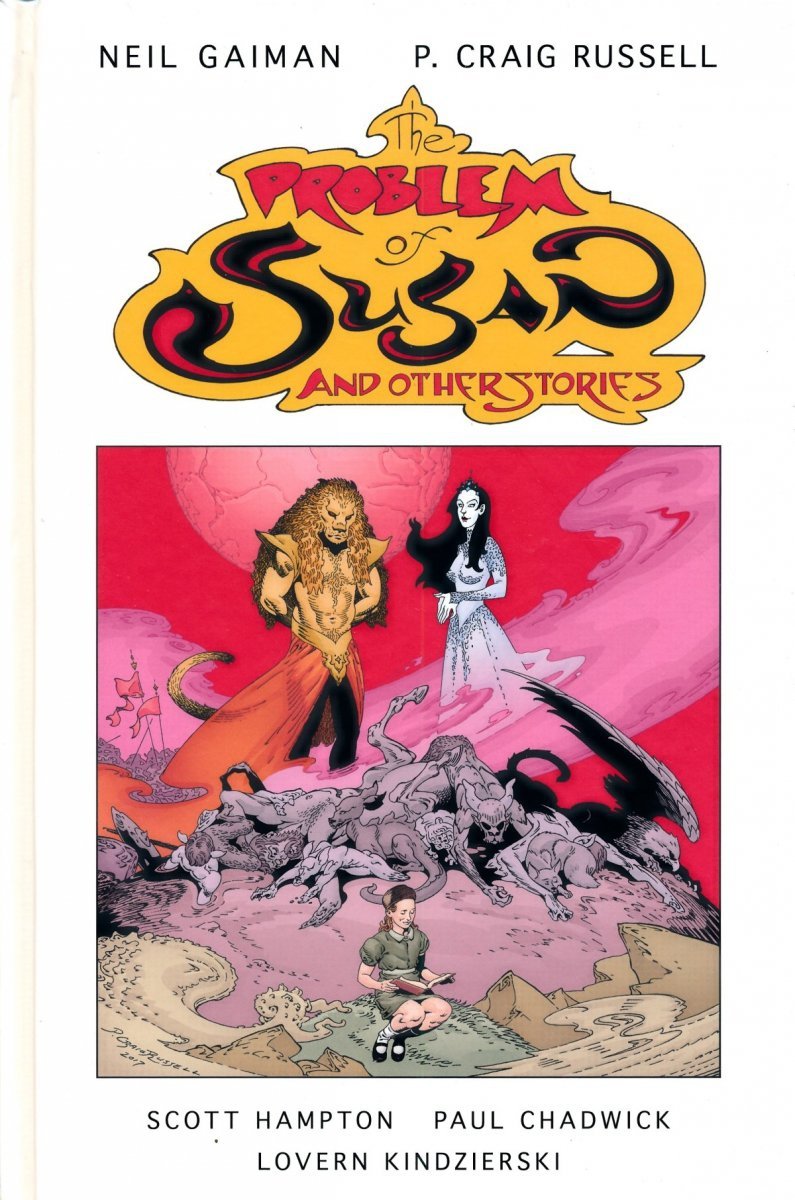
The Problem of Susan and Other Stories by Neil Gaiman, P. Craig Russell, et. al.

I don't know if Dark Horse is actually trying to adapt every last bit of short Neil Gaiman into comics form. He's written a lot of stuff, and much of it wouldn't adapt well. But it does feel like they're trying, at least, with a long sequence of individual graphic novels and a few omnibuses stretching back more than a decade.

The grandly titled "Neil Gaiman Library" has mostly been stories that can turn into reasonable-length books. I've seen a bunch of them: A Study in Emerald; Only the End of the World Again; Chivalry; Snow, Glass, Apples; and Troll Bridge. But not all Gaiman stories can be fit into that length, no matter how hard Procrustes works.

So in 2019 we got The Problem of Susan and Other Stories, which includes adaptations of the title story, another short story, and two poems. Presumably, with this as a model, the rest of his oeuvre on ISFDB is now under development, and we can look forward to Nicholas Was... and Other Festive Poems Real Soon Now.

My joking aside, it's actually good to see that someone realized that not every short story is suitable to be turned into a sixty- to eighty-page graphic novel. If you're going to adapt things to other formats, it's important to keep what works and is distinctive about the original.

All four pieces in Susan were adapted, scripted, and laid out by P. Craig Russell - as usual, Gaiman's participation seems to consist entirely of signing contracts and allowing his name to be used - two of them for other artists and two of them drawn by Russell. 

Now, I say "laid out," but the last piece here is "The Day the Saucers Came," a quick bit of doggerel that is presented on seven splash pages, one for each stanza, so I don't know how much credit Russell should get for that one. It was a fun little poem, and it's a fun little story here, with art by Paul Chadwick.

The other poem is "Locks," which has Russell art. It's a shorter piece (four pages) but broken into regular comics panels - and not as obviously verse, actually, reading like "normal" comics. It's also slight: most of the Gaiman poems I've seen have been interesting ideas turned into solid verse rather than poetry, in the lets-explicate-the-deep-meaning-here sense. (My headcanon is that Gaiman intermittently writes poems to solidify ideas, and sometimes it turns into a fuller story and sometimes the poem is it.)

The other story is "October in the Chair," in which the personified months of the year meet and tell stories. (A very very Gaimanesque idea, clearly.) Most of it is taken up by the story October, the host this time, tells - which is a somewhat creepy one, about a "runt" of a boy who runs away from home and what he decides to do then. The art here is from Scott Hampton, I think in full paintings as he often does, and it's moody and deep to match the story. 

And leading off is the title story, a riff on C.S. Lewis's Narnia stories, in which an old academic - who we suspect, by the end, is Susan, or maybe the real-world version of her - talks to a young reporter about her life and work studying folklore and fantasy. Susan was the Pevensie who didn't die in a train crash in The Last Battle, who didn't get to return to Narnia at death, because she had already grown up too much and was no longer innocent. That is the problem, as both the old academic and the young journalist agree. Gaiman also has a somewhat darker view of the Lion and the Witch here, which will be unsurprising to those who have read his fairy-tale retellings like "Snow, Glass, Apples."

So all four of the stories are interesting and done well, and they vary substantially in tone - the poems are much lighter than the stories, and "Susan" is perhaps even darker than "October," if you accept its cosmology. There isn't really a thread that ties all four pieces together, other than being by Gaiman - but that, I suppose, is the deal of the whole series.

Monday, January 29, 2024

Portions for Foxes: Amy Bezunartea

"Portions for Foxes" is a series of weekly posts, each about one song by a woman or a band led by a woman. See the introduction for more.

I know almost nothing about Amy Bezunartea. I heard this song - it was a free MP3 as a giveaway for promo, somewhere - and I bought the record because of it. That was 2010; I hope she's still out there, somewhere, making music or whatever, but I really don't know.

I do know this song is lovely and real, quietly beautiful and heartbreaking in its low-key, matter-of-fact way. That's more than enough.

The song is Doubles. It's a quiet singer-songwriter piece about working hard and not getting much of anywhere, from an album all about that kind of work.

Some girls they glow in darkness but by our standards that's not much
Some girls they'd like to win but instead they'll serve you lunch

Bezunartea sings it all with a quiet, pure voice - not quite celebrating, not quite lamenting, just stating that this is how it is, even if it's not the way they want it to be. It's tough, but it's life. That will be enough, if only because it has to be enough.

My baby, she works doubles
I can't help her with her troubles
I've got my own, but we're not alone
We're not alone

It's slow and contemplative, quiet and ruminative, poignant and true. It's lovely and real, and I hope Bezunartea has been doing things equally lovely and real, in music or whatever else, since then.

Sunday, January 28, 2024

Reviewing the Mail: Week of January 27, 2024

Two books came in from Tachyon this week, so let me take a look at them and tell you what looks interesting.

These Fragile Graces, This Fugitive Heart is a novella-as-book from Izzy Wasserstein, previously author of the story collection All the Hometowns You Can't Stay Away From and two books of poetry. It's a near-future story billed as "a queer, noir technothriller of fractured identity and corporate intrigue" - I'm not clear if "fractured" here means "torn between competing parts of your life" or "technologically-augmented people doing SFnal things." Our main character is Dora, who's dragged back to a place she used to live by the death of her ex-girlfriend, which murder, in best fictional style, she must solve. It's publishing on March 12th in paperback and the usual collections of electrons.

Slightly earlier - publishing in just about a month, on February 29th - is The Forgotten Beasts of Eld: 50th Anniversary Edition by Patricia A. McKillip. (And looking at the bound galley, I realize I keep forgetting that McKillip died in 2022, and keep thinking of her as still around and writing. We all need our comforting untruths.) Eld was her first major book, her first book for adults, and a World Fantasy winner back in 1974...which doesn't seem like it was really fifty years ago, but that's how time works.

I read Eld when Tachyon first published it, a few years back, and both before and after that have wanted to read more McKillip for a while without really doing so. But I already have two collections of her stories on the shelf, and might have to pull one of them down.

Saturday, January 27, 2024

Quote of the Week: The Allure of Lotusland

"Sure. I used to sing in the chorus, till they found out where the noise was coming from. And then I went to Hollywood and had my photograph taken and found I was swell. It might be the same with you. Why not take a chance? You would like Hollywood, you know. Everybody does. Girdled by the everlasting hills, bathed in eternal sunshine. Honest, it kind of gets you. What I mean, there's something going on there all the time. Malibu. Catalina. Aqua Caliente. And if you aren't getting divorced yourself, there's always one of your friends is, and that gives you something to chat about in the long evenings. And it isn't half such a crazy place as they make out. I know two-three people in Hollywood that are part sane."

 - Miss Lotus Blossom, in P.G. Wodehouse's The Luck of the Bodkins, p.205

Friday, January 26, 2024

Memoirs of a Man in Pajamas by Paco Roca

So the book today is all kinds of things - source of an animated romantic comedy, compared to Seinfeld, a new 2023 collection of the work of the cartoonist behind Wrinkles and The House. What it isn't, though, is a single thing.

Memoirs of a Man in Pajamas doesn't explain itself. But it collects Paco Roca comics in three sections and has three copyright dates - 2011, 2014, 2017 - which three sections are somewhat different in style and format and concerns. And it says, here and there, that these comics originally appeared in Spanish publications, I think always weekly, at those times.

I'll note, here, that all of the reviews I've seen of it focus most tightly on that first section, making me wonder if Publishers Weekly and all the rest only flipped through the back half of the book.

The strips here feature a cartoonist, happy with his life as he hits forty and most enthusiastic about the fact that he works from his home in his pajamas. He is mostly Paco Roca himself, but there are a few strips here that make it clear that Roca intends the pajama-clad cartoonist as a fictional character: this is not a diary comic, it's not trying to be true, and he implies that he's taken stories from friends (other cartoonists, perhaps?) and adapted them for Pajama Man.

That's most important in the first section, too, which is entirely single-pager slice-of-life stories about the cartoonist and his life. The second and third sections see Roca shift to two-pagers (with a few longer pieces here and there, particularly to open each section) - the second is mostly slightly deeper concerns about the cartoonist's life, shading into larger issues, and the third section shifting in the other direction, mostly Pajama Man thinking about larger societal issues with a few this-amusing-thing-in-life pieces mixed in.

What's notable is that none of this is personal. We see Pajama Man's girlfriend consistently, but never learn her name or job or backstory. A small child appears midway through, also without a name. We see Pajama Man traveling to give talks about comics, but - except for a couple of sly references to Wrinkles - no one talks to him about specific books, nor do we see him working on comics. He's just at a screen that we can't see, working long hours like any other knowledge worker - again, this isn't a diary comic, Roca doesn't talk about tools or art supplies or styles or anything about the creative work.

The Seinfeld comparison is apt in an unexpected way: this is a packaged, fictionalized version of a life - turned into comedy for a particular purpose. It looks real, because that's the way to make it work best. And that - Roca has Pajama Man complain a few times here - of course makes his readers think it is real, which is good (for the work) and bad (for Pajama Man, and presumably Roca speaking through him).

Man in Pajamas is denser and longer than you might think - the strips are wordy and discursive, and the book is over two hundred pages long. It's all amusing, and much of the back half is deeper and more thoughtful than that, as Pajama Man grapples with capitalism and Spanish history and the modern world in general. Roca's line is detailed and illustrative, but still fairly close to ligne clair - there are a lot of small panels here, and the type can get a bit small (I read it digitally), but Roca is a fine storyteller, even when the story he's telling is "one guy sitting around, trying not to do anything."

Thursday, January 25, 2024

Mickey Mouse: Zombie Coffee by Régis Loisel

Formats come with expectations and assumptions - not always warranted, but they're along for the ride already.

For example: Mickey Mouse: Zombie Coffee, a bande desinée by Régis Loisel, originally published by Éditions Glénat in France in 2016 in (waves hands) some format, possibly within Le Journal du Mickey, is laid out like a newspaper comic. Four panels across, most of the time, about four times wider than tall, two strips to a page, 137 strips total.

As an American comics reader, on first glance I assumed this was a little less than half a year of dailies in some newspaper, and my thought was "who knew there was a regular Mickey Mouse strip in French newspapers?"

But I think that's wrong. I think these appeared in that magazine, weekly - maybe one at a time, maybe two or three on a page each issue - and that the strip format is either an artistic choice or a very specific slot in that magazine that might look like an American daily, but is a different thing.

So I'm left wondering about the rhythm of this story: was it just one strip a week? That's pretty slow for an adventure strip - though a lot of webcomics are on a similar pace, these days. It might explain why a lot of these are pretty wordy - you need to remind the reader of what's going on. Or, to be positive, perhaps this ran in a really large space, and these strips are shrunken a bit for this book publication.

In any case: it's a Mickey Mouse story, of the old school. The time is during the Great Depression, the place is Mouseton (presumably USA, but unspecified), and our hero and his friends are the downtrodden, pushed-around little guys of the early days rather than the fancy suburbanite or corporate icon of more recent years.

Mickey and Horace Horsecollar are looking for work, with no luck. Mr. Ruff, "the foreman" (seemingly the only way to get hired in Mouseton) keeps finding excuses not to hire them. So the two decide to run off with their girlfriends (Minnie and Clarabelle Cow) to go camping and fishing for a while, bunking with Donald Duck on a lake somewhere, because "camping is free."

That takes up about the first quarter of the story - they return to Mouseton to find things have changed. A rich developer, Rock Fueler, is turning their neighborhood into a golf course. The potential good news is that means jobs, plus money for the houses he's buying. But of course the capitalist is the villain, so his plans are much more nefarious than simply building something.

Fueler has employed two chemists to create massively addictive "Zomba" coffee, which he then distributed free to all of the citizens of Mouseton. The men, zombified by coffee, work almost for free, and the women and children get packed off to a new housing project on the outskirts of town. And the chemists are working on further foodstuffs, to squeeze the last few cents out of the Mousetonians.

Even Goofy, left behind, is now a coffee zombie, though Horace and Mickey do save and reform him.

And then our heroes fight back, against the nearly overwhelming forces arrayed against them. Pegleg Pete is one of Fueler's top henchmen, as of course he must be, so he does a lot of the immediate attacking, sneaking, and other evil deeds. There are chases and fights and confrontations, and various bits of comedy along the way - for example, the chemist's food is so seductive that noseplugs are required to resist its tantalizing aroma, so the big end scene is played out almost entirely with people speaking with those stuffed-nose voices.

I read this digitally, and I think that means I saw it somewhat smaller than the printed book - I hope so, since it's full of detail and life and energy, and a larger format would make it a lot better. I haven't seen Loisel's work before, but he's clearly great at this style, and has had a long and respected career making things that mostly haven't been translated into English.

It's a classic Mickey story told well for a modern audience - my understanding is that the French audience is mostly middle-graders, but there's no reason it needs to be limited to that age.

Wednesday, January 24, 2024

Adventuregame Comics, Vol. 2: The Beyond by Jason Shiga

Even when he's making a comics series for younger readers, Jason (Demon) Shiga can't resist playing around with death.

This second book in the Adventuregame Comics series - although "series" isn't the right word; "format" or "style" is closer - is The Beyond, and it's an afterlife fantasy. That means the "pre-credit" sequence is a catalog of choices that all lead to the death of our main character, Mario Rivera.

Because you can't have an afterlife fantasy while you're still alive, can you?

Beyond follows the format and structure of the first book, Leviathan - see my post for all the details; this is pretty different from a normal middle-grade GN - and distantly follows Shiga's decade-old Meanwhile..., which is a larger-format, more ambitious version of the same thing.

So it's all Choose-Your-Adventure style, with numbers on each page and an intricate web of comics panels connected by pipes - not always in the order you would expect; you need to read the comics panels carefully and follow the pipes - so that the reader can make decisions for Mario and lead him to the next stage of his adventure.

As I said about Leviathan, prose books in this style tend to be bushes: they lead out from a single starting point to a whole lot of dead ends, most of which see the main character die. Shiga's books instead are like the paths in a formal garden or a hedge maze: they loop around and cross each other multiple times, but there's only a small number of exits, and the trick is to find your way to all of them.

The other important thing about Shiga, besides the playfulness and delight in overcomplication, is that he's a mathematician. So there's going to be math - and, more centrally, his stories are mathy in their style and presentation, with a chilly formalism always lurking deep in the narrative.

Here, the afterlife is individual to each person, as Mario learns from his guide, Xochitl. There are doors controlled by books, each of which has a specific number on its spine. Mario can enter each of the books in turn - there are four shown in this story - and, eventually, do more complicated things.

Luckily, there are other people in most of the books, so it's not entirely Mario running through empty rooms - though it starts that way. A reader might wonder, if this is the afterlife and it's specific to each person, who are those other people? Are they "real," or maybe figments of his imagination, or aspects of his personality, or whatever? And, if so, isn't that deeply solipsistic? Well, a lot of Shiga tends to the solipsistic - it's part of being mathy.

But Mario still does need to run through those worlds, find out the permutations - I'm saying "Mario," but I mean "the reader," playing that part - and find his way to the various endings. There are, I think, two good ones and one not-so-nice. Though, again, Mario is dead anyway, so the usual thread-ending of a book like this is off the table.

This is fun, and obviously these books are like nothing else - I've said this before, but Shiga's books are all very Shiga, and very little like anyone else - but I found this one a bit more tedious and less exciting than Leviathan, and certainly not the triumph Meanwhile... was. It might be returning to the same well for a third time, it might be the elevated levels of solipsism, but I just liked this one and didn't love it like I did the earlier ones. Temper your own expectations appropriately.

Tuesday, January 23, 2024

Please Destroy My Enemies by Michael Sweater

This one is confusing me - it looks like a webcomic, but I'm pretty sure it isn't.

Michael Sweater published a zine called Lion's Teeth - on paper, as far as I can tell, in the manner of the Olden Times - probably mostly in the early Teens. (He also seems to have been using the name Mike King at that point, or swapping back and forth between the two names.)

Silver Sprocket published a collection of those strips in 2016 as Please Destroy My Enemies, which Sweater described in a short biographical note at the end as "mostly stuff he forgot to scan." (Meaning he didn't put it up on Instagram, I think.) A second edition of that book came out in 2018, adding color; that's the version I just read.

It reads like a webcomic - mostly three- or four-panel one-off strips in a rounded cartoony style, without continuing characters for a long time before an unexpected stretch in the middle about a boy Charlie, his dog Boobie, and his dad. It has the rhythms of a gag-a-day strip, though with a cluster up front where I wasn't sure if they were supposed to be funny. (As opposed to thoughtful, or interesting, or just quirky.) There's a couple of other short sequences as well, before the end, but I didn't see any recurring characters or situations.

It's also a small book - 56 pages of comics and a few more of related material - and I think small-format as well, though I read it digitally, where all books are exactly the same size.

It has the energy of a young cartoonist and the scope of a creator trying out different things - jokes, viewpoints, character ideas. Sweater is - or maybe was - a tattoo artist as well, and that influence is clear in the bright colors of this version, his rounded crisp lines, and the characters who "read" visually very quickly.

The bottom line when reading a first collection of anyone's work is: would you want more of this? And my answer here is: Yes. His bio note mentions "over 1000 pages" in Lion's Teeth, and I'm wondering if I could find that stuff somewhere other than a random small-press expo - since I'm unlikely to go to one of those but I would like to find a bigger batch of stuff by this guy, whatever name he was using at the time.

Monday, January 22, 2024

Portions for Foxes: Be Your Own Pet

"Portions for Foxes" is a series of weekly posts, each about one song by a woman or a band led by a woman. See the introduction for more.

I can never trust someone who doesn't like punk. You don't have to like all of it, or even much of it - but there has to be that love for something loud and pushy and semi-uncontrolled, all amateur energy and swagger and attitude. Maybe for you it's hardcore, or garage rock, or a dozen other names - but you know the feeling, you know the drive.

Be Your Own Pet has all of that, and more. (Another song of theirs opens with the great line I'm an independent motherfucker, for example.)

My very favorite song of theirs is the glorious, snarky Bicycle, Bicycle, You Are My Bicycle, the anthem for a generation of nihilists on fixies.

No gears, no brakes
All real, no fakes
No gears, no brakes
We'll break your face

It's at least partially self-parody, as the video shows. That's the glory of punk: the attitude can turn from real to a pose to a joke and back to real, all in the course of the same song. Because it's the attitude that matters.

The sound of this song is also awesome - there's an instrumental break in the middle where you can hear the rhythm of bicycles in the music - struggling, fighting the gravity of a hill, and then getting over the crest and accelerating down, faster and faster.

Have fun, and be safe with it
Just kidding, FUCK SHIT UP!
We ride bikes, cars are for idiots

Punk, to me, is happy nihilism - the sense that the world sucks, and things are bad, but who the hell cares? It works best when you're young and full of fervor - and Be Your Own Pet were pretty young when they made this song. It shows. This is the best kind of rollicking, mad, punky energy, a song that grabs you, shakes you for two magnificent minutes, and then runs away laughing.

Sunday, January 21, 2024

Reviewing the Mail: Week of January 20, 2023

This is the back half of the books from the same box as last week; I'm not going to repeat myself.

Big Sky is a novel by Kate Atkinson, in her loose series about detective Jackson Brodie. It came out in 2019, and I'm not sure how many Brodie novels preceded it - I read Case Histories and One Good Turn a decade ago, and have (I think) two more on the shelf to read, but I could have missed some in the middle as well. I want to read more Atkinson, and bought this one even though the books of hers I probably will read next are already on my shelf. That's a recommendation of a kind, I think.

Highfire is an adult fantasy novel by Eoin Colfer, best known for the very popular Artemis Fowl series for younger readers. I think the other Colfer book I've ever tried to read was And Another Thing..., his licensed extension of Douglas Adams's Hitchhiker books - I read about a third of it, realized it was never going to turn into a new book by Douglas Adams, and put it down. But I though Colfer was good at what he did, and figured I'd come back at some point for one of his own plots - I guess now, a decade later, with this book about a dragon in a Louisiana swamp, I'm doing that.

Dirty Pictures is a history of underground comics by Brian Doherty, with one of those non-fiction explain-the-whole-book-and-take-up-the-whole-cover kind of subtitles: "How an Underground Network of Nerds, Feminists, Misfits, Geniuses, Bikers, Potheads, Printers, Intellectuals, and Art School Rebels Revolutionized Art and Invented Comix." I've had it on lists of books to look for, probably since it was published in 2022, so now it can sit on a shelf and maybe I'll even read it.

Out of Body is a novella by fantasist Jeffrey Ford from 2020. I recently read a Ford book that had been sitting on my self for a long time, which got me thinking about what a great writer he is...and so now I have something else to read. This one seems to be somewhere in the loose territory of dream-story, horror, and thriller.

I had a K.J. Parker book in the list last week; I also have a book from his alter ego (and real name, I think) Tom Holt: When It's a Jar. Holt's books under his own name are generally humorous fantasy, while the Parker books are darker and often have subtler fantasy elements. I read a Holt book or two what feels like a million years ago, but not since then - probably his first book, Expecting Someone Taller, which a lot of us read in the '80s. (Holt is British, and my sense is that his career as Holt fizzed along just fine in his native UK but sputtered a bit after his first few books in the US, and various publishers have since tried to re-invigorate it.) Anyway, I haven't read a "Tom Holt" book for a long time; this one was available, cheap, and standalone. I think it's somewhat funny; I'm pretty sure it's contemporary; I'm not sure what the plot is about but the back cover says the main character just killed a dragon with a bread knife.

Blood Grove was the new book in Walter Mosley's "Easy Rawlins" detective series for 2021. Mosley is frighteningly prolific, but also hugely varied - I've read his books off-and-on, getting further and further behind every year. I read the first half-dozen Easy mysteries as they came out - back in the '90s, when I was reading mysteries by the fistful - but I'm at least that far behind now. Maybe I'll just read this one, and then look to fill in the gap.

And last is the random token classic: Keep the Aspidistra Flying by George Orwell. My sense is that it's very uncharacteristic, but it's short, it's by Orwell, and it was cheap - so what the hell. You can't read a book if it's not on the shelf. (That's not the cover on the book I have: I have some cheapie edition printed in India, probably because this is out of copyright, but I'm assuming/hoping the text is the text.)

Saturday, January 20, 2024

Quote of the Week: Arguments That Will Never Work, #3936

A big-bellied old man with gray wattles sidled a few steps forward. He spoke in a wheedling nasal voice: "Must your disgust be so blatant? True: we are anthropophages. True: we put strangers to succulent use. Is this truly good cause for hostility? The world is as it is and each of us must hope in some fashion to be of service to his fellows, even if only in the form of a soup."

 - Jack Vance, "Fader's Waft," in Rhialto the Marvelous, p.666 in the Tales of the Dying Earth omnibus

Friday, January 19, 2024

The Kaiju Preservation Society by John Scalzi

I haven't read a John Scalzi book in a decade.

Given the last time I tried, I grumped all over Redshirts - a perfectly harmless, funny little thing that for whatever reason struck me badly that day - this is not really a bad thing.

But time passes - it wounds all heels, as they say - and I find myself much more in favor of quick and funny these days. Call it ironic if you want: I might. So I figured I should come back, and The Kaiju Preservation Society looked very much like the "quick and funny" kind of thing I wanted.

And, you know, it was. (I almost want to go back to Redshirts and see if, as I suspect, my initial reaction was one-half "Oh God, no more vaguely Star Trekky light SF, it burns us" and one-half "Scalzi could be an awesome serious writer if he just put his mind to it, and this pains me.")

I don't expect to write a lot here - soufflés are meant to be eaten, not deconstructed - but I can tell you a little bit about KPS.

It was very much a novel of a moment: written at the end of 2020 and beginning of '21, set almost exactly at the same time. Parts of it, especially the beginning, might read like a time capsule in a decade or two - it would be nice if they do, actually.

Hey, here's a funny thing. I wrote this, disparagingly, about Redshirts:

a quick, easy read, full of snappy dialogue delivered by characters without too many attributes to confuse the reader and delivered, for the most part, in little-described interior spaces, so as to keep the narrative from being cluttered up by action or description

KPS is the same way...but I'd put that much more positively: it knows what it wants to do, how it wants to tell this story, and has an Elmore Leonard-level awareness of how to stay out of its own way while getting there. Scalzi is really good at leaving out the stuff that people will skip. (Younger Me didn't skip anything, but that guy was also a bit of a pill.)

So KPS zooms along, telling the story of Jamie Gray, a busted doctoral candidate who went to work for a startup in NYC at what turned out to be the worst possible time and found himself fired by Rob Sanders, head of the appallingly-named and cynically positioned delivery app füdmüd and possibly the most punchable billionaire asshole in fiction since GTA V's Devin Weston. Jamie is out of luck until he runs into an old acquaintance who recruits him for a secretive organization known by its initials, KPS, and which does something vague with "large animals."

You've read the title: you know what it stands for. Scalzi wastes no time in getting Jamie to an alternate Earth with actual mountain-sized monsters and a camp of scientists and others that study them. Jamie is the token normal guy - the humanities major with a masters in a crew of hard-science doctorates who know their esoteric specialties very well. The plot from that point is mostly day-to-day - I'm trying to avoid saying "thin" or something similar; this is a book about being thrown into a strange situation, not about a specific sequence of events - but it does build, and Scalzi pulls a dramatic climax and satisfying ending out of what looks for a while like occasionally dangerous but day-to-day scientific work.

The science is handwavy, of course. It's about Kaiju. Scalzi gets some good handwaves in, though - it's all plausible as "expert dumbing things down for a layman" level details, and that's exactly what he needs.

I was looking for quick and funny; KPS delivered. Can't say any better than that, can I?

Thursday, January 18, 2024

Dirk Gently's Holistic Detective Agency: The Interconnectedness of All Kings by Ryall, Akins, Kyriazis, & Livesay

I suppose the Hitchhikers' ground has been thoroughly salted at this point - I've seen the movie; you don't need to tell me - which is why we've gotten two Dirk Gently TV series and these comics over the past decade. But even leaving aside how much Douglas Adams was a writer of voice to begin with, the Dirk books were fun because of the way they were told rather than the vague shaggy-dog stories they told. So doing the same sort of thing in a different medium feels like the wrong next step: the Adams estate would have been better off commissioning someone to write more Dirk novels, I think: assuming anyone could convincingly do that, which is the rub.

Anyway, there is a comics series continuing the Dirk Gently books. This first miniseries, from 2016 - probably not coincidentally the same year as the second, more successful TV show - promises there will be more, but a quick Google here in 2023 did not actually discover more. So I think this slots in just like the original novels: fun, faintly disappointing, not quite going anywhere despite apparent velocity and direction.

Dirk Gently's Holistic Detective Agency: The Interconnectedness of All Kings was written by Chris Ryall, long-time comics scripter and (probably much more importantly) then the head of IDW, publisher of this series. Art is by Tony Akins (pencils on the first two of five issues), Ilias Kyriazis (rest of the pencils), and John Livesay (inks). Colors are by Leonard O'Grady. There is also an introduction by Arvind Ethan David, who produced the second TV series and says here he will be writing the second - so far nonexistent - comics series.

As the book opens, Dirk is moving - carrying basically nothing - from his native UK to San Diego, for no obvious reason. (This isn't a problem: "for no obvious reason" is the way Dirk does everything.) Your Cynical Reviewer assumed San Diego was chosen because Ryall and IDW are headquartered there, but I'm willing to entertain alternate explanations. None are provided, let me be clear. But I'd entertain them if they were.

He soon gets caught up in multiple quirky plots: he grabs a random suitcase, which belongs to a yuppie couple who are engaging in serial-killer touristry: I mean, both being serial killers and doing it in ways that are inspired by classics of the field. There's also a couple of ancient Egyptian men, King Ahktenhamen-adjacent, who are now in the modern world after half-explained magical shenanigans and have the traditional life-stealing curse. Someone is also giving nifty gold cellphones to the homeless of San Diego, but this is much less important to begin with. And Dirk is also casting about for a new base of operations, which of course he does by walking into a random business and claiming it.

There's a lot of complication and goofiness, and the tone strikes me as authentic to the Dirk novels - but I have to admit it's been decades since I read them, so my memory could be off. It's less jokey than Hitchhiker, as I recall - light adventure rather than near-parody.

The whole thing was pleasant but didn't feel Adams-esque, if you know what I mean. Douglas Adams had a tone and a way of constructing sentences, so I'm not sure (as I said up top) that any other medium  or writer could replicate that to begin with. And Dirk is a quirkier, more fragile thing than Hitchhiker to begin with. So this is a nice light adventure comic about a guy called "Dirk Gently" that was pleasant to read but left me a bit flat. Given no sequel has appeared in nearly a decade, I have to assume that reaction was common.

Wednesday, January 17, 2024

Macanudo: Optimism Is for the Brave by Liniers

Some comic strips have ongoing stories - adventure strips are rarer these days, but long continuities still exist, here and there. Some have recurring gags, done slightly differently each time - Lucy and the football, the possibly imaginary Ernesto Lacuna, a sergeant viciously beating a private.

Those are things to grab onto, when you are, as I am now, trying to write about a new book collecting that comic strip.

Liniers' Macanudo is a wispier, quirkier, more variable thing - it does have recurring characters (five or six sets of them, in fact), but their interactions are oddly both more and less templated. The elves always talk about the same kinds of things, ditto the penguins. Olga and Martin have imaginative adventures, usually outside. Henrietta reads books, and does other little-girl things. But what they each do is more intellectual, more about the life of the mind, and less "little Billy draws a dotted line through the neighborhood again" - it's more patter, and less business, to put it in comedy terms.

It's not really patter, either - I think Liniers means it. His characters are serious about their thoughts in a way that's mostly alien to the least-common-denominator dullards of North American zombie strips, who enact the same few actions over and over again because those actions once won their original creators hundreds of syndicated papers and minor fortune.

That's what's interesting about Macanudo, and distinct and exciting. But it does make it difficult to find things to say about a collection of two hundred or so strips. Especially when you (well, me, in this case) said it all once already.

Macanudo: Optimism Is for the Brave is the second collection of the strip in English [1]; the first was Welcome to Elsewhere, last year. I had a long post then, talking about the style and feeling of the strip, and cataloging all of the recurring situations I saw in that first book. There are more, I understand - the Wikipedia entry lists two dozen, so some of them may appear much less often, or were only in the earlier Spanish-language days, or have been left out of these books for other reasons.

So what I said then is still true: it's still the same kind of strip, as you'd expect for something that has been running (counting the Spanish-language-only years, which of course you have to) since 2002.

The title of this one is appropriate: it is a strip with an optimistic tone, most of the time, a strip about the casual bravery of everyday life - the bravery of being positive and open and welcoming to the world instead of closed and hateful and destructive. All of those situations - even the witches, who tend to be more put-upon by people unhappy with their lifestyle - are in a positive, optimistic mode, about being happy and learning new things and exploring both physically and intellectually.

It's not exactly a gag-a-day strip - each strip is a thought or a moment, and they do tend to be separate moments. But they're not "gags," most of the time. They are amusing, or thoughtful, rather than the "hey laugh at this!" post-vaudeville rhythms more common in the standard comic strip. That makes Macanudo a quieter, different  thing, and I wonder how well it fits on the page with the usual comics rabble.

(I only read it in book form, myself - it's not in my local paper. I have no idea how many English-language papers it is in. Given the contractions of the industry, I'd bet fewer than it even was in a year ago.)

You probably know already if Macanudo sounds appealing to you. If it does, you will enjoy it. If it sounds fussy or overly precious to your ear...you might still like it; it's simpler and more grounded than I might be making it sound. But it is different, it is a strip about thinking rather than bonking people on the head. I like that; I hope you will, too.


[1] There's an asterisk if you both read Spanish and have access to the book markets of Argentina, where a dozen previous collections were published.