Showing posts sorted by relevance for query doug savage. Sort by date Show all posts

Tuesday, May 17, 2011

Savage Chickens by Doug Savage

People say that things change, but they really don't. They just go round and round again, with slight variations each time. And that's tremendously satisfying for us -- for one thing, it means we have to spend far less time worrying about what comes next, since we already know.

Take publishing, for example. There have been little books of cruel, funny cartoons for generations -- think of The Book of Bunny Suicides or 101 Uses for a Dead Cat. And there has been workplace humor for just as long -- exemplified by Dilbert for what seems like generations now. And Doug Savage [1] put the two things together -- funny little cartoons, about the bleak, depressing landscape we like to think we all work in -- and started posting them on the Internet, which lead inevitably to those cartoons being collected in a book.

The book is Savage Chickens; Savage draws his characters as chickens, which plays to his simple cartoony line and reinforces the "hapless loser" image he's going for. (He also draws all of these cartoons on Stick-It Notes; I don't have a deep art-history explanation or excuse for that, but I suspect it's because he can grab them for free at work.)

It's all pretty funny, on the same level as the books I mentioned above. Savage only has a few jokes here -- mostly "work is hell" -- but they're jokes we all know and have enjoyed many times before. But this is not a book to be reviewed or deeply investigated; it's a book to come across next to a cash register, chuckle a few times, and then buy on impulse, for yourself or as a gag gift. And the world still needs books like that, so I hope you'll come across Savage Chickens -- preferably randomly, not by running off to buy it on purpose -- the same way you found all of those Truly Tasteless Jokes books that you pretend you've never heard of.


[1] Not Dan Savage, the sex/relationship writer. Not Terry Savage, the personal finance writer. Not Jon Savage, who wrote books about punk rock. Not Rick Savage or Bob Savage or Don Savage, but a whole new Savage. And certainly not Savage Henry.

Thursday, June 13, 2024

Relationships According to Savage Chickens by Doug Savage

It's not quite tripping myself up, but...I sometimes specifically pick really short books to read so that I can have something to write about here the next day. (More often when I'm doing a Book-A-Day run, but at other times, too. Like right now.) But then I usually find that the really short books don't provide a lot of material to write about, because - and here may be the point where I'm stating the blindingly obvious - they are really short.

Now, that could be a feature: if I'm just trying to get done quickly, I read a short book, I write "hey, this book is short and is a really obvious thing" and go on with my life. But I feel like I'm short-changing you, my faithful reader.

(I address you in my head like that, when I'm feeling puckish, as if there actually is anyone who goes out of their way to read this random book-blog with no real theme and possibly the worst circa-2010 Blogger layout imaginable, in this the year of our lord twenty twenty-four. We all have our crotchets.)

Anyway, here I am again. Relationships According to Savage Chickens is a short collection of "Savage Chickens" strips by Doug Savage, one of a clump of themed books that came out around 2012 and only available digitally. (Well: now that I look more closely, this one and Zombies came out in '12, and there were three more last year. That's a good sign for the health of the ongoing Savage Chickens project, which I like to see: it's still a funny strip, and I like to see funny things stay successful.)

When I say "short," I mean "fifty single-page cartoons." That would be tiny for a book with a square binding, though about twice the side of a modern comic book - so I guess it all depends on perspective.

We start and end with "Romeo and Juliet" jokes. Savage is modern and at least mildly edgy; this isn't glurge in any way. I still like his rounded line: his chickens are just funny, with their big round eyes, their little wattles, and the way they look just a bit too big and ungainly for any possible situation.

As always, tastes in humor will vary. I think Savage is funny, and I wish he had more books that were somewhat longer (so I didn't feel awkward trying to write about them). I hope you will have a similarly positive reaction to his work.

Tuesday, September 16, 2025

Laser Moose and Rabbit Boy by Doug Savage

When a creator you like turns to creating works for younger readers, you have two choices: follow him along, and check out the new stuff, trying to have an open mind, or to avoid the new stuff and grump about how creators should keep doing the things you discovered them for, grumble grumble.

OR - and this is what I seem to do most of the time - you could not even notice the creator has material in a different genre for about a decade, and then stumble on it randomly when the "new thing" has a fifth book published, and wonder where the time has gone, alas, where are the green fields of our youth?

Doug Savage is a funny, inventive cartoonist. I discovered him with the Savage Chickens project, which I think was either his first big thing or his breakout. Adults don't buy books of funny drawings very consistently these days - this is sad, because in my youth, the small funny book of cartoons by the cash-register was a dependable publishing category, with big successes every year, but the Internet ruined that like it has ruined so many things - but, and here's the trick, kids still do. So a lot of funny, inventive cartoonists have found that, if they can tune their sensibility to middle-schoolers or grade-schoolers, they could have a really awesome career making fun things, visiting a very appreciative (though often massively rambunctious) audience, and enjoying a mostly supportive community of peers.

I don't know if any of that went into Savage's decision to make Laser Moose and Rabbit Boy in 2016 - many cartoonists fall into making books for younger readers because they have younger readers roaming around their houses - I'm talking about their own children, usually, not semi-feral bands of tweens - and there can be other reasons as well. But Savage made a graphic novel for middle-schoolers, got it published by Andrews McMeel, which also handled his "Savage Chickens" books, and has gone on to do four more books about these characters in the decade since then.

This first book has three mostly separate stories, all set in this same forest and focused on the main characters. They're superheroes, I guess. They fight evil, or try to, or intend to. Laser Moose is a moose who can shoot lasers out of his eyeballs for unspecified reasons, and who takes his responsibilities as a laser-shooting moose very, very seriously, probably too much so. Rabbit Boy is his sidekick, a sunny and positive rabbit with no visible superpowers but a somewhat more grounded view of reality that is desperately needed to keep Laser Moose from just cutting everything within sight in half.

In this book, they "battle" aliens who don't seem to really be invading at all. They discover a hideous Aquabear, transformed into a monstrous chimera by toxic waste, and, after some setbacks, return the monster to the human facility that created him, making him the humans' problem. And they foil a new plot by Laser Moose's arch-enemy, Cyborgupine - yes, a cyborg porcupine - who has created a fiendish minion, Mechasquirrel.

It's all fun and zippy, in an appealing kid-friendly cartooning style, mostly thin lines and flat colors. It's the kind of style that looks like an evolved version of the drawings those kids themselves are making - accessible, immediate, quickly readable. And Savage is as funny here with delusional moose and sunny bunnies as he was with wage-slave chickens. You don't need to be ten to enjoy Laser Moose and Rabbit Boy, though, if you can access your inner ten-year-old at will, that definitely helps.

Wednesday, August 05, 2026

Laser Moose and Rabbit Boy: Spidermania by Doug Savage

First of all: I checked multiple times, because I keep expecting that title to have an exclamation point. But it does not, and that slightly disappoints me.

That might be the only criticism I have of this book, so I'm putting it up front.

Laser Moose and Rabbit Boy: Spidermania is the fifth and most recent book in this middle-grade graphic-novel series, written and drawn by Doug Savage, who more adult readers might know from his online comic Savage Chickens.

Laser Moose is, yes, a moose who shoots lasers from his eyes (when he wants to) and Rabbit Boy is his best friend, a happy and slightly more reality-based fellow without any superpowers. They've previously appeared in the books Laser Moose and Rabbit Boy, Disco Fever, Time Trout, and As the Deer Flies.

They have adventures, generally of the kind involving animal supervillains - well, animals with strange and unusual powers, but not necessarily bwah-ha-ha evil except for the villainous Cyborgupine - in their forest home. They have a supporting cast with a few named characters - Frank the deer, Doc the raccoon, Gus the wolf - and many more squirrels and eagles and other folks who fill out the crowd scenes. The tone is just a couple of clicks towards goofy: the danger is treated as actual danger, but these are the kind of books where we know everything will turn out right in the end. And our heroes have a somewhat different perspective on everything, being North American forest animals, than their readers do.

(There has been some light ecological content, especially in the end-of-book educational exercises Savage includes - mostly along the lines of "the McGuffin here is a weirdly polluting thing from those humans, who are always causing trouble.")

So this time out we start with Cyborgupine being chased by an ominous spider, and then crashing a party at Doc's house, to celebrate Frank getting the casts off his legs this time. (A running joke is that Laser Moose keeps cutting off Frank's legs or otherwise injuring him, and Doc has to keep stitching him up.) Laser Moose is a bit sad, because he doesn't like parties: he'd prefer to be a "lone wolf," which concept Rabbit Boy has been quizzing him about.

Cyborgupine arrives, with an important piece of paper and saying the usual vague and portentous things, before his eyes turn purple, he starts spitting spider webs, and will only say "We are spider." In best zombie-movie fashion, he starts biting party-goers, who in turn also get purple eyes and declare themselves to be spider.

Our heroes flee, grabbing the paper, and head to Cyborgupine's VW microbus HQ. There, they learn that one of Cy's "father's" (a human scientist who had a lot of weird experiments, one of which produced Cyborgupine and several of which caused the plots of the previous books) notebooks details a plan to create a hive-mind among various animals. That's what happened: there's one spider who was mind-enhanced, and now can control anyone she bites, or who they bite.

The paper is a map to the spider's lair, and so they head there, hoping to figure out a way to stop the ever-increasing spider hordes. They do, in the end, without killing the spider or squishing the eggs she thinks she's protecting. And everyone, of course, goes back to normal.

At the end, there's a short piece with Savage-as-himself talking about his fear of spiders, and how, during the creation of this book, he went through a desensitization process to lessen that fear, culminating in an encounter with a giant tarantula.

Again: these are silly, irreverent adventure stories with zippy dialogue and crisp cartooning for an audience of pre-teens. I find that kind of book a lot of fun when done well, and Savage does them very well. Calibrate your expectations accordingly.

Wednesday, March 27, 2024

Zombies According to Savage Chickens by Doug Savage

It can be a feature or a bug, depending on how you look at it, but it's a fact that a digital-book file doesn't clearly tell you how big it is the same way a physical book does. Sure, there's probably a page-count somewhere, but with reflowing and choice of font size and all that hoohaw, it's not definitive even if you notice it.

Whereas a physical book is a thing, and you can see how big the thing is.

Zombies According to Savage Chickens, I learned while reading it, is one of a series of quite short books by Doug Savage, collecting themed entries from his quite funny (and long-running, at this point) scribbled-on-Post-It-Notes strip Savage Chickens.

I picked it up because I thought it was in a similar format to the original, published-on-paper book Savage Chickens, which I shudder to realize is a dozen years old at this point.

Now, Zombies does collect a cluster of themed comics, and it is funny, and I enjoyed it a lot. (And I got it free from my library, too, so there's literally no downside for me.) But it was shorter than I thought it was, which means I hit the end much faster than I expected. That's mildly sad, and worth mentioning.

Specifically, the library app I use says that Zombies is 100 pages long, which must be the result of an error somewhere: it contains 50 cartoons, each on a single page, and a couple of pages of the usual "hey, this is a book!" stuff.

They're fifty good cartoons, all in that style - rounded fat black lines on yellow paper - with smart wordplay and more different jokes about brain-eating than you'd think were possible. So the book gets a thumbs-up, though my skills at book-size-determining clearly need some work.

Wednesday, April 29, 2026

Laser Moose and Rabbit Boy: As the Deer Flies by Doug Savage

This is the fourth in this middle-grade graphic-novel series; it follows the original Laser Moose and Rabbit Boy, a book I haven't been able to find, and Time Trout. And, yes, the series is about a moose who shoots lasers from his eyes and his friend/sidekick, a slightly more reasonable and grounded rabbit without notable fantastic powers.

Well, so far. We've also got cyborg porcupines, time-traveling fish, and a racoon doctor in this series, so it's not impossible that Rabbit Boy will develop his latent mutant powers at some point.

As the Deer Flies continues in the same goofy-but-reasonable tone that creator Doug Savage has established in the earlier books. Strange things happen in the Laser Moose books, but Savage presents it all with a matter-of-fact tone; he's got a crisper, more understated kind of humor than, for example, someone like Dav Pilkey. [1]

This time out, LM and RB are out in the woods, going to visit the Old Oak, which apparently RB has never seen before. It is old and huge and impressive, and it will figure in the amazing action sequence at the end of the book. But, more immediately, when they head over to a nearby marsh to find some water lilies for lunch, they see their friend Frank the deer leap off a cliff.

Frank is seriously injured hitting rocks on the way down, but LM manages to laser-cut a bunch of branches so Frank survives the big bump at the bottom. LM and RB take an unconscious Frank to see Doc (the aforementioned racoon), where they insist Frank's injuries are not their fault this time.

Frank has a lot of broken bones, which Doc can handle. But he's also screeching instead of talking, and acting like a bird, so the three assume he bumped his head in the fall. The doc is going to try to do something about Frank's brain, while LM and RB go off to investigate the site of the fall - LM is sure that some villain pushed Frank off the cliff. (Because why would he just jump?)

There's no sign of a struggle at the top of the cliff, though - just clear prints showing Frank leaping off. 

Luckily, some new characters show up to explain: Gus the wolf and a talking eagle. It turns out that Gus is a tinkerer, and wanted to be able to talk to birds. (Birds and animals both are sapient in this world, but their languages are mutually unintelligible.)  So Gus tried to make a machine to translate from animal to bird, and got it almost working.

Stuck, he went to the other tinkering expert in the forest: Cyborgupine. (Who, yes, is an evil villain.) Cyborgupine was really helpful for a while, and the two got the machine working...as an upgraded mind-transfer device, which Cyborgupine used, in his sudden but inevitable betrayal, to swap the brains of Frank and an eagle.

Hence Frank shrieking like a bird and thinking he can fly. Hence an eagle who can talk and saying he's Frank.

LM and RB of course decide they need to confront Cyborgupine, get the mind-transfer device, and put the eagle and Frank back in their correct bodies. It does not go quite that smoothly, with one more mind-transfer and an extended chase sequence near the end of the book, with a lot of laser eye-beams lancing about and cutting things indiscriminately. In the end, of course, good prevails and everyone is put back into their correct bodies.

As usual, Savage ends the book with a short additional educational section - this time about tree rings.

These books are aimed at middle-schoolers. If you can't get past that, I suppose that's unfortunate. Savage has an accessible cartoony style and a dryer wit than usually seen in books for tweens, plus the expected wacky hijinks the form requires. Frankly, I don't see how anyone can miss a series called Laser Moose and Rabbit Boy once they know it exists, but it takes all kinds to make a world, I suppose.


[1] Example: when Rabbit Boy asks Laser Moose if he meditates, the Moose says "Meditate? I don't meditate. I just come here to sit quietly and focus my mind until I feel a peaceful sense of inner calm."

Tuesday, December 23, 2025

Laser Moose and Rabbit Boy: Time Trout by Doug Savage

First up: I know I missed one. In between the original Laser Moose and Rabbit Boy and this book, there was Laser Moose and Rabbit Boy: Disco Fever, which is unavailable from any library near me, digitally or physically. (In fact, none of the nearby libraries seem to have any of the Laser Moose books in dead-tree form, which shocks and annoys me.) I may have to read it in a bookstore at some point, assuming I remember.

But I'm pretty sure there weren't any shocking revelations or major change in Disco Fever: this is a middle-grade graphic novel series about a moose who shoots lasers out of his eyes and his best friend the slightly more reasonable rabbit, and that's going to be the whole point. Oh, and they fight crime. Well, maybe not crime as such, since they're out in the woods - but they help nice people and foil miscreants, so basically the same thing.

OK, so maybe Laser Moose gets a little wild with his eye-lasers, and cuts off the deer Frank's leg once in a while. These kinds of things will happen when you're defending the forest. And, anyway, Doc the raccoon can sew Frank's leg back on. Again.

Laser Moose and Rabbit Boy: Time Trout is just what the title implies: another adventure of Laser Moose and Rabbit Boy, in which they meet and help out a time-traveling fish. A time-traveler from the polluted far future came back to their bucolic wilderness and dropped his time gizmo, which the fish immediately ate. (Because "I thought it might be a grasshopper. I tend to eat anything in the river, just in case it's a tasty grasshopper. You don't want to find out that it was a grasshopper later, when it's already gone," which makes just as much sense as anyone's motivation in this series.) 

This makes the fish travel semi-randomly in time: a big purple vortex appears repeatedly to pull him off when he thinks about past events and then again to return him to the present day. Our heroes - plus the evil Aquabear from the first book - get caught up in the shenanigans, with the usual time-travel complications, including changing the past and seeing how current-day things actually got that way. Oh, and dinosaurs. Time-travel stories are required to have dinosaurs.

In the end, Moose and Rabbit put (nearly) everyone back in their proper times, get the time gizmo back to the traveler, and watch the fish follow the traveler off to the future in search of adventure.

It is aimed at middle-graders, which may be a detriment for some readers. I love the goofy tone, and the plot's zippiness, and creator Doug Savage's clean cartoony lines, all of which make it a lot of fun and solidly land it in that genre. Graphic novels for pre-teens can often be substantially less serious than those for older readers, and I appreciate that a lot. Savage is particularly good at that kind of thing.

Monday, February 14, 2011

Reviewing the Mail: Week of 2/12

Welcome to Monday once again; below are the books that arrived in my mailbox last week, which I'm now going to tell you a little about. I haven't read any of them yet, so I may well be wrong on certain nitpicky details, but I'll tell you what I can.


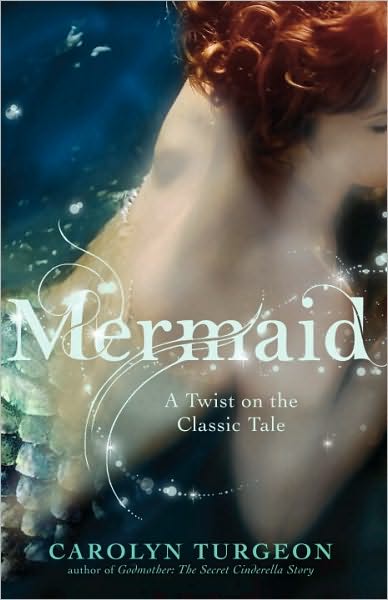
Leading off this time is Carolyn Turgeon's novel Mermaid -- subtitled "A Twist on the Classic Tale" -- coming from Broadway Books as a trade paperback on March 1st. That "classic" tale alluded to in the subtitle is, of course, Hans Christian Andersen's, but Turgeon's version looks to spend equal time, and sympathy, with the transformed mermaid herself and with her rival for the prince's attention. (And he's called a "wounded warrior" on the back cover, which is rather more contemporary and on-the-nose than I'd expect for a fairy-tale retelling.) This is Turgeon's third novel, after Rain Village and Godmother: The Secret Cinderella Story -- so I suspect she's done the rewritten-fairy-tale thing at least once before.

To shift gears entirely, next is a translated graphic novel, Hagakure: The Code of the Samurai. Hagakure was originally a treatise about the life and purpose of a samurai -- told as a series of stories imparted by a wise older samurai to a young man -- dictated by the 17th century Japanese samurai-turned-Zen-priest Yamamoto Tsunetomo, and has had a long life, both in Japan and in various translations worldwide. This manga version is based on the recent William Scott Wilson translation of Hagakure, and has been adapted into comics form by Sean Michael Wilson (no direct relation to William Scott Wilson, amusingly enough) and illustrated by Chie Kutsuwada. (The creative team behind The Story of Lee, in fact, which I reviewed a couple of months ago.) Hagakure was published by Kodansha America -- the local offshoot of a major Japanese publishing house -- in January.

I saw a "blad" -- pre-publication pamphlet of sample pages -- for Doug Savage's cartoon book Savage Chickens a few months back, but now the book itself is in front of me. It looks like one of those great single-idea funny books -- like 1001 Uses for a Dead Cat or Truly Tasteless Jokes -- that I've always loved; it's a work-life-is-hell collection of single-page cartoons, in which all of the characters are chickens. (Though I thought that kind of book was semi-dead these days; they tend to rely on impulse purchases, so they're strongly affected by store traffic -- and traffic at the retail level has been way down.) However, Savage Chickens was a blog before it was a book, so I can hope that Savage has an audience that will seek this out. I want to see more books like this -- publishing can't be all serious, all the time -- so good luck to him. Savage Chickens, the book, is being published in trade paperback by Perigee at the beginning of March.

DAW Books publish three mass-market paperbacks a month, come hell or high water, and I respect the hell out of them for that kind of old-school gumption. One of those is almost always an anthology of brand-new stories on some kind of theme, packaged by Martin H. Greenberg's Tekno Books and featuring a dozen or so stories from a wide range of authors. The book in that slot this month -- this month being "March," since books need to have time to actually get to stores -- is After Hours: Tales from the Ur-Bar, which was edited by Joshua Palmatier and Patricia Bray. It has fifteen new SFF bar stories -- about magical drinking establishments in all times and places -- from writers including S.C. Butler, Anton Strout, Juliet E. McKenna, Laura Anne Gilman, and Maria V. Snyder.

DAW's March list also contains a paperback reprint of the most recent Darkover novel, Hastur Lord, which was originally published in hardcover last year and is credited to the late Marion Zimmer Bradley and Deborah J. Ross.

And last for this week -- and of DAW's paperback in March -- is Seanan McGuire's fourth "October Daye" novel, Late Eclipses. Since the first one, Rosemary and Rue, only came out in September of 2009, that's four full-length novels in barely a year and a half, which is really impressive. (So all of you fantasy fans who complain that your favorite writers are too slow should take a look at McGuire; she'll keep you busy for a while.) October Daye is McGuire's heroine, the requisite tough woman in a modern world filled with unexpected magic -- in this case, a half-fae changeling who works as a private eye and whose cases (and personal life) has more Faerie in it than she's comfortable or safe with. The series has been well-reviewed, but it's definitely piling up faster than I've been able to keep up with.

Monday, December 13, 2010

Reviewing the Mail: Week of 12/11

I usually have a long, tedious explanation of the point of the "Reviewing the Mail" posts here, but it feels silly to do so this week, since the mail brought just one book. I still do have to admit that I haven't read this book yet, which is slightly embarrassing -- it's only one book, and a graphic novel at that! -- but I should point out that the pre-existing stack of books to be read is quite large, and I picked up five books from the library this week as well. Anyway, the one book that arrived in the mail this week is...

The new book by French cartoonist Nicolas De Crecy, author of Glacial Period -- it's the first in a series, called Salvatore, Vol. 1: Transports of Love. NBM will publish this in trade paperback in January, and, as usual for things coming over from France, it actually collects the first two European Salvatore albums. Salvatore himself is a "crack mechanic dog," who is trying to build a magnificent vehicle so he can go visit his lost love after she moved to South America. (Comics are full of people who never think of saving up to buy a ticket, so I feel right at home with that premise.) It looks cute and quirky in about equal measure, but that's from a very fast glance -- I do expect to review this one soon.

I did get things that weren't books in the mail, and I could mention one of them here: a little pre-publication pamphlet (not sure if the publisher is calling this a "teaser" or a "blad") for Doug Savage's Savage Chickens, coming as a trade paperback in March 2011 from Perigee. From what I can see here, it's a book of cartoons about chickens in office situations, and it's pretty funny in an early-Dilbert way. (If you want to check our Savage's cartoons, they were, as nearly everything is these days, published first for free on these very Interwebs.)

Wednesday, June 01, 2011

Read in May

Earlier this year, I had a half-baked plan to make May the month where I'd only read books on my iPad -- since, as we all know by this point, digital is the wave of the future and print is for squares, man! -- but it didn't quite work out that way. My thought was that, since I was starting the month with a week-long business trip to Florida, wouldn't it be keen if I could manage not to take any books, and pack a little lighter?

It didn't quite work out that way -- I took one emergency backup mass-market on that trip, which I didn't open, but I also read two novels this month in library hardcover and close to a dozen graphic novels on paper as well -- making it about par for one of my plans.

But I did read four books entirely onscreen this month, and (as of the moment I'm writing this) about two-thirds of a novella-length report on the future of digital journalism, so I haven't entirely punted on that front.

And I do have plenty to read on the iPad, in a half-dozen reading Apps -- Kindle, OverDrive, Bluefire, Stanza, GoodReader, and iBooks -- to keep me going for several months if I wanted. But, unlike a printed book, my iPad can also play solitaire, or Angry Birds, or check my RSS feeds, or Twitter, or....so I'm much more distractable on it.

But here's what I did manage to read:
  • Joe Daly, Dungeon Quest, Vol. One (5/2)
  • Doug Savage, Savage Chickens (5/9)
  • Masashi Kishimoto, Naruto, Vol. 49 (5/11)
  • Matthew Hughes, The Damned Busters (5/11)
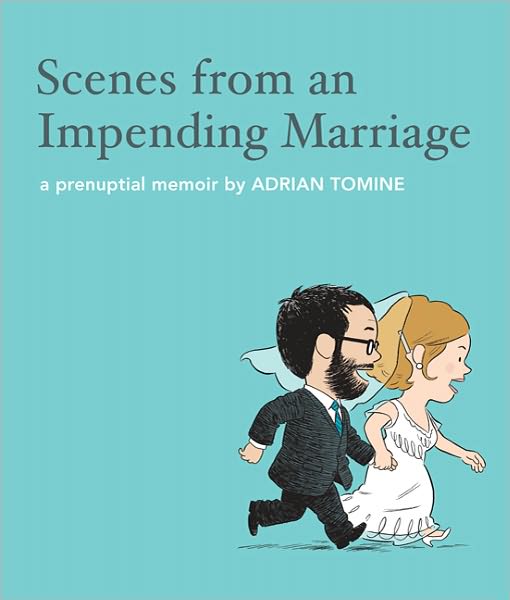
  • Adrian Tomine, Scenes from an Impending Marriage (5/12) Of all the books one might expect from Adrian Tomine, a cute little comedy-memoir about wedding preparations would be really far down the list. And yet -- perhaps showing that absolutely anyone turns to mush in those circumstances -- that's exactly what this book is: a collection of short comic strips about how Tomine and his then-fiancee, Sarah, planned their wedding and all of the funny/annoying things that happened to them along the way. Even less likely, the book Scenes from an Impending Marriage is a slightly expanded (by a six-page Epilogue) version of the actual favor given out to all of the guests at that wedding -- so, somewhere down the line, look for the super-rare "wedding edition" of this book to turn up on auction sites and on the wall of very particular comics shops. The book itself is sweet -- again, not what we've ever expected from Tomine -- and just long enough not to outstay its welcome; if you've ever gotten married or been in love, there will be plenty here that's familiar and raises a smile.
  • Masashi Kishimoto, Naruto, Vol. 50 (5/13)
  • Matt Fraction & Gabriel Ba, Casanova: Luxuria (5/16)
    I'm afraid this very stylish alternate-universe super-spy story didn't involve me as much as it has other critics -- this has been glowing reviewed all across the bits of the 'net that read comics -- mostly because the main character is so relentlessly passive, entirely acted upon and forced into other people's schemes. Ba's art is as crisply energetic as ever, and Fraction's story has plenty of action, quirky ideas, and complicated triple-crosses to keep it all humming along. But the whole thing felt like a lesser version of The Umbrella Academy -- another dysfunctional-family story, with borderline superheroes, the Fate of the World, and complicated matters of ontology and reality. But Casanova himself isn't interesting or active enough to really hold up the story himself, and everyone else here is deeply secondary. So the whole package was definitely stylish fun, but the substance, in the end, was lacking.
  • Dennis Lehane, Moonlight Mile (5/16)
  • Kevin Huizenga, The Wild Kingdom (5/17)
    Now this is...well, it's a thing. Definitely a thing. It's solid, taking up physical space -- you can pick it up, leaf through the pages, read the words, follow it from panel to panel. It's absolutely a graphic novel of some kind, featuring Huizenga's regular character Glenn Ganges, and tries to explicate some kind of complicated relationship between the natural world and the manufactured human world (particular as seen through mass advertising), though a sequence of mostly short, elliptical story-fragments, which don't directly follow each other in any obvious sequence. Yes, this is pretty aggressively art-comics -- even though Huizenga, as usual, draws in a clear, slightly cartoony style, and has a lot of text on his pages as well to comment on the images or ape well-known advertising slogans. It's not graphically artsy; it's conceptually artsy, a book about a subject that's difficult to describe clearly, and one that I really can't say if it was successful or not, since I'm utterly unsure what it was aiming to do. It's definitely less directly engaging and cooler than other Huizenga stories I've read, and I doubt anyone would want a steady diet of comics like this. But, once in a while, it's invigorating to see a creator light out for the territory at high speed like this.
  • Matt Howarth, The Downsized (5/19)
    Howarth spent the '80s and '90s putting out lots of odd comics in his distinctive thin-line Rapidograph style -- centered on the related series Those Annoying Post Brothers and Savage Henry -- and then, from what I can see, moved largely online and into downloadable forms, but kept up his high rate of production. (Unfortunately, I lost track of his work for most of that time, since I was still pretty focused on the ink-on-paper world.) This is one of his rare on-paper works these days, so I actually found out about it, bought it, and read it. Downsized is out of character from my experience of Howarth stories -- of course, I have to point out, again, that I haven't kept track of his work this past decade. But Downsized feels like Howarth doing late-period Eisner: it's a family story, centered around a big family reunion for some of the main characters' parents' fiftieth reunion, out in a big hotel. Howarth's work on such a down-to-earth book -- focused on interpersonal relationships, growing older, and lost opportunities -- is not entirely successful: his dialogue aims for naturalness, but often stumbles, and this is a story entirely driven by naturalistic dialogue. But his people are as lovingly depicted as always; Howarth excels at telling the stories of characters who are bundles of foibles and accumulated bad decisions, and those folks drive this story forward.
  • Roger Langridge, The Muppet Show Comic Book: Muppet Mash (5/20)
    This is the last collection -- at least for now; there are some uncollected and/or unpublished stories that still might see the light of day -- of Roger Langridge absolutely excellent work translating everything that made The Muppet Show such great TV into equally wonderful comics. (And I literally mean "everything;" Langridge's 22-page comics closely track a TV show of the same running time.) I've written about Langridge's Muppet work before -- see volumes one, two, three, and four -- so, this time, I'll just say that it's more of the same, and that it's still lovely, funny work that is certainly not just for kids.
  • Steve Dublanica, Keep the Change (5/24)
  • Diana Wynne Jones, Enchanted Glass (5/27)
  • Karl Shaw, 5 People Who Died During Sex and 100 Other Terribly Tasteless Lists (5/31)
    I read this, very appropriately, in the smallest room of the house, and wasn't disappointed. This is a conglomeration of lists from four separate UK books of Shaw's -- arranged into nine thematic chapters, covering religion, sex, death, food, entertainers, criminals, and so forth -- with this selection presumably chosen for the shorter attention span of the American audience. It was published over here just over four years ago. (I got it as a bound galley around the turn of 2006-2007; I'm still working through things I took home for the Bookspan giveaway shelf, and probably will be doing so for another decade at least.) The point of a book like this is to remember some of the horribly interesting facts and spring them on others at opportune times, but, sadly, I have a lousy memory for trivia like this. Still, this was very entertaining to read, and my mother-in-law has already asked for it once I'm done -- so I have to count this book as a major success.
And that was what I read in May. June, as I've already groused about several times here, will see me flying off to hither and yon, so we'll see how much reading I can get done along the way.

Sunday, February 04, 2024

Books Read: January 2024

It's time for the monthly index again, and this is it. Links, as always, will follow once posts go live.

Léonie Bischoff, Anaïs Nin: A Sea of Lies (digital, 1/1)

Jack Vance, The Star King (in The Demon Princes, Volume I, 1/1)

Mike Lowery, Random Illustrated Facts (digital, 1/6)

Elizabeth Pich, Fungirl (digital, 1/7)

P.G. Wodehouse, A Few Quick Ones (1/7)

Nate Fakes, A Fade of Light (digital, 1/13)

Thierry Smolderen and Jean-Philippe Bramanti, McCay (1/14)

Michael T. Gilbert's The Complete Wraith! (1/15)

Douglas Adams, Dirk Gently's Holistic Detective Agency (1/15)

Philippe Brenot and Laetitia Coryn, The Story of Sex (1/20)

Ben Zaehringer, How Not to Get Into Heaven (digital. 1/21)

Saophie Adriansen and various artists, Nina Simone in Comics (digital, 1/26)

Eoin Colfer, Highfire (1/26)

Jamie Hewlett and Alan Martin, Tank Girl Full Color Classics, Vol. 3: 1993-1995 (digital, 1/27)

Doug Savage, Zombies According to Savage Chickens (digital, 1/28)


I'm pretty sure I will continue reading books in February, and do this again.

Sunday, December 07, 2025

Books Read: November 2025

Here's a list of the books I read in the past month. As always, it's mostly an index, and almost entirely for my own use later. Also, the posts about these books mostly haven't gone live yet, so I'll be updating this later to include those.

Naomi Nowak, Graylight (11/1)

Roy Thomas, Michael T. Gilbert, and George Freeman, Elric: The Sailor on the Seas of Fate (digital., 11/2)

John Sladek, The Muller-Fokker Effect (in SF Gateway Omnibus, 11/2)

Matt Kindt, Tyler Jenkins, and Hilary Jenkins, Apache Delivery Service (11/8)

Doug Savage, Laser Moose and Rabbit Boy: Time Trout (digital, 11/9)

Jack Vance, Marune: Alastor 933 (in Alastor, 11/9)

Ludovic Debeurme, Renée (11/14)

Tom Toro, And to Think We Started as a Book Club... (digital, 11/16)

Richard Wolinksy, ed., Space Ships! Ray Guns! Martian Octopods! (11/16)

Ulf K., Hieronymus B.: 1997-2007 (11/21)

Bill Griffith, Photographic Memory (digital, 11/22)

Jim Henson, Jerry Juhl, and Roger Langridge, Jim Henson's The Musical Monsters of Turkey Hollow (11/23)

P.G. Compton, The Continuous Katherine Mortenhoe (11/23)

Walker Tate, Laser Eye Surgery (digital, 11/27)

Charles Dickens, A Christmas Carol (in Christmas Books, 11/27)

Jennifer Hayden, Where There's Smoke, There's Dinner (digital, 11/28)

Asher Perlman, Hi, It's Me Again (digital, 11/29)

P.G. Wodehouse, Spring Fever (11/29)

Debbie Tung, My Perfectly Imperfect Body (digital, 11/30)

Loren D. Estleman, Burning Midnight (11/30)


Next month I'm pretty sure I will read more books.

Monday, September 01, 2025

Books Read: August 2025

This is what I read last month; as always, it's mostly an index to the blog and primarily useful to me  rather than you the home viewer. But there it is:

Richard Sala, Night Drive (digital, 8/2)

Ruth Goodman, How to Be a Victorian (8/2)

Doug Savage, Laser Moose and Rabbit Boy (digital, 8/3)

Mark Chiarello, editor, Wednesday Comics (8/9)

William Goldman, The Princess Bride (8/9)

René Goscinny and Albert Uderzo, Asterix the Gladiator (8/10)

Sophie Goldstein, House of Women (digital, 8/16)

Jack Vance, Trullion: Alastor 2262 (in Alastor, 8/16)

Sergio Aragones' Groo: The Hogs of Horder (digital, 8/17)

Jeff Lemire, 10,000 Ink Stains: A Memoir (digital, 8/23)

Various, The Mystery Science Theater 3000 Amazing Colossal Episode Guide (8/23)

Peter Bagge and Gilbert Hernandez, Yeah! (digital, 8/24)

Ambrose Bierce, In the Midst of Life: Tales of Soldiers and Civilians (in The Devil's Dictionary, Tales & Memoirs, 8/24)

Kazuo Koike & Goseki Kojima, Lone Wolf & Cub, Vol. 7: Cloud Dragom, Wind Tiger (digital. 8/25)

Carol Lay, Murderburg (digital, 8/26)

Stephen Crane, The Red Badge of Courage (in Prose and Poetry, 8/26)

Stan Sakai, Usagi Yojimbo, Book 8: Shades of Death (digital, 8/27)

P.G., Wodehouse, The Small Bachelor (8/27)

Kenji Tsuruta, Wandering Island, Vol. 1 (digital, 8/28)

Philippe Riche, Bad Break, Chapter #2 (digital, 8/29)

Loren D. Estleman, The Left-Handed Dollar (8/29)

Michael Sweater, Everything Sucks: Kings of Nothing (digital, 8/30)

Denis-Pierre Filippi & Silvio Camboni, Walt Disney's Mickey Mouse and the Amazing Lost Ocean (digital, 8/31)

Dashiell Hammett, The Glass Key (in Complete Novels, 8/31)


I plan to keep reading books in the future.

Wednesday, July 01, 2026

Books Read: June 2026

I'm back-dating this post, because I already have two quote posts "today" (Saturday, the Glorious Fourth, when I'm typing this) and a massive number of hourly quote posts for tomorrow, the twice-yearly day I burn off my excess book quotes.

You don't care about that. But I might wonder, looking back sometime in the future, so, Hi Future Me! that's why you did this.

Here's what I read this past month. I'll add links once the posts go live; that's running five to six weeks ahead, pretty consistently, these days.

Flore Vesco & Kerascӧet, The Court Charade (digital, 6/1)

Edward Anderson, Thieves Like Us (in Crime Novels: American Noir of the 1930s and 1940s, 6/1)

Tom Gauld, Physics for Cats (6/6)

Frank Miller and David Mazzucchelli, Daredevil: Born Again (6/7)

P.G. Wodehouse, Laughing Gas (6/7)

Juan Díaz Canales & Juanjo Guarnido, Blacksad, Vol.2: Arctic Nation (digital, 6/13)

Drew Friedman's Chosen People (digital, 6/14)

Meg Elison, Foundling Fathers (6/14)

Roy Thomas, Michael T. Gilbert, P. Craig Russell, & George Freeman, Elric: The Weird of the White Wolf (digital, 6/19)

Nicolas Pothier & Johan Pilet, Mickey Mouse Vs. The Mouseton Society of Evil (digital, 6/20)

Martha Wells, Platform Decay (6/20)

Hilary Fitzgerald Campbell, Murder Book (digital, 6/21)

Jon Ronson, The Men Who Stare at Goats (6/26)

Doug Savage, Laser Moose and Rabbit Boy: Spidermania (digital, 6/27)

Katriona Chapman, The Pass (digital, 6/28)

Christopher Brookmyre, Quite Ugly One Morning (6/28)


Next month, I do expect to read more books.

Sunday, June 02, 2024

Books Read: May 2024

I forgot to do these monthly index posts for a couple of months, so I'm tossing them in backdated. You are probably not even reading this unless you're wandering through the archives or reading this via RSS.

But, whatever, here's what I read in the merry month of May:

Rick Geary, The Bonito City Tragedy (5/4)

Seamus Heaney, Opened Ground: Selected Poems 1966-1996 (5/4)

Lewis Trondheim, Ralph Azham, Vol. 4: The Dying Flame (5/5)

George Macdonald Fraser, The General Danced at Dawn (in The Complete MacAuslan, 5/4)

Bryan Lee O'Malley, Scott Pilgrim Vs. the World (digital, 5/10)

Noah Van Sciver, Disquiet (digital, 5/11)

A.J. Liebling, The Jollity Building (in The Sweet Science and Other Writings, 5/11)

Jeff Lemire & others, Black Hammer: Visions, Vol. 2 (digital, 5/12)

Doug Savage, Relationships According to Save Chickens (digital, 5/18)

Jack London, The Road (in Novels and Social Writings, 5/18)

Maria Hoey and Peter Hoey, Coin-Op Comics Anthology: 1997-2017 (digital, 5/19)

Daniel Pinkwater, The Worms of Kukumlima (in 4 Fantastic Novels, 5/19)

M.S. Harkness, Time Under Tension (digital, 5/24)

Larry Gonick and Tim Kasser, Hypercapitalism (5/24)

Olivia Jaimes, Nancy (digital, 5/25)

Stewart O'Nan, Ocean State (5/25)

Nate Powell, Fall Through (digital, 5/26)

Jerzy Kosinski, Steps (5/26)

Jesse Lonergan, Hedra (digital, 5/27)

Victoria Rosenthal, Fallout: The Vault Dweller's Official Cookbook (5/31)


As I write this, it is June 23rd, so I can say without fear of contradiction that I have already read books in the following month, but I can't promise I'll do this on time next month (next week).

Sunday, April 05, 2026

Books Read: March 2026

Is it really April of 2026? Neither of those things seems plausible. (I also had an AI tool at work confidently tell me it was 2025 several times this past week, which may be adding to my confusion. Maybe 2025 will never end.)

Anyway, assuming a month did just end, and that it was actually March of 2026, here's what I read:

Anders Nilsen, Tongues, Book 1 (3/1)

Peter Kuper, Insectopolis (3/6)

Roy Thomas and P. Craig Russell, Elric: The Dreaming City (digital, 3/7)

Jordi Lafebre, I Am Their Silence (digital, 3/8)

Ian Frazier, Paradise Bronx (3/10)

Doug Savage, Laser Moose and Rabbit Boy: As the Deer Flies (digital, 3/14)

Osamu Tezuka, Tomorrow the Birds (digital, 3/15)

P.G. Wodehouse, The Girl on the Boat (3/15)

Ana Oncina, Just Friends (digital, 3/20)

Max Huffman, Dogtangle (digital, 3/21)

Lavie Tidhar, A Man Lies Dreaming (3/21)

Zabus and Hippolyte, Incredible! (digital, 3/22)

Mike Dawson, Fun Time Omnibus, Vol. One (3/28)

Kazuo Koike and Goseki Kojima, Lone Wolf and Cub, Vol. 9: Echo of the Assassin (digital, 3/29)

Michael Swanwick, The Universe Box (ARC, 3/31)


In April, if this is April, which I'm not sure I'm convinced of, I will read more books.