Monday, June 30, 2008

I Review Schwartz's Superpowers

That sounds like a vaudeville setup, but I really did review the novel Superpowers by David J. Schwartz.

Honest.

An Opportunity Smartly Not Taken

I just remembered this, and what is blogging for if not to share minor passing thoughts?

In the new Get Smart movie, there's a moment when it would be utterly appropriate -- and reasonably funny -- for someone to say "You can't fight in here; this is the War Room!" I can't believe that line never was considered, and yet it doesn't appear. The movie is stronger without it; it has a clear reference to an older movie without hammering it home (like so many movies and other media do these days).

Restraint is sometimes hard to notice, but it should be celebrated when it appears.

Boing Boing Deletes Person, Clams Up

Via Blog of a Bookslut, I learn that Boing Boing has deleted all references to sex writer Violet Blue, and has refused to comment on the deletion.

It does seem to go against everything they stand for, so I hope an explanation will be forthcoming. I don't think this is a sign of massive sexism, or the End of Journalism, or any of the other unlikely things in that linked post, but blogs are tricky things. Just because you always can change old posts doesn't mean you ever should.

I would have thought Boing Boing would have a policy of transparency for themselves, since they demand and agitate for such policies elsewhere. They regularly decry Orwellian control-of-information tactics, stonewalling, and Stalinist declarations of non-personage when other people do it...

Reviewing the Mail, Week of 6/28: Comics

And this is the yin to the previous yang; here I'll list, and try to explicate, all of the things that came into the Hornswoggler home last week that were comics in one way or another.

I'm going to start with things I paid money for, because I wanted to draw particular attention to this first book:

The third collection of Yoshihiro Tatsumi's manga to be translated and published by Drawn & Quarterly is Good-Bye, and it's in stores now. I reviewed it at ComicMix when the galleys circulated, and probably didn't adequately describe how special Tatsumi is. He's one of the greats of world comics, with stories by turns shockingly raw and evocatively quiet. His stories aren't just good for manga, or good for comics -- they're great short stories, period.

Skyscrapers Of The Midwest is a title I don't know much about -- it's by Joshua W. Cotter, published by Adhouse Books, and seems to be a collection of (linked?) anthropomorphic stories. But I've heard good things about it, and my comics shop had it marked down, so I'll give it a whirl.

Lobster Johnson Vol. 1: The Iron Prometheus is another brand extension of the mighty Hellboy empire -- probably the last one to make it into into stores ahead of the new Guillermo de Torro-directed movie -- and it's written by Hellboy and Lobster Johnson creator Mike Mignola, with art by Jason Armstrong. (Actually, the credit reads "story by Mignola," which may mean that Armstrong worked from an outline and acted as his own scripter.) It was published by Dark Horse sometime in the very recent past.

Fables Vol. 10: The Good Prince is the latest in the modern fairy-tale-inspired fantasy series, written as always by Bill Willingham, with art by Mark Buckingham and (mostly) Steve Leialoha. As I remember, the series is still continuing, so this isn't the big finish, but it looks like a major piece of the story of the battle between the Adversary -- who conquered most of the alternate worlds of fairy-tale characters before the series began -- and our main characters in the expatriate community of New York.

In the same world, but with a somewhat different tone, is Jack of Fables, Vol. 3: The Bad Prince. It's about one of the less heroic characters from the main series, off having his own adventures. (I have no idea if the seemingly linked titles mean these two stories have anything to do with each other, though I do expect to find out soon.) The Jack of Fables series is written by Bill Willingham and Matthew Sturges, and the pencil art in this book is mostly by Tony Akins, though there are four others credited with part of the pencils and inks. This is also from DC, as one would expect, and it was published within the last month.

PvP Volume 5: PvP Treks On os the yes, fifth collection of the webcomic PvP, which is by Scott Kurtz. Image publishes the webcomic as a monthly comic book, and bills their collected books (like this one) as collections of the comic books, without even mentioning the Internet once. The direct market really is its own little parallel universe, isn't it?

I've been looking at Erotic Comics: A Graphic History from Tijuana Bibles to Undergound Comix the last two or three times I hit the comics shop, and went so far as to pick it up and look through it last time. And this time I finally admitted to myself that I was interested enough in the subject to buy the thing, and so I did. It's by Tim Pilcher, with Gene Kannenberg, Jr., and has a foreword by Aline Kominsky Crumb. Harry N. Abrams, which is a classy, serious publisher of art books and whom I trust has kept the whole proceedings as tasteful as possible (under the circumstances) published Erotic Comics in February. (What I'm hoping is that its as interesting and fun as Bob Adelman's Tijuana Bibles of a few years back.)

And the last thing I picked up at the comics store -- literally, just before I got on line to pay for my huge stack of good stuff -- was the first two volumes of Chica Umino's Honey and Clover manga series. I've already got a copy of the movie that was adapted from this series, and I hope to review the whole package for next week's Manga Friday column for ComicMix.

Now, on to the things that actually did come in the mail:

Nate Powell's Swallow Me Whole, which Top Shelf will publish in September, is a big original graphic novel -- the pages aren't numbered, but I'd estimate it's over 200 pages long -- with some kind of supernatural element in it. There are a lot of bugs, on the cover and throughout. (And I can't help wondering if this Powell pronounces his name the way it's spelled or like Anthony Powell -- if the latter, it would rhyme with the title. These are the kinds of things I think about when I see new books...)

Jeff Lemire's Essex County Volume 3: The Country Nurse is also from Top Shelf, but it's publishing slightly later, in October. As the title probably clued you in, this is the third of his graphic novels to be set in his ficionalized Essex County (of Ontario, Canada), after Tales from the Farm and Ghost Stories. This book follows one day in the life of a traveling nurse in a farm community -- I think I recognize her from Ghost Stories, so perhaps this book is meant to tie together the first two volumes.

CMX Manga -- now as always an imprint of the mighty DC empire -- sent me two sets of photcopies with their usual secrecy. (They never have a cover letter, or even a tip sheet/fact sheet/sell sheet to say when the book is being published and the pertinent information -- even the most professional comics publishers seem to struggle with the things that seem simple in trade publishing.) First is Kikaider: Code 02, Vol. 7 by Ishimori Shotaro and Meimu, a science-fiction story with robots -- giant ones, I think -- and the usual accouterments. It will be published in on July 9th and is marked for Mature readers.

Also from CMX is Suihelibe!, Vol. 1, a title which I'm having the greatest of difficulty in spelling correctly (and consistently). It's by Naomi Azuma and seems to be a combination of a school club story and a cute girl from space story. (And I'm sure there's an official Japanese manga term for both of those things, but I don't know them.) This one is a bit further in the future, coming in late October. As befits a series with characters who seem to be about nine years old, it's rated E for everyone.

Manu Larcenet's Ordinary Victories: What Is Precious, collects what were the third and fourth graphic novels in the "Ordinary Victories" series in France -- the first two were published in the US as just Ordinary Victories in 2005, and ended up on Time magazine's list of the five best graphic novels of the year. It's a semi-autobiographical story about a photographer dealing with family issues, and NBM is publishing it in August.

Also from NBM is Bluesman by Rob Vollmar and Pablo G. Callejo, which collects a series originally published in three volumes only a few years ago. It's set in the '20s and about a couple of black musicians in the South -- so I don't expect it will be a terribly happy story. This new complete edition of Bluesman will be published in August.

Vittorio Giardino's No Pasaran!, Vol. 3, is the finale of a trilogy, and the latest book about Giardino's series character Max Friedman, a spy in '30s Europe. NBM will publish it in August.

Slow Storm is the first full-length graphic novel by 2007 Eisner nominee Danica Novgorodoff, a story about tornado season in Kentucky and about a woman firefighter and a Mexican immigrant. It will be published by First Second in September.

And last for this week is the Rick Geary adaptation of H.G. Wells's The Invisible Man, second in the new Papercutz Classics Illustrated series, and publishing in August. This adaptation first saw print in the great, but short-lived CI series from First Comics in the late '80s, but somehow I missed it then (even though I was buying Rick Geary stuff on sight, and most of the First CI books as well).

Reviewing the Mail, Week of 6/28: Not Comics

Once again, the comics part of the mail is too big to fit into a reasonable-size post with anything else, so it'll be broken off by itself, slightly later. And what I have here is:

Brandon Sanderson's The Hero of Ages, third and final book of "Mistborn," coming from Tor in October in hardcover. This series has been acquired by an editor who's a friend, it's gotten excellent reviews, and Sanderson has even been tapped to finish Robert Jordan's last, unfinished "Wheel of Time" novel, which is about as big a vote of confidence as a writer can get. But I haven't yet read the previous books, so I can only give you hearsay -- people I trust say these books are good, and now the trilogy is complete, for those of you who wait for that.

The Dark River by John Twelve Hawks in mass-market paperback, July. The interesting story for me here is that it's a mass-market by Vintage, an imprint that's used for that format only very rarely. It's the second novel in a don't-call-it-SF series, which has not caught the Zeitgeist in quite the way it hoped to. (Though there's something mid-90s about this series, with people "off the grid" has the heroes -- that's more X-Files than 24; we generally prefer our heroes to be finding and torturing the people off the grid these days.)

The Last Realm Book One: Dragonscarpe is an absolutely immense piece of heavily-illustrated fiction by Pat McNamara, Michal Dutkiewicz and Gary Turner, published by what looks like a brand-new press, Angel Phoenix Publishing. I'm not sure if this Gary Turner is the same as Golden Gryphon's Gary Turner -- this one is described as a publisher and musician -- but it's possible. It's a very major, professional-looking thing to come out of nowhere, and I wonder what kind of distribution they're getting for it. I've only just started poking at it, and I'm really not sure what to make of it. There's a corporate copyright -- D.R.E.E.M. TV Pty. Ltd. -- which may indicate that it's being funded by someone-or-other's money in hopes of becoming a big media event. (Or it may just indicate that the three creators have incorporated to keep it all straight.) If any of you have the chance to look at this in person, take it.

I'll mention one book I got from the library just because: John Varley's Rolling Thunder. Varley's been writing vaguely Heinleineque young adult SF novels for the past few years -- which has felt a bit like slumming after his great '90s novels Steel Beach and The Golden Globe -- but getting a new Varley novel nearly every year is still a wonderful thing. This one is the third in the loose series with Red Thunder and Red Lightning; I'm not sure why nothing is read this time. (Perhaps he's referencing one of my favorite old video games? Stranger things have happened.)

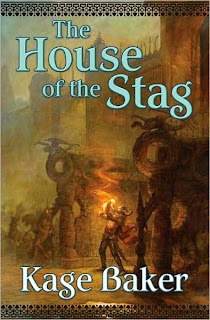
And last is the book that excited me the most this week: Kage Baker's The House of the Stag, a new fantasy novel set in the world of The Anvil of the World. Tor will publish it in September. I don't know much more than that now, except that I want to read this if I can find any time at all.
Sunday, June 29, 2008

Buying In by Rob Walker

Since I'm now working as a "Marketer" rather than an "Editor" -- leaving aside the argument of how much what editors do is marketing -- I thought I should spend some more time and thought on what marketing is these days, and how to reach the people I want to reach.

So I grabbed Buying In when I saw it at the library; I'm somewhat familiar with Walker's work from his "Consumed" column in The New York Times Magazine, and I figured I could trust him as much as I could trust any business-book author. The subtitle is "The Secret Dialogue Between What We Buy and Who We Are," and it's another one of those books that tries to describe contemporary American consumer behavior and figure out what it all means. (Walker describes his "Consumed" column as a "blend of business journalism and cultural anthropology," which also describes Buying In pretty well.)

Buying In, in a nutshell, starts with the conventional wisdom that brands are dead and that advertising no longer works -- since consumers are more savvy, have more options, and are more independent than they were in the past -- and examines it. Along the way, Walker digs up some great quotes -- including what I think was a Business Week article from 1939 -- about how consumers are "now" radically different than they ever were before. His point is clear: this supposed huge, recent shift is something that marketers have been dealing with for close to a century now; it's not new.

Walker is polite, and never quite says that conventional wisdom is bullshit, but he's obviously thinking it. As usual, the reality is more complicated and nuanced than the PowerPoint version -- there's always an audience that considers itself too sophisticated to be influenced by advertising, and that audience (in this modern, media-saturated age) is now a great majority. But saying that advertising and marketing don't influence you is not the same as making it true -- and Walker dives into studies that prove that.

He's got some individual jargon -- the Pretty Good Problem, "murketing," the influencer -- but he explains it all well, and they're all important to his points. He also has done a lot of research, particularly with interviewing entrepreneurs in the "alternative" area, like American Apparel's Dov Charney, to find out their thoughts, plans, and schemes.

Walker's big idea is that consumers are actually more interested in brands than ever before, but they're not passive followers of brands the way they used to be. One of his case studies is the way hip-hop appropriated Timberland boots for their own purposes, and how the company struggled to understand and deal with their new audience. Over and over, Walker points out that the consumer base for a product is not necessarily a single one, wide and deep, but different pieces of a fragmented consumer culture -- in Timberland's case, both urban hip-hop musicians looking for a certain look (and their fans, both urban and suburban), and blue-collar workers who need tough shoes with steel toes.

I tend to think of myself as someone more resistant than the norm to marketing efforts -- but, then, nearly all of us do. (As Walker puts it, most people think that they're smarter, better looking, and more savvy than most people.) Buying In is a great book for consumers interested in their relationships with the things they buy, and an even better one for marketers trying to connect their products to the people that would want and use them most.

Saturday, June 28, 2008

Movie Log: Get Smart

My sister-in-law took the two boys for a sleepover on Wednesday night -- mostly because The Wife is in a stretch of about two weeks where she has to be at the store nearly every minute it's open (while the owner is doing various other things). Since kid-free nights are rare, we jumped on the opportunity to go see a movie and have dinner (at Thatcher McGee's, probably the best restaurant in my home town of Pompton Lakes).

The movie was Get Smart, since the reviews said, essentially, that it was a good spy movie with a lot of funny stuff, too. (As opposed to being a parody or spoof of a spy movie.)

They were right. What they didn't mention, or maybe I just missed, was precisely how gorgeous Anne Hathaway is these days, particularly in the evening gown she wears about halfway through the movie. (In that outfit, she also wears a very Barbara Feldon-esque wig, which was a nice touch.)

To give the other side equal credit, Steve Carell is one of the few modern actors who looks completely at home in a suit, and he's not unattractive himself. (Now if I could only remember his follow-up line when he was talking about the "hot guy in the bathroom.")

Get Smart is very nearly as good as it could be: Carrell and Hathaway are both perfect in their roles, and Alan Arkin is a Chief just as grumpy (but slightly more active) than Edward Platt's. Most of the rest of the cast is good as well, though Terence Stamp seems to be trying too hard now and then as Siegfried and the two gadget guys are clearly only in this movie to tie in to their own direct-to-video spin-off.

The script gets all of the old catchphrases in just enough -- nothing is beaten over the head, and it all comes up perfectly in context. Carrell isn't trying a Don Adams impression, but he falls into a similar cadence much of the time -- he's playing the same character, not miming.

(And it was great seeing Bernie Koppell briefly, but I did wonder why Barbara Feldon didn't cameo. Everyone else from the old show is dead at this point, though it also would have been nice to have Mel Brooks and Buck Henry show up in one or two shots.)

Now, pardon me, I'm off to see what Anne Hathaway movies I might have missed...

Friday, June 27, 2008

Publishing Basics

I've spent the last couple of hours doing some preliminary work for my "Reviewing the Mail" posts for Monday, and I've been surprised and appalled by how many comics publishers -- generally the big ones, too -- who can't handle the very basics of 21st century bookselling.

Here's the #1 thing: you need to have your final cover feeding to the online retailers. Their pages -- particularly Amazon's -- rise to the top of search results for book titles and authors, and it behooves you to have your actual, final cover (not the art without type, not a panel from the book, not any other damn thing) there.

I know feeds don't always run smoothly -- a fair part of my job is dealing with "this book has the wrong cover/wrong copy/ is missing quotes" issues. But you get them done, because they're important.

And it wouldn't kill you to have some decent copy there, as well.

Mr. Fooster: Traveling on a Whim by Tom Corwin & Craig Frazier

I've seen this book generally cited as if its full title was Mr. Fooster Traveling on a Whim, but the book itself clearly differentiates between title (Mr. Fooster) and subtitle (Traveling on a Whim) on cover, spine, and title page -- though not in the CIP data on the copyright page -- so I'm doing that as well.

Mr. Fooster is a slim, heavily-illustrated book at a low price point, designed to sit near the cash-wrap as an impulse purchase. Each spread has a one-page illustration by Frazier, in a light brown tone with lots of little lines for shading and more than its share of crosshatching as well. The facing page has a paragraph -- rarely, more than that -- of the story by Corwin.

It's narrated from a third-person omniscient perspective, though it spends most of the time in Fooster's skull. And this is good, since Fooster never actually speaks, and otherwise he'd be a bit enigmatic.

Mr. Fooster's eleven chapters add up to about five separate stories, in each of which Fooster goes out wandering -- traveling on a whim, as the book repeatedly hammers home -- and then something odd happens. He usually deals with the odd something by blowing a bubble, using a bottle and wand he always keeps with him. And the bubble magically makes everything better, by forming some object which is precisely what is needed. Each story then ends, as if it had just delivered a moral but without the moral itself.

Mr. Fooster has the form of an allegory, but I haven't been able to make the parallels come into focus -- it feels like a book that desperately wants to teach a lesson, but can't think of any lessons to teach. (Other than, perhaps, the very flabby one of "take a look at the world around you.")

Fooster is also fond of musing on odd questions -- some of which are very debased existentialism, some of which are minor-comedian-level wordplay, and some of which would be easily answered by anyone who bothered to do any research. I'd be much more impressed by him if he weren't such a derivative and sloppy thinker.

Mr. Fooster is short and harmless; I vaguely enjoyed it, for the same reason that one smiles at a cute slobbery puppy, even if he is making a mess on the rug. But it's clearly reaching for profundity, and falling very short. I am terribly cynical, so I'm afraid that I assume that this Mr. Fooster will only be the first of many and that it will sell far, far too many copies. But, to me, it reads like a version of Jack Handey's Deep Thoughts that doesn't know that it's a joke.

Manga Sex at ComicMix

Today's Manga Friday column at ComicMix dives into two of the more adult -- not actually pornographic, but with characters who actually do have sex -- subgenres of Japanese comics, redikomi and yaoi.

(I'm really not the person to be reviewing yaoi, but I'm the designated manga guy at ComicMix, so I thought I should bring it up at some point.)

Anyway, I reviewed the titles Love For Dessert, Real Love, and Kiss All the Boys.

Come and see me try not to make a fool of myself...

Thursday, June 26, 2008

Roc and Ace Fall

(That's the season "fall," not "fall" in its verb form.)

Valerie Cortes, a Penguin USA publicist, has created a teaser video for the Ace/Roc Fall hardcovers and trade paperbacks.

It's a different way of getting the information out, and I'm not sure if it's quite as usable as it could be -- getting to any book in particular would be difficult -- but it's definitely interesting and new and webby and eye-catching, which are all good things.

And, from this, I learned that Jack McDevitt has a new book this fall, and that John Steakley's Vampires will be republished. (Maybe I'll read it this time; people have been telling me I should for about a decade.)

Did I Miss the US Sale?

Publishers Lunch's weekly round-up of deals had the following squib this evening:
NYT bestselling author Terry Goodkind's A DIFFERENT KIND OF HUMAN and THE HINGES OF HELL, to Maya Mavjee and Kristin Cochrane at Doubleday Canada, for publication in 2009 and 2010, by Danny Baror at Baror International, on behalf of Russell Galen at Scovil Chichak Galen Literary Agency.
Did I miss the US announcement, or is that deal still hanging fire? It's odd to see a major author -- who isn't himself Canadian, as far as I remember -- with a solo deal for Canadian rights, instead of having them rolled up with either the US or UK.

Update, 6/21: With the (utterly unsubstantiated, but what the hell) rumors posted by the second Anonymous, below, we can work out some of the expected parameters of this deal.

Goodkind has been reportedly unhappy with being a fantasy author, and wants to be seen as a "mainstream" writer (which somewhat explains the quote ascribed to HC UK; they're desperately trying to keep him happy when he's already jumped ship from his US publisher -- the one who discovered him and made him a bestseller).

And "two major powerhouses" -- who could they be? Tor is explicitly out of the running. Given Goodkind's interests and history, I would expect that general trade powerhouses are meant -- and the biggies there are Random House, Penguin USA, Hachette, and HarperCollins. Since it's not necessarily the SF imprints in the mix, I couldn't even guess as to which two of those it is (or which imprints or editors).

I'm intrigued by the "so low in the double digit millions" comment -- for a two book deal, that means the expectation is well north of $5m per book, probably at least $10m for purely US rights.

Let's run some numbers based on that, shall we?

We'll assume a $29.95 hardcover and a subsequent $9.99 mass-market paperback -- both on the high end, but it'll do for these purposes -- and royalty rates of 20% for the hardcover and 12% for the paperback -- similarly high, at the edges of the plausible.

And let's assume that these two books sell just as well as the hardcover of Confessor (the last book of "Sword of Truth") and the paperback of Phantom (the penultimate book of that series). This is an unreasonable assumption, but it's one I expect the agent will be making, and insisting on.

Confessor has sold, according the the standard industry-reporting vehicle that I have access to, on the order of 175,000 copies to date. Let's be generous and say that's only about 60% of Confessor's total final hardcover sales -- it's still selling now, for one thing -- and take the total up to a round 300,000. At a 20% royalty and $29.95 list, that's about $1.8 million earned royalty.

On the paperback side, Phantom has reportedly sold somewhat north of a hundred thousand copies. Again, let's be generous and say the total sale will be two hundred thousand. Assume, again, a $9.99 list and 12% royalty, and each of the new books will earn about $240,000 in paperback.

Add those together, generously assume some revenue from audio sales and other domestic subsidiary rights (but no book club sales -- Goodkind hates bookclubs), and you come out with roughly $2.5 million earned for each book, under quite generous assumptions.

If Anonymous #2 is correct, Tor offered at least twice this figure and was laughed out of the auction.

Since agents love round numbers, I suspect the figure desired in this case is $10 million per book. And, to even get the publisher's revenues to that level, A Different Kind of Human and Hinges of Hell would need to sell over half a million copies in hardcover, each, with a similarly blockbuster paperback sale.

As we know from Publishers Weekly's annual round-up of hardcover sales, only about twenty fiction books hit that level at all in any given year. Goodkind's books have not previously been among them.

To earn out at that level, these Goodkind books would have to sell five or ten times as well as his previous books have -- to be blunt, they'd need to sell to the vast general female audience for romances and thrillers. They would need to sell at a level that -- of the vast range of writers ever connected with the SFF field -- only Stephen King has done consistently, and only a few others (Dean Koontz, John Jakes, etc.) have ever done.

I have not kept up with "Sword of Truth," so I may be working for an outdated image of his work, but...I don't believe Goodkind is the kind of writer whom that mainstream female audience is going to take to heart. He does have a large, devoted fan-base -- mostly of fantasy readers, despite his protestations -- and that audience could always get somewhat bigger. But if A Different Kind of Human sold even one million copies in hardcover, I'd be astonished.

It will be very interesting to see who, if anyone, walks away with US rights for these books, and how much they are reported to have paid for those rights. (And what is included in those rights -- at $10m per book, I know I'd demand film rights be thrown in.)

Update, 6/26: The US sale, as reported today by Publishers Weekly, was for three untitled books. If that's the deal Anonymous #2 was talking about below, the financials become quite different -- obviously, the sales projections from three books will be about 50% higher than for two books. So, assuming this deal was in the low double-digit millions, Putnam Berkley can make money on these books -- as long as they sell at least as well as Goodkind's previous work.

Now, the thing to do is to wait and see -- the first of these books will be published in fall 2009, and, since Putnam is trying to reposition Goodkind, I'd expect a major galley push to booksellers, reviewers, and bloggers (but probably not many fantasy bloggers, if any) in the late spring to early summer. (It'll probably also be a big BEA galley.)

Explain This Bill Day Cartoon To Me

First of all, this image's official home is here; I only host these editorial-cartoon images myself these days because the originals sometimes disappear. If you are UFS Inc. and you disapprove of this use, e-mail me at the address to the right and I'll switch to a hotlink to your image (for as long as it lasts).

Right.

So, in this cartoon, our president is coming out of a building (the Department of Justice, maybe? the Supreme Court? does it matter?), and comes upon the traditional statue of justice, depicted as a svelte, robed, blindfolded woman (a grandmother in this case) holding a sword and a set of scales.

(I'm not mistaken than the figure is George W., am I? It's a loose caricature, but I thought it was supposed to be him.)

W. is carrying a briefcase marked "Jobs/Resumes," for whatever reason.

Looking at the statue, he whistles (presumably a wolf-whistle, which is not really plausible, given that particular statue) and thinks about an elephant (representing the GOP), blindfolded and wearing a bikini.

Every single element of this cartoon is confusing:

What does the star-spangled bikini stand for? (Is that a reference to hiding behind the flag, and the tininess of the bikini shows that the cartoonist thinks there's very little justification?) Or is it just there because it's hard to drawn an elephant in a robe?

Does the fact that the elephant's scales are much much smaller than the original statue's scales mean anything? The elephant's sword is also shorter and stubbier, if that means anything.

Does the briefcase have anything to do with anything?

And what is the message of this cartoon -- that W. needs a job after the end of his term, but has jut realized he can get a sex-change operation and massive plastic surgery in order to become a Supreme Court Justice? That W. has just this second realized that he has the power to appoint judges, so he thinks that he should pick ideologically friendly ones? Or what?

So Who Got Goodkind?

Today's Publishers Lunch teases their (pay) Deal News service with several half-reports, including "Terry Goodkind moves houses."

So, does anyone out there know: which house, and has the dollar amount been released? (I'm assuming this is the two-book deal for A Different Kind of Human and The Hinges of Hell; if not, that would also be interesting news.)

Movie Log: Fever Pitch (1997)

The Wife is an immense Colin Firth fan, so I'm not entirely sure how we missed Fever Pitch the first time around, but we finally caught up to it about a week ago.

This was the first attempt to adapt Nick Hornby's memoir of the same name into a movie -- an American version with Drew Barrymore came along a year or so ago, translating soccer football into baseball (and adding Drew Barrymore, which is no bad thing). I haven't seen the newer American movie, so I won't be comparing those two.

I have read Hornby's book, though, and it's a small gem of its kind. That kind, though isn't fiction, and it definitely isn't a romantic comedy, which both movies have been. The book is a serio-comic look at one man's obsession with a football team -- Arsenal -- and what that's done to his life. It extends out from there, as well -- Hornby is very thoughtful and interesting on the subject of a man's relationship to sports, and to any activity he's a passionate spectator of, giving over his emotional state to something he can't control.

The movie, on the other hand, is on the side of Paul Ashworth (Firth) from the start, which unbalances it. As in many rom-coms, two people with nothing in common are thrown together -- Paul and Sarah Hughes (Ruth Gemmell) are teaching in rooms next door to each other at the same London school, and dislike each other on sight.

Paul is a mussed, indulgent English teacher who loves football far too much. (Well, nearly all of the audience will think that, but the movie doesn't.) Sarah is a new teacher of history, all buttoned up and serious.

So Fever Pitch sets itself up as the story of how Paul loosens up Sarah, and she gets him to grow up. But that's not actually what happens. Over and over, Paul makes it clear that, in any and all circumstances, football will always come first in his life -- before Sarah, before work, before friends, before anything. He's unapologetic, even pugnacious, on that point, and Sarah never really pushes back the way she should. (The script was written by Hornby, who may have identified too much with his male hero.)

So, in the end, Fever Pitch becomes the story of how Sarah changes to suit Paul. And that's exactly backwards -- she was a little stiff, but she'd already loosened by that point. At the end of the movie, Paul is clearly the one who needs to change to make the relationship work...but he doesn't.

Fever Pitch has some nice performances, with Firth particularly good as the kind of guy who cares about his team more than anything else in the world. But it's not as smart about itself, or about that guy, as the original book was, and the ending is a problem.

(The cover up top is the current US DVD, which is frankly horrible -- I guess Firth is too big now to let his face be used for his old minor movies, but it misrepresents the movie very badly. The British cover, second, is better, but I could only find fuzzy versions of it.)

Wednesday, June 25, 2008

Everyone Must Blog Everything, Forever and Ever, Amen

This week's think piece at Booksquare, "Why Publishers Should Blog," does a good job of presenting the positive aspects of blogging for publishing organizations. But there are people out there -- like Jason Pinter, for example -- who could speak to the negative aspects.

Not me, though. Been there, done that. Got the T-shirt. That's all the dead past.

But there always is a negative side, and it's important to think about those possible negative aspects first. Whether you're the publishing company opening things up, or the employee encouraged to "convey excitement and information" without talking "the way you talk about books in your catalog," think about what can go wrong, and what you'll do if it does. Because, in this world, it always does go wrong.

E.C. Segar's Popeye, Vol. 1

The subtitle of this first collection of Segar's Thimble Theater strips is the very appropriate "I Yam What I Yam!"

I've already taken it back to the library -- I actually read most of it on the afternoon of the day after it was due back. (Mostly because it's outlandishly oversized, and so can only be read really comfortably at a table.) So I can't cite chapter and verse.

But damn if E.C. Segar wasn't a sly, funny, and amazingly entertaining cartoonist. The character of Popeye has been very badly served by other hands for the past fifty or seventy years, so seeing the pure Segar is a revelation.

Popeye doesn't even appear until about page twenty-seven -- and this volume starts ten years into Thimble Theater's twenty-year run. The first part of the story has then-lead Castor Oyl inheriting Bernice the Whiffle Hen from his uncle, and then trying, repeatedly, to kill it for a reward. (Whiffle Hens are rare, valuable, and consummate escape artists.) Then Castor spends a month or so selling Bernice to various shady characters -- she always comes home to him, which causes trouble.

Finally, Castor and his friend Ham Gravy -- who had been Olive's long-time boyfriend before being rudely shouldered aside by a rough seaman -- learn that rubbing a Whiffle Hen's feathers brings great luck, so they set off to break the bank of an island casino. But to get there, they need a boat...and a crew.

For crew, Castor hires Popeye. The sailor is clearly supporting cast for the rest of that story, but it's also clear that Segar was having fun with the new character -- and, outside the world of the strip, Popeye was becoming hugely popular.

Popeye leaves the cast at the end of that story, but he's back pretty quickly -- either Segar or someone at his syndicate must have realized they had a great character on their hands. And what's astonishing -- at least to me, in 2008 -- is that Popeye wasn't the caricature that we think of these days. He was a tough guy and a sailor, and not book-smart, but he was canny and knowledgeable, with a great wealth of experience and an individual view of the world. He didn't eat spinach, he didn't fight with a sailor named Bluto (or Brutus), and he didn't talk in catchphrases.

Anyone who thinks Popeye is a dull, essentially limited character should check out this reprint series -- along with anyone who has an interest in classic comic strips. Segar's Thimble Theater was one of the good ones, with long, intricate stories and detailed art.


Tuesday, June 24, 2008

Recent ComicMix Activity

I'm behind again...

Today: a review of Michael Chabon's nonfiction collection Maps and Legends

Yesterday: a review of the graphic novel Muzz, Vol. 1 by FSc

Friday: the usual Manga Friday column, covering books called Variante, Classical Medley, and The Girl Who Runs Through Time

Coming up this Friday: two kinds of sex for girls!

SFX Top 100: Meming Away the Day

First I saw Larry of OF Blog of the Fallen doing it, and thought "is this a meme?"

Then I saw RobB do it, and I knew it was a meme, since he linked to several others.

So now it's my turn -- below are the Top 100 SF Writers, as voted on by the readers of the British magazine SFX, with comments by Yours Truly.


First of all, a caveat: the SFX list is explicitly of "Favourite" authors, not "best." And there really is no arguing with taste...particularly with bad taste. But, since I want to do this anyway I'm going to pretend that the list is of "Best," and complain or praise on that basis. Remember: I know the difference; I'm just ignoring it as suits me. (And also being sarcastic and/or joking much of the time.)

  • 100. James Herbert
    A minor British horror writer who just sneaks onto the list because the voters are all British. I've never read him, but I don't feel it much of a lack. If this were a list of "Best," this would be the first name jettisoned.

  • 99. Gwyneth Jones
    A fine writer whose work has never done much for me. She's influential and worthy, but probably only made it onto this list at all because she's British.

  • 98. Sara Douglass
    She's a crowd-pleasing epic fantasy writer, in a modern, quite feminine way (lots of talking about the relationship and hurt/comfort), but not what I would call a major important writer at this point.

  • 97. Charles Stross
    I'd think he would be higher on the list, but he's had a lower profile in the UK than in the US so far. And his novel career is still only about a decade old. Still, I bet this is only the first hint that this list -- and the reading audience in general -- leans more to Fantasy than SF.

  • 96. Terry Goodkind
    On the grounds that he's a major bestseller with a very popular series, I'm surprised that he's this low on the list. Does he sell less well in the UK? Or do his readers there think of him as a guilty pleasure?

  • 95. Brian W. Aldiss
    Probably should be higher if we're judging pure worthiness, but never wrote that one big novel to crystallize his fame. Aldiss is inevitably the least of the British New Wave triumvirate (with Ballard and Moorcock), but third isn't a bad place to be. The fact that he's on this list at all shows that he's not forgotten, which is the usual fate for older writers.

  • 94. Ken MacLeod
    Given the length of his career to date, this is a reasonable placement for MacLeod.

  • 93. Olaf Stapledon
    On the one hand, he's easily the third most influential British genre writer ever, after only Tolkien and Wells. On the other, he never was the kind of writer to really be a favorite; there's something chilly and distanced about Stapledon. So hitting the list at all, so long after his death, is probably an achievement.

  • 92. Michael Marshall Smith
    I think of him as a minor writer who isn't even writing SF anymore; the great British public (or some subset of it) clearly disagrees with me.

  • 91. Jon Courtenay Grimwood
    I've read a couple of his books and found them decent but slightly sloppy thrillers with not always consistent SFnal skins on them. He's clearly an enjoyable writer, which is why he's on a list like this.

  • 90. Christopher Priest
    He's an influential and highly respected writer, but I wouldn't have expected many people to list him as a favorite. It's a pleasant surprise to see him on this list.

  • 89. Jonathan Carroll
    I do have the feeling that he writes more-or-less the same book every time out, at least for the last decade and a half, but his best works are mesmerizing fantasy novels that merge everyday life and the luminous. I'd have liked to see him higher on this list, but I'd like to see a lot of things that I never will.

  • 88. Scott Lynch
    Can someone really be a favorite when he's only published two novels? Sure, they're both really fun novels, but it seems a little soon for readers to be nailing their colors to his mast.

  • 87. David Weber
    Would probably rank much higher in a poll taken in the US, but his showing here proves that even the Brits like to see regular explosions in space, complete with earth-shattering kabooms.

  • 86. M. John Harrison
    I think of Harrison as being like Priest (#90) only more so, so I'm not entirely sure if I expected him to place higher than Priest did. Priest feels more British to me, and Harrison more New Wave, so I guess I'm surprised Harrison outpolled Priest. But Harrison has had a high-profile book more recently than Priest, which probably explains it. I've only tried to read Harrison a few times, and never got very far.

  • 85. Jacqueline Carey
    Her current "Kushiel" trilogy seems to be notably less popular than the first one -- I suspect that sexy fantasy really needs to have a female protagonist to draw in a large appreciative audience -- which may have hurt her standing in this poll. For myself, I've enjoyed large swaths of her writing, but generally found that there were too many swaths in all for my taste, especially when so many of them involved people hitting each other, ostensibly for fun.

  • 84. Kim Stanley Robinson
    My cynical brain wonders if his recent "only policy wonks can save us from runaway global warming!" trilogy was better received in the UK than over here (where it seem to have just passed through town quietly; I haven't checked sales). His profile seems to have been slowly dropping since the heyday of the Mars books; maybe it's dropped less -- or come back more -- in the UK.

  • 83. Theodore Sturgeon
    In a list of pure merit, this would rank somewhat higher. But, for a guy who's been dead a quarter-century and was never much of a novelist, being 83rd favorite writer is pretty darn good.

  • 82. J.V. Jones
    I believe Jones didn't have the same publishing hiatus in the UK as over here, which may be what makes this seem like an odd choice to me. I may also be judging her too harshly, but she's always seemed like just another average decent fantasy writer to me -- which makes me wonder if the upper reaches of this list will be awash in similar types.

  • 81. Joe Abercrombie
    Who's written, what?, two-thirds of a trilogy so far? Some people may have really low standards, but I don't think anyone can be your favorite writer if you don't even know how he handles endings yet.

  • 80. Joe Haldeman
    A fine SF writer, and I'm happy to see a sizable number of Brits remember him and like his stuff.

  • 79. Simon Clark
    See James Herbert (#100) -- Clark is the equivalent for the next generation. I guess there are people who like horror novels as a matter of course; I find such people creepy and cross the street to avoid them.

  • 78. George Orwell
    I've written about how powerful and important Nineteen Eighty-Four and Animal Farm are before, but I suspect this he's mostly an "I really should" choice. Animal Farm is deeply enjoyable, and could easily help Orwell get on this list, but not Nineteen Eighty-Four. When I think of favorite Orwell, it's his reportage and essays that come to mind, not his SFnal works.

  • 77. Samuel R. Delany
    This is an awfully good showing for a writer who's published only gay porn and literary criticism for the past decade and a half (and left his last major SF work as half of a duology). I've never really loved any of Delaney's novels, so he wouldn't be on my similar list, but he's utterly respectable.

  • 76. Charles de Lint
    Only intermittently to my taste, but a respectable and popular writer -- probably would rank higher on an American version of this list. (And even higher than that in Canada.)

  • 75. Julian May
    Her books are quite enjoyable, which is surely why they're here, but it's all one long series (in two discrete parts). That's not quite the same problem as Abercrombie (#81), but it's close.

  • 74. Edgar Rice Burroughs
    I know that there are people who read ERB for pleasure, but I find his prose like a piece of gravel in my shoe -- rough, uncomfortable, and forever keeping me from moving forward with any grace.

  • 73. Robert Silverberg
    One of the best writers ever to work in SF and the author of many, many great novels and stories. I'd place him higher.

  • 72. Susanna Clarke
    Again, she hasn't written enough for me to be comfortable classing her as a favorite -- it's just one novel and a small stack of short fiction so far. What's there is good, but it's not a whole lot, yet.

  • 71. Stanislaw Lem
    I've never read anything by Lem I'd really call enjoyable; I'm not sure if that's my fault, his, or his translators'. But he'd be nowhere on my similar list.

  • 70. Larry Niven
    Some of Niven's stuff has been really wonderful -- "Inconstant Moon" is one of my favorite stories -- but I've never tried to seriously read lots and lots of his work. He clearly has a devoted fanbase, though.

  • 69. Alfred Bester
    One of the greatest writers in the history of the field, but, still, showing up remarkably high on the list for a guy who wrote two novels fifty years ago.

  • 68. Katherine Kerr
    As others have said elsewhere in a different context, I always mix her up with Katherine Kurtz. I think Kerr is the Celts in Space writer, and I guess a fair number of people like her stuff.

  • 67. Jack Vance
    A great, wonderful, idiosyncratic writer who apparently is remembered more than I was afraid he would be.

  • 66. Harry Harrison
    An intermittently interesting writer, most of whose books are aging badly (even the very lightweight ones). I wonder if he placed this highly mostly out of memory.

  • 65. Marion Zimmer Bradley
    Not my kind of writer, but indubitably popular.

  • 64. Richard Matheson
    Really? All those movies based on his books must be paying off. Good for him!

  • 63. Dan Simmons
    The SF Simmons, the horror Simmons, the mainstream Simmons, or the ranting-against-Muslims-on-the-Internet Simmons?

  • 62. Elizabeth Haydon
    Another solid but unspectacular fantasy writer, as I see it -- I guess a lot of people like that.

  • 61. Terry Brooks
    Like Goodkind, I would have expected to see Brooks higher on this list.

  • 60. Richard Morgan
    They do like him over there in the UK, don't they? I still think his first book, Altered Carbon, is much, much better than anything else I've read by him.

  • 59. Stephen Baxter
    Very talented, very prolific, and fond of writing a chunk of novels in one style and then moving on -- the latter doesn't seem to be a recipe for popularity, but Baxter has made it work somehow.

  • 58. Jennifer Fallon
    Another one of those fantasy writers; I've liked what I've read of hers, but there are an awfully lot of women who write big fat books that I never have enough time for on this list.

  • 57. Mercedes Lackey
    Lackey writes shorter books, and was one of my guilty pleasures for at least a decade. She's also got a huge back catalog at this point, so I honestly could have seen her higher on the list.

  • 56. C.J. Cherryh
    Another writer who does a lot of different things -- many of them very well, but not always to everyone's tastes. It's goo to see her solidly in the middle of this list.

  • 55. Harlan Ellison
    I'm sure he'd be angry at placing this low, if he found out this list existed. (And he'd probably also hate SFX on principle, which is not unreasonable.) But, for a writer who doesn't write novels, hasn't published anything new in nearly a decade, often denied writing SF, and has personally alienated half of the pros in the field, #55 isn't a bad showing.

  • 54. Jasper Fforde
    His novels are all very entertaining, but they're beginning to seem like they're all the same thing. He could potentially be Terry Pratchett if he wanted to be.

  • 53. Octavia Butler
    Another writer I'm surprised to see chart this high; I've read some of her stuff, but I always felt dutiful (rather than joyful) in doing so.

  • 52. J.G. Ballard
    I'd personally rank him much, much higher, but I have quirky tastes. It's great to see him on the list at all, let alone in the middle third.

  • 51. Robert E. Howard
    Unlike ERB, Howard was actually a good writer of prose (despite working for the pulps most of the time), and I find his best work endures. Glad to see others agree with me.

  • 50. Sherri S. Tepper
    Tepper writes for an audience that has a different set of equipment in their trousers than I do; that's fine, but it means I can save some time by not reading her books.

  • 49. H.P. Lovecraft
    Even I'll admit he can be clunky, especially reading him these days. But his SF/horror hybrid hasn't yet been equalled at the things it does best.

  • 48. Mervyn Peake
    Another writer that I'm sure the British esteem more highly than Americans would, and another one who only wrote a few books. The first two Gormenghast books are excellent neo-Dickensian fantasy, and the third is not quite as good and quite different.

  • 47. Jules Verne
    Do Brits read Verne for pleasure? Or is that what the non-readers voted, because they can remember his name? Nosy Americans want to know.

  • 46. Alastair Reynolds
    He's been publishing novels for about a decade, which is long enough to become one of my favorites.

  • 45. Neal Stephenson
    He's an odd case of the writer who started as SF, and never denied writing SF, even though most of his output is not what most of us would call SF unless we squint and make excuses and flail our arms out a lot. What I've read by him - not including the doorstop historical trilogy -- has been reliably smooth and entertaining.

  • 44. Clive Barker
    He seemed to be poised to take over the whole world in about 1991 -- that didn't happen, and his books got farther apart (and often smaller), but he does still have a lot of readers.

  • 43. Jim Butcher
    I like him, and I find this placement about right.

  • 42. Tad Williams
    Another writer of big fantasies -- though I am surprised that Brits apparently like him substantially better than Brooks or Goodkind.

  • 41. Kurt Vonnegut
    Now, now, Vonnegut never wrote fantasy. He explained that over and over again. Who are we to doubt him? (The non-SF books he did write often tend to the sophomoric -- probably not a concern for the SFX crowd -- but were occasionally gems rather than pebbles.)

  • 40. Trudi Canavan
    A writer I've never read, and who seems to be notably more popular in the UK than here. Yet another one of those newish female fantasy writers.

  • 39. Michael Moorcock
    The architect of the New Wave and an unabashed writer of pulpy adventure. Has written more pretty darn good novels than the any random two writers put together.

  • 38. David Eddings
    I get the impression that his fans only really like the Belgariad and related works, but they really like those.

  • 37. Alan Moore
    SFX readers prefer to look at pictures than to read long columns of text -- it's not Voice of the Fire that they're thinking of here. He has written some great stuff, but he's also written some pure filler and some pseudo-spiritual bumf.

  • 36. Orson Scott Card
    Some people love thinking of themselves as the tormented super-genius who saves the entire human race. Others have grown up. (I kid OSC; he's done a lot of other things in his career, and I've enjoyed quite a few of them. But it's Ender's Game that's driving this placement.)

  • 35. Stephen Donaldson
    Bestseller outcast unclean! I had an intense love-hate relationship with the first six Covenant books, and I still think that Donaldson has caused more people to say "That word: I do not think it means what you think it means" than any other.

  • 34. Gene Wolfe
    I'd place him much higher, but a lot of people find his work too hard to follow. So this is a pretty good placement.

  • 33. China Mieville
    His career is still quite young, and I wonder how many of these are "he's so dreamy!" votes, but he does have the writing chops (and the storytelling chops, too) to carry it off.

  • 32. Raymond E. Feist
    Above Brooks and Goodkind? The Brits' tastes in epic fantasy are subtly different from those of Americans.

  • 31. Lois McMaster Bujold
    RASFW would be outraged at this low placement. I haven't kept up with her current fantasy series, but she's been a dependably readable writer for nearly twenty years, which is no mean feat.

  • 30. Roger Zelazny
    One of my personal favorites; he'd have been in my top 5. I imprinted early and hard.

  • 29. Anne McCaffrey
    Once she would have been in the top 5 of a poll like this, but perhaps her recent works (particularly the co-authored ones) have dimmed her fans' enthusiasm a bit.

  • 28. Steven Erikson
    A remarkably high placement for a guy who's written seven dense, small-mammal-crushing fantasy novels that are only comprehensible to readers who have already read a small library of fantasy. I mean, I'm happy for him, but it could be a sign of incipient fantasy decadence.

  • 27. William Gibson
    I'm several books behind, but he's both important and a lot of fun to read.

  • 26. Guy Gavriel Kay
    Very respectable, both the writer and his showing here.

  • 25. CS Lewis
    Seriously? Is this based on Narnia, on the fact that non-readers could remember his name when polled, or is there some huge UK cult around Till We Have Faces?

  • 24. Diana Wynne Jones
    I wonder if her high placement means a lot of SFX readers are younger, or if they're remembering their childhoods. (Or if they're just still reading Jones because they love her books.)

  • 23. John Wyndham
    ...Beynon Harris Parkes Lucas. (From memory -- goes to check, and finds that, as usual, I put the "Beynon Harris" before the "Parkes Lucas," but at least I remembered all of them.) I don't think I've ever read him, but I like his name.

  • 22. Philip Pullman
    I'm only one book into "His Dark Materials," so have no personal opinion. The placement is reasonable, given how successful the trilogy was and the recent movie.

  • 21. Robin Hobb
    I've read one trilogy, which I found full of interesting stuff but a bit too long and overstuffed. I'm a bit surprised she shows up this high on the poll, ahead of a bunch of writers I'm pretty sure sell better than she does (even in the UK).

  • 20. Stephen King
    I think I've heard of him...

  • 19. Ray Bradbury
    Pretty good placement for an author of his stature; a good proportion of the voters for this poll have good taste.

  • 18. Arthur C. Clarke
    There was a time when Clarke would have been in the top ten, but that was at least a decade ago.

  • 17. Robert Jordan
    Sales don't mean everything, I see.

  • 16. J.K. Rowling
    Ditto for sales not meaning everything; fifteen writers who sell substantially fewer copies (except maybe that Tolkien chap, over the long run) outpolled her.

  • 15. Robert Heinlein
    Wasn't there some friendly argument, either in comments here or over at RASFW, about how Brits don't read Heinlein anymore? I guess that isn't true.

  • 14. Frank Herbert
    Herbert above Heinlein? Ick.

  • 13. Peter F. Hamilton
    Are we in the H's suddenly? I would not rank Hamilton here personally, but it's not my poll.

  • 12. David Gemmell
    They do like Gemmell over there. I've never read much by him, so I have very little opinion on his work.

  • 11. Ursula K. LeGuin
    Makes sense.

  • 10. Robert Rankin
    A very high placement for a very British writer; Rankin's never gotten much traction on my side of the Atlantic, but he seems to be very popular in old Blighty.

  • 9. HG Wells
    I do suspect many of these votes were out of name recognition or guilt rather than by people who regularly read Wells for fun.

  • 8. Philip K. Dick
    And the Dick revival is seen to extend beyond the USA.

  • 7. Iain M. Banks
    Of course. I'm slightly surprised he isn't in the top 5.

  • 6. Isaac Asimov
    This is a surprise -- above Heinlein and Clarke, Bradbury and Wells? Is he considered that much of a classic over there? (And does that mean, like Wells, he's name-checked but rarely read?)

  • 5. George R.R. Martin
    Martin has proved that he can write endings, but he's on this list almost entirely for a series that has not yet ended, and so I consider this placement somewhat premature. He's damn good, though.

  • 4. Douglas Adams
    His stuff -- particularly the later books -- is looking clunkier and more dated as time goes on, but the core of his work will live for quite a while.

  • 3. Neil Gaiman
    This is an impressive placement -- I wonder if it's primarily for Sandman or American Gods?

  • 2. J.R.R. Tolkien
    Typically, Tolkien only comes in #2 in polls like this if Jane Austen is in contention. But now he's been lapped by someone in his own field. Someone check his grave for signs of spinning...

  • 1. Terry Pratchett
    There's probably some element of sadness at his recent medical diagnosis, but he's also a really good, and really consistent writer with a vast audience. So his coming in at #1 is no surprise.
My god, that took vastly longer than I'd expected. I've been pecking away at this for two days...

Edit: Spelling of "Delany" corrected -- thanks to Neil Gaiman (Mr. #3) for the nudge. (Several other spellings -- notably "Jon Courtenay Grimwood," and periods in several authors' names, were silently corrected earlier or at the same time.) And for those of you who followed a nearly blind link from Neil's blog, welcome. Hope this entertains you for at least a moment or two, and please do stick around if you feel like it. The point of this blog is explained, more-or-less, here.

How Sad Is It That I Knew Instantly The Name of the Book?

Project manager, discussing book: "It was so tragic! It's not just that they were clones and had their organs harvested, but they never got to really love each other!"
via Overheard in the Office, Jun 13, 2008

(And that's Kazuo Ishiguro's Never Let Me Go, sadly)

Monday, June 23, 2008

Pathetic, That's What It Is. Pathetic.

I haven't done a quiz in a while, so I picked up this one from Ben Jeapes:

Your result for The Deep and Meaningful Winnie-The-Pooh Character Test...

Eeyore

"Do you know what A means, little Piglet?"

"No, Eeyore, I don't."

"It means Learning, it means Education, it means all the things that you and Pooh haven't got. That's what A means."

"Oh," said Piglet again. "I mean, does it?" he explained quickly.

"I'm telling you. People come and go in this Forest, and they say, 'It's only Eeyore, so it doesn't count.' They walk to and fro saying 'Ha ha!' But do they know anything about A? They don't. It's just three sticks to them. But to the Educated--mark this, little Piglet--to the Educated, not meaning Poohs and Piglets, it's a great and glorious A.


You scored as Eeyore!

ABOUT EEYORE: Eeyore lives in his own thistley corner of the forest and wonders why people don't come to visit him more often. He is master of the Guilt Trip, and is always gently forgiving his visitors for neglecting him. Eeyore considers himself to be smarter than the other inhabitants of the Hundred Acre Wood, and is often exasperated by their habit of having adventures and general merriment.

WHAT THIS SAYS ABOUT YOU: You are an anxious person, and you tend to expect the worst. Your friends find you somewhat cynical at times, because you have found that it is best to expect disappointment. You often feel unappreciated by the people you work with, but you rarely actually try and do anything to change that fact.

Your close friends admire you more than you think they do. They wish that you would learn to stop worrying so much and actually start trying to fix what is bothering you. If something is making you unhappy... change it!

Take The Deep and Meaningful Winnie-The-Pooh Character Test at HelloQuizzy

Reviewing the Mail, Week of 6/21: Comics

And this is the second half of the post listing the books I received for review last week, including comics and manga and other similar things. I saw large packages from both CMX Manga (part of DC) and from a manga publisher (one new to me) called Aurora, so I'll start with the latter, end with the former, and add the miscellaneous stuff in the middle.

Nephilim by Anna Hanamaki is the first book from my Aurora package: the main character Abel is from the Nephilim tribe, who all change from male to female at sundown every day (and, apparently, are required to kill people who see them at night, as women). Looks like this will turn into a romance between Abel and Guy (described on the back cover as "playboy/Imperial soldier"), with a fair bit of hurt/comfort and some mild domination. It was published this year.

Also from Aurora is Walkin' Butterfly, the first volume in a story about Michiko, an amazingly tall girl who has suffered for that...until she accidentally becomes a model. The chapter-opening art is a full-page view of Michiko, nude and scowling, which is a bit unusual. It's by Chihiro Tamaki, and was published last year.

Kaoru Ohashi's Nightmares For Sale is the third Aurora title, a series of horror stories about a pawnshop run by a mysterious man named Shadow. As usual with "mysterious shop" stories, I imagine that the people pawning their good get a lot more than they expect. Aurora published the first volume of Nightmares for Sale in 2007.

And also from Aurora is Flock Of Angels by Shoko Hamada, about a boy-band that wear wings onstage and people who got a disease called Angelosis, which made them grow real wings. Oh, and "being bitten by a radioactive spider" is vastly more plausible? (Comics have the weirdest set-ups imaginable; I don't know why, but it's true worldwide.)

Aurora also has imprints devoted to other manga subgenres, and they sent me a few books from Luv Luv, which focuses on romance stories for adult women -- rated "M" for mature. (Does that make these josei, or something more specialized? I need to get up to speed on my manga genres.)

First of the Luv Luv books is Hana Aoi's Love For Dessert, from which we see that having a man sticking his tongue out on a cover only very rarely works. Love for Dessert has six short stories of romance, which all seem to end in very tasteful sex scenes. (Luv Luv looks to me like the comics equivalent of sexy romance novels -- it's all about the woman: what she wants, what she thinks about things, what she fantasizes about.)

Also from Luv Luv is Real Love by Mitsuki Oda, which has the long title story and two shorter pieces. Again, just from poking through it, I see a whole lot of talking about the relationship, ending with sex. (The other way I can tell these books are by and for women? The good sex, at the end of the story, typically starts with just-off-panel cunnilingus.)

Last from Luv Luv is Kanae Hazuki's Voices Of Love, which is much the same: five stories of romance and sex, from women's points of view. (I wonder if this subgenre -- which I see from ads inside the books, once I got rid of the shrinkwrap, is called "Ladies' Comics" or Redikomi -- is always in short-story form? They seem to be all about the Happily Ever After ending, just like mainstream prose romances over here, and that would tend to keep the stories from getting too long...but they could still be as long as a tankubon or four without much trouble.) All three of the Luv Luv books were originally published this year.

Moving outside of my comfort zone, Aurora also publishes yaoi comics under the Deux imprint, and they sent me two titles from that line: Kiss All the Boys by Shiuko Kano and Yakuza In Love by Shiuko Kano. I'm not entirely sure if I'm ready for boy-boy sex in my comics, no matter how tastefully depicted (or how much some of the characters look like women to begin with), but how could I not read something called Yakuza in Love? (I ask you.) So look for my Manga Friday column this week to cover some explicit Japanese sex, and see how squicked out I get...

Moving away from adults-only comics for a while, First Second sent me Prince of Persia: The Graphic Novel, by Jordan Mechner, A.B. Sina, LeUyen Pham, and Alex Puvilland. It's related to the long-running game series and to the movie (based on the games to some degree) coming next summer, but seems to be a mostly original story told in that setting. The graphic novel version of the story will be available September 2nd.

SLG Publishing, the company once known as Slave Labor Graphics, published Muzz, Volume One by the interestingly-named FSc in May, but I only just saw it. Look for a review of it (by me) at ComicMix sometime later today -- or maybe tomorrow, if there's a lot of other stuff in the pipeline.

And now I turn to the CMX package, which, like the one that came last week, had no cover letter or other identifying information. (Hey -- getting the books at all is a big step, so don't think I'm complaining. Don't get the idea that I'm knocking the American system.) CMX sent me a book with my new favorite title, I Hate You More Than Anyone! (I'm particularly interested in the precise meaning -- does the speaker hate the object more than anyone else does, or does she hate him (I'm making assumptions about gender here that may not be warranted) more than she hates anyone else?) It's by Banri Hidaki, and the fifth volume (the one I have) is coming July 16th.

CMX also published Kiichi and the Magic Books,which looks like another entry in the now very popular "magic school" genre. The second volume is what I have on hand, and that's coming July 23rd. It's by Taka Amano.

Another second volume is Dorothea, coming July 16th for Mature readers. It's by the one-named "Cuvie," and features a medievaloid (or possibly actually medieval) warrior-woman, who -- as unlikely this may sound -- actually wears armor pieces that cover her torso. (Her legs look pretty naked, but we'll let that pass for now.) This is coming 7/16.

And last for this week is CMX's Tears of a Lamb. It will be published on July 16 as well and it's by Banri Hidaka. After staring at these manga covers all day, I'm now having trouble telling the boys from the girls. Dr. Andy self-diagnoses a case of manga overload, and that means it's it for me this week.

Sunday, June 22, 2008

Department of Rosy Rear View

Lede to an otherwise decent post by Persona Non Data:
Publishing used to be predictable across generations. Parents read the same books in the same manner as their children and grandchildren.
Really? It did? Readers in 1946 read the same books -- or even the same kind of books -- as those in 1968 and 1993? This is not true for my universe, though it may possibly have been the case wherever Persona Non Data is posting from.

C'mon, folks. Just because things are changing now, in new and sometimes frightening ways, doesn't mean that they never changed before. Things are always changing, and Dad's marketing team sweated just as hard as yours does.

Locus Award Winners

Locus has released the results of their annual poll, and the winners are:
  • SF NOVEL: The Yiddish Policemen's Union by Michael Chabon (HarperCollins)
  • FANTASY NOVEL: Making Money by Terry Pratchett (Doubleday UK; HarperCollins)
  • YOUNG ADULT BOOK: Un Lun Dun by China Miéville (Ballantine Del Rey; Macmillan UK)
  • FIRST NOVEL: Heart-Shaped Box by Joe Hill (Morrow; Gollancz)
  • NOVELLA: "After the Siege" by Cory Doctorow (The Infinite Matrix Jan 2007)
  • NOVELETTE: "The Witch's Headstone" by Neil Gaiman (Wizards)
  • SHORT STORY: "A Small Room in Koboldtown" by Michael Swanwick (Asimov's Apr/May 2007)
  • COLLECTION: The Winds of Marble Arch and Other Stories by Connie Willis (Subterranean)
  • ANTHOLOGY: The New Space Opera by Gardner Dozois & Jonathan Strahan (Editors) (Eos)
  • NON-FICTION: Breakfast in the Ruins by Barry N. Malzberg (Baen)
  • ART BOOK: The Arrival by Shaun Tan (Lothian 2006; Scholastic)
  • EDITOR: Ellen Datlow
  • MAGAZINE: F&SF
  • PUBLISHER: Tor
  • ARTIST: Charles Vess
(seen several places first, but snagged from SF Signal)

Looking at the list of finalists -- which were the top vote-getters in the one-round poll, not a shortlist that anyone chose between -- I might have gone differently if I were King of the World. (I'd probably rank Pirate Freedom above Making Money, and I'm not a huge fan of "The Witch's Headstone.") But, generally, it looks like the Locus voters were canny and thoughtful this year -- which is to say that they agree with me.

Saturday, June 21, 2008

My Employer Posts Good Numbers

Not that anyone cares, but Wiley released its report on the just completed Fiscal Year 2008 this week, and it was mostly good news. Revenue went up 36%, to $1.7 billion, from the prior year, in large part because of the Blackwell purchase. (But revenue went up 5% even excluding Blackwell.)

Friday, June 20, 2008

Quote of the Week

"I’ve worked under tyrants and I can say that I’d prefer to work under a talented, knowledgeable tyrant with a successful plan than a directionless gladhander with a ouija board any day of the week."
- Chuck Dixon

(This may, or may not, be a reference to Jim Shooter and Dan Didio)

Thursday, June 19, 2008

Movie Log: Walk Hard

Walk Hard is a deeply silly movie, and it knows it. Oh, occasionally it looks like it's being serious, but don't get taken in -- that's just to set up another joke. And I appreciate a movie that knows what it wants to do, and goes right out to do it.

John C. Reilly is Dewey Cox, who is a Roy Orbison/Ray Charles/Johnny Cash figure -- oh, heck, let's be honest: he's a deliberate conglomeration of every music-business cliche of the past fifty years.

Dewey -- who killed his brother at the age of six in a tragic machete-fighting accident -- begins his musical career at the age of fourteen by inciting his local high schoolers to riot with an amazingly bland song about hand-holding and is kicked out of the house immediately by his father. His twelve-year-old girlfriend goes with him, and soon bears the first of many, many children.

Dewey gets his big chance when he has to go on in place of the leader of the band in the African-American club where he usually mops the floor -- and, of course, that's the night when "the Jews from the record company" are there. Fame and fortune soon follow, as does temptation. If you've seen an episode of "Behind the Music," you'll know where it goes from there.

The whole thing is played as if it were serious; Reilly and the other actors never break character or wink, which makes Walk Hard work. It's a silly parody movie, but it doesn't act silly -- every moment is deadly serious to the people in it. (It's a style of comedy that used to be in vogue -- look at the original Airplane -- but has been overtaken by more knowing scripts and annoying baby-men.)

In the end, a comedy lives or dies on how funny it is: I thought Walk Hard was very funny, and laughed a lot. The Wife did, too, though she kept trying to watch it as a straight movie (I think, from her comments during it). So that's two votes for funny from the Hornswoggler household. I'll note in closing that there are quite a number of dick jokes, but not as many as there could have been -- especially given the main character's name -- and that they mostly work well, as in the double entendre-laced, and giggle-inducing, song "Let's Duet."

Wednesday, June 18, 2008

Ten Pounds of Crazy in a Five Pound Bag

I don't think I've linked to my latest obsession, Passive-Aggressive Notes, yet.

So, since I'm unlikely to be blogging much in the next couple of days (what with being on a conference exhibit-hall floor for thirteen hours straight tomorrow and all), let me leave you with one of the towering monuments of fun insanity:

Movin' Out (Anthony's Song)


Be sure to read all the comments; it's worth it.

Oh, and Thank You Terry!!!

Movie Log: Eagle Vs. Shark

Eagle Vs. Shark is the anti-Lord of the Rings. It's a small, low-budget movie set in the real world, made by entirely local New Zealand talent, and featuring characters who are not entirely unlike those who have seen Peter Jackson's movies several hundred times and dress themselves up as oliphaunt-riders on weekends.

(Though, as you can see, the two leads of the movie prefer to dress up as somewhat different creatures themselves.)

Actually, there's no obvious sign that Lily and Jarrod -- the leads of Eagle Vs. Shark -- are geeks. I'm just taking the fact that both of them are socially inept and making the all-too-common assumption. We meet Lily first, at work at a fast-food restaurant, and we instantly know that she has a crush on Jerrod...and that she's almost completely socially inept.

What we don't know, until after we get to know Jerrod better, is that he is even worse. By the time the movie's over, we'll have come to see Lily as the normal one.

So these two oddballs meet oddly, get together -- more or less -- and then go on a road trip to Jerrod's hometown. There, Jerrod intends to fight Eric Elisi ("the Samoan"), who tormented him all through high school.

Though Lily and Jerrod are clearly without the higher social graces, it's not as if their surrounding society is much better. Lily likes with her brother Damon, and shares many strange in-jokes with him -- but at least they're clearly a loving family. Jerrod's family, by contrast, is made up of many people, none of whom (except perhaps a grade-school girl) are what you would call functional members of society.

My wife and I kept remarking that, if someone had wanted to make a movie that portrayed all New Zealanders as bizarre and occasionally dim-witted weirdos, so as to keep the rest of the world far away, they couldn't have hoped to have done any better than Eagle Vs. Shark. You need to be able to enjoy the comedy of alienation to really appreciate this movie, but, if you do, you'll probably love it.

Tuesday, June 17, 2008

Twice ComicMix'd

I'm behind in my links again...

on Friday, I had my usual gala manga review round-up, covering Freak: Legend of the Nonblonds, Vol. 3, Heavenly Executioner Chiwoo, Vol. 4, and Dororo, Volume 2

and yesterday I reviewed a graphic novel based on a Dean Koontz character, In Odd We Trust

More on Age-Banding

I was leaving a comment on this post at Cheryl's Mewsings, and, as I so often do, I got carried away. So I'm copying and pasting it here. I'm responding to someone named Roger Cornwell, who seems to be the Eminence grise behind the no-age-banding hysteria:

Roger:
...the major supermarkets who want something easy for the shelf-stackers.
Yes -- they'd like to be able to sell books to people who want to buy books, in a place where people and books already are. Pardon me if I don't see that as a bad thing.

Helping people find books that they might like is good. Deliberately making it harder for those people to find books is bad. Try that one on for size.

The research did not involve talking to either librarians or teachers.
No, it apparently involved talking to people who buy books, as it should have. Librarians and teachers are not the primary decision-makers in this situation -- they're interested parties, but their voices should not be heard over those who are actually buying books.

Librarians and teachers are also gatekeepers, people with specialized knowledge -- of course they don't want to see the power of that knowledge lessened.

If you have a child who is behind on their reading, then you do not want to draw attention to this by having an indelible age rating printed on the book.
Because there are reading cops on every corner checking kids' reading material? I'd heard that the UK was turning into an Orwellian surveillance society, but I thought it hadn't quite gotten that bad.

This is just paranoia; surely the covers of books offer much greater scope for teasing, if teasing is to happen. Are you also calling for all books to be sold with identical, dark-colored covers with no type, so that no book can ever "call attention" to its reader?

Another group writing in has been parents of dyslexic children who are making the same point about stigmatising the slower reader, alongside parents of autistic children some of whom are reading years ahead of the norm for their age.
Let me paraphrase: some people are ahead, and others are behind, but everyone needs to appear to be exactly the same or else unspecified horrible things will happen.

How autocratic are you expecting this system to be? Are you truly worried that a 10-year-old will be forbidden to buy a book marked "Ages 6-9," or that a Greek chorus of taunting children will instantly appear the moment he does so?

Without the age banding on the back, children will be freer to read what’s right for them and, unless it’s a well-known book, their peers will have one fewer clue that they are reading something outside the usual fare for their age.
How are these children "freer" to find anything when they have less information? It seems to me that they'll be more likely to flail about, finding books too hard or too easy for themselves.

This whole campaign is ridiculously focused on the supposedly glass-fragile self-esteem of children reading books with numbers on them lower than their current age. If the kids of the UK are that emotionally fragile, they need a lot more than the lack of age-banding -- they need powerful medication and/or immediate hospitalization.

You also seem to be assuming that there will always be instantly available a wonderfully astute and vastly well-read bookseller/librarian, able to intuit precisely what book will be absolutely perfect for Wee L'il Gareth and place it into his little fist. That is simply not true -- kids, and the adults who buy and select books for them, will need to make their own decisions most of the time, and age-banding gives them another very useful piece of information to make that decision with.

Author Sues Bookseller For Selling Book

No, really. Would I lie to you?

Publishers Weekly has the story today. An author is claiming his distributor/publisher stole his copyright, and so is suing anyone who sold that book.

This, of course, is exactly the way a smart author goes about building good will and getting booksellers to carry his works. Uh-huh. You betcha.

If in the near future a small store, or a big chain, decides that it's just too much hassle to carry books from small publishers, you can lay some of the blame at the feet of Mr. Larry Townsend, the man who sued the bookstore.

Pyongyang by Guy Delisle

Delisle is an animator, originally from Canada, who worked mostly in France, and sometime in the past ten years his work took him to one of the most secretive countries on earth: North Korea. He stayed there for two months, overseeing the production of local animators.

Pyongyang is the story of that trip, of Delisle trying to get his work done and to stave off boredom in a country where he was barely allowed to leave his hotel room. He fell in with the small expatriate community -- not hard to do, since there weren't that many of them, they all lived in the same three hotels, they worked near each other much of the time, and their Korean hosts threw them together regularly.

I suspect many people would react to an extended trip in Pyongyang by drinking heavily; that looks like one of the few activities foreigners were allowed to do without excessive control. (As long as they did it in their own hotel bar.) Delisle is good at evoking the dark, gloomy atmosphere -- in a mostly empty hotel with the public-space lights mostly off, in a Stalinist office building with broken elevators and aggressively cheerful but not always helpful local animators, and on the rare excursions, usually to sites with some connection to the cult-of-personality leaders of North Korea.

I've got a vague interest in going just about everywhere in the world, but Pyongyang made me glad that Delisle went to North Korea, and not me. I doubt his time there was all that pleasant, but reading about it afterward was an excellent time; Delisle captures telling moments and the eternal Orwellian watchfulness of the Korean government. He's written another book, Shenzen, about a trip to China -- and I'll have my eye out for that now.

Monday, June 16, 2008

Page 123 Meme

This one is coming around again, and I decided to do it because I'm at work, and I imagine the sentence I get will be quite different from the usual.

So I'll reach backward, without looking, and grab the closest book...it's Corporate Fraud: A Manager's Journey by K.H. Spencer Pickett.

And the fifth sentence on p.123 is:
27. Go back over the reasons why we are here, and recap the seminar.

(The "27." is in the original; it's near the end of a very long list of things to do.)

Reviewing the Mail: Week of 6/14

The monthly box from Ace landed this week, so there's a lot of SFF to run though...and here it all is:

I have to lead off this week with Charles Stross's new novel, Saturn's Children, partly because it is Charlie's new book -- so I'm excited to read it -- and partly for that wonderfully appropriate/inappropriate sexy/sexist cover. The pneumatic figure on the cover is the heroine, an android "femmebot" programmed to satisfy human desires. Unfortunately, humanity died out a few hundred years before this novel opens, so she needs to find a new purpose in life. Saturn's Children will be published in hardcover by Ace on July 1st.

Also from Ace as a July hardcover is Stephen Baxter's Weaver, the fourth and final book in his "Time's Tapestry" series about alternate histories and manipulation. I haven't been reading this series, but I'm always impressed by how much Baxter publishes, and how intensely he runs through the permutations of his current concerns -- he's never been a writer to repeat himself, though his work runs, interestingly, in epicycles.

The Lost Fleet: Valiant by Jack Campbell is the fourth in a Military SF series -- which Amazon claims will be six books long, and I see no reason to doubt their authority. It will also be published by Ace, and should be available in your favorite bookstore (plus the one you hate) on 6/24.

The Iron Hunt by Marjorie M. Liu is the first book in a contemporary fantasy series -- and I am still amazed at how that end of the field is still growing and proliferating, almost as if there were a vast female audience demanding more books like this...pardon me, I just have to surgically remove my tongue from my cheek. Iron Hunt is another book from Ace, which essentially invented the modern urban fantasy genre, and it will also be published on 6/24. This particular series is about a demon/demon hunter named Hunter Kiss whose tattoos come to life at night. She's the last hope of humanity, of course -- but aren't we all?

I have to admit to an unreasoning prejudice against books that turn the letter "i" into "y' for no good reason, so I cast a stink-eye at Yasmine Galenorn's Dragon Wytch when it arrived earlier this week. But an earlier book in the same series -- this is book four in another paranormal/supernatural contemporary fantasy/romance series -- spelled "Witch" correction, so I can accept this as just a temporary aberration. (And, besides, Galenorn's bio says that she's been "in the Craft for more than twenty-five years and is a shamanic witch," so she might turn me into a newt if I'm not careful.) This is another Ace book, coming the first of July.

The Cold Minds, by Kristin Landon, is the sequel to The Hidden Worlds, continuing a medium-future SF story about humanity hiding from (or maybe, this time, fighting) nasty AIs called the Cold Minds. I suspect there's also a romance subplot here, since it has quotes from Linnea Sinclair and the Romantic Times. This is also from Ace, and is coming June 24th.

Patrice Sarath's Gordath Wood is a debut novel, a contemporary fantasy that looks to borrow more from Mythago Wood than from Buffy, with a stable manager heroine who's riding a valuable horse through the title forest when something unexpected happens. This is from Ace on June 24th.

Dean Koontz's popular character Odd Thomas has been brought to comics by Ballantine with In Odd We Trust, an original graphic novel written by Queenie Chan and Koontz and illustrated by Chan. (I've seen Chan's name mentioned approvingly a lot in the original-English side of the manga world, but I don't think I've read any of her books yet.) Del Rey Manga will publish this in July.

Doubleday is very excited about The Gargoyle, a first novel from Andrew Davidson that they'll publish on August 5th. It's not quite clear whether it has any supernatural elements -- I'll probably have to read it myself to be sure -- but it's a love story that starts out in a burn ward and focused on two characters who may have known each other hundreds of years before. It also has glowing quotes from Peter Straub and Sara Gruen.

CMX Manga -- DC's imprint for non-American-originated titles -- sent me a few books in an early form this week. Unfortunately, the package came open along the way -- or perhaps my mail carriers have become manga fans and ripped it open to read themselves? -- so there was no cover letter when it reached me. The first of those CMX books is Sanae Kana's Classical Medley. DC/CMX will publish the first volume of this series in late October. From a quick look through the pages, it seems to be about a group of adventurers with musical names (Soprano, Alto, etc.) and aimed at a younger, probably female audience.

Also from CMX is the first volume of The Girl Who Runs Through Time, illustrated by Gaku Tsugno from an original story by Yasutaka Tsutsui. The pages I've looked at so far focus on an ordinary schoolgirl, but she does talk a lot about the smells of things, so there may be some A La Recherche Du Temps Perdu moments in here to explain the title. This one is rated for teens and will be published in late September.

The third and last book from CMX was Variante, which is a four-volume series rated "Mature." DC sent me the climactic fourth volume, which publishes in July, so let's see if I can make sense of it without the first three-fourths of the story. Variante is apparently about a girl being experimented on by a shadowy organization to create something with superpowers, and about a male agent trying to rescue her.

And last for me this week was Liz Williams's new novel The Shadow Pavilion, fourth in the Detective Inspector Chen series of supernatural mysteries set in a near-future Chinese-dominated Pacific Rim. I read the first book, Snake Agent (during my tour of duty in the World Fantasy salt mines, two years ago) and liked it quite a bit, but I've missed the last two books. I hope I'll have time to try this one.

Sunday, June 15, 2008

All Hail!

Ellen Datlow is this year's Summer Queen at Green Man Review.

Let's all hope her reign is less eventful than Moon Dawntreader's...

Besteller-dom and Lack of Linkage

I've just spent the last ten minutes trying to get a link to what I'm about to write about, but I was stymied by the odd choices of the New York Times' website and Book Review publishing strategy. The Book Review is available a week before the rest of the paper, sort of -- a few places in Manhattan, and maybe other locations, sell it then -- and the bestseller lists follow that "publication."

What that means is that the lists for this week -- the lists dated 6/15, today -- are now off the Times's website, since they're a week old. So the lists that readers are seeing in their papers this weekend are nowhere to be found online, but new lists, dated next week, are now available.

So a ding on the head to the Times for making things weird and confusing, and no link for you folks -- you'll have to trust me, or dig out your own papers.

What I started out to talk about was that the top three slots in hardcover fiction this week are all taken by fantasy novels -- Laurell K. Hamilton's Blood Noir, Stephenie Meyer's The Host, and Dean R. Koontz's Odd Hours. All are indisputably fantastic, and all three writers came out of a genre background. (Hamilton with a first novel from Roc and then, primarily, the earlier Anita Blake books from Ace, with a side tie-in TSR novel early on; Meyer in Young Adult fantasy; and Koontz, as those with long memories will recall, broke into print with Star Quest, one-half of an Ace Double.)

It doesn't mean we've "won," or taken over, or anything -- but it does mean that fantasy books, by genre writers, can sell as well or better than anything else. So whining about how ghetto-ized we are is not a particularly useful strategy at this point. Just FYI.

Friday, June 13, 2008

Why I Miss Working in NYC

As performed by the cast of Alien Loves Predator.

Books That Take Forever to Read

These days, without the deadline pressure of the clubs, I'm reading fewer SFF books, and reading them more slowly. (On the positive side, I'm also reading fewer books that I dislike, and have stopped entirely doing the efficient but dull "read the first hundred manuscript pages, poke through the middle, and read the last hundred pages" thing.)

And that means that when I hit a really long book, it can jam up the supply chain for ages. For example, this morning I finally finished Reaper's Gale, which will still be the new "Malazan Book of the Fallen" book from Steven Erikson for about another two weeks. I started reading it on May 4th, on my way down to Sales Meeting.

I'll admit, I did put it aside for the two weeks of mid-May, but I've been reading this thing steadily for three whole weeks, and that's a ridiculously long time for me to be in the middle of one book. Part of the reason for that is that I had no deadline, and part of it was that it was so damn long -- I've said before that I read shorter books more quickly, because I can see the end coming up -- and part is because I'm also reading so many comics for ComicMix and here.

But, still, six weeks on one book! I'm appalled at myself. I'll have to see if I can knock off three novels next week to make up for it.

Thursday, June 12, 2008

Name That Year!

I haven't posted about Lynn Johnston's newspaper strip For Better or For Worse here, mostly because I've been broadly in agreement with the More Words, Deeper Hole/Comics Curmudgeon gestalt take on the situation: that Johnston has turned very manipulative as her strip winds down, and that's making her twist characters to fit her preconceived and reductionist pat ending.

The biggest element of that is the nuclear-fusion -- if you shove two particles together with enough force, they'll have to merge, right? -- impending marriage of used-to-be independent daughter-of-the-family Liz and used-to-have-a-non-stalkerish-personality Anthony, which much of the strip's audience thinks is ill-conceived.

But Johnston explained it all yesterday:
For those of you who oppose Anthony as a marriage partner for Liz. Please consider the fact that he has been closely tied to her family all the while she's been away at school and up north. John and Elly invested in, buy their cars from and constantly connect with Gordon Mayes who owns a successful automotive complex with Anthony now as manager of the repairs and maintenance division. Both Elly and John regard Anthony highly and ultimately, this bodes well for Elizabeth's future with him. She respects her parents' opinions.

So, that's that -- her parents like him, so she'll marry him. And it's not like she didn't go to high school with him!

Someone should have told Johnston that sometimes explaining things makes it worse.

Bertelsmann To Sell Out in China

Forbes.com reports today -- picking up a story from Financial Times Deutschland -- that Bertelsmann is planning to sell its mainland Chinese bookclub operations.

Those of us from the diaspora will recall that the Chinese operations were led from the US offices, and also some of the glowing reports of the health of that business.

Forbes refers to Direct Group North America as "posting losses," without explaining where they got that information. Bertelsmann is famously tight-lipped about the specific financial details of its companies, though it they did allow (in this Publishers Weekly article) that DGNA's 2007 revenue was 900 million euros.

Wednesday, June 11, 2008

Whining About Work

Two less-than-perfect aspects of my job struck me today, and so I will share them with you:

One: The Perils of Internationalism
Sometimes, someone from the Canadian office wants to know about an Australian book. And that would be fine, except when they end up going through me. For bonus points, it's usually not even from my division. (Though it usually is about accounting.)

Two: Accountants Never Sleep
I've just seen the schedules for the two conferences I'll be manning a booth at during the next month, and they show that the exhibit hall -- where I need to be during open hours -- opens at 6:45 for one and 7:00 for the other. If I ever hear a SF con dealer complain about having to be at his table at ten AM again, heads will roll...

Who's Next?

SF Signal asked me to be part of their latest "Mind Meld" feature, in which they pose the same question to eight or ten smart people -- and, in this case, also to me -- and run all of the answers together.

In this case, the question was Q: Which new or little-known genre writers will be tomorrow's big stars? Why?, which has the potential, for all of us answering it, of pissing off any writer-friends whom we fail to mention. But we bravely soldiered on, and you can see the answers of people like Ellen Datlow, Gardner Dozois, Jonathan Strahan, Niall Harrison, Colleen Lindsay, and l'il ol' me (bringing up the rear) here.

Tuesday, June 10, 2008

The Education of Hopey Glass by Jaime Hernandez

This is the twenty-fourth Love & Rockets collection; that series has been running longer, and has been more commercially successful, than most current superhero comics. (Just sayin'.)

And I'm covering it here, rather than on ComicMix, because my nemesis colleague Van Jensen got to it before me -- mostly because he's one of those people who makes it to the comics shop like clockwork every Wednesday. (Characterization of such persons suppressed.)

Hopey and her friends are around forty now; this book has stories centering on either Hopey (Jaime's usual main character Maggie's once-best friend and lover) or Ray (Maggie's ex-boyfriend). So even when the stories aren't about Maggie directly, they're about people connected to her -- she's still, and probably always will be, the center of this fictional universe.

The Education of Hopey Glass is a collection of stories rather than a graphic novel, so it doesn't quite have a single plot running through it. (In fact, it starts out with "Day by Day with Hopey," which is the closest thing to a title story, then mostly heads off to focus on Ray for the rest of the book, with side trips to "Angel of Tarzana," a blonde teenager several of the secondary characters lust after.) Were I more cynical, I'd suspect that Hopey's in the title and on the cover because Fantagraphics and Hernandez believe that she's more of an audience draw than Ray.

These are mostly small stories, about moments and characters rather than actions -- what action there is goes on in the background, or around the edges. At this point in Hernandez's "Hoppers" stories -- though I should say that I don't think any of these stories actually take place in Hoppers -- the main characters are well-defined, and much of the pleasure is in revisiting them, and returning to Hernandez's version of Southern California. (Though I certainly wouldn't want to live there, at least the way his characters do.)

Monday, June 09, 2008

The Stupidly Reductive Sentence of the Day

Kassia Krozser of Booksquare writes today, as part of her weekly "I am right about all things publishing-related, and you are wrong" post:
Yes, indeed: very few people pick up a book for work. Reading is a leisure activity, a pleasure, a joy.
Kassia, I'm assigning a bit of homework. Figure out how much larger the world of read-for-work books -- computer books, business books, professional books of all kinds, school texts from K through grad school, and reference books -- is than the universe of fiction and consumer nonfiction. (From the numbers I remember seeing, it's roughly 2-to-1, comparing professional, elhi, and higher ed against "trade" -- and "trade" includes a fair bit of read-for-work books.)

Krozser is right at least as often as she's wrong, but she's yet another one of those supposed "experts" of the publishing world who think that fiction is the only thing that matters.

Every sweeping generalization about publishing is false. Even that one.

Reviewing the Mail: Week of 6/7

This is the part where, every week, I express hope that anyone reading this connected with a publishing company do their part to shower me with books so that I can fill up this column in later weeks. As always, any help would be appreciated, and I am usually pretty even-handed and happy in these Monday round-ups (as opposed to my actual reviews, where I'm typically more sanguine).

On the other hand, I already have giant piles of books everywhere in the basement, and I'm typing this post much later than usual this week.

Anyway, here's what came in this week:

The Bearskin Rug, third in the sex-filled romantic fantasy series from Jennifer Stevenson, after The Brass Bed and The Velvet Chair. I'd thought that I would try to read the first book, since I've had Stevenson's Trash Sex Magic on my to-be-read pile for ages, but they're piling up awfully quickly. This is from Ballantine, and on sale 6/24. I wonder if the title progression -- which I'm assuming is of enchanted but slightly less comfortable places in which to bonk -- will continue? We could have Cold Tile Floor, or maybe The Kitchen Table, or The Cheap Motel. Eventually, if it runs long enough, we could see Upside Down in Gravity Boots...

Kamichama Karin Chu, Vol. 1 by Koge-Donbo begins a sequel series to Kamichama Karin, which I didn't read. It's about a "girl next door" who's also a goddess, and I bet it's mostly about her love life. And check out those giant eyes and masses of pink frills on the cover! (I think we can all tell what the target audience for this one is.) Del Rey Manga will publish it on 6/24.

The Last Vampire by Patricia Rosemoor & Marc Paoletti is the first in a new contemporary fantasy series from Del Rey (also publishing on June 24th). I'm not sure why these vampires require two people to write about them -- perhaps because there are two lead characters, one male and one female -- but they have them if they need them.

The second volume of Osamu Tezuka's historical/supernatural samurai serio-comic epic Dororo is also hitting stores on 6/24; it's published by Vertical. (I reviewed the first volume in early April for ComicMix.) If you only read one book about a swordsman battling demons in medieval Japan to get back his body parts -- well, I hope it's this one, since I'd prefer to live in a world where that wasn't a common plot.

And last this week was a finished book of Mr. Fooster Traveling on a Whim by Tom Corwin and illustrated by Craig Frazier; I'd seen it in bound galley form a few months ago. (But it's been languishing in the unread pile, despite being very short.) It looks quite odd, but so far has been getting admiring attention, so I might just have to break down and read the thing as soon as I finish the massive brick-like fantasy novel I'm working on now. Crown will send Mr. Fooster out into the world on June 17th.

Sunday, June 08, 2008

Why I Didn't Post Yesterday

1) It was way too damn hot.

2) I spent the morning getting rid of hazardous waste and food-shopping with Thing 2 and Thing 1.

3) I spent the afternoon installing air conditioners (two in my house; three in my mother's) -- see #1.

4) I spent the evening at the roller derby! (My brother is turning into a fan, and he dragged me along for my birthday.)

It's still hot today, but I may be able to tap-tap-tap a bit more later today. We'll see.

The Middleman, Vol. 2: The Second Volume Inevitability

I took the credits out of the blog-post title to keep it short; this was written by Javier Grillo-Marxuach and illustrated by Les McClaine.

This is the second of three series so far about the Middleman, who is yet another super-secret agent fighting mysterious evil in the modern world. It's told with a mostly light touch -- the Middleman's slogan is "Fighting Evil So You Don't Have To" -- and in general doesn't attempt to be more than it is. I read the first book about a year ago, and buried my response to it in this post. Oh -- and it's being turned into a TV series, which is probably its natural home to begin with.

In this volume, the Middleman's new sidekick Wendy - who looks precisely like the typical "hot librarian" -- is demanding to take more responsibility, but has to pick up the Middleman's Sensei Ping at the airport. And then a horde of Mexican wrestlers attack. Things go on from there in about the ways you'd expect a light-but-serious modern-day adventure story to go -- Wendy has to save the day, but bumbles more than a bit while doing it -- with an element of pathos (supplied by Wendy's civilian ex-boyfriend) that's pure schmaltz and doesn't really fit. (The great unwashed of TV will probably love it, though.)

And then there are three stories by other artists, with Middlemen of other eras -- all with a sidekick awfully like Wendy -- under the title "Legends of the Middleman." It seems awfully early in the series to resort to that kind of shtick, but everything moves more quickly these days, including shark-jumping.

The Middleman is breezy and fun, with a sense of humor that's not intrusive and a very clean mainstream-comics art style optimized for back-and-white reproduction. It's not as funny or wonderful as the back-cover quotes would have you believe, but it's much better than a poke in the eye with a blunt stick.

Friday, June 06, 2008

This Week in ComicMix...

I've neglected to link to any of my ComicMix reviews this week, which laziness I'm going to blame on my birthday...and hope that sounds plausible.

Anyway, this is what I did there this week:
Next week...I dunno, since there's hardly anything on hand. Maybe I'll finally do a look back at Walt Simonson's Thor, which I've been thinking about for a while.

Marital Quizzes!

The '30s "Are you a Good Wife" quiz -- previously seen at Boing Boing -- has gone and turned itself into a set of quizzes. (I found them via Gwenda Bond.)

I'm going to take both the "husband" and "wife" versions now...and see if I can't get The Wife's answers later in the day. Let's see which of us would be worse as a '30s wife!

120

As a 1930s husband, I am
Very Superior

Take the test!


46

As a 1930s wife, I am
Average

Take the test!


So roughly the same behavior makes for a Very Superior husband, but only an Average wife -- sounds about right to me...

Update: And The Wife has now taken the quiz -- here's her scores:

70

As a 1930s wife, I am
Superior

Take the test!


97

As a 1930s husband, I am
Very Superior

Take the test!

The Difference Between Writers and Publishers

If you follow the publishing news, you might have heard that there's a big uproar among authors in the UK over a previously uncontroversial plan to add "age ranging" to books for children. That is: previously a middle-grade reader wouldn't say "Ages 7-10," but now it will.

The plan started because research showed that consumers -- people actually buying books -- were confused about what was right for their children, and wanted some guidance. Publishers, being in the business of selling books to people, and wanting those people to be happy, were enthusiastic about the plan.

There was some early rumbling from booksellers -- as seen in this PW article -- that the age ranging was all a nefarious plot to steal the expertise of booksellers and shift sales of books to supermarkets, but that was pure paranoia. (Those booksellers don't now know the precise reading level of all of the children buying books or having books bought for them, and so they make educated guesses based on age themselves.)

But now a consortium of authors has lept up and started screaming and stomping their feet. Their core complaint, when you boil it down, is that they don't want anything on their books that implies it might not be right for any potential reader. (The list of complaints on that page also have an air of after-the-factness to them; they look like explanations thought up after one has already decided to be against something and is flailing about for reasons why.) The age-banding protesters seem to have avoided bookshops for some time, or they would have noticed that books are organized and categorized by interest and type now -- even within children's sections today, at least in the US -- to help readers find the books they want and need without having to wade through everything in print.

Writers often live in a naive world, assuming that the audience for their book -- particularly if they write fiction -- is "everyone." They harbor delusions that millions and millions of people would love their book if only they read it, and so anything that limits that potential audience is evil.

This is balderdash.

Publishers know that books have audiences, and a book for "everyone" is a book for no one; anything described that way hasn't been properly focused and is very likely to fail. Any book has a core audience; that audience may be large or small, based on age or not, existent or non-. But it can be determined, at least vaguely: the average picture book is for an adult to read to a pre-school child, while the average YA novel is for a 12-14 year old to read herself.

Some writers don't want to hear that; their books are special unique snowflakes that will appeal to the entire world. These authors are deluded, and actively harmful to their own interests.

An alphabet book is not an easy reader is not a middle-grade chapter book is not a YA novel. And 86% of the people surveyed in Britain as part of the research for this plan wanted age guidance. Why are these authors so arrogant that they think they know what readers want better than the readers themselves? Do they honestly think their sales would plummet with age-banding, that they're now getting loads of confused buyers who would go away with better guidance?

Tellingly, the publisher response has been the usual in cases when authors are acting irrationally -- trying to avoid talking about the issue, hoping it will die down of its own accord so that it can be revived later. And, in the US, books commonly have age guidance already, so I'll be happy to reassure the Chicken Littles of Britain that the sky has not fallen.

Making one's audience clear is not the end of the world; it's the beginning of reaching that audience.

Thursday, June 05, 2008

Because I Don't Think I've Done This Joke in Public

Today's PvP looks like it's wrapping up the epic "wedding" storyline, in a sweet way. But I have only one thing to say to it:

"Niagara Falls! Slowly I turned, step by step, inch by inch..."

Wednesday, June 04, 2008

[FX: Sound of Crickets]

I haven't posted today, and I'm not planning to post, since it's my birthday. (This is not a post.)

Tonight, I'll either be watching Thing 2 play baseball, or going out to dinner with my family (c'mon, rain!). Afterwards, I'll probably watch a movie with the wife and then -- and this is the important bit -- not blog.

So I'll be back tomorrow. Maybe I'll write something about Pyongyang, or the second Middleman collection. Not today, though.

Tuesday, June 03, 2008

On the Road Again

In my no-longer-all-that-new job, I have more travel than I was used to. (Upside: it's usually to major cities, since accountants have more money than skiffy readers. Downside: I actually have to work at these conferences.) And I'm planning my busy summer, and a bit for later in the year.

Just in case people care -- friends or stalkers, perhaps -- I thought I'd run it down here.

I'll be just outside Washington DC in the fabulous Gaylord National Conference Center -- whose name I am absolutely not making up -- for the back half of the week of June 16th. I might possibly be free the night of the 19th, but I don't think I know anyone in that area. (If I'm wrong, email me!)

I'll be flying to San Francisco to party with the hard-living Institute of Internal Auditors on July 6th and coming back the morning of the 10th. I'm definitely free the afternoon into evening of the Wednesday (the 9th), and might have time Sunday and Monday evenings.

On something more resembling the usual topics of this blog, I've just made my plans for Readercon, which is the weekend of July 18th. I'll be driving up the Friday morning and coming back sometime on Sunday. (And I do have one or two extra seats in my Fit, if someone from the north half of New Jersey or nearby points is looking for a ride up or back.)

I'll be in Anaheim -- probably staying in the very same hotel I was in for Worldcon a few years back -- for the amazing American Accounting Association's annual meeting in early August. It ends the same day Worldcon begins, and I spent some time figuring out ways to get from Anaheim to Denver, but finally decided I have to skip Worldcon this year. (And that will be two Worldcons in a row that I'm missing, which is annoying. I can drive to Montreal, so I see no reason to miss it next year.)

In related news, I had decided to go to World Fantasy in Calgary instead, but the lack of direct flights and the fact that I hope to take a major family vacation the very next week put the kibosh on that, too.

Maybe I can make it to another regional this year -- anyone have any suggestions of something drivable from the New York area?

Odd Linkages

Through the intrusive magic of social networking, I've just learned that I and editor extraordinaire Juliet Ullman share the same birthday. (It's tomorrow.) I do expect that I got to that birthday several years before Juliet, but I am a gentleman, so I will not ask.

For another odd connection, I see she went to Yale, and I went to Vassar -- Vassar was courted by Yale back in the late '60s, and nearly moved itself to New Haven to become the female half of the university, but decided to go co-ed itself...in the year I was born.

Science fiction publishing is run by a sinister cabal! Now where did I put my membership packet...

Movie Log: Blow Dry

Some of you may be stronger than I am, but when I heard that Blow Dry was a comedy set in a small British town featuring Alan Rickman as an ex-competitive hairdresser named Phil Allen who has to pick up his golden scissors again when the British Hairdressing Championships (and his nemesis, Bill Nighy, as the villainous Ray Robertson) comes to his small town....well, I just had to see that movie.

The cover plays up a subplot -- one which I suspect American money-makers insisted on -- in which Josh Hartnett (wielding a decent but inconsistent accent as Rickman's son Brian) and Rachael Leigh Cook (Nighy's daughter Christina, pegged in dialogue as "from Minneapolis") meet, dance around each other for a bit, and of course fall in love. She wants to be a colorist; he's a "cutter."

The big haircutting competition is the excuse for the movie, and the source of all of the best scenes -- particularly those with Warren Clarke as the local mayor Tony -- but it's not the core of the film. You see, Rickman was once a major player on the competitive circuit; he worked with his wife Shelly (Natasha Richardson), another cutter, and he had a great model, Sandra (Rachel Griffiths). But about ten years before this movie begins, Shelly and Sandra ran off together.

And now they have shops right next door to each other in this small Yorkshire town, but haven't spoken to each other since (Putting Blow Dry firmly in the great movie tradition of social setups that don't make much sense and that start to crumble as soon as the movie starts.)

Shelly has Movie Cancer -- the kind that allows her to wear a wig over her soft, damaged, short hair, and makes her sit down out of exhaustion and vomit once each, and will kill her sometime after the movie ends, but which otherwise doesn't affect her life in the slightest. She's been hiding this from everyone but Sandra, and she hides her latest, fatal, diagnosis from Sandra.

But she wants to get the family back together -- the fact that she's the one who broke it up is one that everyone is too tactfully British to mention -- and this competition is the way to do it.

Can Phil and Brian work with Sandra and Shelly? Will they enter the competition? Will that scoundrel Ray Robertson cheat to win a coveted third set of golden scissors? Will Christina at first seem bumbling, but come through in the end? Will there be lots of fabulousity? Will our heroes win in the end, with that pesky cancer pushed aside for a happy ending?

You bet your sweet bippy. Blow Dry is a movie that knows precisely what its audience wants, and gives them that in a pleasant, somewhat silly form. It's not utterly predictable, but any regular movie-goer will know where the story is going.

If you're looking for a comedy with some dramatic aspirations about a competition, Blow Dry will fit the bill nicely. And it's jam-packed with solid English acting talent, all of whom do much better Yorkshire accents than poor Hartnett.

Monday, June 02, 2008

The Stupidity, It Stings

Someone named Henry Blodget thinks he knows exactly what's wrong with the publishing business, and how to fix it.

Sadly, he doesn't seem to realize that paperbacks exist, which rather blows a hole in his little argument. (It's all based on his assumptions that $25 is the average price for a book, and that lack of money is the reason for "low" sales of books.)

Why don't these dumb people ever try to fix the rag trade? Why do they always pick on poor l'il book publishing?

If I were to start listing all the things wrong with Blodget's proposal -- let's throw in publishers ceding monopoly power to Amazon and the hefty price of the Kindle itself, just for starters -- I'd be here all day. So I'll leave it at that. Oh, just one more: like everyone else who comes from outside with grandiose schemes, he's utterly fixated on consumer fiction, a sizable but minority slice of the publishing pie.

Books could sell somewhat better than they do, yes. But books for consumers are not going to suddenly take a massive leap upward, no matter what kind of shiny thing is involved.

[link via my colleague Joe Wikert]

Reviewing the Mail: Week of 5/31

The mail was light this week, probably because all of trade publishing was obsessing about, preparing for, and traveling to BEA out in Los Angeles. (Except me -- that's the benefit of marketing a line of professional books; my bookbuyers aren't going to be concentrated at book-industry gatherings.)

Here's what did come in, all from the good folks at Random House:

Tigerheart by Peter David, a new retelling of the story of Peter Pan by a guy who's written a lot of stuff. I haven't been thrilled by recent reinterpretations of Barrie's creation -- the Dave Barry/Ridley Pearson books in particular seem to have completely lost sight of everything that made Peter Pan a specific character -- so I expect I'll have to read this to see if I can approve of it or not. Well, it looks like it's not all too long, and David is usually very readable -- though sometimes that shades over into glib and superficial. (We'll see.) Ballantine will publish Tigerheart on June 17.

The Essential Batman Encyclopedia is a new reference book by Robert Greenberger, a very nice guy who worked for me on a freelance basis for about ten seconds many years ago (before I really met him, I think). There may be two or three people in the world slightly more qualified to write this book than him, but Bob Kane is already dead. Given comics fans' mania for minutiae, I expect this will be a popular book, useful for solving arguments, or starting them. It's a Del Rey book, coming as a gigantic oversized paperback on June 20th.

Out of Picture Volume 2: Art from the Outside Looking In has no credited editor; it says it's by the "Out of Picture Artists," which is like measuring a piece of string by saying it's just as long as itself. It's the "sequel" to last year's Out of Picture, and, like the first book, it collects short comics stories by animators, storyboard artists, and other artsy people who are now or were once associated with Blue Sky Studios (home of the Ice Age movies, among other things). It will be published on June 3rd.

Since that list is so short, here's what I grabbed on my most recent trip to the comics shop:

Princess At Midnight is a very short book by Andi Watson, which I'd entirely missed before. (I don't remember it at all, though I suppose I must have seen it in Previews at some point.) It's from Image, copyright 2008, and is about a schoolgirl who's a princess by night, battling the Horrible Horde. It's clearly meant for much younger people than myself (and probably those with a somewhat different anatomical configuration), but Andi Watson's work is always fun.

Grendel: Devil Quest by Matt Wagner was the first of two Grendel-related books I picked up this week, both of them slim hardcovers reprinting short tales that fill in little chinks of Wagner's convoluted future history. This one is set at the very end of the Grendel timeline, about the search for the cyborg Grendel-Prime hundreds of years after War Child, and it ties into the Grendel-Prime story of Batman Grendel. (That will be enough to get all of the continuity addicts salivating.) This was published by Dark Horse in May.

And then there's Grendel: Devil Child by Diana Schutz, Tim Sale & Teddy Kristiansen, which is the second of the two Grendel small hardcovers. It's the story of Stacy Palumbo, who was Grendel's daughter and mother -- and it's full of happiness, gumdrops, and lollipops! (No, sorry -- it's a Grendel story, so everyone is miserable and evil and dies horribly in the end. I'm glad Wagner does other kinds of books; we'd all really wonder about him if his only work were the gloom of Grendel.) This one came out at the very end of April.

Hellboy Vol. 8: Darkness Calls by Mike Mignola and Duncan Fegredo was shot out into stores ahead of the movie (as was the eighth B.P.R.D. collection; the folks at Dark Horse are no fools). It's the first major Hellboy story not illustrated by creator Mignola, who probably was too busy with that aforementioned movie over the past year or two.

And I also picked up some stuff at the library this week; mostly comics-related books that I'd put on hold:

The Best of the Spirit by Will Eisner was published by DC in November of 2005. It has an introduction/appreciation by Neil Gaiman, and no sign of who actually selected these stories. (I guess Eisner himself probably had a hand in it, since he was around at the time, but saying so would have been nice.) I've only read one or two Spirit stories, so I figured it was time to dive in (and this is much easier to dive into than the giant, expensive Archive Editions).

Pyongyang: A Journey in North Korea by Guy Delisle is the story of one animator's two-month stay in the capital of North Korea, the world's most isolated country. (He was overseeing production of a French TV show there.) Drawn & Quarterly published it in September of 2005.

And last was Popeye Vol. 1: "I Yam What I Yam", the first book reprinting the E.C. Segar "Thimble Theatre" comic strip (from the story in which Popeye appeared, because even in this age of massive strip-cartoon reprinting, nobody wants to read the adventures of Castor Oyl). Fantagraphics published this in November of 2006.

Sunday, June 01, 2008

Read in May

After April's epic total, it was probably inevitable that May would fall off. But I didn't expect that I'd spend a week in Florida at Wiley's Sales Meeting -- we don't have "Conferences" at Wiley, we have "Meetings" -- and not get anything read at all. So this month started off pretty sparse...
Masashi Kishimoto, Naruto, Vol. 10 (5/11)
The preliminaries for the third part of the ninja advancement exams finally end, with some serious injuries. Then there's the revelation of the brackets for that third part, and then, in typical ninja-comic fashion, everyone is told to spend a month training, because they'll need it. (And it still doesn't feel like padding to me; this is the speed Kishimoto is telling his story, and there's always something happening on each page.) Also, Naruto meets the "Pervy Sage" towards the end of this book -- a character I'm very glad my sons haven't yet asked me to explain.
Mashashi Kishimoto, Naruto, Vol. 11 (5/16)
This volume is entirely taken up with training, in which Naruto actually learns something. (He is stubborn, and never gives up, but he also has atrocious study skills and often the attention span of a gnat -- so much of the time he's more bluster than action.) And, at the very end, he's squaring off against his opponent in the big match to level up.
And that was May. Please enjoy these lovely Amazon boxes as parting gifts...