Showing posts sorted by relevance for query horwitz. Sort by date Show all posts

Saturday, November 03, 2018

Book-A-Day 2018 #307: One for the Road by Tony Horwitz

Other people's travels are soothing to read about, no matter what they went through. We can read their books in serenity, sitting  somewhere comfortable, and enjoy their descriptions of hardship and danger while facing exactly none of it.

(That's why we read travel books, right? It's not just me?)

Tony Horwitz, later the Pulitzer Prize-winning author of Confederates in the Attic and other books that I've actually read, was a young journalist, newly married and newly arrived in a foreign country in the mid-80s. He'd done what he describes as a lot of hitchiking in his teens, and had the itch to try it again on the other side of the world.

So he set off, in what seems like the antipodean summer of early 1986, to finger [1] his way around the Outback and see what kind of reporting he could get out of it. His first book, One for the Road, emerged from that trip.

Thirty years later I read that book. Now, the world is big and full of people, and old books move around it like a vast endless wave. So it's probably not true that I'm the only person who read this particular book this year -- Horwitz was later a bestseller, and this was published by Vintage, which means there's probably a lot of One for the Road out there and a lot of people happy to read more Horwitz. But I'd like to think it's so; it's amusing to think of ourselves as more singular than we really are.

He was living in Sydney, so of course that's where he set out from, with originally a vague plan to head straight across the country, through the middle of the Outback. But it turns out hardly anyone goes that way, and there isn't a string of towns to hitch through, so instead he went up, around, and then back south towards Alice Springs.

Eventually, he made it back to the south coast, west of Adelaide, around the south and west coast through Perth, and all the way up to Darwin, where he had a scheduled flight back to Sydney and his regular newspaper job. But, as is more common with travel books than they sometimes let on, he didn't do all that in one go. Horwitz's hiatus came about because of a wreck, so he wrote it into the book -- whether there would have been a pause anyway is unanswerable.

You see a very particular side of a country while hitchhiking, and that's what Horwitz covers -- even in the late '80s, when the tide of hitching had miles yet to go out, the people who would stop for a single man with his finger out are mostly poorer, mostly grumpier, mostly more battered by life. But that's what makes for interesting travel books anyway, so I don't think Horwitz minded at the time, and his readers won't mind now.

Horwitz, unsurprisingly, decides he's too old for this shit towards the end of the book. (I wonder if he secretly knew it all along, but figured the idea was too good to give up on -- and he did get his first book out of it.) We all should be able to know when we're too old for this shit: it's an important lesson.

I still haven't read Horwitz's most famous book, and I'm starting to think I'm unconsciously avoiding it. But if we can't be idiosyncratic in our reading, where can we be idiosyncratic? This is a fun jaunt through an Australia that I'm pretty sure is quite different now, with a young but insightful American as our guide. So why not?


[1] Australian hitchhiking uses the index finger of the left hand rather than the thumb of the right. So, presumably, they do not "thumb" their way around when hitching.

Saturday, July 28, 2012

A Voyage Long and Strange by Tony Horwitz

Pop history is a tricky thing: a writer needs to find a subject that a wide readership will think it knows something about, but still knows little enough to be interested in reading a whole book on the subject. I'm sure fascinating books could be written on the life of Charles the Bald or the wars of the Iroquois Federation, or the mercantile traditions of the African empires of the Dark Ages, but they're not likely to be widely acclaimed or read. (On the other hand, who ever thought, ten year ago, that the "this one thing explains the whole world" book, like Cod, would be popular?)

Tony Horwitz is a journalist turned non-fiction book writer -- before this book, he wrote Blue Latitudes, Confederates in the Attic, and Baghdad Without a Map -- and so he needs to write books that people (chief among them, I expect, his editor) will buy and read and like. (But don't we all have to provide some value to other people, whatever it is we do for a living?) A Voyage Long and Strangeis aimed at a strong American audience: it's a book that asks what the early exploration of America was really like, and then proceeds to investigate that, from the Vikings to the Spanish, from Roanoke to Cibola.

In the great dichotomy between desk-bound researchers and knock-on-doors reporters, Horwitz is firmly on the side of the reporters; each chapter of Voyage mostly tells the story of what he learned on one research trip, with details of the places he went, the people he saw, and the experiences he had there. That isn't to say that Horwitz didn't do his research ahead of time, since he clearly did -- Voyage has a twelve-page bibliography -- but that the things he saw and experienced are more important here than the things he read about; that's how he contextualizes it and explains it to his readers.

So Horwitz does tell us about how the Vikings came to "Vinland," and what they did there -- but it's more important that he went to Newfoundland, and crawled into a longhouse, and reported back on what it must have been like. Similarly, Horwitz walks us through a dozen more chapters, detailing how Europeans met (and mostly slaughtered or enslaved, whenever they had the chance) locals in Santo Domingo, the Gulf coast, the desert Southwest, the Plains, across De Soto's march through the South, Florida, Roanoke, Jamestown, and, finally -- ending where, as he puts it, most Americans think history begins -- in Plymouth.

Horwitz is master of his research and in control of his material: he gives an excellent overview of the "discovery" and "exploration" of America -- and those quotes are as much his as mine; he's writing explicitly about how one people came to a land and declared it unpopulated (according to their own lights) in order to seize it for themselves. It can be a depressing story, but Horwitz tries to keep it light wherever possible. This is a story Americans should know more about, and A Voyage Long and Strange will go a long way towards telling many of us more about the past of our nation than we previously knew.

Sunday, September 04, 2016

Baghdad Without a Map by Tony Horwitz

Baghdad Without a Map is entirely outdated; it's a travel book about the Gulf and nearby regions that ends with an afterword (written for this paperback edition, a year later) set during the early days of the Gulf War. The First Gulf War, from 1991. The only reason to read it would be to know what that world was like before the last twenty-five years of history stomped all over it with big hobnailed boots.

But that's a really good reason, isn't it?

Tony Horwitz was a young reporter on the make when he wrote this book; a stringer worried that he was sliding down the scale and losing any grip on a semblance of a career -- while his reporter wife got better and better assignments and he followed her around the world from one posting to the next.

What could he do in that situation? Well, the only thing a writer can do -- write himself out of it. And so Baghdad Without a Map became his first book, and his first big success, hitting a few bestseller lists and giving him a career with more room to run than stringing for random newspapers did. I think it's semi-forgotten now, as that part of the world moved in different ways over the past two decades and Horwitz got more famous for Confederates in the Attic (and maybe other books too, like A Voyage Long and Strange). But this book did its job: it's the story of Horwitz realizing he really wants to keep being a reporter and writer, and seeing his external opportunities dwindle, so he goes out to make opportunities, and to find whatever stories he can around Arabia.

Horwitz structures the book around individual journeys and time spent in particular places -- not least because each of those chapters was originally a story he tried to sell to some editor or other (and several of them successfully). These were the days when Iraq was mostly safe and vaguely Western-oriented, near the end of their log war with Iran. Yemen was a backwater, but basically peaceful, and Libya was a weird Potemkin experience run by a mad dictator, while Egypt was old and corrupt but stable. And the dangerous spot, the place reporters wanted to try to get to if there was some way of doing so safely, was Lebanon. (The hole in the map -- the place no reporter posted to a Muslim country could visit unless he had a second passport to hide the visa stamp in -- was of course Israel, and Horowitz doesn't go there.) Horwitz went to those places, and a few more, and lived to tell us what they looked like and the people he met there.

These are all individual journeys made by one man in the late '80s, a long time ago. It's not "how these places really are" -- it wasn't that at the time, and it's definitely not that nearly thirty years later. But it is one good reporter's view of those places, at a time when the world was changing but they were still open enough for one Jewish-American man to wander around them and make friends.

Monday, July 09, 2018

Reviewing the Mail: Week of 7/7/18

I'm writing this on Sunday morning, the last day of my vacation -- so if I get wistful or melancholy, that's my excuse. But I hope that won't happen: I have a varied stack of books to write about today, most of which I just bought. (Because vacations are the time to go book shopping, of course! Other times can also be the time to go book shopping -- don't get me wrong.)

But first up is a book that came in the mail just yesterday; since that's in the title, those books always get priority:

Keepers is the second book in Brenda Cooper's "Project Earth" series, after Wilders; it's coming from Pyr on July 31 as a trade paperback. The series is set about fifty years in the future, in the middle of some variety of eco-catastrophe; almost all of humanity has been forcibly relocated into megacities and forbidden from leaving, unless they're special novel protagonists NGO-aligned "Wilders." The landscape between the cities is being mildly terraformed by massive robots, to erase all trace of humanity. (It's not clear from my quick glance where food comes from, in a world divided between megacity and wilderness.) There are, of course, people who are unhappy with this -- they're called Returners, and are out in the wilderness illegally. They are our villains, since only the correct people are allowed to be out in the wilderness. Presumably they will all be killed or re-educated by the end of the series, to usher in the glorious utopia.

And from here on I'm listing stuff that I bought -- one book by mail from that giant hegemonic bookstore that is supposedly taking over everything (though you folks don't use my links to it much these days, so maybe not) and the rest from the Montclair Book Center, my local indy store.

Eurekaaargh! by Adam Hart-Davis is a book about inventions that went wrong, featuring a title quite difficult to ensure you spell it correctly. It looks silly -- it's illustrated with old clip art, reminiscent of Wondermark -- and I think it will be a suitable book for the smallest room in the house.

One for the Road, a travel book about Australia by Tony Horwitz. I picked it up because I read Bagdad Without a Map a couple of years ago, and liked that, so I wanted to see what Horwitz had done since 1991 when Bagdad came out. I was surprised to see that Road is from 1987; there's an author photo of Horwitz looking very young and sunburnt and barefoot. So this is instead what he was doing before that.

Apologies to My Censor is another travel book; Mitch Moxley was a reporter from English-language publications in China for at least six years (went there in 2007, book came out in 2013, for all I know he's there still). This is a then-new collection of his stories about being in China, I think, rather than a fix-up of his actual reportage.

Mrs. Fletcher is the most recent novel by Tom Perrotta, who I have the vague sense is in that weird twilight realm between popular and literary fiction -- selling too well, and a bit too glib, to be "really" literary, but more serious than the usual airport novel. I found his early novels really close to my personal experience of life -- Perrotta writes about suburbanites in New Jersey, generally from Generation X -- which was exciting and eerie at the same time. I still have The Leftovers, his previous novel, sitting on my shelf: I guess either the Rapture plot or the fact that it was quickly turned into a TV show turned me off. But this new one is about a middle-aged woman's porn addiction, I think, so maybe I can get to it.

Everybody Lies was one of the big, talked-about books of last year, from reporter and former data scientists Seth Stephens-Davidowitz. I suspect it's going to be more glib than I'd like, in that Explain Everything bestseller non-fiction style, but I'll give it a try. It's about what Big Data is telling us about what people actually do, as opposed to what they tell us they do. (Hint: the title gives away the size of the gap between those two things.)

Is Sex Necessary? was a quickie book in 1929, written by James Thurber and E.B. White to capitalize on the then-current trend for pseudo-Freudian "serious" books about sex, love, and relationships. Since it was by Thurber and White, who both got much more famous afterward, it's survived much better than most quickie books. I've never read it, but it's short and silly, so I just might get to it this year.

Annihilation is the first book of Jeff Vandermeer's Southern Reach trilogy. I was a World Fantasy judge with Jeff, a decade ago, and liked bouncing off his ideas a lot as the panel argued about books over email. Since then -- hell, since before then, if I'm honest -- I've felt guilty about not getting around to actually reading his books. This one is short, pretty famous, and became a shiny movie this year. (I oddly both gravitate to books turned into movies when sampling writers I haven't read and avoid books turned into movies from writers I've been following. I can't explain me; I can barely describe me.)

Artificial Condition is the second of Martha Wells's books about Murderbot, after All Systems Red. I'm happy to read more in this great series, but also melancholy because, if the world hadn't changed, I bet I'd be vaguely planning to do a 4-in-1 of the series for the SFBC as The Murderbot Diaries, and I'd rather be living in the world where I'm doing that. (If I haven't said it before: fuck Jeff Bezos.)

Blackbird Days is a collection of comics stories by Manuele Fior, who I believe is Italian and who I've never read before. It's pretty new, and it's gotten good reviews, and it was half-price.

Tubby is a collection of comics about the title character, a secondary personage from the Little Lulu comic books, written and drawn by John Stanley. It took me a while to click with Stanley -- I still haven't read any of his Little Lulu comics, supposedly his best work, though I really liked the collection of his manic teen comic Thirteen "Going on Eighteen" -- but I guess I have now, since I'm looking for more of his stuff.

And last is Lewis Trondheim's Mister I, a companion to Mister O, which I read and wrote about here many years ago. Like O, I is a silent simple figure in a cartoony world, just trying to do ordinary things and getting killed in inventive ways at the end of each single-page story. O was as stark and funny and precise as the best Chuck Jones Roadrunner cartoons, and I have hopes this will be the same.

Thursday, November 01, 2018

Read in October

Well, here I am again, huh? And here's what I read this past month:

Nick Drnaso, Sabrina (10/1)

Molly Knox Ostertag, The Witch Boy (10/2)

Howard Chaykin, David Tischman, Marc Laming, and John Stokes, American Century, Vol. 1: Scars & Stripes (10/3)

Howard Chaykin, David Tischman, Marc Laming, and John Stokes, American Century, Vol. 2: Hollywood Babylon (10/3)

Carlos Fuentes, The Old Gringo (10/4)

Christopher J. Moore, In Other Words (10/5)


The Hernandez Brothers, Love and Rockets: New Stories, No. 5 (10/7)

Kyle Baker, I Die at Midnight (10/8)

Carla Speed McNeil, The Finder Library, Vol. 1 (10/9)

Matt Wagner, Mage: The Hero Discovered, Vol. 1 (10/10)

Matt Wagner, Mage: The Hero Discovered, Vol. 2 (10/11)


Tony Horwitz, One for the Road (10/12)

Gilbert Hernandez, The Adventures of Venus (10/13)

Andi Watson, The Complete Geisha (10/13)

Batman: The Jiro Kuwata Batmanga, Vol. 3 (10/15)

Liz Prince, Look Back and Laugh (10/16)

Kelly Sue DeConnick and others, Captain Marvel: Earth's Mightiest Hero, Vol. 2 (10/17)

Pratap Chatterjee and Khalil, Verax (10/18)

Dennis Lehane, The Drop (10/18)

Philip Larkin, Collected Poems (10/19)

Martha Wells, Rogue Protocol (10/20)

Anonymous, editor, Outrageous Tales from the Old Testament (10/21)

Neil Gaiman and Kim Newman, editors, Ghastly Beyond Belief (10/22)

Peter Bagge, Everybody Is Stupid Except for Me (10/23)

Brian Wood and Ryan Kelly, The New York Four (10/24)

Jason McNamara and Paige Braddock, The Martian Confederacy, Vol. 2: From Mars With Love (10/25)

The Hernandez Brothers, Love and Rockets: New Stories, No. 6 (10/26)

Gilbert Hernandez, Julio's Day (10/27)

Kristen Gudsnuk, Making Friends (10/28)

Alan Moore, J.H. Williams II, and Mick Grey, Promethea, Book 1 (10/29)

Noelle Stevenson, Shannon Watters, Kat Leyh, Brooke Allen, and Carolyn Nowak, Lumberjanes, Vol. 5: Band Together (10/30)

Stewart O'Nan, The Odds (10/30)

Jen Wang, The Prince and the Dressmaker (10/31)


And that was October -- only two months left to go with this Book-A-Day thing. As ever, I don't like to make promises, but it's looking good.

Sunday, September 11, 2011

Yet More Books Looted from the Horde of the Slain Dragon B'Ordeur

Yeah, it's a particularly silly post title, isn't it? But how many times can I say "Borders is going out of business, and I bought even more books there"? (There will be, at most, one more time, since this seems to be the final week -- check the closing schedule for those last-minute shelf-fillers, and note that nearly thirty stores closed yesterday and another forty close today.)

This was my trip from Thursday night, the day they jumped discounts to 70-90% (probably the very last price change), and I brought home two big bags full of:

Two more books by Nicholson Baker -- Room Temperature and The Anthologist. Room is his second novel, and, like both The Mezzanine (which I got on a recent Borders trip) and A Box of Matches (which I reviewed a couple of years ago), it's a short book focused on a single character's thoughts during mundane actions. Anthologist is a recent novel, also pretty short, that was reviewed very well. And I'm not admitting that I'm thinking about reading a burst of Baker so that when I inevitably get to his smutty new novel House of Holes I will have a very good excuse for doing so.

Julian Barnes had a new book of stories out, Pulse, which I didn't know about -- I've read nearly all of his books (aside from a copy of Arthur & George that I'd been meaning to read and lost in the flood), and I saw no reason to stop now.

I probably had a copy of Diablo Cody's Candy Girl, but I'm pretty sure that I've never read it, and I get the impression that she tells an interesting story. Plus, I have to imagine that the story of a year spent as a stripper -- by a woman who has no particular axe to grind or sob-story to tell -- has to be a lot of fun.

I intermittently want to read more travel books -- I just finished up one of Paul Theroux's great grumpy sojourns, for example -- and I'm also fond of stunt books that transcend their stuntiness, so I grabbed Tony Horwitz's A Voyage Long and Strange, in which Horowitz wandered around America searching for signs of the earliest explorers.

Reif Larsen's odd metafictional novel The Selected Works of T.S. Spivet -- complete with fictional "real" documents included, something I'm always interested in -- got great reviews, and was in the back of my head, so I was happy to find a copy for 80% off.

I haven't kept up with Walter Mosley's books, which is a shame, since he's a compelling and always-interesting writer. I do want to at least hit his mystery novels, since I started with his great Easy Rawlins books, so I grabbed a nice paperback copy of the first book in his new series, The Long Fall.

K.J. Parker is another writer I really want to read more of, so I grabbed her [1] standalone novel The Company when I saw it. It's the story of five war veterans who colonize an island -- and, if I know Parker, things rapidly go badly from there. (I've read the Scavenger trilogy -- Shadow, Pattern, and Memory -- which are brilliant, stark novels about an amnesiac man or god in a almost Beckettian landscape.)

I've had Michael Specter's Denialism on my look-for-it list for around a year now; long enough for it to turn up in paperback. It's a book about the dangers of irrational thinking, and (I think) one that's not overly partisan.

Similarly, Paula Byrne's biography of Evelyn Waugh, Mad World, is another book I've vaguely looked at and nearly picked up a couple of times, so it was great to find it cheap. It focuses on Brideshead Revisited, and it will help to restart my shelf of books about Waugh, which I think I lost in the flood. (I had his letters and his diaries -- at least one or the other, I can't quite remember -- and half of a two-volume complete life.)

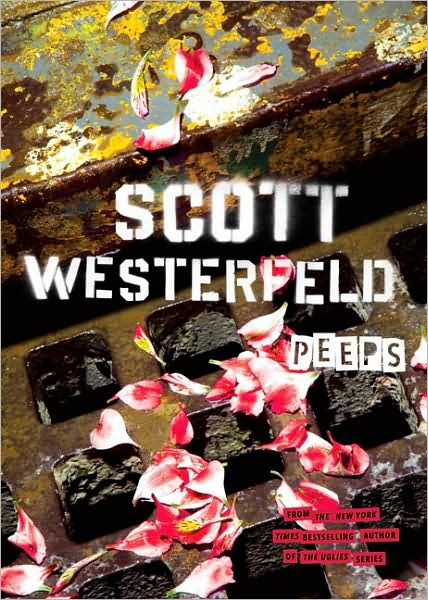
I know I had a copy of Scott Westerfeld's scientifically-justified-vampires novel Peeps, and had even read the first chapter before putting it on the shelf, but it was swept away by the flood as well, so I got a snazzy little Razorbill paperback for nearly free.

I've read at least one of Doug Ten Napel's graphic novels before -- I know I got to one during my Eisner judging -- and I like his energy and style. So I grabbed Creature Tech, about which I know very little -- it's an adventure story of some kind published by Image pretty recently, and that's all I need.

And the happiest discovery was Bill Mauldin's Willie & Joe: Back Home, a collection of his post-war cartoons. Mauldin is one of the great cartoonists (and, in his way, journalists) of the 20th century, but I'm more familiar with his wartime work than with the years just after. Plus, this is pretty much a brand-new book, so I'm not sure how it made its way into the liquidation -- but I'm not complaining!


[1] Parker's biographies have consistently avoided personal pronouns, and Parker's books are tough-minded stories of driven men in dangerous circumstances, so my personal theory has always been that Parker is actually female. (I like to believe that this writer, who is as ineluctably masculine as James Tiptree, Jr. was, is equally as actually masculine as Tiptree.) I've seen some evidence to support this, but it it not confirmed.

Tuesday, May 01, 2012

Read in April

Here's a big oops!: I'm actually typing this on May 7th (though I'm going to back-date this post, so it sits where it's supposed to). Sure, these monthly posts are mostly to help me find things later, and serve as indices of the blog, but it would be nice for me to do them on time.

Anyway, here's what I read last month. I still haven't "reviewed" most of it, and I may need to resort to some kind of Lightning Round posts (or another stint of Book-a-Day) to catch up. I still want each book to have its own post -- mostly so I can link to it later; again, it's just to make things easy for me -- so I won't try to do quick snippets here. But here's the list, with links to (I hope) sprout in the future:
Since I'm doing this a week late, I can tell you that I've already read five books the first week of May (with another that I'll probably finish tomorrow). So the reading part is going fine, though the writing-about-it-afterward bit is more of a problem these days. (And that's because I'm spending too much time doing things like watching MST3K with Thing 2, and playing pool with The Wife, and going to Thing 2's baseball games, and still playing Crazy Taxi -- so I'm going to find ways to fit blogging around those time requirements, not replace them.)

Friday, July 01, 2016

Read in June

Below are either desultory notes about some books I read in June of 2016, or links to slightly longer and perhaps somewhat less desultory notes about said books. I feel compelled to do this stuff, so I hope there's someone out there reading them. If you end up finding something you love because I wrote about it, please do let me know. (If you end up reading something you absolutely loathe, let me know as well, since loathing is always more entertaining than love.)

Dan Wells, Over Your Dead Body (6/2)

John Allison, Lissa Treiman, and Max Sarin, Giant Days, Vol. 2 (6/6)

Peter Bagge, Founding Fathers Funnies (6/8)

Angela Carter, Saints and Strangers (6/8)

Roald Dahl, Boy: Tales of Childhood (6/9)

Tony Horwitz, Baghdad Without a Map (6/15)

Gilbert Hernandez and Darwyn Cooke, The Twilight Children (6/17)

Daniel Pinkwater, Fish Whistle (digital, 6/17)

Charlie Croker, Screwed Up English (6/18)

John Hodgman, That Is All (6/19)

P.G. Wodehouse and Guy Bolton, Bring on the Girls (6/21)

Andi Watson, Little Star (6/22)

James Salter, A Sport and a Pastime (6/24)

Maxim Jakubowski and Marilyn Jaye Lewis, editors, Erotic Photography (6/25)

Jess Walter, The Financial Lives of the Poets (6/29)

Caroline Preston, The Scrapbook of Frankie Pratt (6/30)


I'm happy to note that I read exactly twice as many books in June as I did in May, because I'm all about metrics, even when they're pointless and don't really measure anything.

After June, of course, comes July. I'm pretty sure I read (have read? will read? verb tenses are complicated when you're writing ahead of an event but your words won't be read until after that event) books then, too, and will probably write about them at some point.

Note: Individual posts have been written and scheduled for all of these books, so links will appear in due course...as long as I don't forget to edit this post.

Tuesday, January 01, 2019

Book-A-Day 2018: Post-Mortem

Introductory

First of all: yes, I know. It does seem odd to have a post-mortem for something not yet dead. But, trust me, Book-A-Day 2018 is dead: everything is read and all of the posts written and scheduled. [1] It's just going to twitch a bit for the next two weeks while the dying makes it out to all of the extremities.

2018 was my fourth run of Book-A-Day here on Antick Musings -- before that, it was something I did myself in a desultory way for a few weeks or months, to kick myself out of a reading doldrum. Those prior runs are the year of 2014, a year-long stretch covering 2010-2011, and a 200-day stretch in 2006-2007.

Book-A-Day can be either of two things: either I'm reading a book every day, or I'm writing a post about a book every day. Over the course of a year, the latter turns into the former, obviously. And every time I do this, I try to do both, and I think it's been more successful each time. (Of course, I would think that.)

This is probably the last time I do a Book-A-Day year. I have two reasons for that, one serious-logistical and one silly.

The silly reason first: I just realized that I was laid off soon after finishing every other Book-A-Day run: first in April of 2006 (after ending in February) and then in January of 2015 (after the 2014 run). I should be safe this time, but I'm not planning to tempt fate.

The more serious reason is that I just don't have the vast masses of quick-to-read books coming into my house that I did back in the SFBC days, and I've now worked down all of the remnants of both those days and what I've bought since then. (Well, the quick-to-read portions of both: I still have far more unread books than I can get to in the next five years.)

So even if I wanted to do Book-A-Day again, in 2021 or so, and tempt the Job Gods, I probably wouldn't have the books to do it with. I relied heavily on the library this time out, and the only way to do that again would be to read a lot of junk that I don't care much about just to pad out the totals. (Which, come to think of it, I did quite a bit in the 2014 and 2010-2011 runs.)

Given that, let me take a look at what I did read in 2018, in the manner of the previous Post-Mortems for 2006-2007 and 2014. There will be only one graph, I think, and this is it.

In 2018, I read 433 books in 365 days and wrote 379 blog posts covering 437 books and 6 individual comics issues. Careful readers will note that I wrote about more books in 2018 than I read; I started the year with a small cushion of stuff read in December 2017. I also read more books than I wrote posts, because I wrote about longer series (all comics) more and more as the year went on. The numbers and percentages in the chart and below are based on number of books rather than number of posts.

I don't know if everyone likes placing books into tidy little categories as much as I do, though the wars over the SF/Fantasy border seem to prove they do. But it's how I organize these Post-Mortem posts, so here's what I read, as I categorize it:

Fiction: SF and Fantasy (18, 4.2%)

This is what I used to do for a living: I know, I'm surprised it's this small a portion of my reading these days, too. I keep saying that I'd be happy to go back to SFF publishing if they wanted me, but I have no idea how my current expertise would align with that world.

In 2014, this was 4.4%, with 16 books.

Fiction: Mystery and Thriller (5, 1.2%)

The larger genre right next door to SFF, in which I also used to read a lot more. Several of my would-be reading projects are in this area; maybe one or more will happen in 2019.

In 2014, this was 0.5%, with 2 books.

Fiction: Mainstream (10, 2.3%)

I'm reading fewer long books of prose in the first place these days, but it seems like about the same percentage of it is not obviously genre. But I tend to think of this category as defined negatively: it's what doesn't fit into clear genres.

In 2014, this was 2.7%, with 10 books.

Non-Fiction: Narrative (15, 3.5%)

This is the category for relatively serious non-fiction -- histories, travelogues, memoirs, stuff like that. It's really miscellaneous, obviously.

In 2014, this was 6%, with 22 books.

Non-Fiction: Lists and Frivolities (17, 3.9%)

And this is the non-fiction category for things that aren't serious at all -- a lot of these were bathroom books, and this category has often been the place for things I read quickly in an evening when I realized I hadn't read a book yet that day. But my sense is that the cute little gift-y thing that sits by the cast register isn't really a big book category anymore.

In 2014, this was 2.7%, with 10 books.

Comics: Strip and Panel Collections (27, 6.2%)

I divide the world of comics into possibly idiosyncratic categories, based on how they first appeared. I think it makes sense; you may disagree. First up are books of comics that originally appeared as individual strips somewhere -- online or in print. This used to be mostly collections of newspaper comics, then mostly collections of webcomics, and now it's pretty miscellaneous.

In 2014, this was 10.4%, with 38 books.

Comics: Floppy Collections (194, 44.8%)

The second category of comics includes things that were mostly reprinted from periodical comic books. Most of this stuff reprints series (ongoing or mini-) in an obvious way, but there are a few oddballs like the Best American Comics series, which I put here to put them somewhere. But, generally, things in this category appeared as a publication under the same overall name as the eventual collection. Since the American comics market is what it is, and I was reading a lot of comics this year, it's the largest category -- almost half of all books.

In 2014, this was 19.5%, with 71 books.

Comics: Originals in Book Form (66, 15.2%)

This category should be pretty self-explanatory: comics, by people working in the English language, that first appeared as a book, without any previous serial publication.

In 2014, this was 29%, with 106 books.

Comics: Translated from Japanese (and other Asian languages) (17, 3.9%)

Comics, mostly manga, translated for an American audience.

In 2014, this was 12.9%, with 47 books. I used to read a lot more in this area, but that was mostly stuff that came in as publicity packages and that I didn't necessarily like all that much. Once the flow of free product stopped, there were only a few things from that flood I wanted to keep up with on my own.

Comics: Translated from French (and other European languages) (42, 9.7%)

In 2014, this was 7.7%, with 28 books. This one swapped size with the translated-from-Asia category since 2014, interestingly. I think part of that is just that there's more "art comics" coming over, accessibly, from France than from Japan, and part is that I did a big re-read of the whole Dungeon series, which contributed 17 books all on its own.

Art Books (9, 2.1%)

Back in my SFBC days, this was a huge staple of my book-a-day runs, and often the trigger for them: when I had too many art books stacked up, it was time to run through them comprehensively. But I think there are fewer books like that being published at all, in this Internet age, and I haven't had a way to get them free for a decade now.

In 2014, this was 2.2%, with 8 books.

Books for Children of Various Ages (12, 2.8%)

This is one of my fuzziest categories, since nearly everything here could be counted as something else -- a novel, an original GN, or whatever. But this is where I put things that are very specifically for younger readers, and not just accessible to younger readers. I try to put "YA" books -- which regularly bleed into adult readership -- in the general categories, and books aimed at middle-grade or younger readers here. But I don't promise absolute consistency.

In 2014, this was 1.6%, with 6 books.

Poetry (1, 0.2%)

I read a book of poetry this year! And I have a bookmark in another one, so I may actually finish a similar book next year. I used to read more poetry, ten to fifteen years back -- the book I had going in the bathroom was generally poetry, until some particularly horrible British historical survey anthology knocked me out of the habit.

I have not read any poetry, as far as I can tell, in any prior book-a-day run.

Playscripts (1, 0.2%)

I did read one playscript in 2014, for 0.3% of the total. So that number holds absolutely steady.


That's what I read in 2018. I should come back in about two weeks and add in the last links, once all of the posts have gone live. If you're reading this later than January 16, 2019, you can judge whether I did that or not.

If you've read this far, let me leave you with one last thought. There's probably some similarly crazy project in the back of your head -- maybe for your work, maybe gardening, maybe exercise- or diet-related, maybe housecleaning, maybe running for Congress!

Do it. Do it this year. Start in on it as soon as you can. Jump onto your crazy hard-work ideas and make them real. There's nothing like finishing up something you really wanted to do and looking back on it. I want all of you to have that feeling. So do it. Start the planning today.


[1] With one tiny asterisk: the post for the book I finished today isn't quite done yet. I wrote the post for book #380 today (which I read yesterday) and started #381, but it's not final. So, tomorrow morning I will finalize and set to post the very last Book-A-Day 2018 post.