Thursday, July 31, 2008

Blog Reviewers Are Being Whiny Again

The current topic of debate in the part of the blog world made up of SF-book-reviewing-folks (and that's a small piece, of course) is whether or not "someone" should be paying us. I'm coming to this a few days late, so forgive the link-dump as I get up to speed:

It pretty much started with Jonathan McCalmont asking "Is Online Book Reviewing Sustainable?", where he suggested that publishers should pay for reviews. (In gauging the possibility that this plan would ever happen, remember the reaction when Kirkus Reviews, one of the oldest and most-respected review outlets in the US, attempted to sell reviews to publishers. Then think about who we're talking about here: individual bloggers. Then laugh.) This is a silly idea on its face, but, if transmuted into advertising -- assuming anyone would want to advertise on book-review blogs, which is not necessarily so -- could provide a small stream of revenue to book-bloggers.

McCalmont also seems utterly innocent of the ways of Publicity. Bound galleys are more expensive than "real" books, but not that expensive, and the point is to spread them around, like manure, in hopes something will grow somewhere. Individuals can feel as guilty as they want about whatever they want -- I certainly do -- but no one has an obligation to write glowingly about every last thing that shows up in his mailbox. (Also, there's a divide between people who say "ARC," which is what is printed on the objects, and those who say "bound galleys," which is what they are.)

McCalmont is confused and wrong-headed, but he just wants to be financially compensated for his hobby. (And wouldn't we all like that?) But there's no reason that the people with the money would want to compensate him for it, though -- not unless he's going to provide a more consistently positive product, and preferably for a consumer good whose purveyors actually have some money to throw around. (He also reviews movies; he'd have better luck shaking those folks down for money -- but, again, he'd have to give them something other than the fact that he's reviewing a movie to justify paying him.)

The general point here: he who pays the piper calls the tune. If you want publishers to pay you, you'll have to expect publishers to tell you what to say. People who actually do "provide publicity" don't write whatever they want -- they do what the client asks.

Gabe Chouinard thinks that the problem is that readers aren't clicking enough links and making the advertising work. He also thinks that we should make up our own ad network, and that having such a network would make unspecified people magically throw money at us for our audiences of twelve people and two cats. But he's facing the wrong way entirely, thinking of himself as providing a service to publishers rather than serving readers. The point of blook-blogging is not to "give publicity" to paying customers -- there are professional publicists who are much, much better at that -- it's to write about books and authors that interest you, in a way that makes them interesting to others.

Also, book publishers have tiny budgets for advertising and promotion (compared to other consumer products); mailing out galleys uses up a big piece of it. If you're a book-blogger and you got a galley, you already have your share of the money the publisher is spending on that book. That's it. Do with it what you will.

And if Gabe thinks he's giving a "free ride" to publishers, and that his skills at publicity are so in-demand, the best way to get paid for that is to get a job as a publicist.

Then there's Pat's Fantasy Hotlist, who I have to admit I disagree with most of the time. (We have quite different tastes in books, among other things. And his Terry Brooks-meets-Thor vocabulary has been known to set my teeth on edge.) He has a long, long, long, long post on the subject, and it tires me just to think about it. He also notes that book-blogging is a time-consuming hobby -- as is any kind of serious blogging, which no one seems to be remembering -- and that it seriously impacts his girl-chasing time. And he thinks that publishers have vast pots of money which they could shower on bloggers if only they chose to do so.

Pat has also noticed that people are often polite to him in direct discourse, but that the things they say they love and will "absolutely" do don't always work out (such as ads on his blog). I thus suspect he has never spent any time in an office environment or even read Dilbert.

His view of "quality" blogs also seems to contain no hint of reader metrics or anything else that could be expressed in actual numbers. In general, he thinks he should be paid because he says nice things about books -- if he's serious, he could attempt to develop that attitude into a full-blown protection scheme. ("Nice book you got there. It'd be a shame if something were to happen to it. Shame if it got a bad review.")

And then there's Larry of the OF Blog of the Fallen, who points out that a lot of things in this world feel like work, and many of the ones most worth doing are unpaid. As usual, I agree the most with him.

OK, so those are the terms of discussion: blogging is Really, Really Hard; that it's like Having a Real Job; and that Somebody Should Be Paying Me For This. Yes, I'm being sarcastic and dismissive, but the topic deserves it.

Here's the deal: if you're doing something for yourself, and you're not enjoying it, it's time to stop. Period. If you are enjoying it, but it's getting to be too much, then you need to find a way to cut back. The thing to remember is that you're doing this for yourself, as a hobby. (And it applies not only to personal blogging, but to gardening, classic-car restoring, fishing, scrapbooking, knitting, or what have you.)

The problem isn't the activity; it's you. You need to set your limits and stick to them. Maybe you only have time to do one good review in a week -- so cut back to one a week. This is about your own time management; dreaming of someone else paying you for something that you're liking less and less is not going to lead to you liking it more.

(There's also the fannish/social aspect of the book-review blog world; we are part of a loose economy of gifts and esteem. But you can't let that overwhelm your time. If you're not blogging because what you write is important to you, you shouldn't be doing it at all.)

Oh, and one last point: don't give people like this guy more stones to throw at us. Sitting around complaining about how hard it is that people send you books for free and there are too many of them to read and life is just too much for you is just pure whininess. The people who work with books professionally -- many of whom are being laid off from newspapers right now, you self-indulgent babies -- will only worsen their opinion of all of us the more bloggers are seen as being obsessed about finding a way to get paid for doing something they supposedly love to do.

Suck it up or go home. If you want to be taken seriously, be serious. And watch what the real journalists do. Asking your subject to pay you is very much not what actual journalists do.

Garfield - Garfield + Garfield = Book

In a great example of a creator seeing someone doing something different with one of his creations and embracing that, Jim (Garfield) Davis is allowing a collection including both his original Garfield strips and the Garfield Minus Garfield strips altered by Dan Walsh.

Ballantine, the longtime publisher of Garfield books, announced the book, though not its title, yesterday. Walsh's blog has the press release posted; I'm sure it will be other places as well.

Davis didn't have to do this; he could have had his lawyer send a cease-and-desist letter and shut down Garfield Minus Garfield (as Bil Keane did to several iterations of the Dysfunctional Family Circus). But he saw something worthwhile in Walsh's work, and decided to not only not suppress it, but to celebrate it.

Many creators, and the world in general, have been grappling with issues of derivative works and intellectual property lately. Up until now, the trend had been for corporations and creators to demand as much power and control of everything as they could possibly claim. I don't know if this will help to loosen things up, but it can't hurt.

Wednesday, July 30, 2008

I Am Not Posting

I'm being lazy this week; I'm spending too much of my evenings playing Lego Indiana Jones.

I've got something half-written about the current kerfuffle, Should Blog Reviewers Be Paid? (And I'll give you a preview: just asking the question is dumb, because it implies we have an employer.) Plus all of the books that I need to organize my thoughts on. And I'm running off to Anaheim next week for the fabulous American Accounting Association show. But, right now, I just want to play with my Wii.

See you tomorrow, I hope.

Tuesday, July 29, 2008

What He Said

Edward Keenan on being a man in the summertime, and the art of looking.

Responses to Hugo Handicapping

Mike Glyer thinks I'm making "a public display of contempt" in my comments about the fan categories. It's certainly his prerogative to have any opinion he wants, but I like to think that -- unlike some Hugo-watchers -- I actually notice that there are fan categories, and try in some small way to understand them. (He's quite right that I don't know much about those categories, but, if I'm going to run down the list of Hugos, they're on the list and need to be addressed somehow.)

And that entire post was based on received wisdom and common knowledge; that was the whole point of it. There was no research involved -- it took long enough without any. I didn't Google to be sure that Frank Wu removed himself from contention; I also didn't mention that Donato Giancola did the same in the Pro Artist category. It was not intended as an even-handed, sober consideration of everyone's chances, and I deliberately held off doing it until after voting closed.

If Mike wants to see me actually expressing contempt, I'd suggest that my various comments about the Dramatic Presentation Hugos (and the similar "Best Script" Nebula) are a better fit. When it comes to fan Hugos, "bemused ignorance" is closer to the mark.

Monday, July 28, 2008

Reviewing the Mail: Week of 7/26

This week saw a big box from Yen Press (with the first issue of their new monthly manga magazine, Yen Plus, along with a pile of books), along with a few other things. Considering every publisher that could be sending me things was madly preparing for Comic-Con, I'm surprised I got anything this week. But here's what I did see:

The Diamond of Darkhold by Jeanne DuPrau, the fourth book of the Ember series, coming from Random House Children's Books in August. The gigantic publicity machinery is just gearing up for the movie version of the first book in the series, so having a new book in the series out right now is excellent timing. I'm a bit surprised myself, since I didn't know there had even been a third book -- I read the first two and had them in the book club back at my old job, and even the second one was slightly unnecessary. (The first book was about getting out of an underground country long after an apocalypse; the second was about settling on the surface and learning to live with the people already there. Seems to me that any further books would just be the same thing.)

Jumping into the big Yen box, the first thing I pulled out was the fourth volume of Spiral: The Bonds of Reasoning by Kyo Shirodaira and Eta Mizuno, coming (like just about everything else in that box) in July. I've reviewed both the second volume and the third volume of this series as part of my regular Manga Friday column for ComicMix.

Another continuing series from Yen this month is Shiro Ihara's Alice on Deadlines, the third volume of which is about to hit stores. This is a series I like probably more than I should; I reviewed both the first and second volumes as part of my ComicMix column. Don't be surprised if I review this one as well; I'm a sucker for this series.

And Yen also has the second volume of Kaze No Hana this month, by Ushio Mizta and Akiyoshi Ohta. I'll warn you that the first volume made my head hurt -- that may only say something about me, though.

Yen also has some brand-new series; launching this month is Suzunari!, by Shoko Iwami. It's a 4-panel manga about a typical teenage girl (yadda yadda yadda, insert shoujo manga boilerplate #38943 here) whose life is suddenly turned upside down when a cat-eared double suddenly appears in her room one morning. It looks intensely goofy, but that can be fun.

Also coming with a first volume this month from Yen is S.S. Astro by Negi Banno. It's another 4-panel series, set primarily in the teacher's lounge of a Tokyo high school and revolving around four female teachers (who, I suppose, in the way of such stories everywhere and of all times, are vastly different from each other in somewhat stereotypical ways).

Yen also published the second volume of Forest of Gray City by Uhm JungHyum in July. I think it's a teenage romance comic, since the back-cover copy is entirely taken up by descriptions of "Person X learns more about Person Y, and X has to rethink everything in her life."

And then there's the second volume of Park SoHee's Goong. It's another teenage comic, about a girl who has just married the crown prince of something or other (something Korean, I'm guessing, given the regalia and the book's pedigree), and is trying to adjust.

Something called Legend -- by Kara and Woo SooJung -- is hitting its third volume this month. This one has swords and fighting, though it looks like the main characters are mostly female. (Though it can be difficult to tell from a quick scan of a manga what gender anyone is.)

Comic is a high school manga with a very generic title, but it's by Ha SiHyun, and it's just reached a third volume. Aparrently this one is a bout a teenage girl who won a manga contest, and now works with (and lives with?) an older creator -- who I suppose is grumpy and demanding, as all such mentor figures must be. (That's a question, actually -- is he a mentor figure, or a love interest, or both?)

This month also marks the fifth time around for The Antique Gift Shop, by Lee Eun. Poking through it, I'm not sure at all what this is about, but there's a weird, Gothy-looking family, and two people with blonde hair who I believe are the romantic leads.

I've already reviewed it, but I'd be remiss if I didn't mention that Eddie Campbell's new graphic novel -- done with Dan Best -- The Amazing Remarkable Monsieur Leotard will be published by First Second on August 1st.

And last this week is the novelization of the new animated Star Wars movie, The Clone Wars, by Karen Traviss. Del Rey is publishing it on July 26th at the remarkably low hardcover price of $20.00. I'm really not sure what purpose novelizations serve in this ear, when DVDs come out almost instantaneously, but, if you want to know more about the story of the Clone Wars, Traviss is one of the more popular (and better, in my opinion) writers currently committing Wookiebooks.

Sunday, July 27, 2008

Handicapping the Hugos, 2008 Edition

Well, I did this last year -- and got things mostly wrong -- so why not try again? The same caveat applies as before: I use very cynical rules of thumb, so that I'll be happily surprised when my predictions turn out to be untrue. It's a way I can stay massively cynical, but lighten up the gloom somewhat -- I recommend it to everyone. (I've already run through this list once, when the nominations were announced, so I'll try not to repeat myself.)

Also, if you're looking for the opinions of more than just one grump from New Jersey, let me direct you to Moshe Feder's post at Tor.com and the comments following it -- it's just about the novel race, but Moshe's a smart man and a good editor, and many of the commentors have good points as well. (And some have points that I think are utterly wrong, but that's the way of the world.)

The actual winners will be announced in two weeks at Denvention 3; I wish I could be there, but I won't.

Best Novel
  • The Yiddish Policemen's Union by Michael Chabon (HarperCollins; Fourth Estate)
  • Brasyl by Ian McDonald (Gollancz; Pyr)
  • Rollback by Robert J. Sawyer (Tor; Analog Oct. 2006-Jan./Feb. 2007)
  • The Last Colony by John Scalzi (Tor)
  • Halting State by Charles Stross (Ace)
The Yiddish Policemen's Union seems to have the momentum, having won the Nebula. I still wonder if Hugo voters, who tend to be even more conservative than me, would think Chabon has Mainstream Cooties, but I'm coming to think that he's seen in the same light as Neil Gaiman -- he's done other things in his time, but he's essentially One Of Us. I expect Brasyl, being too little-known and the most difficult read, will be the first to drop out of the running in the instant-runoff Hugo process. If I'm wrong about the support for Yiddish Policemen -- it did sell a lot of copies, but it's hard to tell how many of those were to Hugo voters -- then Stross and Scalzi are strong contenders. I didn't think Last Colony was all that strong for Scalzi, while Halting State is a damn good Stross novel about very geeky near-future ideas (which Hugo voters often like) -- and Stross has been on this ballot five years in a row now. I think Stross will be a close second, but he could take it.

Best Novella
  • "The Fountain of Age" by Nancy Kress (Asimov's July 2007)
  • "Recovering Apollo 8" by Kristine Kathryn Rusch (Asimov's Feb. 2007)
  • "Stars Seen Through Stone" by Lucius Shepard (F&SF July 2007)
  • "All Seated on the Ground" by Connie Willis (Asimov's Dec. 2007; Subterranean Press)
  • "Memorare" by Gene Wolfe (F&SF April 2007)
No one is sending me "best of the year" books this year (except Night Shade, and their book is still in the pile), so I haven't read any of this stuff. The Kress won the Nebula, but she's up against Willis here, and Connie Always Wins. So I'm going to expect it to go to "All Seated on the Ground."

Best Novelette
  • "The Cambist and Lord Iron: a Fairytale of Economics" by Daniel Abraham (Logorrhea, ed. John Klima, Bantam Spectra)
  • "The Merchant and the Alchemist's Gate" by Ted Chiang (Subterranean Press; F&SF Sept. 2007)
  • "Dark Integers" by Greg Egan (Asimov's Oct./Nov. 2007)
  • "Glory" by Greg Egan (The New Space Opera, ed. Gardner Dozois & Jonathan Strahan, HarperCollins/Eos)
  • "Finisterra" by David Moles (F&SF Dec. 2007)
Chiang's story won the Nebula, and he has an even better record than Willis does, so it would be dangerous to predict anyone else to win. (Although, when I look him up in the invaluable Locus Index, I see that his record at the Hugos is much more mixed than at the Nebulas -- and, given the kind of writer he is, I should have expected that.) My impression is that Hugo short fiction voters are still magazine readers (maybe even magazine snobs), so I'm going to add up a couple of wild surmises and predict that Egan will win for "Dark Integers."

Best Short Story
  • "Last Contact" by Stephen Baxter (The Solaris Book of New Science Fiction, ed. George Mann, Solaris Books)
  • "Tideline" by Elizabeth Bear (Asimov's June 2007)
  • "Who's Afraid of Wolf 359?" by Ken MacLeod (The New Space Opera, ed. Gardner Dozois and Jonathan Strahan, HarperCollins/Eos)
  • "Distant Replay" by Mike Resnick (Asimov's April/May 2007)
  • "A Small Room in Koboldtown" by Michael Swanwick (Asimov's April/May 2007; The Dog Said Bow-Wow, Tachyon Publications)
The Nebula went to a Karen Joy Fowler story that was eligible, but didn't make the Hugo ballot. For this one, I'm expecting one of the two stories I've actually read to win: Swanwick's piece of The Dragons of Babel, "A Small Room in Koboldtown."

Best Related Book
  • The Company They Keep: C.S. Lewis and J.R.R. Tolkien as Writers in Community by Diana Glyer; appendix by David Bratman (Kent State University Press)
  • Breakfast in the Ruins: Science Fiction in the Last Millennium by Barry Malzberg (Baen)
  • Emshwiller: Infinity x Two by Luis Ortiz, intro. by Carol Emshwiller, fwd. by Alex Eisenstein (Nonstop)
  • Brave New Words: the Oxford Dictionary of Science Fiction by Jeff Prucher (Oxford University Press)
  • The Arrival by Shaun Tan (Arthur A. Levine/Scholastic)
My rule of thumb in this category is that it goes to the book by the oldest, best-loved writer whenever possible -- to Kate Wilhelm, or Frank Robinson, or Sprague de Camp, or Asimov. This year, the writer closest to that description is Malzberg, which probably surprises him as much as it does me. The Glyer book is scholarly, and I'm sure it's wonderful, but it's not a serious contender. I'm not sure Brave New Words is what Hugo voters want to honor in this category, either. I love The Arrival, but I always assume Hugo voters are less flexible than I am, so I very much doubt that they'll go for a wordless graphic novel published as a children's book. (If I'm wrong, I'll be thrilled; it's one of the best books of any kind of last year.) I'm less sure of the Emshwiller book, where the "old and beloved" heuristic may come into play with both Ed and Carol. But I still think this is Barry's year -- Breakfast in the Ruins is one excellent thirty-year-old book stuffed with some more recent curate's eggs, and he's never won a Hugo. (If he doesn't win, I will bitterly curse not being at Denvention and having a chance to try to sneak into the Hugo Losers' Party to hear what he says afterwards.)

Best Dramatic Presentation, Long Form
  • Enchanted Written by Bill Kelly Directed by Kevin Lima (Walt Disney Pictures)
  • The Golden Compass Written by Chris Weitz Based on the novel by Philip Pullman, Directed by Chris Weitz (New Line Cinema)
  • Heroes, Season 1 Created by Tim Kring (NBC Universal Television and Tailwind Productions); Written by Tim Kring, Jeph Loeb, Bryan Fuller, Michael Green, Natalie Chaidez, Jesse Alexander, Adam Armus, Aron Eli Coleite, Joe Pokaski, Christopher Zatta, Chuck Kim; Directed by David Semel, Allan Arkush, Greg Beeman, Ernest R. Dickerson, Paul Shapiro, Donna Deitch, Paul A. Edwards, John Badham, Terrence O'Hara, Jeannot Szwarc, Roxann Dawson, Kevin Bray, Adam Kane
  • Harry Potter and the Order of the Phoenix Written by Michael Goldenberg, Based on the novel by J.K. Rowling, Directed by David Yates (Warner Bros. Pictures)
  • Stardust Written by Jane Goldman & Matthew Vaughn, Based on the novel by Neil Gaiman Illustrated by Charles Vess Directed by Matthew Vaughn (Paramount Pictures)
The semi-equivalent Nebula went to Pan's Labyrinth, which doesn't help here. I've seen all of the movies, and they're all decent, but flawed or minor in one way or another. (Order of the Phoenix is probably the best of them.) From what I've heard from the people who care about such things, the first season of Heroes was magnificent, but it's been lousy since then, which may have affected the voting. But, still, I'm going to assume Heroes will win, because the thing I know and care the least about usually wins the Best Dramatic Hugo.

Best Dramatic Presentation, Short Form
  • Battlestar Galactica "Razor" Written by Michael Taylor Directed by Félix Enríquez Alcalá and Wayne Rose (Sci Fi Channel) (televised version, not DVD)
  • Doctor Who "Blink" Written by Steven Moffat Directed by Hettie Macdonald (BBC)
  • Doctor Who "Human Nature" / "Family of Blood" Written by Paul Cornell Directed by Charles Palmer (BBC)
  • Star Trek New Voyages "World Enough and Time" Written by Michael Reaves & Marc Scott Zicree Directed by Marc Scott Zicree (Cawley Entertainment Co. and The Magic Time Co.)
  • Torchwood "Captain Jack Harkness" Written by Catherine Tregenna Directed by Ashley Way (BBC Wales)
It would be darkly pleasant to see "World Enough and Time" win, and to have that cause Paramount to have a screaming fit -- only because I enjoy the (distant) sufferings of others. But I don't expect that to happen. Again, using my "know and understand least" idea, I'm going to predict that "Captain Jack Harkness" will saunter off with a rocket ship, and probably do something unmentionable with it afterward.

Best Professional Editor, Long Form
  • Lou Anders (Pyr)
  • Ginjer Buchanan (Ace/Roc)
  • David G. Hartwell (Tor/Forge)
  • Beth Meacham (Tor)
  • Patrick Nielsen Hayden (Tor)
The Hugo voters seem to be using the recent bifurcation of the editor category to reward excellent editors who have been working in the field for many years. (And not to say "this person had the best batch of books last year," which is closer to the way the award is explained to be.) So: Hartwell and Nielsen Hayden already have one each. I hope this won't turn into another Best Locus or Best Whelan or Best Langford categories, though that possibility is there. Assuming that doesn't happen, I think Ginjer Buchanan is naturally next, since she's been editing good books for quite some time and is well-known in fandom. (And, speaking as someone who helped nominate her and Susan Allison for a World Fantasy Award a few years back, I'd be thrilled to see her win, too.)

Best Professional Editor, Short Form
  • Ellen Datlow (The Year's Best Fantasy and Horror (St. Martin's), Coyote Road (Viking), Inferno (Tor))
  • Stanley Schmidt (Analog)
  • Jonathan Strahan (The New Space Opera (HarperCollins/Eos), The Best Science Fiction and Fantasy of the Year, Volume 1 (Night Shade), Eclipse One (Night Shade))
  • Gordon Van Gelder (The Magazine of Fantasy and Science Fiction)
  • Sheila Williams (Asimov's Science Fiction)
Again, the Hugo voters seem to be catching up with people who have been snubbed repeatedly in past years, so it might just be Stan Schmidt's year. On the other hand, this is one of the most conservative categories, so Datlow also has a great chance. (And, to be honest, the stories Ellen buys are usually more to my particular taste than Stan's.) Since I have to choose, I'll say that Ellen Datlow will win again.

Best Professional Artist
  • Bob Eggleton (Covers: To Outlive Eternity and Other Stories (Baen), Ivory (Pyr), & The Taint and Other Novellas (Subterranean))
  • Phil Foglio (Cover: Robert Asprin's Myth Adventures, Vol. 2 (Meisha Merlin), What's New (Dragon Magazine Aug. 2007), Girl Genius Vol. 6-Agatha Heterodyne & the Golden Trilobite (Airship Entertainment))
  • John Harris (Covers: Spindrift (Ace), Old Man's War (Tor, pb), The Last Colony (Tor))
  • Stephan Martiniere (Covers: Brasylont> (Pyr), Mainspring (Tor), The Dragons of Babel (Tor))
  • John Picacio (Covers: Fast Forward 1 (Pyr), Time's Child (HarperCollins/Eos), A Thousand Deaths (Golden Gryphon))
  • Shaun Tan (The Arrival (Arthur A Levine Books))
Shaun Tan really really should win something for the marvelous The Arrival, but the world isn't fair, and he won't. It would be great to see Foglio win, since he hasn't even been nominated for a Hugo since he won back-to-back Fan Artists in '77 and '78. But it will most likely go to Eggleton, since voters in this category mostly run on their accumulated memories and preferences. In my ongoing attempt to be more positive, though, and since Denver isn't that far from Texas, I'm going to predict that John Picacio, pseudo-hometown boy, will win. (I should also say that Harris, Martiniere, Picacio, and Eggleton are all excellent cover artists currently doing fine work; any of them would be a reasonable winner -- I'm just annoyed that Hugo voters tend to pick a favorite in this category and stick with that person for a decade or more.)

Best Semiprozine
  • Ansible, edited by David Langford
  • Helix, edited by William Sanders and Lawrence Watt-Evans
  • Interzone, edited by Andy Cox
  • Locus, edited by Charles N. Brown, Kirsten Gong-Wong, & Liza Groen Trombi
  • The New York Review of Science Fiction, edited by Kathryn Cramer, Kristine Dikeman, David Hartwell & Kevin J. Maroney
The Hugo for Best Locus will go to Locus. It's about time to retire this one; these days the only way anyone else can win if when the Worldcon is in the UK. But I would dearly love to see Helix win, even if I wouldn't be there to see all the heads explode in person.

Best Fanzine
  • Argentus, edited by Steven H Silver
  • Challenger, edited by Guy Lillian III
  • Drink Tank, edited by Chris Garcia
  • File 770, edited by Mike Glyeri>
  • PLOKTA, edited by Alison Scott, Steve Davies, & Mike Scott
I'm terribly ignorant about the fan categories, and so tend to make predictions based on the entrails of small mammals or the flight patterns of sacred birds. I vaguely recall that Mike Glyer is a West Coast guy, so I'm going to predict that File 770 will win.

Best Fan Writer
  • Chris Garcia
  • David Langford
  • Cheryl Morgan
  • John Scalzi
  • Steven H Silver
It will be a re-run of last year's Scalzi-Langford battle, with (most likely) more ballots in play, since the Worldcon is cheaper and more people will be going. I think that will only help Scalzi, who lost very narrowly last year. So I expect this will be John Scalzi's consolation prize. (Though it will be awarded first.)

Best Fan Artist
  • Brad Foster
  • Teddy Harvia
  • Sue Mason
  • Steve Stiles
  • Taral Wayne
Frank Wu, the current 800-pound gorilla of the category, is nowhere to be seen. (Did he take himself out of contention?) Brad Foster and Teddy Harvia are both former 800-pound gorillas here, Harvia slightly more recently than Foster, and Mason wins whenever the Worldcon is in the UK. My Magic 8-Ball says that Brad Foster will take it this year.

John W. Campbell Award for Best New Science Fiction Writer
  • Joe Abercrombie (2nd year of eligibility)
  • Jon Armstrong (1st year of eligibility)
  • David Anthony Durham (1st year of eligibility)
  • David Louis Edelman (2nd year of eligibility)
  • Mary Robinette Kowal (2nd year of eligibility)
  • Scott Lynch (2nd year of eligibility)
Naomi Novik ran away with this category last year, winning without even one drop needed. Lynch was on the ballot then, placing last in the first-place voting. This is a very different year, though -- Edelman and Kowal are reasonably well-known online, but Edelman's second novel was only just published and Kowal's a purely short-fiction writer. (So I think both of them are just socially popular so far.) Durham came from outside the genre, teaching us that things published elsewhere Don't Count -- although his current novel, Acacia, might actually be fantasy, but it wasn't published as fantasy, raising the tricky question of what specifically does qualify one for the Campbell. But I think, in the end, that it'll be between Lynch and Abercrombie. And, since Lynch's best-selling US book (The Lies of Locke Lamora in mass-market) has outsold Abercrombie's best-selling US book (The Blade Itself) by about 40%, I'm going to make the shaky assumption that those sales will translate into more voters and predict a win for Scott Lynch.

Anyone agree? Disagree? Think I'm full of a substance unnamable in polite company? The comments, as always, are open.

Clan Apis by Jay Hosler

It's not unknown for one work of art to devalue another, but it's not as common for those two works to be of completely different kinds. But Clan Apis has seriously devalued my (already low) opinion of Bee Movie.

You see, Apis author Jay Hosler is a biology professor and researcher specializing in honey bees, and one of the many facts about actual bee biology that he works into Clan Apis is that bees change jobs over their lives -- and that there's no typical progression, either. Bees can do very different things depending on what's needed. So the entire plot of Bee Movie was even more based on hooey than I'd previously thought; there's not a scrap of even half-remembered science behind it.

Clan Apis, on the other hand, manages to be a pleasant comics story about the life of a bee named Nyuki, from larva-hood to death and beyond. It's filled with actual science facts, which come up naturally in the course of the plot and are only occasionally too much.

I remember Jay Hosler from his strip in Comics Buyers Guide back in the mid-90s, and I knew that Clan Apis was out there. (It was published in 2000.) I even picked it up in a comics shop once or twice, but never bought it. But it was in a library that's part of the local consortium here, so I got it that way -- and it's really a great book for libraries, so I hope it's in a lot of collections.

Art Out of Time edited by Dan Nadel

Art Out of Time is a book of comics oddities, strips and comic-book stories from the formative years of the medium by lesser-known creators with idiosyncratic viewpoints and styles. The subtitle -- Unknown Comics Visionaries, 1900-1969 -- claims somewhat more for these guys than I'd agree with, but it explains the purpose of the book.

Dan Nadel is a professor, author, and the director of a small comics publishing house, PictureBox -- best known for the annual Ganzfeld anthology. For Art Out of Time, he's apparently dug through his own collection -- and possibly those of others -- to find work by some of the most individual creators of the period before the underground comics hit in the late '60s. (It's explicitly Nadel's thesis that it was difficult "for eccentric talent to publish personal work" before the undergrounds, and, by implication, it was henceforth easy or common.)

Art Out of Time is divided into five sections, and let me quote Nadel on what they contain:
"Exercises in Exploration" focuses on comics that bring readers into new visual worlds.
"Slapstick" is full to the hilt with mercilessly funny comics.
"Acts of Drawing" compiles artists distinguished for their unique way with a pen.
"Word in Pictures" gathers cartoonists who, above all else, were prose stylists and plot technicians.
"Form and Style" is concerned with ingenious graphic devices and aesthetics in comics.
Nadel is generally more interested in the art side of comics than the writing side, but he's unearthed some interesting stuff. (Though the old strips in particular can be difficult to read at the size he reproduces them -- there were a lot of words in newspaper strips in those days.)

Not all of the creators here are particularly forgotten; there are the usual suspects like Boody Rogers, George "Jingle Jangle Tales" Carlson, Milt Gross, Gene Deitch, and Herbie's Ogden Whitney. But Art Out of Time did drag Fletcher Hanks out of obscurity, and a half-dozen other cartoonists in here could be collected as interestingly and successfully as I Shall Destroy All the Civilized Planets.

So Art Out of Time is not always easy to read -- books of early 20th century strip cartoons never are, unless they're printed broadsheet size -- but at least some of the stuff inside is worth perusing or poring over for fans of oddball comics. (Though I will admit that I just looked at the pictures for some of the weirder old strips.)

Saturday, July 26, 2008

Magazine Follies

Today, I actually finished reading the July 2003 issue of The New York Review of Science Fiction, which I think I have been carrying around for the past five years. (No offense meant to NYRSF, particularly since I've kept up my subscription; it's just that magazines have always taken the hit when reading time is limited and NYRSF is generally at the bottom of that pile.)

I hope to read the August 2003 issue somewhat more quickly, though I'm not going to expect to catch up any time soon. I'm hoping to get into some good, juicy SFnal controversies of yesteryear; does anyone remember what we were passionately debating in mid-2003?

Negative Reviews Redux

OK, so now I've got three at least mildly negative reviews queued up to write -- all by writers I like, all I somewhat enjoyed, but all that have what look to me like serious flaws. (I've also got two mostly positive reviews I need to write; I've gotten far behind on the non-comics part of my reading.) And I'm not going to say what any of those books are, before I write them, since one of the reasons I write about books is to work out precisely what I do think about them.

I said a lot of what I wanted to say about negativity in On Bad Reviews, so I won't repeat that here. But I do think I am being more critical (in public, at least) than I used to be -- I don't have a professional connection to the field at the moment (but if anyone wants to drag me back in, just call me) and so only honesty and common human decency is restraining me now.

So there might be an element of bounceback here -- I spent a decade just saying nice things about SFF books in public, at the SFBC, and now I have a chance to be somewhat more critical outside of discussions in the office and at conventions. It's like when someone pushes down on your outstretched arm for a few minutes; when they stop, your arm rises without conscious thought.

But every book I review is a book I read all the way to the end, and every book I argue with is a book that made me think, and made me want to argue with it. I'm a strong believer in the old saw that a novel is a long piece of prose with something wrong with it; every novel has a flaw. Some flaws are bigger than others, and some are more important than others. But there are no perfect novels in this world, so every honest review of a novel will have some criticism in it.

Book reviewing is a weird world, polarized between attacks and slavish praise without all that much in between. The SF end of it is generally polite and pleasant, but it also slides into the "slavish praise" on occasion. (We haven't seen all that much in the way of attacks in recent years; we don't have a James Wood in our area.) And I'm not claiming to be better or more pure than anybody; I'm just a guy with a blog who reads books and then thinks too much about them.

I guess what I'm saying is that writing at length about a book means that it's being taken seriously, and that's something that should be noted, even if the attention isn't entirely laudatory.

Anyway, I hope I can get to some of those before I have to head off on another business trip next weekend. And I hope no one will take it personally if any of them get more critical than I expect them to.

Powers, Vol. 9: Psychotic by Brian Michael Bendis and Michael Avon Oeming

I'm nearly caught up with this cops-in-a-superhero world series, and the plot might not make sense to outsiders at this point. Here's a link back to Vol. 8, which can lead back further to those so inclined.

The $64 question, coming into this volume, is: who is psychotic, exactly? And that's not an easy question to answer.

Following on from the last book, Legends, one of our series leads, detective Christian Walker (himself an immortal but now depowered former superdude), is mentoring and helping the new Retro Girl, Callista.

But of more immediate interest is the dead body of a guy in the costume of the superhero Blackguard. (A Batman/Moon Knight type, powered by a magical gem -- skulking around alleys in the night, frightening cowardly & superstitious criminals, that whole deal.) Blackguard's authentic costume is on the body of a man (Dule DeSanto) who wasn't the Blackguard. He does have a massive head wound from a police-issued bullet, but he doesn't have the gem.

It gets more complicated from there, of course -- there's our other lead detective, Deanna Pilgrim, trying to control her new unexpected powers, and the death of one of Blackguard's old enemies, the Joke. (No points for figuring out who he is.) There's Deanna's ex- boyfriend, who doesn't seem to get that he's
ex. And there's Mama Joon, the fence for all superhero stuff in the city. (And that's just a bit too comic-book-obvious for my tastes, but it's the only major element that set off my bullshit detector in Psychotic.) But this is basically the "how bad can cops behave" storyline for Powers, and the answer is "pretty damn bad."

It all comes together very naturally and cleanly -- this is a storyline with a theme, but it's not forced. It's all about cops: what they will and won't do, what they have to do, and what they cover up. It's one of the better pieces of Powers, which somewhat restores my faith in it. I'm still annoyed that Walker's an ex-power and Pilgrim now has powers herself -- that's just too damn much, and way too much like the supporting cast of some random long-underwear book -- but, as long as they're still cops, I can deal with it. This was a good one.


Friday, July 25, 2008

Blues & Jazz Week at ComicMix

I said I had a theme this week, and here's what it was:
Next week? Who knows -- I'll have to see what's piled up around here.

Thursday, July 24, 2008

For Everyone Who Has Ever Disliked Their Names

Just think: you could have been called Talula Does the Hula from Hawaii.

So, Do I Have Wings Or Not?

Via Gwenda Bond, a little quiz:

Your result for The What Middle Earth race do you belong to Test...

Balrog


You're a Balrog! You scored high on size & strength, low on morality, high on aggression and high on intelligence. Balrogs were once divine Maiar spirits along the lines of Gandalf, but they were corrupted by Morgoth into creatures of flame, shadow and pure malice. Immensely powerful and terrifying, they can also create melee weapons from the fire of their own bodies, favoring swords and bullwhips. Their capacity for destruction is surpassed only by Dragons. Once the high lieutenants of Morgoths army, many of the Balrogs were slain in the War of Wrath. The few that survived were scattered and hid deep in the Earth, away from their enemies.

FYI, your polar opposite is the Hobbit.

Take The What Middle Earth race do you belong to Test at HelloQuizzy

For the geekly among you, my stats:

  • Size & Strength: 82%
  • Morality: 41%
  • Aggression: 71%
  • Intelligence: 76%

A Watchmen Number

As always, I am eager not to abuse my access to that vast repository of book-sales information known as BookScan, so I can't just tell you how many copies it says the trade paperback edition of Watchmen sold in the week ending on Sunday.

(Backing up slightly: Watchmen lept massively in the Amazon rankings when a well-received trailer for the movie version screened before a little movie called The Dark Knight last weekend. But the questions of how much Amazon reflects the wider world of bookselling and just what their ranking numbers mean was still open.)

But what I will tell you is the percentage sales increase from the week ending 7/13 to the week ending 7/20: 244 %. (And it's not as is Watchmen was languishing before that; its sales were already a thing to covet and the previous three weeks had seen smaller but still impressive sales increases of 8%, 26%, and 10%.)

So the short form is: even now, twenty years later, after being one of the strongest-selling comics properties ever, there are still thousands and thousands of people who just heard about it and bought the book this week. This implies that even the very most "overexposed" book could still find more readers -- our numbers are small compared to the wider world, so attention from something larger has the potential to drive lots of book-buyers.

Tuesday, July 22, 2008

They're So Cute At That Age

From Overheard in New York:
Teenager: Dude, my sister is always stealing her friends' books, but like, sometimes no one has the book she wants, how much easier would it be if there was like, a Blockbuster, but for books.

Movie Log: Penelope

Penelope was playing on my flight back from San Francisco last week. I never watch movies on planes -- at least not on those tiny little screens overhead three rows forward -- so I just looked at it now and then, decided it looked interested, and stuck it onto the Netflix queue when I got home. The Wife and I watched it a week ago.

It's an attempt at an original fable, and is mostly successful, though it doesn't quite get the level of diction right. It's set in a deliberately confusing setting -- one-half London, one-half vaguely American, and mostly seeming like the early 1960s.


Christina Ricci is the titular character, the first girl born in a "blue-blood" family in about a hundred years and thus the recipient of a curse laid upon her great-grandfather by a local witch. The curse is that she looks like a pig -- well, actually, she looks like Christina Ricci with a small, low-key, vaguely un-pretty prosthetic nose. Because of this, her parents (Catherine O'Hara and Richard E. Grant) have kept her confined to the family home since birth. The curse will be lifted when she's married to a "blue-blood" man and thus accepted by her kind, so there's a parade of young men who all dive through a window when they first see Penelope.


One of these young men is Edward Humphrey Vanderman III (Simon Woods), who, through a complicated but not interesting series of events, comes to team up with raffish reporter Lemon (Peter Dinklage) to take and publish a picture of Penelope to salvage both of their reputations. They enlist gambling addict and general ne'er-do-well Max (James McAvoy) to charm Penelope and get her picture, but things don't go as planned.


Penelope generally meets her suitors via a one-way mirror; she stays in her multi-level Hollywood-villain's-lair bedroom while the young men emote in a very tasteful drawing room until she emerges from behind a bookcase to scare them away. But Max can't get her to come out over the course of several visits.

Eventually, Penelope runs away from her gilded cage to see the real world -- Max mentioned the incredibly banal worldly trifecta of a pub, street vendors, and "the park," which Penelope latches on to. She meets the inevitable "free spirit," Annie (played by producer Reese Witherspoon), eventually reveals herself, and becomes a media sensation.

There's a wedding at the ending, as all modern fables about women think they must have, and it goes reasonably well -- the message is also exceptionally modern, but it's still a fine message.

Penelope generally does pretty well -- it's a C+ / B- movie. Nothing at all is wrong with it, but the "fable" aspect makes chunks of the background unnecessarily hazy, and the dialogue isn't sharp enough to make up for it. (I have a suspicion that this, like many fables, was turned into that form because the writer thought it would be easier than dealing more directly with the real world.)

One example of the problems with word choice is that word "blue-blood." It's used exclusively to mean "aristocratic" or "rich" or "upper crust" or "ruling class" or whatever -- it's the one word used, though not explained, to describe Penelope and her class. We're supposed to assume that some kind of aristocracy is meant, but we don't know exactly what kind. A lot of Penelope is like that -- words are used bluntly, because they're good enough. A strong fable is like a poem -- the words have to be exactly right to make it all work.

So Penelope is a pleasant movie that's more or less a romantic comedy -- it's funny at times, never overly dramatic, and Max and Penelope do have a connection -- and one which I expect quite a number of young females will like. And if it makes some of them think their own noses are gorgeous by comparison -- and thus stop some pointless cosmetic surgery among some different blue-bloods -- it'll be a good thing

Being Concerned About Things that Have Already Happened

Dave Kellett, the cartoonist who does the webcomic Sheldon, apparently has never heard of the jukebox musical, since his first two strips this week express surprise and amazement at Mamma Mia!

I find his "what if this goes on!" take amusing, especially since there have been piles of them coming and going on Broadway for the past decade -- it looks like Jersey Boys is the only other one currently running , but there have been musicals with songs by Bob Dylan, The Beach Boys, Billy Joel, Elvis, Johnny Cash, and even Kurt Weil.

It's a bit late to even consider closing that particular barn door...

Monday, July 21, 2008

Last Week at ComicMix

I've been busy! BUSY! lately, and so have gotten behind on linking to my ComicMix reviews. Before I dive into a new week of them -- I have one I should be writing tonight -- here's what I accomplished last week:
That's nine books reviewed in one week, which is really too many for my poor typing fingers. This week, if things work out, is Blues and Jazz week, with probably just three books. Don't expect themes all the time, but I'll take 'em when they fall into my lap.

Reviewing the Mail: Week of 7/19

It's mostly Roc and DAW this week, but let me get right to it:

Gale Force by Rachel Caine is first; it's the seventh "Weather Warden" novel, about a gal who controls the weather and her Djinni boyfriend. (I've only read a bit of one of the books, so I don't know the series at all.) It's coming from Roc in August.
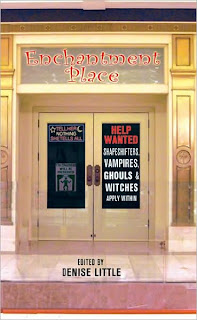
Enchantment Place is this month's entry from the Marty Greenberg anthology factory, with Denise Little in the driver's seat this time. It collects seventeen original -- and rather short, as you've probably guess from the fact that there are seventeen of them in one mass-market paperback -- stories about supernatural creatures at the mall from such names as Mary Jo Putney, Kristine Kathryn Rusch, Sarah A. Hoyt, Jody Lynn Nye, Laura Resnick, and Diane Duane. DAW is publishing this any minute now.

S.L. Viehl's "Stardoc" series, which is about, yes, a science fictional doctor, hits its eighth volume with Omega Games. Roc publishes this one, in the ever-popular mass-market format. I haven't read any of them, so I can't say much more than that. I did always like James White's "Sector General" books, which were also about space doctors -- though I have no idea if Viehl's stories are anything like White's.

John Joseph Adams slipped me a copy of his upcoming anthology Seeds of Change, which gathers nine original stories about major changes to the world. It has stories by Tobias S. Buckell, Ted Kosmatka, Jay Lake, Ken MacLeod, and other impressive names, and Prime will publish it in August. This could be one of the major anthologies of the year, if the stories have the punch they could; I look forward to reading it.

Elizabeth Bear's Hell and Earth is the second half of the novel "The Stratford Man;" the first half was published last month as Ink and Steel. Many publishers would balk at publishing two fat trade paperbacks in back-to-back months; I'm glad to see Roc has stepped up to the challenge. This is part of her larger "Promethean Cycle," but I've been assured that all of the pieces stand completely separately. (And now there are even more Elizabeth Bear books I haven't read.)

Underground is the third novel in Kat Richardson's "Greywalker" series, and the first to be published in hardcover -- that's traditionally a good sign for a series, so congratulations to Kat (who has been know to hang out on one of my favorite Internet haunts, rec.arts.sf.written). Roc is doing this one in August.

And last this week is C.F. Bentley's Harmony, a science fiction novel from a new name in the field. (Though the copyright page credits one Phyllis Irene Radford, a writer with some expertise and knowledge under her belt.) It sounds like an old-fashioned space opera, with human and alien empires battling over a smaller space polity, one ruled by a High Priestess at the top of a Byzantine caste system and just about due to be thrown into upheaval by a plucky and preternaturally gifted young heroine. It's from DAW in hardcover, and will be in stores within a couple of weeks.

Sunday, July 20, 2008

A Minor Amusement

This evening I've been trying to run through as many of my accumulated Bloglines posts as possible -- since I had no Internet access at Readercon, I had three days piled up, and that gets pretty big.

I just cleared out one folder, and was thinking about diving into another -- but it's late, and I'm tired. And then I noticed that I have exactly 1337 unread posts. How could I not leave it at that level for the night?

Itzkoff and the Albino

I'm indebted to John Joseph Adams for first pointing out to me that Our Man Itzkoff was back in The New York Times Book Review -- I was at Readercon over the weekend, while both my Times and my Internet access were back here in New Jersey. So I spent a day and a half in anticipation of the pearls of wisdom and jewels of prose that Itzkoff would bestow on us this time.

As has become his routine, this time Itzkoff takes about twelve hundred words -- one whole page in the NYTBR -- to review a single book. As is also usual, he reviews a reprint of old material that he's already hugely fond of. One might begin to wonder if he's the world's first major book reviewer to hit on a way to practice his craft without actually having to read any books...but that would be unkind, wouldn't it?

The book he's reviewing is The Stealer of Souls, the first of Del Rey's new four-volume reprinting of Michael Moorcock's Elric stories. It's a nice-looking book -- illustrated by John Picacio -- and places the stories in the order Moorcock originally wrote them, which makes as much sense as any other order at this point. (Moorcock went to the ending almost immediately, and then spent nearly forty years interpolating material into different parts of the middle, and his style and concerns changed several times over that period.)

The Stealer of Souls was published in February, which makes this review quite late, but I imagine Itzkoff has been busy dealing with Axl Rose's memoir -- and, besides, the NYTBR has been notably late at covering many, many books this year, so it's probably not even Itzy's fault. (Not noting that the second volume in the series, To Rescue Tanelorn, will be published in nine days is, though, a sloppiness that can only be attributed to Itzkoff.)

By the way, am I the only one to note that "Across the Universe" is now appearing only bi-yearly? The last installment -- which I discussed in this space at the time -- was published in February of this year, covering three YA novels, and the one before that, on Philip K. Dick, was more than a year ago. I will also note without comment that two out of his last three columns are on books he read and loved as a child; Itzkoff appears to be doing very little original reading for this gig.

And so on to the actual review: there's a hideous illustration that manages to give Elric a normal Caucasian skin tone, though I can't fault Itzkoff for that. Itzkoff does realize, about halfway through the review -- but before actually mentioning anything that specifically appears in this volume, in the best Itzkoff fashion -- that he's taking up a whole page to badly review a fantasy book for what is ostensibly a science fiction column, and so he contorts himself to describe one of Moorcock's polemical essays, this one against just about every other SF and fantasy writer at the time. (I suspect this essay, "Starship Stormtroopers," is caught up somehow with the New Wave, but Itzkoff is innocent of all movements and so can't tell us.)

Other things Itzkoff doesn't do:
  • mention the illustrations
  • point out that this Stealer of Souls is a very different book from the old, slimmer Elric collection of the same name
  • talk about any of the new material or the edits to old stories
  • list the titles of any of the stories included here
In fact, he never actually mentions that this is a collection of short stories at all -- he does blather about Elric's "adventures," his "quests," and his "tales," but fails to come right out and say what The Stealer of Souls actually is. If I were a cynical, obnoxious bastard -- and don't look at me like that -- I'd say that it's hard to find any evidence from this review that Itzkoff even cracked the covers of this edition of Stealer of Souls, or possibly even saw it. (It may be personal arrogance, but I think I did a better job of mentioning the important points of Stealer of Souls without reading it at the end of this "Reviewing the Mail" post from February.)

So this is another typical Itzkoff performance of a SF review: well-meaning and enthusiastic, but galumphing off in three wrong directions at once. Itzkoff is the book-review equivalent of Beethoven the dog -- though, sadly, he doesn't have a Hollywood plot to redeem him in the third act.

New York Times Book Review, it's time to stop pretending he can review SF. Either give the job to someone else -- anyone else -- or just go back to ignoring us like you ignore romances.

Friday, July 18, 2008

SFWA's New Grand Master

SFWA has announced that the "Damon Knight Memorial Grand Master" for next year will be Harry Harrison, getting a jump on the April event and continuing the new regime's apparent policy of clearing their desks of all work as quickly as humanly possible.

This is a really, really early announcement, isn't it? I thought typically this news came out early in the year, two or three months before the Nebula Awards Weekend. I hope that doesn't mean that Harrison is very ill, but that's what came to mind first.

SFWA is digging deep into the apple barrel for Grand Masters at this point, choosing prolific and long-lived writers who each wrote a few seminal works but aren't the overarching giants of the field. (On the other hand, that description also fits just as well some of the very earliest Grand Masters, like Simak and Williamson. Grand Masters have only rarely been as "Grand" as they might possibly be.)

Personally, I read a lot of Harrison in my formative years, and enjoyed his books, particularly the "Stainless Steel Rat" novels. Most of those books, though, don't really hold up now. I suspect he's really getting the Grand Master-ship because he survived so long and because of Make Room! Make Room! (I also read a lot of Ron Goulart in those days, and I don't seriously expect to see him made a Grand Master any time soon; I'm not claiming I had wonderful taste at the age of twelve.)

I'm not complaining, exactly -- this is SFWA's award, for people who SFWA really likes, and it has never been explicitly for "great writers" -- just noting that I would put Harrison on a lower level than such recent winners as Le Guin, Silverberg, and Ellison.

And SFWA has now given a Grand Mastership every year since 2003 -- seven in a row. They also gave out GMs for seven years straight from 1994 to 2000, after a much more leisurely pattern in the award's first twenty years. It's hard to avoid thinking that SFWA is trying to hand these out to as many of their older friends and colleagues as they can, as quickly as they can, before those older writers die. Again, it's their award, so they can do what they want with it. But if they want to use the Nebulas to increase their prominence and influence -- as has been repeatedly suggested -- then loading up with a bunch of GMs might not be the optimum strategy.

Thursday, July 17, 2008

A Biased Quiz

It was about time for another quiz designed by and for needy twenty-something single girls, so I picked this one, since Diana Pharaoh Francis was doing it.

I don't agree at all with its characterization of me, since I believe its premises are skewed; what it sees as distance and detachment, I would call "being married for fifteen years." Really, kids, the drama level goes way down later in your lives. At least, it's supposed to.

Your result for The Attachment Style Test...

The Player


You are most comfortable without close emotional relationships. It is very important to you to feel independent and self-sufficient, and you hate the idea of having to depend on others or having others depend on you. The very few times you have fallen in love, it was probably with someone unattainable and disinterested. You know how to have a good time with your friends, but when it comes time to bare your deeper feelings, you tend to laugh nervously and change the subject.

Fictional character with whom you might identify: Captain Jack Harkness (Doctor Who/Torchwood), Holly Golightly (Breakfast at Tiffany's)

CaptainJackHarkness.jpg HollyGolightly.jpg


Other Attachment Types:
Secure: The Unicorn | The Cuddleslut | The Free Agent
Preoccupied: The Cling Wrap | The Squid | The Insect
Fearful: The Doormat | The Leper | The Exile
Dismissing: The Hermit | The Stone | The Player
Confused: The Waffler

Take The Attachment Style Test at HelloQuizzy

Marvel Comics Circulation Figures

I love seeing actual numbers, so this Publishers Weekly article by Todd Allen, which examines Marvel Comics's recently released audited circulation figures, is like catnip to me.

The big take-away for me is something every publishing person should have tattooed on the inside of his eyelids: different markets want different things. Some big direct-market books sell decently as subscriptions and on the newsstand, but some direct-market dogs (notably books for kids) seem to sell much better through other channels.

And so some projects that look like money-losing dogs through the blinkers of the direct market are actually at least modestly successful. Because one market isn't everything, and any industry that tries to rely entirely on one market will find itself in big trouble.

Wednesday, July 16, 2008

Movie Log: Seducing Dr. Lewis

Every so often, there's a small movie about quirky people in some small village, somewhere picturesque but downtrodden, and their relationship with an outsider -- think Local Hero. Seducing Dr. Lewis is the Quebecois version of that story.

In the small fictional town of St.-Marie-la-Mauderne, the men used to be stalwart fishermen, and vigorously pleased their wives when they came back from the sea. (This is explained, only very slightly euphemistically, in the first five minutes of the movie.) But something unexplained happened to stop the fishing, and now nearly the entire population of St. Marie is on the dole, and unhappy about it.

(It's a good enough dole for them to continue to live in their houses and raise their families as they always have, so some right-wing ideologues might think the problem here is that these people don't have enough incentive to get off their duffs and find work. But the movie is solidly Canadian; it prefers work to handouts, but doesn't see anything morally wrong with handouts. Come to think of it, it doesn't see anything morally wrong with bribes, either.)

Anyway, St. Marie has the chance to get a "factory," but they need to have a resident doctor for the company in question to plant their factory there. (They also need to raise the money for that bribe, and to lie about how many people live there, but those are comparatively minor points.)

Through the machinations of an only mildly corrupt policeman, a coke-snorting plastic surgeon named Dr. Lewis (David Boutin) from "the city" (clearly Quebec) is sent up to St. Marie for a month, and the entire village, goaded by new mayor Germain Lesage (Raymond Bouchard), sets out to charm him off his feet by pretending to like cricket, among other things. There is, inevitably, a pretty girl in the town whom Dr. Lewis takes a shine to, but that's a very minor part of the movie -- it's mostly about Germain seducing Dr. Lewis.

Seducing Dr. Lewis is a film that sets its sights on being charming, and lives and dies by how well it lives up to that aim. The Wife and I enjoyed it, and were charmed, so we considered it a success. But if you've watched Waking Ned Devine, Local Hero, etc. recently, you may find this film to be second-hand and derivative.

Movie Log: Wall*E

Our whole family went to see Wall*E the weekend it opened, since we're all immense Pixar fans in the Hornswoggler house. (As all upstanding, right-thinking people are, of course.)

I didn't write about it immediately because things got busy, and because I didn't have any specific things to say about it. If I'd gotten out there quickly enough, I could have made fun of all the people whining about it -- leftists because it's mean to fatties, rightists because it's mean to rapacious corporations -- but I didn't and that's so two weeks ago.

So what can I say? Wall*E is the story of a robot that falls in love; it's one of the best movies for physical comedy in many years; and, in the end, it's somewhat more moralistic than smart. It means well, and it generally does well, even if the humans' ultimate fate doesn't really make sense (except in terms of the moral). I'm not going to bother to tell the story here; at this point, you either know it well enough or you're not interested.

Ranking it in the pantheon of Pixar movies, I'd have to put it in the second tier, like The Incredibles, another marvelous movie that lets its message pop out in unnecessarily embarrassing ways. If it's not as good as Ratatouille or Finding Nemo, it's clearly better than A Bug's Life or Cars. And middle-rank Pixar is better than 75% of the movies out there, so I expect to watch this several more times -- maybe even without the kids.

Bertelsmann Fire-Sale Update

Bertelsmann CEO Hartmut Ostrowski wrote a letter to employees that leaked to the Associated Press recently, in which he said Bertelsmann is looking to sell off just about every book club that isn't in a German- or French-speaking nation.

This somewhat contradicts the recent word that Bertelsmann's French bookclub operation was up for sale. But it is clear that they're trying to divest themselves of as many bookclubs as quickly as they can.

Shoot Me Now

This marketing business is seeping into my brain; I just used the word "impactful" non-ironically...

Why You Little #$&*!

I came across the Bart Simpson Chalkboard Generator while searching for something for work -- no, really -- and figured I might as well share it, since blogging has been light this week.

Try it yourself -- you can have the little scamp apologize for any kind of horrible activities you might think of. Get him to apologize for William Sanders! (Or the political figure of your choice.)

Tuesday, July 15, 2008

Readercon Schedule

I haven't received my schedule for Readercon yet, which either means they're still working their way towards my end of the alphabet, or I got squeezed out by actual working writers and editors and such. I can't honestly complain, either way. But if I do end up on programming, don't expect me to have done much preparation...

There is one other Readercon point of potential interest: I'll be driving up from North Jersey on Friday morning, and there is spare room in my car if anyone needs a lift up. (I'm also coming back sometime on Sunday, if anyone needs a ride back.) E-mail me if this appeals -- if not, I'll see whoever once I get there.

Monday, July 14, 2008

Happy Bastille Day

For those of you who are French, or just wish you were.

Reviewing the Mail: Week of 7/12

I have nothing in particular to say this morning;, so I'll dive right into what came in for review this last week:

Jeff VanderMeer's new book from Prime is Secret Lives, which collects very short pieces he wrote for people who bought his more conventional collection Secret Life. Each story is the secret life, as imagined by VanderMeer, of the original recipient -- and, now, the rest of us can learn what kinds of secrets our friends and neighbors keep. It's available now, in a signed and numbered limited edition.

Me and the Devil Blues: The Unreal Life of Robert Johnson is a manga version of the life of the famous and mysterious bluesman. It's by Akira Hiramoto, and coming from Del Rey at the end of July. Given what twisted uses Frank Miller alone has made of Japanese culture, I have absolutely no objection to Japanese creators doing similar things with American or Western ideas. In fact, I'm looking forward to this one, and I'll probably be disappointed if it turns out to be based on scholarship or particularly reverent.

Also from Del Rey is the first in a more conventional manga series, Kasumi by Surt Lim and Hirofumi Sugimoto. As the back cover says, "Kaumi is a special girl -- and not just because she's a super-cute high schooler with a heart of gold. She has a major secret: she can turn invisible when she holds her breath." Since it goes on to talk about her crush on the student council president of her new private school, and her run-ins with a "mean girl extraordinaire," I suspect that the invisibility is used mostly for hiding, not for super-heroics. Kasumi will be in stores July 22nd.

Kujibiki Unbalance is also from Del Rey; it's written by Kio Shimoku and drawn by Koume Keito. It's also set in a high school, one where luck and chance rule everything. The hero, Chihiro, has had bad luck his entire life, but suddenly has been (randomly) chosen to be on the student council of this new, prestigious school -- and thus forced to regularly battle evil. Even more confusing that that, this series is supposedly the favorite manga of the characters of the manga series Genshiken -- and I saw references to the whole thing being based on an anime series, too. You'll have your chance to be as confused as I am on July 22nd, when Kujibiki Unbalance will be published.

And also also from Del Rey is the novel Zaregoto, book 1 of "The Kubikiri Cycle" by Nisioisin, who previously wrote tie-in novels for Death Note and xxxHOLiC. (It's over three hundred pages long, so I think this is too long to be a "light novel.") Zaregoto takes place on a tiny island in the Sea of Japan, where the exiled daughter of a powerful family has gathered "the best minds Japan has to offer." One of those minds is a young college student, Ii-chan, who has to solve a murder on the island. This one is also coming on July 22nd.

CMX is the publisher of the manga series Two Flowers for the Dragon, and they just sent me the second volume, which will be published August 6th. It's by Nari Kusakawa, and seems to be about a young woman who is also a dragon princess -- she's been kidnapped and is going to be married off to the highest bidder. But her two fiances are after her -- wait, two fiances? Oh, these manga will keep confusing me...

Also from CMX and also coming August 6th is the fifth volume of King of Cards by Makoto Tateno. If I had to guess, I'd say this is a shojo version of Yu-Gi-Oh -- it seems to be based on the Chaos trading card game and features a female lead character.

Interestingly, Patricia Briggs is setting aside her popular Mercy Thompson contemporary fantasy novels to start a new series set in the same world. Cry Wolf is the first of what the cover calls "An Alpha and Omega Novel" (claiming a bit much, I'd say, but no one asked me), and it's about a different werewolf in the modern world. Cry Wolf is from Ace, releasing July 29th.

Jeff Carlson's new novel is Plague War, the post-apocalyptic sequel to last year's apocalyptic Plague Year, in which a nanotech plague killed all warm-blooded life on Earth below 10,000 feet of altitude. (Have I mentioned recently that I greatly resent books that murder me and my family to make room for their "exciting" action scenes? It's not a good strategy to get me interested in reading your stuff, though perhaps it works better for the other five billion people Carlson killed off in the first book.) For those readers who like to pretend that they'd survive a holocaust, Plague War will be available July 29th.

Joe Haldeman's new novel is Marsbound, coming in hardcover from Ace on August 5th. It's by Joe, it's about Mars -- what more do you need to know? I'm hoping I can find time to read it, though I've got at least two others books just from Ace that I should read first.

And last this week is David Louis Edelman's second novel MultiReal, which reminds me that I still haven't read Infoquake. (There are too many books being published, honestly -- could the SFF field just take a break, for about six months, so we can all catch up? Thanks!) MultiReal is the middle book of the Jump 225 trilogy, and Edelman is an interesting guy who wears snazzy hats. If you're not reading piles of comics like I am these days, you'll probably get to this before I will -- and I'll resent you for that.

Sunday, July 13, 2008

361 by Donald E. Westlake

361 is from early in Westlake's career, before he discovered his great talent for humorous crime novels and he moved the hardboiled stuff over to appear under other names. (Most notably Richard Stark, of course.) It was originally published in 1962 -- the same year as the first Stark book, so it was a good year for hardboiled Westlake -- as the third novel under Westlake's name.

(By the way, yesterday was Westlake's 75th birthday -- so happy birthday to him, and a wish for many more.)

361 is a revenge novel, but not a straightforward one -- even that early in Westlake's writing life, he was interested in complications and things that aren't quite what they seem. Our first-persona narrator is Ray Kelly, who has just been mustered out of the Air Force. His lawyer father meets him in Manhattan, to drive him back to their home in Binghamton. But someone was looking for Kelly senior, and they're shot at from a car on the highway. Ray wakes up in a hospital bed with one eye and one father missing.

His brother Bill comes to see him there, but has to leave suddenly -- his wife was just killed in a hit-and-run back in Binghamton. Suddenly, it looks like someone is trying to wipe out the Kelly family. Bill and Ray go to ground in Manhattan, and start investigating their father's past.

It turns out the elder Kelly was a mob lawyer back in the mid-30s -- before he went off to Binghamton -- and that one of the bosses he knew best is getting out of prison in a few week. The Kelly boys put two and two together and decide to nab that boss, Eddie Kapp, when he gets out of Dannemorra. But then someone else shoots at Kapp...

361 twists on from there, following themes of family and blood in unexpected ways and always tightly focused on Ray Kelly, a man not in the habit of thinking or talking about his emotions. (And who has trouble when he's not able to be active immediately -- which happens quite a lot in 361.)

361 is more of a novel than the Stark books are, since the Stark books have a protagonist, Parker, who is eternally unchanged and unchangeable. Ray Kelly does change as 361 goes along, as he learns more about himself and his family. Like all of the other Hard Case books I've read this week, 361 is a lean, tight novel with a lot of action and suspense -- the way they used to make 'em. And it's still well worth reading for those of us who like 'em that way.


And that'll be the end of this streak of Hard Case Crime books; I'll be reading other things for the next week. But this was fun; I should do it again some time.

Saturday, July 12, 2008

Songs of Innocence by Richard Aleas

"Aleas," as many of you might know, is a not-entirely-secret pseudonym for Hard Case Crime's owner/editor/publisher Charles Ardai. (Aleas is not only a homophone for "alias," the full name is also an anagram for "Charles Ardai.") This is his second novel for Hard Case, after Little Girl Lost (which I will now have to track down and read).

Songs is a direct sequel to Little Girl Lost, another mystery centered on John Blake, who was a private detective in Girl but now, three years later, works as an administrative assistant at Columbia. He's an unhappy man, thinking about suicide regularly, and convinced that he's responsible for the deaths of a number of people. (Which, during the events of Girl, he quite likely was.)

In Songs, Blake is investigating the death of his friend Dorothy "Dorrie" Burke, which looks like suicide -- but he's sure that it wasn't. Dorrie was in the writing program at Columbia, the same program Burke works for, and the two of them were close in the way only two damaged people could be.

Dorrie was working as a masseuse -- yes, the kind you're thinking of, the ones that make more money and aren't as respectable -- and Burke believes someone connected to that life killed her and made it look like suicide. So he investigates, in best fictional PI fashion, and pokes his way around the fringes of the sex business and of a Hungarian gang.

It's all fine so far -- Aleas/Ardai is a skillful writer, and updates the hardboiled idiom well to modern Manhattan -- but it's fairly generic and predictable in its broad outlines. But as Songs of Innocence heads towards its ending, it substantially increases the stakes.

There's one twist in the ending which most experienced mystery aficionados will see coming -- maybe Aleas threw that in as a "gimmie." But the final pages are stark and gripping; one of the best and most unexpected endings I've ever read in any novel. Hardboiled novels are supposed to be about the people who really do commit violent crimes and what it does to them; Songs of Innocence delivers and in spades. It ends breathtakingly and perfectly, lifting itt into the pantheon of great crime novels.

The Best of the Spirit by Will Eisner

This is another book I had to return to the library before I got a chance to blog about it, so all I have now is vague memories. (And they're getting vaguer and vaguer by the day, so I'd better post something now before I forget that I ever read it.)

The earliest stories in here were more than a bit creaky with exposition, but were still solid comics. But they got much better as they went along; some of the later pieces were little gems of story. (Not all of them worked as well for me, though.)

I probably still need to read more Spirit; I found these intermittently exciting but not consistently so. Eisner had a great eye for page layout, but also a thudding fondness for the femme fatale. (And those dames start to run together after a while, to be honest.) On the other hand, those femmes fatale are very easy on the eyes...

I'm not the person to tell anyone to read The Spirit, goodness knows, but, if you're interested in comics as an artform at all, you need to at least poke your nose into it to see what it really is about. (Same thing with Krazy Kat, even if, like me, you can't quite see what all the fuss is about.)

Mother Goose on the Loose edited by Bobbye S. Goldstein

Goldstein is, according to her bio, "a prominent educator and a well-known poet for children." Here, she's collected a pile of New Yorker cartoons that comment on or reference nursery rhymes -- Jack and Jill, Old King Cole, Little Jack Horner, and their ilk -- and run them all together.

I don't quite see the purpose to this book, though any collection of New Yorker cartoons is bound to be pretty good, just because the cartoons themselves are pretty good.

I have the feeling that this exists only because The Cartoon Bank is in existence to license New Yorker cartoons to people with the money to buy them, and because Harry N. Abrams (the publisher) has been doing well with a wide variety of New Yorker cartoons. It's a weird idea, and it doesn't really mean anything, or add up to anything -- it's just a collection of cartoons with an unlikely theme.

Goldstein does provide some doggerel for the stories that aren't already nursery rhymes -- Goldilocks, Jack and the Beanstalk, Little Red Riding Hood -- and those aren't embarrassing, but they're not terribly good, either. (She doesn't try to retell the story in verse, but instead comments on it herself.)

I read this because it was in my library and it has some good cartoons in it, but I can't see who would want to pay their own money for it, except maybe fanatical folklorists.

Friday, July 11, 2008

Thank God It's Manga Friday!

And I've just wasted that title forevermore.

This week's "Manga Friday" column for ComicMix references Alison Bechdel's law of movies for cheap intellectual points, and then dives into reviewing four books that I think are all shojo: Sunshine Sketch, Walkin' Butterfly, Kamichama Karin Chu, and Suihelibe!

Standing Up to Be Counted

So, William Sanders, huh? The question of the week -- is he a racist jerk, or a victim of unprofessional behavior?

Well, he's both, actually -- but the unprofessionalism is awfully mild, and exceptionally minor, compared to the racism. So calling attention to the latter to minimize the former is disingenuous at best.

This is one of those times when everyone in the field has to stand up on one side or another and be counted. I'm probably not free of racism myself --how does that song go? -- but I can tell it when I see it. And this is it.

I'm not going to call for him to be drummed out of the SF field and hounded unto death -- as some of the more blood-thirsty commentors at Making Light would prefer -- but bad behavior should be publicly disapproved of.

(Context: K. Tempest Bradford with as much of Sanders's letter as remains posted; Tobias Buckell being reasonable and thoughtful, as usual. Following all the associated links could consume hours of time; I do not recommend checking out the Asimov's boards on this subject.)

I'll Tip My Hat to the New Constitution

Bertelsmann has managed to sell its North American book, DVD, and music club business, reports Publishers Weekly this morning. The new owner of many of my old colleagues is Najafi Companies, a private equity firm from Phoenix.

I don't know whether to congratulate those folks or to commiserate with them; I guess time will tell. But at least the waiting is over.

All The Awards In the World, Part Two

And the more interesting awards news this week is the annual Locus Awards. Locus has prided itself for many years on being the award voted on by the most people, but, this year, that claim jumped up and bit them.

SF Awards Watch has a good account of the rumpus, with links to the more excitable complainers. In short, Locus decided to change the way they counted votes after voting was closed, because they received a very high number of online votes.

There's no explanation of the change online with the list of winners, which is also a time-traveling web page from June 21st. I think I have the new Locus at home, so I'll have to check it out tonight, and see what explanation they give. (Something like "it looked like an attempt to stuff the ballot box" would be reasonable to me, but if it was just "too many of those people voted, and voted for things we didn't want to see win" I would perhaps be as grumpy as certain others.)

Anyway, those winners:
  • SF NOVEL: The Yiddish Policemen's Union, Michael Chabon (HarperCollins)
  • FANTASY NOVEL: Making Money, Terry Pratchett (Doubleday UK; HarperCollins)
  • YOUNG ADULT BOOK: Un Lun Dun, China Miéville (Ballantine Del Rey; Macmillan UK)
  • FIRST NOVEL: Heart-Shaped Box, Joe Hill (Morrow; Gollancz)
  • NOVELLA: "After the Siege", Cory Doctorow (The Infinite Matrix Jan 2007)
  • NOVELETTE: "The Witch's Headstone", Neil Gaiman (Wizards)
  • SHORT STORY: "A Small Room in Koboldtown", Michael Swanwick (Asimov's Apr/May 2007)
  • COLLECTION: The Winds of Marble Arch and Other Stories, Connie Willis (Subterranean)
  • ANTHOLOGY: The New Space Opera, Gardner Dozois & Jonathan Strahan, eds. (Eos)
  • NON-FICTION: Breakfast in the Ruins, Barry N. Malzberg (Baen)
  • ART BOOK: The Arrival, Shaun Tan (Lothian 2006; Scholastic)
  • EDITOR: Ellen Datlow
  • MAGAZINE: F&SF (Gordon Van Gelder, editor)
  • PUBLISHER: Tor
  • ARTIST: Charles Vess

However they were gerrymandered, it's a reasonable list...however, if they were deliberately gerrymandered to get those winners, that would be Not Cricket and I shall have to slide my glasses down my nose and give Locus a very stern look indeed.

All The Awards In the World, Part One

It's summer, which means it's awards season. And what would awards season be without a little controversy?

(And why does all this stuff always happen when I'm busy doing other things -- like packing up a trade show and flying -- and can't blog about it immediately? The world needs to correspond better to my schedule, damnit!)

First, and least, is the odd fact that the John W. Campbell Memorial Award and its brother the Theodore Sturgeon Memorial Award were leaked a few days ahead of their official announcement, which is to be later today. (Link trail: SF Awards Watch <- Torque Control <- Kansas City InfoZine)

And those winners are:
  • John W Campbell Memorial Award: In War Times by Kathleen Ann Goonan
  • Theodore Sturgeon Memorial Award: a tie between “Finistera” by David R. Moles and “Tidelines” by Elizabeth Bear
I haven't read any of those pieces, so I have no official comment.

Speaking of "no official comment," there hasn't been any explanation why this went out to "Kansas City InfoZine" and no one else -- the implied explanation, of course, is the old saw about fandom and amateurism, which gets more tedious and harder to take every year. (Just because you're an amateur doesn't mean you have to do things amateurishly.)

Thursday, July 10, 2008

Not That I'm Proud of This...

I've mentioned a couple of times that I was just on a five-day business trip to San Francisco. And I've blogged before about the agony of picking the right book(s) for a trip -- what if I get stuck on a five-hour flight with a book I don't want to keep reading?

So I thought I should come clean about my book-packing for this trip. It was high, even for me, since I threw in the things I wanted to cover for ComicMix this week, and I was also doing the Hard Case Crime thing as well.

But I packed fourteen books for five days away -- seven Hard Case and seven comics.

Although I should point out that I read eleven of those during those five days, and one more today, after I got back. So it looks like I packed only slightly too many books -- and I can live with that.

Catching Up With ComicMix

I've done a number of reviews for ComicMix in the last week, and have missed linking to them here -- mostly because I was off on a business trip in San Francisco. But I'm back home now, so here's what I've been up to:
That's the past week; tomorrow, with any luck, will see another Manga Friday with a short stack of titles for girls of varying ages.

The Colorado Kid by Stephen King

I was tempted to write this review in a parodistic version of the folksy dialogue that makes up quite a lot of this very short novel, but I finally decided otherwise. (I hope you'll appreciate that.)

The Colorado Kid was the first novel King published after the end of the "Dark Tower" series -- which was also the point at which he declared that he was retiring from writing novels -- and it's a very odd piece. It's odd for King and it's odd for Hard Case, but King does often get more experimental and interesting when he writes at shorter lengths.

Colorado Kid is a twice-told tale; we're hearing it along with Stephanie McCann, a young reporter learning her trade at the Weekly Islander of Maine's Moose-Lookit Island. It's told to her by David Bowie and Vince Teague, two much older and more experienced reporters, after a long lunch with a reporter from the Boston Globe. (The Globe reporter wanted some unsolved mysteries for a series he's doing; the two old islanders didn't tell him the oddest, juiciest one -- but they will tell it to Stephanie and us.)

Colorado Kid grinds its gears for more than twenty of its hundred and seventy pages, setting the Maine island scene and indulging in a lot of pseudo-witty banter between the two old farts. (If it had been by anyone less famous than King, it would have worn out its welcome by then, but we indulge the storytellers we trust.) Finally, David and Vince get down to the story of the "Colorado Kid."

A man was found dead on the beach of Moose-Lookit, with no identification, twenty-five years before, in 1980. He was wearing a dress shirt and suit pants, but no jacket or coat -- unusual for the weather. And, once he was identified, it was as a Colorado man who walked out the door of his office for a coffee about five hours before he had a Maine fish dinner.

It's only just possible for him to have covered that distance in that time, and much of Colorado Kid is taken up with back-and-forth dialogue about how he could have traveled so quickly, how he must have had a car ready here and a charter plane there, and so on.

That's all on the surface: beneath it, Colorado Kid is a direct assault on that old Sherlock Holmes diktat: "When you have eliminated the impossible, whatever remains, however improbable, must be the truth." King does not provide any examples of impossible explanations; the reader has to think them up himself. But they're likely to be more plausible than the merely improbable explanation that the reporters have cobbled together.

So, in its sly way, The Colorado Kid is a plea for the imaginative genres -- horror, fantasy, science fiction -- against and from within the mystery genre. What is the truth? asks The Colorado Kid. The truth is whatever makes the best story -- and this story is left a bit misshapen and lopsided on purpose, since what would have made it the best story -- that impossible explanation -- is left out.

Wednesday, July 09, 2008

Grifter's Game by Lawrence Block

This was the very first Hard Case Crime book, published in September of 2004. Sure, Max Phillips's Fade to Blonde was published the same month, but Grifter's Game is the one numbered HCC-001, so it gets bragging rights.

It's another old Block novel from his days in the paperback mills, originally published in 1961 as Mona. (I might even have another edition of it as Mona; I have a vague feeling that it was one of the early Block books that Carroll & Graf reprinted about a decade ago.)

Grifter's Game is a solid example of that pulp classic, the bumping-off-the-husband book. Joe Marlin is a con-man who drifts from city to city, using his good looks to snag bored rich women for a night or a month, but he's beginning to think about finding one for good. But two things happen when he hits Atlantic City: he accidentally steals a large amount of uncut heroin, and he meets and falls for Mona Brassard, the gorgeous young wife of the man whose luggage (and heroin) he stole.

Before long, they come up with the obvious plot: kill the husband, keep Mona from suspicion, and marry quietly later. Grifter's Game would be awfully boring if things went according to plan, and it's not boring...

Grifter's Game is very clearly of its time and place -- the number of times Joe mentions lighting a cigarette is truly heroic -- and it's solidly in a well-worn genre. But Block does everything right here: we're solidly inside Joe's head from the beginning, and we trust and like him. The book has enough plot, but not too much, and it moves at a steady pace. (Not a particularly quick pace, though; it's only just two hundred pages long but isn't the headlong rush you might expect.)

If you want a book about a dame, and about guys who wear ties everywhere, this is a fine example.

Tuesday, July 08, 2008

Money Shot by Christa Faust

Money Shot is a new book -- published February of 2008 and written not too long before that -- but it fits right into the traditions of the Hard Case Crime line, with violence galore and more than a bit of sex and kink (it's set in the world of porn). It's the 40th Hard Case book, and the first to be written by a woman.

Gina Moretti is the former porn star Angel Dare, now on the far side of thirty and long since retired to running the modeling agency Daring Angels. But when one of her oldest friends, director Sam Hammer, tells her that a girl failed to show up for one of his shoots and his male star, the latest hot young thing Jesse Black, has always wanted to work with her...well, she overrides her better sense and heads over to the location.

And winds up shot, naked, raped, and tied up in the trunk of a Honda Civic, left for dead. (She's there on the first line of the novel, which then drops back and explains.) So Money Shot is a revenge novel -- Angel Dare needs to find out who was behind the attack on her and get rid of them. She quickly learns that there's a lot of money involved, and an international white-slavery ring. (Can we still call the kidnapping-young-women-into-the-sex-trade "white slavery?" Does it help if it's happening in a pulp novel?)

Angel discovers what she's capable of, and takes care of business in the end. Money Shot is an excellent noir novel, with attitude and atmosphere to spare -- I probably even learned some things about the porn business along the way.

And since it is a noir novel, and a story about revenge, I'm not going to complain about a choice Angel made -- it had to happen that way to make the plot go in the right direction. (And it's quite possible that the advice she got was deliberately wrong anyway.) But, even if she was wanted for questioning in a murder, her story would have been massively strengthened by a hell of a lot of physical evidence at one particular point in the story, if she had only gone to the police and/or EMTs.

(Yeah, yeah, I know -- "If Woody had only gone to the police, none of this would have happened.")

I'm not complaining, mind you -- it wouldn't have been the book Faust wanted to write if Angel had gone to the cops -- but I am noting. The frame was not actually as strong and sturdy as it might have appeared at that moment.

That's all beside the point: Money Shot is a damn good modern paperback thriller in a very welcome old style, and Angel Dare is not just a tough cookie, but a smart and worthy one as well.

More Things Bertelsmann Is Selling

Le Figaro says Bertelsmann is close to selling its French book club operation (including the France Loisirs bookstore chain); Bertelsmann denies it.

Financial Times Deutschland
, on the other hand, says Bertelsmann is on the verge of selling the entire direct-to-consumer division (which was the engine of its growth from a small, sleepy Bible publisher to a global media giant).

There's no definitive word, though, on how selling actual books is going...

Tired

I owe you folks a review of Christa Faust's Money Shot, but it's not going to happen tonight -- I just finished up a review for ComicMix after coming back from a very nice dinner with Tachyon Publications' Jacob and Rina Weisman, and I have to be back in my booth at the horrifying time of 7 AM tomorrow.

So I'm doing a little light surfing, and then heading off to bed. Maybe tomorrow.

Bertelsmann Slashes More Book Clubs

As rumored a few weeks ago, Bertelsmann announced on July 3th that it will be immediately closing its 1.5-million-member strong Chinese book club business. The Interfax-China article states that the Chinese operations had "huge losses," but that Bertlesmann will be spending $100 million on new initiatives in China, which are expected to include "media services and magazine publication."

Monday, July 07, 2008

Reviewing the Mail: Week of 7/5

With the holiday, this turned into a short week -- which means I can fit everything that arrived into one post. Here's what I saw last week:

Greg Egan's long-awaited -- seriously, it's been six years since Schild's Ladder -- new novel, Incandescence, which Night Shade is publishing in July. From the description, it sounds like an expansion of his story "Riding the Crocodile" -- originally from Gardner Dozois's anthology One Million A.D. (which was published by someone-or-other, long ago in another country that doesn't exist anymore). SF has changed a lot in the last half-decade, and Charles Stross has essentially grabbed Egan's chair as the High Priest of Weird Hard SF in that time. I thought "Riding the Crocodile" was a solid story, but still running through Egan's old obsessions and ideas -- but I hope Incandescence finds new and exciting places to go to.

Also from Night Shade is a new short novel by Neal Asher, Shadow of the Scorpion. The Night Shade Asher books are shorter than the doorstops Asher writes for other publishers (Tor, on my side of the pond), and this one is a story of the younger days of his series hero Ian Cormac. It'll be published in July, and I bet that there will be some bizarrely vicious climax predators in it.

Yen Press sent me a bunch of manga recently -- actually, most of them seem to be manwha, from Korea. First among those was You're So Cool, Vol. 1 by YoungHee Lee, published in May. It's a school story, about a girl who is in love with her school's "perfect prince" -- until she gets to know him, and discovers he's actually a jerk. Since this is a series and not a short story, I suspect that she's stuck with the jerk in some odd and unlikely way.

Yen also published Cynical Orange, Vol. 4 by Yun JiUn in June. I've had some cynical oranges in my day -- though I'm generally more fond of sardonic apples, or even bumptious plums -- so I'm glad to see that they're finally coming to the attention of publishers. Who knows? Maybe the scourge of sarcastic grapes will be next.

All joking aside, Cynical Orange looks to be another school story, about a heroine who is the "hottest girl in school" and going to all lengths to stay the cutest, most popular, and most beloved. From the tone, I think the audience is meant to sympathize with her quest to get everything she wants, including her "secret crush."

Hissing, Vol. 4 is another Yen title, by Kang EunYoung, coming in July. It's a love story between an aspiring comics artist and an aspiring "tough guy" -- I think the former of those is female, but I'm not 100% sure. So, if you're looking for yaoi or not, this could be it. Or not.

And then there's Very! Very! Sweet, Vol. 1 by JiSang Shin and Geo, another book from Yen in July. This one seems to have all sorts of fascinating cultural baggage -- it's the story of a spoiled wealthy Japanese kid who get packed off to Korean by his grandfather, and told the family's hideous, shameful secret: they're actually Korean. This series is Korean as well, which may affect how this secret plays out.

Angel Diary, Vol. 6 continues the Korean/Yen deluge; it's by Kara and Lee YunHee, and is published this month. According to Yen's website, this series is about the Angel Princess of Heaven, who ran away to Earth to hide as a schoolboy rather than get married to the King of the Underworld.

Once again, I'd like to stress that I don't write 'em, I just try to make sense of 'em.

Last from Yen this time is Ume Aoki's Sunshine Sketch, Vol. 1, which was published in June. They're all four-panel gag strips about a new girl at a high school for the arts. And, of course, every single other character is utterly bizarre in different ways -- isn't it always like that in high school?

And the last thing overall this week is a new novel from Elizabeth Bear, All the Windwracked Stars. I saw it in galley form, and it doesn't publish until November. It's from Tor in hardcover, and it's a fantasy novel set sometime after Ragnarok. As I realized recently, I still haven't read any of Bear's novels, so maybe this one will be first.

Thomas M. Disch, 1940-2008

Locus Online reports that Tom Disch, noted critic and writer of SF as well as a highly respected poet, died by suicide on July 4th in New York City.

God damn that is horrible news. He just had a new book out, too. My thoughts are with all who knew and cared about him -- he'll be remembered, but that's no consolation right now.

Sunday, July 06, 2008

A Diet of Treacle by Lawrence Block

I've been reading Lawrence Block's books almost as long as I can remember -- his "Burglar" books were about the first thing I ever discovered in the adult mystery section of my local library. (Back when that section was in a different wing of the library, and then upstairs, from the kids and YA books. That was a big step to take, I'll tell you -- but I did it around age ten, probably about the same as those of you reading this.)

Block, though, had been writing books much longer than I could remember; he was born in 1938 and started publishing in his teens. By the time he got to A Diet of Treacle, in 1961, he was cranking out sex books on a near-monthly basis and regularly writing mystery novels and stories as well.

Treacle is very early and minor Block, and it shows signs of being written by someone who was spending most of his writing time on books that require a sex scene in every chapter. (This book doesn't actually have those scenes, but it could have, if Block had tweaked it just slightly.) It's basically the story of a bohemian triangle in the boho Greenwich Village of the day: pre-hippie, but definitely already countercultural.

Joe Milani is a twenty-seven-year old Korean War vet who dropped out of college, and, almost entirely, out of life as well. He can't get motivated to do anything, and only intermittently wonders why he doesn't want to do anything. He lives cheaply -- in Manhattan, another sign that this book is set in the now-gone past -- mooching off women or friends, doing odd jobs, just getting along.

Joe lives with Leon "Shank" Marsten, a twenty-year old minor marijuana dealer who turns out to be a psychopath, but at first just seems to Joe to be only slightly more directed and motivated than he is himself. As long as they don't do anything or want anything, the fact that Shank has no real regard for human life doesn't matter. They both spend a lot of time smoking pot, which Block doesn't demonize -- though Joe, in particular, is clearly a stoner/slacker, of the kind that would be much more familiar in later years.

But then Joe meets Anita Carbone, a nice Hunter College girl -- she lives with her grandmother in "wop Harlem" -- slumming downtown because she, too, feels vaguely unsatisfied with her life. Anita convinces Joe to seduce her, eventually -- he's far too passive for it to be entirely his own idea -- and then moves in with them. (This isn't completely convincing -- slumming is one thing, moving in with your new boyfriend and his creepy roommate in a coldwater flat is another -- but let it slide.)

Shank was contained and relatively harmless as long as things didn't change, but now there are a lot of changes. First, there's Anita, having sex with Joe in the one-room apartment. A Narcotics detective is poking around Shank's business, and has already arrested his supplier. And Shank's new supplier pushes him to expand into heroin, with greater profits but also greater dangers.

This is a crime novel, which means it all erupts into crime -- not just drug dealing, but rape and eventually murder. And it's a 1961 crime novel, which means the criminals can't just get away with it. Keep that in mind if you decide to read it.

A Diet of Treacle is most interesting as a portrait of a time and place -- from internal evidence, it's set in the late '50s, given Joe's age and Korean war service -- that conventional wisdom thinks didn't turn into itself for a few years yet. This Village is pre-hippies, pre-Vietnam protests, even pre-the folk music boom. And yet it was already a magnet for disaffected young people, already the place for people who didn't know what they wanted, but knew they didn't want that.

Block spends a lot of time in his character's heads, particularly Joe's. A large part of that is padding; he has a short, simple story to tell, and to get it up to novel length he needs to have extended scenes of Joe or Anita thinking about themselves and what they want out of life. They're decently rounded characters, but you can clearly see the gears working and Block figures out how to show rather than tell and how to get enough plot together to fill up a whole book.

A Diet of Treacle isn't a typical Hard Case book -- it moves slowly for the first two-thirds, and it's not essentially a crime novel at all, just a novel about three characters that has some crime in it. And it's a minor Block novel as well. But it's solidly professional, and great to have available again for Block fans.

Welcome to Hard Case Week

As long-time readers might have noted, I'm prone to bizarre reading projects. And it's been a while since the last one, which means I'm overdue.

So, since I'm on a business trip in San Francisco -- home of Dashiell Hammett, father of the hardboiled mystery -- and since I look to have quite a bit of spare time here, and because I'm missing a publishing party I really wanted to go to (for the launch of Naomi Novik's fifth novel and a celebration of Hard Case Crime)...for all those reasons and more, I took a pile of Hard Case books to read on this trip, and I'm going to try to review them at least one a day while I'm here.

I finished Lawrence Block's A Diet of Treacle on the plane, and am most of the way through Christa Faust's Money Shot, with five more books stacked under those. I'm on West Coast time this week, so my "day" may skew later than usual -- but I hope to have something up about Treacle before Sunday is over here.

And maybe the next time I come to a strange city, it won't be on a holiday weekend, and some actual human beings will be around...

Saturday, July 05, 2008

Always Remember

Any man wearing skinny jeans and a porkpie hat must be watched carefully; he is bound to be up to no good.

Kate Beaton for the Win

Canada's favorite humorous historical cartoonist -- well, who else would you suggest? -- explains, through only her own native wit and a few well-chosen old political cartoons, that the USA really wants to screw Canada.

Thursday, July 03, 2008

Heading off to San Francisco

I'm flying off to San Francisco on Saturday -- losing half of my holiday weekend, of course, but that's the life of an accounting-book marketer -- to attend the annual meeting of those hard-living, two-fisted types of the Institute of Internal Auditors. This time, I'll only be there with one colleague, and I think my evenings won't be stolen by obligatory receptions in the exhibit hall.

So I'm hoping there are some people out there who know me (and I know them) who might be interested in getting together for dinners and suchlike. If you fit that description, drop me an e-mail. (It looks like I'm free every night I'm in town, Saturday through Tuesday.)

If you don't, well...any recommendations for good restaurants or things to do in SF would be welcome, too -- I'll be in the Moscone Center area.

Thanks, and hope to see someone-or-other while I'm out there.

I Only Have a Mild Case

Today's quiz is called "How Geeky Are You?" and my score is...

63% Geek

Created by OnePlusYou

I got it from Ellen Gerstein, who is substantially geekier than I am. (If I was hands-on with computers at all, my numbers would have shot up, but computers are mostly just tools for me.)

Wednesday, July 02, 2008

Kodansha Picks Up Its Toys and Comes Here

The Japanese media giant Kodansha, best known for its manga, announced yesterday that it was creating a US subsidiary and transferring many of its copyrights to the new Kodansha USA.

Kodansha previously licensed its works -- an extensive series of licenses with Tokyopop, now somewhat diminished; a few, mostly more mature titles with Dark Horse; and a current extensive relationship with Random House's Del Rey Manga imprint -- but will now also publish some works directly.

Early reports indicate that existing licenses are expected to stay with their current US publishers, perhaps indicating that Kodansha wants to leverage its huge library of titles in Japan. They may perhaps be aiming at a somewhat different market than Del Rey and Tokyopop, though those imprints mostly do shonen and shojo titles, which are the largest market segments here as well as in Japan.

And, as always when something happens in the SF/comics world, io9 is there to misunderstand the story and comment confusedly -- clapping their hands in glee as if this heralded a massive new OEL program. Pity the clueless, for they will walk into many walls in their time.

"Why Am I Talking to You? You're Not Important."

Editorial Ass writes a post that every author -- particularly wanna-bes, but everyone could take a lesson from it -- should print out, post up somewhere prominent, and memorize.

Bottom line: be very, very careful when you begin to trade on your own self-importance.

(Oh, and this applies equally to folks who work for a publishing company: being polite and respecting the people you're actually working and dealing with is always the best policy.)

The Resurrectionist by Jack O'Connell

I wanted to like The Resurrectionist; I really did. It's a noirish novel with fantasy elements, in which a comic book is important, about a father and his son, set mostly in a creepy hospital in the fictional old mill town of Quinsigamond, Massachusets. It even has psychotic bikers and guys with anger management issues! It sounded like just my kind of thing.

As it turned out, though, The Resurrectionist -- though undeniably well-written, and full of wonderful sentences and paragraphs -- consistently chose a tone and a sequence of events that set my teeth on edge. It may be a better novel than this review would seem to indicate, but it was not the novel I wanted to love.

While reading it, I kept going back to the publicity materials to figure out O'Connell's intentions, since he repeatedly headed off in directions that annoyed and perplexed me. (Bringing in a stereotypical biker gang, having a very obvious virgin/whore dichotomy, and introducing many interesting characters only to have them wander off and have nothing to do with the story.) I came back several times to one Q&A, where O'Connell said that his original idea was to write a short, direct noir novel, the kind you'd find in a Montana bus stop in 1959. (I don't have his exact wording in front of me.) I eventually came to realize what he meant by that -- he wanted a novel that moved quickly and inevitably down a dangerous path.

But that quick inevitable journey became what a gamer would call a railroad -- a series of events that occur in sequence to a group of people, not arising out of their actions, but happening because the author has his thumb pressed heavily on the scales and is forcing it all to happen the way he wants it.

The main character is Sweeney -- if O'Connell ever snuck in the description "apeneck," I missed it, and I was watching for it -- a pharmacist from Cleveland whose son Danny is in a coma. Sweeney has transferred Danny to the Peck Clinic, in Quinsigamond, Massachussets, and taken a job as the night pharmacist there himself, because the brilliant Doctors Peck, father and daughter, have "cured" a handful of patients from long-term comas. Sweeney, we're told, has anger-management issues, but we only ever see him get angry at inanimate objects. When things get very nasty and frustrating for him later in the book, he never lashes out -- mostly because O'Connell never gives him a moment when he could even try. (There's that railroad again -- the anger issues serve to create tension for the reader, but O'Connell never had any intention of firing that particular Chekov Gun.)

The Peck Clinic is large and creepy and old, full of corridors that go unexpected places -- such as the attached home of the Peck family -- and odd characters who talk around things. It's very close to being a parody of the "nasty hospital" or of an insane asylum from a pulpy '50s novel. But O'Connell wants us to take it seriously -- he needs us to take it seriously. The biker gang has similar issues -- it's clearly over the top, but needs to be grounded and real.

Sweeney obsessively collects and re-reads the few issues Limbo Comics, a series that his son loved before his accident, as a way of trying to make a connection to the now-comatose boy. And the narrative of Limbo Comics becomes part of The Resurrectionist -- about every third or fourth chapter retells an issue of Limbo.

Retells. In prose. In prose that is clearly not Sweeney's voice, nor is it (obviously) the original script for the comic, nor can it be the comic itself. O'Connell is a novelist, so he thinks in terms of words, but he's trying to tell a story of a comic based on a TV show, without describing anything of the comic itself. There's not one single description of a panel or a drawing; the Limbo Comics chapters tell the story as if it were prose.

If those chapters had been in the voice of someone -- Sweeney, his son, anyone -- or had been descriptions of the TV show (which they feel more like), they could have worked as O'Connell wanted them to. But, as it is, they're weirdly translated out of what should have been their true form into a flat description of the story of a comic without any reference to how that comic looks. O'Connell is calling this a comic book, but not relating anything about it that makes it comics; he's grabbing hipness by proxy, but not understanding what makes a comic different from another medium.

My other major problem with The Resurrectionist, without getting too specific, is that the lesson at the end is that violence and wishful thinking will make everything better. I don't insist that novels have positive morals, or any morals at all, but I do ask that they not have stupid, counterproductive morals.

The title presumably is meant to resonate with the elder Dr. Peck -- who is in this novel very little -- but it's a direct reference to a late event in the Limbo Comics chapters.

I might well come back to another novel of O'Connell's; his writing is evocative and muscular, with an ear for strangeness, especially in the Limbo Comics chapters. But this particular book is half-baked; it's clear that, as he wrote it, O'Connell kept increasing the scope and importance of the Limbo Comics chapters, but it doesn't appear as if he ever went back and rethought the Sweeney main plot to accommodate it. The two plot lines have thematic connections, but nothing more solid than that, and that just wasn't enough for me by the end. I would have preferred to have read a Limbo novel, honestly -- those were the strongest, most distinctive parts of this novel.

100 Famous And/Or Great Books

Yet another meme; I got this one from Keith R.A. DeCandido. I think I've done something very similar at least once.

Update: Oops, pardon me, time to revise history -- I'm actually doing this meme because John Klima tagged me. Yeah. That's the ticket.

Instructions:
1) Look at the list and bold those you have read.
2) Italicize those you intend to read.
3) Underline the books you LOVE.
4) Reprint this list in your own LJ so we can try and track down these people who've read six and force books upon them.

1 Pride and Prejudice – Jane Austen
2 The Lord of the Rings – J.R.R. Tolkien
3 Jane Eyre – Charlotte Bronte
4 Harry Potter series – J.K. Rowling
5 To Kill a Mockingbird – Harper Lee
6 The Bible
7 Wuthering Heights – Emily Bronte
8 Nineteen Eighty-Four – George Orwell
9 His Dark Materials – Philip Pullman (only The Golden Compass so far)
10 Great Expectations – Charles Dickens
11 Little Women – Louisa M Alcott
12 Tess of the D'Urbervilles – Thomas Hardy
13 Catch 22 – Joseph Heller
14 Complete Works of Shakespeare (I've read seven or eight of the plays, I think, but I'd like to read more)
15 Rebecca – Daphne Du Maurier
16 The Hobbit – J.R.R. Tolkien
17 Birdsong – Sebastian Faulks
18 Catcher in the Rye – J.D. Salinger
19 The Time Traveler's Wife – Audrey Niffenegger
20 Middlemarch – George Eliot
21 Gone With the Wind – Margaret Mitchell
22 The Great Gatsby – F. Scott Fitzgerald
23 Bleak House – Charles Dickens
24 War and Peace – Leo Tolstoy
25 The Hitch Hiker's Guide to the Galaxy – Douglas Adams
26 Brideshead Revisited – Evelyn Waugh
27 Crime and Punishment – Fyodor Dostoyevsky (in a very bad translation, back in high school, so I'm not sure it counts)
28 Grapes of Wrath – John Steinbeck
29 Alice in Wonderland – Lewis Carroll
30 The Wind in the Willows – Kenneth Grahame
31 Anna Karenina – Leo Tolstoy
32 David Copperfield – Charles Dickens
33 Chronicles of Narnia – C.S. Lewis
34 Emma – Jane Austen
35 Persuasion – Jane Austen
36 The Lion, The Witch and The Wardrobe – C.S. Lewis (this would be the version of Lion, Witch & Wardrobe that isn't part of the "Chronicles of Narnia"?)
37 The Kite Runner – Khaled Hosseini
38 Captain Corelli's Mandolin – Louis de Bernieres
39 Memoirs of a Geisha – Arthur Golden
40 Winnie the Pooh – A.A. Milne
41 Animal Farm – George Orwell
42 The Da Vinci Code – Dan Brown
43 One Hundred Years of Solitude – Gabriel Garcia Marquez
44 A Prayer for Owen Meaney – John Irving
45 The Woman in White – Wilkie Collins
46 Anne of Green Gables – L.M. Montgomery
47 Far From the Madding Crowd – Thomas Hardy
48 The Handmaid's Tale – Margaret Atwood
49 Lord of the Flies – William Golding
50 Atonement – Ian McEwan
51 Life of Pi – Yann Martel (I read about half of it, but gave up because it was boring me)
52 Dune – Frank Herbert
53 Cold Comfort Farm – Stella Gibbons
54 Sense and Sensibility – Jane Austen (I know I read one Austen book, and I'm pretty sure this was it)
55 A Suitable Boy – Vikram Seth
56 The Shadow of the Wind – Carlos Ruiz Zafon
57 A Tale of Two Cities – Charles Dickens
58 Brave New World – Aldous Huxley
59 The Curious Incident of the Dog in the Night-time – Mark Haddon
60 Love in the Time of Cholera – Gabriel Garcia Marquez
61 Of Mice and Men – John Steinbeck
62 Lolita – Vladimir Nabokov
63 The Secret History – Donna Tartt
64 The Lovely Bones – Alice Sebold
65 Count of Monte Cristo – Alexandre Dumas
66 On The Road – Jack Kerouac (Way back in high school,so I barely remember it at all)
67 Jude the Obscure – Thomas Hardy
68 Bridget Jones's Diary – Helen Fielding
69 Midnight's Children – Salman Rushdie
70 Moby-Dick – Herman Melville
71 Oliver Twist – Charles Dickens
72 Dracula – Bram Stoker
73 The Secret Garden – Frances Hodgson Burnett
74 Notes From a Small Island – Bill Bryson
75 Ulysses – James Joyce
76 The Bell Jar – Sylvia Plath
77 Swallows and Amazons – Arthur Ransome
78 Germinal – Emile Zola
79 Vanity Fair – William Makepeace Thackeray
80 Possession – A.S. Byatt
81 A Christmas Carol – Charles Dickens
82 Cloud Atlas – David Mitchell
83 The Color Purple – Alice Walker
84 The Remains of the Day – Kazuo Ishiguro
85 Madame Bovary – Gustave Flaubert
86 A Fine Balance – Rohinton Mistry
87 Charlotte's Web – E.B. White
88 The Five People You Meet in Heaven – Mitch Albom
89 Adventures of Sherlock Holmes – Sir Arthur Conan Doyle
90 The Faraway Tree Collection – Enid Blyton
91 Heart of Darkness – Joseph Conrad
92 The Little Prince – Antoine De Saint-Exupery
93 The Wasp Factory – Iain Banks
94 Watership Down – Richard Adams
95 A Confederacy of Dunces – John Kennedy Toole
96 A Town Like Alice – Nevil Shute
97 The Three Musketeers – Alexandre Dumas
98 Hamlet – William Shakespeare
99 Charlie and the Chocolate Factory, Roald Dahl
100 Les Miserables – Victor Hugo (Does it count if I saw the musical? How about if my wife read it?)

I've read 52, and have absolutely no intention of reading a lot of the others -- Enid Blyton? Dan Brown? Mitch Albom? phooey! -- so I'm feeling moderately smug right now.

In Which I Probably Annoy a Whole Lot of People

The latest "Mind Meld" at SF Signal asked the question Gender imbalance in genre fiction publishing is an ongoing point of discussion in the blogosphere. Is there an issue here? If so, then what are possible solutions? What can readers, writers, editors and publishers do to rectify the situation?

I was one of the folks asked to answer it, and I have to admit I'm not particularly worried about this particular problem, so my answer may not be as diplomatic or constructive as those of others. (I haven't yet read the post to see what other people said.)

Among the folks answering this question are Kristine Kathryn Rusch, Hal Duncan, John C. Wright, Jeff VanderMeer, and several others.

Tuesday, July 01, 2008

Neither the Duke of Earl nor the Queen of Hearts

But Prince of Persia: The Graphic Novel.

That's what I reviewed today at ComicMix.

Have a Happy Bikini Month

I learned that this is Bikini Month from Gawker, who were linking to Entertainment Weekly's list of the 18 most iconic bikinis of all time. That's an...interesting...use of the word "iconic," there.

And, to utterly lose what little credibility I may have as a modern, sensitive guy, here are some more examples of what we're celebrating this month:

Reviewing the Mail, Week of 6/21: Prose

This week saw enough of a flood that it will take two posts to list it all -- this one will have the books with just words in them, and the second post (later today) will include books that also have pictures.
Lord of Bones by Justine Musk is a contemporary fantasy and the sequel to BloodAngel. It's coming from Roc in July. I haven't read the earlier book, I'm afraid. I do read Musk's LiveJournal, which is very distinctive and un-typical for a writer's blog: it's mostly about her life in LA as an outsider-ish member of a very, very priviledged set. On that basis, I can say that she's a thoughtful writer with an eye for other people's behavior, which implies good things for her fiction.

The Dimension Next Door is the anthology-of-the-month from DAW for July, edited by Martin H. Greenberg & Kerrie Hughes, and contains thirteen original stories about other dimensions from pretty much the same crew that contributes to every Greenberg DAW anthology. I can't remember the last time I read one of these books, but it's terribly comforting to know that they continue to be published like clockwork; some things in this world need to be utterly dependable like that.

If you're on the Internet -- and how are you reading this if you're not? -- you've probably heard that John Scalzi has a new novel coming up, and Zoe's Tale is it. Tor will publish it in August. Scalzi is one of the very few current writers where I've read all of his novels, and I see no reason to break my streak -- he's always very readable, and tells good stories. Zoe's Tale is the fourth novel in what was supposed to be the "Old Man's War trilogy," so we'll all have to see how he opens back up the box that he supposedly closed at the end of the last book. This one also reportedly has Young Adult elements, or is not inappropriate for that audience, or something like that.

Ink and Steel, the third "Promethean Age" novel from Elizabeth Bear, will be published by Roc in July. (And the direct sequel, Hell and Earth, is coming a month later.) I read a bit of the first book, Blood and Iron, when I had hopes of snagging a job at Ace/Roc, but I didn't get back to it. Bear has been writing novels frighteningly quickly the past few years, and I don't think I've read any of them -- some have sounded like not my sort of thing, and a lot of them have been mass-market originals (and I dislike that format). But I definitely need to read me something-or-other by her at this point.

I've also just gotten The Gone-Away World by Nick Harkaway, a novel which could be called science fiction (though Knopf, the publisher, is very carefully not doing so, billing it as "An electrifying tale of love, friendship and the apocalypse"). It has both pirates and ninjas in it, is supposed to be both funny and full of high adventure, and is coming in September.

E.E. Knight's Fall with Honor is the latest in his "Vampire Earth" series. (The book doesn't say anywhere how many previous books there have been in the series, nor any of their names -- presumably not to scare away any new readers. I find this terribly annoying, but I've long been an advocate for detailed card and permissions pages and even strong penalties for the lack of same.) I don't think I've read any of these, but they seem to be set in a future where...the earth is dominated by vampires! (But I bet you could have worked that last bit out without my help.)

Sherwood Smith's King's Shield is the third in the series including Inda and The Fox, which tells me time is passing at high speed -- in the back of my head, Inda is still on the shelf of my old office, a book I still might get a chance to read sometime soon. Since it's not my office anymore -- and that company has moved itself since then -- I bet that particular stack of paper has been recycled by now. And Inda is now a three-book-long series, of fattish books. DAW is publishing King's Shield on July 1st.

I'm not entirely sure if the Howard Waldrop collection Other Worlds, Better Lives was supposed to come to me -- there was a handwritten label with someone else's name on it under the printed label addressed to me -- but I've got it now, and we all know what possession is. (Besides grounds for a twenty-year stint at Leavenworth.) It's from Old Earth Books, will be published in September (simultaneously in paperback and hardcover), and collects seven of Waldrop's better novellas.

And last this week is the fortieth anniversary edition of Peter S. Beagle's classic novel The Last Unicorn, which is one of those books which I can't remember if I ever read or not. (Or maybe what I can't remember is when I read it.) Oddly, the cover on the actual book that came in the mail -- supposedly publishing in July -- just says "Special Anniversary Edition," and doesn't look as nice and fancy and 40th-Anniversary-esque as this other cover I found online. I may have gotten a stray copy of the last printing -- the ISBN's are the same -- or perhaps that fancy new cover didn't exactly happen. The very nice online cover is to the left; the book I actually got is below. Check your local purveyor of fiction if you have a strong preference for one or the other...

Edit, a week later: I've learned that the copy of The Last Unicorn I got was one of a few left lying around the warehouse, as I'd suspected -- the new edition does have the snazzy new cover, plus it has the author's definitive text. So if you don't have a copy of The Last Unicorn -- or if you have one that's gotten a bit ratty -- this is definitely the time to splurge.

What Romance Novels Are Up To These Days

In the tradition of "Oh John Ringo No," but with more anal sex and less gratuitous violence and rape, I give you Smart Bitches, Trashy Books's review of Shayla Black's romance novel Decadent.

Money quote, slightly abridged but otherwise directly from the novel:
Kimber drew in a great, shocked gasp, her hazel eyes wide. “Deke?”
“What the hell are you doing?” Luc barked.
...Deke could barely form a word. “Fucking her ass. Saving her life.”
I first started reading Smart Bitches over a year ago, but stopped for a long time. "I don't read romance novels," I said to myself, "so why would I want to read reviews of them?" Because Smart Bitches is made of awesome, that's why.

On a Lighter Note

Happy Birthday to Canada!

More About Boing Boing

As of last night -- I haven't been connected long enough to see anything this morning -- there was still no statement from Boing Boing about why nearly all references to Violet Blue were deleted from that blog recently. There's no requirement for them to make any statement, of course, just like there's no requirement for a political candidate to issue a statement when someone close to him says something unpleasant -- but it's a good idea in both cases.

The closest thing to any official word from Boing Boing came yesterday afternoon when Patrick Nielsen Hayden -- who has no direct connection to Boing Boing, but is married to Boing Boing's moderator and is the book editor of Boing Boing member Cory Doctorow -- posted an elliptical reference to the kerfuffle at his blog Making Light. A long comment thread quickly sprung up, which is common for Making Light, but it became heated, which is less common there. (The thread is now closed, which is vanishingly rare for Making Light.) I jumped in late in the evening, trying not to make trouble, but probably failing:

In the interest of determining what may be considered a fair view of Boing Boing's opinion on similar matters, here's one possible parallel:

Cory Doctorow, at Boing Boing, posts, approvingly but without commenting himself, a message from "JFarber" complaining about The New York Times, a privately owned media company, changing their web archives without notice or explanation.

Boing