Saturday, February 28, 2009

Movie Log: The Baxter

A couple of nights ago, I told The Wife my new preference in movies. "Short and funny," I said; I wanted them to be barely 90 minutes long and with at least one moment that makes me laugh. The Baxter was the first test of the new regime, and it passed with flying colors; this obscure mid-00s romantic comedy is both honestly funny and doesn't outstay its welcome.

It's a vehicle for Michael Showalter (the large dweeb on the box cover), who wrote, directed, and starred as Eliot Sherman, the king of the "Baxters." A Baxter is the nice, dependable guy in a romantic comedy -- the one the heroine is planning to marry, but doesn't, because she gets swept off her feet by the romantic male lead (who is usually, in Elliot's experience, a man from her past). There's an entertaining sequence about halfway through the movie where he's seen being the Baxter to four different women, all of whom dumped him to be with the love of their lives.

The Baxter opens at Elliot's wedding to Caroline (Elizabeth Banks), which of course is interrupted by her old high school boyfriend Bradley (Justin Theroux) bursting in to declare his undying love for Caroline. The movie then flashes back to Elliot's first meeting with Caroline...and, immediately before that, with Cecil Mills (Michelle Williams).

Caroline is gorgeous, yes. And Elliot falls for her quickly, which is understandable. (It's not as clear what she sees in him, unless she's settling for a nice, dependable guy.) But it's immediately obvious that Cecil is perfect for him -- she shows definite signs of being the female equivalent of a Baxter.

But the plot has to have somewhere to go, so, once we're all clear on the eventual end of the movie, it dives back into the current day, about two weeks before Elliot and Caroline's (still-unplanned, which is insane) wedding. Bradley -- dark, mysterious, scientific, rich, sensitive -- comes back into Caroline's life unexpectedly, and Elliot is sure that his Baxter luck is going to strike again.

As his and Caroline's relationship unravels, there are a lot of good scenes with a whole lot of solid actors -- I'll mention only Peter Dinklage as Benson Hedges the wedding planner, because Dinklage runs away with his scene (mostly through subtle facial expressions and eye gestures). The Wife and I expressed a willingness to see any movie with Peter Dinklage once The Baxter was over; he's amazingly good and amazingly funny and probably would have grossed ten billion dollars at the box office by now if he was eight or nine inches taller. (And, who knows? He still might -- he's that good. Watching him act, you forget how short he is and only see his character.)

Anyway, the first scene tells you how the movie ends -- though The Baxter is one of those movies where you practically forget that first scene until you get back to it, and then get reminded, suddenly, that you already know what happens at the wedding. But there is a happy ending for Elliot, as there had to be...though, even there, it means someone else gets to be the Baxter this time.

The Baxter has some minor failures of logic, and Elliot is just a bit too dweeby and stiff most of the time -- he's a comedian's caricature to get laughs rather than a rounded character at least some of the time. But, that said, it's a very enjoyable movie, with a bunch of funny scenes, and Michelle Williams is a real cutie here, fulfilling the most important role in a rom-com: being the person that you look at and say "Of course the main character should be with her!"

Friday, February 27, 2009

When We Were Romans by Matthew Kneale

One of the greatest things a novel can do is present a perfect voice, to show the world precisely as one character -- and only that one character -- perceives it. I won't say that When We Were Romans is perfect -- what novel is? -- but it does capture that one voice with a focus and a power that's rare.

The voice belongs to Lawrence, a nine-year-old British boy. He's the man in the house since his mother, Hannah, divorced his unnamed father and took herself, Lawrence, and little sister Jemima away from Glasgow to live somewhere dreary in England. When We Were Romans opens with a lightning trip to Tesco's, quick and quiet because that estranged, unnamed father may be lurking. And the tone is set then: it's Hannah and her kids against the world, no matter what happens. Though the world seems to be getting in more than its share of hits these days.

Impetuously -- it's obvious almost immediately that word describes Hannah most of the time -- the mother decides to take the kids and run off to Rome, where she met their father, the last place she remembers being happy. It'll be an adventure, she says. And so they pack up as many of their things as they can cram into their little car and drive, almost as soon as she thinks of it.

The trip is an adventure, and so is Rome at first, full of Hannah's old friends, who are all happy to see her again. Lawrence thinks of them all as different animals in his head -- rabbits and bears and giraffes, some good and some not. The family stays with one friend, then another and another, as Hannah begins to complain to Lawrence about the ones they've just left. Everyone seems helpful and open-hearted when they meet Lawrence and his family, but things just don't quite go right. And has Lawrence's father followed them?

Lawrence is, by necessity, an unreliable narrator: he doesn't understand the adult world yet, and he's still at the age when he believes what he's told. But he describes events even when he doesn't understand them, and the reader begins to doubt some parts of his story.

I've seen reviews that complain that the ending of When We Were Romans descends into melodrama, but -- coming from the fields of genre fiction as I do -- I found it utterly believable and even a bit understated. It is a novel that depends on the voice of the narrator -- and I admit that I am often a sucker for first-person narrators, particularly unreliable ones -- but I found When We Were Romans utterly compelling, and nearly heartbreaking at the end.

Special Auxiliary Mid-Afternoon Quote

"Say Barnes & Noble signed a deal to sell the next Twilight book at a huge discount. But with a catch—the book would be published in invisible ink, and in order to read it you'd need to buy a special Barnes & Noble black light. This is ludicrous, of course, and no bookstore would ever attempt such a deal. But what's the Kindle other than a fancy digital decoder ring?"
- Farhad Manjoo, "Fear the Kindle,"Slate 2/26/09

Quote of the Week

"I've had a wonderful evening, but this wasn't it."
- Groucho Marx

Thursday, February 26, 2009

Matters of the Flesh

Today, for your friendly neighborhood ComicMix, I reviewed Koren Shadmi's debut comics collection In the Flesh.

Movie Log: Stiff Upper Lips

The Wife and I saw Stiff Upper Lips last night; we'd previously not known of its existence. (Or else a woman who loves costume dramas so much would have seen it already.) It's a mild parody of Merchant-Ivory movies, with occasional jabs at other, similar things (like Chariots of Fire and Brideshead Revisited), and a strong emphasis on the obligatory sexual awakening plot. It's also just over a decade old at this point, and fairly obscure.

It's primarily a extended riff on A Room With a View, with some A Passage to India (mostly just the fact of being in India) bolted on and a central triangle reminiscent of Brideshead. Young virgin Emily (Georgina Cates) meets her younger brother Edward's (Samuel West) best college chum Cedric (Robert Portal), but doesn't want to marry him, even though she is 22 and has already turned down the local vicar for having eyebrows twice as bushy as is acceptable.

Meanwhile, there's a sturdy peasant (George, played by Sean Pertwee) lurking about, who saves Emily from drowning when Cedric can only call for help in Latin. Emily at first dislikes the crass and common George, but falls for his rough charms once her Aunt Agnes (Prunella Scales) relocates the whole group to Italy for no particular reason. (Later, they all go to India, because it's "more English," and Agnes herself falls for tea-planter Horace, played by Peter Ustinov.)

Some of the best parts are when the movie drags the underlying class conflicts up into dialogue, or otherwise makes the subtext (meant or unmeant) of all those slow, stately Merchant-Ivory movies very clear text. George's father Eric (Brian Glover) repeatedly insists that he and his son are "the scum of the earth," which is also the name of the local pub. Cedric mentions how he hates common people when the butler dies carrying their luggage at the train station. And so on -- Stiff Upper Lips doesn't mock its forebears directly, but generally takes what they hinted at and makes it explicit.

And that's quite funny. It's not as sexy a movie as I think it wanted to be, since the only women in it are Georgina Cates and Prunella Scales, but it's wry and very humorous. And hardly anyone seems to know it exists.

So Sick: An iTuned Life

I know I've done this meme, or a version of it, at least once before, but I like doing iTunes memes, so I'll do it again. (This time I got it from Gwenda Bond.)

RULES
1. Put your iTunes, Windows Media Player, etc. on shuffle.
2. For each question, press the next button to get your answer.
3. YOU MUST WRITE THAT SONG NAME DOWN NO MATTER HOW SILLY IT SOUNDS.
4&5. Deleted the part about tagging people, so just do it if you like.
6. Have Fun!

IF SOMEONE SAYS 'ARE YOU OKAY' YOU SAY?
"It'll Be the Same Without You" by The Mendoza Line
Which means, I suppose, "If you want to continue to be allowed to talk to me -- or perhaps to live -- confine your conversation to pleasantries."

HOW WOULD YOU DESCRIBE YOURSELF
"To the Rain" by French, Frith, Kaiser, Thompson
With non sequiturs, I guess. I seem to be a quite obnoxious person, according to this meme.

WHAT DO YOU LIKE IN A GUY/GIRL?
"Black Wings" by Tom Waits
It's true; I can't get enough of chicks with big dark-feathered appendages sprouting from their backs.

HOW DO YOU FEEL TODAY?
"Take My Life" by Black Helicopter
Possibly, but more in the Henny Youngman sense rather than the Wristy McSlashalot sense.

WHAT IS YOUR LIFE'S PURPOSE?

"(We Workers Do Not Understand) Modern Art" by Camper Van Beethoven
It's true; they don't. So my purpose is complete!

WHAT'S YOUR MOTTO?
"Skin & Bone" by The Kinks
Anyone who's ever seen me will laugh at that one.

WHAT DO YOUR FRIENDS THINK OF YOU?
"12345678" by The Hard Lessons
They do think that I can count, and I thank them for that.

WHAT DO YOUR PARENTS THINK OF YOU?
"The Dream" by The Cure
They still dream that I'll become rich & famous and enwrap them in luxury, perhaps.

WHAT DO YOU THINK ABOUT VERY OFTEN?
"Josie and the Pussycats" by Juliana Hatfield and Tanya Donnelly
It's futile of me to deny it...

WHAT DO YOU THINK OF YOUR BEST FRIEND?
"Born to Run" by Cowboy Mouth
I'm not sure I have a best friend, and if I did, it would be either my wife or my brother. But I do think that undefined person is born to run. (Though I certainly do want Wendy to let me in and be her friend -- I certainly will guard her dreams and visions.)

WHAT IS YOUR LIFE STORY?
"So What" by The Cure
Quite appropriate, actually. But two Cure songs that quickly?

WHAT DO YOU WANT TO BE WHEN YOU GROW UP?
"Darkness" by The Police
Not bad, since I am already grown up.

WHAT WILL THEY PLAY AT YOUR FUNERAL?
"Valentine's Day" by The Dollyrots
Only if I kill myself because my boyfriend jilted me on V-Day, I think. And even then, only if I'm about sixteen. Still, it's a great song.

WHAT IS YOUR HOBBY/INTEREST?
"My Main Attraction" by The Lime Spiders
Recursion, I guess.

WHAT IS YOUR BIGGEST FEAR?
"Under Control" by Soft Targets
Oh, yes, I greatly fear being under control. And don't throw me in that brier patch, either.

WHAT IS YOUR BIGGEST SECRET?
"Shade" by Portugal. The Man
That I'm sitting in the shade, or that I already am a shade? I'll never say.

WHAT DO YOU WANT RIGHT NOW?
"Baby Don't You Do It" by The Who
More like the reverse, I'd say.

WHAT DO YOU THINK OF YOUR FRIENDS?
"It Goes On" by The Psychedelic Furs
I just can't get rid of them.

WHAT WILL YOU POST THIS AS?
"So Sick" by Tracy Shedd
And so I will.

And, like I did last time, here's a widget with as many of those songs as I can get. (And that's barely half; I'm surprised at how many of these aren't available.)

Wednesday, February 25, 2009

Movie Log: Prince Caspian

So anyone reading this probably knows that Prince Caspian is the second of the Narnia movies, from the second (and don't get me started on that argument again) of C.S. Lewis's novels.

The movie is a fairly blatant attempt to create a Christianized Lord of the Rings -- the book had a more complicated genesis, but Christian evangelism was definitely in the mix there. But since the god-figure in Narnia is a giant talking lion named Aslan with Liam Neeson's voice -- who never claims to be a god, nor is called that by anyone else -- it causes a certain tension and occasional lack of coherence, as when some of the characters whine to others that they should all just sit down and wait quietly for Aslan to come along and save them all.

(The theology of Prince Caspian is more than slightly muddy -- the first attempt at salvation through good works doesn't go well at all, but simply waiting for Aslan would have been useless, too. As usual with religion and other abusive relationships, the point is to internalize what the powerful being wants, so that no one has to think or talk about it, just to do it before he even asks. But since that powerful being remarks repeatedly in this movie that nothing ever happens the same way twice, it's impossible to use the past as a guide to future behavior -- the Aslan-supplicant must remain preternaturally wary, looking for the slightest sign, and be willing to do anything if it looks like that's what the big CGI lion wants.)

I haven't re-read the Narnia books since I was a teenager, and I doubt I'll go back now -- I poked about a bit in the book Prince Caspian during delays of the movie, and found it twee, archaic, and full of that horrible now-I'm-going-to-tell-you-something-jolly tone that's thankfully been mostly eradicated from books for young people now. The movie substitutes borrowed portentousness and a desire to be the PG-rated (and bargain-priced) Lord of the Rings instead. There's an awful lot of wandering around the scenery, as if the filmmakers thought that was what people liked about LotR. And the last-minute saves and hairsbreadth escapes have the feel of E. Nesbit about them; they're all pretty safe.

Prince Caspian is not at all a bad movie, but it's a difficult one to take seriously. Its cozy world bears little resemblance to the modern day, or such competing fantasy-film franchises as Harry Potter (or the supposed WW II of its real-world scenes, or Lord of the Rings, or any number of other reasonable comparisons). That's probably why it was such a disappointment to its producers and releasing company; the audience can tell when it's being talked down to and having its head patted. I imagine it was more impressive in the theater, but it finds its level on a TV screen -- well-meaning and virtuous, but tasting of an odd mix of treacle and twice-boiled spinach.


Automotive Part Finder Widget!

I've mentioned before that I love widgets. A large part of that love is just the word. Widget. Widget! It's a great word, a noun that sounds like it should be a verb. And widgets themselves can be fun, too.

Amazon has a new widget that seems simultaneously useful and unlikely to me -- it lets you find car parts instantaneously for a particular vehicle year, make, and model...but then you'd have to buy it via the Internet. Seems to me that, if you need a specific car part, you probably need it now. If not, please use this widget.

Or just say "widget" a lot. That's what I'm doing. WidgetwidgetWIDGET!!!

Philip Jose Farmer, 1918-2009

Philip Jose Farmer's hometown paper, the Journal-Star, reports that he died this morning at the age of 91.

Like so much of SF, PJF was a curate's egg -- his best work (like "The Lovers" and To Your Scattered Bodies Go) was as good as anyone's, his worst (I'll refrain from naming any here) were similarly comparable to anyone's, and his oddities (all of those versions of Tarzan, for one thing) were much odder than anyone's. But that all matters much more in the hurly-burly of a career lived than it does after the fact; with a bit of luck, the best of PJF will be remembered for years to come, and the worst will be quietly forgotten.

I expect to see a lot of tributes over the next days and weeks; for now, here's his Wikipedia page, which has a solid overview of his career.

Tuesday, February 24, 2009

Sad Little Robots

Yesterday, I reviewed Felix Tannenbaum's Xeric Award-winning Chronicles of Some Made for ComicMix.

(And I should be writing a review for ComicMix right now, as well.)

Coraline by Neil Gaiman

I just re-read Coraline today, inspired by the movie. I'd originally read it for the SFBC, back before it was published -- so sometime in late 2001 or early 2002. (I probably was the editor who bought it for the club; I don't remember definitively, now.)

It's a very short book -- it won the Hugo as a novella, and it is one, by length -- but it has the shape and feel of a novel, and it's long enough to keep the bookcovers from slamming together, which is all one can ask.

I don't intend to do anything like a full "review" of it here, seven years after it was published -- it's a Hugo-winner, one of the better books of a top-rank fantasist, and the subject of a million book reports and blog posts already. But comparing it to the movie is an interesting exercise, so I might do a bit of that.

Everything is quieter in the book Coraline -- she's less demonstrative herself, her real parents are less dismissive and more distracted, the secondary characters are smaller and less present, the set-pieces are smaller or nonexistent. The mouse circus never actually appears in the book, and Miss Spink and Miss Forcible's show is much less impressive. Whybe isn't in the book, either, and both the Other Father and the nameless cat seem to speak less. It's focused more tightly on Coraline and her Other Mother -- but even the Other Mother is secondary; it's Coraline's story. The dangers are there, but less emphasized -- Coraline is on top of events much more in the book than the movie, and there's less tension as a result. In most ways, the movie Coraline is a retuned and tauter version of the story: hitting the same emotional and plot beats, but doing nearly all of them more strongly and clearly. (The confrontation with the Other Father, though, is much creepier in the book -- if filmed in line with the rest of the book, it would have launched a million nightmares.) The movie also definitely makes things more difficult for Coraline; instead of one gun-on-the-mantelpiece snow globe, there are dozens, and the Other Mother fights back more strongly. (Though, on the other hand, that's the most "Hollywood" and least original part of the movie, in its choice of imagery and action-movie events.)

Now I need to see the movie again, to do a reverse comparison -- though I think I'm missing my window to see it again in 3D. (And I expect to read the comics adaptation by P. Craig Russell soon as well, to add yet a third layer.)

And I'll end by quoting a long passage, from pages 118-120 of the hardcover:
It was a bedroom, and the other crazy old man upstairs sat at the far end of the room, in the near darkness, bundled up in his coat and hat. As Coraline entered he began to talk. "Nothing's changed, little girl," he said, his voice sounding like the noise dry leaves make as they rustle across a pavement. "And what if you do everything you swore you would? What then? Nothing's changed. You'll go home. You'll be bored. You'll be ignored. No one will listen to you, not really listen to you. You're too clever and too quiet for them to understand. They don't even get your name right.

"Stay here with us," said the voice from the figure at the end of the room. "We will listen to you and play with you and laugh with you. Your other mother will build whole worlds for you to explore, and tear them down every night when you are done. Every day will be better and brighter than the one that went before. Remember the toy box? How much better would a world be built just like that, and all for you?"

"And will there be gray, wet days where I just don't know what to do and there's nothing to read or to watch and nowhere to go and he day drags on forever?" asked Coraline.

From the shadows, the man said, "Never."

"And will there be awful meals, with food made from recipes, with garlic and tarragon and broad beans in?" asked Coraline.

"Every meal will be a thing of joy," whispered the voice from under the old man's hat. "Nothing will pass your lips that does not entirely delight you."

"And could I have Day-Glo green gloves to wear, and yellow Wellington boots in the shape of frogs?" asked Coraline.

"Frogs, ducks, rhinos, octopuses -- whatever you desire. The world will be built new for you every morning. If you stay here, you can have whatever you want."

Coraline sighed. "You really don't understand, do you?" she said. "I don't want whatever I want. Nobody does. Not really. What kind of fun would it be if I just got everything I ever wanted? Just like that, and it didn't mean anything? What then?"
If Coraline has a lesson, that's it: "I don't want whatever I want." Do any of us?

The Apotheosis of Suburbia

This evening, while coming out of the Wal*Mart parking lot -- yes, I know -- I was behind a minivan of a soccer mom. I knew she was a soccer mom because she had decals on the back of the van, two of soccer balls and one of a cheerleader. Those decals also had the names of her children.

And those children are Caitlyn, Tyler, and Madison.

Why then, this is hell, nor am I out of it.

Viz Media Restructures

Details are still thin, particularly as to how many people are being let go, but Viz Media, the largest publisher of manga in North America, has announced that it will be restructuring its operations.

Viz's new Haikasoru imprint, for Japanese genre fiction in translation, does not appear to be affected; Haikasoru editor Nick Mamatas noted yesterday that he's "still working."

IcV2 has as many details as are available.

Monday, February 23, 2009

Everything You Ever Wanted To Know About Publishing

I've toyed recently with the idea of asking if there are any questions about publishing that people out there want me to answer. (And, if there are, stick 'em in comments or send me an e-mail, and I'll try to get to them.)

But I've been lapped by Editorial Anonymous, a children's book editor whose blog I've managed to miss for far too long. This editor is currently running an amazingly informative series of posts called "Definitions for the Perplexed." They tend to the 4-color, children's side of the business, as one would expect, but things are more complicated there to begin with -- so it's a great resource. (I've even learned a thing or two, such as how the check digit in ISBNs is calculated.)

If you ever wanted to know what a F&G is (or are; I've always referred to them in the plural), what the differences between the different proofs are, or what CMYK means, go there now.

Reviewing the Mail: Week of 2/21

As I say every week: I like to list everything I see for review, with at least some comments, since I know I won't get to read everything. On top of that, the books I like aren't necessarily the ones everyone else will -- though, if the world had better taste, this wouldn't be true -- so there's also an aspect of "somebody will like this thing, even if it isn't me."

This time around, it's the big monthly package from Yen Press, plus a few other things. I think I've reviewed earlier books in many of these series, so this may be a short 'un this week. We'll see...

Atsuki Ohkubo's B. Ichi, Vol. 2 leads off the Yen pack -- it's a January 2009 book. And I reviewed the first volume for ComicMix back in October, so I'll direct you there for more details of the plot and style. (Though I will note, looking at the cover, that this is yet another fictional manga world where young women struggle with the heartbreak of No-Nose Syndrome.)

Also from Yen, but not hitting stores until March, is Lily Hoshino's Mr. Flower Bride, which looks to be a standalone story. As you might guess from the title, this is a yaoi romance, with the usual unlikely set-up: Shinji is from one of those ridiculously traditional families so common in manga (the ones with traditions that no one else in the world has ever heard of, which they are absolutely wedded to), and the tradition in this one is that if the eldest brother's first child is a boy, his younger brothers must marry men rather then women. (Yes, that makes very little sense; the whole point of yaoi -- of huge swaths of romance manga, actually -- is to force the protagonist to do things he doesn't want to do. It's the cultural version of bondage, I guess.)

Also in March from Yen is Very! Very! Sweet, Vol. 3 by JiSang Shin and Geo. I reviewed the first volume of this series for ComicMix last year.

Another March Yen book is the seventh volume of Lee Eun's The Antique Gift Shop, which I also haven't read. My impression is that it's a fairly dark version of the "magical store" idea, and that each volume is about a different group of characters -- with the shop staff in supporting roles throughout. This one has a thief just getting out of prison, breaking into his older brother the policeman's house, calling his cop brother on the phone to taunt him, and thus making the cop run out into traffic and get killed. And then the plot really starts, with a weird girl who was living with the cop and refuses to be kicked out of his home. I don't entirely get it, but this is volume seven.

March also brings the sixth and last volume of Hissing, a series by Kang EunYoung. I haven't read or reviewed any of the previous books, but it appears to be a Korean romance comic (heterosexual division) about two people named Da-Eh and Sun-Nam. (I do my best not to make fun of Korean names, since I'm sure my name would sound silly to many people around the world, but the style of two hyphenated syllables does always ring very weirdly in my ear, almost like barbarians in a minor epic fantasy series. The problem is clearly mine.)

Another March title from Yen is An Ideal World by Chao Peng and Weidong Chen, a single-volume color comic from China that has a more European sensibility in its panel layouts and denser text. It's about a young man who chases a mysterious rabbit in his dreams night after night -- until, one day, his dull life is turned upside down.

And the last March Yen Press title I have this week is With the Light: Raising an Autistic Child, Vol. 4, by Keiko Tobe as always. I reviewed the first two volumes for ComicMix nearly a year ago, but I didn't see the fourth volume. It's the fictionalized story of one autistic boy in modern Japan, as told by his mother and very closely based on actual cases.

Switching to something very different, I also have Dandelion Fire, the second book in the middle-grade fantasy series "100 Cupboards" by N.D. Wilson. I didn't see the first book (which was 100 Cupboards), but the set-up seems easy enough to understand: young Henry York was sent to live with his aunt and uncle, and discovered a set of cupboards in his room -- a hundred of them, to be precise -- which were actually portals to other worlds. In this book, Henry learns that he's got powers he didn't expect, and that he needs to rescue his family from one of those many worlds. Dandelion Fire will be published tomorrow in hardcover by Random House.

Ian McDonald's Cyberabad Days collects all of the stories related to his 2004 novel River of Gods, including the Hugo-winning "The Djinn's Wife" and the new story "Vishnu at the Cat Circus." There are only seven stories here, but several of them are pretty long -- the new story is a long novella at that. And River of Gods is one of the major SF novels of this decade. So Cyberabad Days is a welcome collection -- it's coming from Pyr, and is officially published in trade paperback tomorrow.

Last for this week is the first part of the new "League of Extraordinary Gentlemen" series from Alan Moore and Kevin O'Neill: Century #1 "1910" will be available from Top Shelf in April. There will be three parts to this new story, each a eighty-page full-color squarebound book and each taking place in a different year of the twentieth century. Top Shelf is also publishing new editions of Moore's only prose novel, Voice of the Fire (as a trade paperback in April) and his controversial erotic graphic novel, Lost Girls (with artist Melinda Gebbie, as a single-volume hardcover at less than half the price of the previous edition.)

Sunday, February 22, 2009

Saturday Is Bond Day #2: From Russia With Love

After missing last week, the boys and I caught up with James Bond Movie #2, From Russia With Love, this afternoon over lunch. (Yesterday was entirely taken up with preparing for and having the annual Cub Scout Blue & Gold Dinner.) And I found that I remembered very little of the movie -- the fact that there was a train in it was about all that was familiar. It is a good spy movie, but most of the boy-appeal action is at the very end. (Which led to some fidgeting, though they both insisted that they really liked it. I bet they'll be much happier next week, when we get to Goldfinger.)

The first two acts, to speak pretentiously, do have some action sequences, but they're all part of a detailed plot by the evil organization SPECTRE to maneuver the British and Russian secret service organizations to fight and damage each other, while SPECTRE cleans up along the way. So the plot brings Bond to Istanbul, where a gorgeous young Russian signals officer is going to defect -- but only to him, since she's fallen in love with his file photo. (As an example of how sophisticated big adventure movies used to be, this is immediately assumed by everyone to be a trap, and a particularly obvious one.) The big blonde killer from SPECTRE sneaks around killing people, and getting Russians and British to kill each other. And then, eventually, Bond gets the girl (and a Russian Lektor encoding machine, which is the real coup) and heads off on the Orient Express. From there, we get more talking -- which made my boys restless but is gripping to those of us who were following the plot, a great hand-to-hand fight on the train, a helicopter explosion, and a boat chase. In the end, Bond is victorious, heading back to England with the "girl" who expects him to stay with her. (The first of many.)

This is also the movie that introduced the cliche of the evil mastermind whose face is never seen, only his hands petting a longhaired white cat. (This is, of course, Ernst Stavro Blofeld, whose name I'm not certain is actually mentioned during the movie.) From reading various things online, I've learned that the SPECTRE bits are original to the movie; the book was a purely us-versus-them Cold War thriller -- and the SPECTRE plot does seem overlaid, involving scenes mostly with a different cast in different locations.

I'm watching the reactions of Thing 1 to the sex-plots of the Bond movies with interest, since he's nearly eleven and has been showing a marked interest in buxom blondes. (Thing 2 is only 8, and seems to care much less about the boy-girl stuff at this point -- but he's also less demonstrative, so it's harder to tell.) Thing 1 ostentatiously hides his eyes during kissing scenes -- so does Thing 2, usually, but doesn't make as big a deal of it -- but was also really happy to see the opening credits (projected onto a bikini-clad gyrating dancer), a belly-dancer in mid-movie, and other semi-clad women. I'm pretty sure he doesn't yet know why he's interested, but he's definitely starting to be interested. Kids grow up so quickly!

Saturday, February 21, 2009

BBC Book List Meme

This came to me from Facebook via Aislinge Kellogg, but I've modified it slightly to use it in a format that allows HTML. (The original had a lot of "add an X to the end of this category, and include a hash to mean thus-and-such," which is too difficult to read.) I expect I'll make comments along the way; I usually do.

Apparently the BBC reckons most people will have only read 6 of the 100 books here.
Instructions:
1) Bold those you have read most or all of.

2) Italicize those you've read only pieces of

3) Add a '#' to those you were supposed to have read in school, but didn't
. (I don't have any of these; I didn't waste my education that way.)
4) Underline the ones you LOVE.

5) Set small those you plan on reading.

6) Set large those you did not read, but saw the movie!

7) Strikethrough
those you really didn't like.
8) Tally your total at the bottom.


  • 1 Pride and Prejudice - Jane Austen
  • 2 The Lord of the Rings - JRR Tolkien
  • 3 Jane Eyre - Charlotte Bronte (three times! all for classes)
  • 4 Harry Potter series - JK Rowling
  • 5 To Kill a Mockingbird - Harper Lee
  • 6 The Bible (who hasn't?)
  • 7 Wuthering Heights - Emily Bronte
  • 8 Nineteen Eighty Four - George Orwell (at least twice)
  • 9 His Dark Materials - Philip Pullman (read the first book so far)
  • 10 Great Expectations - Charles Dickens
  • 11 Little Women - Louisa M Alcott
  • 12 Tess of the D’Urbervilles - Thomas Hardy
  • 13 Catch 22 - Joseph Heller (at least twice)
  • 14 Complete Works of Shakespeare
  • 15 Rebecca - Daphne Du Maurier
  • 16 The Hobbit - JRR Tolkien
  • 17 Birdsong - Sebastian Faulks
  • 18 Catcher in the Rye - JD Salinger
  • 19 The Time Traveller’s Wife - Audrey Niffenegger
  • 20 Middlemarch - George Eliot
  • 21 Gone With The Wind - Margaret Mitchell
  • 22 The Great Gatsby - F Scott Fitzgerald
  • 23 Bleak House - Charles Dickens
  • 24 War and Peace - Leo Tolstoy
  • 25 The Hitch Hiker’s Guide to the Galaxy - Douglas Adams
  • 26 Brideshead Revisited - Evelyn Waugh
  • 27 Crime and Punishment - Fyodor Dostoyevsky
  • 28 Grapes of Wrath - John Steinbeck
  • 29 Alice in Wonderland - Lewis Carroll
  • 30 The Wind in the Willows - Kenneth Grahame
  • 31 Anna Karenina - Leo Tolstoy
  • 32 David Copperfield - Charles Dickens
  • 33 Chronicles of Narnia - CS Lewis
  • 34 Emma - Jane Austen
  • 35 Persuasion - Jane Austen
  • 36 The Lion, The Witch and The Wardrobe - CS Lewis (this, I see, is another one of those badly compiled lists, including the same works twice)
  • 37 The Kite Runner - Khaled Hosseini
  • 38 Captain Corelli’s Mandolin - Louis De Bernieres
  • 39 Memoirs of a Geisha - Arthur Golden
  • 40 Winnie the Pooh - AA Milne
  • 41 Animal Farm - George Orwell (several times)
  • 42 The Da Vinci Code - Dan Brown
  • 43 One Hundred Years of Solitude - Gabriel Garcia Marquez
  • 44 A Prayer for Owen Meaney - John Irving
  • 45 The Woman in White - Wilkie Collins
  • 46 Anne of Green Gables - LM Montgomery
  • 47 Far From The Madding Crowd - Thomas Hardy
  • 48 The Handmaid’s Tale - Margaret Atwood
  • 49 Lord of the Flies - William Golding
  • 50 Atonement - Ian McEwan
  • 51 Life of Pi - Yann Martel (gave up in boredom about 75 pages in)
  • 52 Dune - Frank Herbert
  • 53 Cold Comfort Farm - Stella Gibbons
  • 54 Sense and Sensibility - Jane Austen
  • 55 A Suitable Boy - Vikram Seth
  • 56 The Shadow of the Wind - Carlos Ruiz Zafon
  • 57 A Tale Of Two Cities - Charles Dickens (Dickens is a wonderful writer, but this is a tedious, turgid mess. His short books are generally his worst.)
  • 58 Brave New World - Aldous Huxley
  • 59 The Curious Incident of the Dog in the Night-time - Mark Haddon
  • 60 Love In The Time Of Cholera - Gabriel Garcia Marquez
  • 61 Of Mice and Men - John Steinbeck
  • 62 Lolita - Vladimir Nabokov
  • 63 The Secret History - Donna Tartt
  • 64 The Lovely Bones - Alice Sebold
  • 65 Count of Monte Cristo - Alexandre Dumas
  • 66 On The Road - Jack Kerouac (I think so, but it was back in high school, and I don't remember it at all.)
  • 67 Jude the Obscure - Thomas Hardy
  • 68 Bridget Jones’s Diary - Helen Fielding
  • 69 Midnight’s Children - Salman Rushdie
  • 70 Moby Dick - Herman Melville
  • 71 Oliver Twist - Charles Dickens
  • 72 Dracula - Bram Stoker
  • 73 The Secret Garden - Frances Hodgson Burnett
  • 74 Notes From A Small Island - Bill Bryson
  • 75 Ulysses - James Joyce
  • 76 The Bell Jar - Sylvia Plath
  • 77 Swallows and Amazons - Arthur Ransome
  • 78 Germinal - Emile Zola
  • 79 Vanity Fair - William Makepeace Thackeray
  • 80 Possession - AS Byatt
  • 81 A Christmas Carol - Charles Dickens
  • 82 Cloud Atlas - David Mitchell
  • 83 The Color Purple - Alice Walker
  • 84 The Remains of the Day - Kazuo Ishiguro
  • 85 Madame Bovary - Gustave Flaubert
  • 86 A Fine Balance - Rohinton Mistry
  • 87 Charlotte’s Web - EB White
  • 88 The Five People You Meet In Heaven - Mitch Albom
  • 89 Adventures of Sherlock Holmes - Sir Arthur Conan Doyle
  • 90 The Faraway Tree Collection - Enid Blyton
  • 91 Heart of Darkness - Joseph Conrad
  • 92 The Little Prince - Antoine De Saint-Exupery
  • 93 The Wasp Factory - Iain Banks
  • 94 Watership Down - Richard Adams
  • 95 A Confederacy of Dunces - John Kennedy Toole
  • 96 A Town Like Alice - Nevil Shute
  • 97 The Three Musketeers - Alexandre Dumas
  • 98 Hamlet - William Shakespeare
  • 99 Charlie and the Chocolate Factory - Roald Dahl
  • 100 Les Miserables - Victor Hugo (well, the Broadway show, but close enough)
Total Read Completely: 45
Total Read Partially: 3
Total Supposed to Read, but Didn't: 0
Total Loved: 12
Total Want to Read: 10 (these are all things I own copies of, which, at this point, is my definition of "want to read")
Total Just-the-Movie: 6
Total Read But Hated: 2

So I've seen as many movies as the BBC thinks I've read books, and read nearly eight times as much as they expect. I may perhaps be a bit older than they expect, though, and I'm definitely more interested in books than the norm.

Friday, February 20, 2009

Up Your Amazon With Toys!

The Christmas season is long past us, and it was terribly disappointing to begin with. One result -- or at least I assume so -- is the groaning Toys Outlet section on Amazon, with piles and piles of things for the young 'uns (and older 'uns who still play with toys) at discounted prices.

Amazon would like to sell off some of this stuff -- who wouldn't? -- and so they've asked me to entice you with this fancy banner:

See the banner! Witness its shiny allure! Click the banner and buy many discounted toys!

How To Ditch Your Fairy by Justine Larbalestier

I didn't notice anyone actually looking askance at me on the train while I read How to Ditch Your Fairy, but I wouldn't be surprised if it attracted a few surprised glances. It has a quite girly and teen-looking cover -- though that's very appropriate, since this is a book primarily for teenage girls, about a teenage girl. I doubt many men my age will be reading it, but that's their problem, not mine.

How to Ditch is Justine Larbalestier's fourth novel and first standalone book, after the "Magic or Madness" trilogy. (And, just for full disclosure: I don't know Justine well, but we have met a couple of times, I did buy that trilogy for my old employer the book club, and we once saw a Mets game together with a mutual friend.) She's also a very active blogger, where she's sprightly and charming enough to almost get me interested when she starts running on about cricket.

How to Ditch, like her first trilogy, is written in first person -- a very common strategy for YA novels, since it makes the book immediate and grounded when done well. And it's done very well here: the narrator is fourteen-year-old budding sports fanatic Charlie (short for Charlotte, which is mentioned possibly twice the the entire novel), a freshman in New Avalon Sports High, a highly competitive school governed by a thousand picky rules in the most self-important city in a country that is neither the USA nor Australia but a little of both. And her life, and her desires, drive the story from the first page.

In this unnamed country, everyone has a fairy -- they're invisible but obvious, giving each person a specific kind of luck all the time. Some people have good hair fairies, so they always look perfect. Charlie's best friend has a shopping fairy, so she always finds perfect things at amazing prices. But Charlie -- fourteen-year-old athletic Charlie, living in a big city -- has a parking fairy; cars always find the perfect spot when she's in them. She can't stand her fairy, and has been trying to dump it for most of her life.

As How to Ditch Your Fairy opens, Charlie has been walking everywhere for two months straight. No one completely knows how to get rid of a fairy, but "starving" it is a popular method, and works some of the time. But all that walking makes Charlie continually late and tired, so the demerits in her very rule-obsessed school are starting to pile up. And once demerits get too high, the only way to expunge them is public service -- doing more work, after an already long and physically grueling schoolday, which means being even more late and even more tired and having even less time to do schoolwork...which is likely to lead to more demerits. (New Avalon Sports High is clearly built on the concept of testing to destruction; they believe that the best are the ones left when everyone else falls down.)

On top of her general hatred of her fairy, Charlie has three problems: there's a new boy, Steffi, who she's crazy about. She wants to start dating him, or be good friends with him, or, at the very least, not see a girl she hates kissing him. There's another boy, a single-mindedly dull but fantastically gifted athlete she calls Danders Anders, who demands that she ride in his car to get him parking spots all the time, and backs up his demands by grabbing her bodily. She wants to avoid him at all costs. And Fiorenza, another girl in her class, who has an All-the-Boys-Love-You fairy -- which means all the girls hate her -- seems to want to be her friend. Charlie is pretty sure she wants to stay as far away from Fiorenza as she can. (But she's been wrong before.)

How to Ditch rolls out from that premise, driven forward by Charlie's tough, can-do voice and her utter determination to get rid of her fairy. Larbaliestier also uses a Bridget Jones-esque running tally at the beginning of each chapter, with numbers of current demerits, conversations with Steffi, attempted kidnappings, near-death experiences, and various other plot complications, to both keep the stakes up -- the reader is kept reminded of the escalating demerits and other problems -- and to add a humorous note. It's not a heavily plotted book, but that's just fine -- it's driven by Charlie's voice and her obsession with getting rid of her fairy, so too much plot would only make it overcomplicated.

(Although it could have used just a bit more plot -- the Danders Anders subplot leaves a number of questions in midair as the novel ends.)

How to Ditch Your Fairy is a fizzy concoction of a book, bubbling up in your head as you read it and leaving you grinning and just slightly drunk on the force of Charlie's personality. It just might be the great Australian feminist monkey knife-fighting cricket Elvis mangosteen fairy novel. (Though it could have used just a bit more monkey knife-fighting, and I think I missed Elvis entirely.)

This Year's Crop of Odd Titles

All of us in publishing could use some cheering up, so it's great to see that it's time for the annual Diagram Prize for Oddest Book Title of the Year, with six nominees chosen by Horace Bent of the UK trade journal The Bookseller.

There's a full explanation of the award on The Bookseller, and those nominees are:
The winner will be chosen by a popular vote on the home page of The Bookseller; go and vote right now, if you like.

Borders Cuts Another 136 Home Office Jobs

Borders Group announced yesterday a 12% reduction in staff at their headquarters in Ann Arbor, Michigan, totaling 136 positions. This followed the layoffs of 16 top executives earlier this month.

A Cartoon Conundrum

Today's Chuck Asay cartoon -- yes, I know, I haven't picked on him in a while, and it felt like I was missing something -- seems to be attempting to make a point that Evil Future Socialized Medicine will deny health care to sick people.

That would, indeed, be sad. But would it be sadder than Evil Contemporary For-Profit Medicine denying health care to very similar people for the same reasons?

And does anyone honestly think that health care providers won't have access to the records of their patients? Does anyone want health care providers not to know the details of their patients' health?

(As is far too often true, the real point of the cartoon seems to be to throw in an abortion reference as red meat for "the base." If Asay had found a way to indicate the nasty receptionist was gay-married, the wingers would love it even more.)


Chuck Asay
Creators Syndicate Inc.
Feb 20, 2009

Quote of the Week

"America's first modern central bank was established in 1913, in the teeth of strong populist suspicion of bankers. The men who conceived it were worried about the perception that they were forming a cabal, and so did what you naturally do when you're worried about that: they travelled by private train, under pseudonyms, to a top-secret meeting at a private island off the coast of Georgia."
- John Lanchester, "Heroes and Zeroes," a review of Liaquat Ahamed's Lords of Finance, on p.71 of the 2/2/09 New Yorker

Thursday, February 19, 2009

A Pirate's Life For Me!

On Tuesday, I reviewed Chris Schweizer's Crogan's Vengeance for ComicMix.

(Reviews have been light lately because I'm playing a lot of Mario Super Sluggers with Thing 2 in the evenings, and that means I don't even get to e-mail until after 8 -- leaving a lot less time to get anything done, like relaxing. Dunno when it will change, but video-game baseball with my son wins over pontificating about comics any day.)

Movie Log: Tropic Thunder

There's a lot of swearing in Tropic Thunder -- too much for my wife, I think. But it's a parody -- and comedy for adults tends to the salty these days -- of a Vietnam movie, and those are famously full of cursing. So, for the five people who haven't seen it yet, keep that in mind.

Ben Stiller here reverts back to his older, less popular style of comedy -- the kind that's caviar for the general, usually; like his old TV show, which I and about a half-dozen other people loved at the time -- it's situational and allusional rather than being filled with obvious punch lines. It's not a movie with a lot of laugh-out-loud moments, but it is funny nevertheless. The whole point is that it's exaggerated...but done so straight that it doesn't feel exaggerated, most of the time; the viewer can easily believe that people just like these populate Hollywood, and act just like that.

Tropic Thunder pretends to tell the story of the making of a Vietnam movie, with the usual array of movie stereotypes: the new, in-over-his-head British director (Steve Coogan); the action star on the downhill side of a career (Stiller); the gross-out comedian (Jack Black); the Serious Actor (Robert Downey, Jr.); and more. They're somewhere in Southeast Asia, and the actors are out of control -- so the director decides to do some guerrilla filmmaking, deep in the jungle, just him and the main cast. And then things go bad...but these guys are actors, and take a long, long time to realize (or decide, or admit) that they're not on camera.

The end product, as I said, is very funny -- but not the kind of funny that makes you laugh out loud. (At least, not for me.) And, if there's anything that offends you on any kind of a regular basis -- no matter what that is -- it's a sure bet that this movie will offend, as well. If you've ever laughed and then said "that's not funny," avoid Tropic Thunder. You'd hate yourself in the morning. But I have no shame; I liked it a lot.

Wednesday, February 18, 2009

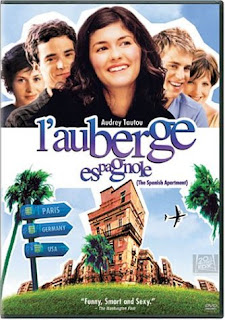
Movie Log: L'Auberge Espagnole

The Wife and I know so little of any other languages that our initial attempts to translate L'Auberge Espagnole came out to "something about an eggplant." Needless to say, that was wrong -- the title actually translates as The Spanish Apartment.

It's another one of those "bunch of young people finding their way in the world" stories, beloved by other young people since time immemorial. The story follows a young Frenchman, Xavier, who is going to Barcelona for a semester-abroad sort of deal, and he ends up taking a room in an apartment with several other students, each carefully from a different country: English Wendy, German Lars, Belgian Isabelle, Spanish Soledad, and Tobias, whose nationality I didn't catch.

And then not a lot of plot happens: they're all young, they're all living in the same apartment, so they talk and eat and drink and run around the city. Xavier has a girlfriend back home, Martine, but he also lusts after his female roommates and carries on an affair with a married woman. (After getting how-to-seduce-a-woman lessons from the experienced and lesbian Isabelle.) There are romantic subplots among the supporting cast as well, and some comic relief from Wendy's loutish younger brother, who comes for an extended visit.

It looks like an ensemble cast, but Xavier is in nearly every shot and probably every scene -- this is clearly his story, and the point of the Spanish Apartment is that it inspires him, once he graduates to what looks like a great fonctionnaire position in one of those huge French government bureaucracies, to chuck it all and try to become a novelist (living either on the good graces of his mother or the French state; the movie is smart enough not to specify).

And who doesn't love a movie about being young and free and unencumbered, attractive and living with a bunch of other attractive people, some of whom you might even get a chance to sleep with? I found L'Auberge Espagnole to be charming, if a bit obvious, and I probably would have liked it better if I'd been able to have the volume turned up higher. (We had it turned down, assuming that it was a foreign-language movie, because our sons were going to sleep. But it's a multiple-language movie, and in English more often than not, which meant the subtitles kept cutting out in the middle of complicated dialogue -- and this movie is all about dialogue.) So, if you're going to see it, make sure you're ready to both read and listen to get the full effect.

By the way, the current box cover overstates Audrey Tatou's role -- she's the girlfriend back in Paris. She's in and out of the movie -- it is an important part -- but more out than it, by screen time. The guy peeking over her right shoulder on the cover is our hero Xavier, the woman behind him is Isabelle, and the two on her other side are Lars and Wendy.

Tuesday, February 17, 2009

Eisner Hall of Fame Voting Open

I've mentioned, once or twice, that I'm one of the judges for the Will Eisner Comic Industry Awards this year -- if not; well, I am. I'm finding it less taxing, so far, than being a World Fantasy judge was; the books all have pictures as well as words, and the stacks haven't gotten as high yet. (Though I'm told that there's a whole hotel ballroom of books waiting for us on our judging weekend at the end of March -- and anything we haven't read before then, we'll need to get through quickly then.)

Our first task is now done; we've selected two Judges' Picks for the Hall of Fame -- Harold Gray and Graham Ingles -- and decided on the list from which Eisner voters will choose the other Hall of Fame winners this year.

The whole details are here -- and, if you're a professional working in the comics industry (either as a creator, publisher, editor, or retailer), you're eligible to vote. And, as always, I urge those eligible to vote for awards to actually do so.

Bipartisanship in Our Time

According to editorial cartoonist Mike Lester, liking our new president (or, perhaps, simple optimism) is the equivalent to mass-murder and religious fanaticism.

Um, not to be all "reality-based" or anything here, but which major American political party is more associated with religious fanatics, again?


Mike Lester
Rome News Tribune
Feb 17, 2009

Movie Log: Hellboy II: The Golden Army

I've been a fan of Mike Mignola's Hellboy comics for more than a decade now -- though I missed the first movie, mostly because I was avoiding comic-book movies on principle for a while -- but I knew that Hellboy 2: The Golden Army was hooey even before the opening credits started. (Exceptionally entertaining, all-out-fun hooey, yes. Hooey with inventive and imaginative creatures and real strangeness to it, true. But hooey none the less.)

There's a voiceover at the beginning, explaining some events, long millennia or eons ago, when humans and elves battled and eventually came to a truce -- after which elves would get the woods and rural lands, while humans would stay in the "cities."

Hear that? It's the sound of me, and every other viewer with the slightest historical knowledge, spitting out our 96-ounce Cokes in unison. Right now, at this very second, only barely more than half of the world's human population lives in cities. In the cod-medieval world of Hellboy II's prologue, well more than 90% of the humans would have lived on farms -- in exactly the places this "pact" supposedly ceded to the elves.

So, unfortunately, I had a bad taste of bullshit in my mouth even before Hellboy II began. Yes, the opening animation under that voiceover was lovely and evocative, and, for a summer movie's backstory, the "humans will stay in cities" idea is only mildly stupid, but, still.

Anyway, the movie goes on from there, with a hotheaded young elf-lord deciding that humans are breaking the pact by living ever more compactly and tightly in cities. (Well, that's not what he says, because the script is resolutely stupid and politically correct on that point -- he's violently annoyed about pollution and global warming and loss of biodiversity, like an unholy cross between Al Gore and Elric.) So he decides it's time to kill all the humans, and tries to find the three pieces of the control mechanism for the elfin doomsday weapon of the title.

Hellboy and his fellow members of the Bureau for Paranormal Research and Defense are called in after the first uncanny event, and a number of fight scenes ensue. They're all quite good fight scenes, obviously done practically as much as possible, since the figures have real mass and weight as they stalk around each other. There's also an excellent visit to a fairy marketplace in search of clues, with an amazing array of grotesqueries. And, in the end, Hellboy and not-Elric battle for the fate of the world, deep beneath an Irish hillside, and I'm sure you know who wins.

It saddens me to think of the Hellboy movie that Guillermo del Toro could have made if it didn't have to be a summer tentpole: he has an eye for freakish creatures (and a sympathy for them) that's a perfect match for Mignola's sensibilities. This could have been a much smarter movie, and equally stylish. I suspect that Hellboy II was "too weird" for a big swath of the summer-movie audience, but, really, it's not quite weird enough. Even the relationships among the characters have been simplified and turned into cliches -- Hellboy and Abe Sapien (the fish-guy) both get girlfriends in this version, for Christ's sake.

I hear this one was better than the first movie, so I'm not sure if I should go back or just ignore its existence entirely. Hellboy II is an entertaining dark fantasy movie, but the director of Pan's Labyrinth could have made it so much better than he did.

Monday, February 16, 2009

Movie Log: Wanted

Wanted is the silliest movie I have ever seen; it's perilously close to being the silliest movie I can imagine.

It's about a secret society of assassins who take their orders from a magic loom, which transmits the will of Fate, in the form of binary-encoded names of their targets. And this binary code has been in use, we're led to believe, for a thousand years.

I'm already laughing out loud, and I haven't even gotten to the making-bullets-go-around-corners-by-swinging-the-gun-and-pulling-O-faces part. Or the "you killed my father!" "I am your father!" dialogue, which would have been side-splitting if it had just happened one or two more times.

We just saw it tonight, because it looked like a stylish action movie, and The Wife likes James MacAvoy even more than I like Angelina Jolie. (I'm not all that fond of her, to be honest, but she's cute and can usually act.) Well, it does have style -- I have to give it that -- but there's not a single thought in its pretty little head.

Timur Bekmambetov, congratulations! You made one of the funniest movies of 2008. (And didn't I remember hearing that the movie actually toned down the craziness of the comic it was based on?) This is not a movie to be seen by anyone who treasures the virtues of coherence, sweet reason, or basic plausibility. The Wife did appreciate a couple tight close-ups of MacAvoy's eyes, though, so at least it has that going for it.

A Lovely Time to Buy a Kindle

If you haven't been completely unplugged from the news for the past week or so, you might have noticed that Amazon has introduced a second edition of their text-reading device, under the snazzy title of Kindle 2.

It'll start shipping by the end of the month, it's a mere $359, and over 230,000 ebooks are available for it right now. (Including such highlights of my own list as Accounting Best Practices, Essentials of Enterprise Compliance, and Internal Audit: Efficiency Through Automation.)

I'm not going to say that you need one of these things -- I don't own one myself, and don't plan to buy one any time soon. (My unread piles are too high for that.) But a lot of people like the darn thing, so you might too. If you think you might, click on the below banner...

Reviewing the Mail: Week of 2/14

It's another week, so here's another pile of books that recently arrived in La Casa Hornswoggler. I do review books, but I can never manage to review everything I see -- so I do these lists to have an excuse to mention and at least quickly talk about all of them when they come in.

It's a big pile this week, so let's dive right in:

Angels' Blood by Nalini Singh is the first in the "Guild Hunter" series, about vampire hunter Elena Deveraux, hired by the archangel Raphael to track down (and presumably dispose of) an archangel gone bad. Singh is also the author of the 5-book "Psy-Changeling" series, published, as Angels' Blood is, by Berkley Sensation. What intrigues me is that the description of this book is solidly in the fantasy camp -- no love interest is even mentioned, and the focus is on the difficulty of the job and Elena's obstacles -- but Sensation is generally a romance imprint. The cover is also balanced between the two: the heroine is shown nearly full-figure and has a weapon, but she doesn't look particularly tough -- though she's also alone and not posed to be sexy. Angels' Blood is a mass-market paperback, and will be in stores March 3rd.

Also on March 3rd, and from Berkley Sensation's older sister, Ace, comes Death's Daughter by Amber Benson, whom I gather is an actress of some kind. (I don't hold it against her; there's no reason an actress can't settle down into a respectable job, like writing urban fantasy or making artisanal cheese.) This is Benson's first solo novel, though she's written the screenplays for two films and several previous novels with Christopher Golden. The title is absolutely straight -- our heroine is the daughter of the anthropomorphic personification of Death, and she's trying to live a normal life when suddenly she gets dragged into the family business. (Some readers may detect similarities with Terry Pratchett's character of Susan, but remember that she's only death's grand-daughter, and by adoption at that.) Continuing my fascination with covers, I like that this one has a model who isn't in a stereotyped "sexy" pose, doesn't have any visible tattoos, and could possibly be older than eighteen.

Ace is also publishing -- still in mass-market, still on March 3rd -- Anton Strout's second novel, Deader Still. It's a sequel to his first, Dead to Me, which introduced Simon Canderous, a government functionary for a secret organization that investigates the supernatural in modern Manhattan. This time, it sounds like the problem du jour is vampires -- though, since they just killed a boat-load of lawyers, it sounds like they're performing a valuable public service, and should be commended rather than tracked down.

Also loosely connected to Penguin, though independent, is DAW Books, which sent me an anthology called Ages of Wonder. (They'll publish it on -- yes, you guessed it! -- March 3rd, as a mass-market paperback.) It's edited by Julie E. Czerneda and Rob St. Martin, and it has nineteen original fantasy stories set in worlds that are analogous -- though not alternate versions of -- to ages in our own world. A quick look at the authors' biographies shows a lot of new writers here -- that plus the loose theme could make this a good book for discovering new talent...assuming these are good stories, which I couldn't tell you at this point.

March 3rd will be a busy day for the SFF section; also coming along on that day is Rob Thurman's Deathwish, which I think is the fourth in a series about supernatural detectives Cal and Niko Leandros. Cal's only half-human, and his other family -- something called Auphe, whatever they are -- are turning up again. And, as usual, estranged family means trouble. Deathwish is from Roc, yet another sibling to Berkley Sensation and Ace in the big Penguin family.

I only saw one manga collection this week: Shizuru Hayashiya's Hayate X Blade, Vol. 2, published by Tor/Seven Seas on February 3rd. I reviewed the first book for ComicMix back in November, and this looks to be more of the same: mildly homoerotic schoolgirls doing a lot of swordfighting.

The Alchemist's Pursuit is the third in a series -- the alchemist has previously had an Apprentice and a Code -- by the indefatigable Dave Duncan. It's set in an alternate medieval Venice, and features Nostradamus in a somewhat (Nero) Wolfean role, with the cover hunk, his apprentice Alfeo, as his Archie. Ace is publishing this in March in trade paperback.

Patient Zero, the new novel by Jonathan Maberry, is subtitled "A Joe Ledger Novel." A quick google leads me to believe that it's not only a Joe Ledger novel, at the moment it's the Joe Ledger novel. (There's a tendency in the mystery field to position even a first book as if it's a long-established, well-known series -- and it must work, if its still going on today. Comparing that to, say, epic fantasy or to the superhero comic is left as an exercise for the reader.) Patient Zero isn't a pure mystery, though Ledger is a Baltimore police detective -- it's aimed more down the line between horror and thriller. You see, the usual fiendish terrorist organization has gotten hold of a new bioweapon, one that turns people into zombies. (Yes, more zombies. Some people are surprised by the resurgence of vampires in popular fiction over the last decade, but I'm astonished by how popular zombies have become.) Patient Zero is a March trade paperback from St. Martin's Press.

Chris Marie Green's "Vampire Babylon" series continues beyond the initially-promised trilogy with a fourth book, A Drop of Red, which sees series heroine (and stuntwoman turned vampire hunter -- who says retraining programs don't work?) Dawn Madison toting something hard to identify but definitely dangerous-looking on the cover. In this book...well, she's a vampire hunter, right? So she goes out and hunts some vampires. C'mon -- you don't need me to explain that, do you? This is an Ace trade paperback in March.

Da Capo Press is publishing a book on the odd and unlikely Antikythera Mechanism -- something very much like an analog computer from classical antiquity, discovered by Greek sponge divers in 1900 in March in hardcover: Decoding the Heavens by London science writer Jo Marchant. It appears to be the first book-length study of the AM, and it also appears that there's been quite a bit of new research on the AM in recent years -- those two facts together imply (or at least give me hope) that this will be a major, important book on a fascinating scientific subject.

Chris Roberson has been publishing books quicker than I've been able to keep track of them, let alone read -- the card page of End of the Century lists eleven previous novels (not even counting two "Shark Boy & Lava Girl" books), nearly all of which have come out since 2005. End of the Century is a Pyr trade paperback, coming to stores tomorrow. And it's a fantasy novel with major characters in three distinct time periods: a young modern London woman in a strange city, a Victorian consulting detective, and the night Galaad. I feel bad about getting so far behind Chris's stuff, so I'll see if I can fit this one in somewhere.

The newish dark fantasy publisher Underland Press sent me one of their upcoming books: Chaos, a thriller from a Dutch couple who write as Escober, about a British soldier who returns from combat duty in Bosnia to a life that falls aprt around him. And then, apparently, things get really bad.

A Magic of Nightfall is the second book of the "Nessantico Cycle" by S.L. Farrell -- Nessantico is a fantasy version of Rome or Byzantium (with secular and ecclesiastical authorities, not always working together) and Farrell is a pen name for Stephen Leigh. It's very big -- six hundred pages in hardcover -- and DAW will publish it on March 3rd.

Allen Steele's fourth novel about the human colony world Coyote is Coyote Horizon, and -- according to the copyright page, at least -- only one of its eight sections was originally a separate short story, which makes it somewhat different from the initial trilogy. Ace will publish Coyote Horizon on March 3rd.

The first novel that's gotten more attention this year (so far -- we're not far into the year, I admit) is Lamentation from Ken Scholes, and now I'm looking at a copy of it myself. It's an epic fantasy, first in a five-book series, and has a map with placenames like "Desolation of Windwir" and "to the Churning Wastes." And yet it's had a lot of glowing pre-publication reviews and quotes. Frankly, I don't know what to make of it; I've become pretty allergic to Yet Another Big Secondary World Fantasy over the past year or so, and I don't think I've started any new series or writer in that space in that time. Lamentation will be published by Tor in hardcover tomorrow; I may just have to wait and see what other people say about this one.

Nancy Kress's new novel is Steal Across the Sky, coming from Tor as a hardcover tomorrow, under one of the most bleak John Jude Palenecar paintings I've ever seen. (And, if you know Palencar's work, that's saying something.) In the near future, an alien race calling itself the Atoners contacts mankind: they're terribly sorry for something they did to us ten thousand years ago, and will send teams of three humans to each of seven alien worlds, each to observe a human society and return to Earth to learn the truth of the Atoners' "Crime." Steal Across the Sky follows one of those teams. It's also a "Sci-Fi Essential Book," for those of you who trust the editorial judgement of the grey eminences of the Sci-Fi Channel.

As SFF writers get older -- assuming their careers continue more-or-less-smoothly -- they almost inevitably circle back to their older works, writing new sequels to old completed works or deciding that they can link everything they ever did into one massive superstructure (the better to re-sell it to publishers and a new generation of readers, presumably). And so, thirty-three years after their Inferno was originally published, Larry Niven and Jerry Pournelle have decided to follow it up -- not with the expected Purgatorio (they didn't manage to get their hero out of Hell in the first place), but with the more pulpily-titled Escape from Hell, which Tor is releasing into the world this month. The first was one part Dante pastiche and one part satire on SF writers of the day; it remains to be seen what the now much older authors (who may be thinking about their own mortality in a way they weren't in the mid-'70s) will make of the continued story this time around.

And last is a book that gives me a chance to teach you all another odd publishing term: blad. A blad is a preliminary marketing tool, usually for a heavily illustrated book -- it's a full-color pamphlet with some spreads, and sometimes full chapters or sections, from a forthcoming book. Sometimes the book's cover is printed on the blad; sometimes the blad sits inside of an early sample cover. And what I have in front of me right now is a blad for The Photographer, a book about Afghanistan, created by cartoonist Emmanuel Guibert, photojournalist Didier Lefevre, and graphic designer Frederic Lemercier. The Photographer combines Lefevre's actual photographs with panels from Guibert putting them into context, and telling Lefevre's story -- he first traveled to Afganistan in 1986, with the nonprofit organization Doctors Without Borders -- and it will be published by First Second on May 1st.

Sunday, February 15, 2009

Outliers by Malcolm Gladwell

I read Outliers several weeks ago, and didn't manage to write about it immediately afterward. It went back to the library -- Gladwell has enough money by now; he didn't need my few bucks, and my shelves are happier this way -- and now I only have a few random notes to jog my memory. So forgive the inevitably scattered and confused nature of what follows. (That is, if it's different in any identifiable way from my usual run of posts about books.)

It's fashionable, these days, to pick on Gladwell as a debaser, a writer who takes bland platitudes and feeds them back to readers. He is a popularizer; he writes books for mass audiences on big topics, and tends to simplify things by the nature of his audience and style. But he's pretty good at it -- there are plenty of other, similar writers who are much worse thinkers, researchers, and writers who don't get attacked the way Gladwell does, mostly because their work is muddier and not as popular. (The nail that sticks up gets hammered down, as always.)

I didn't find Outliers to be a codification of accepted wisdom; actually, it's close to the opposite. Gladwell writes in the New Yorker self-effacing tradition (a little less than the standard, especially towards the end of this book), so he lets his reportage speak for itself most of the time. But Outliers is specifically and directly attacking that central American platitude, the idea that everyone is equal; Outliers shows that neither ability nor opportunity is ever equal, and examines what arises from those inequalities. Gladwell does hope that opportunities, at least, can be made more equal, but he's the least convincing there -- it's a hope rather than a plan.

So Outliers traces the differences between people by looking at the extremes -- extremes of intelligence, as in a couple of chapters about geniuses, and extremes of success, as when Gladwell investigates why Bill Gates was able to build Microsoft into a global power. He finds that there are a lot of geniuses -- people with massive native intelligence -- who never succeeded in life, or did much of anything. And he also finds that the successes tend to have one or more of a short list of advantages: they were born in particular year-ranges; they had the opportunity to spend a lot of time and energy, while still very young, in fields that greatly interested them and that were about to get much larger; they were willing to work very hard, and particularly came from cultures and family businesses/jobs that rewarded exceptionally hard work. They were successful because they were in the right place at the right time, and had prepared for that opportunity -- though often, they weren't deliberately "preparing for an opportunity" at all.

Along the way, he does ease around the unfashionable idea that some cultures are "better" -- at particular things, at least -- than others. One of his strongest object lessons is that a culture with strongly hierarchical tendencies will tend to have more airplane crashes than a more egalitarian culture. But, of course, there are other things that work less well in an egalitarian society; Gladwell is analyzing the needs of particular jobs rather than declaring what is "best" in all cases.

Outliers is a work of popular nonfiction for the masses, but it's also thoughtful and packed with specifics; it's not a book of platitudes by any means.

Saturday, February 14, 2009

Movie Log: Coraline

There's a special Tuesday-night deal around where I live, and the whole Hornswoggler family took advantage of it to see Coraline, which I'd secretly been desperate to see, and which my older son asked about over the weekend. This is now only the second movie the boys have seen in a theater at night-time.

(This was the night before I flew out to AUTM, which made it a hectic day -- lots of meetings and getting-stuff-done at work, then coming home and running out to the movie, then packing. And that's my excuse for waiting four days to write about it.)

I'm not sure why, but Coraline didn't involve me as I hoped it would. Perhaps I was too impressed with the 3D effects and the amazing look of the figures and backgrounds; perhaps I was trying to remember the book and wondering if my sons would find it too scary. But I spent most of the film watching it in what I think of as "editor mode" -- examining each of the bits dispassionately, walking around all sides and kicking the tires. That hardly ever happens with movies in theaters; I get emotionally invested even in trite bits of fluff like Hotel for Dogs. But I didn't with Coraline; I was just watching it, and thinking about it, for most of the length of the movie.

It did make me want to re-read the novel, which I might do soon. And, in its 3D form, it's an absolutely stunning, gorgeous movie. (If you have even the slightest interest in it, go within the next week and see it in 3D. The new process is almost completely inobtrusive, and Coraline makes great use of it.)

I enjoyed Coraline, but it didn't grab me the way I wanted it to. And I'm still not sure why. It's a fine movie, and an amazing achievement. This is quite likely my problem, not the movie's.

(If you want to know the story of the movie, Gary Westfahl has a decent but overly demanding review for Locus, and Roger Ebert has an interesting ambivalent take on the movie as well.)

Friday, February 13, 2009

Another Oversharing Meme from the Wilds of LiveJournal

And, as always, I'm compelled to see how weird these things get. I picked it up from Barbarienne.

Rules: Only answer YES or NO; no explanations or special pleading. One is also supposed to "tag" others, but I never do. If your answer is "it depends on what your definition of is is," pick one -- I did.

Kissed anyone one of your LJ/Facebook friends? NO
Been arrested? YES
Kissed someone you didn't like? NO
Slept in until 5 PM? NO
Fallen asleep at work/school? NO
Held a snake? NO
Ran a red light? YES
Been suspended from school? YES
Totaled your car/motorbike in an accident? NO
Been fired from a job? YES
Sang karaoke? YES
Done something you told yourself you wouldn't? NO
Laughed until something you were drinking came out your nose? YES
Caught a snowflake on your tongue? NO
Kissed in the rain? NO
Sang in the shower? YES
Sat on a rooftop? YES
Been pushed into a pool with all your clothes? NO
Broken a bone? NO
Shaved your head? NO
Blacked out from drinking? NO
Played a prank on someone? NO
Felt like killing someone? YES
Made your girlfriend/boyfriend cry? NO
Had Mexican jumping beans for pets? NO
Been in a band? NO
Shot a gun? NO
Donated Blood? NO
Eaten alligator meat? NO
Eaten cheesecake? YES
Still love someone you shouldn't? NO
Think about the future? YES
Believe in love? NO
Sleep on a certain side of the bed? YES
Talk in your sleep? YES
Laughed until you peed your pants? NO
Passed gas on an elevator with others? NO
Spend too much time on LJ/Facebook? NO
Play a musical instrument? NO
Lived outside of the country? NO
Been skinny dipping? NO
Gone sky diving? NO
Dated someone longer than you should have? NO

Things you have done during your lifetime:
( ) Gone on a blind date
( ) Skipped school
( ) Watched someone die
(X) Been to Canada
( ) Been to Mexico
(X) Been to Florida
( ) Been to Hawaii
(X) Been on a plane
( ) Been on a helicopter
(X) Been lost
(X) Gone to Washington, DC
(X) Swam in the ocean
( ) Cried yourself to sleep
(X) Played cops and robbers
( ) Recently colored with crayons
( ) Paid for a meal with coins only
( ) Been to the top of the St. Louis Arch
( ) Done something you told yourself you wouldn't.
( ) Made prank phone calls
(X) Been down Bourbon Street in New Orleans
(X) Written a letter to Santa Claus
(X) Been kissed under the mistletoe
(X) Watched the sunrise with someone
(X) Blown bubbles
(X) Gone ice-skating
(X) Gone to the movies
( ) Been deep sea fishing
( ) Driven across the United States
( ) Been in a hot air balloon
( ) Been sky diving
( ) Gone snowmobiling
( ) Lived in more than one country
( ) Lay down outside at night and admired the stars while listening to the crickets (howler monkeys etc...)
( ) Seen a falling star and made a wish
( ) Enjoyed the beauty of Old Faithful Geyser
(X) Seen the Statue of Liberty
( ) Gone to the top of Seattle Space Needle
( ) Been on a cruise
(X) Traveled by train
( ) Traveled by motorcycle
( ) Been horse back riding
( ) Ridden on a San Francisco CABLE CAR
(X) Been to Disneyland
(X) Been to Disney World
( ) Truly believe in the power of prayer (spells, chants, hope. . what ever you want to call it )
( ) Been in a rain forest
( ) Seen whales in the ocean
( ) Been to Niagara Falls
( ) Ridden on an elephant
( ) Swam with dolphins
( ) Been to the Olympics
( ) Walked on the Great Wall of China
( ) Saw and heard a glacier calf
( ) Been spinnaker flying
( ) Been water-skiing
(X) Been snow-skiing
(X) Been to Westminster Abbey
( ) Been to the Louvre
( ) Swam in the Mediterranean
(X) Been to a Major League Baseball game
(X) Been to a National Football League game

Speaking of Valentine's Day...

Amazon can also sell you gift cards, if you desperately need to get a gift for someone and the old standbys (flowers, chocolate, adult "novelties," unfeasible underwear) are unavailable or inappropriate. Sure, you'll look like a dork -- particularly if you hand your inamorata [1] a print-out that's still warm from the toner -- but you might manage to avoid being stuck by heavy household objects and/or costly divorce proceedings.

If that scenario describes you -- you poor sad shadow of a human being, you -- click on the below banner to salvage what you can from the twisted wreckage of what you used to call a life.


[1] What's the masculine equivalent of inamorata, anyway? Inamoratus?

Amazon and Marvin Gaye Team Up To Help You Get Laid This Valentine's Day

Here's how it works:

Amazon is offering the quintessential make-out song, "Let's Get It On" by Marvin Gaye, for free today and tomorrow. If you can't get laid with that song, on Valentine's Day -- which is a Saturday this year, giving you even more macking time than usual -- then I'm afraid there's no hope for you.

Here's the banner -- go forth and get it on.

This Is the AUTM of My Discontent

Because it's never winter in Florida in the first place, right?

I'm sure AUTM is a great conference for those people who actually are University Technology Managers, but it hasn't been great for this particular bookish Marketing Manager, who's been trying to get them to buy his wares.

On the positive side, I am in Orlando, and the weather is nice. I did manage to sneak off to a theme park once. But it's taken three days out of my working life to spend (not terribly long, which is its own problem) hours in a booth deep inside a convention center, and I've been left to hope that all of the people who took our booklist will go back to their respective universities and firms, get permission to buy some books, and all hit the Wiley website next week. It's not a very strong hope, in this economy.

Otherwise, it's been a trip full of petty annoyances, from coming back to my room yesterday evening to find my desk chair missing (it had been rickety before, but rickety is better than absent) to finally calling the hotel to get my leaky tub spigot fixed this evening. (And don't get me started on how you need a taxi to get anywhere in Orlando. The next time I'm here, for anything, I'm renting a car.)

The exhibit hall for AUTM was open a very short time -- 9-12 and 1-5 yesterday; 9:30-12 and 2-5 today -- which my lazy side enjoyed, but may have contributed to the dearth of sales. Or maybe longer hours and an opening reception on Wednesday night -- which a lot of similar conventions/conferences/annual meetings have in the exhibit halls on the opening day, because it works -- would have helped out. In any case, I was in the hall long enough to feel tired but short enough to feel lazy, which is a rotten combination.

So: I'm sure this is a perfectly lovely and useful annual meeting for the folks having it, but it's been more of an excuse to be stuck in central Florida for this New Jersey boy. And I wish I was flying out tonight, like my colleague did. Oh well, at least it's a three-day weekend on the other side of that flight.

Quote of the Week

"We arrived at the arena late. By chance, we had guests that weekend, and some of them were reluctant to rush through dinner, even though I kept telling them that, for all we knew about taureaux piscine, the best part might be right at the beginning. The arena looked liked the bullfight arena of a Spanish provincial town except, of course, that in the middle of the ring there was a swimming pool -- a rather small swimming pool, with only a couple of feet of water in it, but still a swimming pool. From the stands it looked like on of those plastic swimming pools that people in the suburbs buy at the discount store and stick out in the back yard for the smaller kids to splash around in. There were a few dozen teenage boys in the ring. There was also a bull -- a small bull, with blunts on the points of his horns, but still a bull. In other words, the bull in taureaux piscine was a bull, and the swimming pool was a swimming pool. Upon my oath.

Within a few minutes it was clear that taureaux piscine has an extraordinary aspect that I had not anticipated during the week I'd spent simply amazed at its existence and enamored of its name. It is the only sport I have ever encountered that has only one rule: If you and the bull are in the pool at the same time, you win. If you do it again, you win again: a limitation of the rule would require a second rule."
- Calvin Trillin, Travels With Alice, pp.44-45

Thursday, February 12, 2009

These Are Our Labor Days

Yesterday, at about the time I was arriving in glamorous downtown Orlando, ComicMix posted my review of the Oni graphic novel Labor Days, Vol. 1 by Philip Gelatt and Rick Lacy.

I had hoped to have another review tomorrow -- I even have a couple of things half-written back at home -- but it's not to be. Maybe Saturday, maybe Monday, maybe some other time.

Saturday Is Bond Day, #1: Dr. No

My two sons -- whom I'm still calling Thing 1 and Thing 2 -- have been watching Mythbusters a lot, partially because they enjoy some science-y stuff, but mostly for the explosions. And Mythbusters had a James Bond special recently, which they've now watched several times...which led them, particularly the ten-year-old Thing 1, to decide that they wanted to see the Bond movies. We finally decided -- since Thing 1 and I are both that kind of person -- to begin at the beginning.

So this last Saturday (February 7th), we watched Dr. No. We're going to miss this next week, since I'll be flying back from the AUTM conference on Saturday morning, but the plan is to watch the Bond movies, in order, every week until we get tired (or they hit PG-13 and I call a halt to it).

I haven't seen these movies since I was a kid -- not much older than my boys, if at all -- so it's also something of an exercise in nostalgia. (And will be a good starting point if I do decide to read all of the Fleming books straight through this summer.)

And the first thing that surprised me about Dr. No was the abbreviation -- for some reason, it's filed in my head as Doctor No. A very tiny point, I'm sure, but it made it hard to look up the movie on Netflix at first.

Otherwise, it was pretty much the way I'd remembered the early Bond movies -- Connery's Bond is tough but not sadistic, the women have quirks and characteristics but don't quite become characters in their own right, and the plot was exactly what we all think of as the "Bond movie plot": Bond foils an evil genius with a plan to get rich and powerful by nefarious means.

I had forgotten that it all took place in the Caribbean, and how many black characters were in it. (The minor villains tend to come off the best; they can be tough and competent, while Bond's boat-driver gets to be superstitious and borderline cowardly.) And I'd forgotten how long it took for Ursula Andress to show up; this movie hits the half-way point, and she's still not jumped on. (I did remember the big difference between her first scene and the way that it plays out in the book, however -- that's a scene no teenage boy reading Dr. No will ever forget.)

It's not quite a Cold War artifact, as I was afraid, and my sons seemed perfectly happy to watch it. They liked the fighting -- didn't seem to notice, or care, the older fight-choreography style, all chops and throws, instead of the modern wire-fu -- and covered their eyes for the kissing scenes. And I was happy to watch it again; it may be nearly fifty years old, but it's a dependably entertaining adventure movie with some fine moments and the was-he-ever-so-young? Sean Connery at its core. This project is starting to look like a great idea.

Great Names in Our Time

After the New York Comic-Con ended, there was a flurry of news reports on the Internet about how it went, and all of them quoted the show's director...which reminded me of that old "truth is odder than fiction" thing.

See, that guy is named Lance Fensterman, which is a name you'd be hard-pressed to get away with in a story -- it sounds like the alter-ego of a Feiffer superhero parody of the early '60s. (Maybe of Super Copywriting Man! Who, from his cubbyhole at Young & Rubicam, wields a pen by day to sell the new line of Oldsmobiles, but, by night, he saves the city from the likes of Captain Commie and The Red Pencil.)

Maybe it's just because I have a name that's bland and common, but interesting names make me perk up every time. And Mr. Fensterman has one of the great quirky names of our time. So Antick Musings is declaring a salute to Lance Fensterman. If any of you know equally wonderful names -- the kind that sound like the come from a world more interesting than our own -- please add them in comments.

(Oh, and here's another one -- there used to be a TV reporter in New York named Kendra Farn, who I thought could have stepped right out of a Jack Vance novel.)

HarperCollins Axes Collins

The big publishing restructuring news this week is from HarperCollins, which is chopping off the latter half of its name -- the Collins non-fiction division -- integrating former Collins imprints into Harper's General Books Group, and layout off an unspecified number of employees. Named in the memo today as leaving the company are Steve Ross, president and publisher of Collins, and Lisa Gallagher, senior v-p and publisher of William Morrow, but it's clear that more cuts, and possibly very deep cuts, will follow.

This radical change follow closely on the heels of the dismal quarterly earnings of Harper's parent, News Corporation. It's clear that NewsCorp head Rupert Murdoch won't be throwing money at Harper the way he has at the New York Post.

[via Publishers Weekly]

Update:
More details came out a day later, and they're not pretty. Two imprints are gone entirely: the just about to launch children's boutique The Bowen Press and the Spanish-language Rayo. (Spanish-language publishing is getting hit pretty hard in this economy, with Rayo and Publishers Weekly's Criticas magazine both closing. I hope that this will mean a new flourishing of small Spanish-language presses, but I'm not that Republican.)

Harper is also bringing the children's publishing group, formerly in separate offices, together with the adult group. And that implies some serious layoffs, though Harper is not commenting on reports that 60 jobs have been lost, or that 5% of their workforce will be eventually cut.

[via another Publishers Weekly article]

Update 2: Locus reports that Eos has lost associate director of publicity Jack Womack and assistant editor Emily Krump in the restructuring. Best wishes to both of them, and all of their unnumbered laid-off colleagues, in a speedy job search.

Tuesday, February 10, 2009

Off For the AUTM

I'm flying out, early tomorrow morning, to Orlando for the star-spangled AUTM annual meeting, where I will be sitting at a booth in a convention hall once again.

If by some bizarre twist of fate you will also be at AUTM, drop by and say hello; I'll be the tall guy with a goatee. (If you see a red-headed woman, that's not me, but my colleague. You can still say hello, but I won't answer, and she may look at you funny.)

I expect to be doing some blogging while down there -- no, let's be honest, I hope, as I always do, that being away from my usual daily routine will suddenly free me to read many books and type madly, at a speed I could never reach at home...even though that never happens. We'll see what actually gets done.

Monday, February 09, 2009

ComicMix Friday & Monday

On Friday, I had a "Manga Friday" column for ComicMix -- the first in a couple of weeks, after a long run without a break -- reviewing three quirky 2008 standalone books: Hideo Azuma's Disappearance Diary, Travel by Yuichi Yokoyama, and Jiro Taniguchi's The Quest for the Missing Girl.

And today I reviewed a quickly published non-fiction comic, 08: A Graphic Diary of the Campaign Trail by Michael Crowley and Dan Goldman.

I'm knee-deep in another review for Wednesday, and have a small pile of other things I've already read, so I may even get up to three ComicMix reviews this week, for the first time in a while. (I'm always a slacker in January, for whatever reason -- I can see it in my old reading notebooks, where I'd go from reading 8-10 books for the SFBC most months down to 3-4 every January.)

He Said It, Not Me

Utterly out of context and from a look at the classic of literature Killinger! --

"Stupid shit like that is exactly why every novel on the front tables at Barnes & Noble has photos of shoes on the cover: American men have given up on books."
- Alan Scherstuhl for The Pitch: Kansas City

Reviewing the Mail: Week of 2/7

Every week, I list the books I received for review here -- perhaps to spark someone's interest, or perhaps not. But I know I'll never be able to read (let along review) all of these, and every book deserves at least a moment of notice. So here's what I saw last week:

The Better to Hold You, a contemporary fantasy that's the first novel credited to "Alisa Sheckley." Sheckley -- the daughter of Robert Sheckley, which gives her a fine literary pedigree -- also writes as Alisa Kwitney (and was a very successful editor at DC/Vertigo for most of the '90s under that name), but the Kwitney books are romances, or chick lit, or something in that vague area. And, since publishers are always worried about audiences being confused, it looks like someone asked "Can we put out this werewolf book under a slightly different name?" Now, I don't know that this is a werewolf novel -- I'll admit. It's clearly "urban fantasy," though, which generally means either vampires or werewolves. And, though the back cover says that the heroine's husband has just come back from Romania with a notable change in demeanor -- and "Romania" is often a big nudge for "vampire" in books like this -- on the front cover, the heroine also has a wolf on her pendant, another wolf right behind her, and a big ol' full moon over her shoulder. And we all know that moons on urban fantasy covers mean werewolves, right? The Better to Hold You will be published on February 24th as a mass-market paperback by Del Rey.

Kari Sperring's first novel is Living With Ghosts, another one of those supposedly rare and despised secondary-world fantasy novels with an identifiable human being on the cover. I suppose all the Abercrombie fans avoid female writers to begin with, so it doesn't have any additional girl-cooties from their point of view. It's set in a fantasy version of France, is nearly five hundred pages long, and has a fine first line. ("Even the lieutenant's ghost looked startled as the door slammed shut.") This one comes from DAW Books -- which probably, as far as J. Young Abercrombie-fan is concerned, is infested with girl-cooties -- and will be available in mass-market paperback on March 3rd.

(Has anyone else noticed that Internet buzz, at least in the SFF world, is entirely about books by boys? I wonder why that is?)

Also from DAW in March is the mass-market reprint of Michelle West's The Hidden City, the first book of her new series "The House Wars." West is one of those writers, like Sheckley/Kwitney above (or, slightly more off-point, the artist Victoria Poyser-Lisi), whose last names you need to keep an eye on -- she's also written as Michelle Sagara and Michelle Sagara West.

And DAW's third mass-market for March is Prophets, a SF novel by S. Andrew Swann -- who, just to keep the theme going, is actually named Steven Swiniarski. Prophets is the first book of a series called "Apotheosis," and is set in the old-fashioned default intermediate future, with humanity having spread to the stars. As this story opens, it's two hundred years since the last government of all humanity, the Confederacy, fell, and transmissions have just been received from parts unknown, which sets off the usual scramble to find their source and exploit it. I note that one faction here, which may be the bad guys, is the Eridani Caliphate; I haven't looked at the book closely enough to be sure if axes are grinding or not.

And my last book this time out is a hardcover from Roc, Anne Bishop's The Shadow Queen. It's the latest book in her "Black Jewels" series, which I have the vague -- and possibly completely misinformed -- sense is basically Darkover with added S&M. And I'm sure saying so will get someone how knows better to explain what these books really are like, via the universal law that the best way to learn the truth is to claim something unlikely on the Internet. Roc will publish The Shadow Queen on March 3rd.

Sunday, February 08, 2009

Travels With Alice by Calvin Trillin

I re-read Travels With Alice because Deciding the Next Decider was so disappointing, and I wanted to remind myself of what Trillin could do when he was in better form. This was the first Calvin Trillin book I ever read -- it was on a freebie pile very early in my days at the book clubs, some time in mid-1991 on the cold, dark, mostly-empty forty-second floor of the Bear Sterns building. And I haven't gone back to it since then, though I have read nearly everything else of Trillin's in the years between.

Trillin is generally pegged as a curmudgeon, and it might say something about me that I find him mostly friendly and even-tempered. He's exceptionally observant, and can find the odd detail in any situation -- and then, usually, focus obsessively on that detail while ignoring everything else.

Travels With Alice is a collection of loosely-linked essays about various vacations Trillin took with his family, mostly, from internal evidence, in the late '80s. His two daughters are mostly in their teens in these stories, though -- reading this book again, as the father of two children of my own -- I notice how private he keeps their lives, and the life of his wife, Alice. It's not simply that Trillin himself is at the center of his stories, and the butt of his own jokes, but that he presents the rest of his family in their public personages: a little caricatured, with some quirks and foibles, but nothing to overly embarrass even a touchy teenage girl.

Trillin loves food -- this is even more clear in his books all about food like, Feeding a Yen and Alice, Let's Eat, but it comes through here as well -- odd sports, and just the idiosyncrasies of a place. He's the kind of traveler who settles into a minor French town for a summer and spends the time not going to museums, historical sites, or great cathedrals, but just living there. It's the kind of life many of us aspire to, and Trillin makes is deeply appealing.

Travels With Alice is a short book, but a lovely one -- Trillin may be a curmudgeon (and I still mildly dispute that), but he's also a wonderful writer and a man with a great eye for the unique and out-of-the way.

Movie Log: Hotel for Dogs

I saw Hotel for Dogs entirely for reasons unconnected with my own interest in the movie -- my two sons had MLK Day off, and we hadn't seen a movie in the theater for a while. And this was the one they picked; they wanted dogs more than Adam Sandler or mall cops. (And I can't blame them.) So I didn't really see this of my own volition, and I probably wouldn't have -- but it's decent enough at what it tries to do, so it's a hard movie to dislike.

You see, Andi and Bruce were left orphans about three years earlier, due to some left-vague event that killed both of their loving parents. (This is a movie that never even whispers the word "orphan," though.) They've demanded to be kept together in foster care, even though they're on the old side of fosterability, at about 15 and 12. They have secretly kept their old dog, Friday, a secret from their current, comically horrible, foster parents, the would-be rockers Lois & Carl Scudder. And then, through a series of seemingly-plausible but deeply Hollywood events, they end up housing several dozen dogs in a decrepit hotel down the street from their apartment in whatever city this is supposed to be. They find friends -- and a very mild love interest for Andi -- along the way, but of course things all go terribly wrong, leading to chases, hairsbreadth escapes, and a big "dogs are special" speech to the media.

It's a movie with an obvious message -- dogs and kids both need love and happy homes -- that it delivers in obvious ways, though it does softpedal the "dogs will be killed in the shelter" point for the benefit of the young audience. (All of the adults in the audience will know that's what's going to happen, but a lot of kids won't realize it.)

The best part of Hotel for Dogs are the Rube Goldberg (Heath Robinson, for those of you on the other side of the pond) devices that the younger of our two protagonists cobbles together to care for the canines while the human cast is away -- they're funny and inventive, and much more care was lavished on them than on the script. But I think I've already said that this is a Hollywood movie for kids, so now I'm just repeating myself. Hotel for Dogs is the perfect movie for a dog-loving tween girl, and quite good for animal fans of any age, as long as that age is under sixteen. For the rest of us, there's nothing obviously wrong with it, and the mostly young cast emotes more-or-less naturalistically.

Speaking of Amazon...

They also asked me to mention a batch of sales that they're running in their Grocery and Health & Personal Care stores -- now, personally, I buy my groceries at a store where I can see them, and have similar issues about health-care products. But if you like to buy mangos by mail, feel free.

Amazon Finds More Things to Sell

Amazon would like me to point out to you that it is now selling game downloads -- the usual array of casual games, though it looks like they're all Windows-only. I would not now take a bet that there's any specific item -- from Mack trucks to tulip bulbs -- that Amazon will not sell you. They also gave me this here banner to play up their games:

If time weighs heavy on your hands, and there's not enough free time-wasters (gaming or otherwise) on the Internet, here's one more option.

Saturday, February 07, 2009

Seen: the Perfect Right-Wing Thriller!

Football

+

scary Muslims

=

Blown Coverage!

(At the library today. There was another right-wing Christian-looking book about football and some kind of disaster, too, but that one seemed light on the scary, scary Other.)

Single Word Answer Meme

Another one tagged to me via Facebook -- I still reserve the right to slip "tags" if necessary, and haven't yet decided if I'm going to issue a blanket Facebook policy yet. But this one looks easy, so what the hell...

Rules: Only 1 word -- it's easy for those not interested in sharing 25 random things! :) Copy and change the answers to suit you. Pass it on. It's really hard to use one word. Be sure to tag the person you received it from.

1) Where is your cell phone? dresser

2) Your significant other? Contessa

3) Your hair? brushy

4) Your mother? Saturdays

5) Your father? Florida

6) Your dream last night? lost

7) Your favorite? unrevealed

8) Your favorite drink? free

9) Your dream/goal? de-basement-izing

10) What room are you in? basement

11) Hobby? here

12) Your fear? cardiomyopathy

13) Where do you want to be in 6 years? Publisher

14) Where were you last night? here

15) Something that you are not? tactful

16) Muffins? tops

17) Wish list/item? capacious

18) Where you grew up? Joisey

19) Last thing you did? bed-making

20) What are you wearing? blue

21) Your t.v.? off

22) Your pets? sons'

23) Friends? maybe

24) Your life? Mine

25) Your mood? yawning

26) Missing someone? no

27) Car? Fit

28) Something you're not wearing? arm-garters

29) Your favorite store? huh?

30) Your favorite color? off-black

31) When is the last time you laughed? presently

32) When was the last time you cried? days

33) Who will resend? unknown

34) One place I go over and over? work

35) One person who emails me regularly? boss

36) Favorite place to eat? Miele's

Friday, February 06, 2009

Graphic Novels, Libraries, and Driver's Seats

Just a quick quote for all of those people who have been complaining -- I've seen at least a few, on message boards and comments, so there's probably more -- that the library market is shoving the graphic novel field in the direction of memoirs and books for kids:
Bookstores generated $265 million in sales in 2008 compared to about $165 million in sales through the comics shop market (also known as the direct market). Libraries represent about $25 million in sales.
From ICv2's annual Graphic Novel Conference this week, as reported by Publishers Weekly.

Just in case those people bad at critical thinking are also bad at math, I'll reiterate: bookstore sales are ten times the volume of library sales. Libraries are, at best, the cart in this particular relationship -- actually, if you include the comics direct market, they're more like a dog tied to the back bumper of this wagon.

This Just In

Epic Fantasy fans think girls are yucky. Author is amused.

No, no, we certainly don't want a girl on the cover of our gritty, tough fantasy novel, do we? (Even if that girl is the main character.) If we let that happen, girls might read the book, or talk to us, or something, and that would be horrible.

(There's a side order of "Ooh! A Map! Shiny!", but I'll leave that aside for now.)

And, yes, de gustibus non est disputandum, but the immediate and one-sided reaction is certainly eyebrow-raising.

Special Bonus Quote

"A lot of fans are basically fans of fandom itself. It's all about them. They have mastered the "Star Wars" or "Star Trek" universes or whatever, but their objects of veneration are useful mainly as a backdrop to their own devotion. Anyone who would camp out in a tent on the sidewalk for weeks in order to be first in line for a movie is more into camping on the sidewalk than movies.

Extreme fandom may serve as a security blanket for the socially inept, who use its extreme structure as a substitute for social skills. If you are Luke Skywalker and she is Princess Leia, you already know what to say to each other, which is so much safer than having to ad-lib it. Your fannish obsession is your beard. If you know absolutely all the trivia about your cubbyhole of pop culture, it saves you from having to know anything about anything else. That's why it's excruciatingly boring to talk to such people: They're always asking you questions they know the answer to."
- Roger Ebert, reviewing Fanboys

Quote of the Week

"Prosperity of a sort had reached the Midlands, and the early 1950s was on the cusp of social change. The poorer that people were, the keener they seemed to be to buy the encyclopaedia, and I often waived my commission (there was no salary) to secure for them the hours of intelligent pleasure I had known as a child. But the better-off residents, especially those working in the Coventry car plants, had moved beyond the hallowed notion of education as a gateway to success. Information came through advertising and the television set. They would show off their huge new screens, their wall-to-wall carpeting and their modern kitchens and bathrooms, taking it for granted that I was genuinely interested in these features, then politely decline the eight-volume Waverly. Consumerism provided all the bearings they needed in their lives."
- J.G. Ballard, Miracles of Life: Shanghai to Shepperton: An Autobiography, p.160

Thursday, February 05, 2009

Locus Recommends You Read 2008 Things: The Meme

Great googly moogly, but this is a long one. I got it from Rob B, a fellow book-reviewing, New Jersey-living, working-in-publishing guy.

It's the usual rule: bold for things one has read, italics for things one has in a pile but hasn't read yet.

And, before I jump in, let me just note that 2008 was the first full year of my working life that I wasn't professionally reading SFF, so I expect long stretches of roman type.

SF novels
  • Matter, Iain M. Banks (Orbit UK)
  • Flood, Stephen Baxter (Gollancz, Roc '09)
  • Weaver, Stephen Baxter (Gollancz, Ace)
  • City at the End of Time, Greg Bear (Gollancz, Del Rey)
  • Incandescence, Greg Egan (Gollancz, Night Shade)
  • January Dancer, Michael Flynn (Tor)
  • Marsbound, Joe Haldeman (Ace)
  • Spirit, Gwyneth Jones (Gollancz)
  • Escapement, Jay Lake (Tor)
  • Song of Time, Ian R. MacLeod (PS Publishing)
  • The Night Sessions, Ken MacLeod (Orbit)
  • The Quiet War, Paul McAuley (Gollancz)
  • The Company, K. J. Parker (Orbit)
  • House of Suns, Alastair Reynolds (Gollancz, Ace '09)
  • Pirate Sun, Karl Schroeder (Tor)
  • Anathem, Neal Stephenson (Atlantic UK, Morrow)
  • Saturn's Children, Charles Stross (Orbit, Ace)
  • Rolling Thunder, John Varley (Ace) [Locus is either kidding or on drugs; I love Varley but this is very thin soup.]
  • Half a Crown, Jo Walton (Tor)
  • Implied Spaces, Walter Jon Williams (Night Shade Books)
Fantasy novels
  • An Autumn War, Daniel Abraham (Tor)
  • The Love We Share Without Knowing, Christopher Barzak (Bantam)
  • The Knights of the Cornerstone, James P. Blaylock (Ace)
  • The Ghost in Love, Jonathan Carroll (Farrar, Straus & Giroux)
  • The Island of Eternal Love, Daina Chaviano (Riverhead)
  • The Shadow Year, Jeffrey Ford (Morrow)
  • Shadowbridge/ Lord Tophet, Gregory Frost (Ballantine Del Rey)
  • The Memoirs of a Master Forger, William Heaney (Gollancz) ; as How to Make Friends with Demons, Graham Joyce (Night Shade Books '09)
  • Varanger, Cecelia Holland (Tor/Forge)
  • Lavinia, Ursula K. Le Guin (Harcourt)
  • The Bell at Sealey Head, Patricia A. McKillip (Ace)
  • The Hidden World, Paul Park (Tor)
  • The Engine's Child, Holly Phillips (Ballantine Del Rey)
  • The Enchantress of Florence, Salman Rushdie (Jonathan Cape)
  • The Alchemy of Stone, Ekaterina Sedia (Prime Books)
  • The Dragons of Babel, Michael Swanwick (Tor)
  • An Evil Guest, Gene Wolfe (Tor)
First novels
  • The Ninth Circle, Alex Bell (Gollancz)
  • The Painted Man, Peter V. Brett (HarperVoyager); as The Warded Man (Ballantine Del Rey)
  • A Curse as Dark as Gold, Elizabeth C. Bunce (Scholastic)
  • Graceling, Kristin Cashore (Harcourt)
  • Alive in Necropolis, Doug Dorst (Riverhead)
  • Thunderer, Felix Gilman (Bantam Spectra)
  • Black Ships, Jo Graham (Orbit US)
  • Pandemonium, Daryl Gregory (Ballantine Del Rey)
  • The Gone-Away World, Nick Harkaway (William Heinemann, Knopf)
  • Last Dragon, J.T. McDermott (Wizards of the Coast/Discoveries)
  • Singularity's Ring, Paul Melko (Tor)
  • The Long Look, Richard Parks (Five Star)
  • The Red Wolf Conspiracy, Robert V. S. Redick (Gollancz, Del Rey '09)
  • The Cabinet of Wonders, Marie Rutkoski (Farrar, Straus, Giroux)
Young Adult Books
  • City of Ashes, Cassandra Clare (Simon & Schuster/McElderry)
  • The Hunger Games, Suzanne Collins (Scholastic Press)
  • Monster Blood Tattoo, Book Two: Lamplighter, D. M. Cornish (Putnam; Omnibus Books Australia)
  • Little Brother, Cory Doctorow (Tor)
  • The Graveyard Book, Neil Gaiman (HarperCollins, Bloomsbury)
  • Eon: Dragoneye Reborn, Alison Goodman (Viking); as The Two Pearls of Wisdom (HarperCollins Australia)
  • Tender Morsels, Margo Lanagan (Knopf)
  • How to Ditch Your Fairy, Justine Larbalestier (Bloomsbury USA)
  • Ink Exchange, Melissa Marr (HarperTeen)
  • Chalice, Robin McKinley (Putnam)
  • The Knife of Never Letting Go, Patrick Ness (Candlewick Press)
  • The Adoration of Jenna Fox, Mary E. Pearson (Henry Holt)
  • Nation, Terry Pratchett (Doubleday UK, HarperCollins)
  • Zoe's Tale, John Scalzi (Tor)
  • Flora's Dare, Ysabeau S. Wilce (Harcourt) [I've been looking for it, more or less, but I don't have a copy.]
Collections
  • The Serial Garden: The Complete Armitage Family Stories, Joan Aiken (Small Beer Press/Big Mouth House)
  • Pump Six and Other Stories, Paolo Bacigalupi (Night Shade Books)
  • The Adventures of Langdon St. Ives, James P. Blaylock (Subterranean Press)
  • Works of Art, James Blish (NESFA Press)
  • The Wall of America, Thomas M. Disch (Tachyon Publications)
  • Dark Integers and Other Stories, Greg Egan (Subterranean Press)
  • The Drowned Life, Jeffrey Ford (HarperPerennial)
  • The Wreck of the Godspeed and Other Stories, James Patrick Kelly (Golden Gryphon Press)
  • The Baum Plan for Financial Independence and Other Stories, John Kessel (Small Beer Press)
  • Nano Comes to Clifford Falls and Other Stories, Nancy Kress (Golden Gryphon Press)
  • Mr. Gaunt and Other Uneasy Encounters, John Langan (Prime Books)
  • Pretty Monsters, Kelly Link (Viking)
  • H.P. Lovecraft: The Fiction, H. P. Lovecraft (Barnes & Noble)
  • Binding Energy, Daniel Marcus (Elastic Press)
  • Ten Sigmas and Other Unlikelihoods, Paul Melko (Fairwood Press)
  • The Collected Short Fiction: Where Angels Fear / The Gods Perspire, Ken Rand (Fairwood Press)
  • The Ant King and Other Stories, Benjamin Rosenbaum (Small Beer Press)
  • Long Walks, Last Flights, and Other Strange Journeys, Ken Scholes (Fairwood Press)
  • Filter House, Nisi Shawl (Aqueduct Press)
  • The Autopsy and Other Tales, Michael Shea (Centipede Press)
  • The Best of Lucius Shepard, Lucius Shepard (Subterranean Press)
  • The Best of Michael Swanwick, Michael Swanwick (Subterranean Press)
  • Other Worlds, Better Lives, Howard Waldrop (Old Earth Books)
  • Crazy Love, Leslie What (Wordcraft of Oregon)
  • Gateway to Paradise: The Collected Stories of Jack Williamson, Volume Six, Jack Williamson (Haffner Press)
Anthologies - Original
  • Clockwork Phoenix, Mike Allen, ed. (Norilana Books)
  • Fast Forward 2, Lou Anders, ed. (Pyr)
  • Sideways in Crime, Lou Anders, ed. (Solaris)
  • Dreaming Again, Jack Dann, ed. (HarperCollins Australia; Eos)
  • The Del Rey Book of Science Fiction and Fantasy, Ellen Datlow, ed. (Ballantine Del Rey)
  • Galactic Empires, Gardner Dozois, ed. (SFBC)
  • Extraordinary Engines: The Definitive Steampunk Anthology, Nick Gevers, ed. (Solaris)
  • A Book of Wizards, Marvin Kaye, ed. (SFBC)
  • The Solaris Book Of New Science Fiction Volume Two, George Mann, ed. (Solaris)
  • Subterranean: Tales of Dark Fantasy, William Schafer, ed. (Subterranean Press)
  • Eclipse Two, Jonathan Strahan, ed. (Night Shade Books)
  • The Starry Rift, Jonathan Strahan, ed. (Viking)
  • Fast Ships, Black Sails, Ann VanderMeer & Jeff VanderMeer, eds. (Night Shade Books)
  • Celebration: 50 Years of the British Science Fiction Association, Ian Whates, ed. (NewCon Press)
Anthologies - Reprint
  • Wastelands, John Joseph Adams, ed. (Night Shade Books)
  • A Science Fiction Omnibus, Brian W. Aldiss, ed. (Penguin Modern Classics)
  • The Black Mirror and Other Stories: An Anthology of Science Fiction from Germany and Austria, Franz Rottensteiner, ed. (Wesleyan University Press)
  • Poe's Children: The New Horror, Peter Straub, ed. (Doubleday)
  • The New Weird, Ann VanderMeer & Jeff VanderMeer, eds. (Tachyon Publications)
  • Steampunk, Ann Vandermeer & Jeff VanderMeer, eds. (Tachyon Publications)
Anthologies - Best of the Year
  • The Year's Best Fantasy and Horror 2008: Twenty-first Annual Collection, Ellen Datlow, Kelly Link & Gavin Grant, eds. (St. Martin's Griffin)
  • The Year's Best Science Fiction: Twenty-Fifth Annual Collection, Gardner Dozois, ed. (St. Martin's)
  • Year's Best Fantasy 8, David G. Hartwell & Kathryn Cramer, eds. (Tachyon Publications)
  • Year's Best SF 13, David G. Hartwell & Kathryn Cramer, eds. (Eos)
  • Fantasy: The Best of the Year: 2008 Edition, Rich Horton, ed. (Prime Books)
  • Science Fiction: The Best of the Year: 2008 Edition, Rich Horton, ed. (Prime Books)
  • The Mammoth Book of Best New Horror: Volume Nineteen, Stephen Jones, ed. (Robinson; Running Press)
  • The Best Science Fiction and Fantasy of the Year Volume Two, Jonathan Strahan, ed. (Night Shade Books)
Non-Fiction
  • Lexicon Urthus: A Dictionary for the Urth Cycle, Second Edition, Michael Andre-Driussi (Sirius Fiction) [I did read, and still have, the first edition, though -- actually, what I have is an ultra-rare comb-bound advance proof of the first edition.]
  • Miracles of Life, J. G. Ballard (HarperCollins/Fourth Estate UK)
  • An Unofficial Companion to the Novels of Terry Pratchett, Andrew M. Butler (Greenwood)
  • The Vorkosigan Companion: The Universe of Lois McMaster Bujold, Lillian Stewart Carl & Martin H. Greenberg (Baen)
  • H. Beam Piper: A Biography, John F. Carr (McFarland)
  • The Worlds of Jack Williamson: A Centennial Tribute 1908-2008, Stephen Haffner, ed. (Haffner Press)
  • Basil Copper: A Life in Books, Stephen Jones (PS Publishing)
  • What It Is We Do When We Read Science Fiction, Paul Kincaid (Beccon)
  • Anthony Boucher: A Biobibliography, Jeffrey Marks (McFarland)
  • Rhetorics of Fantasy, Farah Mendlesohn (Wesleyan University Press)
  • The Magician's Book: A Skeptic's Adventures in Narnia, Laura Miller (Little, Brown)
  • Prince of Stories: The Many Worlds of Neil Gaiman, Hank Wagner, Christopher Golden & Stephen R. Bissette (St. Martin's Press)
Art Books
  • Spectrum 15: The Best in Contemporary Fantastic Art, Cathy Fenner & Arnie Fenner, eds. (Underwood Books)
  • Paint or Pixel: The Digital Divide in Illustration Art, Jane Frank, ed. (NonStop Press)
  • P. Craig Russell, Coraline, Neil Gaiman, adapted and illustrated by P. Craig Russell (HarperCollins)
  • J. Allen St. John, The Paintings of J. Allen St. John: Grand Master of Fantasy, Stephen D. Korshak & J. David Spurlock (Vanguard)
  • Shaun Tan, Tales from Outer Suburbia (Allen & Unwin; Scholastic '09)
  • A Lovecraft Retrospective: Artists Inspired by H.P.L., Jerad Walters, ed. (Centipede Press)
Novellas
  • Or Else My Lady Keeps the Key, Kage Baker (Subterranean Press)
  • "The Overseer", Albert E. Cowdrey (F&SF 3/08)
  • The Word of God: Or, Holy Writ Rewritten, Thomas M. Disch (Tachyon Publications)
  • “The Political Prisoner", Charles Coleman Finlay (F&SF 8/08)
  • "Arkfall", Carolyn Ives Gilman (F&SF 9/08)
  • The Luminous Depths, David Herter (PS Publishing)
  • "Mystery Hill", Alex Irvine (F&SF 1/08)
  • "The Erdmann Nexus", Nancy Kress (Asimov’s 10-11/08)
  • "Pretty Monsters", Kelly Link (Pretty Monsters)
  • "The Surfer, Kelly Link (The Starry Rift) "
  • "The Hob Carpet", Ian R. MacLeod (Asimov’s 6/08)
  • "The Tear", Ian McDonald (Galactic Empires)
  • "Tenbrook of Mars", Dean McLaughlin (Analog 7-8/08)
  • Once Upon a Time in the North, Philip Pullman (Knopf)
  • "The Man with the Golden Balloon", Robert Reed (Galactic Empires)
  • "Truth", Robert Reed (Asimov’s 10-11/08)
  • "True Names", Benjamin Rosenbaum & Cory Doctorow (Fast Forward 2)
  • "Wonjjang and the Madman of Pyongyang", Gord Sellar (Tesseracts Twelve)
  • "The Philosopher’s Stone", Brian Stableford (Asimov’s 7/08)
Novelettes
  • "The Gambler", Paolo Bacigalupi (Fast Forward 2)
  • "Pump Six", Paolo Bacigalupi (Pump Six and Other Stories)
  • "Tangible Light", J. Timothy Bagwell (Analog 1-2/08)
  • "Radio Station St. Jack", Neal Barrett, Jr. (Asimov’s 8/08)
  • "The Ice War", Stephen Baxter (Asimov’s 9/08)
  • "Turing’s Apples", Stephen Baxter (Eclipse Two)
  • "The Rabbi’s Hobby", Peter S. Beagle (Eclipse Two)
  • "The Tale of Junko and Sayuri", Peter Beagle (InterGalactic Medicine Show 7/08)
  • "Uncle Chaim and Aunt Rifke and the Angel", Peter S. Beagle (Strange Roads)
  • "Shoggoths in Bloom", Elizabeth Bear (Asimov’s 3/08)
  • "The Golden Octopus", Beth Bernobich (Postscripts Summer ’08)
  • "If Angels Fight", Richard Bowes (F&SF 2/08)
  • "From the Clay of His Heart", John Brown (InterGalactic Medicine Show 4/08)
  • "Jimmy", Pat Cadigan (The Del Rey Book of Science Fiction and Fantasy)
  • "Catherine Drewe", Paul Cornell (Fast Forward 2)
  • Conversation Hearts, John Crowley (Subterranean Press)
  • "The Things that Make Me Weak and Strange Get Engineered Away", Cory Doctorow (Tor.com 8/08)
  • "Crystal Nights", Greg Egan (Interzone 4/08)
  • "Lost Continent", Greg Egan (The Starry Rift)
  • "The Ray-Gun: A Love Story", James Alan Gardner (Asimov’s 2/08)
  • "Memory Dog", Kathleen Ann Goonan (Asimov’s 4-5/08)
  • "Shining Armor", Dominic Green (The Solaris Book of New Science Fiction, Volume Two)
  • "The Illustrated Biography of Lord Grimm", Daryl Gregory (Eclipse Two)
  • "Pride and Prometheus", John Kessel (F&SF 1/08)
  • "The Art of Alchemy", Ted Kosmatka (F&SF 6/08)
  • "Divining Light", Ted Kosmatka (Asimov’s 8/08)
  • "Childrun", Marc Laidlaw (F&SF 8/08)
  • "Machine Maid", Margo Lanagan (Extraordinary Engines)
  • "The Woman", Tanith Lee (Clockwork Phoenix)
  • "The Magician’s House", Meghan McCarron (Strange Horizons 7/08)
  • "An Eligible Boy", Ian McDonald (Fast Forward 2)
  • "The Dust Assassin", Ian McDonald (The Starry Rift)
  • "Special Economics", Maureen F. McHugh (The Del Rey Book of Science Fiction and Fantasy)
  • "Beyond the Sea Gate of the Scholar-Pirates of Sarsköe", Garth Nix (Fast Ships, Black Sails)
  • "Infestation", Garth Nix (The Starry Rift)
  • "Immortal Snake", Rachel Pollack (F&SF 5/08)
  • "The Hour of Babel", Tim Powers (Subterranean: Tales of Dark Fantasy)
  • "Five Thrillers", Robert Reed (F&SF 4/08)
  • "Fury", Alastair Reynolds (Eclipse Two)
  • "The Star Surgeon’s Apprentice", Alastair Reynolds (The Starry Rift) "
  • "The Egg Man", Mary Rosenblum (Asimov’s 2/08)
  • "Sacrifice", Mary Rosenblum (Sideways in Crime)
  • "Days of Wonder", Geoff Ryman (F&SF 10-11/08)
  • "Lester Young and the Jupiter’s Moons’ Blues", Gord Sellar (Asimov’s 7/08)
  • "Gift from a Spring", Delia Sherman (Realms of Fantasy 4/08)
  • "An Alien Heresy", S.P. Somtow (Asimov’s 4-5/08)
  • "Following the Pharmers", Brian Stableford (Asimov’s 3/08)
  • "The First Editions", James Stoddard (F&SF 4/08)
Short Stories
  • "Don’t Go Fishing on Witches Day", Joan Aiken (The Serial Garden)
  • "Goblin Music", Joan Aiken (The Serial Garden)
  • "The Occultation", Laird Barron (Clockwork Phoenix)
  • "King Pelles the Sure", Peter S. Beagle (Strange Roads)
  • Boojum", Elizabeth Bear & Sarah Monette (Fast Ships, Black Sails)
  • "Private Eye", Terry Bisson (F&SF 10-11/08)
  • "Offworld Friends Are Best", Neal Blaikie (Greatest Uncommon Denominator Spring ’08)
  • "The Man Who Built Heaven", Keith Brooke (Postscripts Summer ’08)
  • "Balancing Accounts", James L. Cambias (F&SF 2/08)
  • "Exhalation", Ted Chiang (Eclipse Two)
  • "The Fooly", Terry Dowling (Dreaming Again)
  • "Truth Window: A Tale of the Bedlam Rose", Terry Dowling (Eclipse Two)
  • "Awskonomuk", Gregory Feeley (Otherworldly Maine)
  • "Daltharee", Jeffrey Ford (The Del Rey Book of Science Fiction and Fantasy)
  • "The Dismantled Invention of Fate", Jeffrey Ford (The Starry Rift) "
  • "The Dream of Reason", Jeffrey Ford (Extraordinary Engines)
  • "The Seventh Expression of the Robot General", Jeffrey Ford (Eclipse Two)
  • "Reader’s Guide", Lisa Goldstein (F&SF 7/08)
  • “Glass”, Daryl Gregory (Technology Review 11-12/08)
  • "26 Monkeys, Also the Abyss", Kij Johnson (Asimov’s 7/08)
  • "The Voyage Out", Gwyneth Jones (Periphery)
  • "Evil Robot Monkey", Mary Robinette Kowal (The Solaris Book of New Science Fiction, Volume Two)
  • "The Kindness of Strangers", Nancy Kress (Fast Forward 2)
  • "The Sky that Wraps the World Round, Past the Blue into the Black", Jay Lake (Clarkesworld 3/08)
  • "The Fifth Star in the Southern Cross", Margo Lanagan (Dreaming Again)
  • "The Goosle", Margo Lanagan (The Del Rey Book of Science Fiction and Fantasy)
  • "The Thought War", Paul McAuley (Postscripts Summer ’08)
  • "[a ghost samba]", Ian McDonald (Postscripts Summer ’08)
  • "Midnight Blue", Will McIntosh (Asimov’s 9/08)
  • "Fallen Angel", Eugene Mirabelli (F&SF 12/08)
  • "Mars: A Traveler’s Guide", Ruth Nestvold (F&SF 1/08)
  • "The Blood of Peter Francisco", Paul Park (Sideways in Crime)
  • "The Small Door", Holly Phillips (Fantasy 5/08)
  • "His Master’s Voice", Hannu Rajaniemi (Interzone 10/08)
  • "The House Left Empty", Robert Reed (Asimov’s 4-5/08)
  • "Fifty Dinosaurs", Robert Reed (The Solaris Book of New Science Fiction, Volume Two)
  • "Traitor", M. Rickert (F&SF 5/08)
  • "Snatch Me Another", Mercurio D. Rivera (Abyss & Apex 1Q/08)
  • "The Film-makers of Mars", Geoff Ryman (Tor.com 12/08)
  • "Talk is Cheap", Geoff Ryman (Interzone 6/08)
  • "After the Coup", John Scalzi (Tor.com 7/08)
  • "Invisible Empire of Ascending Light", Ken Scholes (Eclipse Two)
  • "Ardent Clouds", Lucy Sussex (The Del Rey Book of Science Fiction and Fantasy)
  • "From Babel’s Fall’n Glory We Fled", Michael Swanwick (Asimov’s 2/08)
  • "The Scarecrow’s Boy", Michael Swanwick (F&SF 10-11/08)
  • "Marrying the Sun", Rachel Swirsky (Fantasy 6/08)
  • "A Buyer’s Guide to Maps of Antarctica", Catherynne M. Valente (Clarkesworld 5/08)
  • "Fixing Hanover", Jeff VanderMeer (Extraordinary Engines)
  • "The Eyes of God", Peter Watts (The Solaris Book of New Science Fiction, Volume Two)
  • "Ass-Hat Magic Spider", Scott Westerfeld (The Starry Rift) "
I am utterly innocent of any knowledge of any short fiction since I was booted from the SFBC, it seems that I don't read any short fiction unprompted.

As I usually say around this time every year, I don't want to hear anyone complain that there's no good SFF to read. If you don't like anything on that list, we can all officially shun you.

Why Can't a Book Be More Like a Website?

I'm not entirely sure if David Meerman-Scott -- who writes books for my employer, in case that disclaimer is needed -- agrees with the ideas he quoted in a recent blog post, or if he's just throwing them out to invite comment. He's got a long quote from someone named Zak Nelson who doesn't seem to be clear on the strengths of a sustained piece of prose.

Nelson's primary question: "Why aren't books more like websites? Or even magazines, for that matter? Or hell, like comic books?"

And the answer is: plenty of books are. There are editions of the Bible that mimic young women's magazines, and illustrated "coffee-table" books have many of the visual features of websites and magazines (or vice versa). And, as you know Bob, comic-book narratives have become more and more common on bookstore shelves over the past decade.

Nelson doesn't define what kind of "books" he's talking about. Possibly he means popular non-fiction on business topics, the kind that Meerman-Scott writes -- he is writing to Meerman-Scott, after all. But it's unclear whether he sees this as a template for all kinds of books -- fiction? car-repair manuals? serious biographies? -- or just a neat idea he's playing with.

(I have to admit, though, that it's nice for once to see someone with a master plan to change what books are like forever who isn't utterly focused on big mainstream fiction.)

Diving into more of the nitty-gritty, Nelson is a bit fuzzy on the economics of the modern comics world; he writes that:
Moreover, comics are typically sold in an affordable, cheap-to-produce format, and are only bound and sold as graphic novels after a series has had its run, and then only if it sold well enough to warrant the cost of creating a book.
Yes and no. Floppies aren't all that cheap to produce (even compared to squarebound books), and the floppy-to-trade model is not nearly as stable and dependable as he assumes. Perhaps he's actually writing about the Japanese market of the early '90s?

And, for his big finish:
So what if a book read more like a website? What if it looked more like those Choose Your Own Adventure books, with links to other chapters, pages, and even other resources in the marginalia? What if there were paid advertising on the page, but not traditional ads but rather something more akin to Google AdWords, where the placement is determined online in a bidding process coupled with consumer-driven inputs? What if on the printed page, instead of single photos or illustrations with captions, books adapted the concept of the embedded YouTube video, and used a storyboard format--i.e., a comics format--to depict a scene, when sequential visuals are required?"
Well, the first thing it would be is much more expensive to produce, per page -- like a magazine or a newspaper -- because text wouldn't flow as easily into a standard template, and massively more design and layout time would be required. That's good news for art directors everywhere, I suppose. Perhaps the advertising would offset those added costs, perhaps not.

But, again, plenty of books have magazine-like features now -- look at any travel book, or the fine line of "For Dummies" volumes from the company I work for. Those kind of features, in those kind of books, will probably increase -- in quantity and usefulness -- in electronic formats...but I get the idea that Nelson is talking about "books" strictly as ink on paper.

I doubt the book world will widely incorporate all of the ideas Nelson throws out -- external advertising in books, I believe, is still widely excluded by contract -- and I suspect he's not aware of how much of this is already done. But it's certainly one vision of the future of the book.

Can I Miss Something That's Right Across the River?

Christoph Niemann, a New Yorker in exile in chilly Berlin, replicates his favorite parts of the Big Apple in Lego.

Rodale Lays Off Four in Book Group

Publishers Weekly reports this morning that Rodale has cut four jobs, including VP of Publicity Beth Davey. This follows an apparently horrendous year in which their book sales rose 3.5%.

Wednesday, February 04, 2009

The Rules of Book Events

Yen, of The Book Publicity Blog, has a fabulous post today -- and you folks know I say "fabulous" very infrequently -- all about how off-site author events work, and in particular how to go about selling books at them. As usual with posts like this, there's a whole lot of preconception-shattering. (Not everyone will buy a book; getting books to a particular spot is time-consuming, and unless you are John Grisham on the week of release, the books will not already be there; and so forth.)

All excellent advice. I'll echo her suggestion about flyers at the end -- we create a lot of flyers for authors where I work, in large part because we have a lot of professional authors who do a lot of speaking at conferences, seminars, and whatnot, and they're great for non-fiction writers of most stripes. (Less so for fictioneers, I expect.)

She's also not nearly as gloomy as I would be, if I were writing a similar post: I imagine I'd start with "probably no one will show up, anyway" and just get less cheery from there.

Update: Alison Morris, a childrens' bookseller who blogs for PW, gives the nuts-and-bolts of ordering books for one particularly challenging off-site event.

Borders Fires Sixteen Execs

This week's bookselling layoff news begins at the top at Borders, with six VPs and ten directors getting laid off this week. Their positions are all being eliminated as new CEO Ron Marshall tightens the structure and attempts to reposition the chain for profitability.

Tuesday, February 03, 2009

Twenty-Five Things Meme

This may be supposed to stay within the confines of Facebook, but I don't post anything directly to Facebook, and I don't intend to start now. I do enough typing other places online not to start up a new outlet. I was tagged by Jim Minz on this particular meme. (You may or may not be able to open that link, depending on who you are.)

So: the rules --
Once you’ve been tagged, you are supposed to write a note with 25 random things, facts, habits or goals about you. At the end choose 25 people to be tagged. You have to tag the person who tagged you.

Yes to #1, no to #2; I'm not comfortable "tagging" people, particularly twenty-five of them. I'm not fond of pyramid schemes in the best of circumstances, and these are not them.

1. I got my driver's license a year early for my home state, because I spent that summer in Florida, where the driving age was lower. (And driving instructors were allowed to administer ad hoc tests, which made passing much easier than it should have been.)

2. I didn't get behind the wheel of a car for a dozen years after getting my license. Not once.

3. I've been to Paris, once, for less than forty-eight hours. I spent most of my time there in a basement conference room.

4. I once lost forty pounds on what I called the "jellybeans and ice cream" diet.

5. My high school nickname was "Psycho," given after a particularly interesting freshman-year introductory speech in a required speech class.

6. I was a serious (football) Giants fan in high school, and then a Mets fan from about 1984 through the late '90s. I haven't seen a sporting event (aside from my younger son's baseball game ) since the kids were born.

7. I do most of the laundry in my house.

8. I am the stereotypical blogger in the basement.

9. I generally enjoy mindless repetitive physical activity, like raking leaves. (Once I can get myself out of the house to do it.)

10. In college, I worked on a student security force called "Campus Patrol."

11. I can't stand most vegetables.

12. I have an arrythmatic heart and an astigmatic eye.

13. I proposed to my wife on a hay bale at the New York Renaissance Festival in the summer of 1992. (My wife is allergic to hay, which she had forgotten at the time.)

14. In college, I was in a underperforming floor-hockey team called "What The Hell Is This Bar Graph Shit!" I may still have the T-shirt somewhere.

15. I've made myself lunch and brought it to work nearly every day of the past eighteen years.

16. For a long time, that lunch was a PB&J sandwich. But, when I gave my mother-in-law a grandson, she suddenly started buying us coldcuts every week, without saying anything. More recently, I've taken over buying coldcuts myself.

17. I have at least a thousand books that I haven't read.

18. In my twenties, I sometimes had serious anxiety attacks. I once couldn't go into a restaurant while on vacation with my wife because it was "family-style" and I couldn't bear sitting at a table with strangers.

19. I coveted a floor lamp that my grandfather made from a rifle sometime in the '50s. When that grandfather died, my brother got the lamp. But now it is mine.

20. I was one of the co-founders of my junior high's D&D club, back in about 1980.

21. I once put my hand through the glass front panel of a fire extinguisher door at my high school. I can't remember what I was angry about.

22. Similarly, I've deliberately or accidentally "punched" through drywall twice at my house and twice (in my teens) at my mother's house. But my brother beat me, by doing it in his sleep once.

23. My college English thesis, "Infratextural Structures in Short American Horror Fiction," was published in Lovecraft Studies.

24. My first job out of college was with the reference publisher Gale Research, which announced that it was shutting down its New York office one month after I started there.

25. It took me nearly an hour to think of twenty-five interesting things; if I'd expected that, I never would have done this.

More Weird Spam

Hey, remember the time somebody in Turkey tried to sell me a perfume stand? Well, he, or someone much like him, is back. Today I got this wonderful offer, which of course I can't read. (I'm not 100% sure this one is Turkish, but that's my assumption.)

This time I think they're trying to sell me a warehouse, or maybe just some fancy green-and-yellow machines for my warehouse. I just wish I was the bloated plutocrat that the Turks seem to think I am.

Or, maybe....maybe I would become a towering titan of international commerce if I were only to move to Ankara! Maybe a little house on the Bosporus is just what I need to rule the import-export business with an iron fist! Hmm, this has possibilities....

Monday, February 02, 2009

Quote of the Day

Another in the irregular series of sayings too awesome to wait for a Friday:

"I don't know what country accepts BULLSHIT ARTISTIC CREDIBILITY DOLLARS as valid currency but I'm sure glad I don't live there! Money is money."
- J. Jacques on webcomics

Does This Mean Anything?

Heidi MacDonald's excellent comics blog for Publishers Weekly, The Beat, is down, with an ominous error page that reads:

This is the Plesk™ default page

If you see this page it means:

1) hosting for this domain is not configured
or
2) there's no such domain registered in Plesk.

For more information please contact Administrator.

I'm hoping it means PW was switching hosts, and things got hinky. Anyone have any solid knowledge either way?

Borders Finally Closing Down Walden Stores Quickly

Persona Non Data has rounded up details of Borders' accelerated store-closing pace -- 28 Waldens alone shutting this month, plus some superstores and Borders Express outlets.

I hate to say that closing any bookstore is ever a good thing, but Borders held onto far too many poorly-performing Waldens locations for far too long. There's no question in the industry that B&N's much more aggressive strategy of culling low-performing B. Dalton stores is one reason why B&N is more financially healthy than Borders. (The last time I saw numbers, there were just under a hundred Dalton stores and over five hundred Waldens -- ten years ago, before the cull began, they were about even.)

Yes, it sucks if you're in a location losing its only book store. But those locations are in many cases losing most of the tenants in their malls, so this is not a book-industry problem; it's a retail problem.

Yesterday Was Hourly Comics Day

No, really, it was.

I only realized it because of the awesome Kate Beaton.

She, and many others, chronicled their activities yesterday in hourly detail for the reading pleasure of...well, whoever happens to stop by, I guess.

Learning Things About Oneself

You know that I'm pretty shameless about linking to various Amazon sales and promotions -- I try to be up front about it, but I'm sure it's clear that I do get a (small) kickback on any resulting sales, and that's the real reason I mention those things.

But I've just discovered that there are some depths to which I will not descend.

Amazon sent me an e-mail overnight, asking me to help promote a new novel by Robert Fulghum (the guy who hasn't learned anything since kindergarten and has a habit of lying down on things that are on fire) -- it's in five sections, and comes as two volumes in a slipcase, with a CD of music.

Now, I could have really spewed bile over this item, but I don't like attacking books unless there's something actively damaging about them (like Mein Kampf or Ishmael). So I'll just pass. I doubt any of you want that book anyway, and I don't feel like pointing and laughing at it this morning. But this thing does exist, and Amazon -- for whatever incomprehensible reason -- wants to promote it.

Reviewing the Mail: Week of 1/31

It's Monday morning again, time for another one of my posts about what I saw in the mail for review last week. As always, I haven't yet read any of these books; actual reviews may be forthcoming (or may not, depending on all sorts of factors, including my not being hit by a bus).

Pascal Girard's Nicolas, a semi-autobiographical short graphic novel about the death of Girard's younger brother when he was a boy. Drawn & Quarterly published it in December. It's one of their "Petite Livres" series, which are all short books -- also, I think, all also translations.

Also from D&Q, and another "Petite Livre," is Kaspar by Diane Obomsawin, a retelling of the story of Kaspar Hauser, the mysterious young man who appeared in Nuremberg, Germany in 1828. It was just published in January.

And the third recent "Petit Livre" (I scent a great excuse to review three books together for ComicMix) from D&Q is Pascal Blanchet's Baloney, which was published in December. Baloney is subtitled "A Tale in 3 Symphonic Acts," and is very hard to describe, particularly without having read it. It has symphonic accompaniment, is indeed organized into acts, and looks very formalist -- both theatrically and in terms of the comics page.

I'd also like to mention one book I spent my own money on this week: Journey: The Adventures of Wolverine MacAlistaire, Vol. 2 by William Messner-Loebs, which IDW just published. It's the reprint of the second half of the classic frontier adventure series from the 1980s -- I reviewed the first half some time ago -- and I'm greatly looking forward to reading it.

Peter S. Beagle's new short story collection is We Never Talk About My Brother, which Tachyon is publishing in March. It contains nine stories, all from 2007 and 2008 -- I'm not sure what happened to suddenly make Beagle so prolific, this far into his career, but I'm certainly not complaining. (This is his fourth short-story collection in the last twelve years -- that might not sound like much, but his first few novels novels were published in 1960, 1968, 1986, and 1993! It used to be that getting two Beagle books in one decade was a surprise.)

Remember the "muckers" from John Brunner's classic novel Stand on Zanzibar? Driven mad by modern society, they just snapped and went on killing sprees. It was a background detail in Zanzibar (which was set in 2010, for an added bit of irony), but David Moody's new novel Hater takes a similar idea -- people suddenly and inexplicably becoming murderously violent -- and turns it into a very near-future horror novel. Hater was self-published in 2006, but, when Moody managed to sell the film rights to Guillermo del Toro, interest picked up -- and now St. Martin's Press (probably best known to my readers as the parent company of Tor Books) has picked it up and will publish a new hardcover edition on February 19th. (And how ironic is it that Hater is by a man named "Moody?" I love a world that includes touches like that.)

The biggest book I've seen in quite a while is the new novel from Dan Simmons, Drood. It's nearly eight hundred pages, but looks even bigger than that. (I recall a discussion at a recent production meeting at my publishing company, when a very fat book was discussed -- there I learned that our standard is to use a lower-bulk paper if the book would otherwise be over two inches thick. I don't have a ruler here, but I think Drood well exceeds that, which implies that its publisher Little, Brown has different standards.) I haven't read Simmons in a while -- though I heard great things about his last novel, The Terror, which was equally fat and which I think I still have around here somewhere -- but I may have to find a way to shoehorn this brick into my reading schedule. It's a historical novel about Charles Dickens, with Wilkie Collins as narrator. (A similar connection got me to read Peter Carey's excellent Jack Maggs.) And it sounds like it has some of the qualities of a Tim Powers novel -- twisting a story in between the goalposts of known history, and trying to explain things that don't quite make sense in the established record. So it's aimed right at me as a reader, and I'll have to examine my reading budget very closely. Little, Brown will publish Drood as a doorstopper of a hardcover on February 9th.

I mentioned Eric Nylund's new novel Mortal Coils when I saw a bound galley a month or so ago, and now I'll mention it again, because I've got a finished trade paperback. (Which reminds me that one of the more interesting retronyms of publishing is "finished book," which we used constantly at the clubs -- for most people outside of publishing, all books are finished, but it's different when you're inside the sausage factory.) Mortal Coils is the first in an ambitious five-book contemporary fantasy series (it sounds more Tim Powers than Laurell Hamilton), and his first "personal" novel since he wrote three bestselling novels based on the Halo videogame. Mortal Coils will be published by Tor on February 3rd.

Michael Crowley and Dan Goldman have created a "Making of the President" for the modern era in 08: A Graphic Diary of the Campaign Trail, a graphic-novel retelling of the race that saw Barack Obama win the presidency last year. It's a very bold-looking book, with inky blacks, obvious background patterns, and a very in-your-face bold sans serif type used throughout. And Three Rivers Press published it on January 27th.

Tom Pomplun's Graphic Classics series, which puts out one or two trade paperback collections of new comics adaptations of the work of classic writers, by a usually very diverse and quirky set of creators, has turned to Oscar Wilde for its sixteenth volume. (I've previously reviewed Fantasy Classics, Mark Twain, and Bram Stoker.) Pomplun edits this one as usual, and contributes an adaptation of Salome, which was then illustrated by Moly Kiely -- who's perfect for the job, and who I wish would do more comics that I could mention in public. There are also substantial adaptations of The Picture of Dorian Gray, "The Canterville Ghost," and "Lord Arthur Saville's Crime" -- a slightly odd choice, since it leaves out all of Wilde's iconic humorous plays. Eureka Productions is sending out to stores for publication this month.

Sunday, February 01, 2009

Read in January

Every month, I do this index-style post of what I've read in the past month, mostly for my own purposes. Nearly every book is linked to my review of it, either here or at ComicMix, and the books without a short note or a link are the ones I've haven't gotten to yet, so they should come in the near future.

Anyway, this was January:
  • Malcolm Gladwell, Outliers (1/4)
  • Atsuko Asano & Hizuru Imai, The Manzai Comics, Vol. 1 (1/5)
  • Walter Mosley, Killing Johnny Fry (1/5)
  • Idumi Kirihara, Hitohira, Vol. 2 (1/6)
  • KwangHyun Seo & JinHo Ko, Croquis Pop, Vol. 3 (1/7)
  • Chris Ewan, The Good Thief's Guide to Amsterdam (1/7)
  • Jonathan Ames & Dean Haspiel, The Alcoholic (1/8)
  • Jason McNamara & Paige Braddock, The Martian Confederacy, Vol. 1 (1/9)
  • Stewart O'Nan, A Prayer for the Dying (1/9)
  • Guy Delisle, Albert and the Others (1/10)
  • Emmanuel Guibert, Alan's War (1/11)
  • Miriam Libicki, Jobnik!: An American Girl's Adventures in the Israeli Army (1/12)
  • Liza Donelly & Michael Maslin, Cartoon Marriage (1/13)
  • Kazuo Koike & Goseki Kojima, Path of the Assassin, Vol. 12: Three Foot Battle (1/14)
    Sex and death in medieval Japan, as the tide toward bloody unification continues. The number of players has been radically reduced by this point, which means I can now keep track of all of them. (Many of the earlier books, being more-or-less historically accurate, had a dozen or so warlords on-page or in the background, and their shifting alliances were important -- even when I couldn't follow them.)
  • Charlie Huston, The Mystic Arts of Erasing All Signs of Death (1/14)
  • Kazuo Koike & Goseki Kojima, Path of the Assassin, Vol. 13: Hateful Burden (1/15)
    And here's more medieval ninja action from the creative team behind Lone Wolf and Cub. If Lone Wolf was their Fistful of Dollars, this is their Once Upon a Time in the West.
  • James Morrow, Shambling Towards Hiroshima (1/16)
  • J. Kevin Graffagnino, Only in Books (1/16)
    Graffagnino was the director of the library at the State Historical Society of Wisconsin in 1995, when this book was published -- he's probably elsewhere by now. (You know those academic librarians! Always jetting around the country for newer and more glamorous jobs!) Only in Books is a collection of quotes about books, reading, and libraries -- it tends a bit to the stuffy and self-important, but then again I already said that it was compiled by an academic librarian. (I kid the librarians, I do.) I pulled a fair number of quotes from it, which will show up here on Fridays as "Quotes of the Week" assuming I don't get hit by a bus first. Hm, maybe I should just schedule them now, like I did the sex quotes? Then Antick Musings could continue, in quote form, even after I get hit by a bus...
  • Calvin Trillin, Deciding the Next Decider (1/17)
  • Masashi Kishimoto, Naruto, Vol. 28 (1/19)
    This was the first volume of "Part Two," after the big two-year interregnum where Naruto and his buds all fanned out to train intensively. I think this one was mostly getting-back-in-touch stuff, with an attack by the bad guys on the creepy Gaara near the end.
  • Daniel Clowes with Terry Zwigoff, Ghost World: The Special Edition (1/20)
  • Chris Staros, ed., Top Shelf 2008 Seasonal Sampler (1/22)
    I had two copies of this sitting on my pile, and waiting until 2009 to read it in the first place was getting silly, so I finally got to it. It was probably mostly made for convention giveaways, since it collected previews of all of the new Top Shelf titles for last year, plus details on a lot of their backlist and some even further-out previews of projects coming this year. I like the kinds of publishing Top Shelf does; they manage to put out some impressive comics on what seems to be a shoestring budget. (Nate Powell's