Showing posts sorted by relevance for query ghost town. Sort by date Show all posts

Tuesday, September 30, 2008

Movie Log: Ghost Town

My current earworm: dis town is coming like a ghost town. It has nothing at all to do with the movie, and I can't even remember what reggae song it came from -- Google, hear my plea! Aha! I think it's the Specials -- but it's stuck in my head, and I remembered it because of this movie, so I'll pass it along to your head in hopes that helps.

So. Ghost Town. A Ricky Gervais vehicle, evidently not as successful in its first week as its makers had intended. I'd taken a day off on Friday (just because) and so The Wife and I had a middle-of-the-day "date" while the kids were in school, to see this movie and go out to lunch. It does have the requisite high concept, and follows the precise arc required for a commercial movie these days, but manages to carve out a space for itself through clever dialogue and (particularly) Gervais.

Gervais is a British dentist now living in New York, and a confirmed misanthrope. His job means that most of the people he deals with on a daily basis can't speak to him, and he prefers it that way. He's not a horrible man, but he is a prickly jerk, and there's no reason for him to change. But then he goes into the hospital for a colonoscopy -- and has complete anesthesia, since he says there's no way he's going to be awake while they do that -- and comes out of it the day afterward with a clean bill of health and the ability to see ghosts. (It turns out, a bit later, that he died for seven minutes during the procedure, which is evidently what triggered the ghost-seeing.)

New York is full of ghosts, all people who left something undone, and once they realize Gervais can see him, they besiege him with their demands. (Well, they besiege him in a quiet, respectful way, and are easily driven away when the plot requires it.) The lead ghost is played by Greg Kinnear, whose widow, Tea Leoni, lives downstairs from Gervais.

Kinnear thinks he needs to stop Leoni from marrying her new boyfriend, and tells Gervais that he can keep all of the other ghosts away if Gervais helps him. Gervais doesn't want to help anyone, and has a bad relationship with Leoni to the extent that he even knows she exists, but he finally agrees.

Gervais of course soon falls in love with Leoni -- can you blame him? -- and she comes to first stand him, then like him, and then, maybe, even care for him. But then the plot engines surge onward, into crises both false and real, and the inevitable significant montage. (Parenthetically, do you know the difference between sentiment and true emotion? Sentiment is cheap and tawdry and only affects those idiots. True emotion comes from the deep wellsprings of character and makes me mist up. I'm not going to tell you which description pertains to Ghost Town's significant montage, but it might blow my cover as a tough guy.)

Ghost Town is a romantic comedy, and I wouldn't dream of giving away the ending, but...you pretty much know what it is already, right? (One of the main reasons of going to a movie like this is to get that ending, as long as it's earned.)

I found Ghost Town very funny and quite charming; Gervais in particular is at least amusing every second he's on screen. And Kinnear is a good and subtle actor, though he does seem to play basically the same character all of the time now. Ghost Town doesn't seem to be doing a lot of business out in theaters, which is a shame -- it's a standard Hollywood entertainment, but it does everything right and is a fine example of its genre.

Tuesday, October 09, 2018

Book-A-Day 2018 #282: Multiple Warheads,Vol. 2: Ghost Town by Brandon Graham

I don't want to call Multiple Warheads just a stoner comic -- for one thing, I'm about as far from a stoner as you can get, and I like it quite a bit. But there's a definite free-and-easy, anything-goes vibe to it that will appeal to the cannabis-inclined among us.

Brandon Graham started Multiple Warheads as a sex comic -- I was surprised, several years later, when reading the first collection to find that hardcore-sex scene embedded in the middle of it -- but it mutated after that first story into something less gonad-centric [1], a medium-future amble through what seems to be the radically changed former USSR, full of weird technology and various kinds of sapient creatures and lots of dodgy schemes and little-to-no effective government.

After a hiatus, Graham came back with a second cluster of Multiple Warheads stories over the past year or so, and those were collected this summer as Multiple Warheads, Vol. 2: Ghost Town. (The cover seems to make that last bit "Ghostown," but I think that's just Graham's design-style, which leans heavily on punny misspellings and similar wordplay.)

Our main couple, Sexica and Nikoli, are on an extended journey: Sexica is delivering "the warhead" somewhere for a reason that I don't think was deeply explained in the first volume and definitely isn't here. They're "on vacation," as they put it -- Nikoli is definitely away from his usual work, though Sexica's stealing and sneaking is the kind of thing she can do a bit of no matter where she is.

And so she does.

She connects with some people -- both bipedal, neither anything like human, which is par for the course in Multiple Warheads -- who want to get into a "wizard's lair" to retrieve something ancient and valuable. Meanwhile, Nikoli wanders around, get roped into doing some mechanic work, and has a surprising transformation near the end. The staff of the place (hotel?) where they're staying and the intersecting dancers at a club where Sexica has a meeting with her new partners also get some featured scenes -- the whole thing is loose and flowing, with an extensive cast who have complicated interrelationships.

Graham presents this all a bit sideways: he is fond of puns and wordplay, and that comes up in dialogue and the names of things (the restaurant All's Whale That Ends Whale, one guess as to the main ingredient; a local bodega-ish place is the Manticorner) as well as in labels and other "throwaway" text. So this is a world full of wordplay, where things are named quirkily and those quirks are important.

Ghost Town is, at its core, a caper story -- assemble the small team of experts, learn the secrets of what they're trying to do, and watch them go do it -- but there's a lot of other stuff going on around that. Graham gives Multiple Warheads an everyday, lived-in feeling: his world may be a weird mix of technology and what looks like magic, and his people may look like anything and everything, but they're all still people, trying to make it through their days and get back to the ones they care about.

Despite the big caper stuff, Ghost Town is quieter than the first volume: there's a lot here that could potentially have been overly dramatic, but that's not how Graham plays it.

Multiple Warheads is an intricate delight, full of tiny details and silly sidebars. Each page is a moment to be savored...though some, occasionally, almost need to be decoded. This is definitely not a comic for everyone, but its joys are real, deep, and unique.


[1] Though the sex scene is still completely in continuity, and is referenced on the first story page here -- the fact that Sexica got a werewolf penis through her nefarious activity and sewed it onto her boyfriend Nikoli is central to a lot of Multiple Warheads in general and Ghost Town in particular.

Sunday, January 13, 2013

Quick Comics Round-Up: Lemire, Dahl, Petty & Florido

My hope is that by putting "quick" in the title, I actually will be quick. Wish me luck.

The Underwater Welder by Jeff Lemire

Is underwater welding the most melancholy and depressive of all occupations? In just the last month, I've come across two creative works -- Jeff Lemire's melancholy graphic novel The Underwater Welder and Elizabeth Cook's sad song "Heroin Addict Sister" -- and I'm just waiting for the inevitable third to confirm it. I don't expect any real-world underwater welders to chime in with an explanation, but I expect what creative people find evocative about that job is the combination of skilled blue-collar work -- something not easy, painstaking, and done with your own hands -- and the quiet, lonely depths of the ocean.

And Jeff Lemire certainly knows from quiet and lonely; his solo graphic novels are so far all stories of quiet and lonely people, usually in similarly quiet and lonely parts of Canada. (I know he also writes punchfests for corporate comicdom; I have no knowledge of those and no plans to find out.)

Jack Joseph is an underwater welder, as his father was before him, and his wife is very pregnant as the book opens -- so it's clearly a story about fathers and their children, on the one hand, as it's about silence and depth and compression and leaving the world to do something and then coming back to it, on the other. In Jack's case, he leaves the world and comes back to someplace else -- very similar, perhaps even the same, but as empty and quiet as the deep seafloor.

Underwater Welder mixes thrills psychological and physical, as it bounces between Jack's present-day and his childhood, between his own impending fatherhood and the day his own father died. It's a dark, brooding mix, told through Lemire's scratchy art, all big dark eyes and battered faces, in an equally foreboding landscape on the bleak sea-coast of Nova Scotia. And it won't be for everyone, but it's a well-told story of real people and the things their expectations and reflections lead them into.

monsters by Ken Dahl

Ken Dahl is a sick man. (He's also really, or perhaps also, a man named Gabby Schulz, but leave that aside for now.) And Monsters is the story of that sickness.

Back in 2003, Dahl/Schulz was diagnosed with herpes simplex, type 1, after his then-partner went to a free clinic after several days of very painful genital sores. That relationship fell apart quickly, in the expected ways, and Ken (I'll call him Ken) was left, infected, to make his way through the world of low-paying-service jobs, cross-country moves, and, most importantly, long-term incurable medical conditions.

Monsters is drawn with verve and energy and an amazing visual ingenuity -- you could call it beautiful if not that so much of it was showing Ken's rampant imaginings of infections, disfigurations, and shame. (There's a fair amount of drawn genitalia here -- mostly disembodied, mostly infected, and mostly unpleasant.) This is, without a doubt, the best graphic novel about chronic venereal disease that the world has ever seen, and probably the best it ever will see. Some readers will find it far too icky, but it's a fascinating, compelling character study -- and easily the most interesting educational pamphlet you'll ever see -- with a solid story embedded in it.


Bloody Chester by JT Petty & Hilary Florido

Western heroes, these days, have mostly simplified down to laconic, powerful men, who can just about do anything they set their minds to. Chester Kates -- aka Bloody Chester, aka Lady Kate -- is nothing like that: he's as tough as a small young man can be in a rough town, but that's not nearly tough enough. But he's strong enough to grab an opportunity to clean up and get out of town: the railroad is coming through, and Chester is hired to burn down the supposedly-haunted ghost town of Whale that it needs to go through, so the work gangs will get back to work.

Whale isn't completely empty, though -- there's a pretty girl, and her father (a miner holed up in his mine with secrets and possibly a treasure), and a boy younger, smaller, and possibly even more sensitive about it than Chester -- and also his step-father, the dying pastor of Whale. Whale emptied out because it was hit by a native plague called Coyote Waits, a wasting disease that killed dozens.

(And, of course, those natives -- Sioux Indians -- are out there as well, with their own problems.)

So burning down Whale isn't as easy as it looks, particularly since Chester wants to get those few inhabitants out first -- he's no murderer, he thinks. Bloody Chester is the story of how wrong or right he was about that, and about what Coyote Waits really is, and what treasure there might be in the mountain next door. It's clearly a Western, both in milieu and in style: the story of people on the edge of their civilization, pushed by expanding technology and the desire for wealth, some wanting to live alone and others wanting to make that big strike and show everyone else.  It's told in a crisp historical-comic style, mostly tight on figures rather than expanses of Western landscape, which suits this story about a few small people in one dead town.

Sunday, October 11, 2026

Reviewing the Mail: Week of October 10, 2026

Two books came in the mail this week - from Tachyon - and I grabbed one at the library. I'll take them in that order.

First up is is a new anthology edited by Ellen Datlow, Lovecraft's Brood. From the title, you can guess that it's all cosmic horror of one kind or another. Datlow's introduction does note that the stories mostly aren't full of purely Lovecraftian elements, which I take to mean that it's not a parade of Deep Ones and Mi-Go and so forth, but different ideas and beings and frights. Included are nineteen stories, all originally published other places over the past twenty years, from authors including T. Kingfisher, CaitlĂ­n R. Kiernan, Laird Barron, Conrad Williams, and Elizabeth Hand. I have a finished book, so it's available now.

Also from Tachyon is a new novel by David Liss, The Death and Birth of Iliana Marek. Liss is mostly a thriller writer, I think - I have a couple of his books on the shelf that I keep wanting to read, but haven't managed to get to yet - and this one presents itself as a corrupt-town novel, set in a small Florida town and focused on the title character, the stepdaughter and fixer of the local corrupt police chief. But I think there's at least one fantastic element somewhere in the mix - I won't speculate what or how, but I get the distinct sense this isn't a pure thriller. (Also just read a big chunk of the prologue, which is gripping and intriguing, so I might need to find time for this one soon.)

The library book is the new novel by Tom Perrotta, Ghost Town. It's mostly the story of a kid in the 1970s, as seen from decades later - from the title, you can probably guess there's a significant death early on, but the flap copy doesn't give that away, so I suppose I shouldn't, either. So far, I'm finding the writing crisp and sharp - almost too sharp to bear at times, as someone who was a boy in the 1970s and had a similar loss to Perrotta's protagonist.

Thursday, October 21, 2010

Book-A-Day 2010 # 260 (10/21) -- Odd Is On Our Side by Koontz, Van Lente, & Chan

We all love to pick on cozy mysteries: they're silly, and unrealistic, and often inadvertently funny. Well, I love to pick on cozy mysteries -- I guess I shouldn't claim to speak for you. But there is a reason they're called "cozy" -- they are warm and inviting and pleasant and nice, and sometimes that's just what you want.

I haven't read the novels in Dean Koontz's "Odd Thomas" series, so I can't say how cozy those are. But the graphic novels that branched off from those novels -- first In Odd We Trust (which I reviewed for ComicMix) and now Odd Is on Our Side -- are remarkably cozy for books with attempted mass murder and serial killers, starting with a snappy line of banter between Odd Thomas (our hero, a pancake-slinging fry cook who can see dead people) and his girlfriend Stormy Llewellyn (who is almost too quirky and spunky to live) and continuing through the details of the snug little California town of Pico Mundo. In this book, we're introduced to the Nero Wolfe-esque (in girth, if not in agoraphobia) bestselling mystery writer P. Oswald "Ozzie" Boone and his visiting editrix Valerie Malavont (who are pretty quirky themselves), the former of whom provides the backstory, explaining that Pico Mundo doesn't have normal trick-or-treating on Halloween because a creep named Norman Turley poisoned a bunch of kids twenty-five years before.

So it's Halloween once again in Pico Mundo, but Odd has a feeling that something is going to go wrong -- well, actually, the ghost of Elvis has been dancing at him to indicate danger, like some bizarre human Vegas bee-pollen act. (I swear to god I am not making this up -- Odd and Stormy actually consult an Elvis expert to work out the message in his particular dance. I told you this book was quirky.) There's also a ghost-sheeted ghost kid -- how meta is it for an actual ghost to be dressed as a Halloween ghost? -- and the local highschool kids, who steal everyone's pumpkins every year, to add some more confusion.

Eventually the quirk tide ebbs somewhat, allowing the suspense tide to come in, and there's a moderately exciting climax -- though the villain, and his capture, has a Scooby Doo-ish air to it, as if he's Old Man Jenkins trying to run everyone off his land to work the secret silver mine. Odd does save the day, and helps out his ghost pals, which I suppose is the point -- it's not overly cozy, but there's at least a hint of snuggliness in Odd Is On Our Side.

Queenie Chan's art still has some distracting manga influences -- the police chief, in particular, looks like a caricature Westerner in a second-rank shonen fighting story -- and some foreground elements (telephones, pistols) change size distractingly from panel to panel. But she integrates the humor well into the serious story -- and that's definitely something, since there's quite a bit of unlikely humor here -- and keeps the action moving with her wide-eyed, eternally happy-looking characters. The story -- scripted by Fred Van Lente from some kind of minimal plot (and subsequent kibitzing) by series author Dean Koontz -- doesn't settle into any consistent tone, but I have to assume that Koontz wanted it that way, so I can't blame Van Lente. And it is all undeniably cozy, which I presume is what the series fans want. So: here it is; maybe it will feel less like a soup of random quirks to those who have read the novels.


Book-A-Day 2010: The Epic Index

Sunday, October 31, 2010

Book-A-Day 2010 # 270 (10/31) -- Hellboy: Masks and Monsters by Mignola, Robinson, Benefiel, & Rodriguez

Hellboy is at the center of his own comics universe, these days -- he's the sun that B.P.R.D. and Lobster Johnson and Abe Sapien and Witchfinder all dance around. But it wasn't always that way; at one point he was just another colorful violent character in a distinctive costume. And, since that time was the late '90s, it was inevitable that Hellboy would find himself in a cross-universe team-up.

Masks and Monsters collects two of those team-ups: one with DC's Batman and Starman, the other with Ghost, a character from Dark Horse's now practically forgotten (and bombastically titled -- but I've already said it was the '90s once, so I repeat myself) "Comics' Greatest World." Neither one is a great story, and neither one really adds anything to the canon of Hellboy by being reprinted here, but they're both serviceable superhero stuff, with dialogue that only induces winces a few times.

Most of those winces are early in Batman / Hellboy / Starman, which ran for two large issues in 1999 (a year which seemed terribly futuristic at the time). B/H/S was written by James Robinson, at the time riding a wave of acclaim for his work on the regular Starman comic, but the first few pages read like a particularly dull Little Golden Book about Batman:
Move in! Move in!
More light!
If we're going to find him, we need more light!
There! I see him!
The Joker's down there!
Good. Now just keep him lit...
(A few pages later, we also get Commissioner Gordon declaiming "You'll find him, Batman. You always do," either indicating to the reader that the Joker subplot is entirely pointless -- and it is -- or that Robinson knows the drill too well to even bother to hide that knowledge.)

Anyway, Robinson's story rumbles on, aided massively by having been drawn by Mignola, who I gather also consulted on the story. (Why else would there be Nazis who shoot green magical fire out of their hands, intent on resurrecting a dead Elder God?) Batman runs into Hellboy after Ted Knight, the original Starman who went back to being a comic-book scientist once his sons took up the superhero business, is kidnapped by those darn Nazis. Batman and Starman play tag-team in the two issues -- Batman gets volume 1, and Starman number two -- while Hellboy stays, only the slightest bit out of character with Robinson writing him, throughout the entire story. And, yes, the Nazis are trying to raise an Elder God, with the compelled aid of Starman, Senior, but Hellboy and Starman, Jr. punch them repeatedly until everything's better. (This is not one of the more subtle Hellboy stories.)

It's odd to see a Hellboy story drawn by Mignola but not written by him; the whole affair looks right, but sounds slightly off, as if it was translated into Albanian and then back with a little too much haste. It's not one of the best Hellboy stories, but it does what a Hellboy story needs to: gives the big red galloot some Nazis and some monsters to punch, and then sets him free.

The Ghost team-up story suffers from the opposite problem: Mignola wrote it (so the dialogue sounds true), but it was drawn by Scott Benefiel and Jasen Rodriguez, so Hellboy looks faintly off-model -- a little too defined and not as shrouded in shadow as usual -- much of the time. It also suffers from a common crossover issue; Hellboy just arrives in the city of Arcadia (as he showed up in Gotham City in the other story) as if that town is on the same map he usually travels, but he's never gone to (or mentioned) either of those cities before or since.

It also seems unlikely that Hellboy would be chasing a single ghost -- even one habitually given the uppercase G, and fond of running around shooting living people with handguns -- but that's the setup for this story; he's coming to recruit Ghost for the B.P.R.D., or at least capture her for study thereby. So they meet, and briefly fight, but then get dragged off to the inevitable otherworld where they have to team up to fight the real bad guys. Once they win -- and of course they win -- they will never speak of this story again. And we probably won't, either, unless one of us is a huge Ghost fan.


Book-A-Day 2010: The Epic Index

Tuesday, July 05, 2011

Comics Round-Up: The Kids Are All Right

One of the unexpected side effects of reading books electronically is that it's easier to lose track of them -- particularly for someone like me, who thrives on lists and uses growing stacks of books as a goad to action, ebooks are invisible and stealthy and so can be more easily forgotten. Two of the books I'm about to run through came to me as electronic files, while the third has had its review delayed by the usual busy-or-lazy reasons.

Also, all three of these books are in series, and I've written about all three of those series before -- sometimes extensively. So these would have been short reviews in any case -- assuming I didn't start to run off on a tangent, which may be too big an assumption.

Salt Water Taffy, Vol. 4: Caldera's Revenge! is, as the title makes clear, the fourth book in the all-ages series about two boys roaming through often-supernatural adventures in a small Maine coastal town over the course of one summer. (I reviewed the first two together for ComicMix and then the third one here.) Loux's art is still swooping and energetic, and his dialogue quick and funny -- and with a knowing wink that stays just this side of self-satire. The town of Chowder Bay is even more infested with intelligent megafauna than we'd seen in previous books -- not to mention the regular-sized intelligent creatures, of course -- as, this time, there's a nasty sperm whale and a friendly young squid.

But this book isn't a standalone story, like the previous three -- it begins what is at least a two-part story, ending on a clear cliffhanger, with the boys separated and in various kinds of danger. I wouldn't recommend starting the series here -- besides that non-ending, the opening scene also depends on knowing the plot of the previous books -- but it's a great all-ages series for kids (of all ages) who like stories of adventure and interesting animal life.

Possessions, Vol. 2: The Ghost Table is the second in a similarly humorous graphic novel series by Ray Fawkes. (I reviewed the first one, Unclean Getaway, for the 6/10 issue of Realms of Fantasy, so it's not online for me to link.) The main characters are all supernatural entities in the collection of eccentric old lady Ms. Llewellyn-Vane, anchored by Gurgazon the Unclean, a pit demon in the form of a little girl. (Think Regan from The Exorcist, played for laughs: "Step aside, servant! Gurgazon waits for no lackey!")

This time out, Llewellyn-Vane's collection -- recently enhanced by the addition of Gurgazon -- is being compared to that of competing collector Ms. Carter-Hawthorne, and her ghosts are the most annoying, stuck-up collection imaginable. What's more, they're goading Gurgazon -- who doesn't have great impulse control at the best of times -- into trying again to escape and thwart Llewellyn-Vane's preternaturally able butler, Thorne. (And we have learned by now that getting by Thorne will be exceptionally difficult, if not impossible, for any ghost.)

The plot is very much parallel to the first volume, with the addition of the rival ghosts, but the real joy of these books comes in Gurgazon's wonderfully over-the-top dialogue -- as during the salad course, when he proclaims "Gurgazon is invulnerable to nutrition! Do you have 'screaming helpless enemies' dressing?" And, like Salt Water Taffy, Ghost Table leads into the next book. Fawkes tells his current story completely in this volume, but this is clearly a middle volume; there's going to be some resolution (or at least a revelation) to the Thorne situation -- and, with any luck, that will be in the next book, scheduled for spring of 2012.

And then there's The Complete Peanuts, 1979 to 1980, which is the fifteenth book -- of a projected twenty-five -- in the Fantagraphics series aiming to reprint Charles M. Schulz's comics masterwork complete and in order. (And I've looked at this series a number of times previously -- though, in the opposite to my usual pattern, I didn't cover the first few volumes at all, and then worked my way up from brief mentions up to full-fledged reviews, and, I suppose, am now working my way back down again --  1957-1958, 1959-1960, 1961-1962, 1963-1964, 1965-1966, 1967-1968, 1969-1970, 1971-1972, 1973-1974, 1975-1976, 1977-1978. I also reviewed the 2007 biography Schulz and Peanuts for ComicMix.)

I found '77-78 to be a bit thinner and blander than '75-'76, and even '75-'76 was sliding down the slope of niceness and tennis jokes from the chillier, stronger heights of the late '60s, but those years still had some very strong long sequences and frequent moments of real poignancy. But the two years here are entirely more benign, and less interesting -- even Peppermint Patty, who had taken over from Charlie Brown as the most lovelorn character as the '70s rolled on, gets a sweet little love story of her own in the middle of this book, with a very unlikely beau. The core of the strip is clearly Snoopy at this point, and most of the other characters are a collection of standard reactions and jokes rather than the fuller, more surprising people they had been in earlier years.

The girls particularly come off badly: Sally seems to have forgotten she ever was in love with Linus, and mainly shows up in scenes with her brother, in which her main joke is wanting to take over his room. Lucy lost her cutting '60s edge years before, and is primarily seen as a bad outfielder and a bossy older sister. And even Marcie isn't allowed to be as insightful and quirky as she used to be; her function in these years is to be the straight man for Peppermint Patty's D-minuses.

Schulz's jokes are fine; his characters are likable and instantly recognizable; and Peanuts is never dull. But, in these years, it settled for being a consistently entertaining standard comic strip rather than digging any more deeply than that into the sources of human sadness and discomfort. I'm not expecting the later years of Peanuts to get back to that peak, frankly -- but, on the other hand, before reading these volumes I'd thought the strip had settled down into mediocrity long before it actually did, so I could still be surprised.

Monday, January 17, 2011

Book-A-Day 2010 # 348 (1/17) -- Salt Water Taffy: The Truth About Dr. True by Matthew Loux

One of the curious things about the modern graphic novel market is that the wider world is vastly more interested in stories for younger readers and in memoirs than the comic-shop crowd would ever have expected. Well, perhaps "wider world" may be too much of an assumption; the gatekeepers to that world, the publishers and booksellers interested in graphic stories, are the ones pushing memoirs and books for kids. It's good to have different segments to a market, even if the "mainstream" segments are as narrow and confining in their own way as the superhero-centric direct market is, since that at least gives creators three bowling alleys to try to aim their stories down.

Matthew Loux has been bowling in the kids-comics alley for a few years now with his "Salt Water Taffy" series, about two brothers (ages eleven and eight) living in the small town of Chowder Bay, Maine for one long summer vacation. (I reviewed the first two books for ComicMix back in 2008.) And a third book in that same series has just come along, in The Truth About Dr. True. I won't say that it's a pure strike -- to continue my increasingly-more-annoying metaphor -- but Loux does knock a lot of pins down, and is very entertaining while doing so.

The first two books had notable supernatural elements -- giant, talking animals in both cases -- and Dr. True continues in that vein, as the boys discover an century-old bottle and open it to release the ghost of Dr. Gershom True, namesake of the town's taffy shop and great-grandfather of that shop's proprietor. That ghost calls into question the history of the town's greatest hero, Captain William Hollister, and leads to a confrontation between both two ghosts and those ghosts' present-day relatives. There's a fairly pat reversal at the end -- well-executed, and entirely appropriate for the youthful audience of this story, but the kind of thing older, more jaded eyes have seen a thousand times before -- and then peace reigns again.

Loux's art is still one of the great appeals of "Salt Water Taffy," with slashing angles and swooping lines; it gives energy and movement to even static pages of characters talking to each other. Dr. True is a great book for pre-teens, and quite a bit of fun for their parents (or others of that age), though it won't hold much appeal for older teens and know-it-all twentysomethings.


Book-A-Day 2010: The Epic Index

Tuesday, March 02, 2010

Movie Log: The Invention of Lying

The Invention of Lying annoyed some viewers who actually do believe in a "big man in the sky" who tells everyone what to do and rewards people who don't do three "bad things" with a mansion and eternal joy, but it's obvious religious satire is still funny (and very on point), particularly to those of us who are not troubled by the lack of invisible support. Like Ricky Gervais's first starring vehicle, Ghost Town, it's a bit lightweight, but it has a sharper bite than Ghost did (even as Lying looks amazed at you, with a guileless smile, wondering whatever you could be talking about).

Gervais plays Mark Bellison, a schlubby mediocre screenwriter in a world where no one has ever lied. (SFnally inclined audience will note the similarity to James Morrow's magnificent novella City of Truth, and the similarity actually goes deeper than the immediate premise -- both Morrow and Gervais & cowriter Matthew Robinson posit a similar reason for lying to come into the world -- though they do very different things with it from that point.) Invention of Lying is its funniest and most inventive in the early scenes, as the camera rejoices in discovering a world where people routinely tell each other things like "I was just masturbating" (to a newly arrived date) or "I'm out of your league" or just "I've never liked you," with the most matter-of-fact air.

But, eventually, Mark does learn how to lie, and the satire-of-religion plot starts up from there. It's actually a pretty gentle satire, rooted in the impulse to comfort and shield others from harm. (It's possible that Mark had his breakthrough simply because he's had so much abuse aimed his way that he finally worked out how not to abuse others.) And the second half of the movie isn't nearly as inventive, or cacklingly funny, as the first, particularly as the romantic plot rumbles on. (Gervais assumes that audiences don't want to see him actually be romantic, so he has the plots of his movies maneuver around his sad-sack characters until the woman -- in this case, Jennifer Garner -- realizes how worthy he is and leaves behind the more conventionally attractive and romantically expressive character for Gervais's character.)

But Invention of Lying is very funny and is never dull, which is more than one can usually expect from a modern Hollywood comedy, and it may even lead to interesting conversations afterward -- particularly if you see it with people whose religious views are different from your own.
----------------
Listening to: Okkervil River - The Velocity of Saul at the Time of his Conversion
via FoxyTunes

Thursday, January 01, 2009

How 2008 Was Hornswoggled

Here's something else I've done two years in a row -- I think it was a meme originally, but I find it an interesting snapshot of a blog through time, so I'm doing it every year. (For reference, here are 2006 and 2007.)

How it works: I post the first and last sentences from Antick Musings from each month of the past year. If anyone else feels inclined to pick this up and turn it back into a meme, feel free.

I'm cheating slightly this year, because my monthly "Read in {foo}" posts go up first thing each month, and they all have some variation of the sentence "Here's what I read last month" to lead off, and repeating that over and over and over would be tedious. So I'm silently skipping those posts.

January:
"Unlike everyone else, I always wait until the new year to post my favorite books of the previous year -- in part because I'm a stickler for minor points of protocol, but also in part because the book I'm reading on December 31st just might be one of the best of the year."

"If you don't expect anything large from it, Scenes of a Sexual Nature will be a delight."

February:
"Over at Green Man Review, there's a new issue chock-full of various people telling you what the best music of 2007 was, each from their own idiosyncratic points of view."

"Read us now...or hear about us later!"

March:
"This is a sequel to The Cheese Monkeys, which was widely seen as a thinly-veiled autobiography, even though it was set a decade or so too early to be Chip Kidd's real life."


"A full list of the nominees is also available."

April:
"I may add to this, as the day goes on and I discover more amusement out there, but, to start the morning, here are some links to unbelievable stories of the day:"

"So that's the point: I complain because I love. Really."

May:
"He "doesn’t like it when you tease him about his success, or suggest that many of his books are written by assistants (they’re not, he insists: he deals with absolutely every plot twist and detail, even if he doesn’t write every word)," says Publishers Weekly's Sara Nelson."

"Has anyone out there used Twitter, and actually found it useful. If so...for what?"

June:
"The mail was light this week, probably because all of trade publishing was obsessing about, preparing for, and traveling to BEA out in Los Angeles."

"That sounds like a vaudeville setup, but I really did review the novel Superpowers by David J. Schwartz. Honest."

July:
"As of last night -- I haven't been connected long enough to see anything this morning -- there was still no statement from Boing Boing about why nearly all references to Violet Blue were deleted from that blog recently. "

"Suck it up or go home. If you want to be taken seriously, be serious. And watch what the real journalists do. Asking your subject to pay you is very much not what actual journalists do."

August:
"Bookslut pointed me at this breezy Guardian article about writers who share names (but not much else) by a David Jenkins."

"Oh, well. The numbers go up and down, and it's not like Antick Musings has any coherent focus in the first place."

September:
"Every Monday morning, I post an annotated list of the books that came in the mail to me for review (and occasionally books that came through other channels)."

"Ghost Town doesn't seem to be doing a lot of business out in theaters, which is a shame -- it's a standard Hollywood entertainment, but it does everything right and is a fine example of its genre."

October:
"Chuck Asay is currently my favorite editorial cartoonist; I must admit it."

"This week's "Manga Friday" column for ComicMix reviewed the one, the only Bat-Manga!, a collection of Japanese Batman comics from 1966-67 with a list of credits as long as my arm."

November:
"Another day, another romantic comedy -- I guess I've seen a lot of them recently."

"No, really, you don't. All of the recipes in that book focus on one common, naturally-occurring animal product -- why, for half of you, there's some as close as your own hand. The comments are fun, though."

December:
"This week saw the first package addressed to me specifically as an Eisner judge -- at work, since people in the publishing business tend to know (or be able to find out) where other companies are."

"I've been on vacation for most of two weeks, and have very little to show for it -- I don't even feel as rested as I think I should. At this rate, I'll be happy to get back to work on Monday, so I can Get Things Done. (Maybe that's the point of vacations..."

Explicating any lessons or themes is left as an exercise for the reader.

Saturday, August 04, 2012

Friends With Boys by Faith Erin Hicks

Friends with Boys, the new graphic novel by Faith Erin Hicks (whose The War at Ellsmere I reviewed in a huge round-up month), has an oddly ill-fitting title; it's the story of a teenager, Maggie, who is starting in a public highschool after her mother (who home-schooled her and her three older brothers -- all of whom oddly seem to still be in the same school though there seems to be a few years in between her and her twin brothers and then the oldest one) ran away mysteriously. Maggie has trouble making friends with anyone, since she's been so wrapped up in her family, but she's a tomboy, and has been closer to boys (her brothers) her entire life. So being "Friends With Boys" isn't really the big thing here -- it's that she's in the company of people who aren't family, or without her mother, or something along those lines. The title also makes her homeschooling sound more controlling or sinister, as if it were based on some controlling-young-women religion, and it isn't like that at all.

But there's nothing to stop Maggie from becoming friends with boys, or more than that -- her brothers are friendly and supportive (if awfully rough-and-tumble) rather than over-protective, and even her father (the chief of police of their small town) is a support rather than an authority figure. Friends With Boys is somewhat the story of potential friendships for Maggie, but those friendships are with a brother and sister (Lucy and Alistair) that she meets at school, her brothers (as they work out their own conflicts), and a ghost that she's been seeing in the local graveyard for the past seven years.

The ghost and the Alistair/Lucy friendship together drive much of the plot -- Alistair, a mohawked punk, has a feud with the blond captain of the volleyball team (though, luckily, it's not otherwise as cliched as that may sound), and Maggie is sure she knows what she has to do to put that ghost at rest. But, if Hicks has a message in Friends With Boys, it's that things are more complicated than they look. There are several plot or thematic strands that are raised but never resolved -- primarily among them the disappearance of Maggie's mother just before the book starts -- and the answers we do learn aren't the ones we expected.

All of that makes Friends With Boys an excellent graphic novel for teens, its expected audience -- it's a story about walking out into a wider world, not entirely understanding it, making plans based on what you see -- and then still not entirely understanding that world. So much fiction for teens tries to wrap everything up in one ball or another -- that everything is horrible because adults, or that they can be perfect special snowflakes if they want, or some other pat explanation -- that Hicks' messy complications (and that's without any kind of love-plot, too; how complicated will Maggie's life get what that gets into the mix?) are a breath of cool air, like the dizzying view from a mountaintop. As this book ends, Maggie still hasn't learned how to be friends with boys, but maybe she has learned how to be friends with her brothers, which is one step forward.

Friday, March 29, 2024

Out of Body by Jeffrey Ford

This is not an afterlife fantasy. The main character is still alive. But it's about him wandering the night landscape of his home town, very much like a ghost, so - since out-of-body fantasy is not really a thing - it feels a lot like an afterlife fantasy, of the exploring-one's-former-life type.

It's also by Jeffrey Ford, so you know going in that it's smart and well-written and told carefully.

Out of Body is a short novel, probably a novella. I think it's set in New Jersey, from references to nearby "pine barrens," but it doesn't say that. It doesn't say what county it's set in, either, though a county is mentioned. The town is the fictional Westwend, a small suburb in what seems to be a cluster of small suburbs - New Jersey is like that - near those pine barrens, one more small place in a region of small places.

Our hero is a small man in that small place: Owen, the librarian of the town library, a quiet, self-effacing man of ingrained habits and minor dreams.

One day, on his way to work, he's caught up in a horrific scene at the convenience store he stops every morning. He's the only survivor of what seems to be a senseless robbery attempt, knocked out and knocked around but not seriously hurt, while the gunman and the young counter clerk both die.

And, that night, the sleep paralysis he had as a child starts back up. But, this time, he has an out-of-body experience, traveling the streets of Westwend in a ghostly form, seeing the midnight world.

He meets others who can do the same thing: friendly and deadly. He learns of other dangers in the midnight world, and the things he can learn there. He learns of an long-living person, preying on the locals for decades, and gets caught up in a secret organization devoted to destroying those monsters.

Again, this is a novella: it's taught and focused, the story of a few days that transformed Owen, the most important moments of his life. Some people say novellas are the ideal form for SFF, and, when I read books like this, I tend to agree with them.

Monday, November 24, 2008

Corporate Culture Shock

You really get to know more about a company when you work longer hours than usual. Today, I'm going to be running off to SFWA's annual Author-Editor Reception -- I think the name might actually be longer than that, now, but we all just call it the "Mill & Swill" -- so I'm lingering in the Wiley offices much later than I usually do.

I generally come in early and leave early -- just slightly earlier than the Wiley standard of 8:30 to 4:30 -- so I haven't really known what it's like here after I leave. (And I'm usually one of the first to leave, as I was at the bookclubs.)

But Wiley very quickly turns into a ghost town: the floor is mostly empty by 5. This is in strong distinction to the iron-woman culture of the clubs, where seeing daylight on leaving the office was considered a sign of weakness. There are people still working here, but I bet Wiley doesn't have the office hypermilers the clubs did, people who didn't get out before 8 even on a good day.

I much prefer this current culture, of course.

Wednesday, January 11, 2017

Bad Machinery, Vol. 6: The Case of the Unwelcome Visitor by John Allison

OK, to get it out of the way up front, here are links to the previous cases of the six young people who are definitely not called the Tackleford Mystery Teens: one, two, three, four, five. Oh, and have a link to some pre-Bad Machinery collections of Scary Go Round, also set in Tackleford, and the first two volumes of the only loosely related Giant Days.

When Bad Machinery began, there was something like a loose formula: the six young people (tweens then) were investigating some local mysteries with a supernatural element, as typically the three girls dug into one odd thing and the three boys another. And then, of course, the two cases would turn out to be intertwined, and the groups would either work together or compete to solve it first. That "formula" didn't last long, as the kids kept growing up -- each book takes something like a third or half of a year -- and developed crushes and love interests (on each other at least once) and just got older and more sophisticated.

By the time of The Case of the Unwelcome Visitor, another school year has just ended with the wrap-up of the not-otherwise-chronicled "Case of the Rock Bottom," in which they fingered a local '90s alternative-band drummer for the murder of his singer (now a ghost). Shauna and Mildred and Sonny -- the relatively posh kids, which Allison doesn't say but a careful reader will have realized -- are all away for the summer at various vacation activities. Ace reporter Erin Winters is back in Tackleford and shaking up the staid local paper, the Cormorant.

And there's a strange figure appearing at night and frightening people into comatose states -- mostly the local miscreants, true. Some call him the Night Hero, some the Night Creeper. Charlotte thinks that he's her mother's new boyfriend, a boring sewer engineer who has just moved into town. (Though Charlotte's sister has also just moved back to town with her boyfriend, a dashing young doctor.) Linton's father is the new Chief of Police, and so he wants to solve the mystery to help his dad.

All of the theories are not quite right, and the story of the Night Hero/Night Creeper is more satisfyingly complicated than it seems at first. But the teens left in town, with the help of Erin, do get to the bottom of it, and save Tackleford from another bizarre supernatural thing before the story is done.

Allison told this story once in the Bad Machinery webcomic, but the book version is longer, better paced, and gorgeous -- the books are in an appealingly large format, giving his sprightly art room to breathe and work at its best. And his dialogue is as funny and spiky as ever, particularly since this story is very Charlote Grote-focused. (Allison's best characters, in each generation of his Tackleford stories, are the smart, sharp-tongued young women, from Erin to Esther DeGroot to Charlotte.)

Look, Bad Machinery is one of the great comics of our times, period. You should be reading it, if you read comics at all. I can't say it any plainer than that.

Wednesday, March 04, 2009

A Pile of Comics for Younger Readers

I'm hip-deep in reading for the Eisner Awards, and if I try to give every one of these books its own post, none of those posts will ever get finished. So this, instead, will run (quickly, I hope) through a stack of books published for kids and teens during 2008.

I'm neither a kid nor a teen, though, so -- even if you're not, either -- you might find some of these book of interest, as I did.

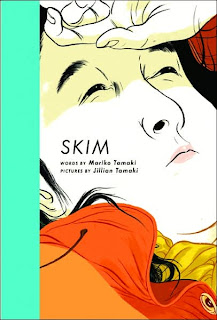
Skim: words by Mariko Tamaki, drawings by Jillian Tamaki (House of Anansi Press/Groundwood Books, Feb 2008, $18.95)

This is a lovely -- both in the delicate and detailed drawings of Jillian Tamaki and in the thoughtful and incisive writing or Mariko Tamaki -- book, told in the voice of teenager Kimberly (Skim) Keiko Cameron. Skim is chubbier than she might prefer, an aspiring Wiccan, a student at a private girls' school, and (like so many teenagers) not at all sure of where she'll fit into the world. It's the sort of story we've all seen a million times, especially in YA fiction: a sensitive young person tells her own story -- in this case, there's even specific references to writing this in a diary -- but that's because millions of us were sensitive teens, and it's a story that can resonate strongly when told well.

And this is told very well; it's one of the finest graphic novels I've read recently. The Tamakis make Skim a real, specific person; she's grumpy and distracted, wondering about love and Wicca and friends and the whole world. There are some "issues" in this book, but I'm not going to tell you what they are; merely mentioning them would give the wrong impression. Skim isn't a book about "problems facing today's teens" -- it's one young woman's story, told brilliantly and by turns funny and moving, sweet and sad. If you see a copy, pick it up: this is a real gem.

No Girls Allowed: written by Susan Hughes, illustrated by Willow Dawson (Kids Can Press, August 2008, $16.95)

The stories of seven women who dressed as men for extended periods of time -- from the Egyptian Pharoah Hatshepsut to US Civil War soldier Sarah Rosetta Wakeman -- are told, in lots of stilted captions and slightly less stilted dialogue, enlivened by Dawson's clear, crisp, and slightly quirky art. (One example: all of the female characters -- down to the images of the creators on the back flap -- have that circle on one cheek that you can see on Mu Lan on the book cover to the left.)

No Girls Allowed is much more "educational," and much less fun. I'm sure it could be very useful to some kid staring down the barrel of an essay deadline, but the stories it tells are rendered dry and flattened. Hughes never speculates or goes beyond what history records, which makes this useful as a reference, but not as much fun as a collection of stories. All of these women were highly secretive -- they had to be, to pass as men for years -- and so there's often not a lot known about them...but that's all there is in No Girls Allowed.

Claire and the Bakery Thief: by Janice Poon (Kids Can Press, March 2008, $15.95)

A pre-teen girl moves to the small town of Bellevale when her parents buy an old bakery there, and at first has trouble making friends, until she meets fellow outdoors-lover Jet. But the parents are fighting -- Claire's mother didn't want to leave the big city in the first place -- and eventually Mom goes away with a mysterious Artificial Flavoring Salesman. Claire and Jet then need to find and save her.

This is positioned as the first in a series, and it means well. (There are even recipes at the end, and a message of eating local/organic/healthy.) But it's both trite and silly, and ends up either trivializing or ignoring Claire's parents' marital troubles. OK for young girls who like to cook, not of much interest to anyone else.

Johnny Boo: The Best Little Ghost In The World: by James Kochalka (Top Shelf Productions, June 2008, $9.95)

Kochalka has done books for kids -- or books that are also appropriate for kids, perhaps -- before, and his quick, cartoony style works well in this short story about a boy ghost and his best friend Squiggle (who looks different, and flies, but is also a ghost, I guess). Boo and Squiggle run and play, and then have some trouble with an ice cream monster. It's a fun, light adventure story for boys, with the loose narrative structure and ideas of a game a couple of kids would play on the spot out in the yard.

So this is light, but a lot of fun -- probably of most interest to younger boys (up to six or seven) and the more tomboyish girls of similar ages.

Yam: Bite-Size Chunks: by Corey Barba (Top Shelf Productions, July 2008, $10.00)

Yam is the little boy in the all-encompassing jumpsuit on the cover; his TV-dog doesn't seem to have a name. This book collects a twenty or so short wordless comics stories about him and his friends, ranging from single-pagers up to one thirty-eight pager. Several of the stories originally appeared in Nickelodeon Magazine, so this character is already familiar to a swath of the preschool set.

The stories are the kinds of things you'd expect from wordless stories for preschoolers -- lots of food and friendship and being nice, with some game-playing and mild conflict and (in the longest story) Yam being in love with a cute shopkeeper but eventually realizing he's just a kid and she isn't. Barba's art is cartoony, but more detailed and noodly than Kochalka's, with a lot of things to look at in every panel. My eight-year-old enjoyed reading it with me, but the subtle details of the stories -- they're wordless, remember -- sometimes escaped him, and will likely escape much of the target audience.

Korgi Book 2: The Cosmic Collector: by Christian Slade (Top Shelf Productions, July 2008, $10.00)

This is another wordless story, but this time it's a fantasy tale, set among winged people called Mollies who live in Korgi Hollow with their fox-like Korgis. (The girl on the cover is a Mollie named Ivy, and the "dog" is her Korgi, Sprout, who has special powers.) The backstory is pretty extensive, for a story told without words, and that requires a several-paragraph long prologue up front (as narrated by a giant friendly toad with a hat and a telescope) as well as a list of characters and races at the end. (This does mean that the reader finds out the point of the story, and something of the details, only after the story is done, which is sub-optimal.)

There's this alien (we learn from the list of characters) named Black 7 (ditto) who shoots Mollies to steal their wings and tack them up on the walls of his house. Ivy takes exception to being treated that way, and goes to get her wing back, either by sneaking or by force. Korgi has more action than most of these other books, and so could skew slightly older -- though the wordlessness tends to push the age down. (As does the slightly twee names and aspects, from "Mollies" to the talking friendly toad Wart.)

Slade's art is gorgeously dynamic and detailed, with magnificent shading. I suspect the art is well more than half of the appeal of Korgi, though the story is just fine for what it is.

Coraline: adapted and illustrated by P. Craig Russell fron the novel by Neil Gaiman (HarperCollins, June 2008, $18.99)

I've now had my fill of Coraline for a while, having seen the film, re-read the Gaiman novel and now read this comics adaptation by Russell within barely two weeks. Russell's adaptation is much more faithful into the comics form than Henry Selick's was for the film, but the film is a much more impressive achievement -- even leaving aside the 3D and other aspects that give film an undeniable edge over any book.

Russell tells Gaiman's story, entirely using Gaiman's words as far as I could tell, and doesn't change even the slightest of plot details. Selick, though, changed quite a bit of the details, adding a character for Coraline to talk to, changing the nature of her final confrontation with the Other Father, and seriously changing the dynamics of the final well scene. Selick's changes all increased the tension and visual interest; Coraline, as a novel, was very quiet and centered in Coraline's head. That's the great gulf between a novel and a movie, of course: a movie can only show what's happening on the outside, though it can hint and imply mental states, while a novel can dive right into a stream of consciousness and make the reader know exactly why a character did something. Graphic novels, at their best, hybridize the two forms -- they can't be quite as visually exciting as movies, since they don't move, but they can come very close. And they can show the inner life of a character just as fully and in as much detail as a novel can.

But Russell, in adapting Coraline, didn't add anything to the mix but his own prodigious skills -- the story is precisely the same, and the otherworldly elements, such as the Other Mother and her creatures, are left understated, not going an inch beyond Gaiman's descriptions of them. His graphic novel is precisely Gaiman's Coraline translated faithfully, while Selick's movie is the same story given a new visual style and a few changes to work better in a different medium.

Unfortunately, to my eye, Russell -- though one of the masters of modern comics and the creator of a long shelf of great adaptations, from Elric to the massive, magisterial Ring of the Nibelung -- wasn't the best choice to illustrate this particular story. The original illustrations for the novel (at least in the US editions I've seen) was Dave McKean, who brought his usual chiaroscuro forms, which imply much more than they illustrate. And Selick's movie also took a more surreal visual style, with its lanky puppets and gorgeous but subtly unreal settings. Russell, on the other hand, is magnificent at drawing real things and real space -- his Coraline is a particular girl of about ten, and the Other Mother looks like a real woman with buttons for eyes.

That's usually a great strength, but it hampers Russell, particularly near the end, when the Other Mother's world is supposed to simplify down and become more crude -- "no more than a crude scribble" and "just a child's scrawl." Russell draws those scenes as warping and twisting, but not deteriorating -- not at all like the drawings of a child. The one place where the text gives specific visual instructions that are precisely translatable to comics, Russell is too good an artist to carry them out.

It may be just that I've had my fill of this story right now, but I found Russell's comics version the third and least of the versions of Coraline. It's neither the pure words Gaiman wrote the story in nor something new and wondrous like Selick's movie -- it's gorgeous and impeccably drawn and laid out, as always with Russell, but doesn't quite grab a life of its own.