Showing posts sorted by date for query rick geary. Sort by relevance Show all posts

Thursday, April 02, 2026

A Billy the Kid Alphabet by Rick Geary

This was a Kickstartered project; you might not be able to get it. On the other hand, Rick Geary has been making books for decades - and comics for even longer than that - so I have to think that he'll have a way for people to buy his stuff. You don't get a career of that length and depth by making it hard for people to pay for your work. My guess is that it will show up on the Books page of his website eventually.

Geary has been doing Kickstarters for books - at this point, I think his output is about one Kickstarted book a year, and he's had probably a dozen or more going back at least a decade - for a while, and I've been backing them to get the books, since I'm a long-standing Geary fan.

The project for 2025, which got to me early in the new year, was A Billy the Kid Alphabet, an abecedary about the man known to history as William Bonney.

And you might be asking "wait, didn't Geary already do a book about Billy the Kid?" That's right: in 2015, he did a more traditional narrative version of Bonney's story, The True Death of Billy the Kid. That earlier book is longer, organized in a more familiar way, has more details, and in general is a better place to start. (Geary also did a book about the related Lincoln County War around the same time.)

But Geary is a fun, quirky creator, and I do enjoy his quirky projects. This is definitely one of them.

Alphabet more-or-less tells Bonney's story, though not in order. Geary has a reasonable word or phrase for each letter, from Alias (covering the names used by Bonney) to Zero (debunking the "he survived his death" rumors), but the stricture of the alphabet means that, for example, the Lincoln County War is referred to a few times before we get to Regulators (the group Bonney was part of during that war) and Tunstall (the landowner Bonney worked for, whose death sparked the war).

So Geary does get to the high points of Bonney's life - that war, his capture, trial, and escape, how he was killed by Sheriff Pat Garrett - but not quite in the order that they happened in life. This might confuse some readers, assuming Alphabet has readers who aren't familiar with the basic facts already.

Each letter has a left-hand page, with the letter big and the explanatory text for the chosen word, and then a right-hand page, with a Geary pen-and-ink illustration of the thing he's writing about. As always, Geary's art is detailed and particular - he's always been good at 19th century faces, clothing, and surroundings, and Alphabet shows his strengths well.

Again, this is a book that would be difficult to find at this point, though it will probably be available from the author in the near future. If you are a Geary or Bonney fanatic who didn't know about it, I wish you luck in finding it.

Sunday, March 08, 2026

Books Read: February 2026

I do this every month: at this point, mostly because I have been doing it every month. I think it's useful, to me at least, as an index. My posts on all of these books have already been written; they'll go live over the next six weeks and I'll eventually add links. (Most likely each month, as I do this post each time and update the previous ones.)

Here's what I read last month.

Manu Larcenet, Ordinary Victories, Vol. 4: Swing That Hammer (digital, 2/1)

Zidrou and Jordi Lefebre, Glorious Summers, Vol. 1: Southbound! (digital, 2/7)

Juan Barrio, Kiosco (digital, 2/8)

Jeff VanderMeer, Acceptance (2/8)

Rick Geary, A Billy the Kid Alphabet (2/13)

Naoki Matayoshi & Shiunsuke Yoshitake, The Neverending Book (ARC, 2/13)

Lewis Trondheim & Nicolas Karamidas, Walt Disney's Donald Duck: Donald's Happiest Adventures (digital, 2/14)

Daredevil by Frank Miller and Klaus Janson, Vol.3 (digital, 2/15)

Alex Potts, Was That Normal? (digital, 2/16)

Kate Atkinson, Big Sky (2/16)

Manuele Fior, Red Ultramarine (digital, 2/21)

Gregory Hirschak, E Is for Edward (2/22)

Lewis Trondheim & Manu Larcenet, Cosmonauts of the Future, Vol. 1 (digital, 2/22)

Juan Diaz Canales & Junajo Guarnido, Blacksad, Vol. 1: Somewhere Within the Shadows (digital, 2/28)


In March, I plan to read more books.

Sunday, February 15, 2026

Reviewing the Mail: Week of February 14, 2026

One book came in the mail this week: let me tell you about it.

Rick Geary has been doing Kickstarters for books for about the last decade - I think it started out as his weirder, quirkier projects, but there have also been a few historical-murder stories that looked a lot like the books he did for bigger publishers. So it might just be the way he initially self-publishes his work these days, which is just fine - I'm on the mailing list, so I get 'em.

The most recent book was A Billy the Kid Alphabet, which heads back a bit towards the quirky side. Geary did a more "normal" Billy the Kid book a few years ago with The True Death of Billy the Kid, which is a better bet for anyone who wants the story told in order with the facts lined up nicely. Alphabet, on the other hand, is in the style of a abecadary, with a big double-page entry (one full-page illustration, one page of text) for each letter of the alphabet, from Alias to Zero.

Billy the Kid is still a source of fascination for many - including Geary, I assume - which is why this book exists and has an audience. For, me, I'm mostly here for Geary telling me about historical murderers and showcasing his magnificently detailed pen-and-ink drawings.

Thursday, May 29, 2025

Daisy Goes to the Moon by Matthew Klickstein & Rick Geary

Daisy Ashford was real. She was born in 1881, and wrote a cluster of stories in her youth: weird, oddball things with eccentric spelling and an often-shaky grasp on how people actually lived and talked to each other, all bathed in the sunny happiness of a coddled girl of the Victorian age. After she grew up, she rediscovered those stories, and some of them were published around 1919 with the help of J.M. Barrie. There have been periodic revivals and rediscoveries since then; a movie of her most famous "novel," The Young Visiters, was made by the BBC about twenty years ago. (I know I saw it, but it must have been before the life of this blog.)

Daisy Goes to the Moon is about Daisy, but not by Daisy. Matthew Klickstein wrote a short novel in Daisy's style - which seems to me to be the opposite of the point of juvenilia, frankly - and it was published in 2009, full of 1950s imagery and ideas. And now Rick Geary, master of both whimsy and Victoriana, has turned Klickstein's story into a short graphic novel, full of authentically Daisy-esque spelling and moderately appropriate Daisy-esque situations and comments.

(Daisy herself died in 1972 at the age of 90, so she's no more going to complain about what people have done to her memory than Shakespeare is.)

This begins with Daisy about the age of nine, when she wrote her most famous works, and dressed up in the usual Victorian-girl look, down to the big bow in her hair. She's sitting under a tree, Alice-like, when a "rokit" lands nearby. It's piloted by Mr. Zogolbythm (Mr. Z), a tall, skinny man all in black who comes from the moon, to which he proceeds to whisk Daisy for an adventure.

The story continues somewhat episodically, somewhat along the lines of the usual tour-of-the-future style for utopian works. Daisy experiences the high-tech of the moon - including a "so-you-can-hear-and-read-too" device implanted in her brain to allow her to understand moon language - flees Moon Monsters and creatures from other planets, shops for shoes and goes to an automat, and so on.

Soon, though, another character pops up: Mr. Blahdel (Mr. B) an American time-traveler from the 1950s, lugging a TV that's missing an important part. B and Z have some mostly minor disagreements, which lead to further adventures when they dispute over the navigation of a spaceship. We also descend into metafiction when Daisy finds a book written by her sister Angie, which retells the first half of the story badly - the bratty Angie has followed Daisy (somehow; this isn't clear) to the Moon.

And, of course, in the end Daisy gets back home safe and sound, and declares that to the best place to be.

Geary's art is as detailed and energetic as always; quirkiness and whimsy typically brings out some of his best work, and that's the case here. I might think that was an odd project, but it's done as authentically and honestly as it could be, and this is a fun, amusing story.

Sunday, May 04, 2025

Books Read: April 2025

This is the monthly index of the blog, basically - it exists to make the search function more useful (for me, I think) and possibly less useful (for you, assuming you are not me, as you search for something and find both an index and the thing itself).

More prosaically, it's the list of what I read, since Antick Musings long ago turned into a book blog. Links get added later, once the posts go live.

Here's what I read in April:

Michael Avon Oeming, William of Newbury (4/5, digital)

Bryan Lee O'Malley, Scott Pilgrim's Finest Hour (4/5, digital)

Paul Milo, Your Flying Car Awaits (4/6)

Wulff & Morgenthaler, WuMo: Something Is Wrong (4/12, digital)

Thomas McGuane, Something To Be Desired (4/13)

Craig Thompson, Ginseng Roots (4/14, digital proof)

Matthew Klickstein & Rick Geary, Daisy Goes to the Moon (4/19, digital)

John McNamee, Just Act Normal (4/20, digital)

Jack Vance, The Dirdir (4/20, in Planet of Adventure)

Greg & Fake, Santos Sisters, Vol. 1 (4/26, digital)

Kayla E., Precious Rubbish (4/27, digital)

Tim Glynne-Jones, compiler, Witty Comebacks (4/27)

Daria Tessler, Cult of the Ibis (4/28, digital)

Gene Wolfe, The Urth of the New Sun (4/28)


Look for a similar post in about a month, covering the stuff I'm reading in May.

Sunday, June 02, 2024

Books Read: May 2024

I forgot to do these monthly index posts for a couple of months, so I'm tossing them in backdated. You are probably not even reading this unless you're wandering through the archives or reading this via RSS.

But, whatever, here's what I read in the merry month of May:

Rick Geary, The Bonito City Tragedy (5/4)

Seamus Heaney, Opened Ground: Selected Poems 1966-1996 (5/4)

Lewis Trondheim, Ralph Azham, Vol. 4: The Dying Flame (5/5)

George Macdonald Fraser, The General Danced at Dawn (in The Complete MacAuslan, 5/4)

Bryan Lee O'Malley, Scott Pilgrim Vs. the World (digital, 5/10)

Noah Van Sciver, Disquiet (digital, 5/11)

A.J. Liebling, The Jollity Building (in The Sweet Science and Other Writings, 5/11)

Jeff Lemire & others, Black Hammer: Visions, Vol. 2 (digital, 5/12)

Doug Savage, Relationships According to Save Chickens (digital, 5/18)

Jack London, The Road (in Novels and Social Writings, 5/18)

Maria Hoey and Peter Hoey, Coin-Op Comics Anthology: 1997-2017 (digital, 5/19)

Daniel Pinkwater, The Worms of Kukumlima (in 4 Fantastic Novels, 5/19)

M.S. Harkness, Time Under Tension (digital, 5/24)

Larry Gonick and Tim Kasser, Hypercapitalism (5/24)

Olivia Jaimes, Nancy (digital, 5/25)

Stewart O'Nan, Ocean State (5/25)

Nate Powell, Fall Through (digital, 5/26)

Jerzy Kosinski, Steps (5/26)

Jesse Lonergan, Hedra (digital, 5/27)

Victoria Rosenthal, Fallout: The Vault Dweller's Official Cookbook (5/31)


As I write this, it is June 23rd, so I can say without fear of contradiction that I have already read books in the following month, but I can't promise I'll do this on time next month (next week).

Thursday, May 30, 2024

The Bonito City Tragedy by Rick Geary

I don't think you can get this book, right at this moment. The author's main website and Storenvy pages are down - at least for me, at least here. It doesn't have an ISBN, so it won't be available through the usual book channels. It was a Kickstarter, and that page is still live - but you can't jump on a train that already left the station.

The Bonito City Tragedy is the latest in a long series of books - originally from NBM, and then, over the last decade, self-published - from Rick Geary, in a small format and telling the story of a famous historical crime. Most of those crimes, I think all of them, have been murders. The publisher-backed series were "A Treasury of Victorian Murder" and "A Treasury of XXth Century Murder" (he switched centuries about seven years after the world did, one century delayed), with nine books in the first batch and seven in the second.

Since 2014, he's self-published a number of similar books: shorter, increasingly about local (to him) history, increasingly told as single large panels for each page. I don't know if this is a comprehensive list, but the books I've seen 2014 include The Elwell EnigmaThe True Death of Billy the KidMurder at the Hollywood HotelThe Story of the Lincoln County WarChester & Grace: The Adirondack Murder, and The Wallace Mystery, which all fall into that general style. (Then there was Carrizozo: An Illustrated History, which is even more local history, but much less murder.)

Bonito City Tragedy tells the story of another multiple murder, in the small New Mexico town of the title - it's currently at the bottom of a man-made lake, but that was long afterward - in 1885, when a boarder got into a fight with his roommate and escalated from there. There's no mystery to this one, unlike the older books: this guy just killed a bunch of people, very obviously, and got the immediate consequences.

Geary's art is lovely as always, rippling precise lines of crisp black making the large pictures of outdoor recreation, carefully-depicted 19th century life, and, inevitably, brutal murder..

The earlier books are deeper and longer and have a lot more nuance - telling Lizzie Borden's story gave Geary more material to work with than Billy the Kid's, for example - but I suppose he's hit all of the obvious candidates long ago, and this is the kind of story he wants to do now. If you actually find Bonito City, it's another solid story of olden-day murder, well told by Geary.

Sunday, May 05, 2024

Reviewing the Mail: Week of May 4, 2024

One book this week, the product of a Kickstarter, and it is...

The Bonito City Tragedy by Rick Geary!

Geary has been kickstarting (when that's a verb, does it take the capital letter? oh, the weird usage questions we get these days) books for about a decade, I think. I've backed a bunch of them, I know.

He used to do small-format books on national or global-level murder stories of the past (first exclusively the 19th century, then shifting to mostly the 20th) for various publishers (I think mostly NBM), but the kickstarted books have tended to be smaller, local historical murders - or similarly local stories that are not quite as murder-centric. I won't claim the list is comprehensive, but books I've gotten from Geary since 2014 include The Elwell EnigmaThe True Death of Billy the KidMurder at the Hollywood Hotel (with The Lampoon Years: 1979-1992 and Rick Geary's Book of Murder also at that link), Early Storties: 1977-1988The Story of the Lincoln County WarThe Secret Door at the White HouseChester & Grace: The Adirondack MurderThe Wallace MysteryCarrizozo: An Illustrated History, and Stories from the '90s.

This is another story of death in rural New Mexico - where Geary has lived for the past decade-plus - but I don't know much more than that. But a new Geary story about death and quirky local history is a good thing, so I'm on board. (Let's be honest, if I signed up for the history of his hometown - Carrizozo is the book I'm referring to, and I did enjoy it - I'm probably on board with anything Geary wants to do at this point.)

At the moment, it looks like Geary's regular site and Storenvy pages are down, but I'll put those links in, just in case they come back. The book itself doesn't have an ISBN, so I don't think it will be available through the normal channels.

Tuesday, March 28, 2023

The Fatal Bullet by Rick Geary

Rick Geary's most obvious oeuvre consists of a sequence of small-format books about historical murders, spanning three decades from Jack the Ripper in 1995 to The Black Dahlia in 2016. [1] Each one is meticulously crafted and deeply researched before drawn with Geary's complex illustrative line, and they usually feature maps and diagrams of murder scenes alongside traditional comics panels.

The Fatal Bullet was fairly early in that sequence; it was published in 1999. Unlike most of Geary's choices, there's no mystery in this one, nothing central still unknown today. Geary here tells the story of Charles J. Guiteau's 1891 assassination of President James A. Garfield, which was done in public and has nothing mysterious about it at all.

Well, other than why Guiteau did it. And that's what Geary looks to explain here: he explicitly sets a 19th-century moralizing tone - somewhat tongue-in-cheek - in the front matter, with a chart depicting "The Two Roads" - the "happy, prosperous life" of Garfield and the "downward path" of Guiteau. And the book follows in that mode: pitched somewhere between penny-dreadful and serious-newspaper, sounding largely like an account from the time period, Geary outlines the lives of both men to show how they came to their fatal encounter.

The one thing this doesn't allow him to do is diagnose Guiteau, who clearly had some kind of mental disorder - he was found sane and guilty at trial, of course, but he was driven to the murder by a monomania about factions in the Republican Party and and vastly inflated sense of his own importance. Any serious modern psychological profiling of Guiteau would break that historical model, and that may be why Geary avoids it. Or maybe no one knows what Guiteau's problem was. 

In any case: he was a nut. A "frustrated office seeker" - he had no qualifications besides a stump speech he wrote supporting Garfield that was never actually used and his own boundless faith in himself - who wanted to be made ambassador to a major, cushy European capital and had been bugging Garfield and his Secretary of State for months. With no luck in that direction, he got it into his head that killing the president would miraculously make everything better and get him the job he wanted.

It didn't work, obviously. Guiteau was immediately arrested, held until Garfield died, then speedily tried and executed. But murders are about people doing extreme things for extreme reasons; that's what this whole long series of books by Geary are about, in the end. And this is somewhat atypical in its lack of mystery, but otherwise right down the middle of the style. Geary's art is lush and immersive as ever, the words are energetic and carefully researched, and the whole thing told excellently. What more could you want out of a murder tale?


[1] And he's self-published a small shelf of similar books since then, actually.

Sunday, January 08, 2023

Books Read: December 2022

I'm actually typing this a few days ahead (Thursday afternoon), but I'm burying the post on a Sunday morning because, honestly, who cares?

Here's what I've read during the past month, mostly to be an index to this blog for Future Me:

Manix Abrera, 12 (digital, 12/3)

Lavie Tidhar, Neom (bound galleys, 12/3)

Laurent Queyssi and Mauro Marchesi, Philip K. Dick: A Comics Biography (digital, 12/4)

Neil Gaiman and Dave McKean, Signal to Noise (12/9)

Rick Geary, The Fatal Bullet (12/10)

Michael Wex, Born to Kvetch (12/10)

Paul Grist, Mudman, Vol. 1 (12/11)

John Allison with Sammy Borras, Steeple, Vol. 3: That's the Spirit! (12/17)

Bean Sears, Night Air (12/18)

Jeff Prucher, editor, Brave New Words: The Oxford Dictionary of Science Fiction (12/19)

Lewis Trondheim, Ralph Azham, Vol. 2: The Land of the Blue Demons (12/23)

John Barnes, Gaudeamus (12/23)

Budjette Tan and KaJo Baldisimo, Trese, Vol. 5: Midnight Tribunal (12/24)

Algis Budrys, Hard Landing (in SF Gateway Omnibus, 12/24)

Tom Gauld, Revenge of the Librarians (12/25)

Joann Sfar, Lewis Trondheim, Christophe Gaultier, and Stephane Oiry, Dungeon: Early Years, Vol. 3: Without a Sound (12/26)

Jeff Lemire, Tate Brombol, Gabriel Hernandez Walta, and Jordie Bellaire, Barbalien: Red Planet (digital, 12/27)

Lawrence Block, The Burglar Who Met Fredric Brown (12/27)

Mallie and Hubert, In Shadows, Book One (digital, 12/28)

Wilfrid Lupano and Paul Cauuet, The Old Geezers, Vol. 1 (digital, 12/29)

Benoit Feroumont, Gisele and Beatrice (digital, 12/30)

Ian Frazier, On the Rez (12/30)

Jason, Upside Dawn (digital, 12/31)

P.G. Wodehouse, If I Were You (12/31)


Twenty-four books in one month is probably the most since my last book-a-day binge in 2018; I can get a lot more reading done when I'm on vacation. Such is life!

Monday, December 26, 2022

Reviewing the Mail: Week of December 24, 2022

Happy Boxing Day, for those who celebrate!

And, speaking of boxes, earlier this month I got a box of books. One of them - the big expensive one - I held aside for the family to give me as a present, so I guess I'll write that up in a Xmas-specific list (which it's not impossible I wrote and posted on Xmas, which would be the day before this post goes live, and that leads me into Douglas Adams-y time-travel verb tenses which I will not try to untangle).

But the rest of these books went right into general pop, so here's what I bought because there was a good Cyber Monday sale at an online comics retailer:

Steeple, Vol. 3 by John Allison (with some coloring by Sammy Borras and a cover by Max Sarin) - This collects five "issues" of Steeple, but I don't think they were published as floppies. I'm not sure if they were online PDFs, or just pages on Allison's site, or some third-party platform thingy. Since I tend to wait for actual books these days, it's mostly academic to me - this is the next batch of stories about the two warring churches of Tredregyn, with the subtitle "That's the Spirit!"

Signal to Noise is a 1992 graphic novel by Neil Gaiman and Dave McKean. I read it, way back then, and maybe more recently (in the sense of "still fifteen or more years ago"), but lost my copy in my 2011 flood. This is the "millennial" story, about a film director who wanted to make a movie about the apocalypse that didn't happen in 999 AD and is now dying.

The Fatal Bullet is one of Rick Geary's "Treasury of Victorian Murder" books, and the murder in this case is that of President James A. Garfield by Charles Guiteau. This one is interesting because it's a murder but not a mystery, and Geary has structured the book almost as much about the two men's parallel lives as about the murder and trial.

Mudman, Vol. 1 is a graphic novel by Paul Grist, creator of Jack Staff and Kane, that I think is a standalone. At least, there doesn't seem to have been a Vol. 2 after this 2012 book. This is a quirky superhero book, bout a teen hero who suddenly has,,,the power to turn into mud? I haven't seen much new from Grist in recent years, which is disappointing - it looks like he last wrote (maybe is still doing?) a team comic for Marvel, not somewhere I would follow any creator.

Night Air is a "Double+" book from Ben Sears. I'd read his House of the Black Spot, later in this series, not too long ago, and liked it, so I wanted to find some more.

Dreadstar Omnibus, Vol. 1 is by Jim Starlin, and I am so not sure how I'm going to feel about it. I read the Dreadstar stories way back in the day, but that was a long time ago, and I don't trust my memories of them. This book collects the first twelve issues of the ongoing series, though I think what I really want is the material that came before this - the Dreadstar GN, The Price, those weird "Metamorphosis Odyssey" stories from Epic Illustrated. (I don't think that stuff was ever collected, and it all went OP really quickly, so it's trapped in back-issue hell.) Anyway, this is adventure comics of the kind that pretends its totally not superheroes, even though it's a team of people in skintight costumes with amazing powers battling evil and emoting to the skies. (Spoiler: they are superheroes. 100%) Finally, the pose on the front cover of this edition is causing me physical pain to look at. I don't think bought this to hate-read it and shame the tastes of Teenage Me, but we will have to see.

Trese, Vol. 5: Midnight Tribunal is, unsurprisingly, fifth in this series by Budjette Tan and KaJo Baldisimo. This is a great urban-fantasy series from the Philippines; see my posts on volumes 1, 2, 3, and 4.

And last is Ralph Azham: The Land of the Blue Demons, second of the four books of that secondary-world fantasy series by Lewis Trondheim. I saw the first one recently, and it has a lot of the energy and viewpoint of the Donjon books. Plus, this one leans into the epic-fantasy genre by actually having a map of the world on the endpapers!

Wednesday, January 26, 2022

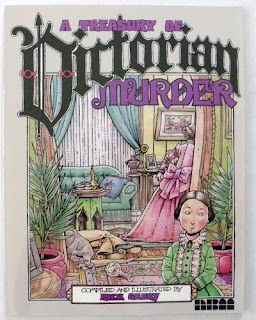
A Treasury of Victorian Murder, Vol. 1 by Rick Geary

I wrote about this book extensively just three years ago, during my last Book-A-Day run. And that post is a nice, straightforward explanation of what the book is, how it fits into Geary's larger career, and what a reader might get out of it.

I don't know if I can do better than that this time: you might want to just hit that link.

This time, writing about Rick Geary's A Treasury of Victorian Murder, Vol. 1, I want to look at the cover.

There it is: right in front of you. A cluttered High Victorian room, stuffed with things. So stuffed it takes a moment to notice the body sprawled on the floor; the woman stalking away to the right is more prominent. That's Geary for you: he'll promise murder, and deliver murder, but not be blatant about it. The murder is one thread of the story he wants to tell - the central thread, yes, the lurid thread, but all of the other objects in that room are just as carefully delineated, in his art and in his story.

And who is that in the foreground? I go back and forth: is that a child or a young woman? She could be sitting down, or she could be that short. She could be the murderess, or an innocent bystander, or a  neighbor whose unexpected visit caused the discovery of the heinous deed. Her face will not give away any of that: she's composed, but not calm. Is that a worried crease to her lips? What is she looking sideways at?

She's the one element of the cover that points outward to us the readers. She's our path into this image, our guide into the story we build in our own heads about the cover image. Perhaps I need to say here that it comes nowhere near the facts of any of the three stories in the book: it's clearly not illustrating anything within. This is a pure picture, a cover to be "A Treasury of Victorian Murder." The book will not tell us how to read this image. This cover stands alone: it implies a story Geary has not explicitly told.

It's also a moment: it's a comics cover, not an illustration. The figure at the front is glancing to her left; the woman in pink is stalking out of the room. There is motion throughout - this is not a static picture, but a moment in time, a moment that will be gone instantly. Something happened a second ago, something else will happen next. But what we have is this moment, as a window into this scene and this Victorian murder.

That's what Geary gives us. The cover is larger and more detailed than most of the panels in the stories inside - though not all of them; there are a couple of fold-out double-page spreads - but it's in their style and manner. This is what we find within: questions and moments, figures and mysteries, bodies and shocks, clutter and detail.

If the cover intrigues you, the book will do more than that.

Sunday, January 02, 2022

Books Read: December 2021

And here's what I read at the end of 2021. As always, this list is mostly for me, as an aide memoire in the future.

Herge, The Adventures of Tintin, Reporter for "Le Petit Vingtieme," in the Land of the Soviets (12/4)

Naoki Urasawa, Asadora!, Vol. 2 (12/5)

Tom Standage, Go Figure (12/10)

Jeff Lemire and Wilfredo Torres, The Quantum Age (12/11)

Charles Stross, Dead Lies Dreaming (12/11)

Neil Gaiman and Dave McKean, Mr. Punch (12/12)

Rick Geary, A Treasury of Victorian Murder, Vol. 1 (12/18)

Kim Deitch, Alias the Cat! (12/19)

Peter Milligan, Brett Ewins, and Steve Dillon, Skreemer (12/22)

Joshua W. Cotter, Skyscrapers of the Midwest (12/23)

Debbie Tung, Happily Ever After and Everything in Between (digital, 12/24)

Shannon Wheeler, Why Did We Trust Him? (digital, 12/25)

Will McPhail, In. (12/26)

Jonathan Yardley, Second Reading (12/26)

Daniel Clowes, Patience (12/27)

Ray Fawkes, One Line (12/28)

Dash Shaw, Discipline (12/29)

Barry Windsor-Smith, Monsters (12/30)

Jason, Good Night, Hem (12/31)


Links will follow later; I've written posts for all of those books but I'm currently running about six weeks ahead. (Mostly so I have a buffer if/when the next bout of reading ennui hits.)

Monday, December 13, 2021

Reviewing the Mail: Week of 12/11/21

For this palindromic date (well, Saturday was, and that's how I date these posts), I have a big bunch of graphic novels that I got from a big sale from one of those big Internet comics shops. I think the sale was Cyber Monday-themed; it was around that time.

Anyway, some or all of these will get wrapped up to be Christmas presents, because that's how it works when you get to my age: you buy the stuff you want and then get other people to wrap it up for you.

Little Nothings, Vol. 2: The Prisoner Syndrome by Lewis Trondheim - the second (of four that I've seen in English) collection of his autobiographical comics. I wrote about it back the first time I read it.

Little Nothings, Vol. 3: Uneasy Happiness by Lewis Trondheim - same as the above, but immediately afterward. I also wrote about this one about a decade ago.

Skyscrapers of the Midwest by Joshua W. Cotter - I remember thinking this was great, but I haven't re-read it in a long time and I don't think I've seen anything else by Cotter since. (I might not have been looking, though.) I wrote about this one as well.

Joseph Conrad's Heart of Darkness by Peter Kuper - This is a graphic adaptation of the Conrad novel by Kuper, which is why there's a weird title.  (Rod Torfulson's Armada featuring Herman Menderchuck!) I'm not sure if that's weirder than the alternative: crediting the book equally to Conrad and Kuper, who lived a century apart and never met. There's also the "script by Shakespeare, additional dialogue by Sam Taylor" style, which is goofy in its own ways. Adaptations just lead to odd credits, I guess.

Alias the Cat! by Kim Deitch - One of his better books, as I remember it, filled with oddball old media and modern-day stories. I read it back in 2007, but just noted that in the very early days of this blog; I've never written about it at any length.


Steeple, Vol. 2
 by John Allison - I still have not read the first book, which I still need to find a copy of. But now I have the second one - I think as the third story is just finishing up in the webcomic, which I haven't read until I can get caught up. I've loved everything else Allison has done, especially in this universe, so I'm not worried about catching up.

Skreemer by Peter Milligan, Brett Ewins and Steve Dillon - I haven't read this in over twenty years, but I remember it being really impressive, from the era where Milligan was still a crazy icon-smashing Brit import rather than a relatively normal writer of Big Two comics. As I remember, it's a SF gangster epic with some literary ambition: isn't it loosely based on Finnegans Wake or something? Anyway, I'm planning to re-read it soon, now that I have a copy again.


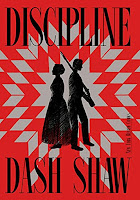
Discipline
 by Dash Shaw - this is his new graphic novel, and I don't know a lot more about it than that. I feel like Shaw made a big splash about a decade ago, with Bottomless Belly Button, BodyWorld, and the pseudo-collection The Unclothed Man in the 35th Century A.D. in quick succession, but has been quieter since then. Last thing I remember seeing from him was Cosplayers, which was pretty small. 

Return to Romance! is a collection of Ogden Whitney comics from the '50s and '60s (I think) edited by Dan Nadel and Frank Santoro. I know Whitney's work from the Herbie comic, which he only drew - I think this collection is comics he both wrote and drew. (Or maybe not: I'll find out.)

One Line by Ray Fawkes - I gather this is another in the line of his One Soul and The People Inside, somewhat formalist takes on using comics to tell multiple interlocking stories simultaneously. I was really impressed by the earlier two books - and, not for nothing, his Possessions series is also a hell of a lot of fun - so I'm back to see him do it again.

In by Will McPhail - a new graphic novel by a New Yorker cartoonist whose single-panel work I've liked. I don't know a lot about it: I gather it's contemporary, and probably some kind of comedy of manners.

A Treasury of Victorian Murder, Vol. 1 by Rick Geary - the original collection of short strips that grew into most of Geary's career for the last three decades. I notice that I wrote about this book just three years ago, so I suspect I may already have a copy of it. (I'm still all discombobulated from my 2011 flood: I'm never quite sure what I used to own and got destroyed, what I used to own and have bought again, what I bought since then, and what I never owned but read another way.)

Mr. Punch by Neil Gaiman and Dave McKean - One of the great books of this generation, but, again, I see I wrote about it in 2016, so I might already have a copy of it lurking about somewhere.

Saturday, July 10, 2021

Books Read: June 2021

I could pretend that I waited a week-plus to type & post this because I wanted the last of the books I read in June to have their posts published, so I could do this all in a neat and tidy fashion. But the last post on a June-read book won't publish until the 22nd, so that would be a lie.

No, I just forgot that I usually do this. But I remembered now, and so I'm doing it now. And it's almost entirely for me, anyway. But here's what I read in June of 2021, the month where I passed the full-year total for 2020:

Kristen Gudsnuk, Making Friends: Back to the Drawing Board (6/5)

Jeff Lemire, Dean Omston, and Dave Stewart, Black Hammer, Vol. 1: Secret Origins (6/6)

Matthew Hughes, Barbarians of the Beyond (6/11)

Mademoiselle Caroline and Julie Dachez, Invisible Differences (6/12)

Rick Geary, Stories from the '90s (6/13)

Sara Barron, People Are Unappealing: Even Me (6/13)

Charles M. Schulz, The Complete Peanuts, 1955-1956 (6/13)

Borja Gonzalez, A Gift for a Ghost (6/19)

Lawrence Block, A Writer Prepares (6/19)

Jeff Lemire and Dunstin Nguyen, Ascender, Vol. 2: The Dead Sea (6/20)

Matt Kindt, Matt Smith, and Chris O'Halloran, Folklords (6/25)

Jeff Lemire, Dean Omston, David Rubin, and Dave Stewart, Black Hammer, Vol. 2: The Event (6/26)

Lawrence Block, The Burglar in Short Order (6/26)

Donald E. Westlake, Comfort Station (6/26)

Ryan North, Derek Charm, and Rico Renzi, The Unbeatable Squirrel Girl, Vol. 9: Squirrels Fall Like Dominos (6/27)


One last note: I actually read three prose books digitally this month, and started a fourth. That, I think, is more than all of the prose books I've read in digital form in all of my previous life put together. So my adjustments to my reading life seem to be working.

Thursday, July 01, 2021

Stories from the '90s by Rick Geary

Self-publishing can strip out a lot of the standard bullshit of publishing. If this book had been published by a Fantagraphics or Dark Horse, it would be called something like Prairie Moons and Night Drives, or maybe True Stories and Other Lies.

But, since Rick Geary assembled it himself out of his archives and published it himself, it can be exactly what it is: Stories from the '90s. Simple, clear, true.

Geary has been assembling his shorter stories into various books for a few years now; I think this is the most recent one, but I hope there's at least one book's worth left of newer work. Already available are Early Stories (pretty self-explanatory), The Lampoon Years: 1977-1988 (mostly single-pagers from National Lampoon in its declining years, though Geary's work was excellent), and Rick Geary's Book of Murder (stories about murder, more and more straightforwardly as his career went on, over a roughly thirty-year span). Older Geary fans may remember At Home with Rick Geary (from 1985) and Housebound with Rick Geary (1997); I think most of those pieces have been collected in these four books now, along with a lot of other material.

Stories from the '90s is even bigger than the previous books - they all landed in the 80-90 page range, while this one tops out at 120. (And is slightly more expensive, though slightly cheaper than his more recent individual Kickstarted books - as usual, pricing is complicated and based on multiple factors.)

And, of course, the whole point is that its full of oddball Geary stories. There are some long ones, like "Prairie Moon" and "Tragedy in Orbit" and "Mr. Nickelodeon" and "Our Illustrious Visitor of 1959," but that's only "long" in context: there are a passel of three-pagers and a half-dozen longer than that, but most of the work here is in single-page form. Geary was always deeply quirky in his short comics, full of strange transformations, matter-of-fact narration of bizarre events, random juxtapositions, and a sprightly, conversational tone no matter the style or matter of a story. This book has one Mask story - yes, the  same character the movies were about; it was a comic first, with work by a whole lot of different people - a couple of Geary-esque retelling of unlikely historical events, and a whole bunch of one-pagers on topics like "Desperate Clergy," "Secret Places of My Shameful Past," "Transgression Hotline," and "Yes, It Happened."

Geary's art is mostly softly rounded here, full of people pulling faces during their madcap antics. His lettering is precise and lovely, either in bigger stories or framing those tiny little boxes of enigmatic objects he did a lot early in his career.

This is one of the most Rick Geary books possible, and it is wonderful. The only way I know of to get it is directly from the author, but don't let that stop you: he uses one of the major amalgamators for merch (Storenvy), and it all works well. Hornswoggler says check it out.

Monday, May 24, 2021

Reviewing the Mail: Week of 5/22/21


Have I mentioned how annoying Blogger's current interface is? There are no keyboard shortcuts for labels or publication time - arrows, tabs, whatever; none of it does anything, so you have to click your mouse like a monkey - and it inserts a space at the beginning of every single post for no damn good reason.

It is horrible, and I suspect it's to do with responsive design somehow: Blogger provides a horrible experience on desktop for a text-based long-form content-creation platform so that it can also provide an inevitably horrible, in different ways, experience on mobile. This is me shaking my fist at the clouds, and insisting that tools should be designed to do specific things in specific ways, not to be loose collections of stuff that works everywhere, sort-of, maybe, kind of.

Anyway, I have some new books this week. I actually have more than this already, but I'm rationing so I have stuff to write about next week and to keep from spending too much time in a basement on a sunny Saturday morning. So I will tell you about one book I bought and six more that came from the library.

The book I bought is Stories from the '90s by Rick Geary, which explains itself very well in its title. It contains stories by Rick Geary, which were written and drawn and published in the 1990s. There's no table of contents, but the credits at the end list twenty-seven issues or publications, so I'm going to guess it has at least twenty-seven stories in its hundred-and-twenty pages. Geary is a fun, quirky comics creator, and his short stuff has always been his quirkiest. This is the period when I think he transitioned from doing a lot of short strips for various outlets (in this case: Heavy Metal, Dark Horse's Cheval Noir anthology series, Dark Horse Presents, a few Geary one-shots and odder places) into doing the book-length explorations of historical murders, which I have to assume paid better and was more dependable. So there may never be a similar book for the Aughts - even if so, this one exists, which is great. The only way to get it is right from Geary himself; he published it and sells it in his webstore. He's been Kickstarting books for about a decade now, and the package is entirely professional  - my only quibble is that the spine has no words on it.

And the rest are books from the library:

The Loneliness of the Long-Distance Cartoonist is a major memoir from Adrian Tomine, who previously mostly told stories about people like him. (Though I should mention Scenes from an Impending Marriage from a decade ago, which was an expanded version of the comics-format favor from Tomine's own wedding.) I think Tomine himself is as conflicted and confused by his life as his characters are about theirs, so I'm not expecting vast changes in style - though the tone looks to be more conversational and the style more personal.

All Together Now is a YA graphic novel by Hope Larson and the sequel to All Summer Long; it came out last year and I realized it existed while poking through some library lists recently. The first one, as I recall, was very clearly not about romance - thirteen-year-old Bina wasn't interested, wasn't ready, and had better things to do - but this one looks to be set during the school year and to see that romantic world affect Bina, whether she wants it to or not. (I'll have to see whether she wants it to when I read it.)

The Man Without Talent is a single-volume manga by Yoshiharu Tsuge, originally published around forty years ago. It's on the literary side - this edition is published by New York Review Comics - and it looks like Tsuge basically stopped making comics soon after this one. I've heard about this for a while, and it sounds like my kind of thing, so a library copy is exactly perfect.

The Contradictions is a graphic novel by Sophie Yanow, about a young American woman in Europe, ostensibly to study but really looking for herself - for the person she wants to be, was meant to be, wants to become, yearns to turn into. I believe it's already won an Eisner award, so I'm expecting something good.

Ascender, Vol. 1 begins a new series by Jeff Lemire and Dustin Nguyen which some people, having seen my post on Descender, Vol. 6 a couple of months ago, will be surprised to see me read. Well, I do have to admit I have the usual human moth/flame attraction, and that I am not above hate-reading something if it turns out that way. To be more positive about it: I've liked literally every other thing I've read that Lemire wrote, and Nguyen is a talented artist. I'm willing to give them another chance after the "let me just murder 99.9% of all sentients in this universe, just to do a fun different story next!" bullshit ending of Descender. One chance.

And last is Derf Backderf's doorstop Kent State, a major non-fictional comics look at the famous massacre. This book has had lousy luck: it was scheduled to come out on the fiftieth anniversary, which was May 4 of last year, and a certain health crisis meant the book was delayed and the publicity tour was (as far as I can tell) entirely cancelled. I hope it's still doing well; Backderf has matured from an interesting alt-cartoonist (The City, which ran in alt-weeklies for a long time) to a solid graphic novelist with an engagingly lumpy drawing style and a working-man viewpoint rare in comics.

Thursday, January 14, 2021

The Brontes: Infernal Angria by Craig Hurd-McKenney and Rick Geary

In our timeline, the Bronte siblings created several fictional worlds -- they started with Glass Town, which grew (mostly from Charlotte and Branwell) into the somewhat separate Angria, while younger siblings Emily and Anne invented the entirely separate land of Gondal. All of those were explicitly set in odd, "exotic" corners of the real world they were familiar with, and peopled with various lords and adventurers and such. And, of course, the three sisters all published novels set in the real England of their day, all beginning with debuts in 1847.

The Brontes: Infernal Angria simplifies this, as fiction often does. There is one land: Angria. It is real, somewhere other than Earth, and accessed, wainscot-style, from the playroom of their childhood house in Haworth. Time works differently there; visitors from England can enter Angria, have any number of adventures, and return at the moment they left...but time can also pass in Angria between visits. (If the reader suspects this is entirely for storytelling convenience, he can hardly be blamed.)

Craig Hurd-Kenney makes the origin of Angria specifically in the children's isolation and grief, starting in 1825 when their two older sisters, Maria and Elizabeth, died. (And a few years after their mother also died.) But he actually begins this graphic novel with a prologue set in 1861, years after all four of the younger Bronte siblings were dead, in which Charlotte's widower attends the death of her father, Patrick, and then destroys all references to Angria in the house. This seems to be setting up a later conflict, but it really doesn't pay off in the current version of Infernal Angria -- I suspect Hurd-McKenney originally had a much longer, more dramatic story in mind, and the current 90-page version is what he and artist Rick Geary were able to actually get done in the twenty-ish years they were working on it.

So Infernal Angria is one part secret history -- this is what the Bronte children were really up to -- and one part unfinished drama. We see the Brontes enter Angria and have adventures and interactions there, but it's all fairly thin and quick and melodramatic, as one might expect of plot points based on the stories told by a bunch of nineteen century pre-teens -- it's almost a distraction to the real concerns, back in England, which center on whether going to Angria at all is a good thing. The core tension is between the nature of Angria, that time-stopping power which is health-reviving for English travelers, and their father's religion. Hurd-McKenney is not always clear why these things should be in tension, unless he's implying Angria is an alternative afterlife. (My understanding is that the Brontes' fictional worlds were not pagan, so they should be as close to their god in Angria as in England. Hurd-McKinney, or his characters, seem to have different ideas but don't quite make them clear.)

I think this is Hurd-McKenney trying to construct a plausible secret history based on real history, and not quite succeeding, to my mind. It's also possible that the original conception of a longer, fuller story would have had more room to make that conflict clearer and stronger. But, as it is, it feel like the Brontes, as they each sicken and get near death in turn, make random choices about who they feel about Angria and Heaven without quite saying what those choices are and what the stakes are.

So I can't find Infernal Angria entirely successful. It's interesting, and knotty, and a thoughtful weaving of secret history. but everything didn't quite come together the way I would have liked. I should admit that I came to it as a fan of Rick Geary, the artist, rather than as a Bronte scholar or knowing anything about Hurd-McKenney -- so the fact that I think the pictures are more successful than the framework they support might just be what was to be expected. Either way, it's quirky and specific: fans of the Brontes, of secret history, of 19th century literature in general, and of vague religious conflicts will find things of interest here.

(Note: this book is not available from the usual hegemonic Internet retailer, nor from B&N or IndieBound -- finding it might be a problem. ISBN is 9781532386244, if you want to do some searching.) 

Friday, January 01, 2021

2020 In the Rear-View

For most of the Years of this Blog, I had several standard posts on the first of the year -- a listing of my favorite books of the prior year, a meme-ish thing where I linked to the first and last sentences of each month, and occasionally other things (launching or ending a Book-A-Day run, the weekly Reviewing the Mail post when it was a Monday). That hit a peak for the Book-A-Day run of 2018, but last year's beginning saw just one white-flag-waving post to say that I wouldn't post a list of favorites, since I read too few books to feel comfortable doing that.

This year was slightly better, but (as I type this on December 28th) it still looks like I'll end the year having read about 75 books, which is about half of what I thought of as my latter-day nadir. In the '90s and Aughts, I usually read 300+ books a year, topping out at 419 in '93. That dipped into the 140-180 range mostly for the last decade, with bumps for the Book-A-Day years of 2014 (383) and 2018 (433).

So I'm still not comfortable saying, "I read six dozen books, and here are the one dozen best ones!" And I will not be doing that here.

But I also neglected to do my monthly lists of books read this year, for all of the same ennui and way-too-much-work and did-you-notice-it-was-2020? reasons. So instead I will list everything I read last year, linking to their posts, and maybe include a sentence or two about the ones that would be Favorite Candidates in a better year.

So my favorite books of the year are contained in the list below, and it may even be clear to the reader which they were. But you're probably better off checking out someone who read more books (particularly new books) during 2020 if you're looking for serious recommendations.

(You may also note that I began the year rather, um, slowly. And it may be quite obvious what days I was on vacation this year. Reading during working days was a thing that basically didn't happen in 2020.)

Adam Hart-Davis, Eurekaargh! (2/6)

Gideon Haigh, The Uncyclopedia (4/20)

Joseph Heller, Catch-22 (5/3)

Charles Burns, Free Shit (5/4)

Doug Gray, The Eye of Mongambo, Book One (5/5)

John Allison, Christine Larsen, & Sarah Stern, By Night, Vol. 1 (5/6)

Jason, O Josephine! (5/7)

Rick Geary, The Wallace Mystery (5/8)

Jaime Hernandez, Is This How You See Me? (5/11)

I'm glad I don't have to calculate the Top 5 Jaime Hernandez L&R storylines, because that's a thankless task. These days, I think "Love Bunglers" is #1, but does "Death of Speedy" come next? Or "Flies on the Ceiling?" Or something else? The main story in this book tries its best to muscle into that company, and arguably does so. Jaime's one of the few whose "Top 5" needs about ten entries.

Box Brown, Tetris (5/12)

Landis Blair, The Envious Siblings and Other Morbid Nursery Rhymes (5/16)

Kevin Huizenga, Glen Ganges in: The River at Night (5/25)

A masterwork of comics and of literature in general, from a creator who keeps finding new ways to get better.

Caitlin Major and Kelly Bastow, Manfried Saves the Day (5/29)

Ian Frazier, Hogs Wild (6/28)

Kim Deitch, Reincarnation Stories (6/29)

Martha Wells, Network Effect (7/3)

An actually new SF novel that I read quickly and can highly recommend. Pity you've all already heard of it....

Ulli Lust, How I Tried to Be a Good Person (7/5)

Ken Jennings, Because I Said So! (7/10)

Jasper Fforde, Early Riser (7/26)

Another excellent, and still reasonably new, book from a quirky author. He might not need my recommendation, either, but he does have it.

Calvin Trillin, Killings (8/6)

Steve Erickson, American Nomad (8/23)

More people should read Erickson's two non-fiction books about American presidential campaigns, Leap Year and this book. They won't, but they should. Erickson's visionary style gets at essential truths in a way nothing more straightforward can.

Jonathan Bernstein, Knickers in a Twist (9/1)

Kage Baker, The Anvil of the World (9/2)

Jason Lutes, Berlin, Book Three: City of Light (9/3)

Rick Geary, Carrizozo: An Illustrated History (9/4)

Lawrence Block, The Night and the Music (9/5)

John Allison, Bad Machinery, Vol. 8: The Case of the Modern Men (9/7)

Elaine Dundy, The Dud Avocado (9/13)

P.G. Wodehouse, Uncle Fred in the Springtime (9/26)

Nick Hornby, Juliet, Naked (10/2)

John Kessel, Corrupting Dr. Nice (10/11)

Daniel Pinkwater, Adventures of a Dwergish Girl (10/18)

Lawrence Block, A Time to Scatter Stones (10/24)

Vera Brosgol, Be Prepared (10/29)

Amal El-Mohtar and Max Gladstone, This Is How You Lose the Time War (10/31)

Another book I got to slightly late (post-several award wins). Just about as good as everyone says, but I may be souring on the entire idea of "these people are really good at violence, which is wicked kewl, and so now they will kiss."

Brian Fies, A Fire Story (11/7)

Bill Griffith, Nobody's Fool (11/8)

John Allison, Max Sarin, Liz Fleming, & Whitney Cogar, Giant Days, Vol. 7 (11/9)

Brian K. Vaughan and Cliff Chiang, Paper Girls, Vol. 6 (11/12)

Roger Rapoport and Marguerita Castanera, editors, I Should Have Stayed Home (11/16)

Jacques Tardi, I, Rene Tardi, Prisoner of War in Stalag IIB, Vol. 2: My Return Home (11/21)

Michael Kupperman, Tales Designed to Thrizzle, Vol. 2 (11/22)

Aaron Renier, The Unsinkable Walker Bean and the Nights of the Waxing Moon (11/23)

Raina Telgemeier, Guts (11/25)

Paul Kirchner, the bus 2 (11/26)

Lavie Tidhar, Central Station (11/27)

Gina Siciliano, I Know What I Am: The Life and Times of Artemisia Gentileschi (11/28)

Tom Gauld, Department of Mind-Blowing Theories (11/29)

This probably would have made it onto my list -- Gauld's writing is smart and funny and his art is stylish and precise, all things I love.

Rich Sparks, Love and Other Weird Things (11/30)

If I wasn't doing the only-one-book-per-month thing I usually do -- which would have been unusually punishing in 2020, where I had three separate months where I didn't finish a single book -- this might have also made it onto the list. Sparks is both unique and consistently funny, in his ideas and his drawings, which is a really big deal.

Guy Delisle, The Handbook to Lazy Parenting (12/2)

Jack Vance, The Dying Earth (in Tales of the Dying Earth, 12/2)

Ben Sears, House of the Black Spot (12/3)

Craig Hurd-McKenney and Rick Geary, The Brontes: Infernal Angria (12/4)

Tillie Walden, Are You Listening? (12/5)

A book both quieter and more impactful than it seems at first, and another big graphic novel from one of the strongest (and most prolific) new talents in the field.

Gou Tanabe, H.P. Lovecraft's At the Mountains of Madness: The First Volume (12/6)

John Allison, Max Sarin, Liz Fleming, & Whitney Cogar, Giant Days, Vol. 8 (12/7)

John Allison, Christine Larsen, & Sarah Stern, By Night, Vol. 2 (11/9)

Riad Sattouf, The Arab of the Future 3 (12/11)

Jon Rivera, Gerard Way, Michael Avon Oeming, & Nick Filardi, Cave Carson Has a Cybernetic Eye, Vol. 1 (12/12)

Gou Tanabe, H.P. Lovecraft's At the Mountains of Madness: The Second Volume (12/13)

Riad Sattouf, The Arab of the Future 4 (12/19)

John Baxter, A Pound of Paper (12/19)

John Allison, Christine Larsen, & Sarah Stern, By Night, Vol. 3 (11/20)

John Allison, Max Sarin, Liz Fleming, Jenna Ayoub, & Whitney Cogar, Giant Days, Vol. 9 (12/21)

Cecil Castellucci, Marley Zarcone, Ande Parks, Marguerite Sauvage, & Kelly Fitzpatrick, Shade the Changing Girl, Vol. 2 (12/22)

Herge, The Adventures of Tintin, Vol. 4 (12/23)

Ryan North, Erica Henderson, & Rico Renzi, The Unbeatable Squirrel Girl, Vol. 7: I've Been Waiting for a Squirrel Like You (12/24)

Susanna Clarke, Piranesi (12/25)

Proof that 2020 was not entirely horrible (as, in its own way, was November 3rd). I hope writing this gave Clarke whatever she needed to keep writing more stories -- Jonathan Strange was a great book, but I'm greedy enough to think she could be a great writer, with many more books in her. Piranesi is a fine signpost, giving me reason to think that's true.

Seth, Clyde Fans (12/26)

Jeff Lemire, Royal City, Vol. 3: We All Float On (12/27)

Jeff Lemire, Frogcatchers (12/28)

Lawrence Block as Jill Emerson, Threesome (12/29)

Barry Blitt, Blitt (12/29)

Edward O. Wilson, Jim Ottaviani, & C.M. Butzer, Naturalist: A Graphic Adaptation (12/30)

Michel Rabagliati, Paul at Home (12/31)

If I did have a Favorites list, this would certainly be on it -- a great new book from a master of cartooning, grappling with life in later middle age when the troubles and changes start to stack up hard and fast. And the fact that I read it on the last day of the year is something I'd call out to validate my eternal "the year's not over until it's over" instance.


As I type this, I have seven books that I've read and haven't written about, though a few are in series that I will clump together. And I have posts scheduled through mid-January, on my new, weekdays-only standard. So I expect I will come back and fill in the missing links (ha ha) once those go live.

I also note that I read more books in November and December than the previous ten months. That seems to be a good sign, but I have no idea if it means anything.

But this is what I read last year, and, if there's any lesson, it's this: unexpected crap happens. Life is weird and twisty. You can figure out how to deal with it and head in the direction you want. You may not get as far as you want. You may not go as quickly as you want. You may suddenly be hit by a nasty unexpected disease, as nearly 20m Americans have been. You may even die from it, as almost 350k Americans have. (I don't want to be a Pollyanna here: we will all die, some sooner than others, and everything we want to do past that point will be gone.) But you can at least adapt and keep your goals in mind in the time you have.

This lesson is more widely applicable than to your reading life.