


There's an idea about that ebooks do not cause any costs to their publishers. (Every person who works in publishing is now laughing, hollowly.) This is a lie. Here's one manifestation of that lie, but it's common on the Internet.
Creating an individual ebook format -- one of the current suite of them -- costs roughly as much as creating a print-on-paper edition; the costs of the actual paper and ink are vanishingly small in this equation. Some ebook formats, such as the currently fashionable one, have a baroque process of creation that involves multiple transformations and iterations of quality control, which drives up costs further. And the cost per unit is massively higher for ebooks than for printed books -- infinitely so in some cases, since there are plenty of ebook editions that have never sold a single copy.
So: stop saying that ebooks should be cheap to buy because they don't cost the publisher anything. It's not true in the slightest. At the moment, they're a huge money sink, and the only reason publishers do it at all is in the hope that someday they might only cost as much as print editions.
Wednesday, September 30, 2009


Tuesday, September 29, 2009
Fake Onion Headlines Post-9/11
I haven't managed to get a real post out today, and I'm hip-deep in writing a review for ComicMix, so I don't think I will get one done, either. So I'll dip into the archives -- I had intended to post this on or soon after the 11th this year, but either forgot or chickened out thought better of it.
Back in the early aughts, I spent a lot of time on the Straight Dope Message Board. One of the more pointed threads there started up about a week after the 9/11 attacks, when the more black-comedic of us tried to predict the headlines for the next issue of The Onion. We were all wrong, of course, but these were my contributions:
9/19/01 1:57 PM
Back in the early aughts, I spent a lot of time on the Straight Dope Message Board. One of the more pointed threads there started up about a week after the 9/11 attacks, when the more black-comedic of us tried to predict the headlines for the next issue of The Onion. We were all wrong, of course, but these were my contributions:
9/19/01 1:57 PM
Bush Declares War on Afghanistan, Pakistan, Uzbekistan, Tajikistan and Stan Musial9/20/01 10:58 AM
"Who can keep them straight?" Asks Prez
Socialites Kept From Lavish Waterfront Condos For Eighth Straight Day
Unruly, impeccably-dressed crowd gathers outside Balducci's
Gambino, Castellano Families Rejoice
"Carting" business sees massive profits; law enforcement distracted
"That fuck bin Laden's the best thing that ever happened to us." Jokes John Gotti
Empire State Building Questioned
"I would never hurt Tradey," Says Empire, "They were like little brothers to me."
Point/Counterpoint:
This Would Never Have Happened If I Were President
by Albert Gore
Shut Up, You Loser
by George W. Bush
India Demands "Dibs" on Pakistan9/21/01 11:50 AM
"Bush can nuke Kabul, but Islamabad is ours, man," Claims Prime Minister, "We've been ready for years to kick their asses."
China Massacres Tibetans, Dissidents, Intellectuals, Foreigners, Livestock
Leaders Call for "Renewed Cultural Revolution"
"Don't waste my time with pissant shit," Says Colin Powell.
Jesus Returns to Earth With Message of Peace for All Mankind, Back in Heaven by Lunchtime
"The time wasn't right," Explains Savior.
Hopes to Reschedule "Second Coming" in New Year
Pate Supplies in Lower Manhattan Dangerously Low
Trucking Delays Taking Huge Toll on Idle Rich
Prices for Helicopter Flights to Hamptons Soar
Brooklyn Reels in Horror
"We haven't been able to see Jersey for 30 years, man, and now it's right in our faces," Weeps One Man
Missing Terror Victims Unhurt; Were Miraculously Saved by Invisible Flying Saucers9/24/01 11:05 AM
Found Sipping Tea with Elvis, Judge Crater
Will Return to Earth with Honor Guard of Airborne Pigs
FEMA Enforces Strict "No Looting" Policy for Emergency Workers
Ill-Paid EMT Forced to Return Bond Trader's Bulging Wallet
Pentagon Staff Demands Equality of Mourning
"Hey, we were hit by a plane too," Says one anonymous source, "Just because our building was strong enough not to fall down doesn't mean we're worthless."
Rural Pennsylvania Had No Comment
Tajikistan Offers Self as Staging Ground for Attack
Told "Not to Hold Its Breath"
Eminem Claims Hate-Filled Song "Stan" Is Actually About Taliban; Should be Spelled " 'stan"
Scrawny Cretin Is Roundly Mocked
Wall Street Announces 50% Reduction in "Big, Swinging Dicks"
No Layoffs Needed; Reduction in Force Accomplished by Attrition, Fire
FBI Arrests Last Free Arab-AmericanI'd say that I'm going to hell for this stuff, but I expect it would have happened by now if it was going to. On the other hand. my heart trouble did hit less than six months later...
Yusuf al-Islam, Greengrocer, Surrenders Peacefully
"Our long national nightmare has finally come to an end." Says FBI Spokesman
Congress Passes Hate-Crime Rider
All Hate Crime Laws Now Say "Except for dirty towel-heads."
Hastert Hopes to Pass Murder Exception in Next Week
Bin Laden Lost In Mountains
Taliban Say They Can't Find Him, "Asked All His Neighbors"
Moved, Left No Forwarding Address
Artist Christo Claims Responsibility for Trade Center Attacks
Environmental Art to Wrap Lower Manhattan in Dust
Threatens Suit Over Destruction of Artwork
Man, 33, Killed at O'Hare Metal Detectors
Reportedly Joked, "I've only Got a Small Bomb, Is That OK?"
Hit Simultaneously by 37 Briefcases, 22 Handbags and 16 Shoes
Monday, September 28, 2009
We Finally Really Did It! You Maniacs!
Today, for ComicMix, I reviewed two cheery and upbeat graphic novels about apocalypse and destruction: Toxic Planet by David Ratte and Ball Peen Hammer
 by Adam Rapp and George O'Connor.
I wasn't overly impressed, but, then again, I'm like that.
----------------
Listening to: Okkervil River - The War Criminal Rises and Speaks
via FoxyTunes
by David Ratte and Ball Peen Hammer by Adam Rapp and George O'Connor.I wasn't overly impressed, but, then again, I'm like that.
----------------
Listening to: Okkervil River - The War Criminal Rises and Speaks
via FoxyTunes
Reviewing the Mail: Week of 9/26
 It's been another week for mail, and I guess it's time for me to let you know what I've seen. Every Monday, I do a post like this to list everything that arrived in the mail the previous week. They were all sent to me for review but -- given time and other constraints -- it's very unlikely that I'll ever manage to review everything I see. So I try to give a quick advance look at everything as it comes in, to give them all a little bit of attention.
This week's happy surprise was a bound galley of Iorich
 , Steven Brust's upcoming novel and the twelfth in his "Vlad Taltos" series. (I've been reading that series since it started in 1983, which makes me feel old. I can only imagine Brust feels older, which comforts me slightly.) Iorich will be published in hardcover by Tor in January of 2010, and it presents me with a dilemma. Since I stopped working for the book clubs, I've tried not to read and review books before publication -- partly because there's something unfair in parading a book that most people can't get yet, and partly because, as a book marketer myself, I know I want press for a book to hit when it would do the book some good. But I may not be able to wait that long to read this. (On the other hand, it reminds me that I still need to drop back and read Dzur, which I didn't read when it was published for complicated waiting-to-do-a-omnibus reasons related to the old job.) If I do eventually read this book, and gloat about it, before publication, I apologize in advance.
 I'm not sure how to react to the partial bound galley of Eoin Colfer's And Another Thing...
 -- which declares itself "an exclusive extended preview" on its cover -- particularly on top of my already massive ambivalence about the project to begin with. On the one hand, it's not as if all of Douglas Adams' Hitchhiker books were good -- the back half of the series, roughly, was at best a curate's egg and was written almost entirely for the money -- so I don't want to claim any high moral standard and demand that no one else sully his great vision. And I haven't read any of Colfer's other books, so I don't have any educated opinion on his work. (Though he has sounded funny and thoughtful in interviews.) But this book just never seemed like a good idea at all -- the strengths of the Hitchhiker books were inherently those of Adams himself, and trying to replicate them with a different author didn't seem like a useful aim to begin with. But now to find out that the bound galleys, being distributed just a few weeks before the publication date (October 12) are incomplete -- it makes me wonder if Hyperion (the publisher) thinks that there's something shocking or newsworthy in the book. I don't see how that could possibly be -- though Colfer hints in that direction in his back-cover letter -- but, if nothing else, it's certainly a decent publicity hook. The good news is that I now have no reason to want to read any of this half-a-book: if it's good, I'd want the rest, and if it's bad, there's no reason to read even this much. But: the book is coming, and half of it is in the hands of various Media People, down to even me. So, if you want to read it, there's not much wait left.
 Oh, let's dive into some manga now, shall we? I'll bullet these for a change of pace, which also will serve to attempt to hide how little I have to say about them individually:
- Karakuri Odette, Vol. 1
comes from Tokyopop and is the new series from Julietta Suzuki, creator of Akuma to Dolce (or so it says on the back cover; I've never heard of Suzuki or Akuma, possibly to my eternal shame). It's the story of a gorgeous teen-girl android going to school to learn to be human, and it's publishing in October.
- Chibi Vampire, Vol. 14
is the latest volume in a series that I've never read -- but nevertheless is one of my favorite titles of all time -- by Yuna Kagesaki, and Tokyopop published itin September.
- From Blu -- which I thought was part of a manga publishing company whose name includes a certain very famous city, though this book has no reference to any other entity -- comes the yaoi story Cause of My Teacher
by Temari Matsumoto, in which a teenage boy is dating his male teacher. Im not sure if that plot is a better illustration of the difference between Japan and the US, or between fiction and the real world, but it's definitely an eye-opener. This was published back in May.
Tokyopop also published KimiKiss, Vol. 2
, which credits art to Taro Shinonome and story to "Entebrain, Inc." -- I've heard of creative types incorporating themselves, but they usually credit their real names! -- which is a school romance story with a focus on soccer. (I also suspect that each volume of this series tells an independent story, but the book doesn't quite say that specifically.) It's coming in October.
- An actual real second volume -- as far as I can tell -- is Samurai Harem: Asu no Yoichi, Vol. 2
by Yu Minamoto, also from Tokyopop in October. It's the source of the anime series of the same name...which I've never seen. But it seems to be a reasonably typical harem/fighting hybrid, though the hero seems to be less of a schlemazl than is usual for the form.
- And last for the bullets of manga is Inukami! Vol 4
, by Mari Matsuzawa and Mamizu Arisawa and published September 29th by Tor/Seven Seas. I reviewed the first volume of this series last November for ComicMix.
 Not quite manga -- which is why it's outside of the bullets -- but primarily of interest to fans of a particular series is the very oddly capitalized RESERVoir CHRoNiCLE: Tsubasa CHARactER GuiDE 2
 , credited to the manga collective CLAMP (who do the Tsubasa series) and to Weekly Shonen Magazine Editorial Department, whom I suspect did all of the real work in putting the book together. Presumably, you'll only be interested in this if you're a big fan of the series, and also already have the first CHARACTer GuiDE, but, if that describes you, you may be happy to know that this second one will be available October 13th. The rest of us will just look at this and wonder what, exactly, is up with the weirdly capitalized letters.
 Things Undone
 is a new graphic novel by Shane White, which is about a young man who is becoming a zombie -- or maybe just feeling like a zombie -- in his new Seattle job. It's described as a dark comedy, which I usually like, and it will be published by NBM in November. I hope it's a bit more than the usual "I'm young and my life is lousy" story, since I find that I have less and less tolerance for those as I get older and find that my life is not appreciably less lousy than it was when I was the age of those guys -- lousiness is just something that you get in a life.
Also from NBM, but hitting stores a month earlier, is the new book in the "Dungeon" series, Dungeon: The Early Years, Vol. 2: Innocence Lost
 . This one has a story by Joann Sfar and Lewis Trondheim, as always, and art by Christophe Blain. The Dungeon books have greatly proliferated into a wide variety of sub-series at this point; see my recent review of volumes in two of them for my attempt to make sense of it all.
 Marvel just published an adaptation of L. Frank Baum's The Wonderful Wizard Of Oz
 by Eric Shanower and Scottie Young, which looks really cute. (I remember there being some controversy about Young's art-style -- wasn't there some other project, from another publisher, that looked amazingly like a Scottie Young work coming out at the exact same time? -- but my Google-fu is weak today, and I can't find it.) Anyway, this will probably become fodder for my Realms of Fantasy column.
Drawn & Quarterly publish books that just look great, and Nancy: Volume One
 is no exception. I'm slightly disappointed that it's John Stanley's Nancy -- the comic-book stories -- rather than the pure Ernie Bushmiller three-rocks Zen comic-strip wonderfulness -- but D&Q is in the middle of a big Stanley reprint project, and I think someone else has recently announced a big Bushmiller series. (Or maybe I'm hallucinating; that happens sometimes.) Nancy came out in September, and now I want to try to review it along with Melvin Monster, another John Stanley reprint for D&Q.
 And last for this week is a big kahuna, one of the major books of the fall: The Book of Genesis Illustrated by R. Crumb
 . (You know that you're a big deal when your name gets incorporated into the title.) It's the full text of the first book of the Bible, faithfully illustrated by the greatest name in underground cartooning, and W.W. Norton will publish it on October 19th.
----------------
Listening to: +/- [Plus Minus] - You'll Catch Your Death
via FoxyTunes
Sunday, September 27, 2009
Movie Log: Bullets Over Broadway
 The Wife wasn't interested in seeing Bullets Over Broadway -- the fact that it was directed by Woody Allen may have turned her off, actually -- so I ended up watching it by myself. And that's often not a good idea, since I distract myself when I'm watching a movie alone, unless it's absolutely gripping. (I've been known to distract myself when watching movies in company as well, but that's a different problem.)
So this was one of the Woodman's periodic returns to comedy; this one for about fifteen years ago. I also found John Cusack -- as the young writer at the center of the movie, i.e., the Woody Allen figure -- didn't do as much of an Allen imitation as many of the actors in similar parts before and since did, which was nice.
But, overall, I didn't pay as much attention to this movie as I probably should have. It was funny in spots, and had some interesting characters, but I suspect I needed to be much more involved in live theater (it's set in the theatrical, and gangster, world of New York in the '20s) than I am to really appreciate it.
So: I saw it, and don't remember it well. On to something else.
Incoming Books: September 27
 I'll get to my usual "Reviewing the Mail" post tomorrow morning -- which will cover the things that publishers sent me for review last week -- but I also got one book randomly from a friend (without even a note, though I think I know why he sent it) and the box of stuff I ordered from Top Shelf's recent sale. So I'm breaking those out into a separate post, since they're not "for review" in the same way, and to keep the other post from getting too long.
Anyway, that mysterious book, from someone who can identify himself here if he wants, is The World of P. G. Wodehouse
 , a look at the life and work of the greatest comic writer of the 20th century from 1971 by Herbert Warren Wind. (And which is a slightly expanded version of a profile from The New Yorker -- it's good to know some things in publishing never change.)
 And the rest of these books came from Top Shelf, at ridiculously low prices:
- Lilli Carre's Tales Of Woodsman Pete
, stories about a solitary bearded guy in the woods (along with some Paul Bunyan stories as well). I read Carre's The Lagoon during my Eisner frenzy earlier this year, so I wanted to take another look at her work.
- Lone Racer
, by Nicolas Mahler -- about a formerly major race-car driver who's been marginalized by time. Again, I read Mahler's Van Helsing's Night Out last year (from the last time Top Shelf had a big sale), and really liked it, so I'm happy to find more of his stuff.
- Trenches
is a graphic novel about the first World War by Scott Mills -- I didn't know anything about it or him before I saw it in the Top Shelf sale, but Top Shelf has great taste in their publishing program, so I decided to give it a try.
- Top Shelf Under the Big Top
is an anthology from 1999 -- hm, I hadn't realized it was that old. I like to grab comics anthologies every so often to introduce myself to cartoonists that I haven't noticed before, but I'm not sure who I'll discover in a ten-year-old book. (Well, you never know, I guess.)
- And speaking of anthologies, I also got Top Shelf Asks the Big Questions
, which is somewhat newer, from 2003.
 I'll probably have another Top Shelf round-up post once I get through most or all of those; watch this space.
----------------
Listening to: RATATAT - Mirando
via FoxyTunes
Saturday, September 26, 2009
Comics About Architecture
On Wednesday, I reviewed David Mazzucchelli's first graphic novel Asterios Polyp for ComicMix. It's a major work...and I'm pretty pleased with my review, too.
I keep hoping to get my ComicMix reviews back on a consistent Mon-Wed-Fri schedule, but life keeps getting in the way -- this week, it was the second Back-to-School Night of the month (for my older son, who's now in middle school). I'll keep plugging away, and see how much I can get done. I do have a frighteningly large pile of books that I've already read and need to review, which I hope will motivate me.
for ComicMix. It's a major work...and I'm pretty pleased with my review, too.I keep hoping to get my ComicMix reviews back on a consistent Mon-Wed-Fri schedule, but life keeps getting in the way -- this week, it was the second Back-to-School Night of the month (for my older son, who's now in middle school). I'll keep plugging away, and see how much I can get done. I do have a frighteningly large pile of books that I've already read and need to review, which I hope will motivate me.
Linking, Demands, and Bookselling
A minor kerfuffle arose yesterday over the news that Barnes & Noble has been asking -- or demanding, or threatening, or cajoling, or whatever, depending on how many levels of gossip the story had run through, and who was telling the story -- authors to link to BN.com as well as other online booksellers, on pain of B&N possibly not carrying that author's books in their stores.
The story broke originally on Smart Bitches, Trashy Books -- which has many good points, but is sadly very prone to hysterical over-reaction and groupthink, as if they're determined to prove all of the cliches about romance readers true -- with a typically high-dudgeon outraged rant. (Don't get me wrong; I enjoy outraged rants, and have perpetrated many of them myself. But I thought this one was severely beside the point, and could be actively harmful to authors who follow that line of thinking.)
I posted some quick comments on the story -- on Twitter, on the GalleyCat story, and replying to some comments on Facebook -- but didn't have a chance to sit down and run through it more carefully until now.
I do appreciate that authors are upset; B&N is a huge chunk of the retail book business in North America, and the possibility of loss of access to that is a frightening prospect. It's also important to note that the story is coming out at fourth-hand: B&N talked to publishers, who talked to authors, some of whom who complained to third parties, some of whom then publicized the story. So there has been plenty of room for nuance and detail to be lost along the way.
I need to tread lightly on this subject; I am a marketing manager for books for a major publishing house, and my colleagues and I have been hearing similar messages from several major accounts for some time now. I'm not going to discuss anything proprietary or specific to my company, just the general outlines of the situation.
But I really don't think this is a big deal. Booksellers are all trying to maximize their reach, and they're continually looking at what they're putting their resources behind and re-justifying those resources. They think like businesspeople, because they are businesspeople. Authors, on the other hand, usually don't think that way, and don't like to consider themselves in business.
But they are. Each author is the proprietor of a small business -- some are larger than others, of course -- and small businesses need to keep an eye on their major customers. For most authors in North America, those major customers are, in vague order of importance: B&N, Amazon, Borders/Walden, Books-A-Million, Indigo/Chapters. (The precise order varies by genre and specific author, but those are the players in their rough sequence.) And if B&N is your most important customer -- and, for a huge number of authors, it is -- you need to pay attention to what that customer wants.
As all small businesspeople know, customers aren't always rational, and their demands/requests not always reasonable. But this request/demand -- that, if an author is linking to booksellers on her website, that she include this bookseller as well -- strikes me as being in everyone's best interest. The author links more widely, and possibly gets more sales. The booksellers are treated equally, and each get a piece of the online sales.
Now, I may be more sanguine about this situation than most; I've been pushing books (through a great group of reps) to various booksellers for two years now, and I think I've had precisely one book that even managed to get to an all-stores level at both B&N and Borders. So I've internalized a lesson that a lot of editors, authors, agents, and other publishing folks don't like to think about: there's no guarantee that any account will take any book. The accounts make the decisions on whether to carry a book or not; we don't. We can pitch, we can sell, we can bounce up and down with enthusiasm, but, in the end, it's their decision. I do a lot of books that go to "top stores" at major accounts, and some that don't even manage that. That does make those books tougher to sell...but not impossible. But if an account tells you that they really want X -- and X is something that's pretty simple for you to do -- you'd have to be a fool, or a martyr, not to do X.
So, authors: if you have web presences, you need to decide about your links. You can link to a wide variety of booksellers, or to none. But linking to one or two is just going to get the others mad at you -- and you want those booksellers to like you, and to want to sell your books. Ask your particular publishers what the concerns are in your case -- all buyers and all accounts are not equal, and some are tougher on this subject than others -- and make a smart decision accordingly. And, most of all, remember that the point is to get more copies of your books into more hands, so more connections and sales outlets is better.
The story broke originally on Smart Bitches, Trashy Books -- which has many good points, but is sadly very prone to hysterical over-reaction and groupthink, as if they're determined to prove all of the cliches about romance readers true -- with a typically high-dudgeon outraged rant. (Don't get me wrong; I enjoy outraged rants, and have perpetrated many of them myself. But I thought this one was severely beside the point, and could be actively harmful to authors who follow that line of thinking.)
I posted some quick comments on the story -- on Twitter, on the GalleyCat story, and replying to some comments on Facebook -- but didn't have a chance to sit down and run through it more carefully until now.
I do appreciate that authors are upset; B&N is a huge chunk of the retail book business in North America, and the possibility of loss of access to that is a frightening prospect. It's also important to note that the story is coming out at fourth-hand: B&N talked to publishers, who talked to authors, some of whom who complained to third parties, some of whom then publicized the story. So there has been plenty of room for nuance and detail to be lost along the way.
I need to tread lightly on this subject; I am a marketing manager for books for a major publishing house, and my colleagues and I have been hearing similar messages from several major accounts for some time now. I'm not going to discuss anything proprietary or specific to my company, just the general outlines of the situation.
But I really don't think this is a big deal. Booksellers are all trying to maximize their reach, and they're continually looking at what they're putting their resources behind and re-justifying those resources. They think like businesspeople, because they are businesspeople. Authors, on the other hand, usually don't think that way, and don't like to consider themselves in business.
But they are. Each author is the proprietor of a small business -- some are larger than others, of course -- and small businesses need to keep an eye on their major customers. For most authors in North America, those major customers are, in vague order of importance: B&N, Amazon, Borders/Walden, Books-A-Million, Indigo/Chapters. (The precise order varies by genre and specific author, but those are the players in their rough sequence.) And if B&N is your most important customer -- and, for a huge number of authors, it is -- you need to pay attention to what that customer wants.
As all small businesspeople know, customers aren't always rational, and their demands/requests not always reasonable. But this request/demand -- that, if an author is linking to booksellers on her website, that she include this bookseller as well -- strikes me as being in everyone's best interest. The author links more widely, and possibly gets more sales. The booksellers are treated equally, and each get a piece of the online sales.
Now, I may be more sanguine about this situation than most; I've been pushing books (through a great group of reps) to various booksellers for two years now, and I think I've had precisely one book that even managed to get to an all-stores level at both B&N and Borders. So I've internalized a lesson that a lot of editors, authors, agents, and other publishing folks don't like to think about: there's no guarantee that any account will take any book. The accounts make the decisions on whether to carry a book or not; we don't. We can pitch, we can sell, we can bounce up and down with enthusiasm, but, in the end, it's their decision. I do a lot of books that go to "top stores" at major accounts, and some that don't even manage that. That does make those books tougher to sell...but not impossible. But if an account tells you that they really want X -- and X is something that's pretty simple for you to do -- you'd have to be a fool, or a martyr, not to do X.
So, authors: if you have web presences, you need to decide about your links. You can link to a wide variety of booksellers, or to none. But linking to one or two is just going to get the others mad at you -- and you want those booksellers to like you, and to want to sell your books. Ask your particular publishers what the concerns are in your case -- all buyers and all accounts are not equal, and some are tougher on this subject than others -- and make a smart decision accordingly. And, most of all, remember that the point is to get more copies of your books into more hands, so more connections and sales outlets is better.
Friday, September 25, 2009
Fireworks: Jingoistic or Not?
I've been very quiet on this blog for the front half of this month -- things have been busy at work, and I've been so tired/lazy at night that I've mostly been playing online games and generally wasting time instead of blogging. (Plus the kinds just went back to school, which means schedules are now both different and busier.) That means I've got a backlog of things I wanted to blog about, which may finally spur me to activity. (We'll see.)
First up is the question of fireworks. The Sunday of Labor Day weekend was Pompton Day -- most of the towns in my area have a street fair-cum-Whitmanian celebration of themselves at some point during the summer, and this was our turn. As usual in the US, a civic holiday in the summer means large explosions once darkness hits, and so there was a fireworks display over the local lake. (The town is Pompton Lakes, after all.)
The choice of music during the pyrotechnics was aggressively Amurrican -- almost entirely rah-rah patriotic, from Kate Smith to those flag-waving country songs that people who drive pick-ups love so much. And that got me to thinking.
I wondered if this is a particularly American phenomenon -- perhaps influenced by our national anthem, which is, after all, about watching "shells bursting in air" as the enemy attacks one of our forts -- or if fireworks displays are just vehicles for nationalism wherever they appear.
And I could have continued to wonder, but I decided I would, instead, ask you folks, in an utterly unscientific poll, how fireworks displays work where you live.
I'm going to try to embed a poll in the body of this blog to ask that question. I'm using an online poll service -- I expect to see a number of comments about how I've chosen the wrong one, and how this one is crashing various people's weird homebrew Linux rigs running on tree bark -- for the first time, and I expect bugs. If all goes well, it'll sit up at the top of this blog for about a week. If all goes wrong...I'll try something else; maybe a Blogger poll in the sidebar.
----------------
Listening to: we are soldiers we have guns - Songs That No One Will Hear
via FoxyTunes
First up is the question of fireworks. The Sunday of Labor Day weekend was Pompton Day -- most of the towns in my area have a street fair-cum-Whitmanian celebration of themselves at some point during the summer, and this was our turn. As usual in the US, a civic holiday in the summer means large explosions once darkness hits, and so there was a fireworks display over the local lake. (The town is Pompton Lakes, after all.)
The choice of music during the pyrotechnics was aggressively Amurrican -- almost entirely rah-rah patriotic, from Kate Smith to those flag-waving country songs that people who drive pick-ups love so much. And that got me to thinking.
I wondered if this is a particularly American phenomenon -- perhaps influenced by our national anthem, which is, after all, about watching "shells bursting in air" as the enemy attacks one of our forts -- or if fireworks displays are just vehicles for nationalism wherever they appear.
And I could have continued to wonder, but I decided I would, instead, ask you folks, in an utterly unscientific poll, how fireworks displays work where you live.
I'm going to try to embed a poll in the body of this blog to ask that question. I'm using an online poll service -- I expect to see a number of comments about how I've chosen the wrong one, and how this one is crashing various people's weird homebrew Linux rigs running on tree bark -- for the first time, and I expect bugs. If all goes well, it'll sit up at the top of this blog for about a week. If all goes wrong...I'll try something else; maybe a Blogger poll in the sidebar.
----------------
Listening to: we are soldiers we have guns - Songs That No One Will Hear
via FoxyTunes
Fireworks Poll
A minor point of clarification: I'm not asking Americans to identify themselves as Red or Blue, but their communities, since I suspect, e.g. Alabama is more likely to have flag-waving in any random civic context than e.g. Vermont. Given that I'm from New Jersey, which is both quite Blue and full of patriotic music during our fireworks, this may not turn out to be the case.
Update: This fancy poll isn't working properly; the "vote now" button leads to the homepage of the poll service. (I guess you get what you pay for with free web apps.) I will tinker with it as much as my (very minor) coding skills allow, but this link goes directly to a page where the poll can actually be taken.
Update: This fancy poll isn't working properly; the "vote now" button leads to the homepage of the poll service. (I guess you get what you pay for with free web apps.) I will tinker with it as much as my (very minor) coding skills allow, but this link goes directly to a page where the poll can actually be taken.
Quote of the Week
"Ho do you know if it's time to wash the dishes and clean the house? Look inside your pants. If you find a penis in there, it's not time."
- Jo Brand
- Jo Brand
Thursday, September 24, 2009
Abandoned Books: The Sheriff of Yrnameer by Michael Rubens
 This is not a review; I only read the first 79 pages of The Sheriff of Yrnameer, and I can't speak at all to the remaining 190 pages. It may become the greatest novel in the history of the universe in that space, for all I know. But I didn't expect it would, so I put it down quietly, and I don't expect to pick it back up again. We all make our choices in life.
Sheriff of Yrnameer is the first novel by a TV writer/producer, and I have to admit that I assumed it would be lousy as soon as I saw that. It's petty and reductive of me, and I regret it, but it's true. It's supposedly satirical as well -- Yrnameer is a corruption of "Your Name Here," and the planet of that name is the fabled Last Unbranded Outpost of Freedom in a Corporately Controlled Galaxy.
I was hoping that Rubens would show some small sign that he'd ever read Fredric Brown, or Bob Sheckley, or Fred Pohl -- any of the mid-'50s Galaxy stable, to which Yrnameer owes everything -- or even Douglas Adams. (I was beyond hoping for a reference to John Sladek; that would have been too much hope.) I didn't get any of those...in the first 79 pages, of course.
The pages I read of Yrnameer are set in that terribly familiar circa-1960 default future Milky Way -- full of planets that it's easy to get to, and alien races that are physically bizarre but psychologically just like the carpenters of Levittown. Ron Goulart did versions of that setting -- but he did them funnier than this, he did them three times a year or so, and he did them in paperback about forty years ago.
I have the terrible feeling that Yrnameer is supposed to be funny, as well. Now, humor is famously relative, so you shouldn't necessarily take my word for it, but...it isn't funny. Not a bit. (Well, not at all in those 79 pages. Perhaps the other 190 are sparkling with Coward-ian wit.)
I could go on, but why? Yrnameer has taken the most basic and degraded furniture of SF from fifty years ago and found new bland things to do with it. That's an achievement of a sort, I suppose.
When books like this get published I shudder for humanity. Or at least the part of humanity that toils in publishing companies, as I do. If you want to read a SF novel this year, please at least read one by someone whose read a SF novel from the last four decades? Please?
Other Spaces, Other Times by Robert Silverberg
 Robert Silverberg has never before written a formal autobiography, and he's hasn't actually written one now; Other Spaces, Other Times gathers a variety of pre-existing essays with some autobiographical content into a rough organization based on chronology and theme. It doesn't consistently explain where those essays come from -- though a few declare themselves to have come from Amazing Stories in the early '90s, and some others are obvious story notes from Silverberg's 2005 retrospective In the Beginning.
Other Spaces is divided into four main sections, plus a new introduction and a decent bibliography, and is also extensively illustrated with photos of Silverberg in his younger days and the covers of various publications featuring his work. That art, like the prose, is slightly haphazardly chosen and placed, but it's all excellent and worth being in the book somewhere, even if there doesn't seem to be a compelling reason for it to be on that particular page. The layout is solidly professional as well -- and that only looks like a small thing when it's done right, particularly where there's so much art for the text to run around.
The first section of the book, "Beginnings," shows Silverberg running through the events of his early life -- primarily those parts of it that took place after he discovered science fiction stories, of course. Since it's made up of about a dozen separate essays, there's some repetition as well as plenty of things that Silverberg never gets around to writing about. But we've all see this kind of thing before, from various writers and fans, so we can always fill in those gaps ourselves.
The second part of Other Spaces is a collection of story head-notes from mostly the early part of his career -- though it does also encompass most of the most renowned and famous stories from the '60s through the early '90s. This section is also repetitious, particularly in the notes on those early stories -- Silverberg essentially traces his development, story by story, for two years, and then speeds up to hit only the high points of the next forty years. This is an artifact of the essays that existed to be collected into this book, obviously, but it would have been nice to see Silverberg talking about his career and writing at greater length and with a more coherent focus.
Next is a section called "Autobiography," the bulk of which is the essay "Sounding Brass, Tinkling Cymbal," originally published in Hell's Cartographers, a collection of similar autobiographical essays by SF writers and edited by Brian W. Aldiss and Harry Harrison. (The '70s really was a time when any anthology idea could get published.) That essay covers, again, some of the same years and thoughts and ideas and the previous essays, and it is followed by an update, a year later, and then some more miscellaneous pieces from later in Silverberg's career, mostly focusing on his popular world of Majipoor.
And then last is "Miscellany of a Life," which collects more essays, still mostly on SFnal topics, but not always as close to Silverberg's own career.
I'm generally dubious about books that pretend to be something that they aren't, and Other Spaces, Other Times is very much an essay collection masquerading as autobiography. However, since the veil isn't very thick to begin with, and since Silverberg is a wonderful storyteller collecting interesting stories of a long and fruitful career, I'm prepared to overlook the blot this time. But I do hope that neither Silverberg nor Nonstop Press, which published this book, makes a habit of it.
----------------
Listening to: The Mountain Goats - Sax Rohmer #1
via FoxyTunes
Wednesday, September 23, 2009
Movie Log: My Neighbors the Yamadas
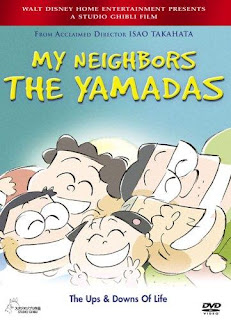 I'm picking off the last few Studio Ghibli movies that I haven't seen yet, and so the Hornswoggler family recently saw My Neighbors the Yamadas for one of our Friday family movie nights.
It's directed by Isao Takahata, better known for Grave of the Fireflies (which I still haven't seen, since it would be too much for my sons and I don't really have time to see animated movies without them) and for Pom Poko (which might just be the one movie my older son has seen the most; he returns to it every two or three months like clockwork, and like no other movie). Yamadas is a much lighter movie than either of those, though, a pastel-colored cartoony series of loosely interlinked sketches about one Japanese family.
There's no continuing story, just a series of story-like scenes about these five people -- father, mother, grandmother (I didn't quite figure out whose mother she was supposed to be, actually), older brother, and younger sister. There's a mixture of broad comedy -- the characters are all types, though they seem somewhat less like types to those of us from the other side of the world -- and of smaller, quieter haiku-inspired moments. It's all based on a popular series of 4-panel Japanese comics by Hisaichi Ishii, which I don't think have ever been widely available in English translation -- so we're all on our own that way.
If you're willing to accept the idiosyncratic animation -- it doesn't look like any other movie I've ever seen, in its hazy, caricatured, watercolored, half-finished way -- and the lack of an overall plot arc, My Neighbors the Yamadas has a lot of enjoyment to be found in it. It's quite funny, in ways that mostly do translate. It's a bit like a more refined, though still occasionally earthy, Japanese version of the original Simpsons shorts from twenty years ago -- the stories of one family who are definitely not role models, but whom we can sometimes see ourselves in.
Odd and the Frost Giants by Neil Gaiman
 Gaiman has previously written young adult novels -- Coraline
 and The Graveyard Book
 -- and picture books -- Crazy Hair
 and Blueberry Girl
 -- but Odd and the Frost Giants sees him hitting the land in between those great children's-book empires, with a novel solidly launched at the middle-grade audience.
Odd is a short book, and somewhat obvious; Gaiman tamps down his natural slyness and wit for this younger audience in a way that he never did for their older siblings. Coraline and Graveyard Book, for all their brevity, are two of his best and most biting works, belying the usual idiocy that adult writers "limit themselves" when they writer for a younger audience. But Odd, though clever and engaging, is obviously a more circumscribed story than Gaiman's books for older younger readers.
Odd is a boy of indeterminate years, growing up smart (and lame, after an unfortunate tree-chopping accident partly caused by that cleverness) in a small Nordic village somewhere cold and unspecified, when the men of his land still went as Vikings to get what they wanted -- food, valuables, wives. Odd's own mother was raped away from Scotland by his now-dead father, which Gaiman, unsatisfyingly, mentions once early on in the novel, and then explains, with much more of a tone of juvenality than his voice can sustain, that said father was so in love with that mother that he did carry her off, but didn't touch her until he made her fall in love with him. There are writers who could pull that off -- William Goldman, in full Princess Bride mode, could, and Gaiman could have made a good run at it as well using his full powers -- but it sits their like a Lie-to-Children in this novel, a stumbling block for anyone, young or old, who is not as innocent as Gaiman assumes his reader will be.
Odd detests his stepfather and new stepsiblings, and so spends his time, at what he hopes is the tail end of a far-too-long winter, out in his father's abandoned wood-cutting hut. And there he's met by three animals -- a fox, a bear, and a one-eyed eagle. They turn out to be more than they seem, and soon Odd is off with them to confront the frost giant of the title, across the rainbow bridge Bifrost. (For Gaiman, as is often the case, is classically oriented, and so a fantasy story set among Vikings must mean their cosmology as well.)
Odd's name is in the title, and this is a book for young readers, so the reader can assume it all comes out right in the end. It also doesn't take very long to get to that end; Odd is less than two hundred pages, and those are small pages with large words on them. (Not to mention the dozen or two full-page illustrations by Brett Helquist, which are excellent but do tend to make the reading experience even quicker than one expected.)
Odd and the Frost Giants was originally published in the UK as a special edition for World Book Day -- this imposed certain limitations (of length and, I believe, of audience as well) that made this book what it is. It's a great cause, and there are probably thousands of kids in the UK for whom Odd is the first book they owned for themselves, or read with enjoyment. But, outside of that, it is a quite slim, and rather more juvenile than expected, minor work from Gaiman. I only mention that so that the completists among you don't get your expectations up -- but, if you have a young reader nearby who might appreciate Odd and the Frost Giants, go and find it as quickly as you can.
Tuesday, September 22, 2009
Death and Other Defining Moments
Yesterday, ComicMix posted my review of Seth's excellent graphic novel George Sprott: 1894-1975 , for your reading enjoyment.
Now, if you'll excuse me, I should be writing something else for them right this moment.
, for your reading enjoyment.Now, if you'll excuse me, I should be writing something else for them right this moment.
Movie Log: Duplicty
 Tony Gilroy's second film as both writer and director -- after the tense and satisfying Michael Clayton -- is Duplicity, the same sort of story told sideways and with a lighter heart. It's not as successful as Clayton is, in the end, perhaps because Gilroy plays the industrial espionage straight but, in the end, doesn't want the audience to take it all that seriously.
So Duplicity wants to be both a thriller and not a thriller, to wow us with its tricky double-reversals and repeated dialogue, its complicated stutter-step chronology, and its high-wattage movie stars, while at the same time smiling and telling us not to be so serious, to just take it easy.
It's a movie that rewards focus, and so probably played better on a big screen in a dark room; living rooms are much better for movies that don't require tight attention. I, unfortunately, did see it in a living room, and it may not perhaps have gotten my full attention and understanding because of that.
Those two movie stars are Clive Owen and Julia Roberts, who bounce off each other repeatedly as they cross and double-cross everyone in sight (including each other, themselves, their bosses and partners, and pretty much every other character in the movie). They're smart and stylish and very good at their spycraft; their first meeting takes place with Claire (Roberts) working for the CIA and Ray (Owen) on the side of MI6, but the rest of the movie covers the period when they've gone private, working in tight counter-espionage shops for two big personal-products companies (shampoo, deodorant, etc.).
There's no point in trying to explain all of those feints and parries -- to do so would require a diagram, or the original screenplay -- but Duplicity does work its way through a long sequence of scenes that each make the audience go back and reconsider a lot of what they assumed from those earlier scenes. It felt a bit overlong in my living room, though -- it has to push a big package uphill for a long time before the pieces are all in place and it can start running down through the fun parts at the end.
It is a movie for adults about adult things -- greed, lying, sex, ambition, professional pride -- and that is a thrill to see. It's also done well in an era of dumb "adult" thrillers and tedious teen-oriented junk, so it may well be counter-productive to point out that Duplicity isn't as fun or exciting as it should be. But it's true; this is a decent movie, but it's no Michael Clayton.
----------------
Listening to: Dylan Champagne - Junk Parts
via FoxyTunes
The Hotel Under the Sand by Kage Baker
 A girl is caught in a dangerous storm, and torn from everything she knows. She's cast adrift on a strange shore, and has to fend for herself...but she quickly meets a boy of about her own age, and comes to build a new society with him and the others who accumulate around them.
The Hotel Under the Sand is, surprisingly, very similar in premise to Terry Pratchett's 2008 novel Nation, though it goes in a quieter, more old-fashioned direction, and is more suitable for younger readers. Where Nation is a reasonably realistic novel -- though set in a world populated entirely by Pratchett characters, people a bit smarter and more self-conscious and English than is true in the real world -- Hotel is a tale for children, with a tone only slightly removed from the nursery and the classic 19th century stories meant to be read aloud by parents and guardians.
Hotel is the story of a girl named Emma,
a little girl both clever and brave, and destined -- so you might think -- to do well in any adventure that came her way. But the first adventure Emma had was dreadful.Hotel is also dedicated to a girl named Emma, though I have no idea what storms she may or may not have seen. But it's like Alice in Wonderland in that way -- being the fictionalized adventures of a character who shares the name of a person the author knows. In Emma's case, she's thrown, by that storm which Baker never specifies, onto a beach where a century before the Grand Wenlock Hotel was buried irretrievably by the Storm of the Equinox. She's told this by a helpful ghost, Winston, who had been the Bell Captain of that hotel, which was struck by disaster just as it was about to open for the first time.
One day a storm came and swept away everything that Emma had, and everything that Emma knew. When it had done all that, it swept Emma away, too.
It might have been a storm with black winds, with thunder and lightning and rising waves. It might have been a storm with terrible anger and policemen coming to the door, and strangers, hospitals, courtrooms, and nightmares. It might have been a storm with soldiers, and fire, and hiding in cellars listening to shooting overhead. There are different kinds of storms. (pp.11-12)
The hotel -- which had a field that slowed time within its confines -- reappears in another storm, due to (unknowing) actions of Emma, and so she moves into it with Winston as a guide. Before long, a cook (and her dog), an only slightly scruffy pirate, and the runaway great-grandson (and last heir) of the hotel's owner have joined her there, and the hotel has opened for a group of very unlikely clients. (And Hotel's expected readers won't have any clue who any of them are -- and even I have to admit that I found one of the four groups utterly opaque.)
There are a few moments that have a bit of tension, but not much; this is a consolatory fantasy, and not one with sharp teeth. Emma and her friends win through in the end, as we knew they would. Hotel Under the Sand feels like it, like the Hotel Wenlocke, was buried in the sands for a century, kept untouched from the ravages of time -- not so much in the language, which is much like Baker's other work, though slightly simplified for this audience, but in the story-telling, which is in a style that's been out of fashion for children's books for at least four decades. It's a cozy book, for good or bad, and readers who treasure coziness will enjoy it the most.
----------------
Listening to: The Frames - Falling Slowly
via FoxyTunes
Monday, September 21, 2009
Movie Log: Sunshine Cleaning
 I've seen six movies since Sunshine Cleaning -- and that's leaving aside the ways that's its set up as a semi-generic indy movie, with a lot of familiar elements to confuse viewers like me -- so my memories of it are fuzzy.
Amy Adams is ex-cheerleader Rose Lorkowski, and, for once in this history of movies for adults, we're supposed to be on her side. Luckily, her cheerleader-ness isn't particular important to the movie, and her post-high-school history never becomes clear. (Sunshine Cleaning has a lot of vagueness, particularly in its characters' backgrounds, where a more careful screenplay would have had specifics.) She has a son -- who the movie hints, but never quite manages to say, is the result of her long-term and now adulterous relationship with her highschool boyfriend Mac (Steve Zahn) -- and whom is having issues at school that essentially get him kicked out of the public system.
(The Wife and I, who have a special needs child of our own, were annoyed and dumbfounded by this turn of events, particularly since, at this point in the movie, we still thought it took place somewhere in California. When it finally located itself outside Phoenix in neo-Libertopian Arizona, this event became slightly more reasonable, but I really doubt any state is so blunt and old-fashioned as to state that a parent needs to place their child in a private school, since the public system won't accommodate him.)
Anyway, Rose's life is a mess -- she lives at home with her always scheming father Joe (Alan Arkin, proving the most obvious strategem to make this film look like Little Miss Sunshine Redux), sleeps with Mac when she's supposedly taking nightschool courses, and cleans houses for the now-rich girls she went to school with. And so she decides to better herself in the traditional American way: find a job that pays really well, and do it in a half-assed way.
For Rose, that's hazmat cleaning -- crime scenes, suicides, and other dead bodies, mostly. It's dirty, disgusting, and horrible, but it does pay very well. She drags her ne'er-do-well sister Norah (Emily Blunt) into the business, and things go along entertainingly for a while until there's the required Big Problem.
The Big Problem gets a Big Solution, with much hugging, and everyone's self-esteem is restored. Rose even gets what might turn out to be a love interest -- a quirky, damaged character, of course, since this is an indy movie -- who is not married to someone else.
Sunshine Cleaning means well, and it's pleasant to watch, with solid acting and decent dialogue. But it doesn't quite cohere, and it feels like it was made up on the fly from the rag-bag of Random Indy Movie Tropes. If you like seeing movies like this, Sunshine Cleaning is a minor entry, but moderately worth it. If you generally don't like movies about aimless people trying to figure out what to do with their lives, there's no reason to seek out this one.
----------------
Listening to: The Moldy Peaches - Anyone Else But You
via FoxyTunes
Reviewing the Mail: Week of 9/19
 This was one of those weeks dominated by a single big box -- in this case from Dark Horse -- so I'll talk about the other things first and then dive into that. But, first: the explanation! I review books, so I get books to review -- sometimes things I ask for, sometimes not, and always more than I'll be able to manage to read. I do these Monday-morning posts to make sure that I mention everything -- the books I know I'll love, the books I'll read five pages of and quietly drop, the ones that will fall deeper and deeper into a pile until they're finally eaten by a grue.
First this week is a book with the cheery title It's Beginning to Look a Lot Like Zombies!
 , a collection of Christmas carols written by Michael P. Spradlin with an introduction by Christopher Moore. It also has a number of cheery illustrations by Jeff Weigel, full of rotting flesh and juicy brains. It's one of those cute little impulse buys that I expect will sit at the cash-wrap in various bookstores starting in November, when it will be published by Harper. (Given that Spradlin is, by day, a Harper sales rep who lives in Michigan, I hope one particular chain will be particularly enthusiastic about it.)
 The fifth and last of the Joe Pitt Casebooks series from Charlie Huston -- about vampires in New York, who act very much like real-life organized criminals and gangs -- is My Dead Body
 , coming as a trade paperback from Del Rey on October 13th. (I reviewed one of the earlier books, No Dominion, last year, and keep thinking that I need to find time to read the rest of the series. Maybe I will now that it's complete.)
I mentioned Douglas Clegg's new novella-as-a-book Isis
 when I saw a copy at BEA this summer; it's now turned into a real hardcover (slim and handsome, just a bit too late for a Fashion Week tie-in) from Vanguard Press. It's illustrated, in a great spidery, neo-19th century style, by Glenn Chadbourne, and it will be officially published in October.
 I've complained before about graphic novels from major publishers that downplay the work of the artist -- usually with a credit like "illustrated by" or "artwork by," even in cases where that artist was working from a vague script without even panel breakdowns. But I now have an even worse case -- The Zombie Survival Guide: Recorded Attacks
 is credited only to Max Brooks on the front cover and title page. The artist, Ibraim Roberson, is merely mentioned on the bottom of the back cover and with a small reference on the copyright page. Three Rivers Press, this is simply unacceptable. A graphic novel is not a work by one writer, and it's stupid to pretend that it is. From that copyright page, it also looks like Recorded Attacks collects comics stories originally published by Avatar, but it doesn't make that connection clear at all. What Recorded Attacks does have, once the reader can figure it out, is a dozen comics stories of between five and twenty pages, all drawn by Roberson and written by Brooks, about attacks by zombies at various points in history. If you like reading about random historical people being eaten by supernatural creatures -- and seeing that depicted in an appropriately detailed, gory style -- Recorded Attacks will be available on October 6th.
And now I get into the Dark Horse box -- everything from here on out is published by Dark Horse, and is available now.
 Next is Usagi Yojimbo: Bridge Of Tears
 , the twenty-third collection of the long-running series by Stan Sakai. I've only looked at Usagi intermittently, but even I know that it's about an anthropomorphic (rabbit) samurai in classical Japan, wandering and having the kind of adventures that honorable ronin have, among a series of other characters who look more individual and less "furry" than is usual for anthropomorphic comics. And now that I have this book in my hands, I guess I should read it and do a more serious review of Usagi.
Indiana Jones Omnibus: The Further Adventures Volume 2
 collects the early '80s series from Marvel comics -- remember when big comics companies could have long-running, popular series in the first place, and they're weren't necessarily all long-underwear types? Ah, good times -- written by David Michelinie, with art from a variety of folks like Herbe Trimpe, Jackson Guice, Luke McDonnell, David Mazzucchelli, and even Steve Ditko. This book collects issues 13-24 of the Further Adventures of Indiana Jones series, plus the three-issue adaptation of the movie Temple of Doom, which interrupted it. It looks like typical '80s Marvel adventure comics -- wordy, with occasionally shaky continuity on character's faces, but full of action and forward momentum.
 And then there's Kull: The Shadow Kingdom
 , a graphic novel adapted from Robert E. Howard's story of the same name by Arvid Nelson, with art by Will Conrad and Jose Villarrubia. Dark Horse is doing a lot of Howard-related books recently -- there's their long-standing Conan series, both new work and reprints of the old Marvel stuff, plus this and a Solomon Kane book coming up -- and I thought I'd try to do a big Howard-at-DH review this fall. Now that I've actually said that in public, I hope it will happen.
Speaking of Howard and Dark Horse, I was surprised to see that their reprints of the old long-running Marvel series has hit Volume 18: Isle of the Dead
 . (I own the first five, but stopped following it closely after that, since I was primarily interested in the Windsor-Smith era.) This one has stories from 1982 and 1983, written by Bruce Jones and Steven Grant, with art from John Buscema (who did Conan, off and on, for a very long time, I note once again), Marc Silvestri, Val Mayerik, Alfredo Alcala, and others.
 Speaking of Conan stories from Marvel in the early '80s, Dark Horse also recently published The Savage Sword Of Conan Volume 6
 , which collects all of the 1981 issues of that Marvel black-and-white magazine in one of those phone-book-looking collections that everyone seems to have forgotten Dave Sim invented. Savage Sword was the older brother of the Marvel Conan comics series, aimed at a somewhat older audience, with more graphic violence, no Comics Code, and even a few hints of sex. These stories are by Roy Thomas, Michael Fleisher, and Bruce Jones, with, again, most of the art by the hard-working John Buscema. Gil Kane shows up for one issues, and Ernie Chan inks Buscema most of the time, and does one issue solo.
 And last for this week is Turok, Son of Stone Archives, Volume 2
 , collecting the second six-pack of the Dell comics series from the '50s. This was well before my time, and it looks a bit crude these days -- particularly in the bland typeset lettering -- but I'm sure there will always be an audience for stories about Indians fighting dinosaurs. At least, I wouldn't want to live in a world where no one cared about Indians fighting dinosaurs!
----------------
Listening to: Rupa & the April Fishes - Une Américaine à Paris
via FoxyTunes
Subscribe to:
Posts (Atom)
