Tuesday, October 31, 2006

Itzkoff Watch Continues

One of my top-secret, highly-paid spies has slipped me information that indicates that this week's New York Times Book Review will have another "Across the Universe" column by a certain Dave Itzkoff.

In fact, I have seen a PDF of this column, which I will read and report back on once I get to a printer. Further mockery of Itzkoff should be expected.

It's another theme column, covering Neil Gaiman's new story collection Fragile Things and Absolute Sandman Volume 1, the massive compendium of the first half of the Sandman comic, written by Gaiman and illustrated by various folks.

First thoughts, before reading:
  1. Itzkoff's not going to cover much of the field if he only reviews at most two closely-related books once a month.
  2. I guess this answers the question of whether "science fiction" (Itzkoff being the official SF reviewer) includes "fantasy" for New York Times purposes.

Monday, October 30, 2006

Book-A-Day #106 (10/30): Chicken With Plums by Marjane Satrapi

Satrapi's fourth graphic novel, after the two volumes of Persepolis (about her own childhood) and Embroideries (a more loosely organized book about women's sexuality, more or less). This one is apparently the true story of Satrapi's grand-uncle, who willed himself to die over a week in 1959 in what I can only characterize as a pure snit.

I have very little sympathy for tortured artists, and that's what Nasser Ali Khan presents himself as -- a man too damaged to live once his wife breaks his precious musical instrument (a tar) during a fight (which seems to mostly be about how he's a self-pitying musician who doesn't do anything and leaves her to raise the family and make the steady income in the house).

You see this? This is the world's smallest violin, playing a sad song just for him.

Given that I thought the main character was an asshole, I didn't warm to this story much. It's a short graphic novel (84 pages), but it jumps around in time, perhaps because Nasser's story is pretty short and pointless to begin with.

I've liked each Satrapi book less than the one before (the first volume of Persepolis was her best work, I think), and I might just avoid her next one, unless I have a reason to believe she's reversed that trend. Perhaps a non-autobiographical story would reinvigorate her muse?

The Fabulous Book-A-Day Index!
Edited 1/2/07: the huge list of links was getting annoying, and screwing up my Book-A-Day searches, so I've killed them in these posts that had them.

Sunday, October 29, 2006

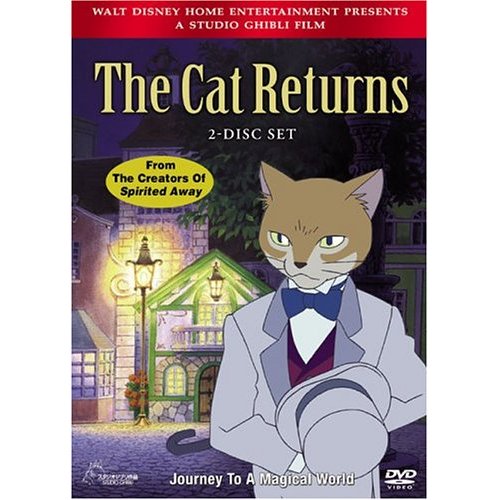
Movie Log: The Cat Returns

I saw this a week ago now, with the boys, as our "Boys' Movie Saturday" selection. (This week, they wanted to watch Aladdin, but that ended up being Thing 1 poking through the 2nd disc of the 2-disc set and watching various odd things, so I'm not counting that.)

My memories are getting a bit faint now -- I'll try not to tax them too much.

The Cat Returns is a minor Studio Ghibli movie -- before I look it up on IMDB, I'll guess that it was done for TV or a direct-to-video release (what I think they call an OAV, if I'm not misusing that term). The title positions it as a sequel to Whisper of the Heart, since "the cat" here is a figurine that played a role in that movie (and came to life in a short story-within-a-story near the end, supposedly written by Whisper's heroine). Presumably, we're to think of The Cat Returns as another story about the Baron character from Whisper's story-in-a-story, and probably as having been written by that girl what's-her-name.

Well, IMDB doesn't entirely clear things up -- it seems that this started as a twenty-minute short for a theme park, but grew along the way. (I can't tell if it was released theatrically in Japan, but it certainly doesn't seem to have been in the USA.)

In any case, it's a small, minor, cute little movie about a girl and some cats. She saves a cat from a speeding truck on the way home from school one day, and soon finds herself in the land of the cats with multiplying troubles. My boys enjoyed it, but didn't love it -- I bet girls would like it better, and cat-crazy girls the most. For adults, I wouldn't recommend going out of your way to see it unless (like me) you're trying to work through all of the Studio Ghibli movies.

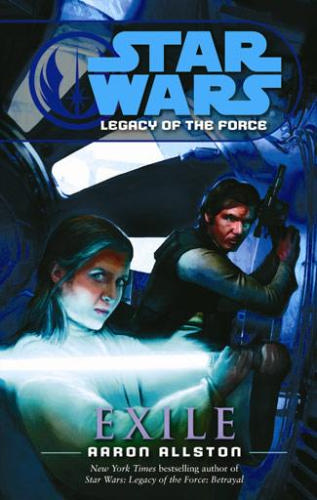
Book-A-Day #105 (10/29): Star Wars: Legacy of the Force: Exile by Aaron Allston

Since this book doesn't publish until February 27, I won't talk about plot points (they wouldn't make much sense without knowing the previous three books in the "Legacy of the Force" subseries, anyway, and #3, Bloodlines, doesn't even publish for a month).

I can say I had more fun reading this than I have with most recent Star Wars novels, whatever that means -- it felt zippier than previous "Legacy of the Force" books to me (on the other hand, I've just been on vacation for a week, so that could just mean that I'm not sleep-deprived for once). If you have any reason to believe your tastes are like mine when it comes to space opera, you'll probably like this. If you're on the Star Wars-hater side to begin with, though, this book won't convince you -- try Sean Stewart's Yoda book or Matt Stover's Shatterpoint for that.

The Fabulous Book-A-Day Index!
Edited 1/2/07: the huge list of links was getting annoying, and screwing up my Book-A-Day searches, so I've killed them in these posts that had them.

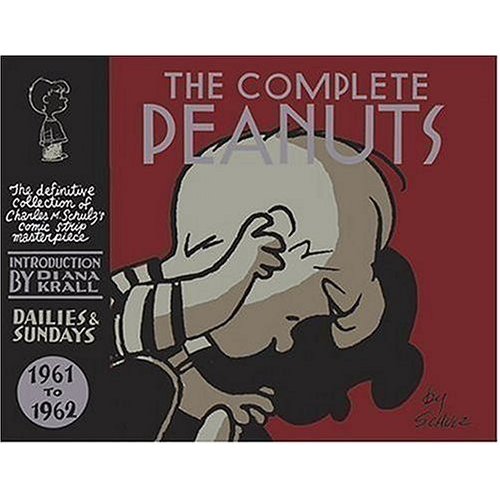
Book-A-Day #104 (10/28): The Complete Peanuts, 1961 to 1962 by Charles M. Schulz

It's the sixth volume in the series collecting all of Schulz's Peanuts cartoons, in order. What's left to say about these books at this point? The books are still wonderfully designed (by the cartoonist Seth), the cartoons themselves are still little gems of bittersweet humor, and Schulz's drawing had hit its expressive peak by this point. (Though I still have to admit my personal preference for those first couple of years of the strip, when the humor was a bit meaner and the character-models hadn't quite gelled yet.)

This is good stuff, and the best thing about strip cartoons is that you don't need to start anywhere in particular -- if you happen to find any of the Complete Peanuts books cheaply, grab them and start reading there.

The Fabulous Book-A-Day Index!
Edited 1/2/07: the huge list of links was getting annoying, and screwing up my Book-A-Day searches, so I've killed them in these posts that had them.

Saturday, October 28, 2006

Book-A-Day #103 (10/27): PvP, Vol. 1: At Large by Scott Kurtz

The first collection of the popular webcomic, which I bought because I found it incredibly cheap at the comics shop this week. I've been reading this online for close to a year now, but hadn't had it in any dead-tree form before now.

And, damn it, I think I'm now going to have to buy the second collection, because this is really funny stuff -- and it's even funnier reading a whole bunch at once. I hate it when that happens.

The Fabulous Book-A-Day Index!
Edited 1/2/07: the huge list of links was getting annoying, and screwing up my Book-A-Day searches, so I've killed them in these posts that had them.

Quote of the Week

"History, n. -- an account, mostly false, of events, mostly unimportant, which are brought about by rulers, mostly knaves, and soldiers, mostly fools."
- Ambrose Bierce, from The Devil's Dictionary

Friday, October 27, 2006

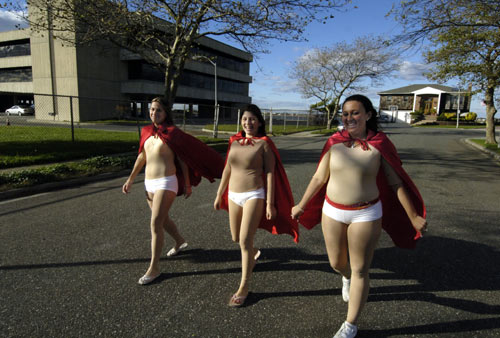
Mean Principal Bans Underpants Girls

Since Antick Musings is your source for all Captain Underpants-related news, I needed to pass on this:

According to Newsday, a fine Long Island fishwrap, three 17-year old seniors at Long Beach High School were sent home on Wednesday because they had dressed up as Captain Underpants (with capes and tighty whiteys over flesh-colored leotards) and their principal thought they looked "too naked." Wednesday was Superhero Day at the school, part of a week-long series of odd dress-up days that leads Your Intrepid Reporter to wonder if they ever get any work done in this school. (And also to wonder whether they expected demure and sensible costumes on Superhero Day -- clearly no one in administration at Long Beach High has been in a comics shop recently.)

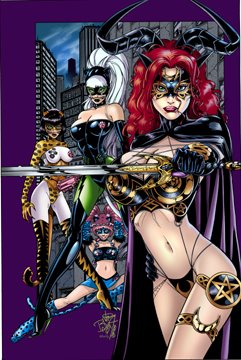
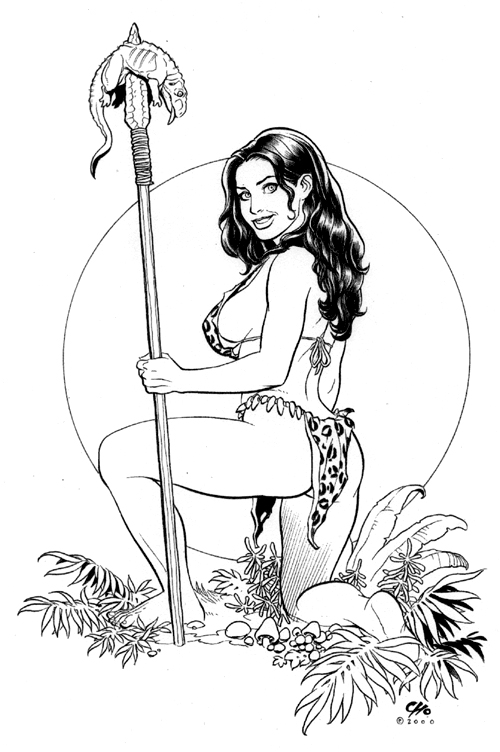
It's a good thing no one dressed up as Tarot, Cavewoman, or Witchblade -- or that principal would see what "comic book naked" really means...

The Dreaded To-Be-Read "Pile"

Patrick, over at Pat's Fantasy Hotlist, has dared us all to reveal the contents of our to-be-read piles. While I don't have time enough to type in all of the titles, I can give you an overview, since -- inspired by him -- I've just measured my shelves.

My unread shelves total about eighty-seven and a half feet (a thousand and fifty inches). The books range in size from a quarter inch to two inches, so let's call it about three books per two inches for a rough average -- that gives me about fifteen hundred unread books. In recent years, I'm averaging reading about three hundred twenty books a year, of which roughly 62 percent (or one hundred ninety-eight books) were for myself (and not for work). At that rate, if I don't add any more books to the stack, I can finish up everything I already have in only about seven and a half years.)

Some of the things I have to read, choosing one book semi-randomly from each distinct area or pile, are:
  • The Rainbow Fairy Book by Andrew Lang, illustrated by Michael Hague
  • A History of Britain (three volumes) by Simon Schama
  • The Plot by Will Eisner
  • Ulysses by James Joyce
  • He Knew He Was Right by Anthony Trollope
  • American Poetry (Library of America, probably edited by someone, in four very large volumes)
  • The Letters of Evelyn Waugh edited by Mark Amory
  • Collected Poems by Philip Larkin
  • The Mysterious Flame of Queen Loana by Umberto Eco
  • The Fortress of Solitude by Jonathan Lethem
  • Yaleen by Ian Watson
  • White Time by Margo Lanagan
All of those books share two things in common: 1) I can read their titles, more or less, from where I'm sitting now, and 2) I'm not likely to get to any of them this year.

Yet Another iTunes Meme

Because memes are much more fun than actual thought, right? This one I picked up from Paul Cornell:

Earliest Track in My Library:
The Raymond Scott Quintet, "Powerhouse" (1937) -- along with seven other songs from that year on the same CD. You know this song; it's the one that plays whenever there's a machine run amok in any Warner Brothers cartoon of the '40s and '50s. See? You're humming it now.

Year from Which I Have Most Tracks:
1993 wins, with 704 tracks. That was the year the kind of music I like the most -- vaguely "alternative" rock with smart lyrics -- was actually popular, for a brief, shining, moment, so it makes sense.

Earliest TV Theme:

I only have a handful of TV show themes, and they're not categorized as that in iTunes, so trying to figure this out would be a pain and wouldn't tell me anything. Pass.

Five Star Ratings from the Year I was Born:
There are nine of them:
  1. "Golden Slumbers" by The Beatles
  2. "Victoria" by The Kinks
  3. "Arthur" by The Kinks
  4. "Cinnamon Girl" by Neil Young
  5. "Careful With That Axe, Eugene" by Pink Floyd
  6. "The Nile Song" by Pink Floyd
  7. "You Can't Always Get What You Want" by The Rolling Stones
  8. "I Want To Take You Higher" by Sly and the Family Stone
  9. "Christmas" by The Who
Five Star Ratings from the Year I was Sixteen:
Twenty-one of them! I'll italicize the ones I actually listened to and loved at the time (as opposed to the ones I discovered later).
  1. "E=MC2" by Big Audio Dynamite
  2. "Take the Skinheads Bowling" by Camper Van Beethoven
  3. "Brothers in Arms" by Dire Straits
  4. "Anything, Anything (I'll Give You" by Dramarama
  5. "White Lies" by Jason & the Scorchers
  6. "Running Up That Hill (A Deal With God)" by Kate Bush
  7. "Just Another Day" by Oingo Boingo
  8. "Dead Man's Party" by Oingo Boingo
  9. "No One Lives Forever" by Oingo Boingo
  10. "Wendell Gee" by R.E.M.
  11. "I Can't Hardly Wait (Tim Version)" by The Replacements
  12. "Here Comes a Regular" by The Replacements
  13. "Cannon Song" by Stan Ridgway
  14. "Road to Nowhere" by Talking Heads
  15. "Stay Up Late" by Talking Heads
  16. "Singapore" by Tom Waits
  17. "Cemetery Polka" by Tom Waits
  18. "Time" by Tom Waits
  19. "Bad (Live)" by U2
  20. "Love Comes Tumbling" by U2
  21. "I Held Her in My Arms" by Violent Femmes
Five Star Ratings from This Year:
Three, but they're all cheats: "Teen Angst (What The World Needs Now)," "Sweet Thistle Pie," and "The World Is Mine" from Cracker's Greatest Hits Redux record (which featured re-recordings of their hits to sabotage the similar greatest hits collection from their old label, which had just dumped them). Some of the songs on Beth Orton's The Comfort of Strangers might slide up to five stars as I listen to them more, though. (And maybe something from the Elvis Costello-Allen Toussaint record The River in Reverse, though that's not as likely).

Top Ten on my Most Played List:
Probably the same as the last time I posted them:
  1. "Don't Drop the Baby" by The Judybats (36)
  2. "Better Things" by Fountains of Wayne (33)
  3. "Pictures of Matchstick Men" by Camper Van Beethoven (32)
  4. "(What's So Funny 'Bout) Peace, Love and Understanding" by Elvis Costello and the Attractions (32)
  5. "Christmas (Baby Please Come Home)" by U2 (32)
  6. "Little Red Light" by Fountains of Wayne (31)
  7. "Wall of Death" by R.E.M. (31)
  8. "Why Does the Sun Shine? (The Sun Is a Mass of Incandescent Gas) (Live)" by They Might Be Giants (31)
  9. "Spider-Man" by Ramones (30)
  10. "Maureen" by Fountains of Wayne (29)

Book-A-Day #102 (10/26): The War Within by G.B. Trudeau

This isn't one of the major Doonesbury collections, but a smaller (one strip to a page), thematic one. The theme, as you might guess, is now-helmet-less B.D.'s problems dealing with his PTSD.

It's both funny and true, in that way Trudeau can achieve intermittently, though I don't have any first-hand knowledge of combat veterans or amputees, so I shouldn't claim too much for this on my own. (But it does seem that real live soldiers have been supporting this series of strips, which is a bit odd, considering how and when Doonesbury started.)

Anyway, it's a decent Doonesbury collection, but it is all about B.D.

The Fabulous Book-A-Day Index!
Edited 1/2/07: the huge list of links was getting annoying, and screwing up my Book-A-Day searches, so I've killed them in these posts that had them.

My Favorite Fantasy Novellas of 2005

And so we finish up on Day Five.

This will be my last list, and, following WFA rules (since those governed my reading and thinking this year) it consists of stories between 10,000 and 40,000 words. Since there are fewer stories of this length published, I just have ten stories to mention. And the list, like the others, is in alphabetical order by author:
  • "The Imago Sequence," Laird Barron (F&SF 5/05) -- I don't love it as much as some people do, but it's definitely a major story.
  • "In the Machine," Michael Cunningham (Specimen Days) -- Oh, it so counts as a novella. (Specimen Days is less of a novel than Van Vogt's most obvious fix-ups.) But this is a really good fantasy novella.
  • "Voluntary Committal," Joe Hill (20th Century Ghosts) -- A great, great creepy story. Everyone should read this. Read it before his novel comes out, when everyone in the world will be talking about how great Joe Hill is.
  • "UOUS," Tanith Lee (The Fair Folk, edited by Marvin Kaye) -- Speaking of creepy, this story ups the creepy quotient even from Hill's already high level. After a long era of sweet cutesy-pie fairies, and tall Tolkienesqe elves, we're finally (with stories like this and Jonathan Strange & Mr Norrell) getting those mean, sneaky, folkloric "fair folk" back.
  • "Magic for Beginners," Kelly Link (Magic for Beginners and F&SF 9/05) -- It's the story of 2005, and one of Link's best, though I'm still not sure what it all means.
  • Another War, Simon Morden (Telos, published as a book) -- It's Lovecraftian, which I nearly always like when it's done well, and it's straightforward rather than being artsy (which I appreciated in the middle of reading a lot of artsy stories for World Fantasy).
  • "The Gypsies in the Wood," Kim Newman (The Fair Folk) -- It's a bit too long, and the structure is a bit wonky, but this is essentially an excellent novella with a very good short story stuck onto the front of it.
  • "The Last Ten Years in the Life of Hero Kai," Geoff Ryman (F&SF 12/05) -- I am inordinately fond of extremely structured stories, but I don't think that's the only reason I like this story; it's also damn good.
  • "Inside Job," Connie Willis (Asimov's 1/05) -- There are those who don't like Willis in her funny mode, but I hope even they will enjoy this odd tale, which runs straight down the line between SF and Fantasy, demanding to be both and neither at the same time.
  • "Even the Queen," Jane Yolen & Midori Snyder (The Fair Folk) -- I'm not entirely convinced by the ending, but otherwise this is an excellent story.

Thursday, October 26, 2006

Metaphor-O-Rama!

From "The Sharpened Quill," a review of several recent books on Thomas Paine, in The New Yorker's October 16, 2006 issue, by Jill Lepore:
Thomas Paine is, at best, a lesser Founder. In the comic-book version of history that serves as our national heritage, where the Founding Fathers are like the Hanna-Barbera Super Friends, Paine is Aquaman to Washington's Superman and Jefferson's Batman; we never find out how he got his superpowers, and he only shows up when they need someone who can swim.

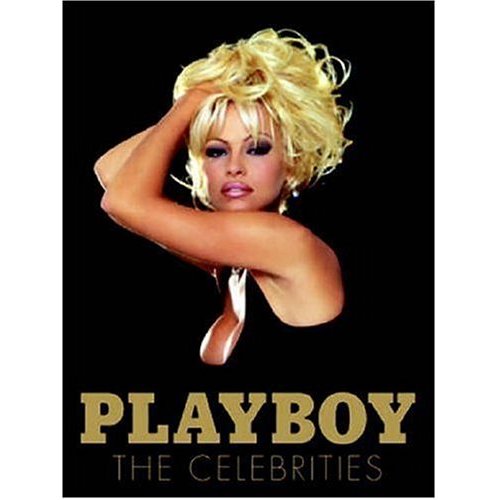
Book-A-Day #101 (10/25): Playboy: The Celebrities

Presumably, Playboy: The Celebrities was edited or compiled by someone, but you can't figure that out from the book itself; it credits an introduction by Hugh Hefner and an afterword by Gary Cole (Playboy's photo editor for the past thirty years), but nothing else. I imagine Cole probably put the book together, with Hefner having veto power, but it could easily have been someone completely different, or a shadowy cabal of Playboy functionaries. (Can a magazine have shadowy functionaries, by the way?)

From the title, you've already figured out the point: this is a collection of naked pictures, mostly tasteful, of supposedly famous women, mostly blonde. The standard of fame here is quite variable, and the book seems to be skewed to the last decade. So we have Brooke Burke, a minor cable TV personality, prominently featured, along with others of her ilk. The book opens with someone named Jamie Pressly, who is a fine example of the standard '90s Playboy blonde -- you know, the kind that Hefner needs to have six of in all of his creepy recent publicity photos? -- but whom I've never heard of.

I seem to recall that there are women who were much more famous in their day who appeared naked in Playboy than the ones who appear in this book, but it's possible memory is playing me false. (It's also possible that Playboy didn't secure adequate reprint rights for those hazily-remembered photos at the time, and so couldn't include them here.) In any case, the women here break down into several categories:
  • now-forgotten "European" actresses: Dominique Sanda, Marissa Berenson, Jane Birkin, Elke Sommer
  • minor pop stars trying to create a comeback: Jody Whatley, Samantha Fox, Deborah Gibson, LaToya Jackson, Belinda Carlisle
  • celebrities who posed naked long before they were famous: Vanna White, Madonna, Deborah Harry, Lauren Hutton
  • people current college students will recognize (though why anyone would expect college students to buy a $40 book is beyond me): the aforementioned Brooke Burke, Carmen Electra, Denise Richards, Gena Lee Nolin, Charisma Carpenter
  • people current nursing-home residents will recognize: Dian Parkinson, Nancy Sinatra, Carol Lynley
  • Playboy Playmates who went on to minor acting careers: Donna D'Errico, Pamela Anderson (whose original face, I am reminded, was actually quite cute), Erika Eleniak, Brande Roderick, Jenny McCarthy, Kelly Monaco, Anna Nicole Smith, Barbi Benton (from back in the days when Playmates could have authentic smiles rather than bad porn-movie come-hither looks)
  • John Derek's wives: Ursula Andress, Linda Evans, Bo Derek
  • supermodels trying to pretend they're not entirely skin and bones: Stephanie Seymour, Angie Everhart, Cindy Crawford, Rachel Hunter, Elle Macpherson, Naomi Campbell
  • actresses trying to sex up their careers with classy black-and-white shots: Joan Severance, Farrah Fawcett, Robin Givens, Brigitte Nielsen
  • the old standbys: Marilyn Monroe, Bettie Page, Jayne Mansfield
  • women who got naked because, apparently, it was the '70s: Melanie Griffith (looking younger than you can imagine), Suzanne Somers, Raquel Welch, Valerie Perrine, Kim Basinger
  • people I have never heard of: Kylie Bax, Teri Polo, Kiana Tom
  • and young women trying to get out of their families' shadows: Rae Dawn Chong, Mariel Hemingway, Sheri Belafonte
There is also a movie still of Sharon Stone from Basic Instinct (you know the one), which, of course is a cheat -- the movie had nothing to do with Playboy.

If you'd like naked photos of some appreciable fraction of those women in your own home -- and the pictures are all professional and many of them are very nice -- this is a book for you. If you would like words to explain or contextualize the nudity, you are out of luck -- this book has short bits of text at fore and aft, but otherwise is just captioned.

The Fabulous Book-A-Day Index!
Edited 1/2/07: the huge list of links was getting annoying, and screwing up my Book-A-Day searches, so I've killed them in these posts that had them.

Comic Shop Trip: 10/26

I needed to get to the comics shop (since I only make it there once a month to begin with), and I needed to drop off my 2007 health-care forms (they always seem to be due the week I'm on vacation), so I took a quick trip into the city.

I managed to get in and out of the office in about half an hour, without picking up my phone or opening my e-mail (though I did open and organize the pile of packages on my desk -- there's some things I'm just compelled to do), so I'm moderately proud of myself.

Anyway, at that comics store, I got three comics and two manga-sized trade paperbacks for Thing 1 (the latter to be doled out for car trips, bribes, and whatnot), and, for myself, two comics and a bunch of books:
  • Dork #11, the new Evan Dorkin comic
  • Castle Waiting, Vol. 2 # 2, which will go on the pile under #1, and get read eventually
  • Path of the Assassin, Vol. 2
  • PvP at Large, a collection of the webcomic that was on the sale shelf for $3.75, so I couldn't pass it up
  • Scout, Vol. 1, a collection of the '80s comic that I really hope still holds up (since I loved it then)
  • Fables: 1001 Nights of Snowfall
  • Nexus Archives, Volumes 3 and 4, which were also on the sale shelf for great prices
  • Spectrum 13, which I had to buy in a store this year (from which you can probably guess that the SFBC won't be selling it -- not my choice, but it happens)

My Favorite Fantasy Short Fiction of 2005

And so we come to Day Four...

Since I worked up all of my lists for World Fantasy purposes, I've divided the world of short fiction into two: short fiction (under 10,000 words) and novella (10,000 to 40,000 words).

This list is much longer than the others, since it includes all of the stuff I liked enough to scribble down on my WFA pad. For that, and other reasons, this list will be the least helpful for those of you trying to figure out what will win. As usual, everything is in alphabetical order by author, and I'll refrain from saying that anything is my favorite. Perhaps you should think of this as a virtual "Best of the Year" collection?
My Top 10:
  1. "Angry Duck," Scott Bradfield (F&SF 7/05) -- I don't think even Gordon Van Gelder, who originally bought it, likes this story as much as I do. But how can you not love the story of a duck professor?
  2. "Is There Life After Rehab?" Pat Cadigan (Sci Fiction 8/17/05) -- Cadigan always has a great line in wry and ironic dialogue, and here she has a great hook to hang them on.
  3. "Chester," David Gerrold (F&SF 6/05) -- My second animal story of the list, after "Angry Duck." Perhaps I'm becoming an old softie? But this is a story that doesn't go the way you expect, which I really appreciated.
  4. "The Cape," Joe Hill (20th Century Ghosts) -- I don't consider "Best New Horror" to be a fantasy story, so I think this was Hill's best work at this length in genre for 2005. And I certainly don't ever want to meet a Hill character, in a darkened alley or a brightly-lit room.
  5. "A Cheap and Frugal Fashion," Heather Martin (Electric Velocipede 8) -- My wife has had tightwad tendencies, off-and-on, so this story really spoke to me, and I particularly loved the everyday-ness of it.
  6. "Go Between," China Mieville (Looking for Jake) -- Somewhat political, as we've come to expect from Mieville, but this also has an existentialism that's not as usual, and put me in mind of Greg Egan stories like "The Infinite Assassin."
  7. "'Discrete Mathematics' by Olaf and Lemeaux, or, The Severed Hand," David Connerley Nahm (Lady Churchill's Rosebud Wristlet #17) -- Another wonderful, wonderful story that you might have to be me to appreciate. Metafictional in the very best ways.
  8. "A Christmas Card," Reggie Oliver (The Complete Symphonies of Adolph Hitler) -- Most of Oliver's collection was pretty much the same kind of thing -- well-done ghost stories in various types of old-fashioned-feeling middle-class British surroundings -- and they were all decent stories, but the repetition hurt them a bit. This one, the last story in the book, headed off in a different direction and was very successful at it. I hope he writes more like this.
  9. "Bottom Feeding," Tim Pratt (Asimov's 8/05) -- For those still counting, this is the third animal story. It also features a great embodied metaphor of the past.
  10. "CommComm," George Saunders (The New Yorker) -- Saunders can be hit and miss for me -- sometimes he's just too arch for my tastes -- but this one is a very solid hit, right in the gut.

Others:

  • "The Two Old Women," Kage Baker (Asimov's 2/05) -- But I'm a sucker for Baker's stories, always.
  • "Two Hearts," Peter S. Beagle, (F&SF, Oct/Nov 2005) -- Which does not descend into sentimentality, but remains in the realm of honest sentiment -- quite an achievement for a sequel this long-delayed to a story that beloved.
  • "Follow Me Light," Elizabeth Bear (Sci Fiction 1/12/05) -- Creeped me out a bit, but in a good way.
  • "Magic in a Certain Slant of Light," Deborah Coates (Strange Horizons) -- Which I only fuzzily recall now.
  • "Fancy Bread," Gregory Feeley (TEL: Stories) -- Not really fantasy at all, but still a good story.
  • "Sunbird," Neil Gaiman (Noisy Outlaws, ...) -- A bit obvious, but we'll let him get away with that -- it was a YA anthology, and Gaiman made me enjoy his faux-Lafferty even though I don't have much taste for the original.
  • "Gillian Underground," Michael Jasper, Tim Pratt and Greg van Eekhout (Polyphony 5) -- Minotaurs are always cool.
  • "La Peau Verte," Caitlin R. Kiernan (To Charles Fort, With Love) -- Kiernan's stories in Charles Fort all had a similar structure (mostly that they stopped before they ended), but it probably worked best in this new story.
  • "Monster," Kelly Link (Noisy Outlaws, ....) -- This felt different from the stories in Magic for Beginners, somehow -- more dangerous and uncertain -- so I hope Link is continuing to push her stories into new places.
  • "Master Lao and the Flying Horror,"Lawrence Person (PostScripts Summer 2005) -- Not as serious as most of these stories, but a wonderful piece of swashbucking.
  • "The Other Grace" Holly Phillips (In the Palace of Repose) -- There was a SF story in 2005 with an extremely similar premise (Daryl Gregory's "Second Person, Present Tense"), which I thought was more ambitious and more successful. That has nothing to do with this story, which is a fine piece; it was just the luck of the draw. But the two stories have been rolling around my head together ever since.
  • "Anyway," M. Rickert (Sci Fiction) -- I'm afraid I don't remember what this one was.
  • "Single White Farmhouse," Heather Shaw (Polyphony 5) -- I think of this as a feel-good story, which may say something about me.
  • "Girls and Boys, Come Out to Play," Michael Swanwick (Asimov's 7/05) -- On my toteboard, this counts as SF, which is the only reason it's not in the Top 10. It had enough fantasyesque elements to mention it here, though. One of the best stories of the year, whatever genre it is.

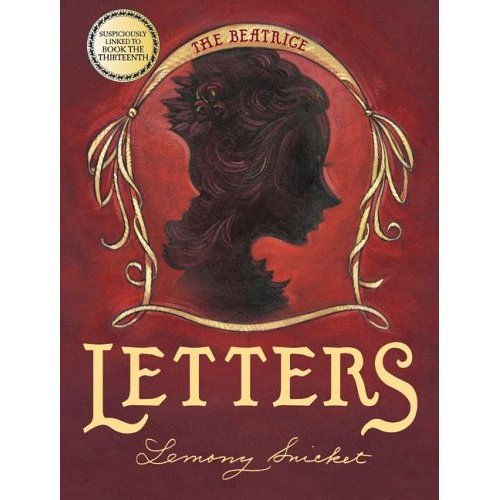
Book-A-Day #100 (10/24): The Beatrice Letters by Lemony Snicket

Huzzah! I'm still hoping to make it to the end of the year, but, if I miss a day now, at least I've hit a big round number.

I've just written an awful lot about Lemony Snicket and "A Series of Unfortunate Events" (to which this book is a pendant), so I won't repeat myself. The Beatrice Letters is a sidebar to the series, published just before The End, though I think it makes more sense read after The End. (Many of the Amazon reviewers didn't pick up on the most important clue -- that not all women named Beatrice are the same person.)

This is apparently crammed with hidden messages, cryptograms, anagrams, and other word games, but I didn't try to decode it; I just read it. (I have a prejudice against books that cannot be enjoyed by just reading them, such as the kind of mysteries you're supposed to solve yourself and the kind of SF novel which requires the reader's flying slipstick to make sense.)

It's a neat physical object -- a two-section file folder with board covers, held together by an elastic band, in which is a poster and a softcover book (with sections that can be punched out to form letters -- not that I think anyone is actually going to do that). And it's an interesting extra bit of SUE-iana, for those who don't want the story to be quite over. But it still doesn't answer all of the lingering questions, of course -- as I said about The End, that's the point.

The Fabulous Book-A-Day Index!
Edited 1/2/07: the huge list of links was getting annoying, and screwing up my Book-A-Day searches, so I've killed them in these posts that had them.

Book-A-Day #99 (10/23): The End by Lemony Snicket

"In any case, this is how all our stories begin, in darkness with our eyes closed, and all our stories end the same way, too, with all of us uttering some last words -- or perhaps someone else's -- before slipping back into darkness as our series of unfortunate events comes to an end." (pp. 319-320)

Everything I said last year about The Penultimate Peril is still true about The End; this is a remarkably dark series of books -- particularly one aimed at 9 to 12 year olds -- saturated with gloom and obsessed with the difficulty, even the impossibility, of doing good in an imperfect world. Yes, intelligent kids of that age often have realized the world is unfair and nasty, but there's a level of world-weariness here that is well beyond that. Young Adult books typically harness that preteen sense that the world is all wrong, and that those readers (the proverbial next generation) are the ones who must make everything right, if they work hard enough. But, in "A Series of Unfortunate Events," all the Baudelaire orphans can hope for is to find a somewhat safe, quiet place away from the world to live in peace -- and even that is a distant hope.

The series has also gotten more and more writerly as it went along. It always had a metafictional element, as "Lemony Snicket," the author and narrator, was a person in the fictional world of the Baudelaires, following behind them to investigate their exploits -- and it gradually became clear that his story was deeply linked to theirs.

In fact, The End (and the last third or so of the series in general) is so writerly that I started comparing "A Series of Unfortunate Events" (SUE) with the 800-pound gorilla in the room, Mr. Harry Potter. The Potter books are for kids who like stories, who love adventure -- they've translated pretty well into movies (questions of length aside), because what is special about them is the story. SUE, on the other hand, turned into an odd but interesting (and financially unsuccessful) movie -- because, I think, the SUE books are more essentially books. This story isn't "unfilmable" (hardly anything really is), but it's a story about the power of words, and the trickiness of words, so the words that tell that story are more important.
Sidebar: there's also the question of orphans. Harry is orphaned off-stage at the beginning of his first adventure -- as are the Baudelaires -- but the similarities end there. Harry's story is about finding a community in which he can be loved and appreciated, where he is important and special. The Baudelaires have only each other; even their friends and associates are forced to leave them by the press of events. They are much more thoroughly orphaned than Harry is, even though there are three of them. And even though more people die in the Potter books. And even though the Potter books seem to be more about death.

Similarly, Voldemort is, I'm afraid, a stock Dark Lord -- with his own style and verve, yes, but still a variation on a character we've seen a million times before, who can always be counted on to monologue long enough for the hero to think up a last-ditch, one-in-a-million plan to save the day. Count Olaf, on the other hand, is simply the worst relative anyone has ever had -- casually cruel, venial, unpleasantly sarcastic, and all-too-much like ourselves for comfort. Olaf is the greater creation, because we can almost like him, because we can almost see ourselves in him.
So the SUE books are something of a test, I think -- the kids who love them are going to be the next generation's serious readers, the writers and editors and critics of 2030, as well as the folks who just read those future books. Good luck to you, kids -- "Snicket" is setting the standards high for you, but I'm sure you can live up to it.

I poked around a bit at Amazon, reading the reader reviews, some of which are a bit obtuse (the ones complaining that not all of the mysteries and questions of the series have been neatly tied up and explained). Just in case any of those people are reading here, I'll try to be more blunt than Daniel Handler was:
  1. Life is unfair.
  2. Nothing ever really ends, and nothing ever really begins; everything is connected to more than you could explain, and there will always be oversimplifications, self-serving explanations, omissions and elisions.
  3. In mediocre fiction, you know the story is over when all of the good people have had a happy ending and all of the bad people have had an unhappy one.
  4. But, in great fiction, you know the story is over when you the reader have been changed by the reading of it.
  5. This story is now over.
The Fabulous Book-A-Day Index!
Edited 1/2/07: the huge list of links was getting annoying, and screwing up my Book-A-Day searches, so I've killed them in these posts that had them.

Wednesday, October 25, 2006

My Favorite Fantasy Artists of 2005

Day Three dawns cold and snowy. (Well, I'm sure it did somewhere...)

When I was working on this category for World Fantasy, I sat down with all of the piles of books, magazines and other stuff that I had on hand, and just looked at cover art for a few hours. I've often complained that the Hugo for "Best Artist" seems to go to a good artist for their body of work, but not to the artist who was doing the best work in that specific year (and that bugged me). So I wanted to make sure I had something to point to for each artist I nominated -- at least one work that I could say "this is why I nominated this guy." In fact, a couple of the people I'd been thinking of nominating didn't have any one piece I liked that much, so they didn't make it to my final list.

Anyway, this list is more idiosyncratic than the others, but I hope it will also point to some great art. Like the others, it's in strictly alphabetical order by artist; all these guys did great stuff last year. This list, unlike the others, is linkalicious, so you can see what I'm talking about.

Tuesday, October 24, 2006

Incoming Books: 24 October

I'm on vacation, which always means a trip to waste several hours at the bookstore. And this vacation, that trip was today.

I came home with two books for presents (one of the recipients of which I think reads this, so I'll say no more), one books each for Thing 1 and Thing 2, and twelve for me. (It's good to be the king.)

Of those twelve, there is only one work of fiction I haven't already read (John Banville's The Sea), and about half is comics or cartoons of various kinds. (So, with any luck, I'll be able to read a big chunk of it even before vacation is over.)

Well, gotta go -- I'm home alone with Thing 2, who always wants someone to play with him...

My Favorite Fantasy Collections of 2005

Day Two! Hello, Cleveland -- are you ready to rock?!

Again, these are all in alphabetical order by author, so you can't figure out how I voted for World Fantasy. I only have a Top 10 list here; there are fewer collections published than novels (or, maybe, I'm harder on short fiction). But all these books are well worth reading.

  • I Live With You by Carol Emshwiller
    Emshwiller writes tough, biting stories that don't always make me happy, but which do impress me.
  • 20th Century Ghosts by Joe Hill
    If there were more story collections like this, I might finally stop saying that I hate horror. At least three of the stories in here ("Voluntary Committal," "The Cape," and "Best New Horror") are world-class, and that's flabbergasting for a new writer's first batch of stories.
  • To Charles Fort, With Love by Caitlin R. Kiernan
    Dark, languid stories that always end just before the events that you're expecting and dreading.
  • Magic for Beginners by Kelly Link
    I think I like her first collection better -- it's a bit more varied in style -- but Link is a short-fiction powerhouse, who can make the English language do absolutely anything she wants it to.
  • Harrowing the Dragon by Patricia A. McKillip
    McKillip isn't prolific in the shorter lengths -- she's been writing for thirty years, and this medium-sized book is her collected short fiction -- but all of it is choice. She manages to do new things with fairy-tale material that isn't the same as the great mass of "new takes on fairy tales."
  • Looking for Jake by China Mieville
    This is a bit uneven, since it's all of his stories to date, but it's well worth reading, and the best stories here are as good as anyone's.
  • The Complete Symphonies of Adolph Hitler by Reggie Oliver
    Low-key ghost stories in an old-fashioned vein; this is something I would never have heard of without World Fantasy. I'm glad I did: not only is the book itself a beautiful physical object, the stories are little gems, evocative of a world very different from my own.
  • In the Palace of Repose by Holly Phillips
    Many of the books on this list -- many of the books I looked at that aren't on this list -- are full of stories all in the same style and of the same type. Phillips's collection isn't like that; every story here is different, and every story is successful at doing whatever it sets out to do.
  • Strange Itineraries by Tim Powers
    Powers's collected short fiction fills up only a relatively small book; I wish there was more of it. But we take what we can get, and this is worth grabbing with both hands.
  • The Keyhole Opera by Bruce Holland Rogers
    By weight, this is more than half non-genre, but don't let that stop you. Rogers is one of the best short-story writers out there, and this contains an amazing array of stories, flash fiction, and even odder items.
These will be harder to find than the novels (only a couple were published by anything larger than a small press), but I have faith in the ability of you folks to find good writing.

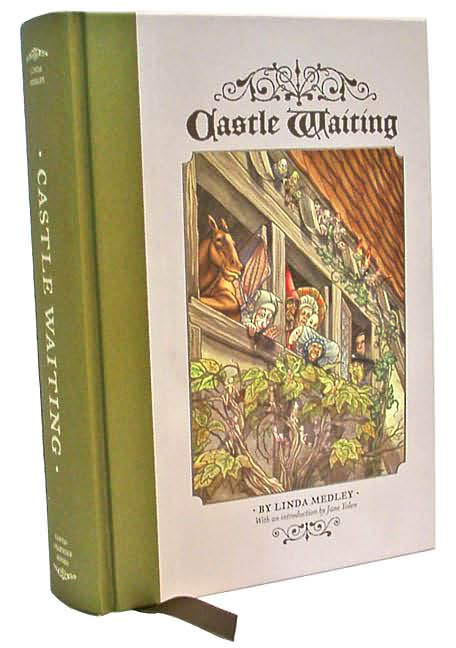
Book-A-Day #98 (10/22): Castle Waiting by Linda Medley

Linda Medley has been writing and drawing this comic (at what seems like ever-more irregular intervals) for the past decade, and its finally been all collected into one small handsome hardcover. (A new series has also just started up, and I'll probably keep buying that, too, even though, as is well known, I hate single issues.)

It's probably the most light-hearted and kid-friendly of all the current batch of revised fairy tale comics; nothing more than mildly unpleasant ever happens, and all of Medley's main characters are deeply and thoroughly nice. (This is not exactly a criticism, but it is an observation.) Castle Waiting is also more loosely based on specific tales than most of the others (like Fables); the castle in question is Sleeping Beauty's, but the main story takes place some unspecified time later. The characters are often fairy-taleish types, but they're not specific people out of older tales (unlike Bill Willingham's Fables, for example).

Medley's art style is nicely illustrative, and looks to be influenced by the late 19th century book illustrators; she uses a lot of lines, but manages to keep her compositions from being too busy. (And, for all of the odd characters -- one of the inhabitants of the castle has a horse's head, and another a stork's -- her style never gets cartoony or exaggerated; it's always rendered in a realistic style.)

This might be a bit too "girly" for many comics readers, but those who enjoy light-hearted fantasy in prose will probably like it in comics form as well.

The Fabulous Book-A-Day Index!
Edited 1/2/07: the huge list of links was getting annoying, and screwing up my Book-A-Day searches, so I've killed them in these posts that had them.

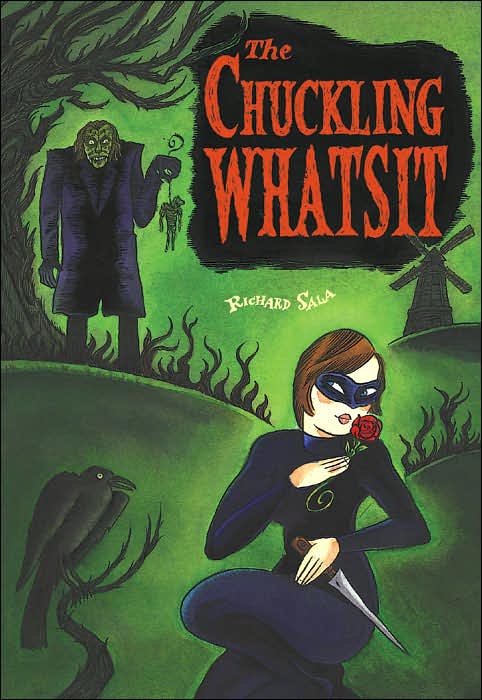
Book-A-Day #97 (10/21): The Chuckling Whatsit by Richard Sala

Sala's comics are all the same sort of thing: pseudo-Gothic adventures with convoluted plots, a huge cast of strange characters (most of whom die before the end), some horror/fantasy elements, and a winking, knowing approach to the whole pulpish apparatus.

This is a good example of the type; I won't try to explain the plot, which is labyrinthine and deliberately over-convoluted, besides mentioning that it's there, and it's typical Sala. Some of his books are a somewhat lighter version of the same thing (like the Peculia books), and those tend to have female main characters -- this one has a young man as its "hero," and it's as dark as can be.

His art is particularly expressive here -- he uses a lot of spot blacks and lines of various width for shading. It's an exceptionally good style for black & white Gothic horror comics.

The Fabulous Book-A-Day Index!
Edited 1/2/07: the huge list of links was getting annoying, and screwing up my Book-A-Day searches, so I've killed them in these posts that had them.

Monday, October 23, 2006

My Favorite Fantasy Novels of 2005

Now that the World Fantasy nominees have been announced and we're counting down to the awards ceremony in a few weeks, I feel like I can list some of the things I liked best from 2005. (Because what's the good of reading a giant pile of stuff if you can't share the ones you think are particularly good?)

I'm on vacation this week, so, each day, I'm going to post one category, since I have lists of stuff to tout. (Nothing against the other categories; they're just less toutable, at least by me.) Since I'm doing these ahead of time, I'm hoping this will help me keep away from the computer (and reading books!) as much as possible this week.

So that no one thinks they can work out anything from this (or any subsequent lists in other categories), I'm listing books alphabetically by the author's name, and I'll refrain from saying anything was "my favorite" or "the best" anything. I also see that I wasn't 100% positive about most of these -- well, let's always remember that the only good definition of a novel is "a long piece of prose with something wrong with it." And a book with only one interesting thing wrong with it is one of the best of the year.

This list is partially based on the one I used for voting for WFA, but partially isn't. It's a list of really good fantasy books that were published in 2005, so, coincidentally, many of them are already in paperback, or should be hitting paperback shortly -- which makes it a great time to check them out.
My Top 10:
  • Vellum, Hal Duncan
    Easily the most ambitious book I've read in five years; Duncan has the new writer's fire, energy, and sense that there's nothing that he can't encompass within a novel. It's not a quick or easy read, but it definitely repays the effort.
  • Lunar Park, Bret Easton Ellis
    A nasty little bit of metafiction from a writer I hadn't read in about two decades (since Less Than Zero, actually). If you've ever wanted to see "Bret Easton Ellis" get his comeuppance, you might like this novel.
  • Anansi Boys, Neil Gaiman
    Not deep or profound, perhaps, but this is an exceedingly well-crafted, amazingly enjoyable book without a single wrong note. It reminds me a bit of Wodehouse, and that's high praise.
  • The Narrows, Alexander C. Irvine
    A quietly moving meditation on family and necessity, from a writer who doesn't get nearly enough attention.
  • The House of Storms, Ian R. MacLeod
    A big (maybe too big) pseudo-Victorian novel with several fascinating main characters and an interesting take on industrialized magic.
  • A Feast for Crows, George R.R. Martin
    I do worry that this series is sneaking out of Martin's grasp, but -- even though I might think some of the sections here are properly sidebars rather than the main story -- everything in this book is mesmerizing and true.
  • Od Magic, Patricia A. McKillip
    I hadn't read McKillip in ages, and was happily surprised at how sprightly her prose was and how lived-in this world feels. It looks like she's been writing a novel this good every year for a couple of decades; where have I been?
  • Kafka On the Shore, Haruki Murakami
    I've been a Murakami fan since I bought his first translated novel (A Wild Sheep Chase) from the SFBC about twenty years ago. His newest novel isn't a genre fantasy, but it brings to life a world of secrets, danger, and the uncanny in a way few can match.
  • Thud!, Terry Pratchett
    The ending is a bit rushed -- that seems to happen irregularly with Discworld books -- but Pratchett's plot is well-yoked in support of his theme, and his story is as smooth as honeyed wine. Pratchett is another writer who quietly puts out one good book after another, but, in his case, he's also building up a world as a mirror to our own, brick by careful brick.
  • Ptolemy's Gate, Jonathan Stroud
    Finale of the "Bartimaeus Trilogy," which is one of the best works of fantasy -- YA or for adults -- of the last few decades; it's really something extraordinary. I'm not entirely sure if Gate stands completely alone -- though I do think it can be read with great effect even without the earlier books -- but there's no reason not to start with The Amulet of Samarkand and read all three: these are books that will stand with the best of fantasy fifty years from now.

Other Notable Novels:
  • The Healer, Michael Blumlein
    It's on this list rather than the main one for two reasons: one, I think it's more SF than fantasy, and two, it's awfully slow-moving. If you have the patience for it, though, it is a deeply moving and very rewarding novel about healing.
  • It's Superman!, Tom DeHaven
    The ending didn't quite work for me, but, up to that, this is a wonderful version of the Superman legend, well-grounded in the real 1930s (though DeHaven's Superman is actually less of a left-winger than the Siegel-Shuster original, which is a bit disappointing).
  • The Girl in the Glass, Jeffrey Ford
    If it had actually been a fantasy novel, this would have easily been in my Top 10. But it's not: it's a detective story (and a damn good one), also set in the 1930s. But it's by a fantasy writer, so I'll list it here.
  • The Stone Ship, Peter Raftos
    An interesting but meandering academic satire, published by a minor Australian press and probably the most obscure thing I'm listing here. It's worth tracking down for fans of Gene Wolfe or James Hynes, and I hope we hear from Raftos again.
  • Snake Agent, Liz Williams
    First in what I think will be a great series about a police detective dealing with a very Confucian supernatural in a near-future Chinese city. The background doesn't come across as "exotic;" it's just the world these characters live in.

If you haven't read all of the above books, you've got some good reading ahead of you. And if you think I've missed the obvious best fantasy novel of 2005, then by all means comment and take me to task.

World Fantasy Survey

John Klima always picks up on my memes, so here it's my turn to do one of his:

1. On a scale from 1 to 10, how excited are you for the convention? (1 being low, as in you'd rather be audited than go to the convention, and 10 being high, as in you're looking forward to the convention more than getting laid)
A solid 7; I don't get 10-excited about anything.

2. Did you buy anything special to bring to the convention?
No.

3. How's the hair?
Today it's horrible; I had a shower in a hotel with their shampoo and it looks like a pile of thatch. But I'm getting it cut on Wednesday, and I always get a flattop, which will cow it into submission for another month or so.

4. Are there any books you're hoping to find at the convention?
That would be telling.

Actually, I don't have a list at the moment, but I do want to eyeball the small press stuff and see what I've missed lately.

5. Are there any authors/editors/artists/etc. that you're hoping to meet at the convention?
Oh, boatloads. Too many to even start naming.

6. Are you scared about going to Texas?
No; my cousin lives in Austin and she's promised to protect me.

6a. If Yes, is it because everything's bigger in Texas?
No

6b. If No, is it because you're going to Austin?
No

7. Are you trying to figure out why World Fantasy is in Saratoga next year?
I was born in Albany, so I know well the lures of Saratoga Springs. I just thought they had ended about a century ago. (I'm also happy to have a WFC I can drive to.)

8. On a scale from 1 to 10, how much are you planning on drinking at the convention? (1 being no drinks at all and 10 being slightly more than Nick Cage drinks in Leaving Las Vegas) On the scale of drinking at a SFF convention, I'd be about a 3, but that's the personal equivalent of an 8, since I hardly ever drink outside of conventions these days.

9. What panel(s) are you most excited about seeing at the convention? (panels include any programming at the convention)
I'm afraid I've only looked to see what I was on myself so far; I have no idea what else is going on. I am looking forward to the art show.

10. Are there any nominees that you really want to see win? (for current judges, are there any people you want to makehave judge future World Fantasy Awards?)
I obviously can't comment on the first part...

Jim Minz would make a fine World Fantasy judge, and he'll probably only curse me mildly for bringing up his name. I don't think Diana Gill or China Mieville have done it yet, either. (I'm sure there are people who've been WFA judges more than once, but the "I've done my time" attitude seems to be much more common.)

Is SF Dead or Merely Dying?

This may be scattershot, since I got back from a short family vacation and should be doing about a dozen other things.

There's a pernicious idea going about the SFnal world to the effect that SF was about a third of the mass market in the early '70s and is now about 7-8 percent of that market (which may well be true; the earlier figure doesn't look out of line to me, and the latter is similar to figures I've seen recently), and that therefore SF was doing something right then and wrong now.

This is hogwash.

The "early '70s" date is a crafty one for two reasons: 1) it's just before the first big romance boom, when the mass-market discovered that women will read lots of books if you give them the books they want to read, and 2) it allows one to pretend that the "SF" that was selling then was cutting-edge New Wave metafictions.

Balderdash 1: No, SF is not entirely for teenaged boys (though it certainly was mostly so in the early '70s, and don't forget that), but it's historically been read more by people of the male persuasion. And before romances really took off, paperback publishing was more aimed at the male reader (business travelers, servicemen, and so on). Therefore, obviously, SF had a bigger piece of that pie. And, equally obviously, once women began buying piles of books, the share of the total held by SF went down -- because the total was getting much bigger. Mass market books increased in sales enormously during the '70s and '80s, partially because of and partially driving the chain-store boom.

Balderdash 2: Dhalgren sold a ridiculous number of copies in mass market in that period, for reasons now inexplicable. This is not true for the great mass of similar books. SF at that time had a tendency to sell at roughly the same level, no matter what it was (as long as the hardcovers didn't offend librarians and the paperbacks didn't offend distributors), but the more "cutting-edge" literarily ambitious books were the ones most likely to offend, and so had the most problems and often the lowest sales. What were people really reading in the early '70s? Lots of space opera -- reprints of Doc Smith and Edmond Hamilton, then-modern shelf-filler like the Dumarest of Terra books, humorous versions from Ron Goulart and Harry Harrison. And, of course, masses of Edgar Rice Burroughs books, as well as those of his imitators.

So this is yet another case of taking two perfectly respectable facts and trying to shove them together at relativistic speeds to generate some kind of nuclear reaction. Sadly, all that actually results is a lot of light and heat.

The SF that has always been the most popular is the adventure stuff, and it always will be the most popular. These days, that's the vast sharecropped empires on the one hand and writers like David Weber and Anne McCaffrey on the other. That might not be what SF aficionados like to talk about together, but that's what moves the most books, and what most of the people who read SF read most often. If we try to gerrymander the stuff that people read out of the genre, we'll quickly find ourselves in the position of modern poetry: exactly nowhere.

Sunday, October 22, 2006

Incoming Books: 10/20ish

I'm on vacation this week, so original blogging may be light here and at the SFBC. (Though I do have a series of "Best Fantasy Stuff from 2005" that I've been saving up, so those should run here on the weekdays, unless I suddenly decide it's a bad idea.)

Also, I'm running off to Hershey Park with the family in about an hour (in the middle of the school year, with short-attention-span boys, you take short vacations).

But, before I do that, I wanted to state for the record that I brought five books home from work this week: Lemony Snicket's The End (which is going in the car with me), two books of strip cartoons, a guide to old New York points of interest, and Bob Newhart's I Shouldn't Even Be Doing This! (which I've only read a few pages of so far, though I do wonder why he did it now rather then ten years ago, when every comedian in the USA could get a book deal for several million dollars just for making a book editor laugh once).

Saturday, October 21, 2006

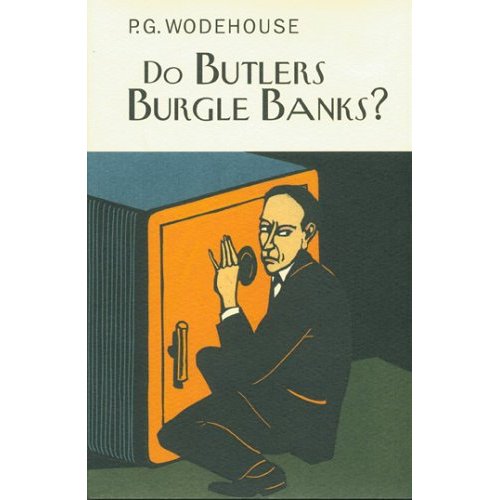
Book-A-Day #96 (10/20): Do Butlers Burgle Banks? by P.G. Wodehouse


Like most creative folks, Wodehouse didn't start off at his peak; he had to work his way in, and develop his inimitable style as he went along. And, like any creative types who have the good luck to live a long and productive life, he also fell off a bit towards the end of his life.

Luckily, his books were already light and frivolous to begin with, and he never tampered with his essential style -- so his late books might not be as wonderful as his high period (which I'd say is mostly the '30s and '40s), but they're, at worst, just thinner and sillier variations on the essential Wodehouse themes. (And not embarrassments, as so many late books by literary giants are.)

Do Butlers Burgle Banks? was originally published in 1968, near the end of Wodehouse's long life. (He was born in 1881 and died in 1975.) It has an ending that feels like a hard wordcount has just been hit, and so the story must end right there; the younger Wodehouse would have added an additional complication or three, popped out another ten thousand words or so, and wrapped things up more gracefully. But that's really the only thing "wrong" with this book; it's of a piece with Wodehouse's other adult work -- silly and frivolous, but fun. It doesn't try to be "up to date" for 1968, and so it lands firmly in Wodehouse-land, that timeless England that's one part Edwardian, one part Roaring '20s, and three parts Wodehouse meringue.

I wouldn't start reading Wodehouse here -- he wrote at least two dozen novels in a similar vein that are better than this one, as well as a tall stack of short stories -- but it's a nice piece of Wodehouse for those of us who are already fifty or so books in, and hoping that the vein will continue to yield gold. It does.

The Fabulous Book-A-Day Index!
Edited 1/2/07: the huge list of links was getting annoying, and screwing up my Book-A-Day searches, so I've killed them in these posts that had them.

Friday, October 20, 2006

Quote of the Week

"A louse in the cabbage is better than no meat at all."
- Pennsylvania Dutch proverb

Thursday, October 19, 2006

Book-A-Day #95 (10/19): The Clumsiest People in Europe by Mrs. Favell Lee Mortimer, edited by Todd Pruzan

Mortimer was a 19th century author of books for children (all non-fiction; she seems to have had the deep-dyed Protestant's horror of all things fictitious) who even I find mean-spirited and judgmental. Pruzan is some contemporary guy who found three of Mortimer's old books (all guides to the countries of the world), and edited together the good bits for a modern-day audience. And so The Clumsiest People in Europe exists.

Pruzan says that Mortimer is hilarious, but I think her pronouncements would be better read aloud in company; they can be vaguely funny when read silently, but they're not knock-'em-dead material. It is entertaining, though: she doesn't seem to like anyone, and she casually slanders a good 95% of the world's population as she explains to her young readers that nearly everyone everywhere is dirty, lazy, stupid and shiftless -- oh, and their religion is wrong and/or evil as well. (As is usual, she seems to be even more horrified of Roman Catholics than of Muslims, Hindus, or what she refers to as the devil-worshippers of Sri Lanka.)

Of course, there must be cheap irony when looking at the past (or else we wouldn't do it): she's fervently anti-slavery, and even takes her own England to task for its past role in the trade. This, of course, puts her in what we today would consider the positive, progressive vanguard of public opinion for the early 1850s. And yet, of course, and yet...everything else about her opinions strikes us as just exactly what we'd expect from an insular, misanthropic, and sour 19th century Englishwoman.

I'm not sure precisely who to recommend this book to, though I do think books like this should be read widely -- it reminds us that historical people were real people, not the background to historical movements or cardboard cut-outs marching forward to produce our glorious world. They were all just as weird and conflicted and nasty and friendly and unpleasant as any of us today -- sometimes in exactly the same ways.

There is something to be said for reading primary sources now and then, so, if you don't read this book, try to read something like it in the next few months. Your brain will thank you for it.

The Fabulous Book-A-Day Index!
Edited 1/2/07: the huge list of links was getting annoying, and screwing up my Book-A-Day searches, so I've killed them in these posts that had them.

I Am The Very Model of A Modest Minor Muppet

Today's dumb meme, which I got from someone I'm embarrassed to name, is full of extraneous space. However, I'm not confident enough in my HTML-fu to clean it up, so you'll just have to deal.

Who am I? I'm a muppet you've probably never heard of. I was hoping for Oscar, or, failing that, The Count, but, no, instead I'm...

Guy Smiley
You scored 64% Organization, 41% abstract, and 25% extroverted!
This test measured 3 variables.

First, this test measured how organized you are. Some muppets like Cookie Monster make big messes, while others like Bert are quite anal about things being clean.

Second, this test measured if you prefer a concrete or an abstract viewpoint. For the purposes of this test, concrete people are considered to gravitate more to mathematical and logical approaches, whereas abstract people are more the dreamers and artistic type.

Third, this test measured if you are more of an introvert or an extrovert. By definition, an introvert concentrates more on herself and an extrovert focuses more on others. In this test an introvert was somebody that either tends to spend more time alone or thinks more about herself.

You are mostly organized, both concrete and abstract, and more introverted.

Here is why are you Guy Smiley.

You are both mostly organized. You have a good idea where you put things and you probably keep your place reasonably clean. You aren't totally obsessed with neatness though. Guy Smiley is your average Joe. He'll dress up and look nice for his game show, but he's not a neat freak.

You are both a concrete and abstract thinker. Guy Smiley uses his imagination to come up with ridiculous game shows. However he's concrete enough to stick by his rules and perform his role as host. You know when to be logical at times, but you also aren't afraid to explore your dreams and desires... within limits of course.

You are both introverted. At first glance Guy Smiley may appear to be an extrovert given he hosts a popular show. But in reality he struggles to relate with other people. His prizes tend to just be Guy Smiley merchandise. For whatever reason you are a bit uncomfortable in social settings. You may have one or two people that you are close with. You'd rather do things by yourself and you dislike working in groups where things are always so inefficient.

The other possible characters are
Oscar the Grouch
Bert
Snuffleupagus
Ernie
Elmo
Kermit the Frog
Grover
Cookie Monster
Big Bird
The Count

If you enjoyed this test, I would love the feedback! Also if you want to tell me your favorite Sesame Street character, I can total them up and post them here. Perhaps your choice will win!


My test tracked 3 variables How you compared to other people your age and gender:


free online datingfree online dating
You scored higher than 99% on Organization


free online datingfree online dating
You scored higher than 99% on concrete-abstra


free online datingfree online dating
You scored higher than 99% on intro-extrovert

Link: The Your SESAME STREET Persona Test written by greencowsgomoo on OkCupid Free Online Dating, home of the The Dating Persona Test

Bedtime Reading: 10/19

These are four kids' books I've read at least once this week; it's not the record of any one night, but they're all books I like and could say something about.

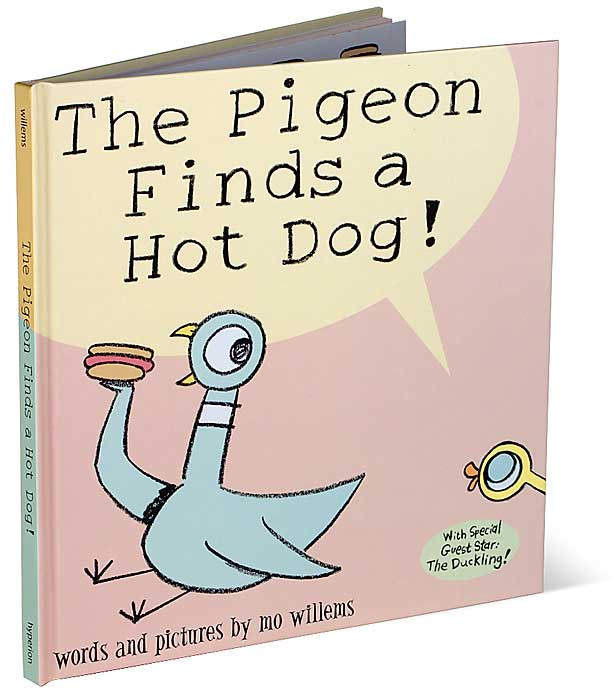
  • The Pigeon Finds a Hot Dog by Mo Willems -- the thrilling sequel to Don't Let the Pigeon Drive the Bus! (and which was followed, in its turn, by Don't Let the Pigeon Stay Up Late!). Bus is easily the best of the pigeon books, but they're all very fun read-out-loud books, and the two Don't book in particular have a nice call-and-response rhythm to them. (The kids you're reading to are to be encouraged to keep telling the pigeon "no" when he asks to do things.) Hot Dog is a slightly different story, and introduces another main character in "the duckling." (Bus and Stay Up have a bus driver character, but he's really just there at the beginning and end to tell the kids not to let the pigeon do what he wants to do.) Both the pigeon and the duckling have very distinct "voices" on the page, which makes it very easy to give them funny read-out-loud voices (and I think I have); my boys like all of these books quite a bit.
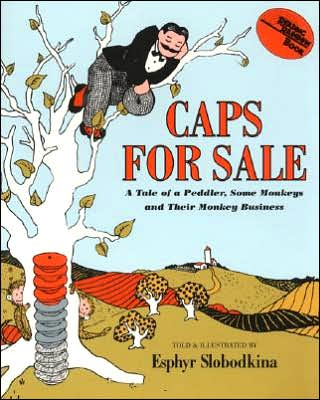
  • Caps for Sale by Esphyr Slobodkina -- one of the great classics of the field; if you're younger than about 70, your parents probably read this to you. This is the one about the peddler who carries his caps on his head, but monkeys steal them while he naps, and then copy everything he does. No moral at all, and it's got monkeys! How can you go wrong with monkeys?
  • Wow! America! by Robert Neubecker -- a quite large book with nice art (but not overly-finished-looking; it's a bit cartoony and scrawled, which I like a lot), the sequel to Wow! City! In the first book, the author's young daughter accompanied him on a trip to New York, and was thrilled by various things there -- this time, she and her even younger sister go all across the USA and see lots of sights. This book has a very, very minimal text (the word "Wow" and a word about the particular scenic whatzis on each page), which makes it great for very little kids -- they can figure out what the words are without really being able to read, if necessary. America has two multi-page fold-outs, too, and really uses the large format well to show big panoramas of American stuff. If'n you're not some kind of dirty anti-American Commie agitator, you'll like this.
  • Leonardo the Terrible Monster by Mo Willems -- yes, another Mo Willems book; I hadn't realized I had two of his when I dragged the pile downstairs to type them into the computer. This is more of a minor work, and is definitely didactic, but it's still a nice story with some cute monster designs. It's about a kid monster who's terrible -- not evil, but terrible at being a monster; no one is scared of him. So he tried to remedy that, and learns a lesson in the end. I can take or leave "lesson" books (it depends on the lesson a lot of the time), but this is a good one.

Book-A-Day #94

#94 is a scratch; I was working on a list of links of all of the earlier Book-A-Day posts, and I realized that I had two #15s, way back when July turned into August. So, #94 will be an anti-leap day, to get us back into synch. I briefly toyed with the idea of going back and re-numbering every post from #15 redux to #93, but finally decided that life is too short.

Also, I had originally planned to save that big list of links for the big Book-A-Day #100, but I changed my mind; I'll just start putting it at the end of all of these. I don't see why not to (yes, it's long, but I tend to write long posts to begin with, and the immense blogroll over on the left makes the page very long no matter what, anyway), and I doubt #100 is going to be particularly special to begin with.

The Fabulous Book-A-Day Index!
Edited 1/2/07: the huge list of links was getting annoying, and screwing up my Book-A-Day searches, so I've killed them in these posts that had them.

Wednesday, October 18, 2006

Book-A-Day #93 (10/18): Memories of My Melancholy Whores by Gabriel Garcia Marquez

The only Marquez I've read before this was One Hundred Years of Solitude, in what I puckishly called my "wetback" class at college (the real title was something like "The Latin American Novel in Translation," but I was being aggressively un-PC in those days). Solitude was long and dense and repaid close reading, but it didn't exactly make me eager to run out and read more Marquez.

But, fifteen years later, when a sister club did this very slim book, I grabbed a copy of it. And now, a year after that, I've read it, mostly because it's so short that it was an easy Book-A-Day pick.

Memories of My Melancholy Whores reads like a book from a time capsule (or just from a part of the world feminism hasn't affected much yet); the narrator (an unnamed man in an unnamed city in an unnamed country) has just turned ninety as the book opens and decides to "give myself the gift of a night of wild love with an adolescent virgin." So, being as he's a guy who's never not paid for it in his life (and he's proud of that, for Latin American reasons inscrutable to me), he rings up his favorite madam and orders up a fourteen-year-old girl. (She doesn't have a name, either. What's the deal with literary types not wanting to name their characters?)

Yes, yes, I know. I was cringing, too. Does it make it any better if I say that he doesn't actually sleep with her?

When he gets to the brothel, she's asleep (naked, of course), so he just watches her, and muses on various topics of interest to old lechers. And since, by an iron law of the universe, men must leave brothels at dawn, he leaves before she wakes and she is left undeflowered. But, of course, he has somehow along the way found a new zest for life, and...come on, you can fill in the rest, right?

This scenario repeats itself a couple of times -- he never sees her awake -- and our narrator also talks about true love, his long life, and the other sorts of things tedious old men drone on about. (That's not quite fair; Marquez is a pleasing writer, so it's mildly interesting, but the narrator himself is, at the very best, a disgusting old humbug.) He has a mild renaissance in his professional life (as a newspaper columnist), because, Marquez says, he is in love for the first time ever.

In typical literary-novel style, the novel (really a novella) ends just before the real event happens -- I think he either marries the girl, screws her, or keels over dead right after the last page. (But it's hard to be sure which, or if it's actually all three.)

I imagine people who've read more Marquez than I have will get more out of this. For the rest of us, well, Solitude is quite good, and I've heard good things about The General in His Labyrinth and Love in the Time of Cholera. This book's major virtues are that it is short, a pleasant read, and has "Whores" in the title.

Tuesday, October 17, 2006

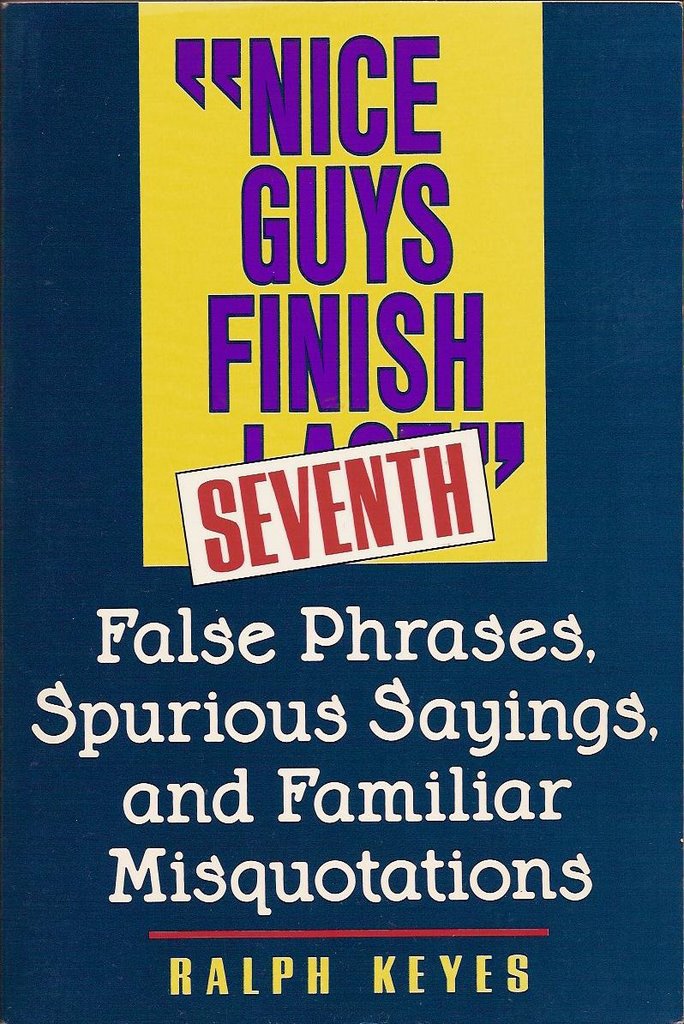
Book-A-Day #92 (10/17): "Nice Guys Finish Seventh" by Ralph Keyes

I am one of those editors who are fascinated by language (though, sometimes, in the Jerome K. Jerome "I love to watch other people doing things all day long" sense), so I bought this book on my last major book shopping trip -- hey! it was only five bucks!

I'm glad I did; it's actually a pretty good book (and seems to be well-researched, from a desultory poke through the sources). "Nice Guys Finish Seventh" is essentially a book of misquotes -- quotes run to ground (as much as possible) and attributed, in the correct words, to the correct person.

Keyes is a bit humorless, and an absolute stickler for credit, so even people who put existing thoughts in very different words are lightly worked over. But this is a useful book, and an interesting one, for people who like quotes, and who are intrigued by the idea of tracing a thought back to its originator.

Reading Into the Past: Week of 10/8

This week, I rolled a nine on my dice, and these are the books I read this equivalent week in 1997:
  • John M. Ford, The Dragon Waiting (10/1)
    I'm sorry to say that I didn't love this; I thought it was more than a bit opaque, and seemed to wander aimlessly for much of its length. I know it's supposed to be a major modern classic of fantasy, and Ford has just died (much too young), but it just didn't thrill me.
  • Scott Adams, Dilbert: Seven Years of Highly Defective People (10/6)
    A big fat Dilbert collection, on the occasion of the all-important seventh anniversary. Of course, anything Dilbert was like coining money in 1997, so you can't blame them.
  • John Mortimer, Rumpole for the Defense (10/8)
    The fourth book of Rumpole stories, which are all pretty much the same (although the last couple of books are getting more tendentious and political as Mortimer gets older and more crotchety). If you haven't read Rumpole, you probably shouldn't start here -- though you could start with any random Rumpole book, since they're all collections of independent stories.
I read the next two Rumpole books, ...and the Golden Thread and Last Case, the next two days. I'm not sure why I was reading so slowly that week; the next thing that turns up for work is Kathleen Ann Goonan's Mississippi Blues on the 21st, which I have marked as "quit unfinished." (Maybe I bogged down in it.) Or maybe this is when I dug my old Nintendo out of storage and discovered that it still worked -- I did that once or twice, and lost quite a bit of reading time whenever that happened.

And, once again, it's taken more than a week to remember to get back to this. Since it's mostly for my personal amusement, that's just fine.

The Greatest Superpower of All

Writing about Grimjack last week reminded me of the thing that annoys me the most about superhero comics. And, since I am a blogger, I can now share it with the two of you who care.

Every single mainstream superhero, from whatever publisher, have one superpower in common. It doesn't matter who they are, what their powers supposedly are, or any other consideration -- they all have this one amazing ability not found in the real world.

They all have the incredibly fine-grained ability to control their level of violence in their vicinity. Nearly every superhero has a "code against killing" (the source of much angst when the Joker breaks out of Arkham and kills hundreds of people for the hundredth time, but, still, an unbreakable code), and yet they spend most of their time running around at top speed, hitting other people as hard as they can, diving from rooftops, and doing other incredibly dangerous things. No one ever dies accidentally, or through misadventure; a stray bullet or piece of shrapnel never kills anyone -- therefore, obviously, we can deduce that all superheroes have the amazing and never-mentioned ability to sense and entirely control nearby fatal and near-fatal violence.

A hero never dies, unless it's in a big cross-over event and it Means Something.

A villain never dies, unless it's to show that This Superhero Has Broken The Code And That Is Bad.

Every civilian death (there are a few of them, to motivate the heroes, but they're usually offstage) is Poignant and Meaningful.

And no one -- no one -- ever dies inadvertently. In a comic-book world, it is impossible to die unless someone specifically chooses to kill you.

Monday, October 16, 2006

Book-A-Day #91 (10/16): Cars and Trucks and Things That Go by Richard Scarry

I normally wouldn't have counted this book, but I've read it to Thing 2 both last night and tonight, and it takes nearly a half hour each time. Added up, that's as long as many of the comics collections (and longer than some art books) that I've listed for Book-A-Day, so I'm going to claim it counts.

There's a whole lot of Richard Scarry product out there, and nearly all of it is at least decent. But you do want to make the important distinction between books that are actually by Richard Scarry (that he wrote and drew himself, before his death in 1994) and the TV tie-ins and cut-n-pasted books that have come out since then (and somewhat before, since the TV stuff started up a bit earlier). This can sometimes be hard to determine, since every single one of those books is billed as "Richard Scarry's whatever-it-is" these days.

Most of the major "real" Scarry books are large-format hardcovers, like this one, often with the distinctive Little Golden Book binding. The other ones I'd recommend are What Do People Do All Day? (which has about a dozen shorter stories about different kinds of jobs; it's wonderful for getting kids to think about how the world works, and how people interact day-to-day), The Best Word Book Ever (good for younger kids; there's an interesting comparison of the 1963 and 1991 editions on Flickr), and Great Big Schoolhouse. He usually had lots of labels on his pictures, so his books are great for reading with little kids and talking about the names of things. (I've found that my boys love books with lots of stuff in the art -- labels, hidden characters, details and jokes -- and that those are the books they get the most out of. Scarry is very good in that respect.)

There are also a lot of Scarry 4x4 books; the ones with "Busytown" in their names are probably from the early '90s TV show -- they're OK, but, again, not as good as the pure Scarry stuff. (He was active in children's books from the '50s up to his death, so there are a lot of his books out there.) His character Mr. Frumble is an accident-prone pig, and my boys particularly like him.

Personally, my favorite Scarry book is What Do People Do All Day?; it has a variety of stories, with a nice flow to them, and there's a lot of information presented in a fun and humorous way my kids love. But both of my boys, I think, have liked this one best -- there's a character hidden on every page (and some other "Easter Eggs"), and it's all about cars. Girls probably won't like this book as much as boys, but 4-7 year old boys should adore it.

Book-A-Day #90 (10/15): Deliverer by C.J. Cherryh

The third book in the third atevi trilogy, coming in February.

I read all 503 manuscript pages in one day, which is my usual aim for a weekend day (but which I haven't hit in quite a while).

Since 1) it's not publishing for a while and 2) the plot at this point is a bit opaque to those who haven't read the earlier ones, I'll just note I read it.

Book-A-Day #89 (10/14): Lost Girls, Book 1 by Alan Moore and Melinda Gebbie

The first of three volumes in that famous Alan Moore porno comic. (#1 is the blue volume, for those following along at home.)

I'll leave commenting until I read the whole thing...

Sunday, October 15, 2006

Book-A-Day #88 (10/13): The Dead Fathers Club by Matt Haig

I read this for work; it doesn't publish until February. So I'll be brief.

Philip Noble is eleven; his father (the proprietor of the Castle and Falcon pub) has just died in a car crash, and his uncle is getting awfully chummy with Philip's mom. Then Philip's father's ghost appears, telling his son that he was murdered -- and that his son must revenge him.

Sound familiar yet?

There are a lot of parallels to Hamlet here, and they're worked in brilliantly; several times a plot twist caught me by surprise, until I realized how exactly Hamlet it was.

More interesting, actually, is Philips's voice -- this novel is all told in first person, and it's the most idiosyncratic and authentic British kid voice I've come across since Adrian Mole. (Though Dead Fathers Club isn't really funny -- the publisher claims it is on the back of the galley I have, but no one who's read it at my company agrees with that.) The publisher also compares this to The Curious Incident of the Dog in the Night-Time, which is accurate; Philip is also trying to figure out what's going on around him without necessarily understanding what's really going on.

This is a very impressive novel; it's being published as mainstream (and the Hamlet parallels throw it solidly into the literary-novel category rather than genre fantasy), but anyone with a passing familiarity with the plot of Hamlet could read it with great appreciation. Whatever you call it, it will be one of the major fantasy novels of 2007; it's that good.

Book-A-Day #87 (10/12): Gullible's Travels by Cash Peters

I'd seen this book recommended somewhere I can no longer remember a while ago, and spent a number of months looking for it in bookstores. Finally, I gave up and just special-ordered the thing.

(Luckily, I enjoyed it.)

Peters is a finicky, 46-year-old Englishman who has mostly worked in radio journalism (though, as he keeps saying in this book, he really wants to get into TV), and this book chronicles the last eighteen months or so of a series of reports he did for Minnesota Public Radio (yes, the Big Leagues) called The Bad Taste Tours. Essentially, he spent five or six years going to tacky places and making fun of them.

And this is great, because he's one of those sarcastic, nitpicky types who can't stand sentiment and is really good at making snide remarks under his breath. Gullible's Travels ends up being a record of those snide remarks (about such horrors as The Museum of Bad Art, The American Museum of Sanitary Plumbing, The Museum of Questionable Medical Devices, and Graceland).

Along the way, he also decides that he's tired of doing this, but, thankfully, he never descends into soul-searching or pathos. This isn't a memoir, with teary revelations and heartfelt connections with his past; Peters was quite happy to do this gig for a while, but eventually he wanted to do something else. And good for him.

I did laugh out loud several times while reading this, and found it at least amusing all of the way through. It was a pain to get a hold of, but it was worthwhile in the end. (And Peters did reveal near the end that he is gay, thus proving my suspicions -- neat, middle-aged, unmarried, fussy, few possessions, lives with an unspecified "partner" -- true.) If the idea of going to weird tourist destinations and making fun of them sounds good to you, read this book.

Saturday, October 14, 2006

Another Meme: Over-Sharing

Caitlin R. Kiernan was doing this one, too (see yesterday for slightly more context), so I'm just a big ol' lemming:

70 Random Personal Questions

1. The phone rings. Who do you want it to be?
I hate talking on the phone, so it had better be someone offering me lots of money for free. (Sex would be nice, too, but I doubt my wife would appreciate my accepting the offer.)

2. When shopping at the grocery store, do you return your cart?
I leave it against a pillar on the sidewalk, which is usually where I found it.

3. In a social setting, are you more of a talker or a listener?
I wasn't aware that was an either-or thing. I think I listen more than I talk.

4. Do you take compliments well?
Exceptionally well -- just try me!

5. Are you an active person?
Not "active" in the sense of liking to get up and run around outdoors and do things like that, no. I am active rather than sessile, though.

6. If abandoned alone in the wilderness, would you survive?
If it wasn't very far into the wilderness, maybe. I imagine I could walk out of a wilderness if I had to, but not survive there in the longer term.

7. Do you like to ride horses?
I've never tried, and I never intend to.

8. Did you ever go to camp as a kid?
Yes, one week of Boy Scout camp, which I not only loathed, but which turned me off scouting entirely.

9. What was your favorite game as a kid?
At what age? Probably Hide & Seek at about 5, Adventure on the old Atari at 10 or 11, 1st edition AD&D at 14 or so.

10. If a sexy person was pursuing you, but you knew he/she was married, would you get involved with him/her?
It will never happen, so I can be virtuous and say "of course not."

11. Are you judgmental?
What kind of a person asks such a question? What are you, a moron? No, I take it back -- you're subhuman, a complete moral cripple to even dare to ask me that.

Um, no, I don't think so.

12. Could you date someone with different religious beliefs than you?
Unless she was an incredibly pious and close-minded whatever-it-is, I think I'd be fine. But, again, my wife would have serious problems with that.

13. Do you like to pursue or be pursued?
Romantically? Neither; I'm not in the market.
Fox hunting? Pursuer, definitely.

14. Can you speak another language?
No.

15. If you had to choose, would you rather be deaf or blind?
Deaf.

16. What's your favorite food?
As a type of food? I guess I'd say pizza -- I am from New Jersey.

17. Do you know how to shoot a gun?
I understand the principles involved, but I've never held one.

18. If your house was on fire, what would be the first thing you grabbed?
Thing 1 or Thing 2, whichever was closest.

19. How often do you read books?
Slightly less often than I breathe, but more often than I eat.

20. Do you think more about the past, present or future?
Yes.

21. What is your favorite children's book?
Where The Wild Things Are by Maurice Sendak

22. What color are your eyes?
Brown.

23. How tall are you?
I always say "six foot three," but I think I'm really a hair under that.

24. Where is your dream house located?
In the magical forest of N'astraum, beside the shining waters of the Gloam, where the pixies dance in the moonlight. Barbie currently caretakes it for me; you can buy a plastic replica for $89.99 this Christmas.

Honestly, I have a fairly definite image of my dream house in my head, but I really don't care where it is.

25. Last person you talked to on the phone?
Either my boss (yesterday at work) or Sheriff Jerry Speziale's recorded voice with an important message about the county's reverse 911 system last night.

26. Have you ever taken pictures in a photo booth?
No.

27. When was the last time you were at Olive Garden?
Not sure; probably during Lunacon last year. The Wife prefers Red Lobster for her franchised medium-priced meals.

28. What are your keys on your key chain for?
The Wife's car, my car, our house, my mother's house, a file cabinet that I think I threw out a few years ago, my usual luggage, some other luggage key.

29. What's your favorite color?
Black.

30. Where was the furthest place you traveled today?
So far, down into the center of town for the boys' Karate class and other errands. I'll go slightly further in another direction later today.

31. Where is your current pain at?
In the organ that detects faulty grammar.

32. Do you like mustard?
Not particularly.

33. Do you prefer to sleep or eat?
That entirely depends on whether I'm sleepy or hungry; wouldn't it always?

34. Do you look like your mom or dad?
Quite a bit like my father.

35. How long does it take you in the shower?
Ten minutes at the most.

36. Can you do splits?
God no.

37. What movie do you want to see right now?
Thank You For Smoking.

38. Do you put lotion on your dog or cats?
?!
Is this a common thing? I mean, it's bad enough to have small, nonsapient, hairy animals in your house, but do they usually require some kind of greasy emolument, too? {shudders}

39. What did you do for New Year's?
"If one elects to live with barbarians, one must endure the barbarous noises of their barbarous superstitions, but the disagreeable simpleton who sits up till midnight to ring a bell or fire a gun because the earth has arrived at a given point in its orbit should nevertheless be deprecated as an enemy to his race."
-Ambrose Bierce

40. Do you think The Grudge was scary?
I'm afraid I can't answer a question about a movie I'll never see in a genre I despise.

41. What was the cause of your last accident?
(Did this turn into the MMPI somewhere along the way? What's with the bizarre non sequitur questions?)
I probably tripped over something...

42. Do you own a camera phone?
No.

43. What are you drinking?
Bourbon and Coke, thanks. I'll get the next round.
(Actually, nothing at the moment.)

44. Was your mom a cheerleader?
No. Though she did originally plan to be a Phys Ed teacher.

45. What's the last letter of your middle name?
N.

46. Who did you vote for on American Idol?
You seem to be under the impression that everyone is interested in the same things you are -- it's a sign of a quite immature brain.

47. How many hours of sleep do you get a night?
Six during the week, eight on the weekends.

48. Do you like Care Bears?
I don't loathe them the way I did when I was sixteen and desperate for any shred of coolness, but I can't say I'm particularly fond of them.

49. What do you buy at the movies?
Tickets.
Is this some sort of IQ test?

50. Do you know how to play poker?
In a broad sense, yes. Haven't played in ages, though, and never was any good.

51. Do you wear your seatbelt?
Yes.

52. What do you wear to sleep?
Underwear.

53. Anything big ever happen in your hometown?
The mayor was arrested for bribery in an FBI sting, and the initial news report was that he was kidnapped. (This was almost twenty years ago.) That's probably the biggest.

54. How many meals do you eat a day?
Two most days; I try to hold the line at no more than three.

55. Is your tongue pierced?
No. Nor anything else.

56. Do you always read MySpace bulletins?
I've been on MySpace only a couple of times, and always flee from the deadly light into the peace and safety of a new dark age.

57. Do you have pets?
The boys have four fish (with one fish and one snail deceased), and did have two hamsters (which also died). I don't have any vermin personally.

58. Do you like funny or serious people better?
Funny, I guess. Both can be tedious if they only have the one mode.

59. Ever been to LA?
More or less -- I've been to conventions in Anaheim twice, and one of those times I flew into LAX.

60. Did you eat a cookie today?
Several.

61. Do you use cuss words in other languages?
No.

62. Do you steal or pay for your music downloads?
I mostly buy music the old-fashioned way, on CDs (since it then comes with its own backup). But I'm sure I've got some songs that I got somewhere not-entirely-legally.

63. Do you hate chocolate?
No.

64. What do you and your parents fight about the most?
I'm past that age, thankfully. (Once again another example of my Iron Rules of LiveJournal, that the assumption is that everyone is a high school student.)

65. Is your cell usually on vibrate or ring?
It's really only for making calls, so it's always on vibrate; most of the few calls I get are mistakes.

66. Are you a gullible person?
No.

67. Do you need a boyfriend/girlfriend to be happy?
I don't think so, but I've been with The Wife for twenty years now, so...

68. If you could have any job (assuming you have the skills) what would it be?
Landed Gentleman.

69. Are you easy to get along with?
I think so.

70. What is your favorite time of day?
Late at night/early in the morning.

Friday, October 13, 2006

Hornswoggler II: Find the Map! Soundtrack

As I said earlier today, I did a version of this meme before -- but that won't stop me from doing it again! So this time, it must be the soundtrack for the obligatory sequel, in which more things blow up, the sidekick gets too much screen time, and the wonderful love interest from #1 is replaced by a grating blonde.

The version I'm using this time was picked up from Caitlin R. Kiernan (who had the absolute best fight song), and goes as follows:

IF YOUR LIFE WAS A MOVIE, WHAT WOULD THE SOUNDTRACK BE?
1. Open your library (iTunes, Winamp, Media Player, iPod, etc)
2. Put it on shuffle
3. Press play
4. For every question, type the song that's playing
5. When you go to a new question, press the next button
6. Don't lie and try to pretend you're drad...
[Comments from me will be in italics inside brackets. For example: drad? What is this "drad?"]

[Oh, and I'm not using my full library, since I have something like fourteen thousand songs, and a huge chunk of them are part two of movement three of something. I'm still working from a list of 8957 songs, though, so it should be random enough.]

Opening Credits
"Brilliant Disguise" by Elvis Costello
["He thought he was the king of America, where they pour Coca-Cola just like vintage wine..."
Sure I am.]

Waking Up
"Psychotic Reaction" by Count Five
[I guess it works.]

First Day at School

"One Step Ahead" by Split Enz
[Slightly creepy, a bit like the flip side of "Every Breath You Take." Doesn't make much sense in context...]

Falling in Love
"These Days" by R.E.M.
[If those last two were swapped, it would make more sense.]

Fight Song
"Country Death Song" by Violent Femmes
[I fight dirty, I guess.]

Breaking Up
"Reaching Out" by Kate Bush
[Another song that would work much better in another category, but mid-period Kate Bush is all pretty moody, so it's plausible.]

Prom
"Utopia Parkway" by Fountains of Wayne
[Damn! Missed "Prom Theme" by that much. Same album, even. This can be slow-danced to, if you really want to.]

Life is Good
"Counting Backwards" by Throwing Muses
[It's relatively happy-sounding. I'll take that as a win.]

Mental Breakdown
"Yesterday" by The Beatles
[My movie has descended into horrible cliche. Luckily, there's no chance we'd be able to afford this one, so I'm sure we'll have to replace it with something else in post-production.]

Driving
"Less Than Zero" by Elvis Costello
[I'd have preferred "Radio, Radio" or "Lipstick Vogue" or "(I Don't Want to Go to) Chelsea," but this will work.]

Flashback
"Rip This Joint" by The Rolling Stones
[Flashing back to my days as a bouncer in a honky-tonk bar, apparently. I knew should have kept up with those script revisions...]

Getting Back Together
"You Can Sleep While I Drive" by Melissa Etheridge
[This one is actually perfect.]

Wedding
"Liar" by Sex Pistols
[We may be looking at the world's shortest marriage in this movie.]

Paying the Dues
"Lonesome Johnny Blues" by Cracker
[Life is tough all over.]

The Night Before the War
"How Far" by Beth Orton
[Doesn't really work at this point in the movie -- it's a bit too jazzy and high-spirited, but the lyrics aren't bad for the "event."]

Final Battle
"Broken" by Belly
[Featuring a line I take ungodly pleasure in hearing Tanya Donelly sing: "the curve of her ass is unparalleled" -- what kind of battle is this, anyway?]

Moment of Triumph
"It's Not" by Aimee Mann
[One of my very favorite songs of all time, but...it is so very, very much not a song of triumph.]

Death Scene
"Six Months in a Leaky Boat" by Split Enz
[SPOILER ALERT! I seem to have drowned.]

Funeral Song
"I'm Not Like Everybody Else" by Cracker
[I could see having Kinks songs played at my funeral -- I could even see Kinks covers. And I like this song, and this version. But it's awfully present-tense for a funeral.]

End Credits
"Trouble Me" by 10,000 Maniacs
[I can see a long list of names rolling up in front of me as this plays, so it works.]

That 'Ol Big List O' Books

As usual, Keith DeCandido is the earliest person in the alphabet I noticed doing this, so I picked it up from him.

The rules: books you've read are in bold, books you intend to read are in italics, and add three books at the end. (I foresee this list swiftly consuming all of the computing resources of the world...)

I've added a new twist: books you wouldn't be caught dead with are in strikethrough.

  • The Da Vinci Code - Dan Brown
  • The Catcher in the Rye - J.D. Salinger
  • The Hitchhiker's Guide To The Galaxy - Douglas Adams
  • The Great Gatsby - F.Scott Fitzgerald
  • To Kill a Mockingbird - Harper Lee
  • The Time Traveler's Wife - Audrey Niffenegger
  • His Dark Materials - Philip Pullman
  • Harry Potter and the Half-Blood Prince (Harry Potter 6) - J.K. Rowling
  • Life of Pi - Yann Martel (half-credit; I read about 100 pages and gave up in boredom)
  • Animal Farm: A Fairy Story - George Orwell (at least three times I can recall)
  • Catch-22 - Joseph Heller (at least twice)
  • The Hobbit - J. R. R. Tolkien
  • The Curious Incident of the Dog in the Night-time - Mark Haddon
  • Lord of the Flies - William Golding
  • Pride and Prejudice - Jane Austen
  • 1984 - George Orwell (at least twice)
  • Harry Potter and the Prisoner of Azkaban (Book 3) - J.K. Rowling
  • One Hundred Years of Solitude - Gabriel Garcia Marquez
  • Memoirs of a Geisha - Arthur Golden
  • Harry Potter and the Goblet of Fire (Book 4) - J.K. Rowling
  • The Kite Runner - Khaled Hosseini
  • The Lovely Bones - Alice Sebold
  • Harry Potter and the Order of the Phoenix (Harry Potter 5) - J.K. Rowling
  • Slaughterhouse 5 - Kurt Vonnegut
  • Angels and Demons - Dan Brown
  • Fight Club - Chuck Palahniuk
  • Harry Potter and the Philosopher's Stone (Book 1) - J.K. Rowling
  • Neuromancer - William Gibson
  • Cryptonomicon - Neal Stephenson
  • The Secret History - Donna Tartt
  • A Clockwork Orange - Anthony Burgess
  • Harry Potter and the Chamber of Secrets (Book 2) - J.K. Rowling
  • Wuthering Heights - Emily Bronte
  • Brave New World - Aldous Huxley (but so long ago I'm not sure it still counts)
  • American Gods - Neil Gaiman
  • Ender's Game (The Ender Saga) - Orson Scott Card
  • Snow Crash - Neal Stephenson
  • A Prayer for Owen Meany - John Irving
  • The Lion, the Witch and the Wardrobe - C.S. Lewis
  • Middlesex - Jeffrey Eugenides
  • Cloud Atlas - David Mitchell
  • The Lord of the Rings - J. R. R. Tolkien
  • Jane Eyre - Charlotte Bronte (three times! three goddamn times!)
  • Good Omens - Terry Pratchett, Neil Gaiman
  • Atonement - Ian McEwan
  • The Shadow Of The Wind - Carlos Ruiz Zafon
  • The Old Man and the Sea - Ernest Hemingway
  • The Handmaid's Tale - Margaret Atwood
  • The Bell Jar - Sylvia Plath
  • Dune - Frank Herbert
  • The Unberable Lightness of Being - Milan Kundera
  • Hey Nostradamus! - Douglas Coupland
  • The Nature of Blood - Caryl Phillips
  • Children Playing Before a Statue of Hercules - Ed. David Sedaris
  • Yarn Harlot - Stephanie Pearl-McPhee
  • Odd Thomas - Dean Koontz
  • Spook - Mary Roach
  • Jonathan Strange and Mr Norrell - Susanne Clarke
  • Marley and Me - John Grogan
  • Gone to the Dogs - Emily Carmichael
  • Book the 11th: The Grim Grotto: The Series of Unfortunate Events - Lemony Snicket
  • State of Fear - Michael Crichton
  • The Speed of Dark - Elizabeth Moon
  • Interview with the Vampire - Anne Rice
  • The Vampire Lestat - Anne Rice
  • The Snow Fox - Susan Fromberg Schaeffer
  • Anansi Boys - Neil Gaiman
  • The Princess Bride - William Goldman
  • Luck in the Shadows - Lynn Flewelling
  • Arthur & George - Julian Barnes
  • The Seven Dials Mystery - Agatha Christie
  • The Stupidest Angel - Christopher Moore
  • Sabine's Notebook - Nick Bantock
  • Strangers in the Night - Linda Howard
  • Night Tales (v.1) - Nora Roberts
  • Reunion - Nora Roberts
  • White Lies - Linda Howard
  • Fever Season (Merovingen Nights) - CJ Cherryh
  • Divine Rite (Merovingen Nights) - CJ Cherryh
  • Angel With a Sword (Merovingen Nights) - CJ Cherryh
  • Mount Dragon - Douglas Preston, Lincoln Child
  • Ella Enchanted - Gail Carson Levine
  • Dreams Underfoot - Charles de Lint
  • Settling Accounts: Return Engagement - Harry Turtledove
  • In Cold Blood - Truman Capote
  • Cell - Stephen King
  • Staying Dead - Laura Anne Gilman
  • Stiff: The Curious Lives of Human Cadavers - Mary Roach
  • The Historian - Elizabeth Kostova
  • Star Trek: S.C.E. #66: Many Splendors - Keith R. A. DeCandido
  • The Crucible, Book Three: The Crippled Angel - Sara Douglass
  • Star Trek: Mere Anarchy, Book One: Things Fall Apart - Dayton Ward, Kevin Dilmore Dragonlance Chronicles, Book One: Dragons of Autumn Twilight - Margaret Weis & Tracy Hickman
  • Star Trek: Mere Anarchy, Book Two: The Centre Cannot Hold - Mike W. Barr
  • Duty First: A year in the Life of West Point and the Making of American Leaders - Ed Ruggo
  • Hit Parade - Lawrence Block
  • Jpod - Douglas Coupland
  • Manhattan Transfer - John Dos Passos
  • The Neon Wilderness - Nelson Algren
  • The Bride Wore Black - Cornell Woolrich
  • Rain in the Doorway - Thorne Smith
  • City of Glass (graphic novel) - Paul Auster with Paul Karasik & David Mazzaucchelli
  • Star Wars: Republic Commando: Triple Zero - Karen Traviss
  • The Starslip Crisis Technical Manual - Kristofer Straub
  • Four Ways to Forgiveness - Ursula K. Le Guin
  • Reinventing Paul- John Gager
  • The Ghost Stories of M.R. James- selected by Michael Cox
  • La vita nuova- Dante
  • Star Trek: Crucible: McCoy: Provenance of Shadows- David R. George III
  • Dancing After Hours- Andre Dubus
  • Gun, with Occasional Music- Jonathan Lethem
  • Infinite Jest- David Foster Wallace
  • Frankenstein, or the Modern Prometheus - Mary Shelley
  • Homicide: A Year on the Killing Streets - David Simon
  • Dancing on the Edge of the World - Ursula K. Le Guin
  • Time's Arrow - Martin Amis
  • The Book of the New Sun - Gene Wolfe
  • Titus Groan - Mervyn Peake
I see this list has run through some not-overly-discriminating readers before it reached me...

That "Life Soundtrack" iTunes Meme

It's running around again, but I'm at work now, and so don't have access to my vast iTunes library.

However, I did this once before -- and even changed a lot of it, since I thought the plotline of that putative movie didn't make much sense -- so I direct you to Hornswoggler! The Movie Soundtrack.

(I see the new version is quite different from the one I did, so I may indulge myself tonight and see what this new version gets me.)

Quote of the Week

This one has been sitting in the file for a long time, because I was afraid it would be taken as a reference to some specific decision. It isn't; for me, it reflects the attitude of all leaders everywhere.

"When the President does it, that means it's not illegal."
- Richard Nixon

Thursday, October 12, 2006

Incoming Books: 10/12

Seven books have come home with me from work over the past week or so, including three things we're selling in the SFBC but I haven't read yet (one of which is the Ellen Kushner omnibus Swords of Riverside), and four random books from other clubs that I hope to find time for.

Only the Kushner is really seriously fat, and I've already read half of that one, so I'm actually in pretty good shape.

Book-A-Day #86 (10/11): Grimjack: Killer Instinct by John Ostrander and Tim Truman

Last night I read the collected edition of this grand reunion limited series from last year sometime, the sixth issue of which is probably on my stack of comics to be read, wherever that is. (Stupid single issues. I hate single issues.)

Grimjack gets a bit too Dr. Phil in the middle of this one for my tastes -- talking about emotions in an adventure comic is rarely a good idea, and doing it for several pages is like nails on a chalkboard -- but this is otherwise quite good. I don't know if anyone is going to jump in here, but they could, easily -- this is set chronologically before the beginning of the original Grimjack series, and it stands very well as its own story.

What's it about? John Gaunt, aka Grimjack, is a cop/secret agent/PI in an aggressively multi-dimensional (and arbitrarily immense) city, and he walks down those mean streets, yadda yadda yadda. It's hard-boiled fantasy adventure, in a setting where anything can pop up and probably will. Everybody betrays everybody (especially the dames), and everybody but our hero is corrupt as all hell. Ostrander is generally a skillful writer, though (as I said above) sometimes the Weltschmerz just runs away with him. And Truman's art is gorgeously pointy.

This is the kind of comic that the comics world thinks of as being vastly different from superheroes, even though John Gaunt:
  • wears the same clothes all the time, which instantly identify him
  • saves people (and the world) regularly
  • has what amounts to a codename
  • has a couple of similarly-burdened friends who he "teams up" with on occasion
  • appears in 4-color pamphlet form
  • is a freaking cop/secret agent/PI!
Clearly, the comics world is deeply weird. Grimjack, to my eye, is probably too much like a superhero to attract many people outside the comics ghetto, but he probably also is too far away from a superhero (his clothes aren't skin-tight, you see, and he has been known to kill people) for the comics nerds. But it's good Chandleresque fun for those few of us in the middle.

There Is No Dead Grandpa

I guess this is a meme, since several people are doing it today. (I think I saw Tobias Buckell first, so he gets credit.)

Welcome to the Nietzsche Family Circus!


Morality is the herd-instinct in the individual.

Wednesday, October 11, 2006

Book-A-Day #85 (10/10): Memoirs of a Mangy Lover by Groucho Marx

I think it was Fritz Leiber who said that taboos on sex in books are no problem for a writer, as long as they're consistent; the problem is when they're changing, and a book that's dangerously racy one year becomes not just tame but silly in its circumlocutions a few years later. And he was absolutely right.

There was a burst of "racy" books in the late '50s through the '60s, urged along by a lot of things in the culture (Playboy and its imitators, the Ulysses decision, Beat poets, Lenny Bruce, and so on). They were in that middle zone, where the barriers were dropping but hadn't completely fallen yet (by sometime in the '70s, just about anything sexual could be printed in a book without trouble), and that's the most dangerous time.

This, I'm afraid, falls right into that time and milieu; it's the racy stories of Groucho Marx, as original published in 1963. It's pretty racy for its day, and Groucho tells his stories well, but it smells musty, like an old London club that hasn't been properly aired out in decades.

There is some non-racy material, too, which is OK, but Groucho's first book, the wonderful Groucho and Me is far superior. No one who hasn't read Groucho and Me should start here, but it's an acceptable second (smaller) dose of Groucho for those who have already been inoculated.

Tuesday, October 10, 2006

Slaves of Rikers Island

Fourth in an occasional series (one two three); your home for corrections, clarifications, bafflegab, waffling, and general hornswoggling.

My mother (in a private e-mail) corrected my mistaken impression that she was born in Albany; she was actually born in a hospital in Kingston, NY. Her family lived in Saugerties at the time and only moved to Albany when she was two weeks old. I can't imagine why I wouldn't remember this.

A person or persons unknown (possibly operating under the aliases "Feisen" or "MLR") thanked me, also in a private e-mail, for introducing him/her/it/them to the wonderful world of Captain Underpants, and told a humorous story of how, after all of the bookmarks mysteriously disappeared, my humble blog was re-found by googling the Waistband Warrior. (There's no correction here; just me being smug about a very minor good deed.)

Joan D has asked for more recommendations for children's' books; I'm going to try to do "Bedtime Reading" about once a week in response. Other things I've done that are about kids' books in one way or another include: Pinky & Stinky by James Kochalka and Library Run: Kids' Books.

Robert Hutchinson thinks that Antick Musings is 38% fascinating. Considering that my aim was to hit 66% tolerable, I think I'm doing OK. (Unless the other 62% is eye-gougingly bad, but I'm hoping not.)

Eeyore Presents the Random Quiz of the Day

No one was doing this one, but I wandered over to blogthing to check out a different quiz, and I just had to know...
Your Extroversion Profile:
Activity Level: Medium
Assertiveness: Medium
Sociability: Low
Cheerfulness: Very Low
Excitement Seeking: Very Low
Friendliness: Very Low

And that's about what I expected. Bah humbug.

Book-A-Day #84 (10/9): Powers, Vol. 3: Little Deaths by Brian Michael Bendis and Michael Avon Oeming

"So this..."
"A comic book?"
"What? Kinda, it's a graphic..."
"Graphic, huh -- is that like graphic sex..."
"...novel, but you could call it..."
"...or graphic violence?"
"...a comic book. I mean, there are superheroes..."
"Call 'em Powers, 'superheroes' owned by The Man."
"Oh, right, yeah, Powers who, like, fight crime and so on..."
"Boys with too many muscles and girls with big tits?"
"What? No, it's more about cops, and they have to deal with that world..."
"And one of 'em was a Power, right? An ex-super-dude?"
"Well, yeah, but that's just background, y'know, it's really about the police work..."
"What about the sex thing, man -- this some Alan Moore porno shit?"
"No, no. I mean, there's one sex scene..."
"Whoo hoo! Naked cartoon boobies!"
"...but it's like totally necessary to the plot."
"Of course! Naked boobies are always necessary!"
"There's this super-guy, Olympia..."
"What's he, a Charles Atlas-type?"
"Yeah, super-strong, flies -- the brick, y'know?"
"Mr. f-in' Incredible, right?"
"Naw, the story's from before that. So, like Olympia dies, and he was bangin' all these groupies..."
"Oh yeah! Lots of naked cartoon boobies! Superman gettin' it on!"
"No, no, he's dead, y'know? And the cops find his like Bat-cave, y'know..."
"With his harem in it?"
"No, no, he took 'em to this cheap apartment..."
"Classy. My man Olympia is classy."
"But the cops find his little black book..."
"Who the hell actually keeps one of those, anyway?"
"Olympia."
"Yeah, right."
"Well, so they go question all of the girls, right?"
"And we get mondo boobie flashbacks?"
"No, we just see that Olympia had a major hard-on for redheads."
"Just like you, m'man!"
"Shut up. And, anyway, they find the girl he was banging when he died..."
"Finally we get to the cartoon boobies!"
"Yeah, that's the sex scene. But the story's more about fame and power and corruption..."
"And boobies and hot naked redheads..."
"Not so much. It's like a crime story, y'know? So it's gotta be all dark and depressing and shit."
"So why'd you read it?"
"Naked boobies."
{laughs}
"No, really, it's, like, a good crime story that just happens to have superheroes..."
"and naked boobies..."
"...and naked boobies, yeah, in it. And there's some other, shorter stories to fill up the book."
"You mean a bunch of random shit they stuck in to fill up the page count?"
"Well, kinda, only it's all good stuff."
"And you paid money for this?"
"Well, I read comics, y'know?"
"And you can't read regular super-dudes, 'cause those are too juvenile for you, right?"
"Well, yeah."
"But super naked redhead boobies, that's just what you need."
"Shut up."
"And how's the dialogue in your naked-boobie book?"
"Eh. A little Bendis goes a long way..."

Addendum: I read Vol. 1 and Vol. 2 earlier this year, and buried my thoughts about them in gigantic what-I-read-that-month posts.

Monday, October 09, 2006

I Am Legion

Monday morning means it must be time for a meme, so, in the spirit of "Googling Myself," here we have...


HowManyOfMe.com
LogoThere are:
412
people with my name
in the U.S.A.

How many have your name?

To compare, there are 102 people with the same name as Thing 1, 210 matching Thing 2, and 292 like The Wife. (But none with her maiden name, since that's so rare that it's not in this database. Perhaps I should have changed my name to hers when we got married...but I've always liked being at the end of the alphabet.)
Other useless facts:
  • Wheeler is the 199th most popular last name
  • I have the 54th most popular first name
  • my brother has the 16th most popular first name, and there are 749 folks with his name
  • my father has the 8th most popular first name, so there are 1306 people with his name -- so my family is getting less popular every generation

Sunday, October 08, 2006

Book-A-Day #83 (10/8): first of a Lovecraftian swords & sorcery trilogy

Yes, once again I'm reading three books for the SFBC, and I want to at least pretend that they're secret for a little while. (In this case, it's much more of a pretense, since the category is not a particularly large one. But I will refuse to confirm or deny any guesses until I at least talk to the publisher.)

With any luck, I'll read books two and three in the next couple of days, and then things will progress however they progress.

Oh, and I should tell you folks that the last time I did this (book one, book two, book three), the books were actually Children of the Night, Burning Water, and Jinx High by Mercedes Lackey, and that all three are going to be included in the SFBC omnibus Diana Tregarde Investigates. See? I do explain myself, eventually.

Saturday, October 07, 2006

Book-A-Day #82 (10/7): Killed Cartoons edited by David Wallis

This was a bound galley (aka Advance Reading Copy, which seems to be what everyone else in publishing calls them these days) that I found on the giveaway shelf at work a few weeks back, and have been reading at bedtime since then. I'd nearly finished it last night, so I decided to polish it off today. The book itself doesn't publish until...(checks back cover)...March, which is later than I thought.

Killed Cartoons is essentially a sequel; the editor did a book called Killed: Great Journalism Too Hot to Print, which I haven't seen. I expected Killed Cartoons to be very partisan and current, and I particularly expected massive amounts of liberal Bush-bashing.

There is certainly some of that (and probably too much for anyone who watches Fox News in prime-time regularly), but it's a much more balanced and historical book than I expected. Of course, it implicitly assumes that editorial cartoonists should always be given their head and allowed to do whatever cartoons they want to do that day, but that's only to be expected. There's a fair bit on the Danish cartoon furor of 2005, a number of Clinton-bashing cartoons from the '90s, and at least one panel from the WWII era.

It is very US-centric (with occasional ventures to the rest of the world, though usually on issues of interest to Americans) but that's a minor criticism. Its major theme becomes the general chilling of editorial comment (in cartoons and otherwise) as US newspapers have become consolidated in the hands of fewer and fewer conglomerates, which themselves have gotten larger and larger. (And the newspaper business is that oddest of capitalist ducks, the massively profitable enterprise that is slowly shrinking -- so that layoffs and cuts are not exactly necessary, but can easily be justified by looking at the right numbers.)

This will be most of interest to people who worry about media bias, and about what gets reported. Of those people, the most right-wing types won't like it (since they will find it hard to believe that big corporations could ever do anything wrong), but the rest of us will find it interesting, though more than a bit worrying.

Book-A-Day #81 (10/6): Somewhere in America by Mark Singer

Singer is a solid New Yorker reporter, and this book finds him as the official heir of Calvin Trillin, one of my favorite writers. Trillin has been associated with the New Yorker for his entire career, and spent about fifteen years doing a regular feature (every three weeks) called "U.S. Journal" (the book collection of which I read late last year). The "U.S. Journal" department title was retired when Trillin stopped doing it in the early '80s, but it was revived when Singer went out on the road with the same purpose in 1999.

I wasn't entirely happy with Trillin's U.S. Journal when I read it (though middling Trillin is better than pretty good just about anybody else), mostly because it was full of snapshots of a time and place in American history that's awfully far in the past now. (It was around the time I was born, to put it into personal perspective.) Somewhere in America may have the same problem thirty years from now (I had similar concerns with Singer's early-80s bank-failure book Funny Money), but, for the moment, I'm in the middle of the cultural context of these stories, so they all work for me as reportage.

Somewhere in America contains nineteen essays, all originally published in The New Yorker, all about 14 pages long (so call them 7,500 words at best; non-fiction short-stories rather than novelettes). At that length, Singer doesn't have room for much analysis, and he really doesn't try -- he just lets the individuals tell their stories, and explains a bit about what he's found in this place. The topics of the stories are all over the map (literally, ranging across the whole continental US from 2000 to 2003); the subtitle, "Under the Radar with Chicken Warriors, Left-Wing Patriots, Angry Nudists, and Others," gives some of the flavor of the different subjects here. It's a good book for anyone interested in ground-level America right now, and I'd particularly recommend it for that reason to non-Americans (or people who live in less typically American areas, like New York and LA).

Friday, October 06, 2006

Credo

There are a number of memes running around right now which are well-intentioned, and which I at least somewhat agree with -- but they're all of the form "copy these words exactly to show that you're One Of Us, and not One Of Them." I'm afraid that I probably am One Of Them in many cases, though I'm not going to repeat verbatim anyone's loyalty oath.

I don't do loyalty oaths.

And, again, I never intend for this to be a political blog, so I don't want to talk about particulars.

So, instead, here's what I believe, in general terms:

  • It's none of my business who you're sleeping with, and it's none of the government's business, either. Absent coercion, violence or massive power discrepancies (such as those between any teenager and any adult), this is purely a private matter. I'm not for "X rights," whatever X is, but I am for treating people equally and fairly. Except for a very few cases, I would prefer government and private citizens to act as if there is only one class of persons: "people."
  • Physical torture is barbaric, generally useless, and stupid. Any regime that relies on it demonstrates that they are only interested in "proving" what they already know, and not in learning the facts.
  • Invading another country to "bring democracy" to them is something Democrats do. And it never worked when they tried it, either. Democracy is not a pizza delivery; you can't bring it with you.
  • I'm hesitant to call upon anyone to disobey orders or laws they consider illegal or unconstitutional; this opens a massive can of worms. Some people may abhor laws that the manifesto's writer loves, and disobey them. We all have to do what we can, where we are, with what we have. I would much prefer a world in which no one ever tried to be a hero, in which no one cared about abstract things that much.
  • I am against Big Anything: Big Business, Big Government, Big Labor, Big NGOs. Any large organization inevitably turns against its original purposes and becomes a tool of corruption and self-serving. The best imaginable society is one in which the larger interests oppose each other at every turn, and no one interest or consortium can get control of more than a limited piece of the society.
  • All politicians are liars and thieves, in direct relation to the amount of power they control. The most honest and innocent-seeming ones are the worst, since they're the best at hiding.
This I believe.

(I'm trying to stay on the realistic side of "grumpy old crank," but sometimes it's hard. This has also been sitting all week, as I did tiny little edits that didn't change anything and wondering if it's a good idea in the first place, but I think I'll finally post it now.)

Book-A-Day #80 (10/5): The Goon, Vol. 2: My Murderous Childhood (And Other Grievous Yarns) by Eric Powell

See Volume One for the beginning of the story.

I gave it another try, and it's still the same thing, and it still doesn't work for me. Sorry, dude, your comic sucks.

(Hm. Being on the Internet seem to be affecting my diction in unexpected ways.)

Reading Into the Past: Week of 9/24

This week I'm trying to remember the books I read in 1998, and beady-eyed readers will notice that I'm running a week behind:
  • Karen Kijewski, Stray Kat Waltz (9/17)
    Another in the series I talked about a few weeks ago (I think this was the last in the series, actually). One odd thing I've noticed from doing these "Reading Into the Past" posts is that I tend to read books by particular authors at the same time of year -- this, of course, depends on those writers being published at about the same time each year, but that's fairly common.
  • Bill Willingham, Ironwood, Vol. 2 (9/18)
    The second half of a pretty good comics series that joined hard-core sex with sword & sorcery adventure -- mostly successfully. I've been a Willingham fan for a while (back to when Elementals was good because he was doing it), which is my excuse for owning this series.
  • Stephen R. Donaldson, Reeve the Just and Other Tales (9/19)
    His second volume of collected short stories (after Daughter of Regals, which I've never read). This was new at the time, and I was checking it out for the SFBC. I don't recall details terribly well, but Donaldson is an interesting writer (even more at the shorter lengths) who is often grappling with issues of morality, and I remember liking and respecting this book.
  • Jack Dann & Gardner Dozois, editors, Nanotech (9/20)
    A collection of mostly recent (well, they were recent, then) SF stories about nanotech, about which I don't remember much.
  • Chris Van Allsburg, The Polar Express (9/20)
    The picture book that was later made into the (uncomfortably Uncanny-Valley-dwelling) animated movie. I'm not sure why I read it then (I'd probably just gotten it as I was building up a library for the kids -- Thing 1 was about six months old at this point), and I don't list picture books when I read them now. (Particularly since I read at least four of them a day.) I don't love this -- it's far too wordy to be a good read-out-loud book -- but the art is great, and the story is nice.
  • Janet Evanovich, Four to Score (9/21)
    I read the first seven or so of this series until I realized that Stephanie Plum would never learn anything, and that her thick-as-two-short-planks stupidity was outweighing the sprightliness of the prose, as well as driving my blood pressure up. I don't recommend this series to men or feminists, but women who can ignore the fact that Steffie should have Darwinized herself out of our misery a decade ago will find these a hoot. I have no idea what happened in this one, not that it mattered, even then -- they all have pretty much the same plot.
  • Evan Dorkin, Fun With Milk and Cheese (9/22)
    Collection of the nihilistic comic strip by one of comics' angriest of young men. It's not quite indescribable -- it's about an anthropomorphic carton of milk and wedge of cheese who run around wreaking havoc and killing people, mostly -- but descriptions can't capture the corrosively funny rage that makes these stories work.
  • James Lee Burke, Sunset Limited (9/23)
    Ah -- these were the days when I was still caught up on Burke. This is a Robicheaux novel, I think, but I couldn't tell you which one. (Some of them I can remember -- In the Electric Mist With Confederate Dead is a hard title and plot to forget -- but many just blur together.)
  • Mike Mignola, Hellboy: The Chained Coffin and Others (9/24)
    I think this was the first collection of miscellaneous short Hellboy stories, and that it came out after the second of the big storylines. I also think I mentioned it before, but it is a good place to start Hellboy, for anyone who wants to.
I think I'm going to give this week a miss and try to jump back on the horse for next Sunday, and we'll see how well that works out. In any case -- everybody go read something good.

Quote of the Week

Another set of paired quotes, since they say much the same thing. (And, if I was blogging ten years ago, I could have posted them then. Heck, or twenty years ago, for that matter. Probably not thirty years back, though, since I was only seven years old then and kinda liked Jerry Ford.)

"Every government is run by liars and nothing they say should be believed."
- I.F. Stone

"Every decent man is ashamed of the government he lives under."
- H.L. Mencken

Thursday, October 05, 2006

Movie Log: Open Season

Recipe for an early-fall animated movie: take two parts Madagascar, one part Cars, a sprinkling of buddy movie, and a pound of "fish out of water." Over-season, and let it half-bake for not quite long enough. Serve when the audience is exhausted, and hope you get away with it.

The boys really wanted to see Open Season, so the whole family set off to the marvelous Kinnelon Clearview Cinema on Sunday (and we weren't in the theater with the dripping ceiling!) to see it. It was a reasonable way to kill about ninety minutes, but not much more than that.

In fact, it's so generic, and so unworthy of further discussion, that I won't say anything more.

Wednesday, October 04, 2006

Book-A-Day #79 (10/4): The Jack Vance Treasury edited by Terry Dowling and Jonathan Strahan

I'll mention I've read it, since it's what I've mostly been reading for the past four days, and because it's wonderful. But that's about as far as I should go, since I read it with SFBC propeller beanie firmly in place.

This is coming from Subterranean Press in January, and the line-up of stories is amazing: it has "The Dragon Masters" and "The Last Castle" and "The Moon Moth" and six Dying Earth stories and that's still only half of the Table of Contents.

If you already own the Vance Integral Edition, you can airily wave your hand in the air. Everyone else needs a copy.

Book-A-Day #78 (10/3): Zippy the Pinhead: Type Z Personality by Bill Griffith

This is essentially the sixth of the current series of large annual books, collecting roughly one year of the Zippy The Pinhead comic strip. I marvel every year that this is actually a daily strip, and wonder how many papers it can possibly be in.

Zippy is a peculiar taste -- not an acquired one, since I'm not sure one can acquire it, but definitely a strip for people who like absurdist humor. It's close to being a parody of itself these days (as what strip that's been running for a decade or more isn't?), but I find it's still enjoyable in annual doses.

This had been sitting mostly finished on my emergency shelf; I pulled it out because I didn't feel like reading a whole comics trade paperback. Thus I can be lazy and still keep to book-a-day.

Bedtime Reading: 10/4

I see that the only other time I did this was just over a month ago. Since I doubt you folks care as much about books for kids as I do, that's probably about right.

Here's what I read to Thing Two tonight. (Thing One was reading one of the many things on his floor -- probably a Garfield collection or the DK guide to the Transformers.)
  • Taking Care of Mom by Mercer Mayer -- one of the endless series of "Little Critter" books, of which we have at least two dozen. They're not my favorite Mayer books (though the earlier ones are awfully good), but they're decent "message" books without being heavy-handed. This is a relatively late one (1993) -- after he simplified his art style (sometime in the mid-80s) but before he started doing the art on a computer (around about 2000, I think).
  • The Little Engine That Could by Watty Piper -- in a somewhat shortened pop-up edition. If there's anyone out there unfamiliar with this book, then I can only guess you didn't grow up in the US. A very very obvious message book, but it's a good message.
  • David Gets In Trouble by David Shannon -- third of the "David" books. The first one, No, David!, was inspired by the discovery of a "book" the author did in elementary school, consisting of pictures of himself doing things he shouldn't and the words "no" and "David" repeated over and over. The "real" version of the book is very similar, in an energetic, pseudo-childlike style. In this one, David's trying to explain himself and get out of trouble. All of these books are required for any parents who have young boys -- they'll love the books, and you'll recognize your own life far too often.
  • Once Upon a Cool Motorcycle Dude by Kevin O'Malley, Carol Heyer, and Scott Goto. OK, so there are these two kids, see? One boy and one girl, probably about fifth graders. They have to research a fairy tale and present it together (presumably in front of a class, though we only see and hear them) but, well, they just couldn't agree. O'Malley wrote the book and does the art of the two kids; Heyer does the art for the girl's story and Goto does the boy's story. This is absolutely great, and, read out loud in appropriate "boy" and "girl" voices, can thrill up to a couple of dozen kids. It also stands with The Monster at the End of This Book as one of my favorite bits of metafiction for preschoolers.

The One-Year Anniversary of Antick Musings

One year ago today, I started this blog. I immediately followed up that very timid test post with my first statement of purpose; I seem to have mostly been doing what I thought I would (lots of booky posts, avoiding politics as much as possible), which I suppose is a good thing. And, since I'm terminally self-obsessed, this is a great time to see what the heck I've done with my time since then.

My first milestone, the 100th post, was devoted to my favorite political joke.

I somewhat restated my purpose in the guise of a New Year's Resolution. When the SFBC Blog finally launched, I announced that here, and reiterated that this is my personal blog, and that nothing I say here is indicative of anything whatsoever. (I find I regularly have trouble getting people to understand this point.) Much later, I answered the musical question "Who is This Hornswoggler, Anyway?"

I explained early on why I'm calling The Wife, Thing One and Thing Two by those names. I find I've only rarely trotted out "look how cute my kids are!" stories, which I'm sure you all appreciate -- Scissors of Pain and Darkness, and Limber Children are the only major ones two I saw.

I've mouthed off about various SFFnal things:
I spent a lot of time analyzing the flood of World Fantasy materials, starting here, and following just about every day through the end of June.

I recommended a long list of lesser-known graphic novels on a cold February day.

I provided photographic proof of my much-too-large unread "shelf" in three parts. (There's more now...)

I started picking on Dave Itzkoff here. I'll leave finding the follow-up posts as an exercise for the reader.

Other things I'm proud of:
Lots and lots of posts have been about books I read, starting with Tim Powers's Strange Itineraries. (I also owned up to quitting a book in the middle.) I did a very long post about kid's books once, and keep thinking I will do more (shorter!) similar posts.

I started a similar line of patter about movies with Chicken Little in November, and have seen a whole bunch of animated kids' movies and slow-moving indy dramedies since. (Yes, my movie-watching life is schizophrenic, what of it?)

I started my now-irregular "Reading Into the Past" feature with this ridiculously long monster back in late October, and soon afterward carved it back to a more reasonable size. I now do it (supposedly) weekly.

I embarrassed myself by listing all of the Hugo, Nebula, and World Fantasy winners, and admitting which ones I'd read and not read.

I asked readers what the Great SF Novels of the 1990s were, was surprised when Neil Gaiman linked to me, and then posted the results.

And I had a contest after someone burned a book and mailed it to me: announcement, prizes, update 1, update 2, winner.

Finally, I've done far more memes than are good for me, but I won't link any of them here. All in all, a good year. Let's see what Year Two brings (if Batman's life is any guide -- and why should it not be? -- I'll be getting a brightly-colored sidekick any day now.)

Tuesday, October 03, 2006

Book-A-Day #77 (10/2): The Goon, Vol. 1: Nothin' But Misery by Eric Powell

My colleague, Jay Franco, bought a two-volume set of Goon collections for the SFBC's Altiverse program, and (as I usually do with comics and related stuff from that area) I took home copies to read myself.

Well, I finally got to the first Goon collection last night, and I have to say eh. I don't really understand the world (it's a city with lots of zombies, apparently ruled by crime bosses), not do I get the Goon himself (a big tough guy who I gather is supposed to be more than just a big tough guy). The whole thing looks to me like it should either be played basically straight (in the Hellboy vein) or pushed all of the way over into being really funny (like a 30s pulp version of Megaton Man). Instead, it's somewhere in between, trying to be funny and serious at the same time.

Maybe this collection has weak stories; I might try to read the other collection (since I have it). But I have to say this dropped right onto the floor between two stools for me, and I didn't get much out of it.

Book-A-Day #76 (10/1): Ghost of Hoppers by Jaime Hernandez

I get schizophrenic when it comes to the Hernandez Brothers -- whichever one of them I've read more recently is clearly the greater artist. So I've spent the last month (well, 26 days) with Gilbert in my head as the superior Hernandez (since I read Sloth), and now I've read a Jaime book, so everything has to change.

Maybe I can be a bit more even-handed this time. I still think Gilbert is the more formally exciting; he tries bigger, odder things and makes them work most of the time. But Jaime is a bit better at drawing, and his characters have more life and energy to them. (Or maybe I just mean that Gilbert has huge casts, so I don't get to know any of his people as well as I do Jaime's central characters.) There's also something a bit cold about Gilbert's work; he's seeing his people from outside. Jaime's people feel more emotionally present to me.

Anyway, Ghost of Hoppers is Volume 22 of the Complete Love & Rockets, which makes it sound like a horrible place to begin. Actually, it's a pretty good introduction to Jaime's half of the book -- it focuses mostly on Maggie, his long-running central character, and you don't need to know anything about her or her world to read this. (In fact, it's probably best to start reading Love & Rockets with one of the current collections; the beginning is quite different from the way it ended up.) Maggie is fortyish and managing an apartment complex in LA; when the series started, she was a teenaged punk (and, intermittently, a "pro-solar mechanic" in the more SFnal stories). I find it hard to describe these stories; they're neither slice-of-life (in the Harvey Pekar sense) nor are they exactly part of a larger narrative. They're just stories, some longer than others, all of which do add up to a larger story (this book) and are also part of an even longer, more intricate story (the whole of Jaime's Love & Rockets work to date).

I'm explaining all of this badly, but both of the Hernandez Brothers are among the very best artists and writers in modern comics. Their stories have been consistently strong, and the collected Love & Rockets stands as one of the towing achievements in the field: a major, sustained work that's both personal and accessible, specific and universal. Ghost of Hoppers is one good door into that world for people who've never been there before.

Monday, October 02, 2006

In Which I Deliberately Avoid Free Stuff

I just want you all to know that I am officially an important blogger, since a marketing person has tried to get me to promote something he's selling. You may all bask in my reflected glory for a few minutes.

Ok, that's enough.

Sadly, the things in question are two straight-to-video Eloise movies, and I am so much the wrong audience for them (I'm not a girl now, nor was I ever one, and my two children are exceptionally boyish boys) that I'm not going to take this nice marketer up on the offer for free stuff.

For all I know, these are great movies and fun for the whole family -- I know the Eloise books are much-loved (particularly among New York women of the appropriate age and class, and I've met quite a few of them), and they seem to be the kind of thing that could translate to movies without much trouble. But I read the first one in a library a year or two ago, and that little brat is not to my taste, to put it mildly.

But, if the idea interests any of you, please go -- check out the link, buy the videos, tell 'em I sent you. And maybe the next free thing someone offers me will be a better match for my quirky so-called talents.

Sunday, October 01, 2006

Unread Books Meme

Niall Harrison at Torque Control was doing this one last week, and I can't avoid book-related memes, so...

Ten Books I Own and Want to Read But Haven't Gotten To Yet
I have so many more than ten books I haven't read, so I'll try to pick ones that I've had a ridiculously long time, or otherwise have a vaguely interesting story.
  1. Seven Pillars of Wisdom by T.E. Lawrence -- I think I got this in college; I had it so long in the back row of a doubled-shelved bookcase that the top two inches of its spine are sun-faded. For a while I was trying to decide whether to read this or Jeremy Wilson's biography Lawrence of Arabia first, but I never read either.
  2. A Christmas Carol and Other Haunting Tales by Charles Dickens -- I've thought about reading this in December for the past five years or so, and haven't done it yet.
  3. Bitterroot by James Lee Burke -- the first of four Burkes stacked up on my mystery shelf (along with three Sara Paretskys, the US and UK versions of the same giant Lawrence Block collection, more Loren D. Estleman books than I can shake a stick at, and sundry other things).
  4. The Amazing Adventures of Kavalier and Clay by Michael Chabon -- I own it in hardcover, and it's been gathering dust for at least five years.
  5. The Civil War: A Narrative by Shelby Foote -- three big fat volumes, which I got when I joined Book-of-the-Month Club in about 1989. I don't think I've so much as cracked them open.
  6. An Instance of the Fingerpost by Iain Pears -- the book everybody was reading four or five years ago. I got it then...
  7. Patriots and Liberators by Simon Schama -- a decade ago, I was tearing through Schama's books; I think when I got this one it was the only book of his I hadn't read yet. Since then I've piled up three volumes of A History of Britain, Rembrandt's Eye, and probably one or two more I'm forgetting.
  8. The Year's Best Science Fiction, Twentieth Annual Collection edited by Gardner Dozois -- I've read every other annual book in this series since the 8th collection, but I bought this one before reading it four years ago, and since learned that, in bookclubs, if you buy it before you read it, you'll never have time to go back and read it, since there are always books to buy you haven't read yet.
  9. Silverlock by John Myers Myers -- I've upgraded my copy once (meaning I've bought it twice), but never read it.
  10. Strange Travelers by Gene Wolfe -- and I'm now three story collections behind on Wolfe. If I manage to read Soldier of Sidon this fall I'll still be caught up on his novels, though.

Book-A-Day #75 (9/30): She-Hulk, Vol. 2: Superhuman Law by Dan Slott and various artists

I spent a few hours yesterday reading the first hundred-or-so pages of a SF novel I was quite enjoying, but, one of the times I came up for air, I had to ask myself the dreaded question "But can I get SFBC members to buy it?" The honest answer was no, so it has to go on the shelf for later. So SFBC reading time moved on to something else, which I'll probably be able to specify in a few days (after I finish it).

But, to find something to finish yesterday, I reached over to the stack of comics and stuff (still very tall, but no longer threatening to fall over and kill me), and pulled out this collection of the second half of the 2004 She-Hulk comics series, and read it straight through. I read the first collection of this series back in April, and enjoyed it, though I liked the original artist (Juan Bobillo, who can do super-folks stuff but has his own light-hearted spin on it; I'm honestly thinking of looking up what else he's done and maybe buying it, which is just this side of unimaginable for a story guy like me) much better than the more generic folks who followed him. Bobillo is back for the first two issues (of six) in this book, and the pattern is the same: Bobillo is light and deft and humorous, the follow-up (Paul Pelletier) is completely professional but leadenly generic. The stories follow that pattern as well, so I suspect some higher-up at Marvel told the She-Hulk folks to get serious. I'm way out of the loop on mainstream comics, but it seems that the trend du jour is The New Seriousness, and that, this time -- unlike 1990 or so, the last time Grim 'n Gritty reared its ugly head -- all long-underwear comics are required to toe the line. This is a mistake, I think: She-Hulk is much better when she's not entirely serious. The last time I cared about her was John Byrne's series about a decade ago, which was similarly frivolous, and quite entertaining.

So I can't recommend this 100%: the beginning is fun, and in keeping with the tone of the first collection, but the second half veers badly, and shows signs of trying to paper over some stupid crossover or other. (I don't know if writers are allowed to do this anymore, but my advice on this subject is always: if you don't like what the crossover did to your character, just ignore the crossover entirely; no one will care in three months anyway and you'll save yourself lots of agida.) I still have Volume 3 on the to-be-read pile, so I hope it goes back to what it does well, and stops trying to be just another stupid slugfest.